


Original Research for AI Search Visibility: A Smart Guide
Original Research for AI Search Visibility: A Smart Guide
Original Research for AI Search Visibility: A Smart Guide
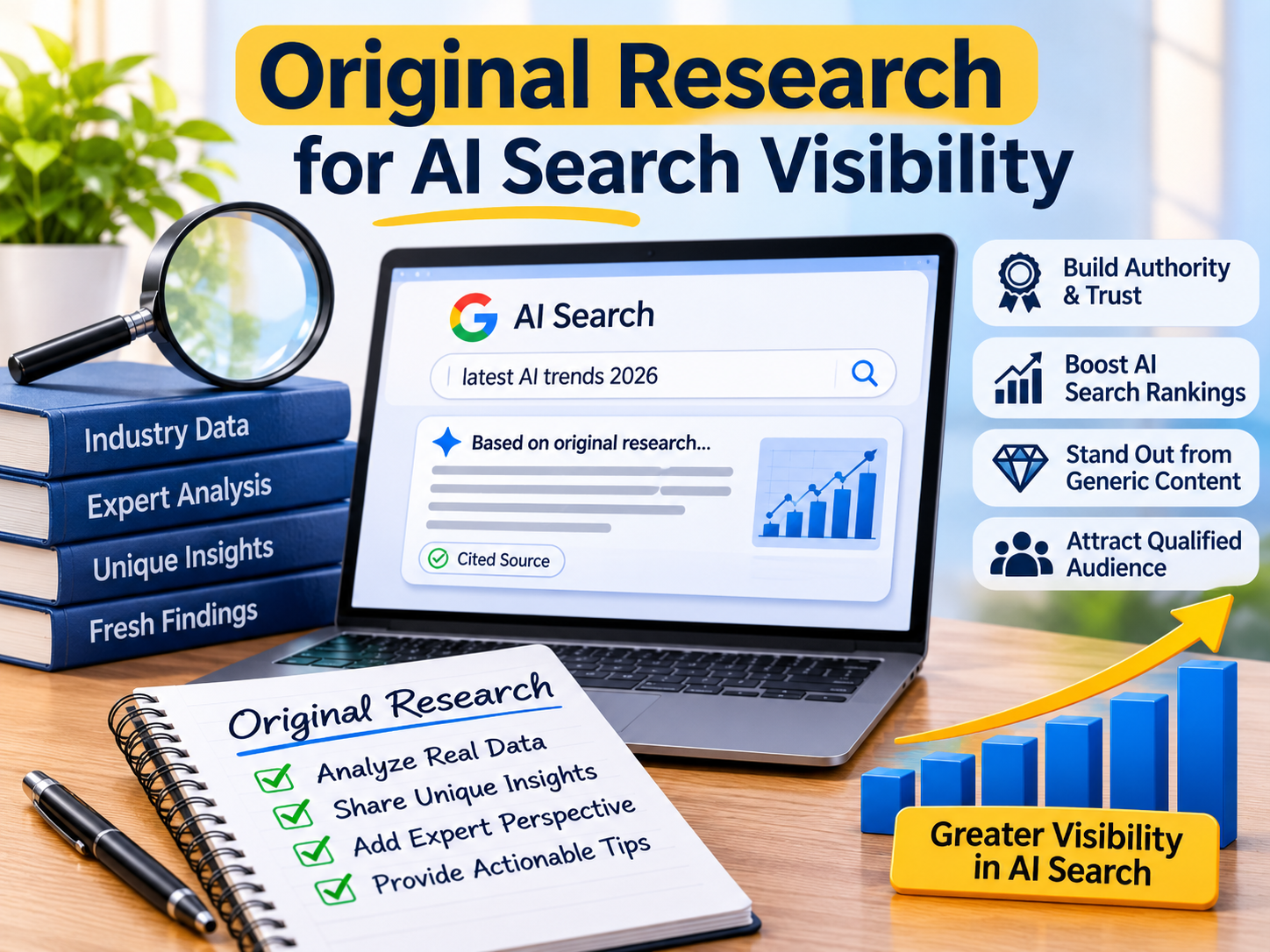
AI search is changing how businesses get discovered. Publishing more content isn’t always enough, especially when competitors are sharing similar advice, statistics, and industry opinions.
Original research for AI search visibility offers a different approach: publish reliable information that others cannot simply reproduce.
Original research can improve a website’s chances of being discovered, referenced, and cited by AI-powered search systems. It introduces unique data, credible findings, and expert analysis that may be useful when AI platforms generate answers. However, publishing original research doesn’t guarantee citations, higher rankings, or additional traffic.
For SaaS companies, B2B marketers, and digital agencies, the opportunity is to become a trusted source of industry evidence rather than another website repeating familiar information.
A 2025 Pew Research Center survey found that 65% of US adults encountered AI-generated search summaries at least sometimes. This highlights how frequently users encounter AI-powered information during everyday searches.
The challenge for businesses is clear: how do you create research worth finding, citing, and sharing?
How Original Research Improves AI Search Visibility
Original research introduces information that may not be available elsewhere. Instead of summarizing existing articles, businesses generate new insights through surveys, experiments, proprietary datasets, and independent analysis.
This creates opportunities for stronger editorial credibility, industry recognition, backlinks, and AI search discoverability.
What Counts as Original Research in GEO?
Generative engine optimization (GEO) focuses on improving how content is discovered and represented within AI-generated answers.
Original research supporting GEO can include.
Industry surveys.
Collecting insights from customers, professionals, or decision-makers.
First-party datasets.
Analyzing information gathered through your own products, operations, or customer interactions.
Controlled experiments.
Testing specific changes and reporting measurable results.
Industry benchmarks.
Comparing performance across organizations, market segments, or time periods.
Independent data analysis.
Producing genuinely new findings from appropriately sourced datasets.
For example, a SaaS company could analyze onboarding challenges across its customer base and publish anonymized findings about common implementation delays.
That provides more distinctive evidence than another article listing generic SaaS onboarding tips.
However, simply asking an AI tool to summarize existing reports does not automatically create original research.
Information Gain and Topical Authority
Information gain refers to the additional value content provides beyond information already available to readers.
Consider a cybersecurity company publishing its own threat-response benchmarks.
Rather than repeating industry recommendations, it presents measurable findings, explains its methodology, and discusses what the results mean for security teams.
This kind of research can establish credibility within a particular subject area.
Transparent methodology, accurate source attribution, and expert interpretation make findings easier to evaluate and reference.
AI Citations vs. Traditional SEO Rankings
AI visibility and traditional SEO performance are related, but they aren’t interchangeable.
| Visibility Metric | What It Measures |
|---|---|
| Traditional ranking | A webpage’s position in conventional search results |
| AI citation | A source explicitly referenced in an AI-generated answer |
| Brand mention | A brand appearing within an AI response, with or without a link |
| Referral traffic | Visits generated through links to the website |
| Conversion | A meaningful business action, such as an enquiry or qualified lead |
A report might receive AI citations without ranking prominently for its primary keyword.
Similarly, strong organic rankings do not guarantee that AI-generated answers will reference the page.
Businesses should measure these outcomes separately.
How AI Search Engines Find and Cite Research
AI-powered search platforms can retrieve external information to support their answers. Research containing relevant, accessible, and attributable findings may become a useful source.
However, citation practices vary between platforms.
Source Selection in Chat GPT, Gemini, and Google AI Overviews
Chat GPT, Gemini, and Google AI Overviews can use external information when generating certain responses.
Some retrieval workflows use retrieval-augmented generation (RAG), which connects AI-generated answers with information retrieved from external sources.
The exact retrieval and citation process differs across systems.
Google’s official AI search guidance reinforces the importance of accessible content, indexability, internal linking, and established SEO practices.
Google also states that no special AI-specific markup is required to become eligible for its AI search features.
This makes technical SEO a practical foundation for research visibility.
E-E-A-T and Verifiable Research
Experience, Expertise, Authoritativeness, and Trustworthiness (E-E-A-T) provide a useful framework for evaluating content credibility.
For original research, strong trust signals include.
Clearly identified authors or research teams.
Transparent sampling and data collection methods.
Publication dates and research periods.
Verifiable findings and references.
Disclosed limitations and potential biases.
Expert interpretation grounded in the collected evidence.
E-E-A-T is not a universal numerical score that guarantees AI citations.
Its value lies in helping publishers create content readers can examine and trust.
Backlinks and Earned Media
Research can also attract attention from journalists, industry publications, and professional communities.
Imagine a technology publication referencing a SaaS adoption benchmark.
That coverage may introduce the research to new audiences and provide a relevant backlink.
An unlinked brand mention can increase awareness, although it doesn’t offer the same direct referral opportunity.
Mak It Solutions’ SEO services address related foundations, including technical accessibility, content structure, and link acquisition.
Types of Original Research That Support GEO
The best research format depends on the question being investigated and the quality of available data.
Industry Surveys and B2B Benchmarks
Industry surveys can reveal customer priorities, adoption barriers, purchasing decisions, and emerging business challenges.
For example, a B2B software provider might survey IT decision-makers about cloud migration priorities.
Breaking results down by company size, industry, or location can make findings more relevant.
Survey conclusions should reflect the actual sampling method. A small convenience sample shouldn’t be presented as representative of an entire national market.

First-Party Data and Controlled Experiments
Businesses often already possess information that could support valuable research.
Product analytics, customer support patterns, and operational data may reveal meaningful trends when analyzed responsibly.
Controlled experiments can help answer questions about specific changes.
For example, a SaaS company could test different onboarding experiences and compare user completion rates.
The distinction between correlation and causation matters. Observational findings shouldn’t be described as proof that one factor caused another.
Research Reports and Data Journalism
Even strong findings can be overlooked when they are difficult to understand.
Effective research reports combine.
Clear summaries of the main findings.
Readable charts with accurate labels.
Accessible data tables.
Downloadable methodology documents.
Practical explanations of business implications.
Mak It Solutions’ business intelligence services provide a relevant foundation for turning complex datasets into understandable reporting.
How to Create Original Research for AI Search Visibility
Producing credible research requires more than collecting interesting numbers.
A reliable process connects meaningful questions with sound methodology, accessible publishing, and responsible distribution.
Choose a Research Question Worth Answering
Start with a problem your audience genuinely wants to understand.
For example.
Which SaaS onboarding challenges most frequently delay enterprise adoption?
A specific question makes it easier to define the required data and evaluate whether the research provides useful answers.
Prioritize topics with clear audience demand, available evidence, and commercial relevance.
Collect and Validate the Data
Define the target population, sampling method, research period, and data collection process.
Before analyzing the findings, check for missing information, duplicate responses, inconsistent definitions, and possible selection bias.
If the dataset contains customer information, assess relevant privacy obligations before publication.
Document limitations rather than hiding them.
A smaller, transparent study can be more useful than a larger report with unclear methods.
Publish Accessible, Attributable Findings
Publish the main research findings on a stable, accessible HTML page.
Include a concise executive summary, visible attribution, methodology, publication date, charts, and clearly explained results.
Use relevant Article or BlogPosting structured data where appropriate, ensuring that the markup accurately reflects the visible page.
PDF reports can provide additional detail, but they shouldn’t be the only way readers can access important findings.
Strong web development foundations also help ensure that research pages remain technically accessible.
Distribute Research Through Relevant Channels
Useful research still needs an audience.
Prepare concise summaries for journalists, industry newsletters, specialist publications, professional communities, and relevant partners.
Highlight the findings most relevant to each audience rather than distributing identical promotional messages everywhere.
Businesses can coordinate outreach and performance measurement through appropriate digital marketing services.
The objective is to encourage genuine discovery and attribution, not manufacture citations or backlinks.
Monitor Visibility and Business Results
After publication, establish a consistent monitoring process.
Track relevant AI-generated answers, brand mentions, source citations, backlinks, organic traffic, and qualified leads.
Compare results against a baseline where possible.
Remember that an increase in visibility following publication doesn’t automatically prove that the research caused the change.
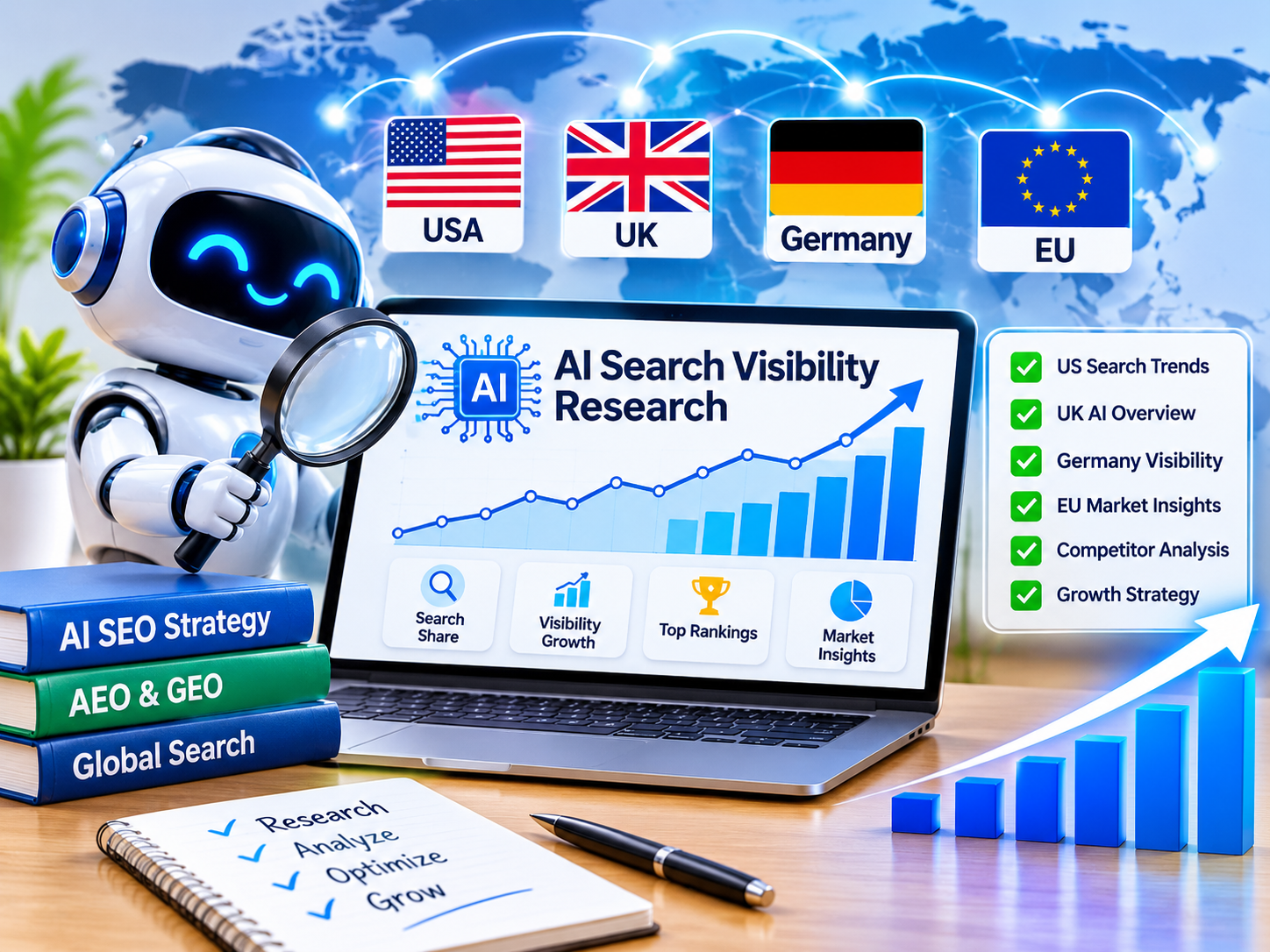
GEO Research Strategies for the USA, UK, Germany, and EU
Research becomes more useful when it reflects the audience’s local business environment, terminology, and regulatory requirements.
The same study may need different framing across markets.
USA.
US-focused research can investigate software adoption, cloud spending, customer acquisition, and technology purchasing behavior.
A study comparing technology businesses in New York, Austin, and San Francisco might reveal useful differences between market segments.
Where personal information is involved, businesses should assess applicable federal and state privacy requirements, including California’s CCPA/CPRA where relevant.
UK.
UK-focused research should reflect local industry conditions and business terminology.
A London agency performance study or a Manchester technology adoption survey could provide material relevant to UK publications.
Organizations handling personal data should review UK GDPR obligations and the Information Commissioner’s Office guidance.
Germany and the Wider EU.
German-language research requires more than translating an English report.
Businesses in Berlin and Munich may use different terminology, operate within different industry structures, and prioritize market-specific evidence.
GDPR, known as DSGVO in Germany, should inform how personal data is collected, processed, and published.
Cross-market research also needs consistent measurement definitions.
| Market | Research Opportunity | Key Consideration |
|---|---|---|
| USA | B2B SaaS and technology benchmarks | State-specific privacy requirements |
| UK | Agency performance and digital adoption | UK GDPR and local terminology |
| Germany | Enterprise software and cloud adoption | DSGVO and German-language reporting |
| Wider EU | Cross-market technology comparisons | GDPR and dataset comparability |
Localizing findings can make research more relevant to regional audiences while preserving its methodological integrity.
How to Measure AI Visibility and Research ROI
A research report’s value shouldn’t be judged by AI citations alone.
Businesses need to understand whether their research improves discoverability, attracts relevant audiences, and contributes to measurable commercial outcomes.
Track AI Citations and Brand Mentions
Create a monitoring set of buyer questions relevant to your products or services.
For each observation, record the AI platform, prompt, market, language, citation URLs, and brand mentions.
Keep the monitoring process as consistent as possible.
AI citation share = (Responses citing your research ÷ Total monitored responses) × 100
This calculation provides a measurement for the selected sample of responses, not a universal measure of AI visibility.
Use Semrush, Ahrefs, and Analytics
Different platforms offer different perspectives on research performance.
Semrush AI Visibility Toolkit: Helps monitor sampled AI search visibility and brand presence.
Ahrefs Brand Radar: Supports analysis of AI mentions and source visibility.
Google Search Console: Measures overall Google Search impressions, clicks, and organic performance.
Google Analytics 4 (GA4): Helps evaluate website engagement and conversion activity.
No individual tool captures every AI-generated answer or private user interaction.
What Pew Research Reveals About AI Search Clicks
A Pew Research Center study published in July 2025 analyzed 68,879 unique Google searches associated with browsing data from 900 US adults.
The browsing activity took place in March 2025, with search results collected in April.
Researchers found that.
18% of the analyzed searches produced an AI-generated summary.
Users clicked traditional search-result links in 8% of visits involving an AI summary.
When no AI summary appeared, users clicked traditional results in 15% of visits.
Only 1% of visits involving an AI summary resulted in a click on a source link within that summary.
These findings illustrate how AI-generated summaries were associated with search click behavior in the observed sample.
They do not prove that original research is more likely to receive AI citations.
The results also reflect the study’s specific population, platform, and measurement period rather than every search experience.
For related technical considerations, see Mak It Solutions’ guide to Google AI Mode SEO.
Connect Visibility With Commercial Outcomes
A practical reporting framework should include both editorial visibility and business performance.
| KPI | Measurement Approach |
|---|---|
| AI citation share | Cited responses divided by monitored responses |
| Brand mention rate | Responses mentioning the brand divided by monitored responses |
| Earned backlinks | New relevant referring domains |
| Organic performance | Search Console clicks and impressions |
| Referral engagement | Visits and engagement from identifiable referral sources |
| Commercial impact | Enquiries, qualified leads, and relevant conversions |
This approach gives research teams a clearer understanding of what their publishing investment is achieving.
Building Long-Term Authority Through Original Research
One well-executed study can provide valuable evidence.
A consistent research program can develop a stronger foundation for ongoing content, industry relationships, and search discoverability.
Create a Repeatable Publishing Calendar
Consider quarterly mini-studies, annual benchmarks, and periodic methodology reviews.
The right frequency depends on data availability, research resources, and how quickly the subject changes.
Avoid updating a report merely to give it a newer publication date.
Refresh findings when new evidence adds genuine value.
Connect Research With Related Content
A flagship research report can support related guides, technical resources, industry commentary, and case studies.
For example, research about AI-generated content quality could connect naturally to a guide on creating distinctive AI-era content.
Internal links help readers explore related topics while making content relationships easier for search engines to understand.
Prioritize Research Gaps Competitors Haven’t Addressed
Look for questions that buyers repeatedly ask but existing articles fail to answer with reliable evidence.
Evaluate opportunities based on audience demand, data availability, research feasibility, and relevance to your services.
The goal isn’t to produce the largest report.
It’s to publish evidence that helps people make better decisions.

Final Thoughts
Original research for AI search visibility gives businesses an opportunity to contribute evidence rather than repeat existing industry opinions.
A carefully designed study can support expert credibility, earn relevant coverage, and provide information that AI-powered search systems may reference.
But meaningful results depend on the quality of the findings, how clearly they are published, and whether the research addresses questions people actually care about.
At Mak It Solutions, we help businesses develop data-driven digital strategies, strengthen technical SEO, and build measurable digital marketing experiences.
Ready to identify research opportunities relevant to your industry?
Contact Mak It Solutions for an evidence-led assessment.
Key Takeaways
Original research introduces distinctive evidence that may improve AI search discoverability and attribution.
Transparent methodologies and verifiable findings make research more credible.
Surveys, proprietary datasets, experiments, and benchmarks provide different forms of original insight.
Technical accessibility and clear attribution support research discovery.
GEO strategies should reflect the language, commercial priorities, and privacy requirements of each market.
AI citations, brand mentions, backlinks, organic traffic, and conversions should be measured separately.
Sustainable research programs prioritize useful findings over publication volume.
FAQs
Q : Can small businesses produce original research without large budgets?
A : Yes. Small businesses can use existing analytics, appropriately anonymized operational data, customer interviews, or focused surveys. Transparent methodology and realistic conclusions matter more than the size of the research budget.
Q : How long does original research take to improve AI search visibility?
A : There is no guaranteed timeline. A practical approach is to establish a baseline before publication and monitor citations, brand mentions, and backlinks consistently for three to six months. Longer-term results depend on the research topic, platform behavior, discoverability, and distribution.
Q : Can publishing research only as a PDF reduce discoverability?
A : Potentially. Search engines can index many PDFs, but HTML pages offer greater control over headings, navigation, internal links, and accessible tables. Publishing key findings in HTML with a supplementary PDF is generally a practical approach.
Q : Should businesses refresh existing studies or publish new research?
A : Refresh an existing study when its research question and methodology remain suitable and new data adds meaningful value. Create a new report when the population, methodology, or central question changes significantly. Clearly distinguish updated findings from historical results.
Q : Can anonymized customer information be used in industry research?
A : Potentially, provided the organization has appropriate rights to use the information and meets applicable privacy requirements. Removing customer names alone may not provide adequate anonymization. Businesses should review relevant contracts, lawful processing requirements, and re-identification risks before publication.