



Agentic AI Security: GCC Trust Guide
Agentic AI security is how GCC enterprises protect autonomous AI agents that can plan tasks, use tools, call APIs, access business data, and trigger real actions. For companies in Saudi Arabia, the UAE, and Qatar, it means controlling identity, permissions, data leakage, approvals, logs, vendors, and compliance before AI agents move into production.
In practice, AI agents should be treated like digital workers. They need limited access, clear ownership, monitored behavior, and fast shutdown options when something goes wrong.
Autonomous AI agents are moving from pilots into business workflows across Riyadh, Dubai, Abu Dhabi, Doha, and Jeddah. That is exciting, but it also expands the attack surface. Every connected CRM, ERP, payment API, cloud database, memory layer, support inbox, and admin panel becomes a possible risk point.
For GCC leaders, agentic AI security is not only a cybersecurity topic. It is also about customer trust, regulator confidence, Arabic-language data protection, and safe digital transformation. OWASP’s Top 10 for Agentic Applications 2026 focuses on risks facing autonomous and agentic AI systems, while NIST’s AI RMF supports trustworthy AI governance and risk management.
What Is Agentic AI Security?
Agentic AI vs. traditional AI security
Traditional AI usually predicts, classifies, or generates content. Agentic AI goes further. It can plan, decide, call tools, use memory, query systems, and act across workflows.
That means security must cover the full runtime, not only the model. The real risk often sits in the tools, APIs, permissions, logs, prompts, and connected systems around the agent.
Why GCC enterprises should treat AI agents as digital workers
For a Saudi fintech, UAE retailer, or Qatar bank, an AI agent should not be treated like a simple chatbot. It should be treated like a non-human worker.
That means it needs.
A unique identity
A business owner
Clear permissions
Approval rules
Usage logs
Fast revocation
Regular access reviews
A support agent in Dubai should not share credentials with a finance agent in Riyadh. A compliance agent in Doha should not have access to production systems unless that access is necessary and approved.
Main risks: identity abuse, tool misuse, and data leakage
Most agentic AI security risks are easy to understand but difficult to control at scale.
The biggest risks include stolen credentials, unsafe API actions, over-permissioned agents, prompt injection, customer-data exposure, and hidden tool misuse. This is where secure web application architecture API controls, identity governance, and continuous monitoring become essential.
Why Agentic AI Security Matters in the GCC
Saudi Arabia, the UAE, and Qatar are moving AI into regulated workflows
AI agents are already entering customer service, fintech onboarding, logistics tracking, e-commerce personalization, insurance claims, and government-service workflows.
In Saudi Arabia, SAMA announced the commencement of licensing fintech companies to provide open banking services after its regulatory sandbox phase. That shows how regulated digital finance is maturing and why AI agents connected to financial data need stronger controls.
AI agents increase exposure to sensitive data
Agents may touch payment data, health records, Arabic customer chats, invoices, contracts, government IDs, banking consent, or internal reports.
A Dubai e-commerce brand using an AI support agent, for example, must stop order histories, phone numbers, and customer addresses from leaking into prompts, logs, memory, or third-party tools.
For teams modernizing Node js backend systems or Python automation platforms agentic AI governance should be designed before production access not after the first incident.

GCC buyers need security before scale
CISOs, CTOs, founders, and board teams need proof before connecting agents to CRMs, ERPs, payment gateways, identity platforms, and cloud databases.
That proof should include access controls, approval gates, vendor reviews, data-retention rules, incident response, audit logs, and evidence that the agent cannot act beyond its approved scope.
Identity, Access, and Least Privilege for AI Agents
Give every AI agent a unique machine identity
Never use one shared service account for all agents. Shared credentials make it harder to investigate abuse, revoke access, or prove what happened.
Give each agent a separate identity based on workflow, environment, and business function. A Riyadh finance agent, Dubai support agent, and Doha compliance agent should all have different credentials and permissions.
Use least privilege and least agency
Least privilege limits what the agent can access. Least agency limits what the agent can do.
A Saudi fintech agent may read consented open banking data, but it should not approve payments. A UAE enterprise assistant may draft customer replies, but it should not send bulk messages without review.
This simple rule matters: the agent should only have the access and action rights it needs for its exact job.
Build audit trails for every action
Logs should capture prompts, tool calls, retrieved data, approvals, outputs, API actions, timestamps, and user context.
Good audit trails help security teams answer practical questions.
What did the agent access?
Which tool did it call?
Was human approval required?
Did it expose sensitive data?
Who owned the workflow?
Without this evidence, it becomes difficult to explain an incident to customers, regulators, or internal leadership.
Preventing AI Data Leakage Across GCC Systems
Map what agents can access before deployment
Before launch, classify the data your agents can touch. This includes personal data, financial data, government data, Arabic support transcripts, internal documents, API responses, and analytics exports.
This is especially important for companies using business intelligence dashboards where AI agents may summarize sensitive reports or customer behavior.
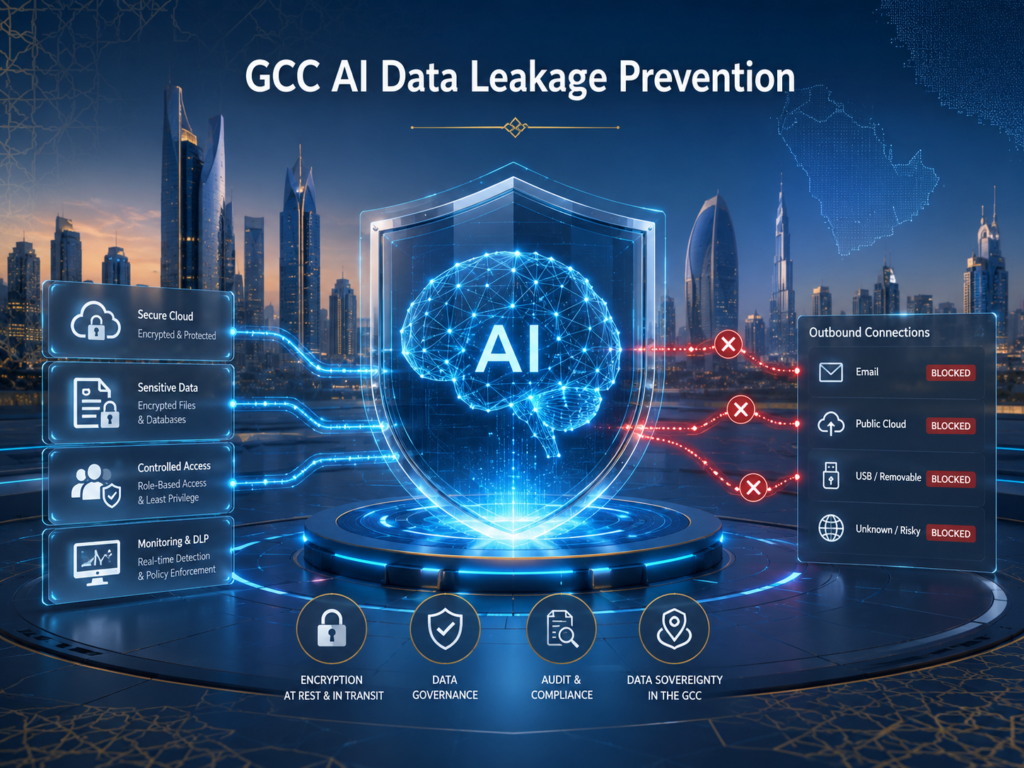
Apply DLP to prompts, memory, logs, and outputs
Data loss prevention should not stop at databases. AI agents introduce new places where sensitive information can leak.
Apply controls to.
User prompts
System prompts
Retrieved documents
Agent memory
Tool responses
Logs and traces
Final outputs
Third-party integrations
Use masking, redaction, sensitive-data classifiers, retrieval limits, output filtering, and short retention periods where appropriate.
Do not store sensitive Arabic prompts forever “just in case.” Agent memory should be intentional, reviewed, and deletable.
Align data handling with local privacy expectations
Saudi teams should consider SDAIA and PDPL requirements, UAE firms should align with Federal Decree-Law No. 45 of 2021 regarding personal data protection, and Qatar businesses should consider Law No. 13 of 2016 on protecting personal data privacy.
This does not mean every AI workflow needs the same controls. It means each workflow should be assessed based on the data involved, the business risk, the sector, and the market where the data is stored or processed.
Tool Abuse, API Misuse, and Human Approval Controls
Identify high-risk tools before agents can use them
Not every tool creates the same level of risk.
High-risk tools include payment APIs, browser automation, admin consoles, CRM exports, database queries, ticketing systems, email-sending tools, code execution, and production deployment systems.
These tools need stronger guardrails than low-risk content drafting or internal summarization.
Require human approval for sensitive actions
Human approval should be required before agents perform sensitive actions such as.
Payments
Refunds
Account changes
Large exports
Legal responses
Regulatory submissions
Customer notifications
Production deployments
Contract updates
For safer product builds, pair AI workflows with secure mobile app development role-based admin controls, and clear escalation paths.
Secure digital identity workflows in the UAE and Qatar
UAE PASS is the UAE’s national digital identity for citizens, residents, and visitors. It enables access to many online services across sectors, which makes identity-linked workflows especially sensitive when AI agents are involved.
For UAE and Qatar businesses, identity-linked actions should include strong authentication, transaction limits, session monitoring, abuse detection, and detailed audit logs.
GCC Compliance, Data Residency, and Cloud Readiness
Build a regulator-ready AI security checklist
A practical GCC checklist should cover SAMA, SDAIA, NDMO, NCA, TDRA, QCB, ADGM, DIFC, and Qatar NCSA expectations where relevant.
Include.
Agent owner
Business purpose
Data classes
Risk score
Model and vendor review
Access rights
Approval workflows
Logging and monitoring
Incident response
Retention rules
Audit evidence
QCB also lists Artificial Intelligence Guidelines among its fintech resources, which matters for Qatar banks, payment companies, and fintech teams.
Plan cloud hosting and data residency by market
Cloud choices matter for AI-agent logs, memory, prompts, and retrieved data.
AWS documentation lists Middle East regions in Bahrain and the UAE, and AWS has announced plans for a Saudi Arabia Region. Microsoft lists UAE Central, UAE North, and Qatar Central regions, while Google Cloud opened its Doha region in Qatar.
For regulated workflows, document where logs are stored, how they are encrypted, who can access them, how long they are retained, and how deletion requests are handled.

Prepare evidence for audits and board reviews
Board teams and auditors do not need vague claims like “our AI is secure.” They need evidence.
Keep model cards, risk registers, approval logs, access reviews, DLP reports, vendor assessments, test results, incident playbooks, retention policies, and change records.
From a GCC enterprise point of view, this evidence is often the difference between a controlled AI rollout and a risky experiment.
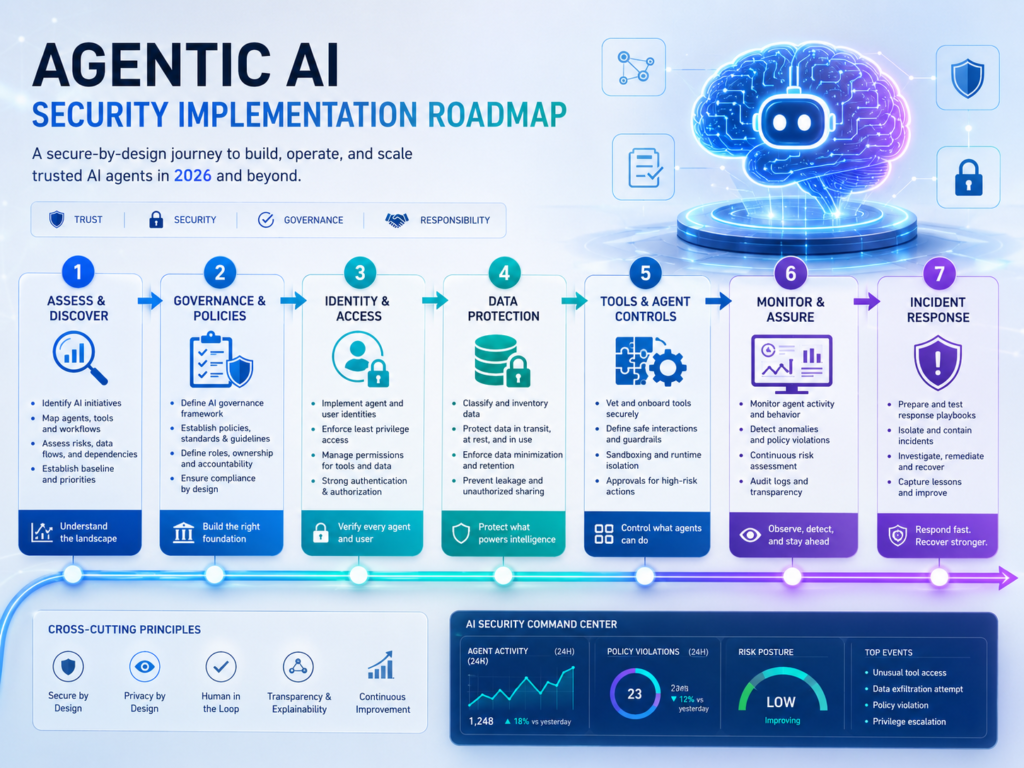
How to Implement Agentic AI Security in GCC Enterprises
Inventory agents, tools, data, and users
Create a register of every agent, owner, connected system, permission, API, and data class.
Include shadow AI tools used by support, sales, development, operations, and marketing teams. If an agent can access company data or trigger a workflow, it belongs in the register.
Apply controls before production access
Before agents reach production, apply unique identity, least privilege, prompt filtering, DLP, sandboxing, rate limits, approval gates, and secure logging.
For customer-facing systems, align this with [Internal link: secure e-commerce development] and [Internal link: responsible digital growth campaigns].
Monitor, test, and improve continuously
Agentic AI security is not a one-time setup.
Run red-team tests, prompt-injection tests, access reviews, tool-abuse simulations, incident drills, and compliance checks across Saudi, UAE, and Qatar operations.
When a new tool, API, model, or vendor is added, review the risk again.
Practical Examples for GCC Teams
A Riyadh fintech can let an agent summarize consented open banking data, but require human approval before any payment-related action.
A Dubai e-commerce brand can use AI for Arabic customer support while masking phone numbers, addresses, and order IDs.
A Doha SME can keep sensitive AI-agent logs closer to Qatar users by choosing a suitable local or regional cloud setup.
An Abu Dhabi insurer can require documented AI governance before using agents for claims triage.
A Jeddah logistics firm can connect agents to tracking APIs but block deletion, refund, and contract-change permissions.
These examples all follow the same principle: give the agent enough power to help the business, but not enough freedom to create uncontrolled risk.
Concluding Remarks
Agentic AI security is not only an AI issue. It is identity security, API security, data protection, cloud readiness, governance, and compliance working together.
For GCC companies in Saudi Arabia, the UAE, and Qatar, the safest path is to design controls before agents connect to regulated data, payment systems, digital identity workflows, government portals, or cross-border cloud environments.
Mak It Solutions can support GCC-focused AI systems through end-to-end technology services secure engineering, and scalable digital platforms.
Ready to secure AI agents before they reach production? Contact Mak It Solutions to review your security gaps and build a GCC-ready agentic AI security strategy that protects trust, compliance, and growth.
FAQs
Q : Is agentic AI security relevant for Saudi startups using open banking APIs?
A : Yes. Saudi startups using open banking APIs should treat agentic AI security as a core trust and compliance requirement. If an agent can access consented financial data or trigger workflow actions, it needs identity controls, least privilege, secure logs, and human approval gates.
Q : Can UAE companies safely connect AI agents to UAE PASS-enabled workflows?
A : They can, but only with strict limits. UAE PASS is a strong national identity layer, but identity-linked workflows raise the impact of agent mistakes or abuse. Use strong authentication, transaction limits, human approval, session monitoring, and detailed audit logs.
Q : What should Qatar fintechs document before using AI agents?
A : Qatar fintechs should document agent purpose, data access, model and vendor details, human oversight, security controls, testing results, incident response, and approval workflows. They should also keep evidence of prompt-injection testing, access reviews, and data-leakage controls.
Q : How can GCC retailers protect Arabic customer prompts?
A : Classify Arabic customer prompts as potentially sensitive. They may include phone numbers, addresses, order IDs, complaints, payment references, or family details. Use DLP scanning, masking, restricted memory, short retention, and output filtering.
Q : Do Dubai and Riyadh enterprises need local cloud hosting for AI-agent logs?
A : Not always. They should assess data residency, sector rules, customer contracts, cloud-region availability, encryption, retention, deletion, and audit requirements before deciding where logs are stored.