
AI Agent Identity Security: 2026 Guide
AI agent identity security is now a serious enterprise priority because AI agents are starting to act like digital workers. They can access data, call APIs, trigger workflows, update systems, and make decisions across cloud, SaaS, and internal platforms.
At its core, AI agent identity security means discovering, governing, authenticating, authorizing, monitoring, and revoking access for AI agents and other non-human identities. For enterprises in the US, UK, Germany, and the EU, it connects IAM, PAM, IGA, zero trust, and compliance into one identity-first security strategy.
Why AI Agent Identity Security Matters Now
Traditional automation followed fixed scripts. AI agents are different. They can interpret goals, choose tools, and act across business systems with a level of autonomy that older bots did not have.
That creates a new identity problem: who owns the agent, what can it access, and how do you prove control during an audit?
An AI agent may need
API keys
OAuth tokens
Service accounts
Cloud permissions
SaaS access
Data warehouse access
Workflow automation rights
Privileged system actions
This is why AI agent identity security should sit alongside cloud IAM security, secure application design, and platform engineering.
What Is AI Agent Identity Security?
AI agent identity security is the practice of managing AI agents as governed identities throughout their full lifecycle.
That includes.
Discovery
Ownership
Authentication
Authorization
Privileged access control
Monitoring
Access reviews
Secrets rotation
Revocation
In practice, it treats AI agents like non-human identities, but with extra attention to autonomy, delegated access, runtime decisions, and auditability.
AI Agents vs Bots, Service Accounts, and APIs
Bots usually perform narrow, predictable tasks. Service accounts run applications. APIs connect systems. Machine identities authenticate workloads, devices, certificates, and services.
AI agents may use all of these, but they add goal-directed behavior.
For example, an AI support agent may read a CRM record, summarize a ticket, call a knowledge base API, update a case, and escalate the issue to a human team. Each action needs identity context.
That is where IAM, PAM, IGA, and ITDR become essential.
How IAM, PAM, IGA, and ITDR Fit AI Agent Identity Security
AI agent security is not one tool. It is a control model.
| Control Area | Role in AI Agent Identity Security |
|---|---|
| IAM | Authenticates agents and controls access |
| IGA | Manages ownership, approvals, lifecycle, and reviews |
| PAM | Secures privileged access and sensitive actions |
| ITDR | Detects abnormal identity behavior and access threats |
| Zero Trust | Verifies every agent action before trust is granted |
Together, these controls help answer four audit-ready questions.
Who owns this AI agent?
What systems and data can it access?
Why is that access allowed?
When should access expire?
For software teams building AI-enabled platforms, these controls should be designed early through secure architecture, custom software development, and business intelligence services.
What Changed in IAM, PAM, and IGA in the Agentic AI Era?
Traditional identity systems were built around employees, contractors, applications, and service accounts. AI agents make identity more dynamic.
An agent’s access may depend on.
The task it is performing
The user it represents
The sensitivity of the data
The system it is calling
The location or environment
The current risk score
Whether the action is reversible
Static roles are no longer enough.
IAM Must Handle Dynamic AI Agents
IAM platforms such as Microsoft Entra, Okta, AWS IAM, Azure, and Google Cloud IAM are now part of the AI governance conversation because agents often operate across SaaS and cloud boundaries.
The goal is not just login control. It is context-aware access.
A low-risk agent may read anonymized analytics data. The same agent should not automatically access customer records, payroll data, payment information, or production infrastructure.
IGA Must Create Accountability
IGA becomes the accountability layer.
Every AI agent should have.
A named human owner
A clear business purpose
Approved access scope
Expiration date
Access review cycle
Audit trail
Decommissioning path
Without lifecycle governance, “temporary” AI access can quietly become permanent risk.
PAM Must Control Privileged AI Agent Access
PAM matters when agents can administer systems, read production data, deploy code, modify infrastructure, or access secrets.
Strong controls include.
Vaulted credentials
Just-in-time elevation
Session monitoring
Approval workflows
Privilege expiration
Emergency shutdown rules
This reduces the blast radius if an agent is misconfigured, compromised, or manipulated through prompt injection.
Non-Human Identity Governance for AI Agents
The safest AI agent governance model gives every agent a verified owner, defined purpose, least-privilege access, expiration date, audit trail, and continuous monitoring.
Start with visibility. Many enterprises already have unmanaged AI agents inside SaaS tools, workflow platforms, code assistants, customer support systems, data pipelines, and cloud environments.
Discovery should cover.
AI agents
Service accounts
OAuth apps
API keys
Secrets
Certificates
Cloud roles
Agent plugins
Automation scripts
Teams running AI across multi-cloud environments can pair this with multi-cloud cost and performance governance.
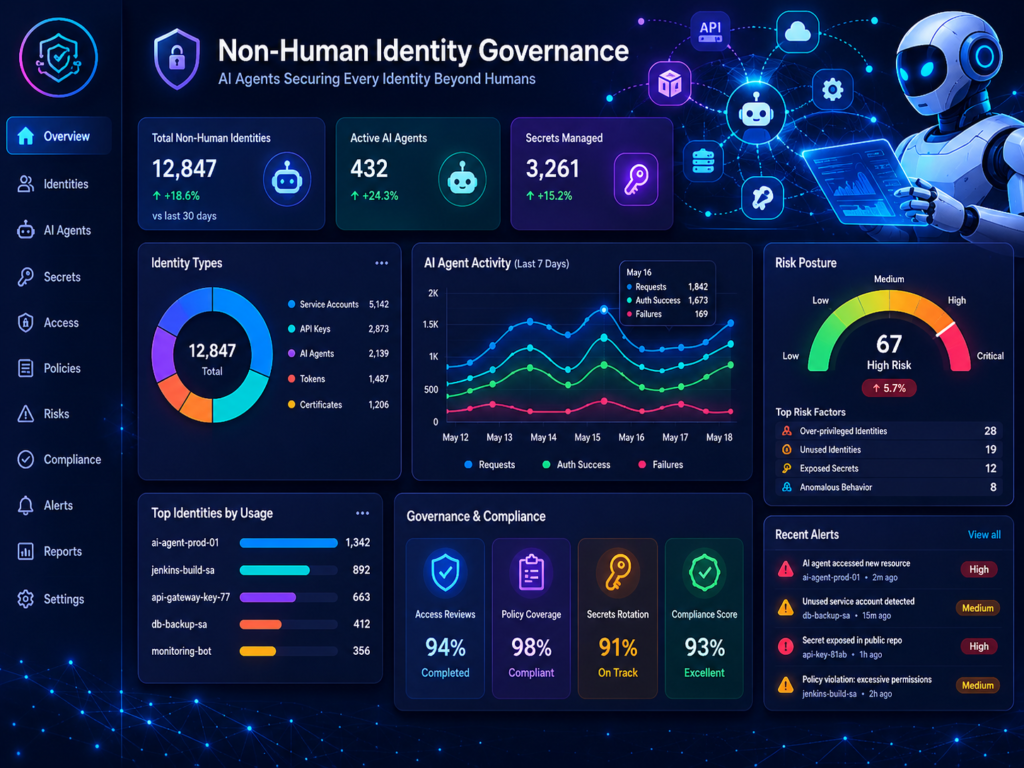
Map Every Agent to a Human Owner
Every AI agent needs a human accountable owner.
That owner should define.
Business purpose
Allowed systems
Data classification
Access boundaries
Approval route
Monitoring requirements
Emergency shutdown process
For example, a customer support agent in Austin may read CRM tickets but should not export payment data. A London fintech agent may summarize Open Banking records, but it must still follow UK-GDPR accountability expectations.
Zero Trust Identity for AI Agents
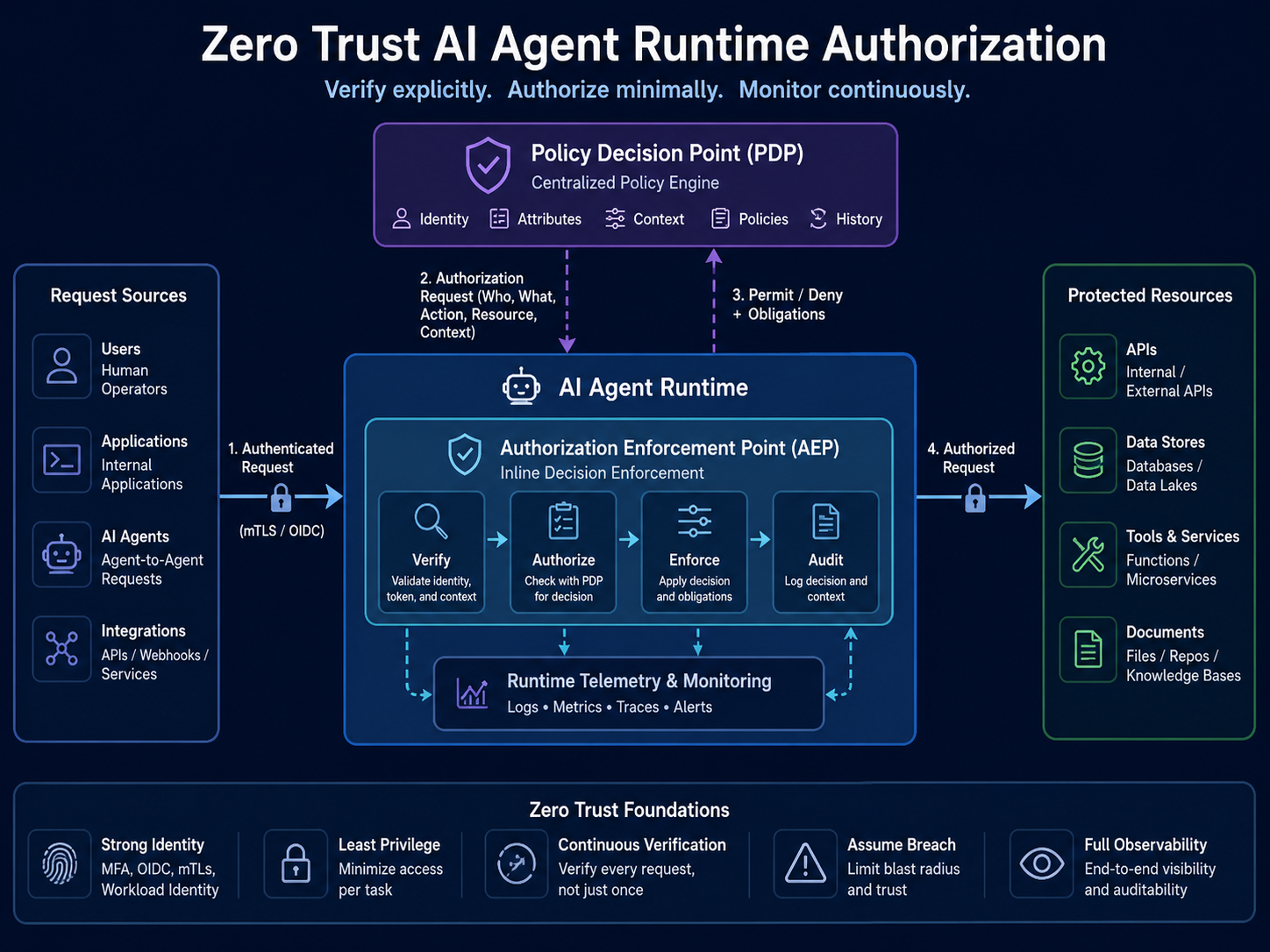
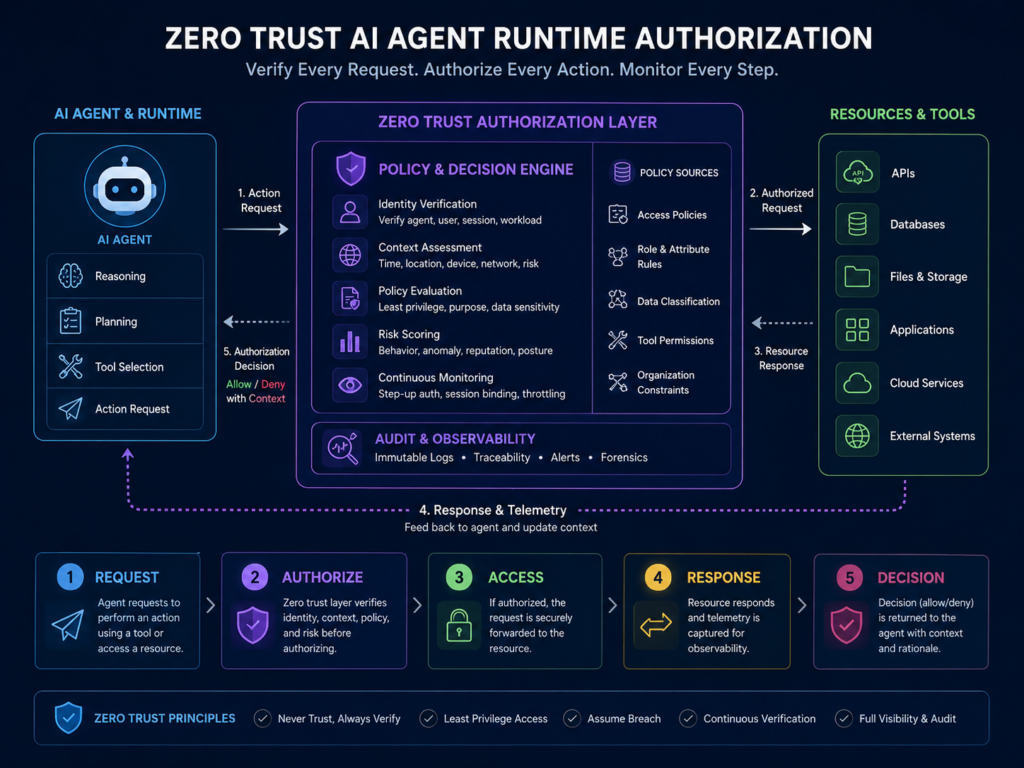
Zero trust for AI agents means no agent is trusted by default. Every action should be authenticated, authorized, risk-scored, logged, and continuously verified.
This matters because agents can act quickly and repeatedly. A single over-permissioned agent can create real exposure across cloud, SaaS, and data systems.
Apply Least Privilege and Just-in-Time Access
Least privilege limits what an agent can do. Just-in-time access limits when it can do it.
Together, they reduce risk if an agent behaves unexpectedly or if its credentials are exposed.
For AI-enabled web, mobile, and cloud products, these controls should be planned early, especially in mobile app development, React Native applications, and connected SaaS platforms.
Use Runtime Authorization
Runtime authorization checks whether an action should be allowed at the moment it is requested.
A policy engine may evaluate.
Requested action
User delegation
Data sensitivity
Device posture
Location
Time
Risk score
Recent behavior
Approval status
This is more flexible than static roles and better suited to autonomous workflows.
Monitor Agent Behavior Continuously
ITDR and anomaly detection help security teams spot abnormal behavior, such as.
Sudden privilege escalation
Unusual API calls
Mass data extraction
Repeated access denials
Impossible travel patterns
Access outside approved business scope
NIST’s Generative AI Profile, published in July 2024, supports managing AI risks across the AI lifecycle, which aligns with this identity-first approach to agent governance.
Regional Compliance: USA, UK, Germany, and EU
In regulated markets, AI agent identity security must prove who owns each agent, what data it can access, why access was granted, and how access is reviewed or revoked.
USA.
In the US, healthcare organizations must consider HIPAA when agents touch electronic protected health information. HHS states that the HIPAA Security Rule requires administrative, physical, and technical safeguards to protect electronic protected health information.
For payment workflows, PCI DSS pushes organizations toward strong access control, monitoring, and secure handling of cardholder data. For SaaS companies, SOC 2 evidence often depends on proving access governance, change control, logging, and vendor oversight.
UK.
In the UK, AI agents used in fintech, NHS workflows, public sector services, or SaaS platforms need clear accountability.
The ICO explains that accountability under UK GDPR means organizations are responsible for complying with data protection principles and must be able to demonstrate compliance.
For AI agents, that means audit trails, DPIAs where appropriate, data minimization, access reviews, and clear ownership.
Germany and EU.
Germany and the wider EU bring strong expectations around GDPR, data residency, financial resilience, third-party ICT risk, and AI governance.
The EU AI Act entered into force on August 1, 2024, and introduced a risk-based framework for AI systems across EU countries.
For financial entities in Germany and the EU, DORA has applied since January 17, 2025, with requirements around ICT incident reporting, resilience, and third-party ICT risk.
For Frankfurt banks, Berlin SaaS firms, and Munich insurers, AI agent access should be reviewed alongside ICT risk, vendor dependencies, operational resilience, and audit evidence.
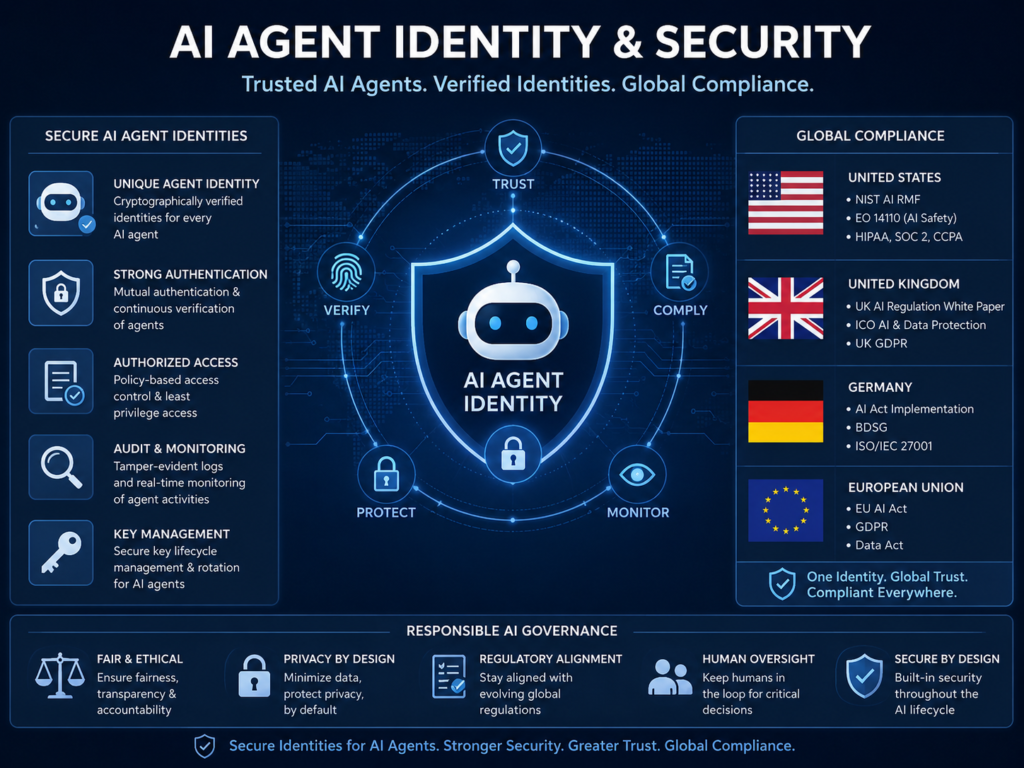
AI Agent Identity Security Best Practices for Enterprises
Enterprises should begin with practical controls, not abstract policy documents.
Build an AI Agent and NHI Inventory
Create an inventory of.
AI agents
Service accounts
API keys
OAuth apps
Secrets
Certificates
Cloud roles
Workload identities
Classify each identity by owner, system, risk level, data access, privilege level, and expiration date.
Define Ownership and Access Policies
Policies should explain.
Who can create agents
Who approves access
Which data classes are allowed
Which actions require human approval
How logs are retained
When access must be reviewed
How agents are decommissioned
Align these controls with GDPR, UK-GDPR, HIPAA, PCI DSS, ISO 27001, ISO 42001, and internal risk policies.
Apply Least Privilege by Default
AI agents should not inherit broad user permissions.
Use.
Scoped tokens
Task-based access
Temporary elevation
Segmented environments
Data-level permissions
Human approval for sensitive actions
A finance agent that summarizes invoices does not need full ERP administrator rights.
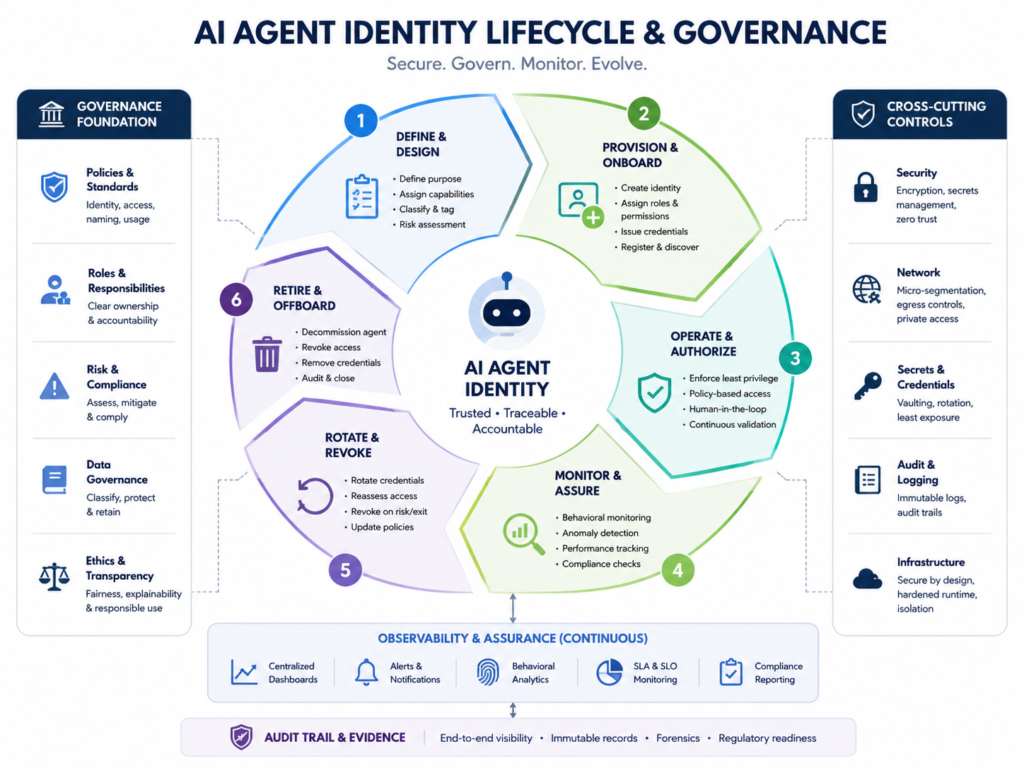
Automate Lifecycle Management
Lifecycle automation prevents access drift.
When an agent is created, register it. When its use case changes, review it. When a project ends, revoke its credentials.
A strong lifecycle includes.
Registration
Owner approval
Policy check
Secrets rotation
Access review
Monitoring
Revocation
Evaluate IAM, IGA, PAM, and Security Platforms Carefully
When reviewing Microsoft Entra, Okta, SailPoint, CyberArk, IBM, CrowdStrike, AWS IAM, Azure, or Google Cloud IAM, ask whether the platform supports.
Non-human identity discovery
AI agent ownership mapping
Lifecycle automation
Privileged session control
Runtime authorization
ITDR signals
Compliance reporting
Vendor selection should focus on practical governance, not just AI branding.
Final Thoughts
AI governance and identity governance must now converge. AI agents act through identities, and identity is where policies become enforceable.
A strong AI agent identity security strategy starts with visibility, ownership, least privilege, lifecycle automation, privileged access control, runtime monitoring, and compliance-ready evidence.
Mak It Solutions can help teams connect AI strategy with secure cloud, SaaS, mobile, and data architecture. Explore the services overview or contact the team to scope your AI agent identity security roadmap.
Ready to secure AI agents before they become audit findings? Book a practical readiness assessment with Mak It Solutions to map your AI agents, non-human identities, privileged access, and compliance gaps across cloud, SaaS, and data systems.
Key Takeaways
AI agent identity security treats autonomous agents as governed non-human identities.
IAM, IGA, PAM, and ITDR must work together to control agent access.
Zero trust requires least privilege, runtime authorization, and continuous monitoring.
US, UK, Germany, and EU compliance programs need ownership, access evidence, and audit trails.
Start with discovery, then automate lifecycle controls from creation to revocation.
FAQs
Q : Are AI agents considered non-human identities?
A : Yes. AI agents are considered non-human identities when they authenticate, access systems, use credentials, call APIs, or act on behalf of users or business processes. They should be governed like service accounts and workload identities, with extra attention to autonomy and delegated access.
Q : How should enterprises discover unmanaged AI agents?
A : Enterprises should scan SaaS platforms, cloud accounts, workflow tools, code repositories, API gateways, secrets vaults, and identity providers. Discovery should be continuous, not handled as a one-time audit.
Q : What access controls should AI agents have?
A : AI agents should use least privilege, just-in-time access, scoped tokens, approval workflows, runtime authorization, and detailed logging. High-risk actions should require stronger controls such as human approval or privileged access management.
Q : How does AI agent identity security support GDPR compliance?
A : It supports GDPR by improving accountability, access minimization, auditability, and data protection by design. When an agent processes personal data, the organization should know its owner, purpose, data scope, lawful basis, retention rules, and review history.
Q : Which teams should own AI agent identity governance?
A : Ownership should be shared across security, IAM, data governance, platform engineering, legal, compliance, and business application owners. Security defines the control model, IAM and IGA teams manage access, and business owners justify why each agent needs access.