
AI Governance GCC 2026: Control Autonomous AI
AI Governance GCC 2026: Control Autonomous AI
AI Governance GCC 2026: Control Autonomous AI
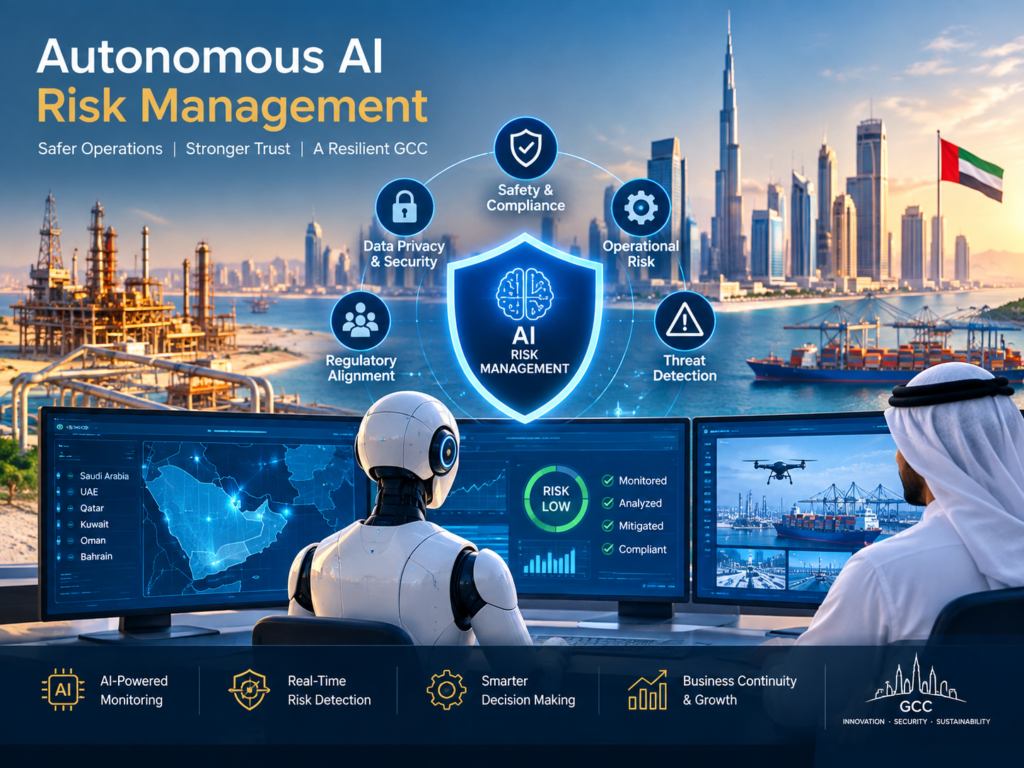
AI governance GCC programs in 2026 need more than a written AI policy. Organizations need to know which AI systems they use, who owns the risks, when people must intervene, and how automated decisions can be reviewed after the fact.
For businesses operating across Saudi Arabia, the UAE, and Qatar, the practical answer is clear: build one strong enterprise governance baseline, then apply country- and sector-specific controls. Treating the GCC as a single regulatory environment can create gaps in privacy, oversight, risk classification, and accountability.
What Is AI Governance in the GCC in 2026?
AI governance in the GCC is the framework an organization uses to control how AI systems are selected, developed, deployed, monitored, changed, and retired.
It brings together internal decision rights, technical controls, privacy requirements, sector obligations, risk management, and responsible-AI principles.
AI governance is not the same as regulation. Governance defines how the organization operates internally; regulation covers legally binding obligations; responsible AI focuses on principles such as fairness, transparency, privacy, safety, and accountability.
Saudi Arabia demonstrates this layered approach through SDAIA resources including AI Ethics Principles, an AI Adoption Framework, and a National AI Risk Management Framework published in 2026.
Why Autonomous AI Makes GCC Governance More Important
Traditional AI often recommends or predicts. Autonomous and agentic AI can go further by accessing tools, connecting to business systems, and carrying out multi-step actions.
That changes the risk profile.
An AI assistant that summarizes a document is very different from an agent that can approve a workflow, trigger a payment, change a customer record, call an API, or send information to another system.
As AI autonomy increases, organizations need stronger controls around.
Permissions and system access
Human approval points
Transaction limits
Audit trails
Exception handling
Data access
Incident escalation
Ongoing monitoring
For GCC businesses, the key question is no longer just, “Is the model accurate?” It is also, “What is this AI allowed to do, and who is accountable when something goes wrong?”
Companies building agent-enabled platforms can support these controls through secure architecture and governed integrations.
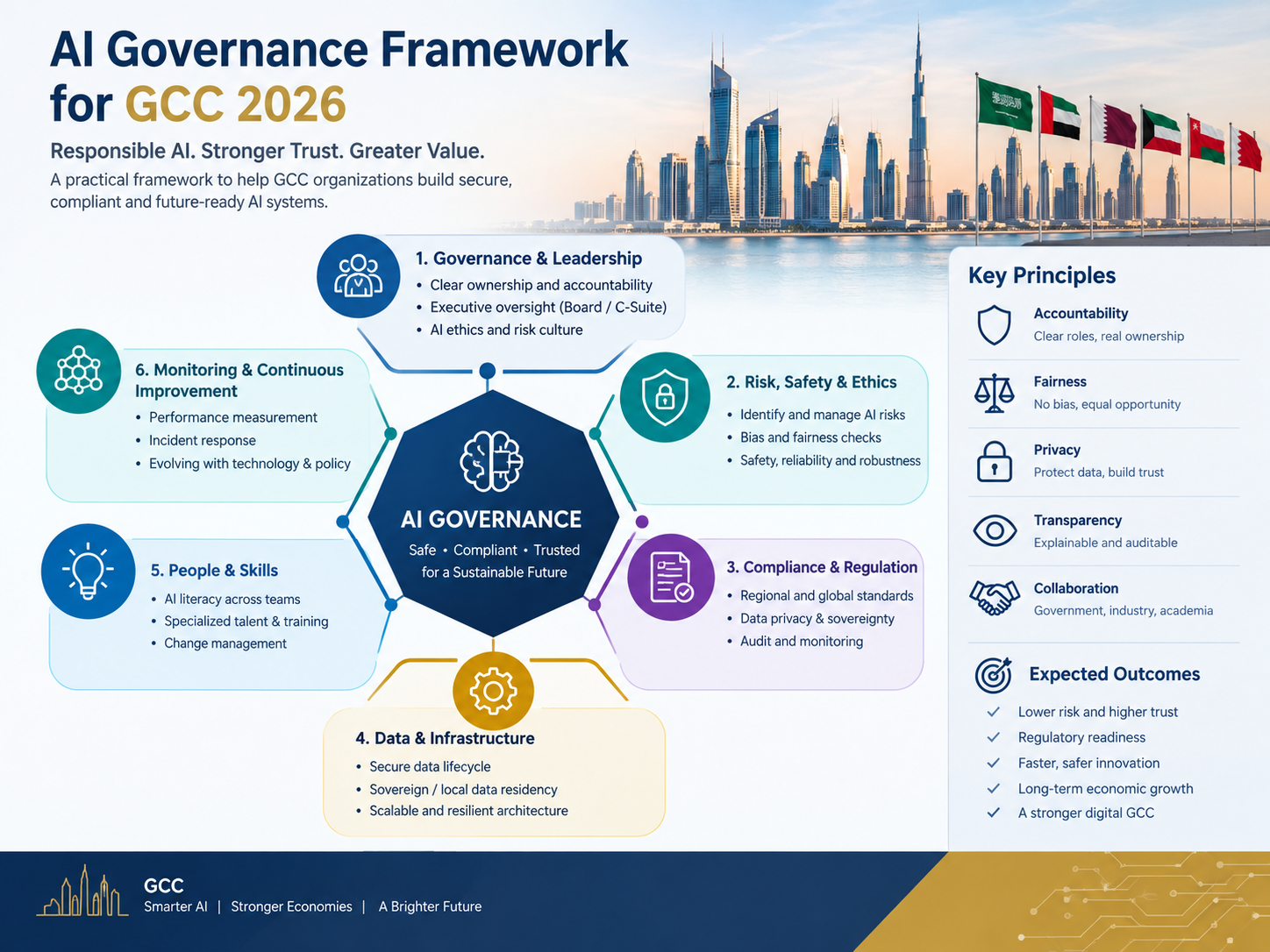
Core Components of an AI Governance GCC Framework
A practical AI governance GCC framework should cover the full AI lifecycle instead of focusing only on model deployment.
The core controls include.
AI inventory
Risk classification
Named ownership
Human oversight
Privacy and data controls
Testing and validation
Audit trails
Incident escalation
These controls can form the enterprise baseline. Local requirements can then be layered on for Saudi Arabia, the UAE, Qatar, and other GCC markets.
How Should GCC Companies Govern Autonomous AI Decisions?
GCC companies should govern autonomous AI according to the impact of the decision, not simply according to the technology being used.
The more authority an AI system has over money, customers, personal information, regulated services, or consequential decisions, the stronger the oversight should become.
Define What AI Can Do Without Approval
A useful governance model separates AI actions into categories such as.
Advisory AI that provides recommendations only
AI that acts after human approval
Conditionally autonomous AI operating within defined thresholds
Fully automated low-risk actions
A fraud-detection workflow in a Riyadh fintech business, for example, may require very different controls from automated warehouse routing in Jeddah.
The important point is to define those boundaries before deployment rather than after an incident.
Apply Human Oversight to High-Impact Actions
Human-in-the-loop governance is especially important when an AI system can materially affect customers, employees, money, sensitive data, or regulated services.
Human-on-the-loop monitoring may be suitable when limited autonomy is justified and the organization has strong monitoring and override controls.
Approval thresholds and escalation procedures can be particularly relevant in sectors such as.
Financial services
Healthcare
Government
Procurement
Insurance
Employment-related workflows
Qatar Central Bank’s AI guidance, for example, links the absence of direct human oversight with potentially higher risk and identifies certain systems affecting financial services or employees as potentially requiring stronger risk treatment.
Maintain AI Decision Logs and Audit Trails
Organizations should be able to reconstruct important AI-driven actions.
Useful records may include.
Model or agent identity
Relevant input or request
Action taken
Human approval, where required
Exception or override
Policy version
Timestamp
Connected systems or tools
Good logging supports AI assurance, incident investigations, internal audit, and regulatory review.
For analytics-heavy environments, a strong monitoring and reporting layer can also help identify unusual behavior, performance drift, and recurring governance exceptions.
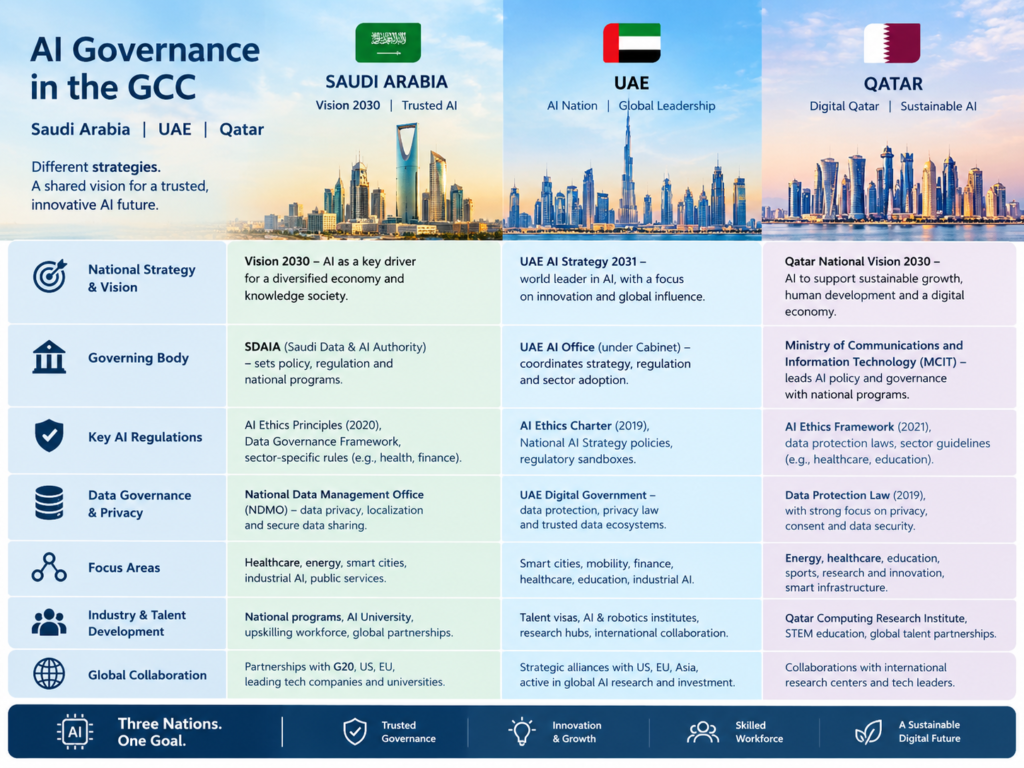
How AI Governance Differs Across Saudi Arabia, UAE, and Qatar
Saudi Arabia, the UAE, and Qatar share broad themes such as accountability, privacy, risk management, and human oversight. Their governance instruments, regulatory structures, and sector expectations are not identical.
For multi-country organizations, the practical model is.
Enterprise baseline + local regulatory overlay + sector-specific controls.
Saudi Arabia.
Organizations operating in Saudi Arabia should consider relevant SDAIA guidance, Saudi data-protection obligations, and applicable sector rules.
SDAIA’s AI materials emphasize principles including fairness, privacy, safety, transparency, and accountability. Its 2026 risk-management framework adds a more structured approach to identifying, assessing, treating, and monitoring AI-related risks.
For businesses in Riyadh, Jeddah, and other Saudi markets, documented AI ownership and risk classification can therefore become important parts of governance.
UAE.
The UAE has developed responsible-AI guidance and self-governance resources, while organizations may also face additional requirements depending on their sector and jurisdiction.
Businesses operating in environments such as DIFC or ADGM should therefore assess the rules that apply to their specific operations rather than treating general AI ethics guidance as a universal AI law.
For example, a Dubai e-commerce company using autonomous personalization should consider not only model performance but also customer impact, privacy, data handling, access permissions, and escalation controls.
Qatar.
Qatar’s financial-sector guidance provides detailed direction on issues including AI risk, human oversight, and governance registers.
A Doha financial institution should identify which AI systems could materially affect customers or employees and apply stronger controls where potential harm is significant.
That may include tighter documentation, stronger validation, more direct human oversight, and clearer escalation requirements.
How to Build an AI Risk Management Framework for GCC Operations
A workable governance program does not need to start with an overly complex control library. It needs a repeatable process that teams can actually use.
A practical sequence is.
Inventory → Classify → Assign Controls → Monitor → Escalate
Create an Enterprise AI Inventory
Start by identifying where AI already exists across the business.
The inventory should include internally built systems, third-party tools, embedded AI features, copilots, automated agents, and vendor platforms.
Shadow AI matters too. Employees may already be using AI tools before formal governance catches up.
Classify AI Risk
Risk classification should consider factors such as.
Level of autonomy
Customer impact
Employee impact
Access to sensitive data
Financial exposure
Regulatory relevance
Explain ability
External system access
Potential scale of harm
A low-impact productivity assistant should not require the same governance burden as an AI system influencing access to financial services.
Assign Controls According to Risk
Once risk is classified, connect each category to defined controls.
Higher-risk systems may require additional testing, approvals, logging, security reviews, human intervention, compliance checks, or executive ownership.
This makes governance proportionate instead of applying the same process to every AI use case.
Assess Data Residency, Privacy, and Cross-Border Risk
Organizations should map where prompts, source data, training information, logs, outputs, and backups may travel.
Regional cloud infrastructure can support architecture choices, but geography alone does not determine compliance.
Examples of regional infrastructure include AWS Middle East infrastructure and Microsoft Azure regions in the UAE and Qatar.
The correct architecture should follow applicable legal, contractual, security, and business requirements.
Arabic-language workflows also deserve specific governance attention. Translation quality, dialect interpretation, and hallucinations can materially change outcomes.
Monitor AI Throughout Its Lifecycle
Governance should continue after deployment.
Review AI risk during.
Procurement
Design
Testing
Deployment
Major model changes
Permission changes
New tool integrations
Incidents
Retirement
A system’s risk profile can change quickly when an AI agent gains access to new data, systems, or actions.
Who Is Accountable When an AI Agent Makes the Wrong Decision?
Automation should not create an accountability vacuum.
Every material AI system should have clearly named owners who understand both the technology and the business consequences of its decisions.
Assign Business, Technical, and Risk Owners
Depending on the use case, accountability may include.
Executive sponsor
Business owner
AI or technical owner
Data owner
Information security team
Compliance or legal function
Internal audit
The exact structure will vary by organization, but ownership should be explicit.
Build Approval and Escalation Thresholds
Not every AI action needs the same approval process.
Thresholds can be based on factors such as.
Transaction value
Customer impact
Personal-data exposure
Regulatory sensitivity
Irreversibility of the action
Access to external systems
Higher-impact actions should trigger stronger review or approval requirements.
Prepare for AI Incidents
An AI incident plan should cover more than model downtime.
Potential governance failures may include.
Incorrect automated actions
Unauthorized tool access
Sensitive-data leakage
Prompt or agent manipulation
Hallucinated information
Model drift
Broken approval logic
Unexpected downstream actions
After an incident, lessons should feed back into system design, risk classification, monitoring, and internal policy.
Best Practices for AI Governance GCC Programs in 2026
Start With High-Risk and Autonomous Use Cases
Do not try to govern every AI tool with the same intensity from day one.
Prioritize systems that affect money, customers, legal rights, regulated services, sensitive information, or important business actions.
Localize Governance for Arabic and GCC Operations
Arabic-language AI deserves dedicated testing rather than assuming English-language controls will transfer perfectly.
Governance reviews should consider.
Arabic output accuracy
Dialect handling
Bilingual documentation
Bias and cultural context
Escalation processes
Human review for consequential decisions
This is especially important when misunderstandings could affect payments, financial services, healthcare, government services, or customer rights.
Increase Governance as AI Autonomy Increases
A chatbot policy may be sufficient for a basic internal assistant. It is unlikely to be enough for an agent that can access databases, execute transactions, or trigger business workflows.
As autonomy and business impact rise, AI governance GCC controls should become stronger as well.
AI Governance GCC Checklist
Before deploying a material AI system, ask:
Is the system included in our AI inventory?
Has its risk level been classified?
Is there a named business owner?
Are technical and data owners clear?
Do we know what the AI is allowed to do?
Are human approval points defined?
Are important actions logged?
Have privacy and cross-border data flows been reviewed?
Has Arabic-language performance been tested where relevant?
Is there an incident and escalation process?
Will governance be reviewed when the system changes?
If several answers are unclear, the system may not yet be governance-ready.

Last Words
AI governance GCC programs in 2026 should focus on operational control, not policy documents alone.
Organizations need to know which AI systems they use, what those systems are allowed to do, how risks are classified, when humans intervene, and who remains accountable when automated decisions affect customers, data, money, or regulated workflows. ( Click Here’s )
For businesses operating across Saudi Arabia, the UAE, and Qatar, a strong approach combines one enterprise governance baseline with local and sector-specific controls.
Mak It Solutions can support organizations building governance-ready digital platforms, secure integrations, data architectures, and AI-enabled workflows across GCC markets.
FAQs
Q : Does Saudi Arabia require companies to follow SDAIA AI governance principles?
A : Organizations should assess the specific SDAIA publication, sector, and use case rather than assuming every AI-related document has the same legal status.
SDAIA provides national AI guidance and governance resources, while Saudi data-protection requirements and sector-specific rules may create separate obligations.
Q : What AI systems may be considered high risk in Qatar’s financial sector?
A : Qatar Central Bank guidance considers factors including potential harm, human oversight, and effects on individuals.
Systems that influence access to financial services or materially affect employees may require stronger risk classification, documentation, testing, and supervision.
Q : Do UAE companies need a separate governance policy for autonomous AI agents?
A : Not necessarily.
Existing AI governance can often be extended to cover agent permissions, tool access, transaction limits, monitoring, approval thresholds, and escalation. Businesses should also assess the privacy, contractual, financial-sector, and jurisdiction-specific rules that apply to their operations.
Q : How should GCC companies govern AI systems that process Arabic-language data?
A : Governance should include Arabic accuracy testing, dialect coverage, bias assessment, bilingual records, and human review for consequential decisions.
The stronger the potential impact of an Arabic-language misunderstanding, the stronger the review process should be.
Q : Can one AI governance framework work across Saudi Arabia, UAE, Qatar, Kuwait, Bahrain, and Oman?
A : A shared enterprise baseline can work well, but local overlays are still necessary.
Organizations can standardize controls such as AI inventories, ownership, testing, monitoring, and auditability while separately mapping each country’s data, sector, and AI-related requirements.
[…] Is AI Agent […]