


AI-Native Development Platforms for Enterprise Teams
AI-Native Development Platforms for Enterprise Teams
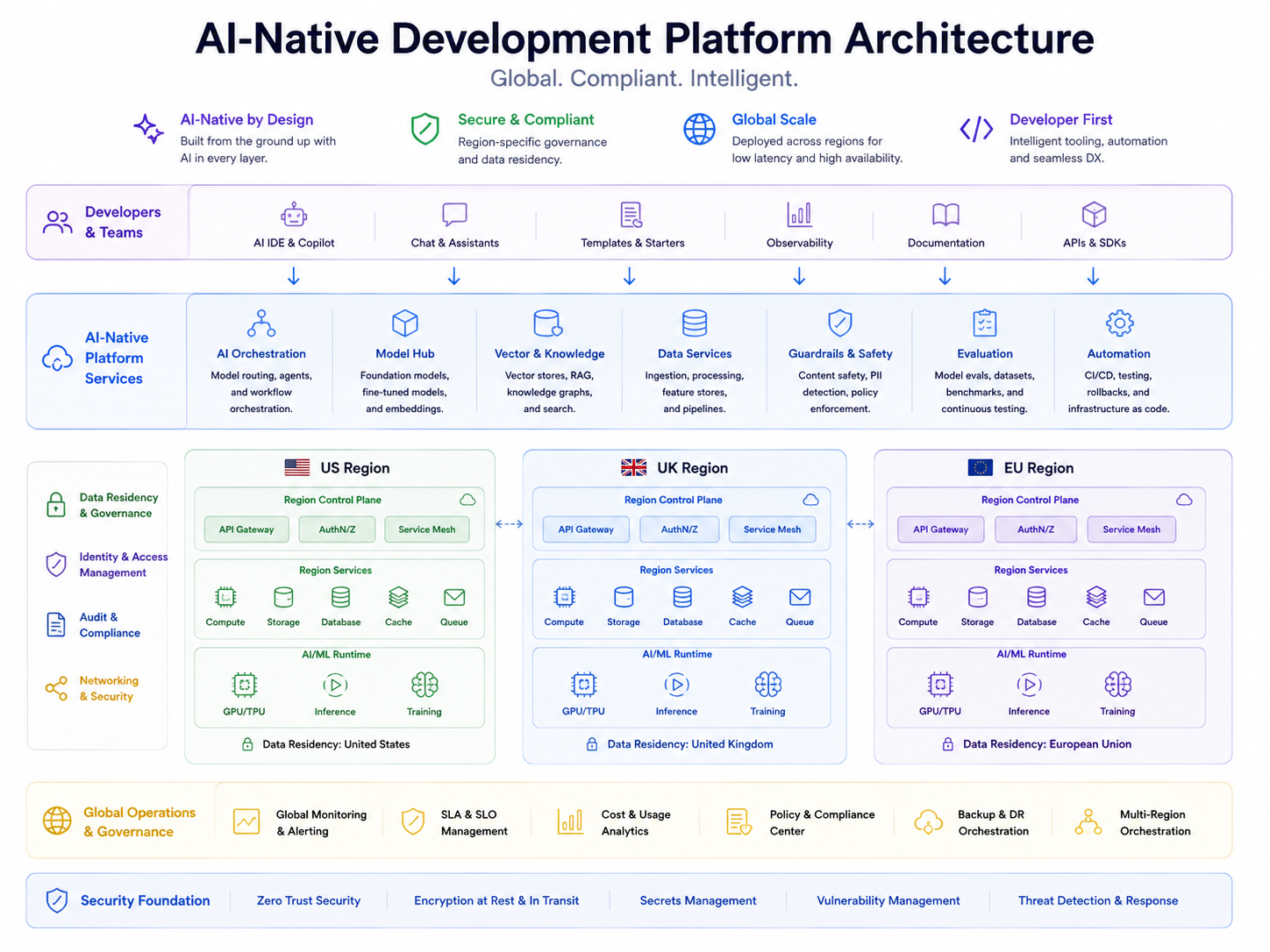
AI-Native Development Platforms for Enterprise Teams
AI-native development platforms are becoming the new delivery model for enterprise software teams. Instead of using AI only for code suggestions, companies now use it across planning, coding, testing, documentation, security review, deployment, and observability.
Put simply, AI-native development platforms help software teams combine AI coding agents, automation, DevOps, testing, governance, and compliance into one controlled delivery system. For enterprise teams in the US, UK, Germany, and the wider EU, the real value is faster software delivery without losing security, compliance, or human oversight.
That balance matters. Stack Overflow’s 2024 Developer Survey reported that 76% of respondents were using or planning to use AI tools in their development process, while IBM reported the average global cost of a data breach at USD 4.88 million in 2024.
So the boardroom question is not, “Should we buy every AI coding tool?” It is: how do we ship software faster without creating uncontrolled AI, security, and compliance risk?
What Are AI-Native Development Platforms?
AI-native development platforms are environments where AI is built into the software delivery lifecycle, not added as a side chatbot. They combine coding agents, AI-powered SDLC automation, governance, testing, DevOps, documentation, security controls, and compliance evidence into one operating model.
For example, an enterprise team in New York might use AI to generate unit tests, summarize pull requests, scan code, update documentation, and prepare release notes. But the same platform should also enforce human review, secrets scanning, audit logs, and deployment gates before code reaches production.
AI-Native vs AI-Assisted Software Development
AI-assisted software development usually means a developer uses tools such as GitHub Copilot, Cursor, Claude Code, or Gemini Code Assist to write code faster.
AI-native development goes further.
It connects those tools to CI/CD, DevSecOps, observability, knowledge bases, issue tracking, and governance workflows. AI-assisted tools improve individual developer productivity. AI-native platforms improve team-level delivery performance.
Why AI-Native SDLC Matters in 2026
By 2026, engineering teams face pressure from every direction: deliver more software, prove security, control cloud cost, and meet regional rules such as GDPR, UK-GDPR, HIPAA, PCI DSS, NIS2, DORA, and the EU AI Act.
The EU AI Act entered into force on August 1, 2024, and the European Commission notes that rules for high-risk AI systems will apply in phases, including August 2026 and August 2027 timelines.
That makes AI-native SDLC governance a business requirement, not just an engineering upgrade.
How AI-Native Development Platforms Improve Delivery Speed
AI-native development platforms help teams ship faster by reducing repetitive engineering work while keeping delivery pipelines measurable and controlled. The speed gain comes from automation across the lifecycle, not from blindly accepting AI-generated code.
Research on GitHub Copilot found that developers completed a coding task 55.8% faster in a controlled experiment. That does not mean every enterprise will see the same result, but it does show the productivity upside when AI is used in the right workflow.
AI Coding Agents for Faster Engineering Workflows
AI coding agents can draft boilerplate, refactor legacy modules, generate test cases, explain unfamiliar code, and suggest bug fixes.
A SaaS team in Austin might use agents to accelerate API development. A fintech team in London may restrict agents to test generation and internal tooling until compliance review is complete.
Teams working on complex front-end products can pair AI agents with React development services to speed reusable component delivery. Back-end teams can align AI workflows with Node.js development services for API, event-driven, and microservice architectures.
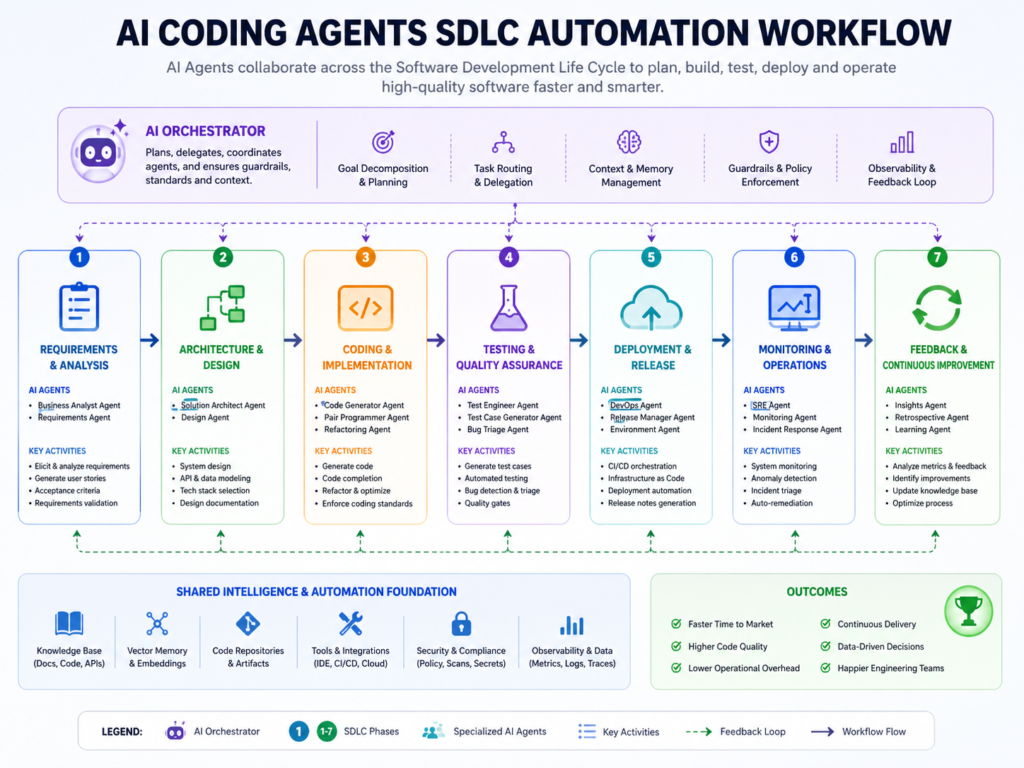
Automating Testing, Documentation, DevOps, and Security Tasks
The biggest gains often happen outside coding.
AI can create regression test drafts, summarize failed builds, update runbooks, explain infrastructure changes, and flag risky commits. In mature environments, this connects directly to DevSecOps pipelines.
That is where broader web development services and business intelligence services become useful. AI-native delivery needs product architecture, telemetry, dashboards, and reporting that leadership can trust.
The goal is not to remove engineers. The goal is to remove low-value manual work so engineers can focus on architecture, product quality, and customer outcomes.
AI Coding Platforms vs Enterprise AI Development Platforms
AI coding platforms help developers write, review, and understand code. Enterprise AI development platforms add governance, identity, security, auditability, model controls, data boundaries, and integration with delivery systems.
That distinction matters for CTOs and CIOs choosing between point tools and a long-term platform strategy.
When Tools Like GitHub Copilot, Cursor, Claude Code, and Gemini Code Assist Fit
Tools like GitHub Copilot, Cursor, Claude Code, and Gemini Code Assist are useful when teams want fast adoption, better developer experience, and lower friction in daily coding.
They fit startups, product squads, and internal platform teams experimenting with AI-assisted software engineering.
Still, adoption should include usage policies, code review rules, secrets protection, and license/IP guidance.
When Enterprises Need Platform-Level Governance
Enterprises need platform-level governance when AI touches regulated codebases, sensitive data, customer workflows, or production systems.
A healthcare software team in Boston handling HIPAA-regulated data needs stronger controls than a small marketing site team. A payment platform must think carefully about PCI DSS. A European financial firm may need auditability, outsourcing controls, and regional data handling rules.
In practice, the more sensitive the workflow, the more important governance becomes.
How AWS, Microsoft, Google Cloud, IBM, and SAP Fit the Ecosystem
AWS Bedrock, Amazon Q Developer, Microsoft Azure AI, GitHub, Google Cloud Vertex AI, Gemini Code Assist, IBM watsonx, SAP AI, and SAP Build all fit different parts of the ecosystem.
Some support coding. Others support enterprise data, workflow automation, application modernization, or AI governance.
For many organizations, the platform is not one vendor. It is a controlled architecture across cloud, code, data, identity, and compliance.
Governance, Security, and Compliance Risks to Control
Governance is essential because AI coding agents can introduce security, compliance, IP, explain ability, and vendor-risk issues if used without policy controls.
The practical risk is not that AI writes code. The risk is that nobody can prove what was generated, reviewed, tested, approved, or deployed.
Secure AI Development, IP Protection, and DevSecOps Guardrails
Secure AI development starts with simple rules.
Do not paste secrets into public AI tools.
Do not expose sensitive customer data in prompts.
Review generated code before merging.
Scan dependencies and generated outputs.
Document acceptable and prohibited AI use.
Define when legal, security, or architecture review is required.
Good governance makes AI adoption safer, not slower. It gives developers clear boundaries and gives leadership evidence that delivery remains controlled.
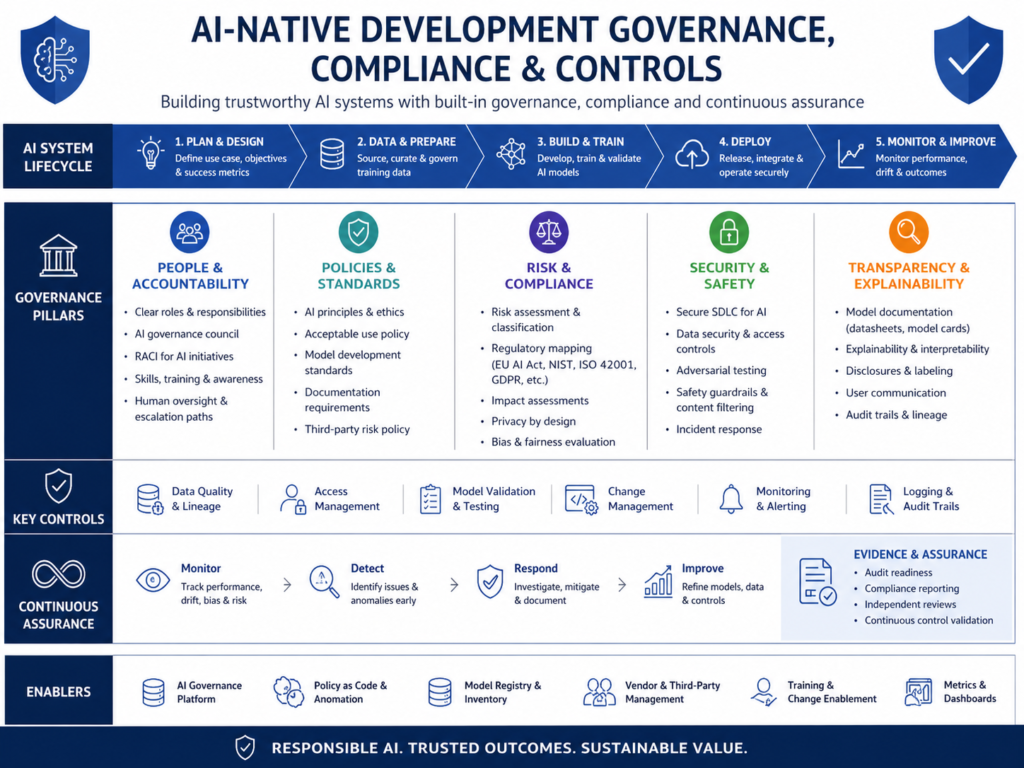
GDPR, UK-GDPR, HIPAA, PCI DSS, NIS2, DORA, and EU AI Act Considerations
In Europe, GDPR and DSGVO require careful handling of personal data, especially when AI tools process logs, prompts, tickets, or customer records.
In the UK, teams must consider UK-GDPR, supplier assurance, public-sector rules, FCA expectations, NHS requirements, and Open Banking where relevant.
In Germany, BaFin-regulated financial firms in Frankfurt or Munich may need stronger auditability, outsourcing-risk controls, and data residency planning. Across the EU, DORA and NIS2 add resilience expectations for critical and financial-sector organizations.
For regulated teams, AI-native development platforms should support evidence, not just automation.
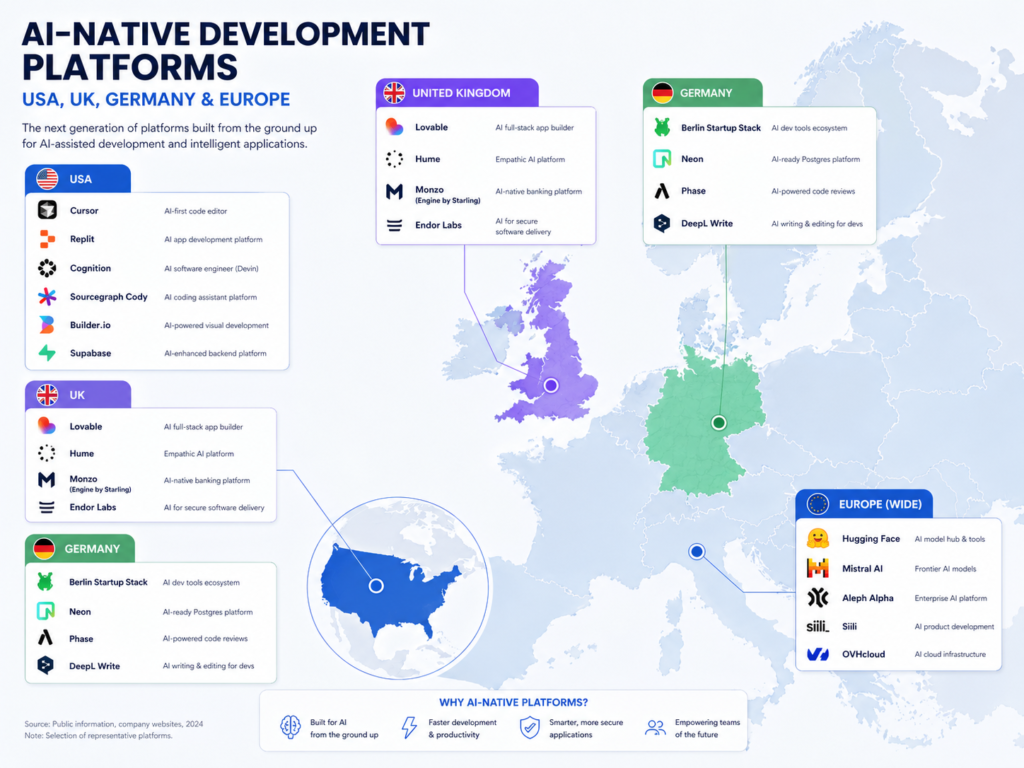
Regional Adoption: USA, UK, Germany, and Europe
AI-native development platforms are being adopted differently across the United States, United Kingdom, Germany, France, Netherlands, Ireland, Switzerland, the Nordics, and the wider European Union.
The common pattern is simple: speed plus control.
USA: HIPAA, SOC 2, IP Protection, and Developer Productivity ROI
US teams in San Francisco, Seattle, Austin, New York, and Boston often focus on developer productivity ROI, SOC 2 readiness, IP protection, and HIPAA where healthcare data is involved.
A SaaS company may use AI agents for test automation while keeping customer data out of prompts.
UK: UK-GDPR, FCA, NHS, Open Banking, and Public-Sector Assurance
UK teams in London, Manchester, and Cambridge often evaluate AI-native platforms through UK-GDPR, FCA, NHS, HMRC, and Open Banking expectations.
Public-sector and financial workflows need explain ability, audit trails, and strong supplier assurance.
Germany and EU: DSGVO, BaFin, Data Residency, SAP, and AI Governance
German and EU teams in Berlin, Munich, Frankfurt, Hamburg, Amsterdam, Dublin, Paris, and Zurich often prioritize DSGVO, BaFin expectations, AWS/Azure/GCP region selection, SAP integration, works council consultation, and EU AI Act readiness.
Data residency and employee transparency can be as important as coding speed.
Building an AI-Native Platform Engineering Strategy
An AI-native platform engineering strategy defines how people, tools, workflows, governance, and metrics work together.
Buying tools first often creates chaos. Designing the operating model first creates repeatable delivery.
Define the Operating Model Before Buying Tools
Start by defining.
Who can use AI tools.
Which repositories are allowed.
What data is restricted.
What review is mandatory.
How exceptions are approved.
Which metrics prove value and safety.
This should include engineering, security, legal, compliance, and product leadership.
For teams modernizing customer portals, mobile products, or transaction platforms, mobile app development services and e-commerce development may also need AI-ready delivery standards.
Connect AI Agents to CI/CD, DevSecOps, Observability, and Documentation
AI agents should not sit outside the delivery system.
Connect them to CI/CD, ticketing, secure code scanning, observability, documentation, and release workflows. This makes automation measurable and auditable.
Prevent Delivery Chaos with Standards and Human Review
Use standards for prompt handling, code review, testing, model usage, architecture decisions, and deployment gates.
Track metrics such as.
Lead time
Pull request cycle time
Review defects
Escaped bugs
Deployment frequency
Security findings
Developer satisfaction
Compliance evidence completion
Human review remains essential for architecture, security, compliance, and production release decisions.
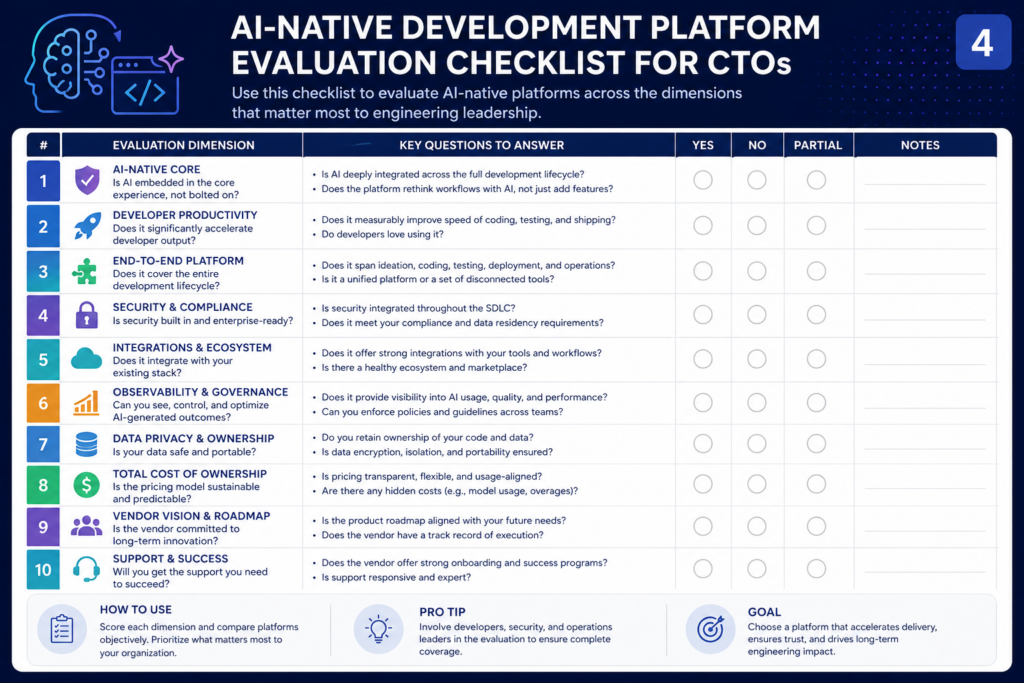
How to Evaluate AI-Native Development Platforms
Enterprises should evaluate AI-native development platforms by delivery impact, security posture, compliance readiness, integration depth, auditability, and regional regulatory fit.
The best platform is not always the most impressive demo. It is the one your teams can govern in production.
Evaluation Checklist for CTOs, CIOs, and Platform Engineering Leaders
| Evaluation Area | What to Check |
|---|---|
| Use cases | Coding, testing, documentation, DevOps, support, security, analytics |
| Data controls | Public, internal, confidential, regulated, and restricted data handling |
| Vendor review | Model controls, retention, training policies, identity, logging, contracts |
| Integrations | Git, CI/CD, cloud, ticketing, observability, knowledge bases |
| Pilot approach | Low-risk workflows first, then controlled expansion |
| Measurement | Productivity, quality, risk reduction, adoption, compliance evidence |
Must-Have Capabilities
Strong AI-native development platforms should include.
Role-based access controls
Policy and approval workflows
Prompt and data handling options
Audit logs
Secure SDLC integration
Vulnerability scanning
Human approval gates
Developer-friendly workflows
Regional compliance support
For content and growth teams, technical delivery should also connect with SEO services so new product features remain discoverable and measurable.
Concluding Remarks
AI-native development platforms give enterprise teams a practical way to move faster without losing control. The strongest results come when AI coding agents, automation, DevSecOps, documentation, observability, governance, and human review work as one delivery system.
For US, UK, German, and EU teams, the priority is not just faster code. It is safer, more auditable, and more predictable software delivery.
Mak It Solutions helps teams design AI-ready software delivery models across web, mobile, SaaS, cloud, and analytics systems. To reduce risk before scaling AI coding agents, request a scoped estimate or explore how Mak It Solutions can support your next platform engineering, web development, or business intelligence initiative.( Click Here’s )
Key Takeaways
AI-native development platforms extend beyond AI code suggestions into SDLC automation, DevSecOps, testing, documentation, and governance.
Enterprise teams need platform-level controls when AI touches regulated data, production systems, or customer-facing workflows. US, UK, German, and EU adoption patterns differ because HIPAA, UK-GDPR, GDPR/DSGVO, BaFin, FCA, DORA, NIS2, and the EU AI Act shape risk decisions.
The biggest productivity gains often come from automating tests, documentation, reviews, and release workflows, not just writing code.
Vendor choice should be based on auditability, integrations, security posture, compliance fit, and developer experience.
FAQs
Q : Are AI-native development platforms replacing developers?
A : No. AI-native development platforms support developers by automating repetitive work such as boilerplate code, test generation, documentation updates, and DevOps summaries. Developers still make architecture decisions, review code, validate security, and understand customer requirements.
Q : What is the difference between AI coding agents and AI development platforms?
A : AI coding agents help with specific engineering tasks, such as writing code, explaining functions, generating tests, or suggesting refactors. AI development platforms connect those agents to Git repositories, CI/CD, DevSecOps, ticketing, documentation, identity, audit logs, and compliance controls.
Q : Which industries benefit most from AI-native software development?
A : The strongest fit is in industries that need both speed and control. This includes SaaS, fintech, healthcare, insurance, e-commerce, logistics, telecom, government, and enterprise IT.
Q : How can regulated teams use AI coding tools safely?
A : Regulated teams should classify data, restrict what can be pasted into AI tools, use enterprise-grade settings, enforce code review, log usage, and scan generated code. They should also define policies for secrets, customer data, health data, payment information, and confidential IP.
Q : What metrics should enterprises track after adopting AI-native development platforms?
A : Enterprises should track delivery speed, deployment frequency, pull request cycle time, escaped defects, security findings, test coverage, documentation freshness, developer satisfaction, and compliance evidence completion.