
AI Observability Platform for GCC Teams
AI apps are moving from experiments to real products across Riyadh, Dubai, Abu Dhabi, Jeddah, and Doha. Once a chatbot, AI agent, fraud workflow, or Arabic-English support assistant goes live, teams need more than “it seems fine.” They need visibility.
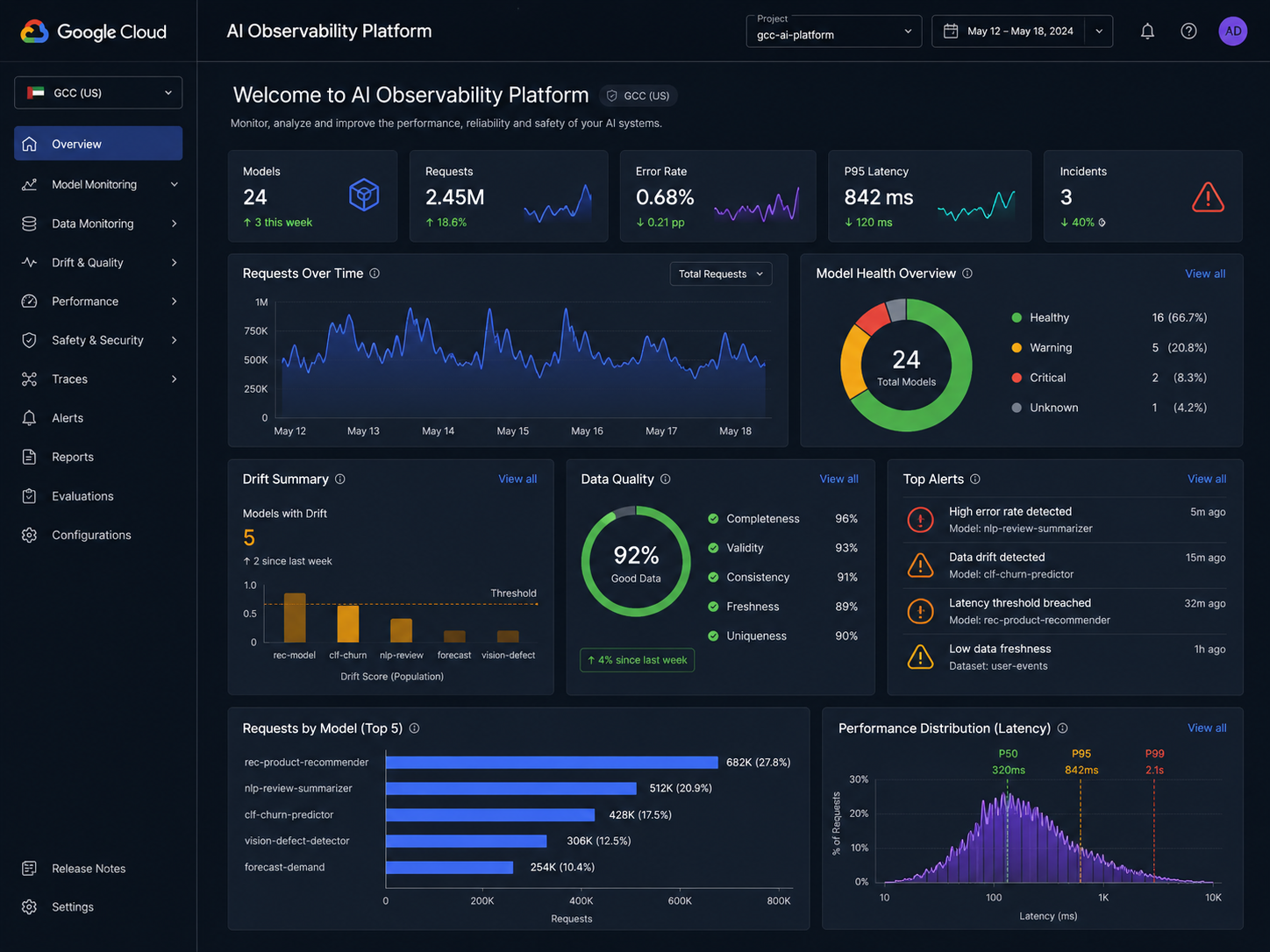
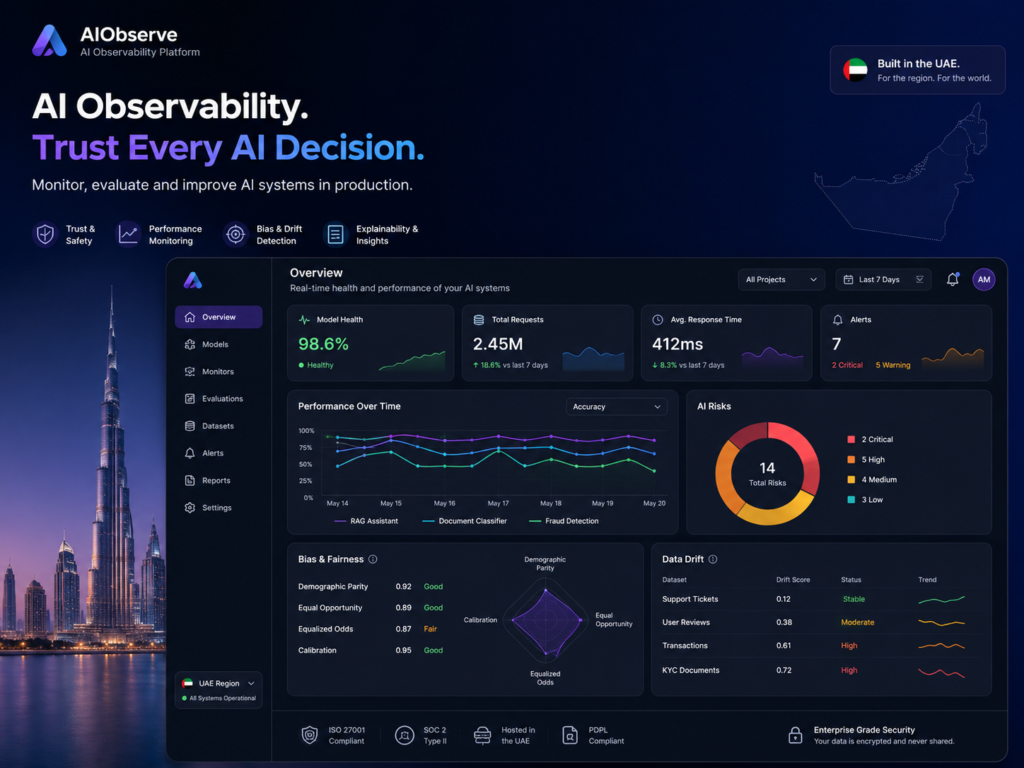
An AI observability platform helps GCC teams monitor how AI systems behave in production. It tracks prompts, responses, LLM traces, token costs, tool calls, failures, audit logs, and incidents so engineering, product, and compliance teams can review what happened and improve it.
For Saudi, UAE, and Qatar businesses, this matters even more when AI supports Arabic users, regulated workflows, financial services, government journeys, or customer-facing automation.
What Is an AI Observability Platform?
An AI observability platform is a monitoring layer for AI applications. It records prompts, responses, model calls, latency, token usage, evaluations, errors, and incidents so teams can understand how AI behaves after launch.
Traditional monitoring tells you whether an API is down. AI observability tells you whether the model misunderstood Arabic intent, gave an unsafe answer, used too many tokens, failed a tool call, or created a response that needs human review.
For teams building with Python-based AI backends or Node.js application layers, this visibility helps engineers debug AI logic faster and reduce production surprises.
Why LLM Observability Matters for Production AI Agents
AI agents can search databases, call tools, update records, summarize documents, or trigger workflows. One failed action can create a customer complaint, compliance concern, or hidden cost leak.
A strong observability setup helps teams answer questions like.
Which prompt created the issue?
Which model answered?
Was the answer based on approved data?
Did the agent call the wrong tool?
How much did that workflow cost?
Can the incident be reviewed later?
That kind of audit trail is hard to rebuild after something goes wrong.
Why GCC Companies Need AI Observability Before Scaling AI
Saudi Fintech and Enterprise Teams Need Audit-Ready AI Workflows
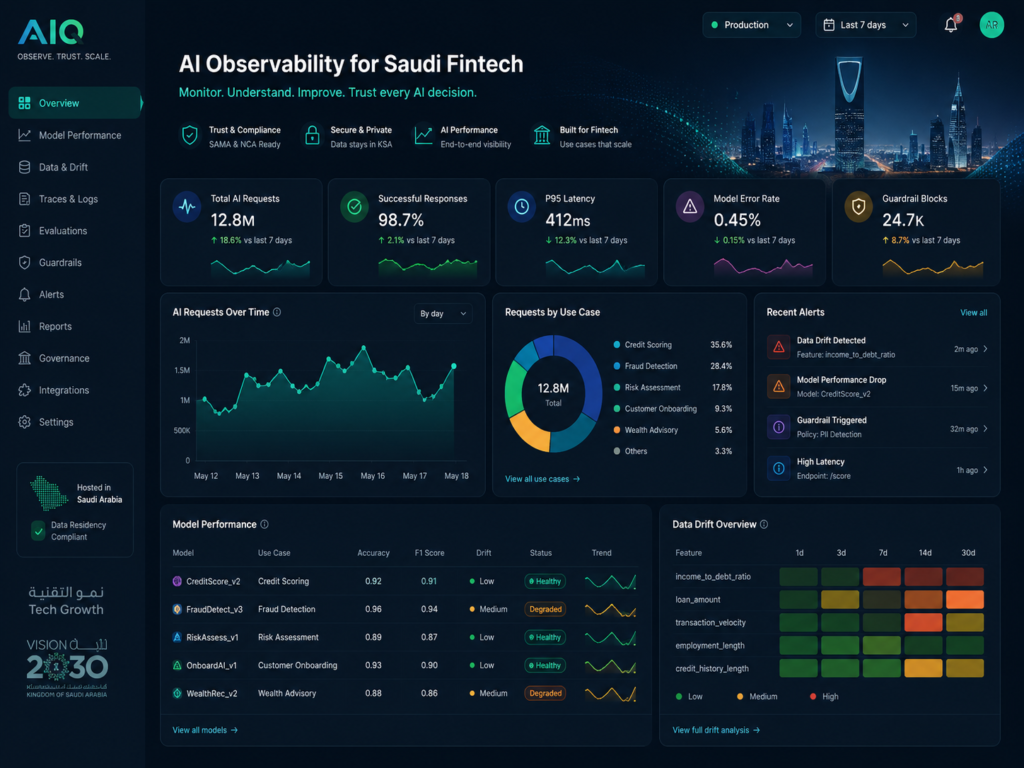
In Saudi Arabia, fintech and enterprise AI teams need to think carefully about controls, logs, and risk. SAMA describes its Regulatory Sandbox as a live environment where financial institutions and fintech companies can test innovative financial products or services with real consumers under defined periods and controls.
That makes audit-ready AI workflows highly relevant for Riyadh fintech teams. If an AI assistant supports onboarding, fraud review, customer support, or internal risk analysis, teams should be able to review prompts, model outputs, decisions, and escalations.
UAE SaaS and Digital Service Teams Need Visibility Before Launch
In Dubai and Abu Dhabi, SaaS products, UAE PASS-related support journeys, and digital government services need stable user experiences. TDRA has launched AI initiatives to support digital government enablement, showing how seriously the UAE treats AI in public digital services.
For launch-ready products, mobile app development and AI monitoring should work together. If an AI feature affects login help, document guidance, onboarding, or support, teams need clear logs before customers start reporting issues.
Qatar AI Teams Need Governance-Ready Monitoring
In Doha, fintech and enterprise teams should prepare for governance, documentation, and monitoring from the start. Qatar Central Bank states that its FinTech Supervision Department regulates QCB-licensed fintech companies and conducts onsite and offsite inspections to ensure compliance with QCB instructions.
For Qatar companies, LLM monitoring is not only a technical improvement. It supports better reporting, stronger internal controls, and clearer review when AI is used in customer service, financial workflows, or enterprise operations.
What Should an AI Observability Platform Track?
Prompt Logs, Prompt Versions, and Arabic-English Behavior
GCC users often switch between Arabic and English in the same journey. A useful AI observability platform should track prompt language, prompt version, user intent, model response, escalation status, and quality signals.
This helps teams spot.
Misunderstood Arabic requests
Dialect or tone issues
English prompts that perform better than Arabic prompts
Sensitive responses that need review
Prompt versions that create more errors
For Arabic-first or bilingual products, this is one of the most important parts of AI monitoring.
LLM Traces, Tool Calls, Latency, and Failed Actions
Engineering teams should be able to see every model call, retrieval step, API call, tool action, timeout, and failed response.
This is especially useful for teams building custom dashboards through business intelligence services. Instead of guessing where the AI failed, engineers can follow the trace and fix the exact step.
Token Usage, Model Spend, and Cost Dashboards
AI costs can grow silently. Token usage analytics help founders and product teams in Dubai, Riyadh, and Doha compare models, reduce unnecessary context, and set budget alerts before scaling.
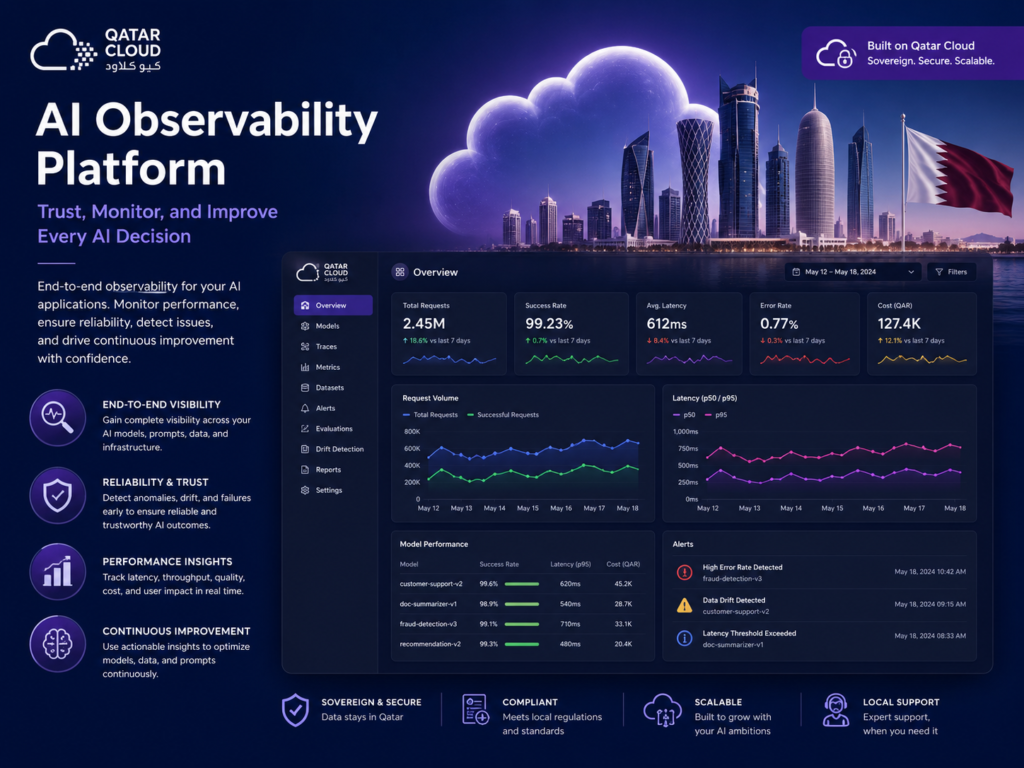
A practical dashboard should show:
| Metric | Why It Matters |
|---|---|
| Token usage by feature | Shows which workflows cost the most |
| Cost per user | Helps estimate product margins |
| Model spend by team | Supports budget planning |
| Latency by model | Improves user experience |
| Error rate by workflow | Helps prioritize fixes |
| Escalation rate | Shows where humans still need to help |
In practice, cost visibility often becomes the difference between a promising AI feature and one that becomes too expensive to run.
GCC Compliance, Security, and Data Residency Considerations
Saudi Considerations.
Saudi teams should design AI logging with privacy, consent, access control, and retention in mind. For fintech and enterprise use cases, logs should support review without exposing sensitive customer data to people who do not need it.
Useful controls include:
Role-based access to prompt logs
Masking or redaction for personal data
Clear retention rules
Separate environments for testing and production
Incident logs for risky or incorrect AI responses
This is not only about compliance. It also helps teams build customer trust.
UAE Considerations.
UAE teams should consider cloud controls, identity, and audit trails, especially for Abu Dhabi and Dubai fintech environments. If AI features connect with regulated workflows, support journeys, or identity-related experiences, monitoring needs to be built into the product architecture early.
For UAE SaaS teams, the goal is simple: know what the AI did, why it did it, and whether the team can review it later.
Qatar Considerations.
Qatar teams can benefit from regional cloud planning when latency, governance, and availability matter. Google Cloud announced that its Doha region opened with three zones to help users distribute applications and storage for higher availability.
That does not remove the need for internal governance. Teams still need clear logging, access control, monitoring, and review workflows for AI-powered products.
AI Observability Use Cases Across GCC Industries
Fintech: Monitor AI Decisions, Fraud Workflows, and Support Bots
A Riyadh fintech startup can use an AI observability platform to review fraud alerts, chatbot answers, onboarding support, and loan-related assistance before issues reach risk teams.
The platform can show whether the AI followed policy, used approved knowledge, escalated sensitive cases, and avoided unsupported claims.
Government: Track Arabic UX, Citizen Service Bots, and Audit Trails
A UAE public-service chatbot can monitor Arabic UX, failed intents, and support issues around digital service journeys. Observability helps teams improve service quality without relying only on user complaints.
For citizen-facing systems, a clean audit trail is especially important.
Retail and Logistics: Reduce Hallucinations, Delays, and Model Costs
A Dubai e-commerce brand using e-commerce solutions or Shopify development can track product recommendation errors, delivery-support hallucinations, refund-policy confusion, and rising model costs.
This helps teams protect customer experience while keeping AI spend under control.
How to Choose the Right AI Observability Platform in the GCC
Compare Hosted, Self-Hosted, and Private Cloud Models
Hosted tools are faster to launch. Self-hosted or private cloud options may suit regulated teams better.
A Doha SME may consider Qatar-based cloud options for latency and governance planning. A UAE enterprise may evaluate cloud controls for Dubai or Abu Dhabi operations. A Saudi fintech team may need stricter internal approval before logs leave approved environments.
The best choice depends on your risk profile, data sensitivity, and engineering capacity.
Check Integrations With LLMs, Frameworks, and Agent Workflows
The right platform should support the models, tools, and frameworks your team already uses. That may include OpenAI, Anthropic, Gemini, LangChain, vector databases, retrieval pipelines, and custom agents.
It should also fit your web development architecture instead of forcing your team into a workflow that slows delivery.
Prioritize Dashboards for Costs, Incidents, Compliance, and Executives
Executives do not need raw traces every day. They need clear signals.
Cost per user
Model quality trends
Incident volume
High-risk workflows
Unresolved escalations
Compliance review status
Teams can pair this with SEO and digital visibility planning when AI features affect customer acquisition, product trust, or support quality.
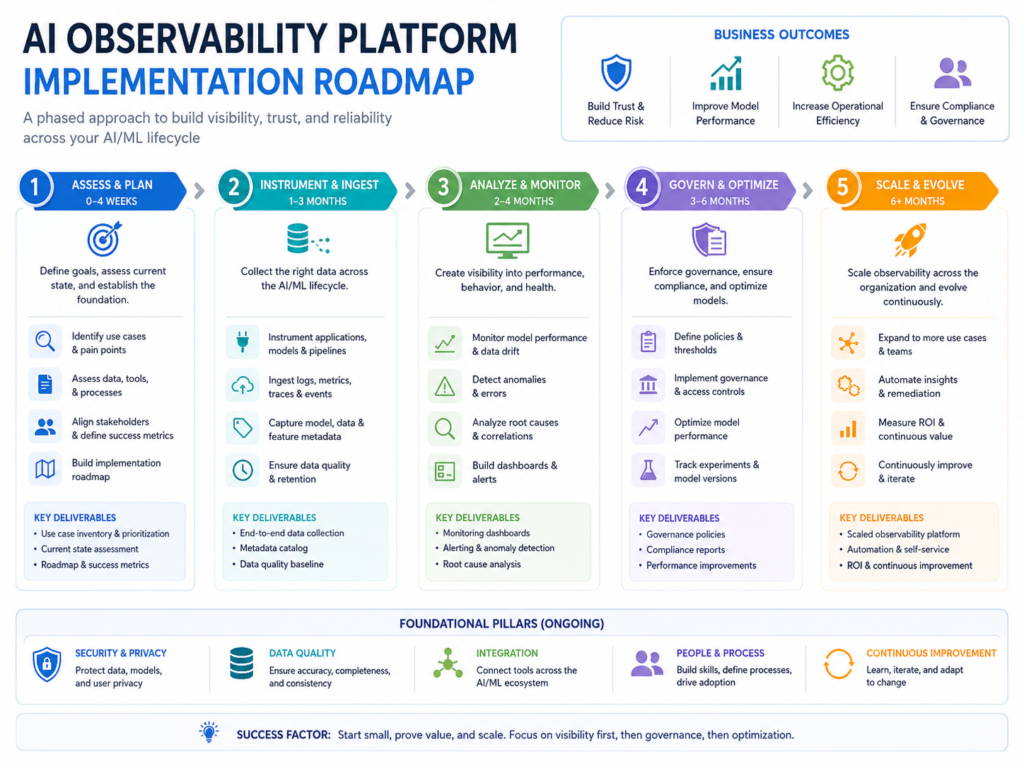
Implementation Roadmap for Saudi, UAE, and Qatar Teams
Start With Prompt Logging and LLM Tracing
Begin by logging prompts, outputs, model names, user journeys, retrieval steps, and tool calls. Mask personal data where needed.
Start small. Track the workflows that matter most: customer support, onboarding, fraud review, internal search, and any AI feature connected to regulated decisions.
Add Cost Monitoring, Alerts, and Incident Workflows
Create token dashboards, latency alerts, failed-action alerts, and escalation workflows for engineering and compliance teams.
A useful alert should not create noise. It should tell the team what happened, where it happened, and who needs to review it.
Create Compliance-Ready Dashboards and Audit Reports
Build dashboards for internal governance reviews and, where relevant, SAMA, TDRA, QCB, ADGM, DIFC, or leadership reporting.
Keep reports simple enough for executives and detailed enough for technical teams. The goal is not to collect logs forever. The goal is to make AI behavior reviewable, measurable, and safer to scale.
Common Mistakes to Avoid
Many GCC teams wait until after launch to add observability. That usually makes debugging harder.
Avoid these mistakes.
Logging prompts without protecting sensitive data
Tracking costs only after the invoice arrives
Monitoring English responses but ignoring Arabic quality
Letting AI agents call tools without trace visibility
Giving compliance teams dashboards they cannot understand
Treating observability as only an engineering concern
AI observability works best when product, engineering, security, and leadership all use it.
Concluding Remarks
An AI observability platform gives GCC teams the visibility they need before AI products become too complex to manage. It helps teams monitor prompts, costs, Arabic-English behavior, incidents, compliance logs, and production quality in one place.
For Saudi, UAE, and Qatar companies, this is not just a technical upgrade. It is a practical step toward safer, more reliable, and more scalable AI.
Mak It Solutions helps businesses design reliable digital products, dashboards, AI-ready systems, and GCC-focused technology strategies. Contact Mak It Solutions to book a consultation or request a custom AI observability roadmap for Saudi, UAE, and Qatar markets.
FAQs
Q : Is an AI observability platform useful for Saudi fintech companies?
A : Yes. Saudi fintech companies can use an AI observability platform to monitor prompts, model decisions, customer support bots, fraud workflows, and compliance logs. This helps regulated teams improve audit readiness, customer trust, and production control.
Q : Can UAE SaaS startups use AI observability for UAE PASS-related workflows?
A : Yes. UAE SaaS startups can use AI observability to track user journeys, errors, Arabic-English prompts, and failed identity-related support flows around UAE PASS-connected experiences. Teams should also apply careful privacy controls and incident reporting.
Q : Do Qatar companies need LLM monitoring for AI governance?
A : Yes. Qatar companies building fintech, enterprise, or customer-service AI should monitor LLM behavior from the beginning. In practice, LLM monitoring helps Doha teams review AI responses, manage risks, reduce errors, and prepare better governance reports.
Q : How can GCC companies track Arabic and English AI prompts?
A : GCC companies should log prompt language, prompt version, user intent, model response, quality score, and escalation status. This helps teams compare Arabic and English behavior and identify dialect, tone, or misunderstanding issues.
Q : What is the best way to reduce LLM costs for AI apps in Dubai, Riyadh, and Doha?
A : Track token usage by feature, user type, model, and workflow. Then shorten prompts, cache repeated answers, use smaller models for simple tasks, and set alerts for unusual spikes.