Arabic RAG for Company Documents in GCC
GCC companies are managing thousands of HR policies, contracts, SOPs, compliance files, bilingual PDFs, emails, and legacy documents across SharePoint, Google Drive, portals, and internal systems. Arabic RAG for company documents helps teams search those approved sources in Arabic or English and get cited answers instead of vague chatbot responses.
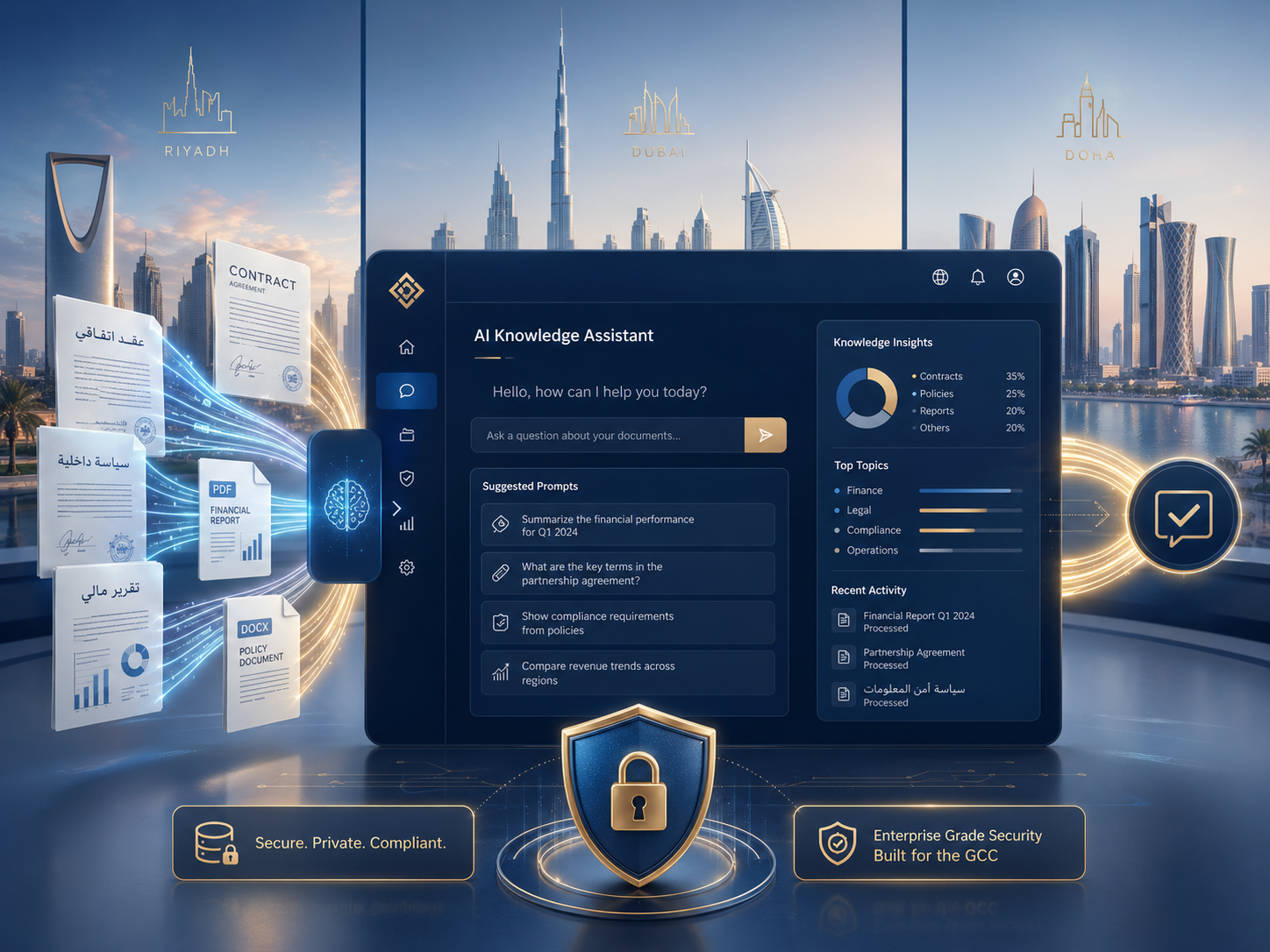
In simple terms, Arabic RAG connects AI to your company’s own documents. It retrieves the most relevant files first, then generates an answer based on those sources. For companies in Saudi Arabia, the UAE, and Qatar, that can mean faster internal search, fewer repeated HR or legal questions, and stronger control over sensitive knowledge.
This matters because normal keyword search often breaks down in GCC workflows. Employees may use Arabic terms, English abbreviations, scanned PDFs, old policy names, or mixed Arabic-English contract wording. A well-built RAG system handles that mess more intelligently.
What Is Arabic RAG for Company Documents?
Arabic RAG for company documents is a private AI search system that answers questions using approved internal files. RAG stands for Retrieval-Augmented Generation.
Instead of asking a general chatbot to guess, the system:
Reads the user’s question.
Searches trusted company documents.
Retrieves the most relevant sections.
Generates a clear answer.
Shows citations so the user can verify the source.
For example, an employee might ask.
What is our annual leave policy in Saudi Arabia?
The system can retrieve the latest HR policy, find the right section, and answer with a citation to the approved document.
Why Arabic and Bilingual Documents Need Specialized RAG
Arabic is not just another keyword-matching problem. Words can change shape, spelling may vary, and business documents often mix Arabic and English in the same file.
GCC company documents may also include.
Right-to-left formatting
Scanned stamps and signatures
Arabic-English contracts
Government-style terminology
Policy PDFs with tables
Legacy documents with inconsistent naming
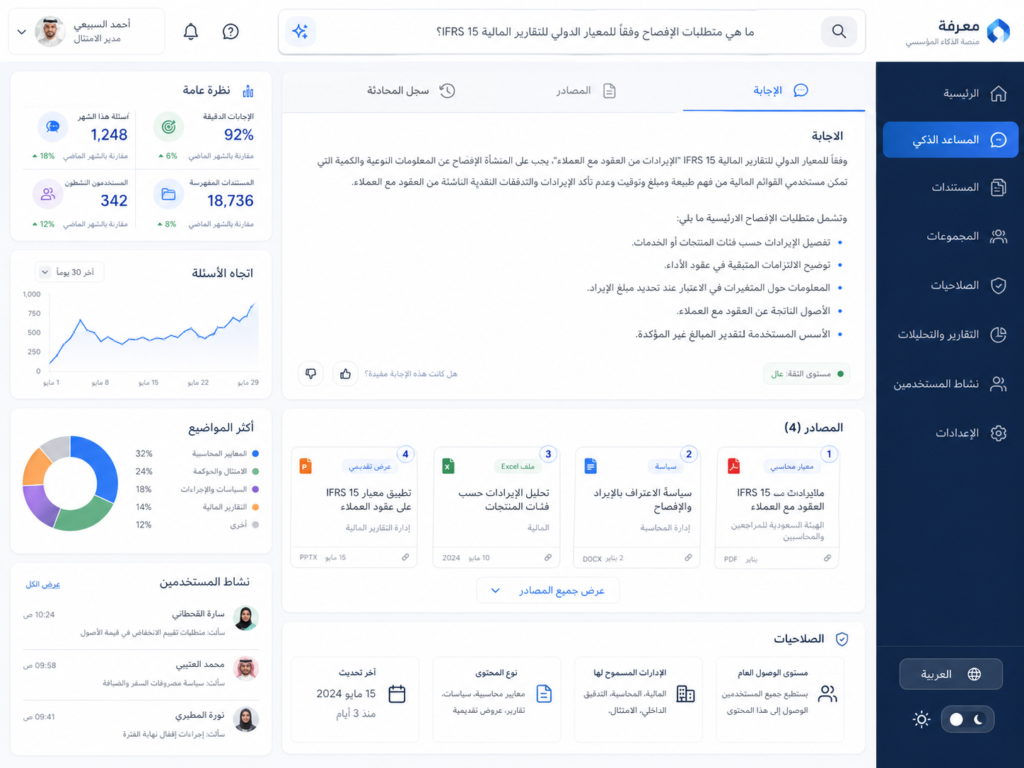
A strong Arabic RAG system should support semantic search, multilingual embeddings, Arabic-aware OCR, permissions, citations, and a user interface that works properly for Arabic and English users.
Key Use Cases for Arabic RAG in Saudi, UAE, and Qatar
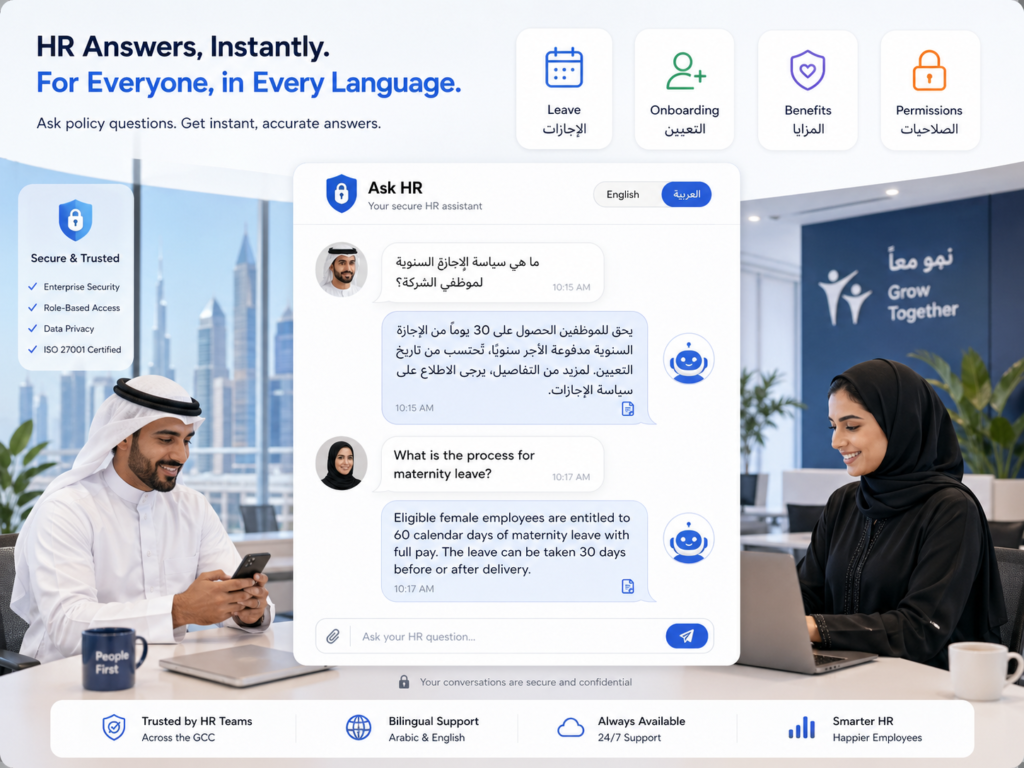
HR Policy Search and Employee Self-Service
HR teams in Riyadh, Jeddah, Dubai, Abu Dhabi, and Doha often answer the same questions again and again: leave balance, medical benefits, onboarding, travel rules, allowances, payroll cutoffs, and internal approvals.
Arabic RAG can turn approved HR documents into a self-service assistant. Employees ask in Arabic or English, and the system answers from the latest policy.
This reduces repetitive tickets and helps HR focus on sensitive cases instead of routine document lookup.
Contract Search for Legal and Compliance Teams
Legal teams can use Arabic RAG to search renewal dates, liability clauses, termination terms, payment conditions, and Arabic-English wording differences.
This is useful for logistics companies in Jeddah, retail groups in Dubai, fintech teams in Riyadh, and regulated finance teams in Doha. Instead of opening dozens of PDFs manually, legal users can ask focused questions and review cited contract sections.
Internal Knowledge Assistants for Operations
Operations teams can use Arabic RAG for SOPs, IT manuals, procurement rules, call-center scripts, escalation playbooks, and internal service guides.
For example, a support agent can ask, “What should I do if a customer reports a failed payment?” The system can retrieve the approved escalation policy and provide a step-by-step answer.
Mak It Solutions’ business intelligence services can support this by turning scattered internal knowledge into decision-ready systems.
GCC Compliance and Data Governance Considerations
Arabic RAG is powerful, but it must be designed carefully. Company documents often contain employee data, contracts, customer information, financial records, or regulated material.
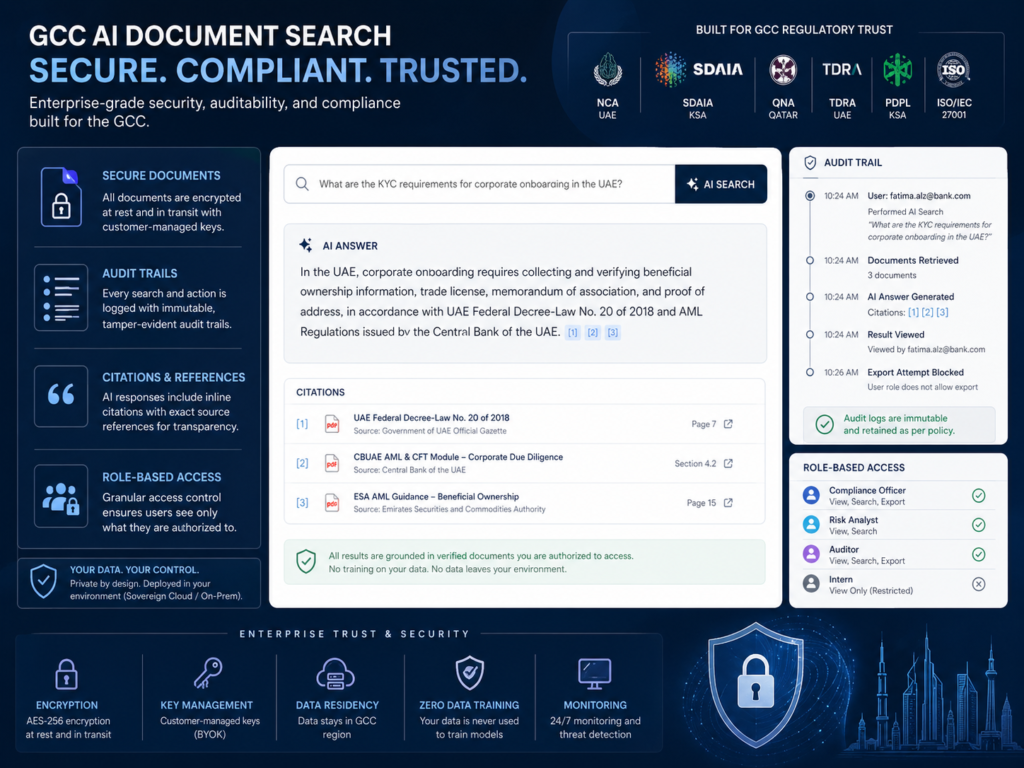
A private AI document search system should include.
Role-based access control
Audit logs
Data classification
Document-level permissions
Clear retention rules
Secure hosting
Citation-based answers
Admin review workflows
Saudi Arabia.
For Saudi banks, fintech firms, government entities, and healthcare buyers, governance matters from the start. SAMA’s Cyber Security Framework says member organizations should define, implement, monitor, measure, and evaluate cybersecurity controls for hybrid and public cloud services.
That means an Arabic RAG system for regulated Saudi environments should not be treated as a casual chatbot. It needs proper controls, access review, vendor due diligence, and clear data-handling rules.
UAE.
In the UAE, Dubai and Abu Dhabi enterprises may need to consider TDRA expectations, UAE PDPL, and free-zone requirements from ADGM or DIFC.
The UAE’s official government portal describes data protection law as setting controls for personal data processing and obligations for companies that hold personal data.
For Arabic RAG, this means companies should be careful about personal data, access permissions, and how AI systems process internal files.
Qatar.
In Qatar, banks, government-linked entities, logistics firms, and document-heavy SMEs should design Arabic RAG around internal data classification, hosting preferences, and sector expectations.
Doha-based teams often care deeply about where documents are stored, who can access them, and whether answers can be audited later. That makes citations and permission-aware retrieval essential.
Deployment Options for Private AI Document Search
Different companies need different deployment models. The right choice depends on risk, budget, compliance needs, document sensitivity, and IT maturity.
| Deployment Option | Best For | Main Advantage | Key Trade-Off |
|---|---|---|---|
| Public cloud | Fast pilots and lower-risk use cases | Quick setup | Needs strong governance |
| Private cloud | Sensitive enterprise workloads | Better isolation | Higher setup effort |
| On-premise | Government, finance, or highly sensitive data | Maximum control | More infrastructure responsibility |
| Hybrid | Mixed-risk document environments | Flexible control | More architecture planning |
Data Residency Across Saudi, UAE, and Qatar
Cloud options across the region are improving. AWS lists Middle East regions including Bahrain and UAE, each with three Availability Zones. Microsoft lists UAE Central, UAE North, and Qatar Central among its Azure regions. Google Cloud announced its Doha region in 2023, launched with three zones.
For GCC buyers, this does not automatically solve compliance. It simply gives more architecture options. Each organization still needs to review data residency, service availability, vendor contracts, access controls, and sector rules.
How Arabic RAG Improves Accuracy Over Normal AI Chatbots
Cited Answers from Approved Company Documents
For HR, contracts, compliance, and procurement, citations build trust. Users can see where the answer came from instead of relying on a generic AI response.
This is especially important when the answer affects employee benefits, contractual obligations, or regulated business processes.
Lower Hallucination Risk for Sensitive Workflows
A normal chatbot may answer from general training or conversation context. Arabic RAG retrieves approved company content first.
That does not make it perfect, but it reduces the risk of invented policies, fake clauses, or outdated guidance. For sensitive workflows, the system should still include human review paths and clear disclaimers for legal, financial, or compliance-heavy answers.
Better Arabic UX for GCC Employees
Arabic prompts, English-Arabic switching, right-to-left design, and local business terminology improve adoption.
A good user experience should make the system feel natural for Arabic-speaking employees and international teams. Mak It Solutions’ web development services and back-end development services can help build secure portals for this kind of workflow.
What Impacts Arabic RAG Implementation Cost?
Arabic RAG cost depends on the complexity of your documents and infrastructure.
The biggest cost factors are usually.
Number of documents
OCR quality for scanned files
Arabic and bilingual complexity
Existing document repositories
Permission structure
Hosting model
Compliance review
Integration with HR, CRM, ERP, or ticketing systems
Admin dashboard and analytics needs
A small pilot for HR policy search is very different from a full enterprise knowledge assistant covering legal, finance, operations, and compliance.
Typical Rollout Stages for GCC Companies
A practical rollout should start focused and expand gradually.
Discovery
Identify the main use case, users, document sources, risks, and success metrics.
Document Audit
Remove outdated files, classify sensitive data, confirm document owners, and decide which repositories should be included first.
Prototype
Build a limited version using a high-value document set, such as HR policies or SOPs.
Security Review
Test permissions, hosting, logging, access controls, and data-processing responsibilities.
Pilot and Training
Launch with selected users, collect feedback, improve answer quality, and train teams on responsible use.
Production Launch
Scale the system with monitoring, admin controls, audit trails, and continuous improvement.
Teams may start with Python development services, Node.js development services, and database architecture before moving to enterprise scale.

Signs Your Company Is Ready for Arabic RAG
Your company may be ready for Arabic RAG if you have.
Thousands of internal files
Repeated HR or policy questions
Arabic-English documents
Slow contract reviews
Strict permission requirements
Multiple document repositories
Outdated or duplicated files
Leadership pressure to improve knowledge access
In practice, the best first use case is usually narrow but painful. HR policy search, contract lookup, and SOP assistance are good starting points because the value is easy to understand.
Best Practices Before Building Arabic RAG for Company Documents
Clean and Classify Internal Documents First
RAG quality depends heavily on document quality. If the system reads outdated, duplicated, or poorly scanned files, the answers will suffer.
Before building, clean your repositories and label sensitive records. Assign document owners and confirm which files are official.
Start with One High-Value Use Case
Do not start with every department at once.
Start with one focused workflow, such as:
A Riyadh fintech handling HR policy search
A Dubai e-commerce brand improving support knowledge through e-commerce solutions
A Doha SME centralizing procurement and internal policy documents
Once the pilot works, expand carefully.
Measure Accuracy, Adoption, and Risk
Track more than usage volume. Measure whether the system is actually helping people find correct answers.
Useful metrics include.
Answer accuracy
Citation quality
User adoption
Time saved
Escalation reduction
Search failure rate
Audit findings
For content visibility around the launch, SEO services can help explain the solution internally and externally.
Is Arabic RAG Right for Your GCC Company?
Arabic RAG for company documents is a strong fit for fintech, government, logistics, retail, healthcare, legal, and enterprise HR teams with sensitive bilingual documents.
It is especially useful when teams waste hours searching for policies, contracts, SOPs, and internal knowledge. The safest path is to start with one clear use case, protect permissions, test citations carefully, and scale toward a private enterprise knowledge assistant.
This is not legal, financial, or compliance advice. Regulated organizations should review requirements with their internal legal, cybersecurity, and compliance teams before deployment.
Mak It Solutions can help you design a secure Arabic RAG strategy for Saudi, UAE, and Qatar workflows. Book a consultation, explore our services, or request a custom GCC AI document-search roadmap for your business.( Click Here’s )
FAQs
Q : Is Arabic RAG suitable for Saudi HR policy documents?
A : Yes. Arabic RAG is suitable for Saudi HR policy documents because it can answer employee questions from approved leave, benefits, onboarding, and internal policy files. For companies in Riyadh or Jeddah, the key is to keep HR documents updated and align access with internal governance.
Q : Can UAE companies use Arabic RAG for contract search?
A : Yes. UAE companies can use Arabic RAG to search contracts, summarize clauses, identify renewals, and compare Arabic-English wording. Dubai and Abu Dhabi teams should consider UAE PDPL, sector rules, and free-zone requirements when regulated data is involved.
Q : Does Arabic RAG support bilingual Arabic-English company files?
A : Yes. A well-built Arabic RAG system can support bilingual Arabic-English files, including contracts, policies, PDFs, manuals, and internal knowledge bases. It should use multilingual retrieval, Arabic-aware OCR, semantic search, and right-to-left interface design.
Q : Can Qatar companies use AI document search for compliance and policies?
A : Yes. Qatar companies can use AI document search for compliance, HR, procurement, contracts, and operations documents. Doha-based teams should pay close attention to hosting preferences, internal data classification, and access permissions.
Q : What is the difference between Arabic enterprise search and a normal chatbot?
A : A normal chatbot may answer from general training or conversation context. Arabic enterprise search with RAG retrieves approved internal documents first and answers with citations. That makes it more reliable for HR, legal, compliance, and operations workflows.