


Arabic SEO Case Studies: The GCC AI Search Advantage
Arabic SEO Case Studies: The GCC AI Search Advantage
Arabic SEO Case Studies: The GCC AI Search Advantage
A fintech company in Riyadh publishes detailed Arabic campaign findings backed by real customer research. Meanwhile, a competitor publishes another generic English blog about SEO best practices. When someone in Saudi Arabia asks an AI search engine a specific question in Arabic, which source is more likely to provide a useful answer?
Arabic SEO case studies can offer AI search systems valuable local context, original evidence, and industry-specific information that generic blogs often lack. However, better information does not automatically mean higher rankings or more AI citations. Search visibility still depends on content accessibility, relevance, factual accuracy, and how each platform retrieves information.
Google’s expansion of AI Overviews into Arabic in May 2025 made this distinction particularly relevant for businesses targeting Saudi Arabia, the UAE, and Qatar.
For GCC companies investing in bilingual SEO, the real opportunity lies in publishing content that answers local questions accurately—and measuring whether AI search platforms actually find and use it.
How AI Search Understands Arabic SEO Case Studies
AI search systems can interpret Arabic content, identify relevant concepts, and connect information across languages.
But three things need to happen before a case study contributes to an AI-generated answer: the system must discover the content, recognize its relevance, and use it accurately.
How Arabic Natural Language Processing Works
Arabic presents some interesting challenges for search technology.
Words change through prefixes, suffixes, grammatical forms, and regional expressions. A customer in Riyadh might describe a service differently from someone in Dubai, even when both are looking for the same solution.
Modern natural language processing (NLP) helps search systems recognize these relationships.
Multilingual retrieval can also connect Arabic questions with relevant English information. Some AI search systems use retrieval-augmented generation (RAG) to incorporate external sources into generated answers.
Still, language understanding is not the same as factual reliability. An AI system may find a relevant source but misunderstand a technical term or omit important context.
Why Original Arabic SEO Case Studies Provide Better Context
Consider a Saudi financial technology company documenting how customers research digital payment services.
A useful case study might explain.
The customer questions investigated.
The Arabic search terminology observed.
The campaign methodology and research period.
Verified findings and measurable outcomes.
Limitations affecting the results.
A generic blog could discuss the same industry without providing any original evidence.
That doesn’t make every case study superior. A poorly documented case study may be less useful than a thoroughly researched educational article.
The difference is the quality and relevance of the evidence, not simply the content format.
How Google AI Overviews and Chat GPT Search Use Arabic Content
Google AI Overviews and Chat GPT Search operate through different discovery, retrieval, and answer-generation systems.
Google’s official announcement about bringing AI Overviews to Arabic established Arabic-language availability.
However, that announcement did not establish a ranking preference for case studies.
Similarly, Google’s guidance for AI features and websites emphasizes accessible, helpful content rather than a special optimization requirement for AI-generated answers.
Businesses should therefore avoid assuming that publishing an Arabic case study guarantees AI visibility.
Arabic SEO Case Studies vs Generic Blogs in GCC Search
Arabic SEO case studies can be particularly useful when they address questions specific to GCC markets.
Search behavior in Saudi Arabia, the UAE, and Qatar can differ because of local terminology, customer expectations, language preferences, and regulatory environments.
Saudi Arabia: Riyadh SEO and Local Buyer Intent
A customer searching for financial software in Riyadh may want information about locally relevant payment processes, business requirements, or service availability.
Someone searching for the same broad category in Jeddah may use different location references or have a different commercial intent.
A properly documented campaign can show how these differences influence content planning.
Combining original findings with professional SEO audits and optimization also helps businesses evaluate whether their website addresses actual customer questions.
Separate city-specific pages make sense when they offer genuinely different information—not when they simply repeat the same copy with different location names.
UAE: Dubai and Abu Dhabi Bilingual Search
Dubai businesses often communicate with customers through both Arabic and English.
For B2B companies in Abu Dhabi, consistency across language versions matters just as much as translation quality.
Suppose an organization publishes an Arabic case study describing a service improvement, but its English version uses different performance figures or outdated terminology.
That inconsistency can confuse readers and complicate automated interpretation.
Localized pages should communicate equivalent facts while adapting the language to the intended audience.
Qatar: Doha Business Context and Relevant Evidence
Imagine a Doha logistics company publishing verified information about its delivery procedures.
Its Arabic case study could answer questions about service coverage, delivery limitations, and operational terminology that a general Middle East logistics article does not address.
This makes the content potentially more relevant for particular Qatar-focused searches.
However, whether an AI search engine retrieves or cites the case study still requires testing.
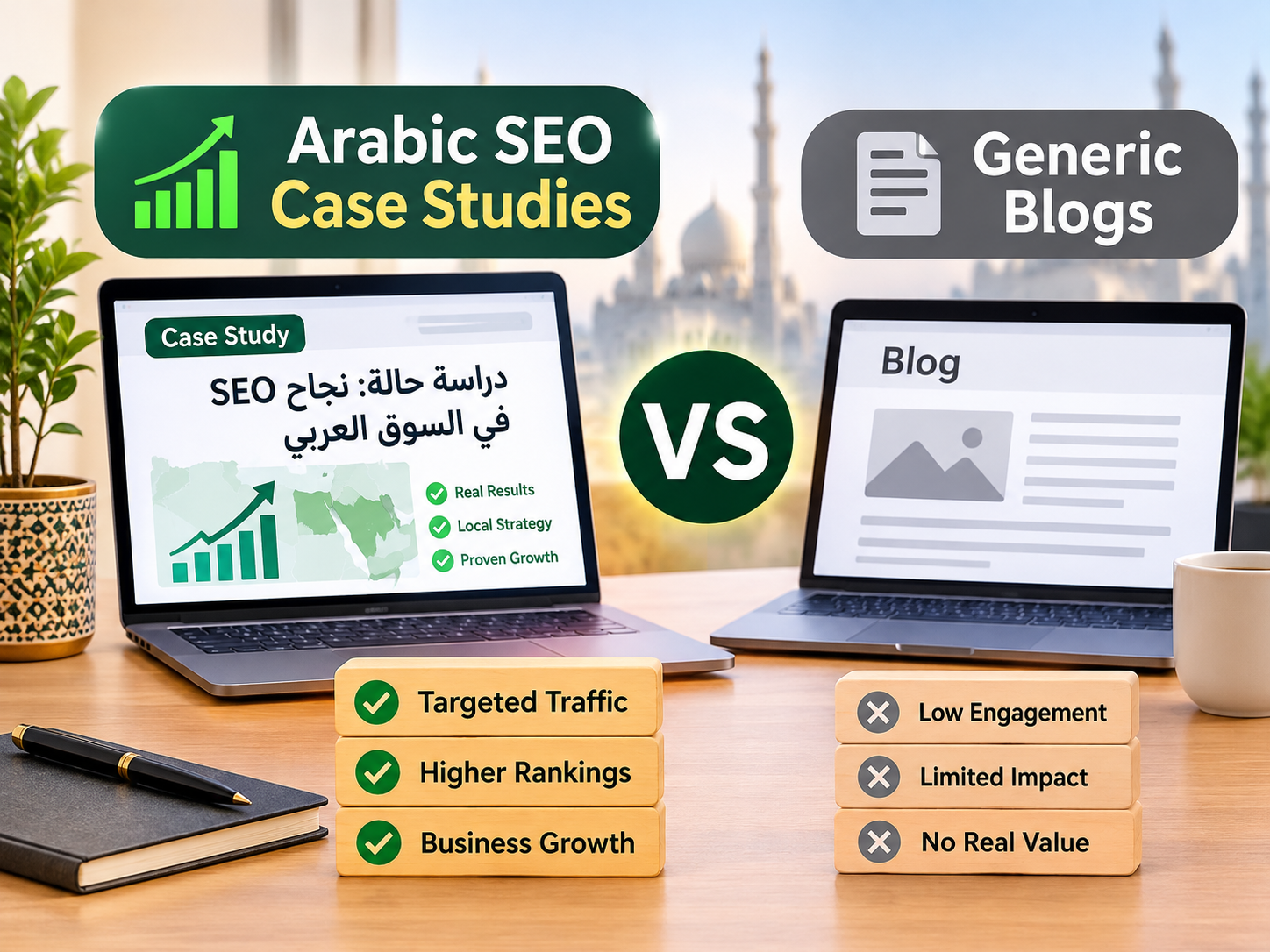
Content Comparison: Arabic Case Studies vs Generic Blogs
|
Factor |
Arabic SEO case studies |
Generic blogs |
|---|---|---|
| Local relevance | Often focused on specific markets | Usually addresses broader topics |
| Original evidence | May include firsthand findings | Often relies on existing sources |
| Methodology | Can document research and processes | Depends on the article |
| Attribution | Can identify original data sources | Varies by publication |
| AI retrieval | Must be tested | Must be tested |
| AI citation advantage | Not guaranteed | Not excluded |
These comparisons describe common content characteristics rather than experimentally verified ranking advantages.
Trust, Accuracy, and GCC Compliance for Arabic Content
Publishing original findings can make a business more credible, but only when the information is accurate and appropriately authorized.
For companies handling customer or financial information, privacy compliance is particularly important.
Saudi Arabia.
Saudi Arabia’s Personal Data Protection Law (PDPL) establishes requirements for processing personal data.
The Saudi Data and Artificial Intelligence Authority (SDAIA) and National Data Management Office (NDMO) provide important data-governance context.
Financial organizations may also need to consider applicable Saudi Central Bank (SAMA) requirements.
Before publishing customer-related case studies, companies should review the lawful basis for processing, necessary permissions, anonymization, and any relevant contractual restrictions.
Ordinary marketing content does not automatically require approval from SAMA. Requirements depend on the organization, activity, and information being disclosed.
Businesses can consult the Saudi personal data protection portal for relevant guidance.
UAE.
The UAE has distinct regulatory and data-protection considerations depending on the business and its jurisdiction.
The Telecommunications and Digital Government Regulatory Authority (TDRA) provides relevant digital-government context.
Meanwhile, Abu Dhabi Global Market (ADGM) and Dubai International Financial Centre (DIFC) maintain separate legal and data-protection frameworks.
A Dubai agency publishing a customer case study should identify which rules apply before including identifiable customer details.
The ADGM Data Protection Guidance provides useful information for businesses operating within that jurisdiction.
Qatar.
In Qatar, the Qatar Central Bank (QCB) oversees relevant financial activities, while the Ministry of Communications and Information Technology (MCIT) supports national digital development.
Businesses publishing financial technology or customer-service findings should verify their disclosures against applicable requirements.
The Qatar Central Bank’s FinTech supervision information is one relevant resource for regulated financial activities.
Across all three markets, reliable case studies should identify their methodology, publication date, evidence sources, and relevant limitations.
Real-World Applications of Arabic SEO Case Studies in GCC Markets
The following examples are illustrative business scenarios, not verified client success stories. They show how organizations could develop useful Arabic content without inventing campaign results.
Saudi Arabia.
Challenge: Help Riyadh customers understand digital payment services.
Approach: Research common Arabic customer questions, document approved findings, and explain relevant terminology.
Evidence needed: Verified customer research, approved records, and clear methodology.
AI search test: Check whether an AI platform retrieves the content and explains the payment terminology accurately.
Limitations: Financial compliance requirements and uncertain AI retrieval.
Measured outcome: Not available.
This type of case study would become more valuable with actual research findings rather than promotional claims alone.
UAE.
Challenge: Explain delivery expectations for Dubai customers.
Approach: Publish localized Arabic-English information describing delivery procedures, service restrictions, and customer questions.
A clear digital marketing content strategy can connect those questions with the business’s published information.
Evidence needed: Approved operational policies and documented service information.
AI search test: Ask whether the system correctly distinguishes Dubai delivery policies from those applicable in Abu Dhabi.
Limitations: Changing operations and possible inconsistencies between language versions.
Measured outcome: Not available.
Qatar.
Challenge: Answer Doha-specific service questions accurately.
Approach: Develop Arabic and English case study pages with consistent facts, appropriate local terminology, and accessible supporting evidence.
Evidence needed: Approved service records and documented processes.
AI search test: Determine whether the system retrieves the correct Qatar-specific source.
Limitations: Platform variability and limited source coverage.
Measured outcome: Not available.
The common lesson is that original content provides something useful to test. It does not establish success without measured results.
How to Test Arabic SEO Case Studies Against Generic Blogs
Instead of guessing which format performs better in AI search, GCC businesses can conduct a structured comparison.
The goal is to evaluate retrieval, citations, accuracy, and local relevance under reasonably consistent conditions.
Select Comparable Content
Choose Arabic case studies and generic blogs covering similar topics and search intentions.
Record each page’s language, publication date, accessibility, and evidence quality.
A comparison between unrelated topics would reveal little about the influence of content format.
Test Matching Arabic and English Prompts
Prepare equivalent Arabic and English questions.
Run them through selected AI search platforms, including Google AI Overviews where available and Chat GPT Search.
Record the exact prompt, test date, language, and relevant platform settings.
Avoid treating a single generated answer as conclusive evidence.
Measure Retrieval, Citations, and Accuracy
|
Metric |
What to measure |
|---|---|
| Source retrieval | Whether the target page was found or referenced |
| Citation accuracy | Whether the citation supports the relevant claim |
| Factual accuracy | Correct claims compared with verified claims |
| Local relevance | Score using a defined 1–5 scale |
| Language consistency | Meaningful differences between Arabic and English answers |
Repeat the same tests over time and retain the original responses.
An AI platform may change its answer even when the underlying content has not changed. Consistent evaluation methods help distinguish normal variability from potentially meaningful improvements.
Practical Arabic SEO and GEO Optimization for GCC Businesses
Generative Engine Optimization (GEO) focuses on making information useful and accessible to systems generating AI-powered answers.
For Arabic SEO case studies, the strongest foundation remains accurate content supported by sound technical SEO.
Improve Arabic-English SEO and Technical Accessibility
Arabic pages should be easy for both readers and search systems to access.
Important considerations include.
Crawlable HTML rather than content hidden behind inaccessible interfaces.
Correct hreflang annotations for corresponding language pages.
Arabic right-to-left layouts that work on mobile devices.
Clear headings, descriptive URLs, and contextual internal links.
Consistent facts across Arabic and English versions.
Appropriate canonical and indexing configurations.
Businesses can address technical barriers through professional web development and WordPress optimization.
Present Original Evidence Clearly
A good Arabic case study should make its main findings understandable without forcing readers to interpret lengthy promotional language.
Begin with a direct explanation of the problem and the documented outcome.
Then provide the research methodology, evidence, limitations, and original references.
Use tables when they genuinely clarify comparisons.
Clearly attribute claims to their actual sources. Do not add fabricated research findings or invented client outcomes to make content appear authoritative.
Structured data should accurately describe information visible on the page. Google does not require special AI-specific schema markup for content to be eligible for its AI search features.
Plan GCC Content Investment and Reporting
The cost of producing Arabic case studies depends on the complexity of the work.
Research requirements, Arabic-English localization, client approval, technical implementation, and ongoing measurement can all influence the budget.
Before commissioning new content, businesses should also review existing commercial pages.
Improving service-page SEO alongside website design may provide a more useful foundation than publishing additional articles without addressing technical problems.
Mak It Solutions‘ broader technology services can support businesses evaluating these needs.
The priority should be consistent: publish reliable information, make it accessible, and test how effectively it answers relevant customer questions.
Final Thoughts
Arabic SEO case studies can provide richer, more locally relevant evidence than generic blogs, especially when they reflect verified business experiences in Saudi Arabia, the UAE, and Qatar.
They can explain customer problems, document research, and answer questions that broad marketing articles may overlook.
But AI search visibility is never guaranteed by content format alone.
Businesses need accurate information, accessible websites, careful localization, and repeatable testing to understand what works.
For GCC organizations, the most useful strategy is not simply to publish more Arabic content. It is to publish better-supported Arabic content that serves real customer needs.
Does your business have valuable research, customer insights, or campaign findings that are not reaching the right audience?
Mak It Solutions helps businesses explore SEO, digital content, website development, and technical improvements that support stronger online visibility. ( Click Here’s )
Explore our SEO and digital services or contact our team to discuss a bilingual content audit.
Develop an Arabic SEO case studies strategy built around original evidence, relevant GCC audiences, and measurable search performance.
FAQs
Q : Does Saudi Arabic SEO need different keywords for Riyadh and Jeddah?
A : Sometimes. Riyadh and Jeddah audiences may use different geographic references, customer expressions, or service-related terminology.
Businesses should research search intent by location, comparing Modern Standard Arabic with the language customers actually use.
Separate location pages are most useful when they address genuinely distinct needs rather than repeating identical information with different city names.
Q : Should Dubai businesses publish separate Arabic and English case study pages?
A : Separate language URLs can be helpful when each version offers meaningful localized content.
Use appropriate hreflang annotations, maintain consistent facts, and ensure Arabic pages support right-to-left reading.
Separate pages do not guarantee better rankings, but they can improve accessibility and the customer experience.
Q : Can Qatar businesses improve AI search visibility using bilingual content?
A : Potentially. Arabic-English content can help Doha businesses address a wider range of customer questions and terminology.
However, publishing more language versions does not guarantee AI citations.
Businesses should verify that both pages communicate accurate information and test whether AI systems retrieve the appropriate sources.
Q : What privacy precautions apply to Saudi fintech case studies?
A : Saudi fintech organizations should consider the PDPL, relevant SAMA requirements, contractual restrictions, and applicable data-processing obligations.
Use appropriately anonymized or aggregated information, secure necessary permissions, and involve legal or compliance reviewers where required.
Avoid publishing confidential transaction details or identifiable customer information without an appropriate lawful basis and authorization.
Q : How often should UAE businesses review Arabic GEO performance?
A : Monthly monitoring with quarterly strategic reviews is a practical starting point, rather than a regulatory requirement.
Review Arabic-English prompts, citations, factual accuracy, organic search performance, and outdated content.
Increase testing after substantial website updates or major changes to AI search platforms.