Blogs
Ecommerce Performance Marketing: Saudi Growth Guide
Content Editor · November 28, 2026 · 14 min read
Direct answer
How much should a Saudi ecommerce store spend on TikTok Ads?
Start with a testing budget based on your target acquisition cost, contribution margins and applicable TikTok campaign minimums.
Getting more clicks is easy. Turning those clicks into profitable sales is where the real challenge begins. Ecommerce performance marketing in the GCC is a data-driven approach to increasing online sales through paid…
Ecommerce Performance Marketing: Saudi Growth Guide
Getting more clicks is easy. Turning those clicks into profitable sales is where the real challenge begins.
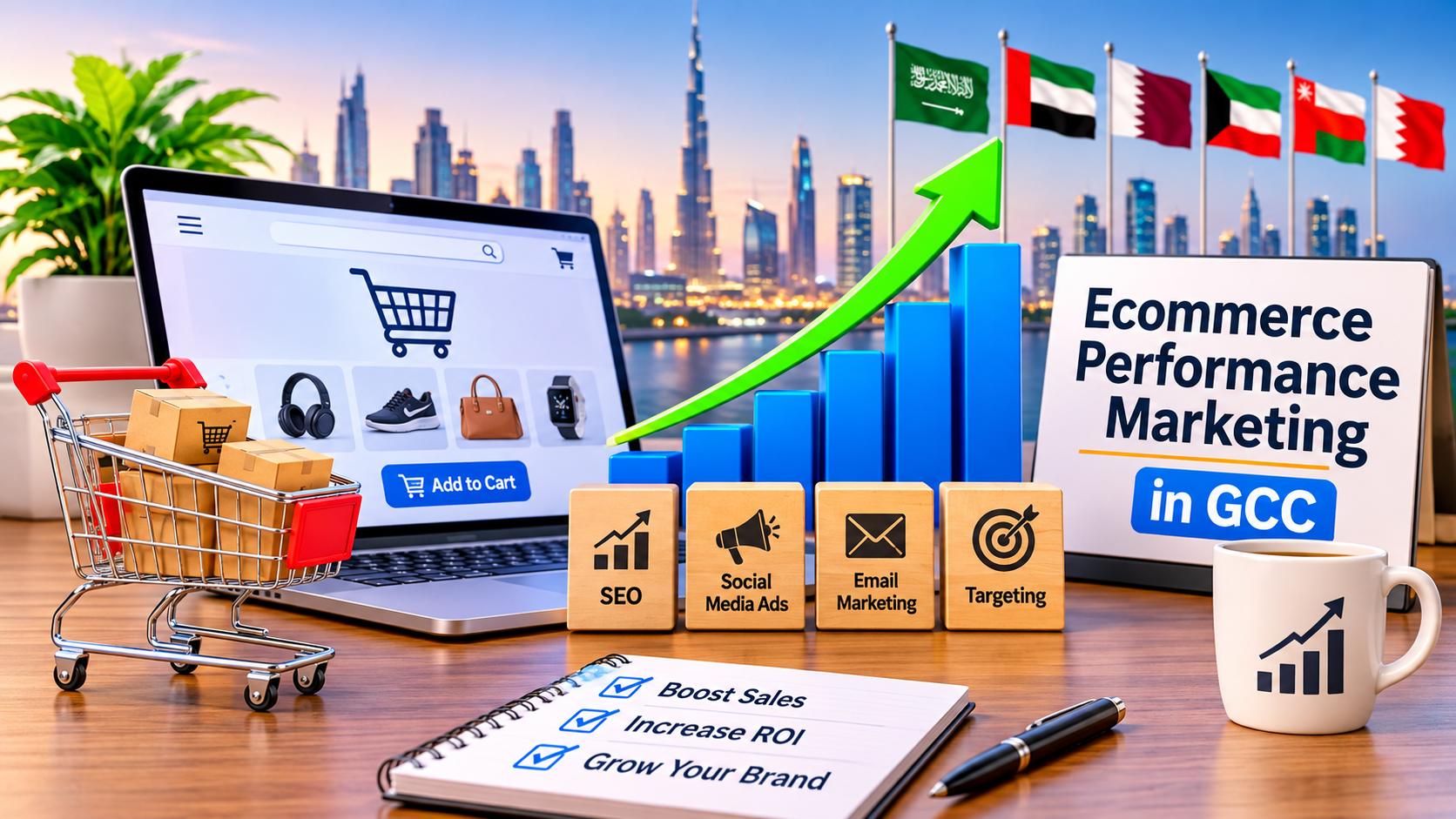
Ecommerce performance marketing in the GCC is a data-driven approach to increasing online sales through paid advertising, accurate conversion tracking, localized campaigns and continuous optimization. It helps businesses across Saudi Arabia, the UAE and Qatar manage customer acquisition costs, reduce advertising waste and build more sustainable revenue streams.
Whether you manage a Salla store in Riyadh, a Shopify brand in Dubai or an online retail business in Doha, your marketing strategy should connect every advertising investment with measurable business outcomes.
From TikTok and Meta Ads to Pixel setup and ROAS optimization, the goal is to attract customers, increase conversions and protect your profit margins as your business grows.
What Is Ecommerce Performance Marketing in GCC?
How Ecommerce Performance Marketing Works
Performance marketing connects advertising investment with measurable customer actions, such as product views, checkout completions and purchases.
Rather than focusing exclusively on impressions or website traffic, businesses evaluate how effectively their marketing budget generates revenue.
The most important performance metrics include:
Customer Acquisition Cost (CAC)
The cost of acquiring a new customer.
Return on Ad Spend (ROAS)
Revenue attributed to advertising relative to advertising expenditure.
Conversion Rate.
The percentage of visitors who complete a desired action.
Average Order Value (AOV)
The average amount customers spend per order.
Customer Lifetime Value (CLV)
The estimated value a customer generates throughout their relationship with a business.
Professional digital marketing services can help ecommerce businesses build campaigns around these metrics rather than superficial engagement numbers.
Performance Marketing vs. Traditional Digital Marketing
|
Factor |
Performance Marketing |
Traditional Marketing |
|---|---|---|
|
Primary objective |
Measurable conversions |
Brand awareness |
|
Measurement |
Revenue and acquisitions |
Reach and exposure |
|
Budget allocation |
Performance-driven |
Campaign-driven |
|
Optimization |
Continuous |
Often periodic |
|
Accountability |
Conversion-focused |
Awareness-focused |
Both approaches have value. However, performance marketing is particularly useful for ecommerce businesses that need to understand the relationship between advertising expenditure and sales.
Why GCC Ecommerce Brands Need a Localized Strategy
The Gulf region is not a single, uniform consumer market. Customer expectations, language preferences, payment options and shopping habits can differ between countries.
A campaign that performs well in Riyadh may need different messaging, creatives or delivery offers to succeed in Dubai or Doha.
Regional ecommerce strategies should consider Arabic and English advertising, local payment preferences, mobile-friendly storefronts, delivery expectations and seasonal shopping events such as Ramadan, Eid and White Friday.
Localization should extend beyond translating advertisements. The entire customer journey needs to feel relevant to the market.
TikTok Ads vs. Meta Ads for GCC Ecommerce
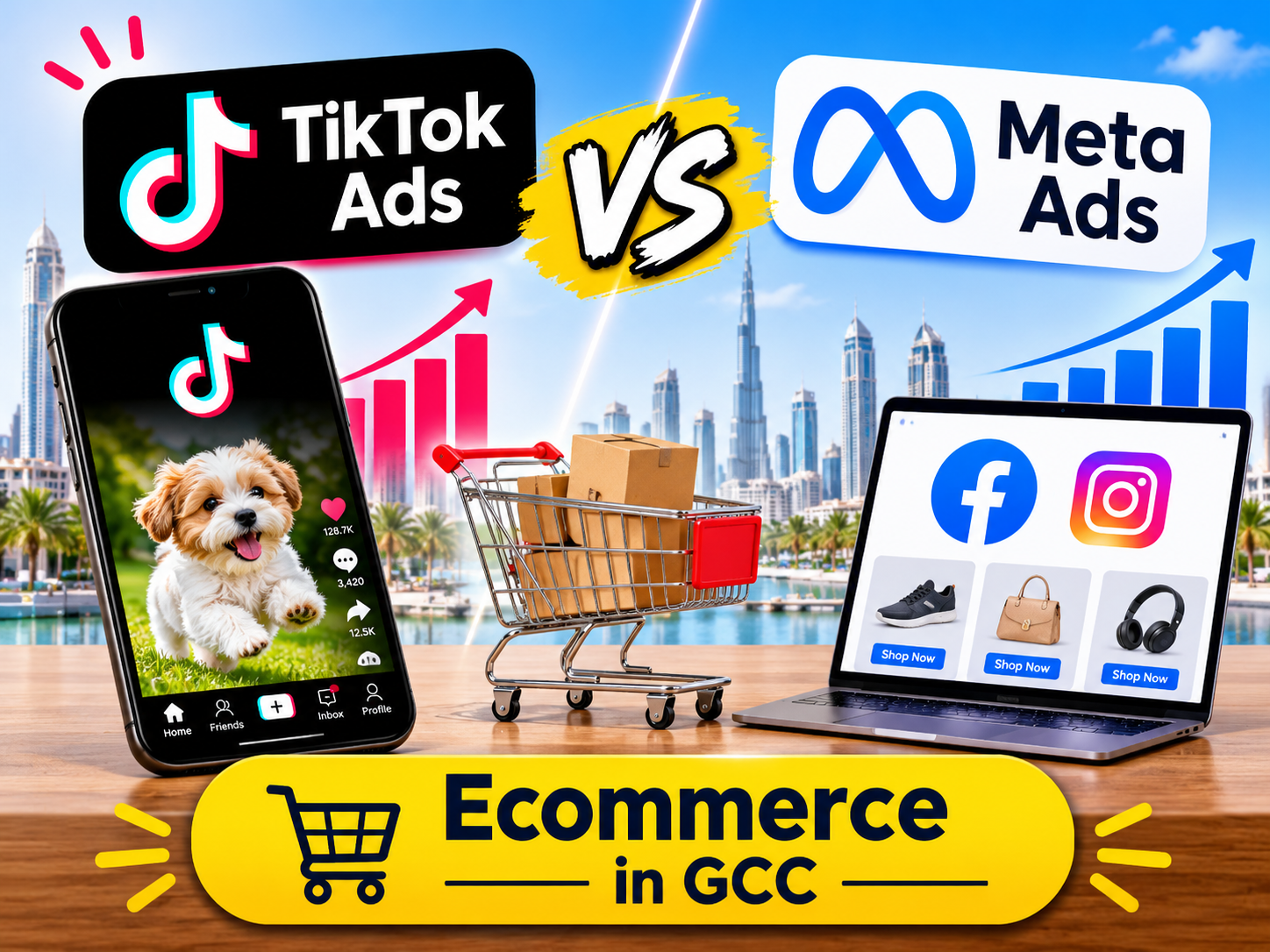
TikTok Ads and Meta Ads can both support ecommerce growth, but they serve different creative and customer acquisition needs.
TikTok is particularly useful for creative-led product discovery, while Meta provides opportunities for catalog advertising, prospecting and retargeting.
TikTok Ads
Creative-led customer acquisitionProduct discovery
Arabic UGC
Short-form videos
Spark Ads
Creator partnerships
Meta Ads
Full-funnel customer acquisitionProduct catalogs
Facebook and Instagram
Prospecting
Retargeting
Advantage+ campaigns
TikTok Ads for Ecommerce in Saudi Arabia
TikTok gives Saudi ecommerce brands an opportunity to introduce products through engaging, native-style content.
For Salla and Zid merchants, Arabic user-generated content (UGC), short product demonstrations and creator partnerships can help communicate product benefits without relying entirely on conventional advertisements.
Beauty, fashion and lifestyle brands can experiment with product tutorials, unboxing videos and practical demonstrations.
The priority is creating content that feels natural within the platform while giving customers a compelling reason to purchase.
Meta Ads for Ecommerce in UAE and Qatar
Meta Ads allows retailers to reach potential customers across Facebook and Instagram throughout different stages of the purchasing journey.
Product catalog campaigns are particularly useful for stores with multiple products, including fashion, beauty and electronics businesses.
Retargeting can help reconnect with visitors who viewed products or abandoned their carts, subject to applicable privacy requirements.
For UAE and Qatar retailers, bilingual creatives and market-specific delivery information can make advertisements more relevant.
Which Advertising Platform Is Best for GCC Online Stores?
There is no universal winner between TikTok Ads and Meta Ads.
The right platform depends on your product category, customer behavior, creative capabilities, acquisition costs and contribution margins.
Test both platforms against consistent profitability targets. A campaign generating inexpensive clicks is not necessarily more valuable than one attracting customers who complete purchases.
Ecommerce Pixel Setup and Conversion Tracking
Without reliable conversion tracking, it becomes difficult to determine which campaigns generate meaningful sales.
Advertising Pixels and server-side integrations help ecommerce businesses measure customer interactions and provide advertising platforms with conversion signals.
Ecommerce conversion tracking architecture
Simplified tracking architecture with browser-side and server-side event processing.Meta Pixel and Conversions API Setup
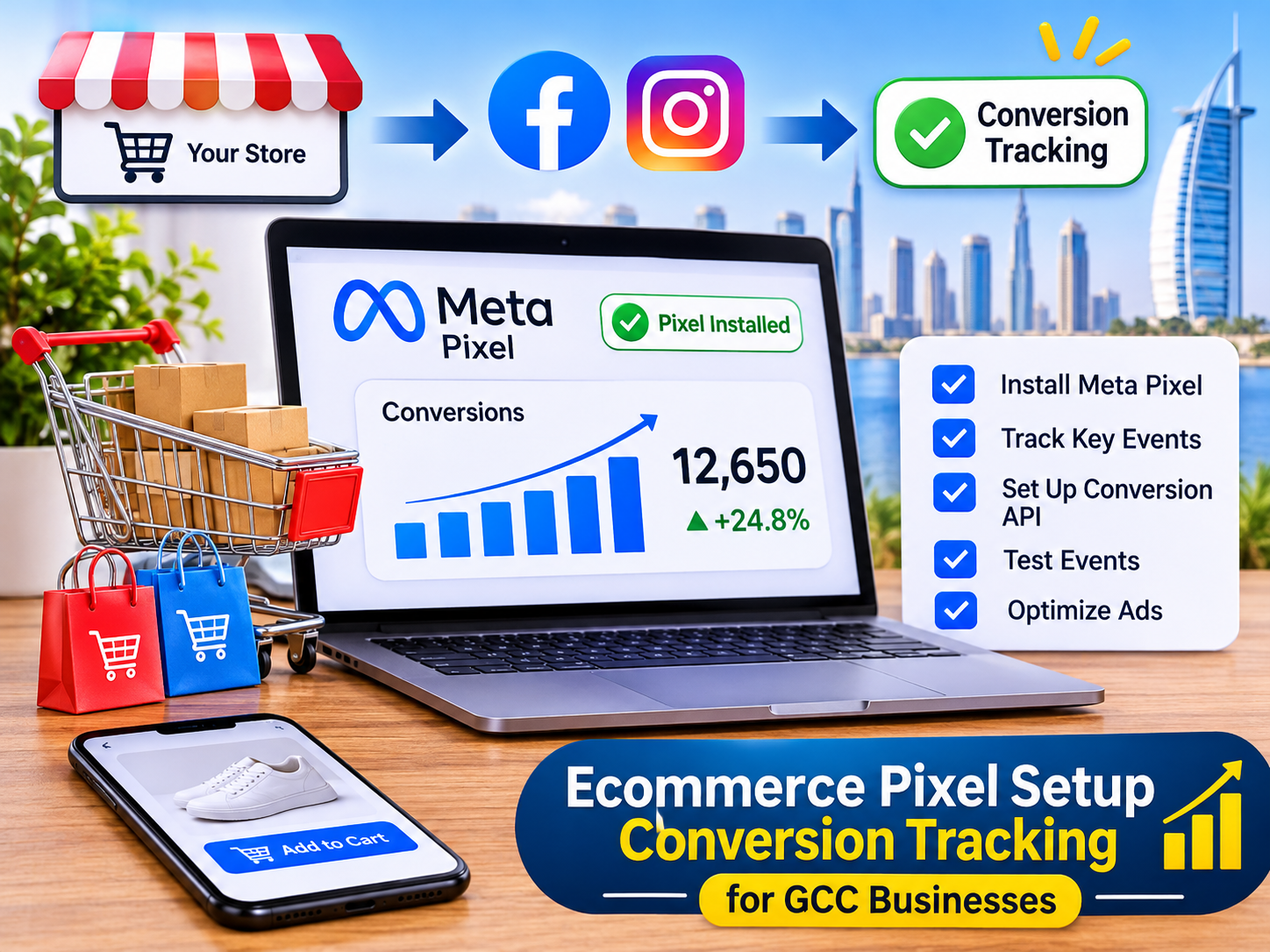
Meta Pixel records supported customer interactions through the browser, while the Meta Conversions API supports server-side event transmission.
When configured correctly, these integrations can improve the reliability of conversion reporting.
Shopify, Salla and Zid merchants should verify their available integration options, purchase values, currencies and event deduplication settings before increasing advertising budgets.
Incorrect configurations can result in duplicated purchases and misleading ROAS figures.
TikTok Pixel and Events API Integration
TikTok Pixel and Events API help advertisers measure important ecommerce interactions, including product views, cart additions, checkout initiation and completed purchases.
Combining browser-side and supported server-side tracking can improve measurement reliability when the implementation is properly configured.
Businesses with complex storefronts or customized checkout systems may benefit from professional web development services to support these integrations.
Refer to TikTok's event deduplication documentation when configuring overlapping conversion events.
How to Set Up Accurate Ecommerce Conversion Tracking
Audit your existing tracking implementation.
Configure Meta Pixel and TikTok Pixel.
Implement supported server-side integrations.
Map purchase events, transaction values and currencies.
Configure event deduplication.
Validate privacy settings and test conversion events.
Compare advertising reports with actual store orders.
Google Analytics 4 (GA4), Google Tag Manager and advertising platform Events Managers can help identify reporting discrepancies.
Remember that attribution models differ between platforms. Your store's confirmed orders and financial records should remain central to profitability reporting.
GCC Ecommerce Advertising Compliance and Data Privacy
Accurate tracking matters, but responsible customer data handling is equally important.
Ecommerce businesses operating across Gulf markets should assess the privacy obligations that apply to their advertising technologies, customer information and third-party integrations.
Saudi PDPL and Ecommerce Advertising Requirements
Saudi Arabia's Personal Data Protection Law (PDPL) establishes requirements for processing personal information.
Ecommerce merchants should consider applicable marketing consent requirements, privacy disclosures, sensitive data restrictions and cross-border data transfers when implementing advertising technologies.
The official Saudi Data Governance Platform provides regulatory resources under the Saudi Data and Artificial Intelligence Authority (SDAIA).
UAE and Qatar Data Protection Considerations
UAE ecommerce businesses should assess federal personal data protection requirements alongside relevant DIFC or ADGM regulations where applicable.
Official guidance is available through the UAE Government's data protection resources.
In Qatar, retailers should consider the Personal Data Privacy Protection Law (PDPPL) and guidance from the National Cyber Security Agency (NCSA).
Requirements may differ depending on business activities, jurisdiction and the type of information being processed.
Privacy-Conscious Pixel and Server-Side Tracking
Responsible conversion tracking should incorporate appropriate consent management, data minimization, secure integrations and transparent privacy disclosures.
Server-side tracking is not a way to bypass customer privacy obligations.
Businesses involved in regulated financial or payment activities may also need to assess relevant requirements from authorities such as the Saudi Central Bank (SAMA) or Qatar Central Bank (QCB).
This section provides general informational guidance and does not constitute legal advice. Businesses should confirm applicable requirements with qualified professionals and current official regulatory resources.
ROAS Optimization for Profitable GCC Ecommerce Growth
High revenue does not automatically mean high profitability.
A campaign may generate impressive sales figures while leaving limited profit after advertising expenses, shipping, payment processing, discounts and returns.
Effective ROAS optimization starts with understanding your actual business margins.
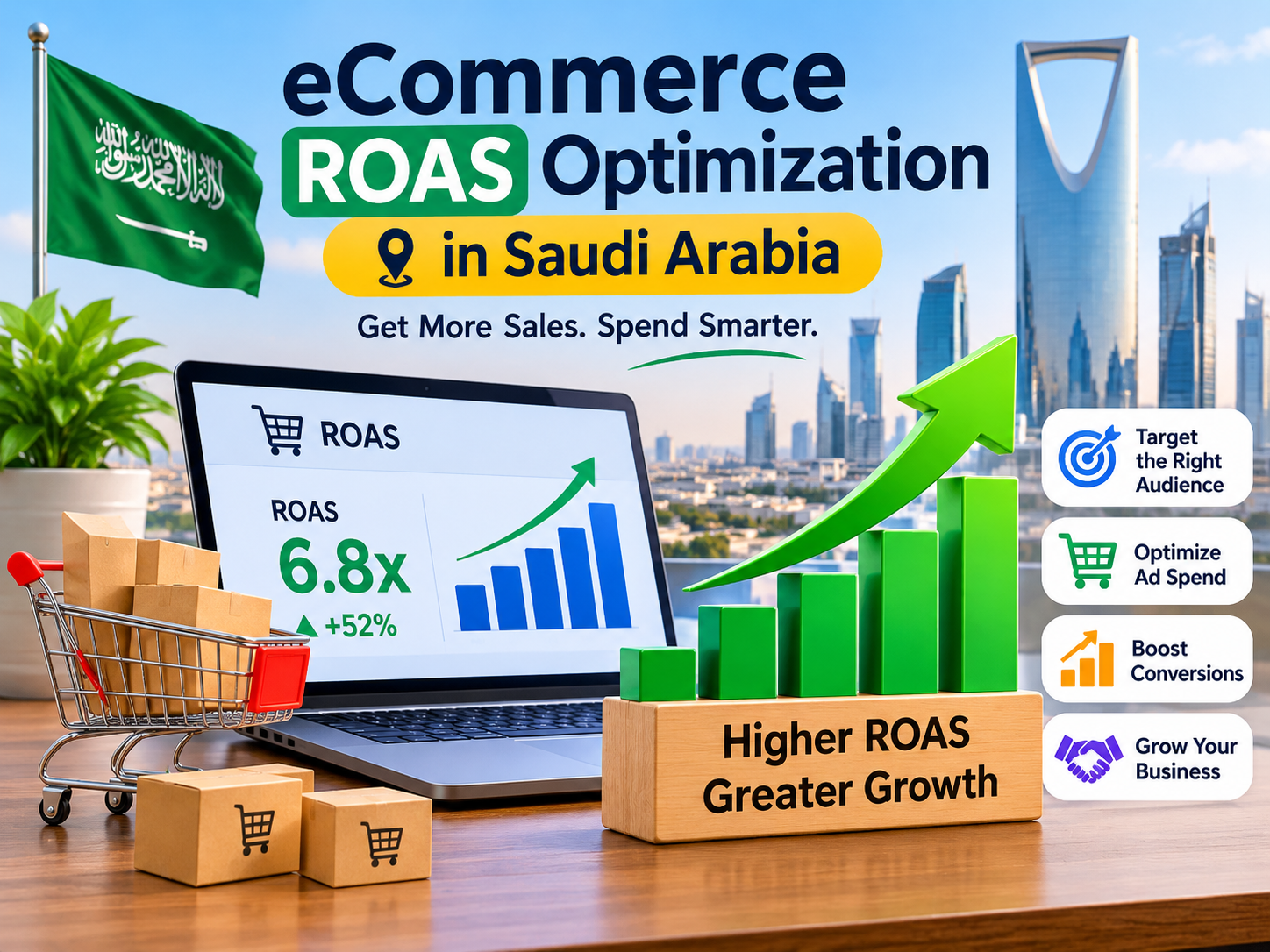
What Is a Good ROAS for Ecommerce in Saudi Arabia?
A good ROAS is one that allows your ecommerce business to cover its variable costs and advertising expenditure while contributing toward operating expenses and profit.
For example, a Saudi ecommerce business with a 40% pre-advertising contribution margin requires a 2.5x break-even ROAS, before accounting for fixed operating expenses.
The appropriate target will vary depending on the business model and cost structure.
How to Calculate Break-Even ROAS for GCC Stores
The standard ROAS formula is.
The break-even ROAS formula is.
Contribution margin should be expressed as a decimal when using this formula.
For example, generating SAR 10,000 in attributed revenue from SAR 2,500 in advertising expenditure results in a 4x ROAS.
GCC Ecommerce ROAS Calculator
Use this calculator to estimate advertising efficiency and contribution after advertising costs.
Advertising profitability calculator
40%
4.00x
2.50x
1,500 SAR
4.00x
2.50x
Strategies to Reduce CAC and Improve Advertising Profitability
Reducing customer acquisition costs is not simply a matter of lowering advertising bids.
Often, the biggest opportunities are found elsewhere in the customer journey.
Test different creative concepts and product messages.
Improve product pages and landing page experiences.
Reduce unnecessary checkout steps.
Display transparent shipping costs and delivery estimates.
Improve mobile website performance.
Develop customer retention and repeat purchase strategies.
Measure completed and delivered orders rather than relying exclusively on platform-reported purchases.
Well-designed ecommerce solutions can support these improvements by addressing technical barriers that prevent visitors from becoming paying customers.
How to Scale Ecommerce Sales Across GCC Countries
Scaling an ecommerce business requires more than increasing advertising budgets.
A sustainable approach combines reliable tracking, proven creatives, operational readiness and a clear understanding of customer acquisition economics.
Scaling Salla and Zid Stores in Saudi Arabia
Saudi ecommerce merchants can strengthen their growth strategies by combining Arabic advertising creatives with locally relevant shopping experiences.
Consider integrating mada payments through appropriate providers, improving mobile checkout experiences and managing cash-on-delivery (COD) orders carefully.
Seasonal campaigns around Ramadan, Eid and White Friday should be supported by inventory planning, realistic delivery commitments and profitability targets.
Attracting more customers is valuable only when the business can fulfill their orders efficiently.
Growing Shopify Ecommerce Brands in UAE and Qatar
Shopify merchants targeting the UAE and Qatar should prioritize bilingual campaigns, accurate product catalogs, local currencies and market-specific delivery options.
Product pages should clearly communicate pricing, delivery timelines and return policies.
Businesses with more complex catalog requirements, multiple storefronts or advanced integrations may also consider Adobe Commerce development solutions.
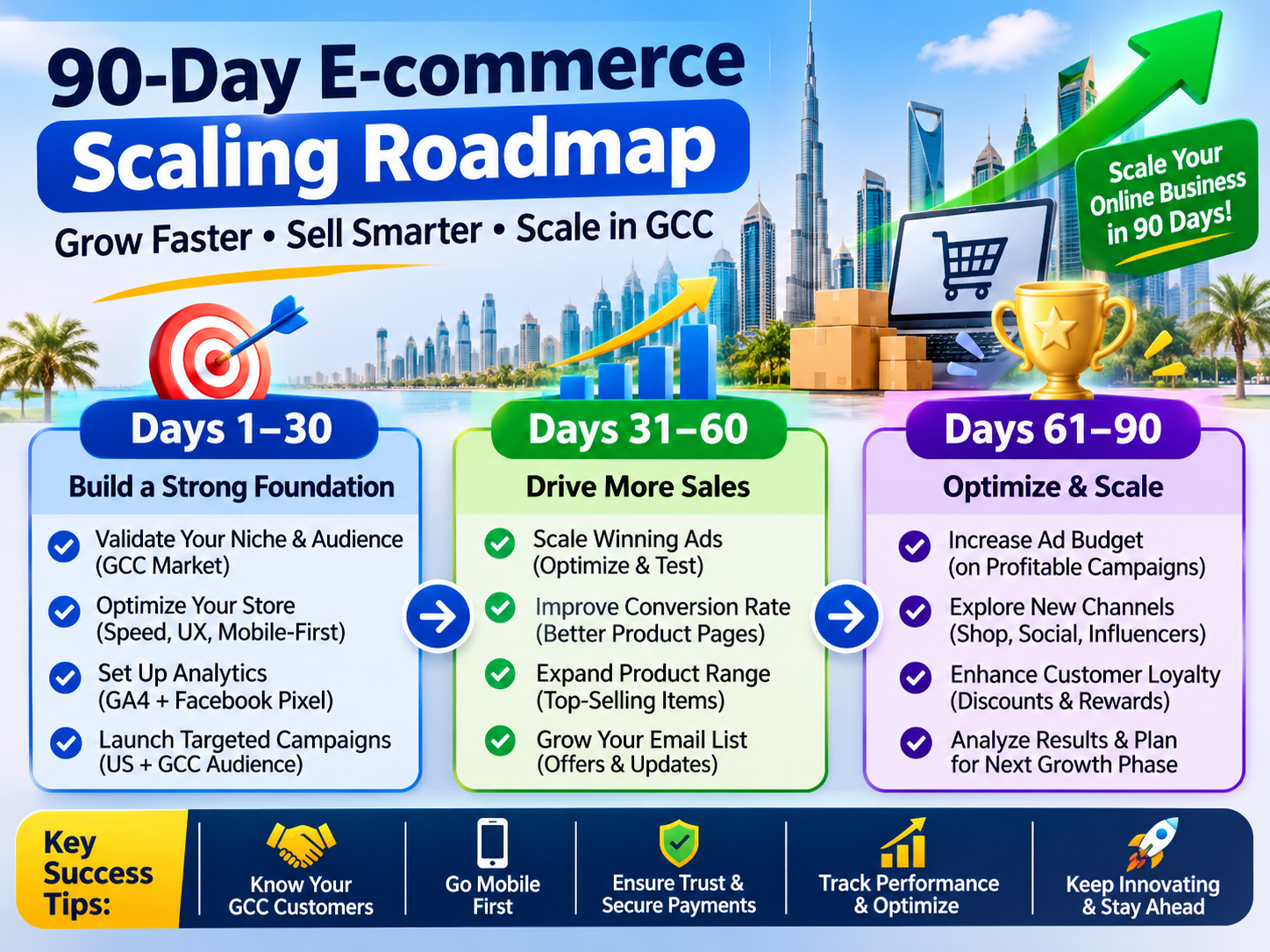
A 90-Day Ecommerce Scaling Roadmap
Instead of increasing advertising expenditure immediately, establish a reliable foundation and scale campaigns once their performance has been validated.
90-day ecommerce growth strategy
A practical, illustrative roadmap for GCC online retailers.Foundation
Audit tracking, configure Pixels, establish baseline campaigns and define profitability targets
Optimization
Test creatives, refine targeting, improve conversion rates and address acquisition inefficiencies.
Controlled scaling
Expand validated campaigns, explore regional opportunities and improve customer retention.
The roadmap should remain flexible. If tracking issues or profitability challenges emerge, resolve them before moving into aggressive scaling.
Ecommerce Performance Marketing Across GCC Markets
|
Market |
Business example |
Strategic focus |
|---|---|---|
|
🇸🇦 Saudi Arabia |
Salla fashion store |
Arabic UGC and COD profitability |
|
🇦🇪 UAE |
Shopify beauty brand |
Meta catalog ads and CRO |
|
🇶🇦 Qatar |
Electronics retailer |
Localized checkout |
|
🇰🇼 Kuwait |
Lifestyle DTC brand |
KNET payment integration |
|
🇧🇭 Bahrain |
Retail small business |
Mobile conversions |
|
🇴🇲 Oman |
Emerging online store |
Controlled customer acquisition |
These examples represent hypothetical business scenarios and strategic opportunities, not actual client results or guaranteed outcomes.
Choosing an Ecommerce Performance Marketing Agency in GCC
The right ecommerce marketing agency should understand both advertising platforms and the operational realities of selling products online.
Attractive creatives and high traffic figures are useful, but they should ultimately support measurable business objectives.
What Should GCC Ecommerce Performance Marketing Services Include?
A comprehensive performance marketing service should bring together paid media management, conversion tracking, creative testing, conversion rate optimization and transparent reporting.
It should also consider how your ecommerce platform, payment systems and checkout experience influence advertising results.
Businesses looking for integrated technical and marketing support can explore Mak It Solutions' technology and marketing services.
Ecommerce Advertising Costs and Management Fees in GCC
When evaluating agency proposals, separate advertising expenditure from management fees, creative production, tracking implementation and additional technical services.
The cheapest proposal is not necessarily the most cost-effective option.
Evaluate the total investment in SAR, AED or QAR against your product margins, acquisition targets and expected business outcomes.
Ask how the agency measures profitability and whether its reports account for returns, cancellations and other relevant ecommerce costs.
When Should You Hire an Ecommerce Performance Marketing Specialist?
Professional support may be worthwhile when customer acquisition costs continue to increase, conversion tracking becomes unreliable or advertising campaigns struggle to scale profitably.
An experienced team should help identify whether the underlying problem is advertising, tracking, website performance, product positioning or another part of the customer journey.
Performance marketing agency checklist
Use these criteria when comparing agencies rather than relying exclusively on promised ROAS figures or projected sales.
Final Thoughts
Successful ecommerce growth is not about spending more on advertising. It is about making better decisions with every advertising investment. Mak It Sol
An effective ecommerce performance marketing strategy combines the right advertising platforms, reliable conversion tracking, localized customer experiences and profitability-focused optimization.
At Mak It Solutions, we bring together technology and digital marketing solutions to support businesses looking to improve their online sales performance.
Whether you operate a Saudi Salla store, a Dubai Shopify brand or an online retail business in Qatar, start by understanding where your current marketing strategy can improve.
Build a measurable growth strategy around your business margins, customer needs and regional expansion goals.
Request an Ecommerce Performance Marketing Audit
FAQs
For example, a Saudi retailer targeting a SAR 50 acquisition cost could allocate SAR 1,500 toward testing. Achieving that target would generate approximately 30 acquisitions, although actual campaign results may differ considerably.
Customer information must also be handled in accordance with applicable Saudi data protection requirements.
Retailers should also assess applicable UAE privacy requirements before transmitting customer information to advertising platforms.
The National Cyber Security Agency provides relevant privacy guidance, including resources concerning electronic direct marketing.
Saudi merchants can offer mada through appropriate payment providers, while Kuwait retailers can consider KNET. Measuring delivered orders alongside placed orders provides a more meaningful understanding of customer acquisition costs and advertising profitability.
Frequently asked questions
Quick answers related to this article.
Comments
Join the discussion. Comments are moderated.
No comments yet. Be the first to share a thought.
Building something related?
Tell us about your product goals — we’ll respond with a clear next step.
Discuss your project