
Carbon Neutral Cloud Computing Strategies for CIOs
Carbon Neutral Cloud Computing Strategies for CIOs

Carbon Neutral Cloud Computing Strategies for CIOs
Carbon neutral cloud computing means running workloads on cloud infrastructure where emissions are reduced as far as possible through efficiency and renewable energy, then balancing the remaining footprint with high-quality offsets or removals across Scopes 1–3. For US, UK, German and wider EU enterprises, that usually means shifting workloads into lower-carbon AWS, Microsoft Azure and Google Cloud regions, using the providers’ carbon tools, and running GreenOps so cost, performance and emissions are optimised together.
Introduction
Cloud and AI demand are exploding just as climate laws, ESG investors and regulators tighten the screws in the US, UK, Germany and across the EU. Every new LLM, analytics pipeline or real-time customer experience you spin up adds to a data-centre footprint that already uses roughly 1.5–3% of global electricity and is on track to roughly double by 2030.
Carbon neutral cloud computing offers a way out of this trap: you keep scaling digital services while staying aligned with net-zero commitments, CSRD and SEC climate rules. This roadmap walks through how to move towards carbon neutral cloud computing on AWS, Microsoft Azure and Google Cloud, with a clear focus on lower-carbon regions in Northern Virginia, Oregon, London, Frankfurt, Dublin, Stockholm and beyond.
By the end, you’ll know how to.
Understand the big cloud providers’ decarbonisation roadmaps
Choose lower-carbon regions without breaking latency or data residency
Use cloud carbon tools inside ESG and CSRD reporting
Run GreenOps to migrate and continuously optimise high-emission workloads
What Is Carbon Neutral Cloud Computing?
Carbon neutral cloud computing means running workloads in cloud infrastructure where remaining emissions are minimised through efficiency and renewables and then balanced with high-quality offsets or removals across Scopes 1–3. In other words, you reduce as much as possible, then neutralise what’s left with credible removals rather than cheap “paper” offsets.
Clear Definition vs “Green” and “Sustainable” Cloud
Carbon neutral cloud computing focuses specifically on greenhouse gas emissions: the goal is net-zero CO₂e for the workloads you run.
Green cloud computing is broader, covering energy mix, water use, circular hardware and e-waste.
Sustainable cloud computing goes further still, touching social and governance topics such as labour practices, governance and community impact.
In a cloud context, Scopes 1–3 usually look like this under the GHG Protocol: ([Ecobio Manager][3])
Scope 1
Direct emissions from a provider’s own facilities and vehicles (e.g., backup generators at data centres).
Scope 2
Indirect emissions from purchased electricity, steam, heating and cooling (the grid power your workloads ultimately draw).
Scope 3
All other value-chain emissions, including manufacturing and transporting servers, customer use of cloud services, and end-of-life hardware.
For most cloud customers, Scope 3 dominates: embodied emissions in servers, networking and storage, plus the energy used over the service lifetime. That’s why choosing providers, regions and architectures matters more than the office lights in London or Berlin.
Why Cloud Can Be Greener Than On-Premise
Cloud is not automatically “green”, but hyperscale data centres are typically far more efficient than traditional enterprise facilities. Average PUE (power usage effectiveness) in generic data centres is still around 1.5–1.6, while leading hyperscale sites run close to 1.1–1.2, meaning far less energy wasted on cooling and power conversion.
On top of efficiency, providers such as AWS, Microsoft and Google Cloud are now some of the world’s largest corporate buyers of renewable energy, with Amazon matching 100% of its electricity use with renewables in 2023 and remaining the largest corporate purchaser globally. ([Amazon Web Services, Inc.][5]) Many are also pursuing water-positive and zero-waste goals at data-centre level, further reducing the environmental impact per unit of compute.
For CIOs in New York, London or Munich, this is the core argument: moving from small, under-utilised on-prem racks to modern cloud regions can cut emissions and cost per transaction provided you pick the right regions and architectures.
Net-Zero, Carbon-Neutral, Carbon-Negative.
Quick definitions for busy ESG and IT leaders.
Net-zero
Deep emissions cuts across Scopes 1–3 aligned with 1.5°C pathways, with remaining emissions balanced by permanent removals.
Carbon-neutral
Emissions are balanced by offsets/removals, but reductions may be less aggressive or not 1.5°C-aligned.
Carbon-negative
The organisation removes more CO₂e than it emits overall.
Most enterprises today are aiming for a “low-carbon cloud” that significantly reduces emissions intensity, then uses high-quality removals to neutralise the rest. True carbon negativity at an IT-estate level is rare in the near term; the practical goal is a credible, auditable path to net-zero that regulators, auditors and investors will accept.
How Tech Giants Are Building Carbon Neutral Clouds
AWS, Microsoft Azure and Google Cloud are racing to decarbonise their infrastructure with 100% renewable power, advanced cooling and carbon tools but their targets, metrics and transparency differ by provider and region. For regulated US, UK and EU workloads, these differences matter when you choose landing zones and long-term partners.
AWS, Microsoft Azure, Google Cloud Roadmaps to 2030
At a high level.
AWS has pledged net-zero carbon by 2040 under The Climate Pledge and to power operations with 100% renewable energy, a goal it reports meeting globally from 2023 onwards. It also targets water-positive operations by 203
Microsoft committed in 2020 to be carbon-negative, water-positive and zero-waste by 2030, and to remove its historic emissions by 2050.
Google Cloud has been carbon-neutral (via offsets) for years and is now pursuing 24/7 carbon-free energy (CFE) on every grid it operates in by 2030, alongside net-zero across its operations and value chain.
Beyond the big three, players like Meta, IBM, Oracle and European clouds have signed the Climate Neutral Data Centre Pact, committing to climate-neutral data centres by 2030 through efficiency targets, 100% carbon-free energy, water conservation and circular hardware.
Carbon Neutral Data Centers in the US, UK, Germany & EU
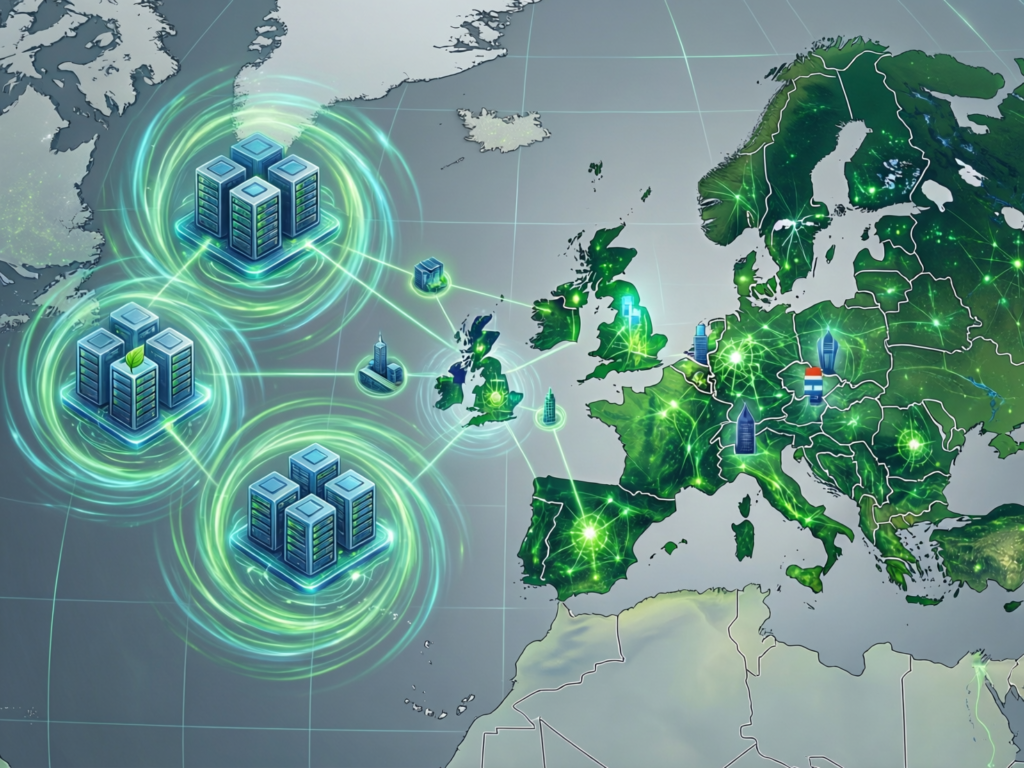
Cloud regions are not created equal from a carbon perspective. Some examples your architects and GreenOps teams should keep in mind:
US
Regions like Oregon and Iowa benefit from abundant wind, hydro and solar; parts of Northern Virginia increasingly tap renewables but also face grid-constraint debates; Texas mixes strong wind and solar with grid-stability challenges.
UK
The London metro area and emerging hubs in Wales/Cardiff combine renewable PPAs with advanced cooling and, in some cases, waste-heat reuse into district heating.
Germany/EU
Frankfurt, Amsterdam, Dublin, Stockholm and Helsinki are among the leading “green” data-centre hubs, many aligned with the Climate Neutral Data Centre Pact and national energy-efficiency rules. Nordic regions in particular offer low-carbon grids and free-air cooling.
For a bank in London or a manufacturer in Berlin, “greenest” doesn’t always mean “closest”. The art is balancing carbon intensity, latency and data residency instead of defaulting to your nearest region.
How “Green” Are AI & GPU-Heavy Cloud Workloads Really?
Generative AI and GPU clusters are driving some of the fastest growth in data-centre electricity and water use worldwide. Recent IEA analysis projects that data-centre electricity consumption could more than double by 2030 to around 945 TWh, with AI-optimised data centres more than quadrupling their electricity demand over the same period.
At the same time, Google reports that its overall emissions have risen by around 50% since 2019, largely due to AI and data-centre expansion illustrating how hard it is to “out-offset” AI-driven growth even with huge renewable investments
To keep AI workloads low-carbon, providers and enterprises are experimenting with:
New cooling
Immersion, rear-door heat exchangers and seawater-assisted cooling.
Geothermal and nuclear partnerships
For round-the-clock low-carbon power near major AI regions. ([Reuters][12])
Novel concepts
From floating data centres to speculative space-based or orbital facilities, though many remain experimental.
For your architects, the takeaway is simple: AI workloads must be treated as first-class climate risks, not just “bigger VMs”.
Green Cloud Architectures & Carbon Neutral Data Centers
Architecting for carbon neutral cloud computing means combining energy-efficient services, carbon-aware workload placement and renewable-powered regions with data-centre-level innovations in cooling and hardware. This is where GreenOps and FinOps meet everyday engineering choices.
Green Cloud Architecture Principles
A few design patterns move the needle quickly.
Right-sizing and autoscaling
Over-provisioned VMs are wasted energy. Use autoscaling, vertical rightsizing and spot/low-priority instances where possible.
Serverless and managed services
Functions, managed databases and event buses often run at higher utilisation than DIY clusters.
Data lifecycle management
Archive cold data to lower-energy storage classes; implement retention and deletion policies instead of hoarding everything.
Storage tiering and compression –
Reduce both capacity and I/O with sensible tiering for logs, backups and analytics.
GreenOps extends FinOps by adding carbon and water as first-class optimisation dimensions alongside cost and performance. Instead of “cheapest region wins”, GreenOps teams look for “green sweet spots” where price, latency, compliance and carbon intensity align for example, choosing North Europe or Scandinavia instead of more carbon-intensive EU regions where data residency allows.
Renewable-Powered & Energy-Efficient Data Centers
At data-centre level, three metrics matter most.
PUE (Power Usage Effectiveness)
Total facility energy divided by IT energy; lower is better. Leading hyperscale sites report ~1.1.
WUE (Water Usage Effectiveness)
Litres of water used for cooling per kWh of IT load.
Carbon-free energy share
The percentage of local power that is renewable or nuclear.
Techniques like free-air cooling, liquid and immersion cooling and waste-heat reuse into district-heating networks are increasingly common in Nordic and Northern European hubs. Under the Climate Neutral Data Centre Pact, new EU data centres must meet strict PUE and carbon-free energy thresholds by 2025–2030, with independent audits.
Choosing Low-Carbon Regions in AWS, Azure & GCP
Not all AWS, Azure or GCP regions publish identical carbon metrics, but most provide regional carbon or CFE scores, especially Google Cloud.
A few practical patterns.
EU workloads
Where GDPR/DSGVO allows, consider Stockholm, Helsinki or Dublin for low-carbon grids; otherwise, target efficient hubs like Frankfurt or Paris with strong renewable PPAs.
US workloads
For latency-tolerant workloads, look at Oregon or Iowa; for heavily regulated data (e.g., HIPAA), pick greener regions within the US rather than shifting offshore.
UK workloads
Use London and any UK sovereign/cloud regions that publish strong renewable and efficiency credentials, possibly backed by PPAs in Wales and Scotland.
If your teams already rely on Mak It Solutions’ guides on cloud hosting, cost optimisation and AWS vs Azure vs Google Cloud, you can extend those TCO models with region-level carbon metrics and GreenOps KPIs.
Measuring Cloud Emissions, ESG Reporting & GreenOps
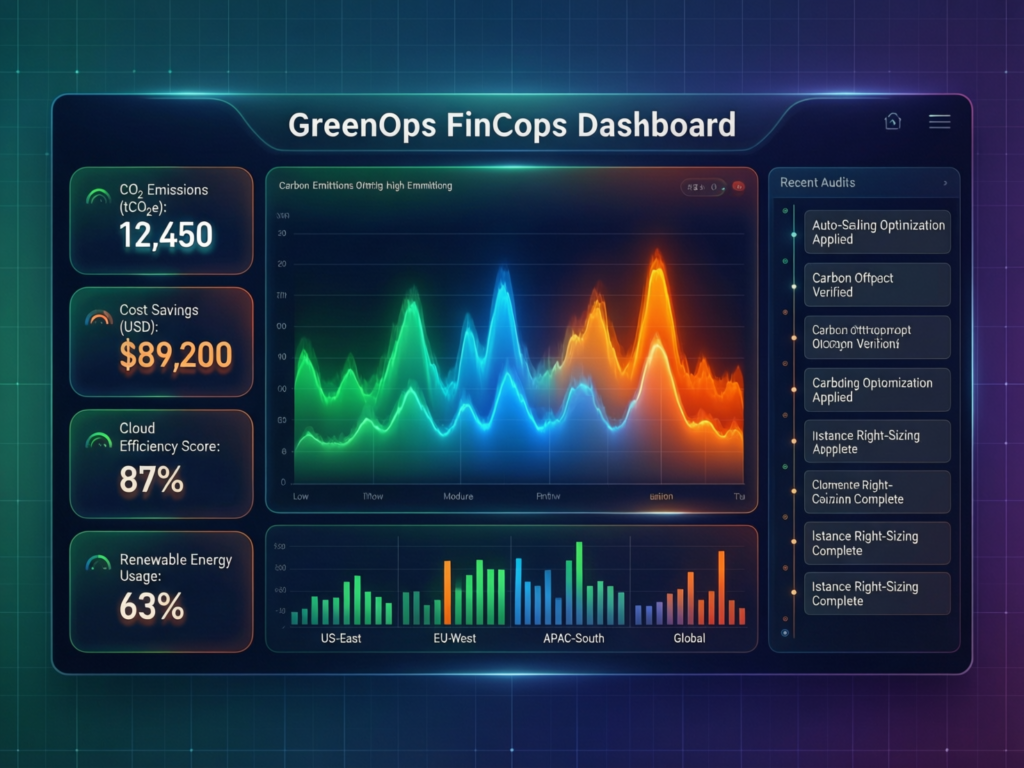
To make carbon neutral cloud computing real rather than a slide-deck concept, enterprises need to measure emissions at workload level, plug that data into ESG reporting and run GreenOps processes alongside FinOps. Without the numbers, “green cloud” is just marketing. ([Gamma][16])
Cloud Carbon Calculators & Dashboards
All three major hyperscalers now provide built-in carbon dashboards: ([Amazon Web Services, Inc.][5])
AWS Customer Carbon Footprint Tool
Shows emissions associated with your AWS usage, broken down by region and scope, with exports aligned to GHG Protocol categories.
Azure Emissions Impact Dashboard
Built on Power BI, combining Azure usage data with emissions factors and offering exports suitable for CDP and CSRD disclosures.
Google Cloud Carbon Footprint
Provides per-project, per-region emissions data, plus CFE scores to help you choose greener regions.
Look for features such as scope coverage (1–3), granularity (service/region/workload) and export formats compatible with GHG Protocol, CDP, SEC climate filings and EU CSRD templates.
Embedding Cloud Data into ESG & CSRD/SEC Reporting
Regulators increasingly expect cloud emissions to be visible in your ESG reports, not buried in “other IT”. Under the EU CSRD, large companies must report Scope 1, 2 and 3 emissions with detailed value-chain transparency, and Scope 3 is explicitly mandatory.
For a US-listed company, cloud data feeds into SEC climate-disclosure rules, TCFD/ISSB-aligned risk sections and scenario analysis. For UK organisations, cloud choices interact with UK-GDPR, FCA expectations and sectoral guidance (e.g., NHS digital and sustainability policies).
Practically, your ESG and GreenOps teams should:
Map each cloud subscription/project to a business unit and ESG segment
Feed carbon dashboard exports into a central ESG data platform
Align categories with GHG Protocol scopes and CSRD reporting tags
Use the data in materiality assessments, not just back-of-report annexes
GreenOps in Practice for Multi-Cloud Environments
GreenOps is the operational discipline of optimising cloud for spend, performance, carbon and water together especially in multi-cloud setups.
A simple operating model.
Roles
CIO and head of sustainability co-sponsor; a GreenOps lead works with FinOps, SREs and enterprise architects; regional leads in the US, UK and EU own local trade-offs.
KPIs
Emissions per unit of revenue or transaction, percentage of workloads in “preferred” low-carbon regions, share of AI workloads in energy-efficient architectures.
Cadence
Quarterly optimisation cycles using dashboards, architectural reviews and migration waves.
If this sounds heavy, a managed GreenOps/ESG advisory service from a partner like Mak It Solutions can help you baseline, design dashboards and run optimisation sprints across AWS, Azure and Google Cloud instead of building everything in-house. ([Mak it Solutions][14])
Migrating Workloads to Carbon Neutral Clouds (GreenOps in Action)
Migrating to carbon neutral cloud computing is less about a “big bang” move and more about systematically re-hosting, re-platforming and re-architecting high-emission workloads into lower-carbon regions and services. The sequence matters more than perfection on day one.
Prioritising Workloads by Carbon, Cost and Risk
Start with a workload inventory that scores each system on.
Carbon intensity
Region, architecture (e.g., GPU clusters vs serverless) and utilisation.
Cost
Cloud spend or on-prem TCO.
Risk and criticality
Regulatory scope (HIPAA, PCI DSS, GDPR/DSGVO, UK-GDPR), RTO/RPO, business importance.
AI/ML training clusters, HPC jobs, analytics warehouses and always-on databases usually sit in the high-carbon, high-cost quadrant. For US, UK, German and EU enterprises, mapping this “carbon heat map” across regions (Northern Virginia vs Oregon, London vs Dublin, Frankfurt vs Nordics) highlights where migration will have the biggest impact.
Migration Patterns.
In practice, most programmes mix four patterns.
Lift-and-shift to greener regions
Minimal refactoring; move VMs and databases from a carbon-intensive region to a cleaner grid within the same jurisdiction (e.g., from one US region to another).
Managed PaaS replacements
Swap self-managed databases, Kafka clusters or Kubernetes for provider-managed services running at higher utilisation.
Serverless refactors
Break monoliths or cron-heavy microservices into functions and event-driven architectures that “scale to zero”.
SaaS consolidation
Replace bespoke workloads with SaaS that can prove strong sustainability credentials and data residency.
You’ll need to balance latency and data residency (GDPR/DSGVO, UK-GDPR, HIPAA, PCI DSS) against the carbon benefit. For example, a UK healthcare workload may need to stay in UK or EU regions even if a Nordic region is “greener”.
Case-Style Examples.
A few anonymised patterns we regularly see.
US healthcare provider (HIPAA)
Moves analytics and non-PHI services from older on-prem data centres in the Northeast into a mix of Oregon and Midwest regions, while keeping patient-record systems in compliant US regions with strong renewable contracts.
UK bank (Open Banking, PCI DSS, UK-GDPR)
Standardises on London and EU regions (Dublin, Frankfurt, Paris) with documented data flows, using regional carbon data to route non-regulated workloads into greener options while keeping card data close to customers.
German manufacturing group (BaFin-influenced, CSRD)
Runs core SAP systems in Frankfurt to satisfy DSGVO and BaFin guidance while offloading batch analytics and AI workloads into Nordic regions within the EEA under strict data-processing agreements.
Partners like Mak It Solutions can help design these hybrid migration waves, combining experience from US, UK, German/EU and even GCC cloud-localisation projects.
Compliance, Risk & Regional Considerations (US, UK, Germany, EU)
A sustainable, carbon neutral cloud strategy only works if it also satisfies sector regulation, data-protection laws and regional risk expectations in the US, UK and EU. Regulators increasingly look at where your cloud runs, not just which logo appears on the invoice.
Data Protection & Sovereignty.
For EU and UK workloads, data protection drives region choice as much as carbon metrics.
GDPR/DSGVO (EU, including Germany)
Requires clear data-processing agreements, appropriate safeguards for transfers and, in practice, strong arguments if personal data leaves the EEA.
UK-GDPR
Mirrors many GDPR expectations but under UK regulators and courts.
A workable pattern is often “lowest-carbon region within the right jurisdiction”:
EU personal data: Nordic or other EEA regions with strong CFE shares.
UK-only workloads: UK regions first, then nearby EU regions under appropriate transfer mechanisms.
US-regulated data: US regions, choosing lower-carbon grids where possible.
Sector Regulators.
Cloud sustainability for regulated industries is increasingly a supervised topic, not a side note.
US SEC
Climate disclosures require visibility into IT and cloud as part of operational emissions and risk.
BaFin (Germany)
Outsourcing and ESG guidance emphasise control over critical IT and cloud providers, including resilience and sustainability.
NHS and UK regulators
Expect careful cloud sourcing, data residency and sustainability considerations in procurement.
Open Banking bodies (UK/EU)
Focus on resilience, security and data protection but increasingly probe cloud concentration and operational risks, where sustainability links to physical resilience (e.g., heatwaves, droughts).
Supplier due diligence should explicitly cover sustainability roadmaps, regional carbon data and independent assurance of claims.
Third-Party Standards.
Traditional security and compliance frameworks are also starting to intersect with sustainability questions:
SOC 2 / ISO 27001
Demonstrate strong controls over change, resilience, logging and supply chain; you can extend RFPs to ask how climate risks and sustainability are integrated into those controls.
PCI DSS, HIPAA and sectoral rules
Don’t dictate carbon targets, but they do constrain where you can move high-risk workloads.
In RFPs and cloud-selection checklists, consider asking for:
Published science-based targets and progress reports
CDP scores and ESG ratings
Evidence of participation in initiatives like the Climate Neutral Data Centre Pact
Mak It Solutions’ work on IT cost optimisation, cloud hosting futures and GCC data localisation already uses similar due-diligence patterns you can re-use for sustainability.
Important
This article is general information only and is not legal, financial or investment advice. Always consult qualified advisers before making decisions on regulation, reporting or cloud contracts.

Building Your Carbon Neutral Cloud Roadmap
A pragmatic roadmap ties together baseline measurement, provider selection, GreenOps and migration waves into a 24–36 month plan aligned with your net-zero and ESG targets.
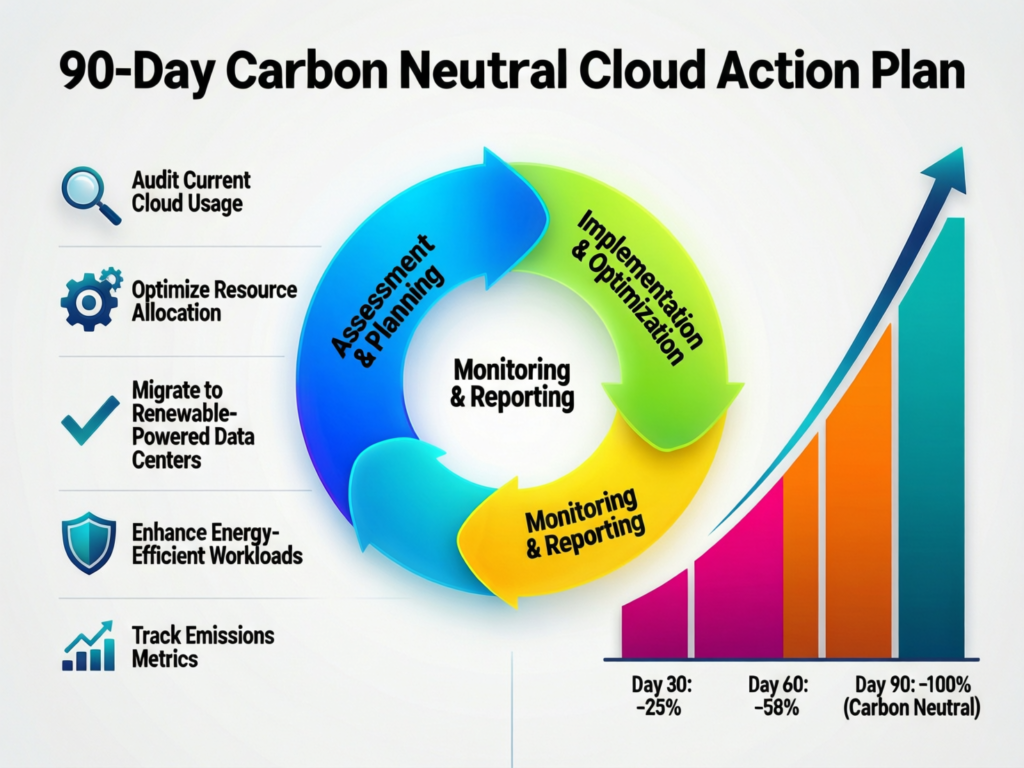
90-Day Action Plan for CIOs and Sustainability Leads
In the next 90 days, you can.
Measure & baseline
Turn on AWS/Azure/GCP carbon tools everywhere; tag accounts/projects and build the first carbon heat map across US, UK, German and EU workloads.
Benchmark providers & regions
Compare carbon intensities, renewable commitments and regulatory fit for your top 10 workloads.
Identify quick wins
Shortlist 3–5 workloads for low-risk moves (e.g., analytics, archives, non-regulated SaaS) into greener regions or architectures.
Establish GreenOps governance
Define roles, KPIs and a joint FinOps/GreenOps forum; pick one dashboard that everyone CFO, CIO, CSO can read.
This is also an ideal window to involve a partner like Mak It Solutions to validate the roadmap and build automation into tagging, reporting and optimisation.
12–36 Month Roadmap & Investment Themes
Over 1–3 years, your carbon neutral cloud roadmap should include:
Pilot migrations
Prove patterns for lift-and-shift, PaaS and serverless refactors in each major region (US, UK, EU).
AI/HPC optimisation
Treat AI clusters as dedicated programmes with clear carbon budgets, cooling strategies and regional placement rules.
Multi-region, carbon-aware scheduling
For flexible workloads, route jobs to regions with the lowest real-time carbon intensity within legal constraints.
Supply-chain and Scope 3 integration
Bring cloud emissions into supplier screening, RFPs and contract renewals.
When to Bring in a Partner
External consultants or MSPs are most valuable when:
You run complex multi-cloud estates across AWS, Azure and Google Cloud
You operate in heavily regulated sectors (banking, healthcare, public sector) with conflicting residency and latency needs
Your ESG data is fragmented across teams and tools, and you need a single source of truth
Mak It Solutions already supports CIOs and data leaders across the US, UK, Germany and wider EU on cloud, data and analytics modernisation. Extending that partnership into GreenOps and carbon neutral cloud computing gives you a single team to handle architecture, migration and ESG reporting together.
Key Takeaways
Carbon neutral cloud computing combines low-carbon architectures, greener regions and high-quality removals, rather than relying on offsets alone.
Hyperscale clouds can be significantly more efficient than on-prem, but AI and GPU workloads are driving a steep rise in electricity and water use.
GreenOps extends FinOps by optimising for carbon, water, cost and performance together across AWS, Azure and Google Cloud.
Region choice is a three-way trade-off between carbon intensity, latency and data-protection rules (GDPR/DSGVO, UK-GDPR, HIPAA, PCI DSS, BaFin, NHS, Open Banking).
A 90-day plan plus a 24–36 month roadmap gives CIOs a realistic path to align cloud growth with ESG and net-zero commitments.
Partners like Mak It Solutions can bring together architecture, analytics and ESG reporting into one sustainable cloud programme.
If your cloud and AI roadmaps are growing faster than your ESG and net-zero plans, you’re not alone and you don’t have to solve it with spreadsheets and guesswork. Share your current AWS, Azure and Google Cloud footprint (regions, spend, key workloads) and your regulatory constraints in the US, UK, Germany and EU.
Mak It Solutions can help you design a practical carbon neutral cloud roadmap from measurement and GreenOps dashboards to migration waves and AI workload optimisation so your next 24–36 months of cloud growth move you towards, not away from, your climate commitments.( Click Here’s )
FAQs
Q : Is public cloud always greener than running my own data center?
A : Not always but it often is, if you choose regions and architectures carefully. Hyperscale data centres typically operate at much better PUE than typical enterprise facilities and buy large volumes of renewable energy, which lowers emissions per unit of compute. However, if you simply “lift-and-shift” badly designed workloads into carbon-intensive regions, you may see limited gains. The biggest benefits come when you right-size, adopt managed services and route workloads into lower-carbon regions that still meet your latency and data-residency needs.
Q : How can we tell if a “green” or “carbon-neutral” cloud claim is credible and independently audited?
A : Look for cloud providers and data-centre operators that publish detailed sustainability reports, have science-based targets and participate in initiatives like the Climate Neutral Data Centre Pact with third-party audits. Check whether they disclose regional carbon-free energy shares, PUE/WUE metrics and progress against time-bound goals (e.g., 100% renewable by 2025 or 24/7 CFE by 2030). Ask for assurance statements, CDP scores and evidence of independent verification, not just marketing badges on a slide.
Q : What are the biggest cloud sustainability mistakes enterprises make when scaling AI workloads?
A : Common pitfalls include placing GPU clusters in carbon-intensive regions “for convenience”, over-provisioning infrastructure for peak loads, ignoring cooling-related water use and treating AI experiments as outside the normal governance process. Many teams also forget to tag AI projects properly, so emissions cannot be traced back to products or business units. A better approach is to treat AI as a dedicated programme with its own regional strategy, carbon budgets and GreenOps KPIs just like cost and reliability.
Q : Can carbon neutral cloud computing actually reduce our total IT spend, or is it mainly a cost add-on?
A : Done well, carbon neutral cloud computing often reduces total IT spend over time rather than adding cost. The same levers that cut emissions rightsizing, autoscaling, serverless, storage tiering, consolidation also eliminate wasteful spending. Carbon-aware region and architecture choices can sometimes be slightly more expensive on a unit basis but cheaper at system level once you factor in discounts, efficiency and decommissioned hardware. Combining FinOps and GreenOps lets you surface the options that win on both TCO and emissions, not one or the other.
Q : How do small and mid-sized companies approach GreenOps without a full ESG team?
A : SMBs don’t need a dedicated ESG department to start GreenOps. Begin by enabling cloud carbon dashboards in your main AWS/Azure/GCP accounts, tagging core workloads, and aligning with a few simple KPIs (like emissions per customer or per transaction). Make GreenOps part of your existing cloud-cost reviews: when you hunt for waste, look at both cost and carbon. For specialist tasks—CSRD mapping, regulator-ready disclosures or AI workload optimisation—you can lean on partners such as Mak It Solutions to provide templates, dashboards and advisory support on a project basis rather than hiring a full in-house team.