
Classical AI vs Quantum AI: GCC ROI Decisions
Classical AI vs Quantum AI: GCC ROI Decisions
Classical AI vs Quantum AI: GCC ROI Decisions
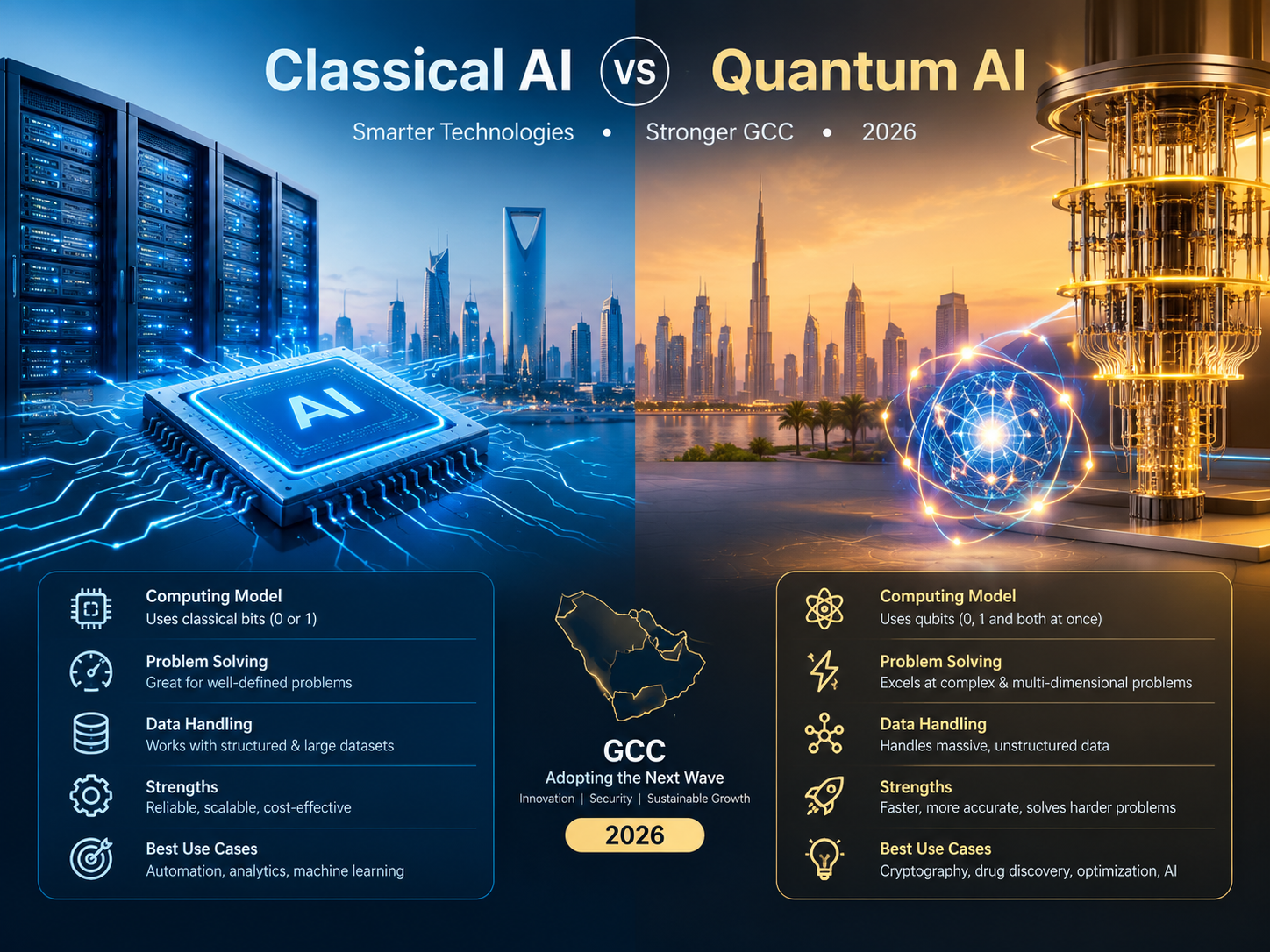
Businesses across Saudi Arabia, the UAE, and Qatar are investing in artificial intelligence to improve productivity, streamline operations, and remain competitive. But when comparing Classical AI vs Quantum AI, which technology makes more financial sense today?
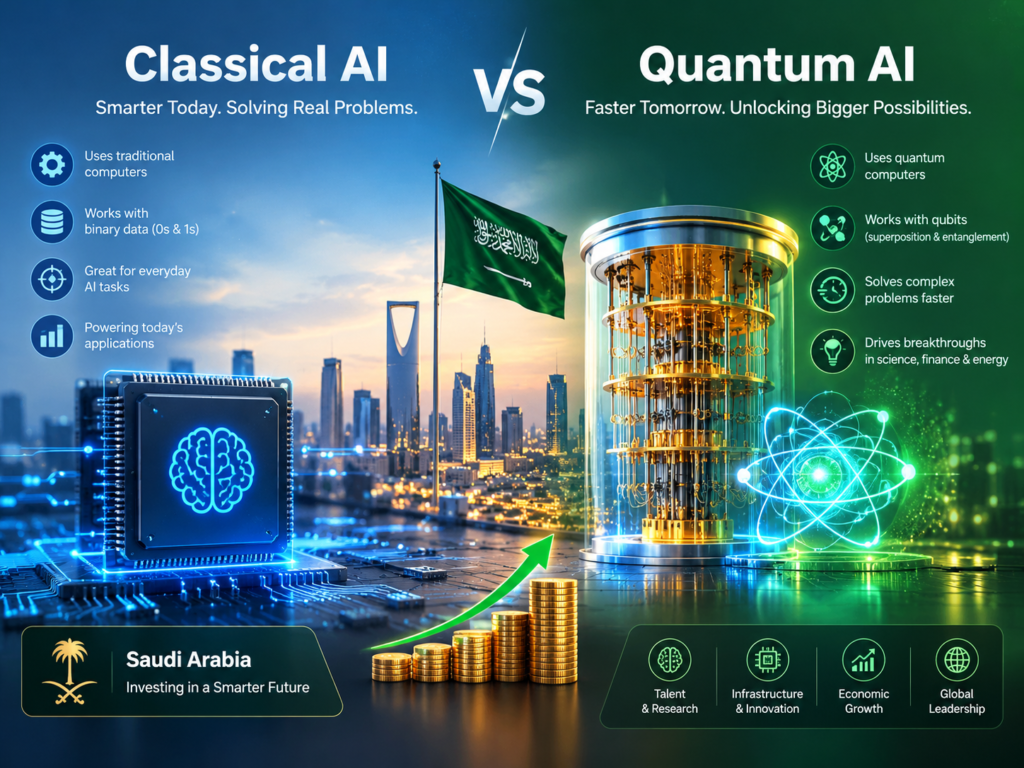
For most GCC businesses, Classical AI is the stronger near-term investment. It already supports commercial applications such as fraud detection, demand forecasting, customer service, and business automation. Quantum AI, meanwhile, offers promising research opportunities but has yet to demonstrate a consistent commercial advantage over established AI systems.
For business leaders in Riyadh, Dubai, and Doha, the decision comes down to practical readiness, implementation costs, regulatory compliance, and measurable returns.
Classical AI vs Quantum AI: Key Differences
Both technologies aim to solve complex problems, but they operate differently and have very different levels of commercial maturity.
What Is Classical AI and How Does It Work?
Classical AI uses conventional computing systems, including CPUs, GPUs, and cloud infrastructure, to process data, recognize patterns, and generate predictions.
It powers many familiar business applications, including machine learning, predictive analytics, generative AI, fraud detection, and workflow automation.
Consider a bank in Riyadh detecting suspicious financial transactions or a Dubai retailer predicting seasonal purchasing demand. Both businesses can use established classical AI technologies without building specialized computing infrastructure.
For companies planning AI integration, reliable web development solutions help connect intelligent applications with existing enterprise systems.
What Is Quantum AI and How Does It Work?
Quantum AI combines artificial intelligence research with quantum computing, which uses quantum bits, known as qubits, to perform certain types of computation.
Quantum machine learning (QML) investigates whether quantum processors can improve specific machine learning tasks. These approaches may combine quantum processing units (QPUs) with conventional computers.
However, quantum computing and quantum AI are not the same thing.
Quantum computing is a broader field that includes simulation, optimization, and other computational applications. Quantum AI focuses specifically on the intersection of quantum computation and AI-related methods.
Although research continues, quantum AI has not established a broadly reproducible commercial advantage over well-optimized classical AI systems.
For GCC enterprises, that distinction matters when deciding where to allocate investment.
Classical AI vs Quantum AI Comparison Table
|
Factor |
Classical AI |
Quantum AI |
|---|---|---|
| Technology maturity | Commercially established | Mostly experimental |
| Infrastructure | CPUs, GPUs, cloud platforms | QPUs, simulators, hybrid systems |
| Business applications | Automation, forecasting, analytics | Specialized research |
| Implementation complexity | Varies; established tools available | High specialist requirements |
| Near-term ROI | Can be measured against business outcomes | Generally unproven at scale |
| Investment priority | Deploy validated use cases | Explore selectively |
The main difference: Classical AI can address existing business problems using established infrastructure, while quantum AI generally requires research investment before its commercial usefulness can be established.
Why GCC Businesses Should Prioritize Classical AI
Gulf organizations face growing expectations to improve operational efficiency, customer experience, and digital services.
Classical AI offers practical tools for addressing these priorities. Quantum AI remains worth monitoring, but most businesses have more immediate opportunities within their existing operations.
Saudi Vision 2030 and Practical AI Investment
Saudi Vision 2030 supports economic diversification, digital transformation, and the development of a knowledge-based economy.
The Saudi Data and Artificial Intelligence Authority (SDAIA) plays an important role in the Kingdom’s data and AI ecosystem.
For Saudi companies, practical AI opportunities include financial analytics, supply-chain forecasting, customer service, and logistics optimization.
A logistics company in Jeddah, for example, could use predictive models to anticipate delivery demand and improve resource planning.
Instead of investing immediately in experimental quantum technology, the business could evaluate whether conventional AI produces measurable improvements in delivery efficiency and operating costs.
UAE Enterprise AI ROI and Digital Transformation
Businesses in Dubai and Abu Dhabi are well positioned to explore AI applications in banking, retail, logistics, hospitality, and public services.
Classical AI can support customer-service automation, fraud monitoring, operational forecasting, and internal knowledge management.
Companies such as G42 and Presight also illustrate the UAE’s developing enterprise AI ecosystem. Their activities, however, should not be interpreted as evidence that quantum AI has already achieved commercial profitability.
For UAE retailers, combining predictive analytics with e-commerce technology solutions can support inventory planning and digital customer experiences.
The important question is not how advanced the technology sounds, but whether it improves an identifiable business outcome.
Qatar’s AI Development and Enterprise Opportunities
Qatar National Vision 2030 provides a strategic foundation for economic diversification and knowledge-based development.
Organizations such as Qai and the Qatar Computing Research Institute (QCRI) reflect the country’s growing involvement in AI research and development.
For businesses in Doha, immediate opportunities may include energy demand forecasting, Arabic-language customer support, and logistics analytics.
These applications can be assessed against existing processes without depending on experimental quantum infrastructure.
GCC AI Compliance, Data Residency, and Security
AI investment decisions cannot be separated from privacy, cybersecurity, and regulatory requirements.
A technically successful AI project may still create commercial or legal problems if customer information is mishandled or data-processing arrangements are unsuitable.
Saudi PDPL, SDAIA, NDMO, and SAMA Requirements
Saudi businesses developing AI applications should assess the Personal Data Protection Law (PDPL), relevant SDAIA guidance, applicable National Data Management Office (NDMO) standards, and sector-specific obligations.
Financial institutions may also need to comply with requirements established by the Saudi Central Bank (SAMA).
Importantly, Saudi data regulations do not create a universal prohibition on overseas cloud hosting. Localization and international-transfer requirements depend on the data, processing activity, and applicable regulations.
Companies should review hosting arrangements, vendor agreements, access controls, and international transfers before deployment.
The SDAIA laws and regulations resources provide a useful starting point.
UAE AI Governance, TDRA, ADGM, and DIFC
UAE companies must consider the federal personal-data protection framework and any additional rules applicable to their activities.
The Telecommunications and Digital Government Regulatory Authority (TDRA) has responsibilities within telecommunications and digital-government domains.
Organizations operating within Abu Dhabi Global Market (ADGM) or Dubai International Financial Centre (DIFC) must also consider their respective data-protection regimes.
Before adopting an AI platform, businesses should evaluate where information is stored, who can access it, and whether sensitive inputs may be used for model training.
The UAE government’s data-protection guidance offers additional regulatory context.
Qatar Data Privacy, QCB, and Cross-Border Security
Qatari companies must consider the country’s Personal Data Privacy Protection Law when collecting, processing, or securing personal information.
Organizations should assess vendor contracts, data retention, security safeguards, and international data transfers.
Financial institutions may have additional obligations under Qatar Central Bank (QCB) requirements.
Qatar’s National Cyber Security Agency also provides relevant privacy and cybersecurity guidance.
Regional cloud infrastructure, including AWS Bahrain, Azure UAE Central, and Google Cloud Doha, may support GCC hosting strategies. However, service availability and regulatory suitability must be evaluated separately.
Practical consideration: Selecting a regional data center does not automatically make an AI application compliant. Governance, access controls, processing arrangements, and contractual safeguards matter just as much.
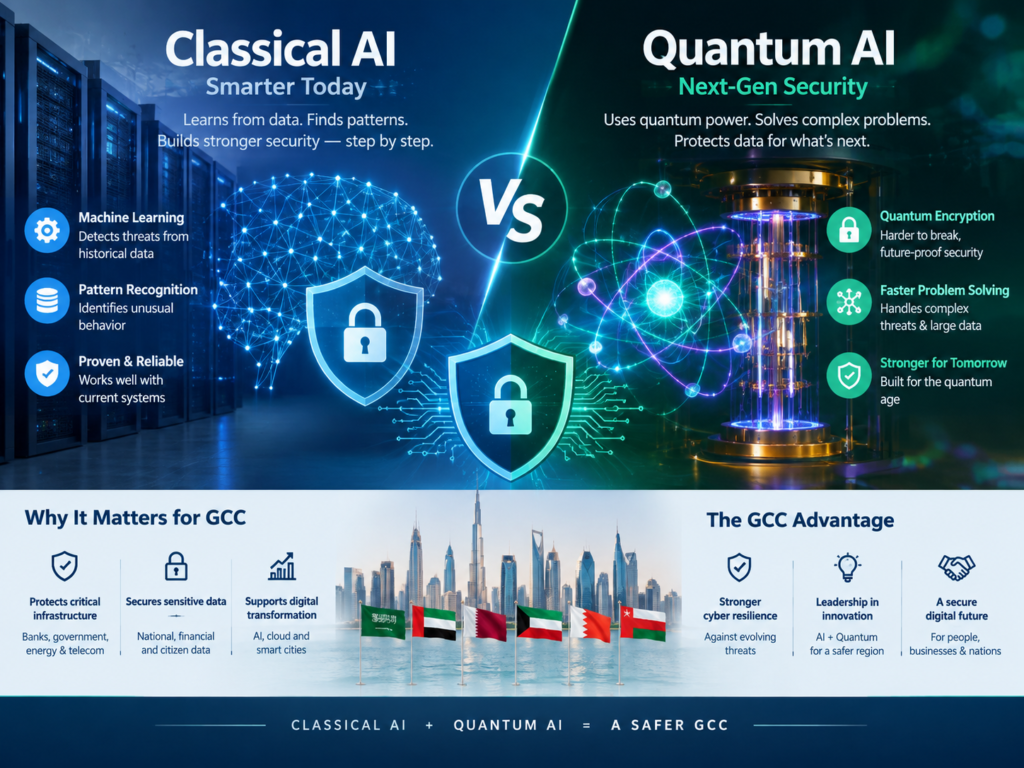
Classical AI vs Quantum AI.
The strongest investment case becomes clearer when businesses examine specific operational problems.
AI in Riyadh Fintech and UAE Banking
Financial services businesses can use classical AI for transaction monitoring, risk analysis, document processing, and customer support.
A Riyadh fintech company, for example, could test a fraud detection model while implementing applicable SAMA requirements.
Banks operating within DIFC or ADGM should evaluate the regulations governing their activities.
Quantum financial modeling remains an active research topic. It should not yet be treated as a proven commercial replacement for conventional risk-management systems.
Quantum Research in Saudi and Abu Dhabi Energy
Energy companies have established opportunities to investigate classical AI for predictive maintenance, equipment monitoring, and production forecasting.
Quantum computing research could eventually contribute to optimization, molecular simulation, and materials discovery.
Research involving Aramco and Pasqual, alongside quantum initiatives associated with Abu Dhabi’s Technology Innovation Institute (TII), demonstrates regional interest in quantum technologies.
However, research partnerships do not automatically demonstrate profitable quantum machine learning applications.
Energy businesses can continue implementing validated classical AI systems while evaluating quantum research through separately managed projects.
AI in Dubai Logistics and Doha Government Services
Logistics operators in Dubai can evaluate AI-assisted demand forecasting, fleet management, and delivery-route optimization.
Public-service organizations in Doha may benefit from Arabic document classification, information retrieval, and administrative workflow automation.
These applications require careful evaluation of Arabic-language accuracy, privacy controls, and human oversight.
Reliable backend development and enterprise data architecture are also essential for integrating AI into existing business systems.
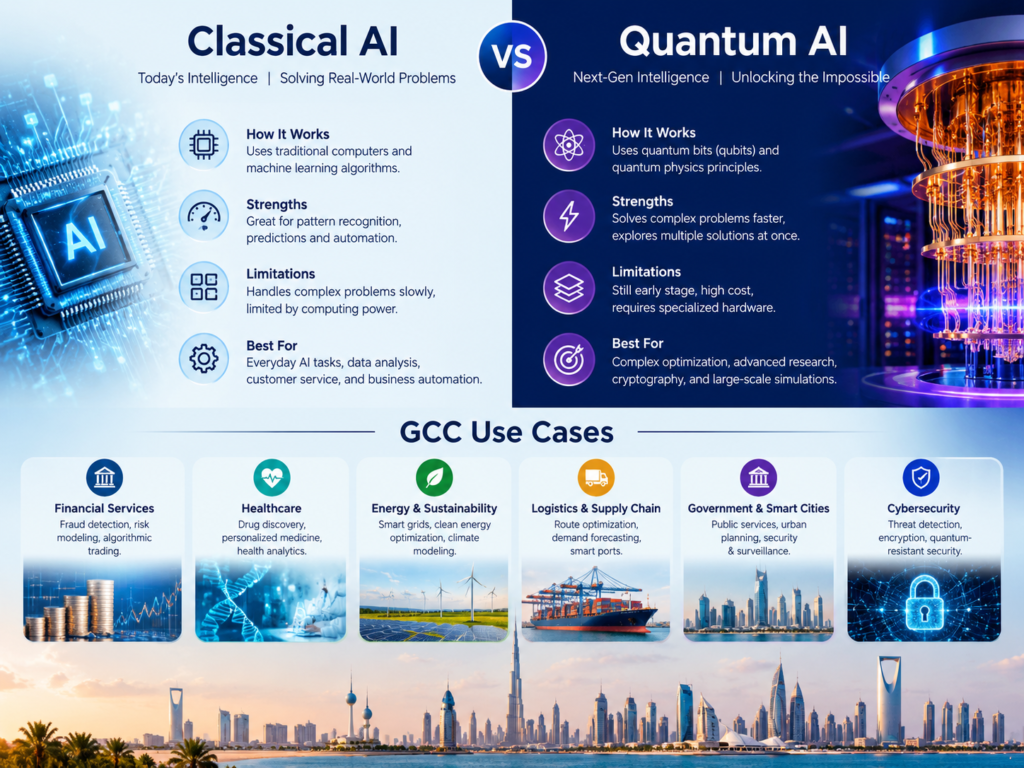
Classical AI vs Quantum AI Costs, ROI, and Readiness
Technology investment should be evaluated against business value rather than technical novelty.
For GCC enterprises, the costs of classical and quantum AI differ significantly in structure, expertise requirements, and commercial certainty.
Classical AI Implementation Costs for GCC Enterprises
Classical AI implementation costs may include software subscriptions, computing infrastructure, cloud usage, systems integration, data preparation, security, and technical personnel.
Costs depend on the project’s scope, existing infrastructure, and operational requirements.
A limited forecasting or customer-service pilot generally requires fewer resources than an organization-wide AI deployment.
Before committing to a larger rollout, businesses should define measurable targets such as processing time, prediction accuracy, operating costs, and customer satisfaction.
Organizations developing AI-powered software should also review AI-generated code security practices.
Quantum AI Investment Costs and Technical Limitations
Quantum AI introduces additional research and development considerations.
These can include specialist expertise, quantum processor access, experimental algorithms, simulator resources, hardware noise, and repeated benchmarking.
Even where cloud-based quantum computing services are available, access does not guarantee that a particular algorithm will outperform conventional alternatives.
Quantum advantage remains dependent on the problem, algorithm, hardware, and comparison method.
Businesses should avoid assuming that greater quantum research spending will automatically improve commercial results.
AI Investment Decision Matrix for Saudi, UAE, and Qatar
|
Business situation |
Recommended approach |
|---|---|
| Reliable data and a defined operational problem | Test classical AI |
| Clear performance baseline | Measure implementation ROI |
| Sensitive customer or financial information | Assess relevant regulations first |
| Limited AI experience | Begin with a controlled classical AI pilot |
| Access to specialist quantum researchers | Consider a focused research project |
| Demonstrated improvement over conventional methods | Evaluate further investment |
For most GCC businesses, the practical approach is to prioritize validated classical AI projects while reserving carefully governed funding for quantum research where justified.
How GCC Businesses Can Build a Future-Ready AI Strategy
An effective AI strategy does not require choosing one technology permanently. It requires matching investment decisions to business needs and technical readiness.
Audit AI Readiness and Identify Use Cases
Start by reviewing existing business processes, data quality, technical capabilities, and regulatory requirements.
Identify repetitive or data-intensive activities where AI could provide measurable benefits.
Common starting points include customer support, financial reporting, forecasting, and Arabic-language document processing.
Companies can also review the Mak It Solutions services portfolio when planning the technical infrastructure needed for AI integration.
Pilot Classical AI and Measure Performance
Choose a manageable project with a clearly defined business objective.
For example, a Dubai retailer could test AI-powered demand forecasting against its existing inventory planning process.
Measure accuracy, operating costs, employee productivity, and customer outcomes.
If the project demonstrates meaningful value and meets security requirements, the company can consider expanding its use.
Evaluate Quantum AI Through Controlled Research
Businesses interested in quantum AI should identify a specialized problem that may justify experimental investigation.
Research partners, including universities and organizations such as TII or QCRI, may provide relevant expertise.
Any quantum approach should be compared against a strong classical benchmark under clearly defined testing conditions.
Further investment should depend on reproducible evidence of improvement, not expectations surrounding the technology.
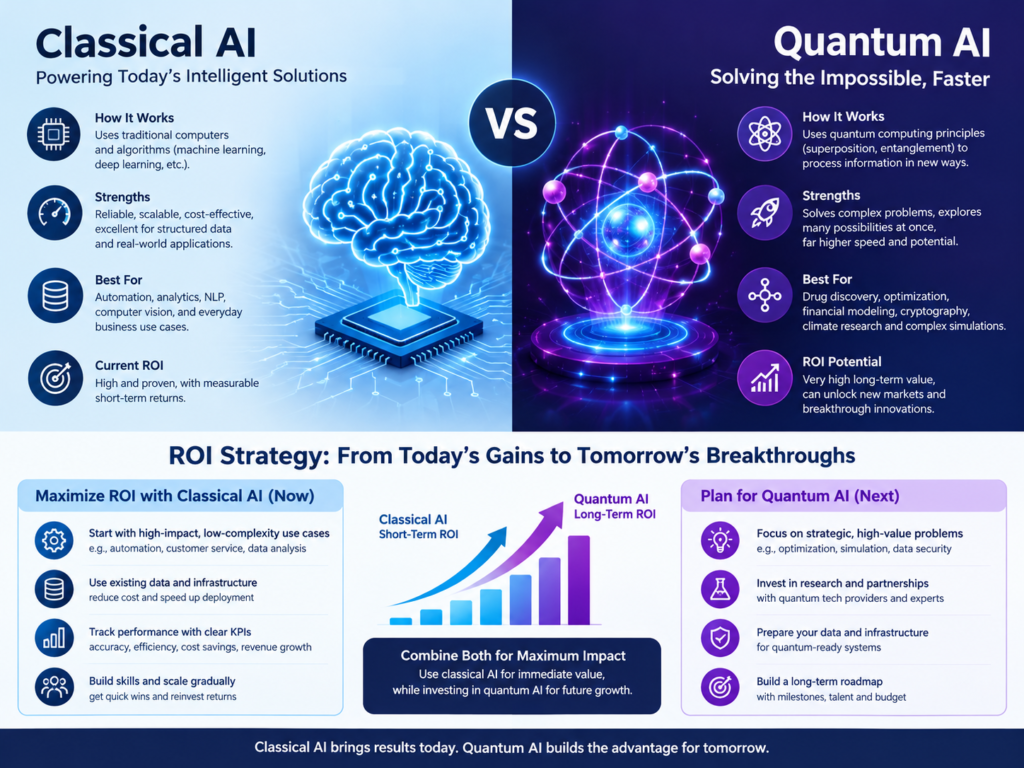
Final Thoughts
The Classical AI vs Quantum AI decision is not simply a choice between established technology and future innovation.
For most businesses in Saudi Arabia, the UAE, and Qatar, classical AI offers a more practical starting point because it can be integrated into existing operations and evaluated against measurable performance targets.
Quantum AI remains a promising research direction, particularly for organizations investigating specialized computational challenges. Its commercial value, however, must be demonstrated rather than assumed.
GCC companies can build sustainable AI strategies by focusing on real business problems, protecting sensitive information, supporting Arabic-language requirements, and testing results before expanding investment.
Plan Your GCC AI Investment With Mak It Solutions
Considering AI adoption in Saudi Arabia, the UAE, or Qatar?
Contact Mak It Solutions to discuss your technical requirements, integration challenges, and digital transformation goals.
Our development and integration services can help establish the software infrastructure needed to support your AI initiatives.
FAQs
Q : Can Saudi SMEs adopt classical AI without building their own data centers?
A : Yes. Saudi small and medium-sized enterprises can use managed AI platforms, cloud services, and subscription-based software without constructing dedicated data centers.
They should still assess Saudi PDPL requirements, vendor agreements, information security, and any applicable sector-specific regulations. Businesses handling sensitive models can also review AI model protection practices.
Q : Which Dubai business sectors can benefit from AI automation?
A : Retail, banking, logistics, hospitality, and customer service offer practical AI automation opportunities in Dubai.
Companies can apply AI to demand forecasting, transaction monitoring, customer inquiries, and operational planning. Results depend on data quality, implementation, and appropriate human oversight.
Q : What data privacy rules should Qatari companies check before using AI?
A : Qatari companies should review Law No. 13 of 2016 concerning personal data privacy protection.
Businesses should also examine vendor contracts, international data transfers, information security, retention policies, and how external AI providers process submitted information. Financial institutions may face additional Qatar Central Bank requirements.
Q : Can Abu Dhabi energy companies benefit from quantum computing research?
A : Potentially. Quantum computing research may eventually support complex optimization, molecular simulation, and materials discovery.
However, commercial quantum AI advantages remain unproven at scale. Energy companies should benchmark experimental approaches against established computing methods before increasing investment.
Q : How can Bahraini and Omani businesses begin using Arabic-language AI?
A : Businesses in Bahrain and Oman can begin with controlled applications such as Arabic customer support, document classification, and internal knowledge retrieval.
Models should be tested against local terminology, dialects, and realistic business scenarios. Organizations must also assess applicable privacy laws, security safeguards, and human-review requirements before deployment.