


Cybersecurity Metrics for CEOs: GCC Board Guide
Cybersecurity Metrics for CEOs: GCC Board Guide

Cybersecurity Metrics for CEOs: GCC Board Guide
Cybersecurity metrics for CEOs help GCC leaders turn technical security data into clear business decisions about risk, resilience, compliance, and investment.
For companies in Saudi Arabia, UAE, and Qatar, these metrics also support board-level conversations around regulators such as NCA, SAMA, TDRA, ADGM, DIFC, and QCB. The goal is simple: less technical noise, more clarity on what can affect revenue, customers, operations, and trust.
Why CEOs in GCC Need Cybersecurity Metrics
CEOs in Saudi Arabia, UAE, and Qatar are now judged on cyber resilience, not just digital growth. A fintech in Riyadh, a logistics group in Dubai, or a financial institution in Doha cannot treat cybersecurity as a technical SOC report anymore.
Boards want clarity. Security teams often bring alerts, vulnerability counts, and tool dashboards. Cybersecurity metrics for CEOs close that gap by translating threats, control gaps, downtime risk, and compliance exposure into business language.
For GCC businesses, this matters even more because digital transformation, cloud adoption, Arabic user journeys, and regulatory scrutiny are all moving quickly.
What Are Cybersecurity Metrics for CEOs?
Technical KPIs vs CEO-Level Cyber Metrics
Technical KPIs show firewall alerts, malware events, vulnerability counts, endpoint detections, and patching status.
CEO-level cybersecurity metrics answer a different question: “What does this mean for the business?”
For example.
| Technical KPI | CEO-Level Metric |
|---|---|
| 450 open vulnerabilities | Three critical payment systems remain exposed to high-risk vulnerabilities for more than 30 days |
| 12,000 security alerts | Two business-critical systems need faster detection and response coverage |
| 18 failed backup jobs | Customer-facing services may not meet recovery targets during ransomware |
A CEO does not need every alert. They need to know what could stop operations, trigger regulatory issues, damage customer trust, or require urgent investment.
Why CEOs Should Measure Risk, Resilience, and Compliance Together
Strong cyber risk management connects three questions.
What can hurt the business?
How fast can we recover?
Are we meeting regulatory expectations?
When CEOs measure only compliance, they may miss operational risk. When they measure only incidents, they may miss audit exposure.
That is why cybersecurity metrics for CEOs should combine cyber risk, cyber resilience, and control maturity in one executive dashboard.
Why GCC Regulations Make Cyber security a Leadership Issue
In Saudi Arabia, the NCA Essential Cybersecurity Controls are designed to strengthen national cybersecurity and protect information and technology assets. SAMA also sets cyber expectations for supervised financial institutions.
In the UAE, TDRA’s UAE Information Assurance Regulation supports protection of critical information infrastructure. In Qatar, QCB publishes information and cybersecurity requirements for financial-sector entities.
For CEOs, this means cybersecurity is no longer just an IT function. It is part of governance, continuity, compliance, and board accountability.
Core Cybersecurity Metrics GCC CEOs Should Track
Risk Exposure Metrics
Risk exposure metrics show where the business is most vulnerable and what impact that exposure could create.
Key metrics include.
Percentage of critical assets classified
Crown-jewel systems exposed
High-risk vulnerabilities overdue
Cyber risk by business unit
Top cyber risks by revenue impact
Privileged access exposure
Customer data exposure
Cloud misconfiguration risk
In Saudi Arabia, this may include payment infrastructure and customer data. In the UAE, it may include e-commerce platforms and regulated digital services. In Qatar, it may include financial systems and payment environments in Doha.

Cyber Resilience Metrics for CEOs
Cyber resilience metrics show whether the company can detect, respond, recover, and keep operating during an incident.
Important resilience metrics include.
Mean time to detect
Mean time to respond
Backup restore success rate
Ransomware recovery time
Backup immutability status
Incident simulation results
Recovery-time objective performance
Critical service availability
A Dubai e-commerce brand, for example, should know whether checkout, warehouse, and payment systems can recover within approved timelines.
Compliance Metrics
Compliance metrics should show where the company stands against regulator expectations and internal controls.
Useful metrics include.
Open audit findings
Control maturity by regulator
Overdue remediation
Exception approvals
Evidence quality
Third-party compliance gaps
Country-specific regulatory exposure
This helps CEOs discuss NCA, SAMA, TDRA, ADGM, DIFC, and QCB requirements without turning board meetings into technical reviews.
How Cybersecurity Metrics Differ Across Saudi Arabia, UAE, and Qatar
Saudi Arabia.
Saudi CEOs should prioritize NCA ECC alignment, SAMA cyber maturity for financial services, NDMO-related data governance, Saudi data residency, and critical service availability.
A Riyadh fintech startup, for instance, should track privileged access, cloud-hosting controls, incident escalation, and vendor risk before major board expansion decisions.
UAE.
In the UAE, metrics should reflect TDRA expectations, UAE IA control maturity, DIFC and ADGM requirements for financial entities, and service continuity in Dubai and Abu Dhabi.
For UAE companies using public cloud, cloud-region choice, disaster recovery, and data governance should appear clearly in the cybersecurity dashboard.
Qatar.
Qatar CEOs should focus on QCB reporting, board ownership, cyber governance, incident reporting readiness, and data protection for financial services.
For Doha-based banks, insurers, and payment service providers, one of the most useful executive metrics is business-service resilience: can critical customer, payment, and reporting systems continue or recover within approved timelines?
What a CEO Cybersecurity Dashboard Should Include
Board-Ready Cyber Risk Scorecard
A strong CEO dashboard should include.
Overall cyber risk rating
Trend direction
Financial exposure
Top risks
Key incidents
Remediation progress
Risk acceptance decisions
Budget impact
For executive teams building digital platforms, Mak It Solutions’ technology services can support practical dashboards that connect systems, applications, and reporting.
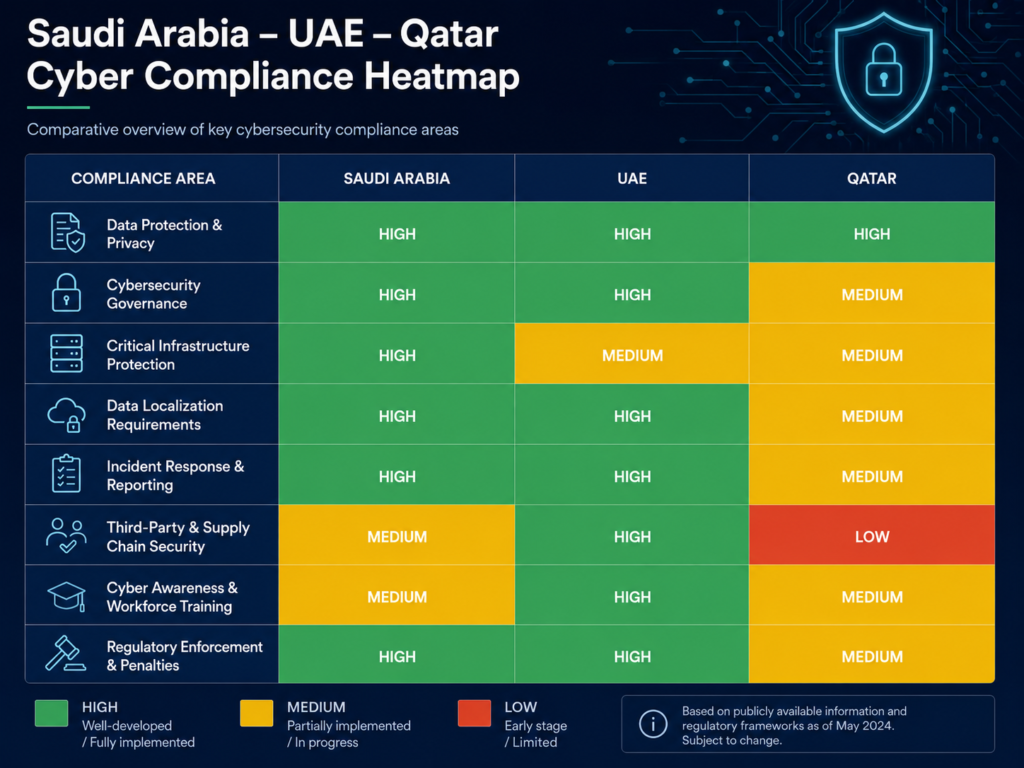
Compliance Heatmap by Country, Regulator, and Business Unit
A GCC compliance heatmap should show Saudi Arabia, UAE, and Qatar separately.
It should also show maturity across NCA, SAMA, TDRA, DIFC, ADGM, QCB, and business units. This gives boards a clear view of where risk is increasing, where controls are improving, and where leadership decisions are needed.
Vendor and Third-Party Risk Visibility
Vendor risk is now a board issue, especially for companies using cloud platforms, outsourced development, payment providers, managed SOCs, and SaaS tools.
Vendor metrics should include.
High-risk suppliers
Expired vendor assessments
Cloud concentration risk
Data-sharing exposure
Outsourced SOC performance
Third-party incident history
Critical vendor dependency
For companies modernizing platforms, secure architecture should start early with web design and digital experience planning and continue through development, testing, and monitoring.
GCC Compliance Metrics CEOs Cannot Ignore
Saudi Compliance Metrics for NCA ECC, CCC, SAMA, and NDMO Alignment
Saudi CEOs should monitor ECC control maturity, cloud control gaps, data classification, privileged access, third-party risk, and SAMA exceptions where applicable.
For Saudi organizations, the most useful dashboard is not a long control checklist. It is a clear view of which gaps affect operations, customer trust, regulatory readiness, and national-level cyber expectations.
UAE Compliance Metrics for TDRA, UAE IA, DIFC, and ADGM Expectations
UAE executives should track UAE IA maturity, incident response tests, regulated data flows, cloud-region choices, and governance ownership.
For Dubai and Abu Dhabi firms, cybersecurity metrics should connect directly to trust, customer experience, service continuity, and investor confidence.
Qatar Compliance Metrics for QCB and Sector-Specific Reporting
Qatar financial institutions should track technology risk assessments, payment-service controls, audit gaps, and board reporting readiness.
For QCB-regulated organizations, evidence quality matters. The dashboard should show whether controls are working, whether gaps are being closed, and whether executives can explain the risk clearly.
Cyber Resilience Metrics for GCC Business Continuity
Incident Response Readiness Across Riyadh, Dubai, Abu Dhabi, and Doha
Incident response readiness should be tested across cities, teams, languages, and vendors.
A regional company should know.
Who approves shutdowns
Who contacts regulators
Who communicates with customers
Which systems get restored first
Which vendors must respond during an incident
Whether Arabic and English communication templates are ready
This is where cyber resilience becomes practical, not theoretical.
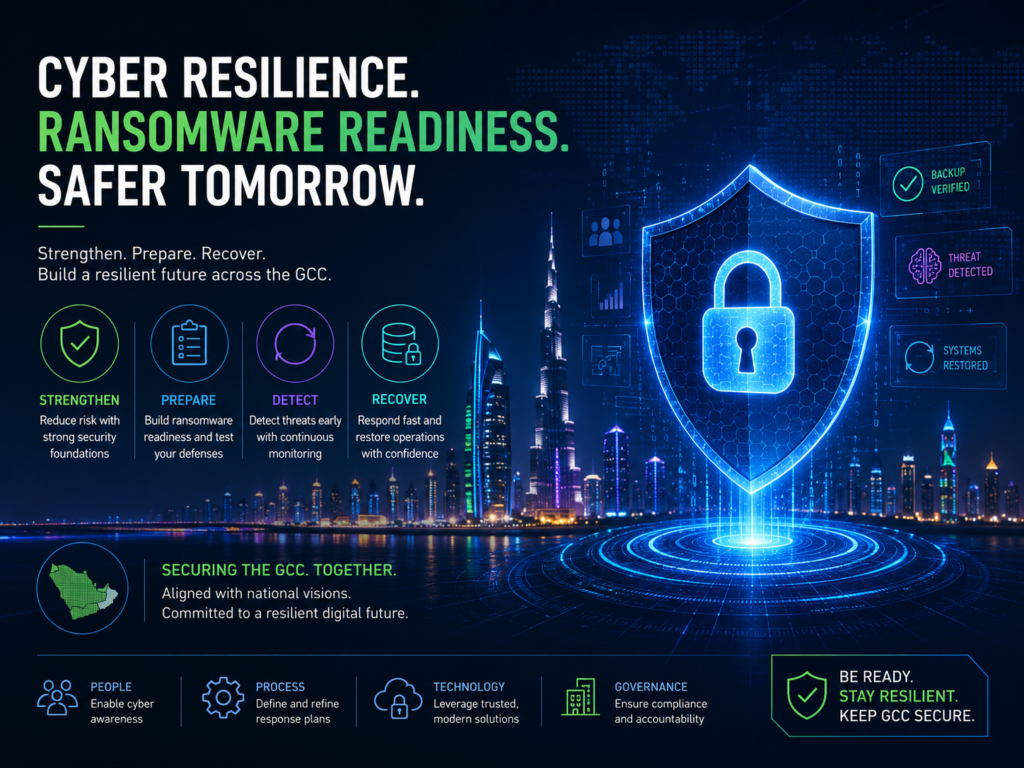
Ransomware Readiness and Recovery Indicators
Ransomware readiness should be visible at CEO level because it directly affects downtime, customer trust, and revenue.
Track.
Restore test success
Offline backup availability
Privileged account exposure
Endpoint protection coverage
Ransomware tabletop results
Recovery-time performance
Backup immutability
For mobile-first companies, resilience also includes app availability. Mak It Solutions’ mobile app development services help teams design more reliable customer-facing systems.
Arabic UX and Employee Awareness Metrics
Cybersecurity awareness only works when employees understand the message clearly.
For GCC teams, this often means bilingual training, Arabic policy summaries, and phishing simulations that match local communication habits.
Useful metrics include.
Arabic training completion
Phishing click rate
Suspicious-email reporting rate
Policy comprehension
Department-level awareness scores
This matters across Saudi Arabia, UAE, and Qatar, where many businesses operate in Arabic and English.
How CEOs Should Use Cybersecurity Metrics in Board Decisions
Prioritize Cybersecurity Investment by Risk Reduction
CEOs should fund initiatives that reduce measurable risk.
High-impact areas often include.
Identity security
Backup resilience
Cloud controls
Vendor assurance
Secure software delivery
Incident response readiness
Governance and reporting
This turns cybersecurity from a cost center into a business continuity investment.
Report Cyber Risk to Boards, Investors, and Regulators
Board reports should show cyber posture, trend, exceptions, business impact, and next decisions.
The best format is usually one page:
| Dashboard Area | What It Should Show |
|---|---|
| Risk score | Current cyber risk level and trend |
| Resilience score | Detection, response, and recovery readiness |
| Compliance heatmap | Gaps by regulator, country, and business unit |
| Open decisions | Risks needing executive approval |
| Budget impact | Investment needed to reduce exposure |
This format keeps the conversation focused on decisions, not technical noise.
Choose Between Internal SOC, vCISO, GRC Tools, and Managed Providers
Different GCC companies need different operating models.
Internal SOCs work best for mature enterprises with enough scale. vCISO support helps growing companies build governance quickly. GRC tools help multi-market firms manage evidence and audits. Managed security providers support monitoring, response, and specialist coverage.
For tailored delivery, teams can explore Mak It Solutions’ company profile and contact page.

Concluding Remarks
Cybersecurity metrics for CEOs are not about more reports. They are about better decisions.
For GCC companies in Saudi Arabia, UAE, and Qatar, the right metrics help leaders understand risk exposure, resilience, compliance, vendor dependency, and investment priorities. When the dashboard speaks the language of business, boards can act faster and with more confidence.
Mak It Solutions can help GCC businesses design executive dashboards, strengthen digital platforms, and build practical cyber risk strategies for Saudi Arabia, UAE, and Qatar. Book a consultation or request a custom GCC strategy through the Mak It Solutions contact team.
FAQs
Q : What cybersecurity KPIs should a Saudi CEO report to the board?
A : A Saudi CEO should report critical asset exposure, NCA ECC control maturity, SAMA-related gaps if the company is regulated, incident response readiness, ransomware recovery time, and third-party risk. The board also needs to know which risks affect revenue, customer trust, and Saudi data obligations.
Q : How can UAE companies measure cyber risk for DIFC or ADGM compliance?
A : UAE companies should measure cyber risk through control maturity, audit gaps, regulated data flows, incident readiness, privileged access, and third-party exposure. DIFC and ADGM entities should also track governance ownership, board escalation, and vendor concentration risk.
Q : What cybersecurity metrics matter most for Qatar financial institutions?
A : Qatar financial institutions should track QCB-aligned technology risk assessments, incident response readiness, payment-system exposure, data protection controls, third-party risk, and audit remediation progress. The most useful executive metric is whether critical customer, payment, and reporting systems can continue or recover within approved timelines.
Q : How often should GCC CEOs review cybersecurity dashboards?
A : GCC CEOs should review cybersecurity dashboards monthly, with immediate escalation for major incidents, regulatory exceptions, ransomware risk, or critical vendor exposure. Boards may review cyber risk quarterly, but executive teams should monitor high-risk trends more frequently.
Q : Should GCC companies track Arabic cybersecurity awareness metrics?
A : Yes. GCC companies should track Arabic cybersecurity awareness because many teams work in bilingual environments. Useful metrics include Arabic training completion, phishing simulation results, policy understanding, and incident reporting rates.