



Data Governance for AI: Zero-Trust Guide
Data governance for AI is now a board-level issue, not just a data-team concern. As enterprises move AI from pilots into real customer, employee, finance, healthcare, and compliance workflows, the quality and control of data decide how safe those systems really are.
At its core, data governance for AI means making sure AI systems use data that is trusted, compliant, traceable, secure, and permissioned. A zero-trust model strengthens that foundation by verifying every user, dataset, prompt, model, workflow, and output before access is allowed.
What Is Data Governance for AI?
Data governance for AI is the framework that controls how data is collected, classified, accessed, used, retained, audited, and protected across AI systems.
It answers practical questions.
What data can the AI system access?
Where did that data come from?
Who approved it for AI use?
Does it contain personal, financial, health, or regulated information?
Can the organization prove what happened later?
Traditional data governance focuses on quality, ownership, reporting, cataloging, and security. AI data governance goes further because AI systems can summarize, infer, retrieve, generate, and combine information in ways that are harder to predict.
For example, a BI dashboard may only show approved revenue metrics. A generative AI assistant connected to the same data might summarize sensitive trends, expose customer segments, or combine records in a way that creates new privacy risk.
That is why AI needs governance designed for models, prompts, embeddings, RAG pipelines, agents, and automated workflows.
For a related strategy view, see Mak It Solutions’ guide on human-in-the-loop AI workflows.
Why Data Governance for AI Needs Zero Trust
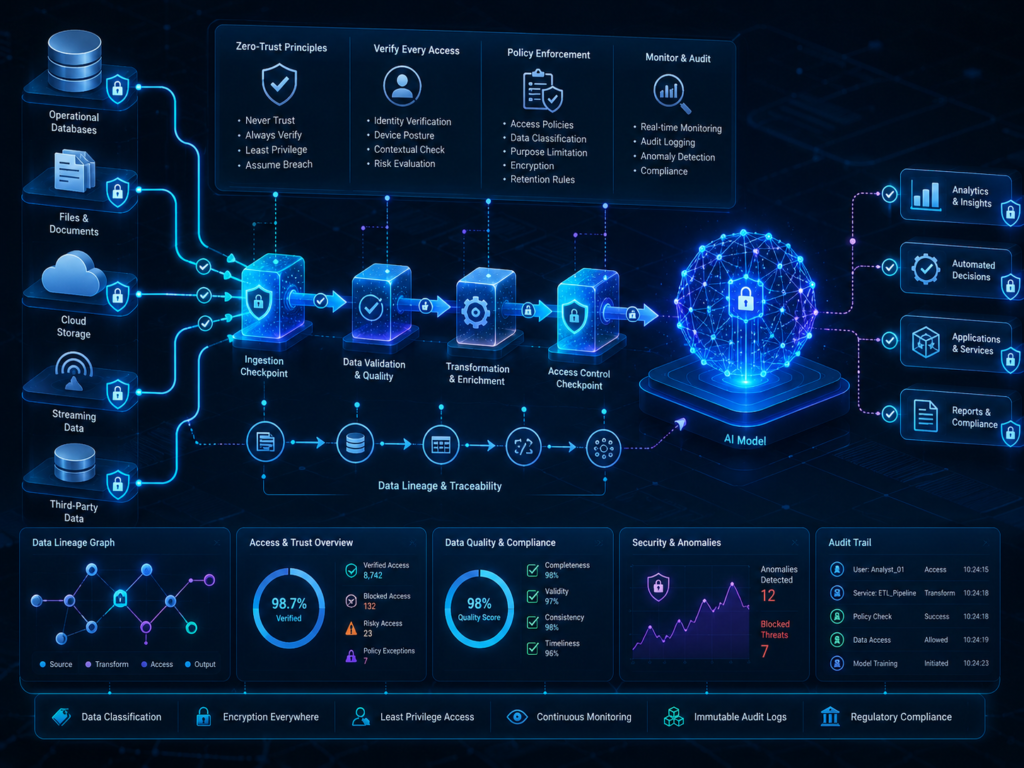
Zero trust means no user, device, app, dataset, model, or workflow should be trusted automatically. NIST describes zero trust as a shift away from static perimeter-based defenses toward protecting users, assets, and resources through stronger verification.
For AI, this matters because a model should not gain broad access just because it is connected to SharePoint, a CRM, a data warehouse, a ticketing tool, or a vector database.
A zero-trust AI governance model checks.
User identity and role
Dataset sensitivity
Business purpose
Region or jurisdiction
Model permissions
Prompt context
Data lineage and provenance
Output review requirements
Audit and logging rules
In practice, this reduces the chance that an AI assistant exposes HR records, payment details, patient data, source code, legal documents, or confidential strategy.
It does not remove every AI risk. But it makes risky data flows visible, testable, and auditable.
Core Components of Secure AI Data Governance
A strong AI data governance framework should be practical for engineering teams and clear enough for legal, security, risk, and compliance leaders.
Data Quality and Validation
AI systems need accurate, current, and relevant data. Poor-quality data can lead to weak summaries, misleading recommendations, hallucinated answers, and bad business decisions.
Data quality checks should cover accuracy, completeness, duplication, freshness, formatting, and source reliability.
Data Lineage and Provenance
Data provenance shows where data came from. Data lineage shows how it moved, changed, and entered an AI workflow.
This is especially important for RAG systems, analytics copilots, fine-tuning pipelines, customer service AI, and decision-support tools.
When an output is challenged, the organization should be able to trace which sources influenced it.
Metadata Management
Metadata gives AI systems and governance teams context. It can define the owner, source, sensitivity, retention period, permitted use, jurisdiction, and quality level of a dataset.
Without metadata, AI tools may treat payroll data, public FAQs, customer emails, and regulated health information as equally safe. They are not.

Data Classification
Classification labels data according to risk and allowed use. Common categories include public, internal, confidential, restricted, regulated, and AI-prohibited.
This helps teams decide what can be indexed, summarized, trained on, retrieved, exported, or shown to users.
Policy-Based Access Control
Policy-based access control applies business rules to AI access decisions. Role-based permissions define what each user, service, model, or agent can do.
For example, a support chatbot may access public knowledge-base articles but not employee records. A finance copilot may summarize approved reports but not raw payroll files.
Audit Trails and Evidence
AI governance needs evidence, not just policies. Logs should capture user identity, prompt, data accessed, model response, timestamp, approval status, and final action.
This evidence helps during internal reviews, incident investigations, vendor audits, and regulatory assessments.
For related security architecture, see Mak It Solutions’ article on confidential computing for sensitive cloud workloads.
AI Compliance Risks by Region
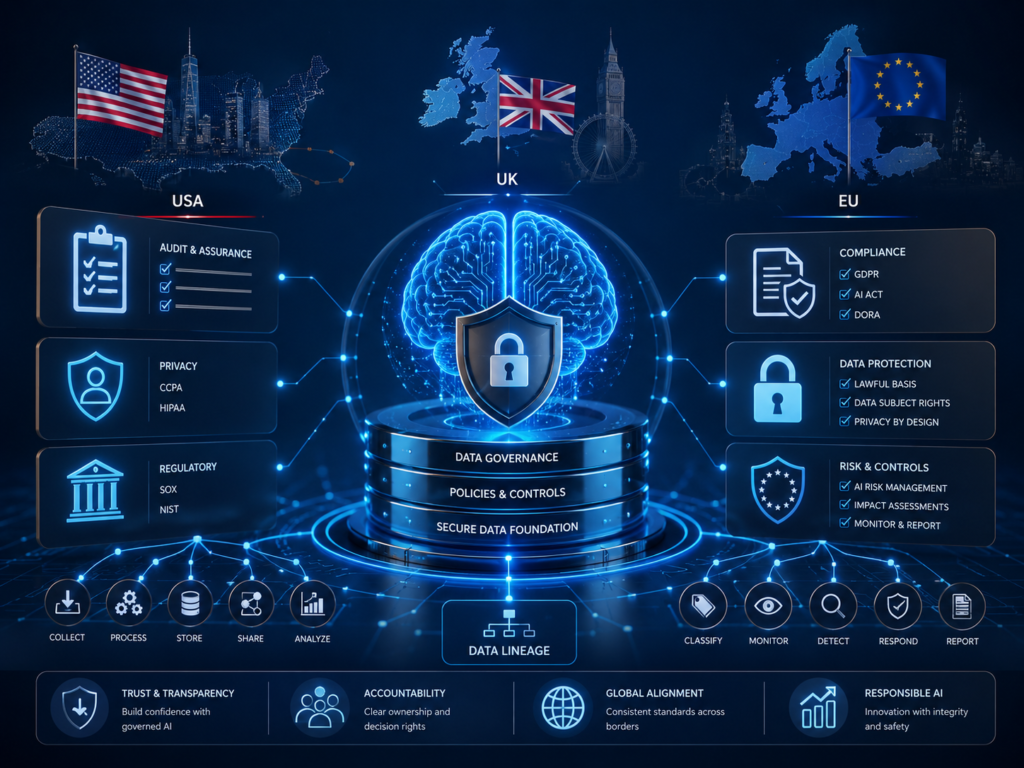
AI compliance is not the same everywhere. Enterprises operating across the USA, UK, Germany, and the wider EU need governance controls mapped to local laws, regulators, and sector expectations.
USA.
In the USA, healthcare teams need strict controls for protected health information. HHS states that the HIPAA Privacy Rule establishes national standards for the use and disclosure of protected health information.
Payment workflows should account for PCI DSS requirements, while SaaS, finance, insurance, and public-sector teams often need SOC 2, NIST, SEC, FINRA, or procurement-aligned evidence.
NIST’s AI Risk Management Framework is also relevant because it helps organizations manage AI risks to individuals, organizations, and society.
UK.
In the UK, data protection is governed by UK GDPR and the Data Protection Act 2018.
For London fintechs, Manchester health-tech teams, NHS suppliers, and public-sector vendors, AI governance should define lawful basis, access rights, retention, model explainability, review responsibilities, and audit readiness.
Germany and EU.
In Germany and the EU, AI governance needs to account for GDPR/DSGVO, the EU AI Act, BaFin, EBA expectations, data residency, and cross-border transfer controls.
The European Commission says the AI Act entered into force on August 1, 2024, and is intended to support responsible AI development and deployment in the EU.
For teams in Berlin, Munich, Frankfurt, Amsterdam, Paris, Dublin, and Zurich, governance should be part of architecture, cloud region selection, vendor review, data classification, and AI release management from day one.
How to Build a Zero-Trust AI Data Governance Framework
The goal is not more paperwork. The goal is safer AI adoption with controls that engineering, security, compliance, and business teams can actually use.
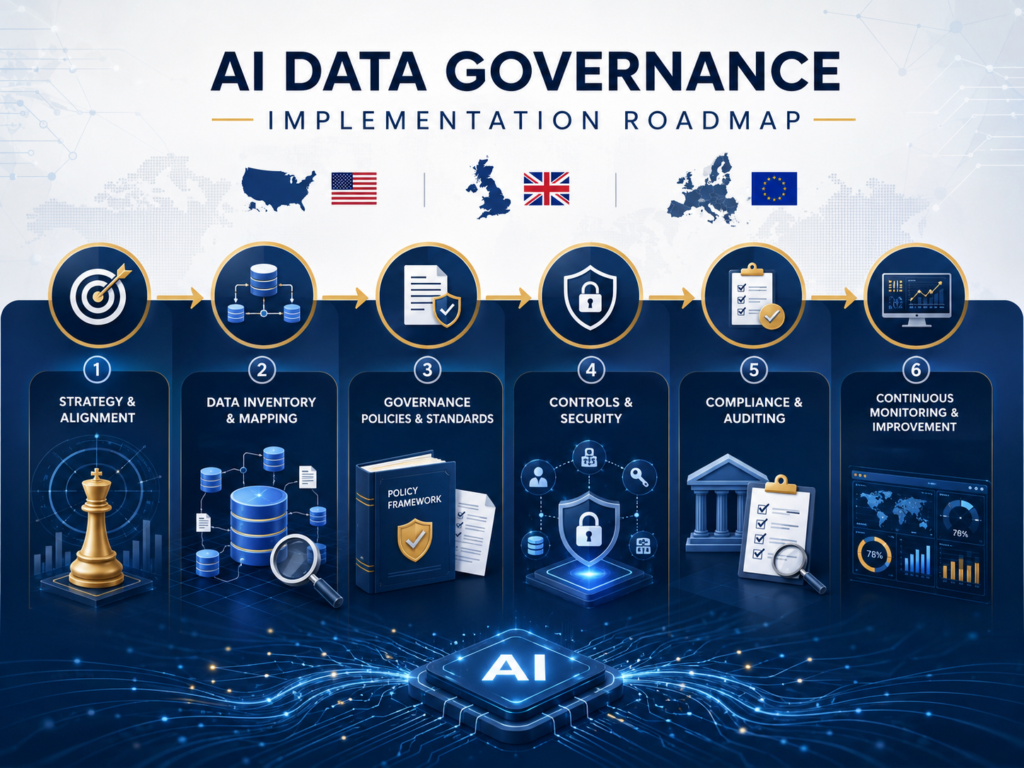
Start With High-Risk AI Use Cases
Begin where the risk is highest: finance, healthcare, insurance, government, SaaS, telecom, education, and critical infrastructure.
Common high-risk use cases include.
Claims summarization
Fraud detection
Clinical documentation support
Credit review
AML monitoring
Customer onboarding AI
Procurement screening
Employee-data copilots
Legal document analysis
Map AI Data Flows
Document how data moves from source systems into AI workflows. Include databases, cloud storage, SaaS platforms, APIs, vector databases, model endpoints, logging systems, and output channels.
This helps teams see where sensitive data may be copied, embedded, retrieved, cached, or exposed.
Classify Sensitive and Regulated Data
Before connecting AI tools to enterprise systems, classify customer data, employee data, payment information, health records, contracts, source code, credentials, and intellectual property.
Some data may be safe for retrieval. Some may require masking. Some should never be indexed or used by AI.
Enforce Access Controls
Access should follow identity, role, business purpose, location, sensitivity, and risk level.
A zero-trust model should verify access at runtime instead of assuming that a connected AI tool can use everything available in a workspace or database.
Add Monitoring and Audit Trails
AI activity should be logged in a way that supports investigation and compliance review.
Track prompts, retrieved sources, model outputs, user actions, approvals, exceptions, and policy violations. Review logs regularly, especially for high-risk workflows.
Review Vendors and Tooling
AI governance platforms and data governance software should support data cataloging, lineage, classification, access control, risk scoring, approval workflows, evidence capture, and integrations with identity providers.
Tools should also fit the organization’s compliance needs, such as GDPR, UK GDPR, HIPAA, PCI DSS, SOC 2, ISO/IEC 27001, or ISO/IEC 42001.
Mak It Solutions’ Business Intelligence Services can help create stronger analytics foundations before scaling AI governance.
Best Practices for Data Governance for AI
The strongest governance programs usually start small, prove value, and then scale.
Use these practices as a baseline.
Govern the riskiest AI workflows first.
Keep humans in the loop for sensitive decisions.
Do not index restricted data by default.
Use metadata to enforce AI-specific policies.
Separate training, testing, retrieval, and production data.
Mask or tokenize sensitive information where appropriate.
Review prompts and outputs for high-risk use cases.
Maintain audit trails that compliance teams can understand.
Recheck vendor permissions and cloud-region settings.
Train business users on what AI should not access or reveal.
Enterprise AI investment is growing quickly. Stanford’s 2025 AI Index reported that generative AI attracted USD 33.9 billion in private investment globally in 2024, which shows why governance needs to mature alongside adoption.
IBM’s 2025 Cost of a Data Breach Report also highlights the risk of adopting AI without proper security and governance, reporting a global average breach cost of USD 4.44 million.
Final Thoughts
Data governance for AI is the foundation of safer enterprise AI. If teams cannot explain where data came from, who accessed it, whether it was allowed, and how it shaped an output, they should not scale that workflow into production.
The next step is to assess AI data readiness. Map your highest-risk use cases, classify sensitive data, review permissions, check regional compliance gaps, and measure how mature your zero-trust governance model really is.
Planning to scale AI without creating new data risk? Mak It Solutions can help assess your AI data readiness, map compliance gaps, and design a zero-trust governance roadmap for US, UK, German, and EU teams.( Click Here’s )
Key Takeaways
Data governance for AI ensures AI systems use trusted, compliant, traceable, and permissioned data.
Zero-trust AI governance verifies users, datasets, models, prompts, permissions, and workflows before access is granted.
USA, UK, Germany, and EU organizations should map AI governance to regional compliance needs, including HIPAA, PCI DSS, UK GDPR, GDPR, BaFin, NIST, and the EU AI Act.
Strong controls include data lineage, metadata management, classification, policy-based access control, audit trails, model risk management, and sensitive data discovery.
Enterprises should start with high-risk use cases, then scale governance across departments, regions, and AI platforms.
FAQs
Q : What is data governance for AI?
A : Data governance for AI is the framework that ensures AI systems use accurate, secure, approved, traceable, and compliant data. It covers data quality, lineage, metadata, classification, access control, privacy, retention, and audit evidence.
Q : How is AI governance different from data governance for AI?
A : AI governance covers the broader management of AI systems, including model risk, ethics, performance, bias, security, human oversight, and accountability. Data governance for AI focuses specifically on the data that AI systems use, retrieve, generate, or expose.
Q : Why does AI need zero-trust data governance?
A : AI needs zero-trust data governance because models, agents, prompts, APIs, files, and users should not be trusted automatically. Every access request and data flow should be verified based on identity, permission, context, sensitivity, and business purpose.
Q : Which data governance controls are needed before using generative AI?
A : Before using generative AI, enterprises should define data classification, access controls, data lineage, retention rules, privacy checks, prompt logging, output review, and audit trails. Sensitive data discovery is also important before indexing documents into RAG systems or vector databases.
Q : Which industries need secure data governance for AI the most?
A : Finance, healthcare, insurance, SaaS, government, telecom, education, and critical infrastructure need secure AI data governance most urgently. These sectors often handle sensitive personal data, payment information, regulated decisions, or operational risk.