


Data Integrity in Analytics: A GCC Trust Guide
Data Integrity in Analytics: A GCC Trust Guide
Data Integrity in Analytics: A GCC Trust Guide
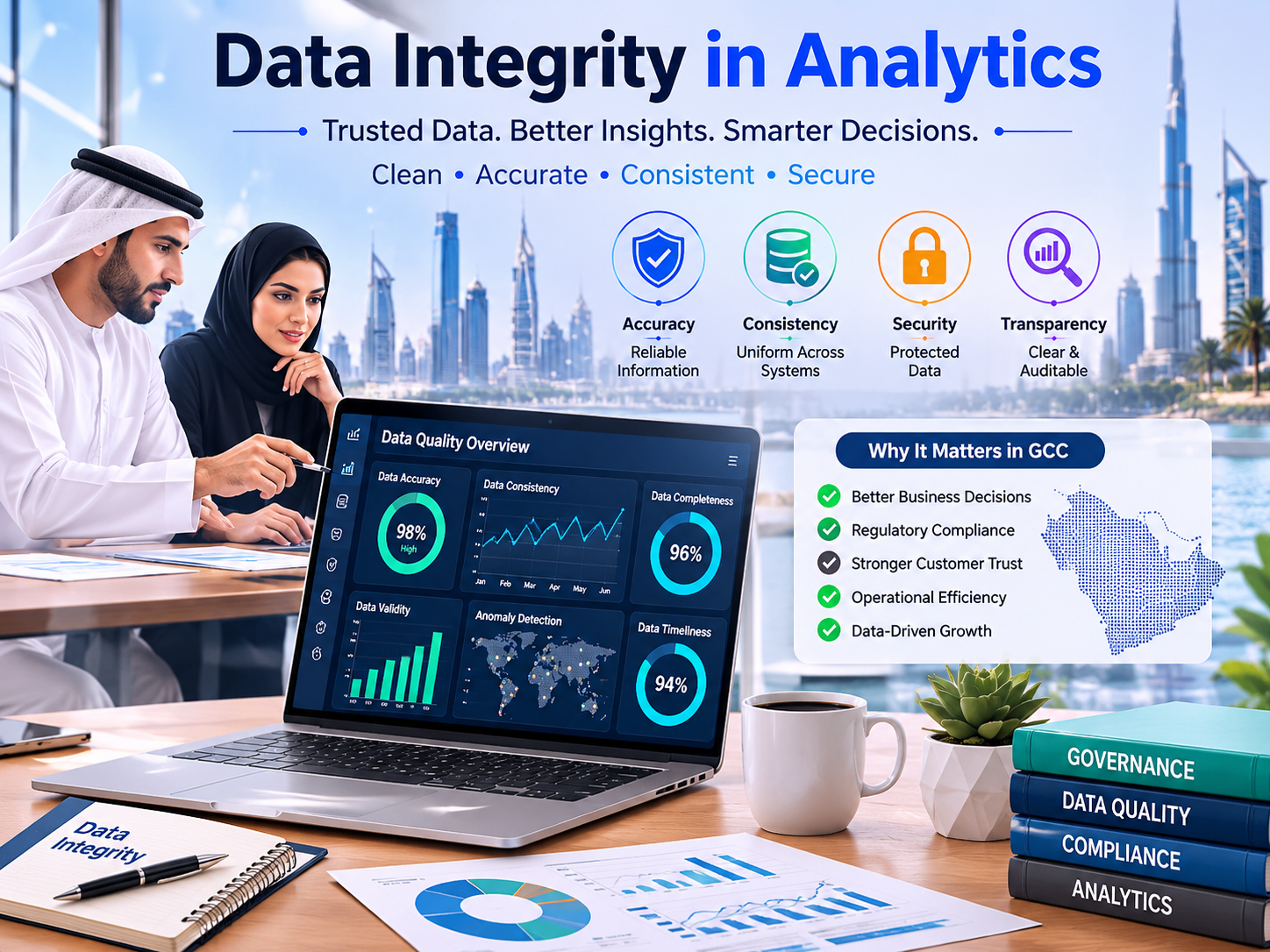
A polished dashboard can still tell the wrong story. One changed filter, manually edited spreadsheet, inconsistent KPI definition, or incomplete dataset can distort decisions involving significant budgets, customers, and business risk.
For organizations across Saudi Arabia, the UAE, Qatar, and the wider GCC, data integrity in analytics means keeping data accurate, consistent, traceable, and protected from unauthorized changes as it moves from source systems to reports and dashboards. Strong integrity depends on clear governance, validation, controlled access, data lineage, reconciliation, and reliable audit trails.
What Is Data Integrity in Analytics?
Data integrity in analytics is the preservation of trustworthy information throughout its lifecycle from collection and storage to transformation, analysis, and reporting.
The goal is not simply to produce an accurate number. Decision-makers should also be able to understand where that number came from, how it was calculated, what changed along the way, and whether the result can be reproduced.
Data Integrity vs. Data Quality
Data quality focuses on whether information is accurate, complete, timely, consistent, and useful.
Data integrity goes further. It asks whether that quality remained protected while information moved between databases, APIs, spreadsheets, ERP systems, analytics tools, and dashboards.
Organizations building reporting environments can strengthen this foundation through business intelligence services, where data integration, reporting accuracy, and meaningful analysis work together.
Data Integrity vs. Data Governance
Data governance defines ownership, policies, stewardship, permissions, standards, and accountability.
Data integrity is one of the outcomes those governance controls should protect.
For Saudi organizations, this distinction matters because national data-management initiatives place increasing emphasis on structured governance, accountability, classification, and responsible data handling.
Why Data Integrity in Analytics Matters for GCC Enterprises
A Riyadh fintech may depend on transaction dashboards. A Dubai retailer may use conversion and inventory reports. A Doha financial institution may rely on risk and operational analytics.
Different sectors, same problem: unreliable data can weaken forecasting, compliance reporting, AI outputs, management decisions, and executive confidence.
Poor integrity can lead to.
Incorrect business decisions
Misleading executive dashboards
Inaccurate regulatory or financial reporting
Weak AI and forecasting outputs
Disputes over KPI definitions
Reduced confidence in analytics teams
Difficulty investigating how a figure was produced
When users repeatedly question whether dashboard numbers are trustworthy, the organization has more than a reporting problem. It has a trust problem.
How Can Analytics Data Be Manipulated?
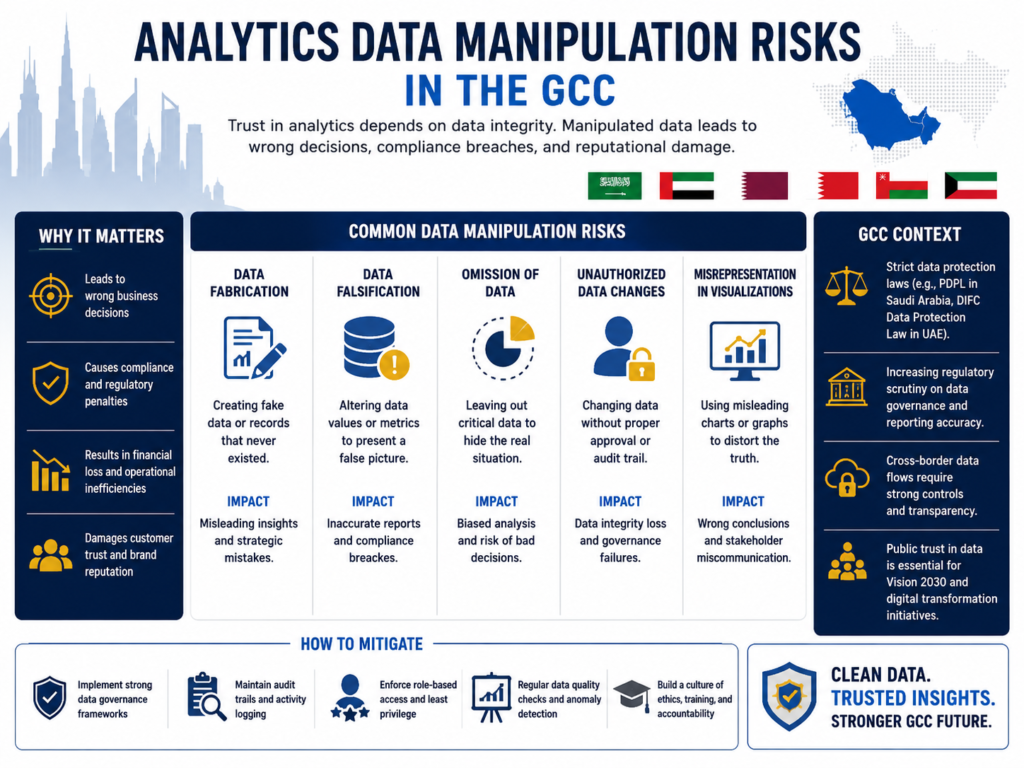
Analytics manipulation is not always deliberate. It can result from poor processes, inconsistent definitions, accidental edits, weak permissions, or undocumented reporting changes.
The most common risks include KPI gaming, selective filtering, unauthorized source-data changes, and misleading visual presentation.
KPI Gaming, Cherry-Picking, and Reporting Bias
A KPI may appear objective while still being influenced by how it is defined.
A team might change a denominator, select an unusually favorable reporting period, remove inconvenient outliers, or redefine a metric after seeing the results.
One practical safeguard is to document every important KPI with.
A named owner
An approved data source
A standard calculation formula
Defined exclusions
A refresh schedule
A documented change process
An approval or review mechanism
This reduces the opportunity for important metrics to change quietly from one report to another.
Dashboard Filters and Misleading Visualizations
A dashboard can be technically correct and still create a misleading impression.
Hidden filters, compressed chart scales, excluded branches, selected customer groups, or inconsistent date ranges can dramatically change the story a report tells.
For example, a Dubai retailer displaying only its strongest locations could make overall performance appear healthier than it really is.
Digital businesses should also ensure that analytics connects cleanly with operational sources such as e-commerce platforms and digital marketing systems. If source metrics are poorly defined, the reporting layer cannot fix the underlying problem.
Unauthorized Changes to Source Data
Integrity problems can begin long before information reaches a dashboard.
Common examples include.
Manual spreadsheet edits
Deleted transactions
Backdated records
ERP adjustments
Changed customer or product master data
Direct database editsUncontrolled data imports
Secure back-end development can help organizations enforce controlled data access and stronger application-level integrity instead of relying on informal manual processes.
How GCC Companies Can Prevent Data Manipulation
Preventing manipulation requires both technology and accountability. Automated checks are useful, but they work best when ownership, permissions, review, and escalation responsibilities are equally clear.
Implement Data Validation and Reconciliation Controls
Validation should happen before questionable information reaches executive reporting.
Useful controls include.
Required-field validation
Duplicate detection
Range and threshold checks
Anomaly monitoring
Source-to-report reconciliation
Exception alerts
Missing-data checks
Cross-system comparisons
In a logistics operation, for example, shipment totals displayed in an operational dashboard should reconcile with the underlying transaction system rather than being treated as correct simply because the visualization looks reasonable.
Organizations can also use Python development and data automation to flag suspicious, incomplete, or unusual records before they flow into reporting pipelines.
Use Data Lineage and Reliable Audit Trails
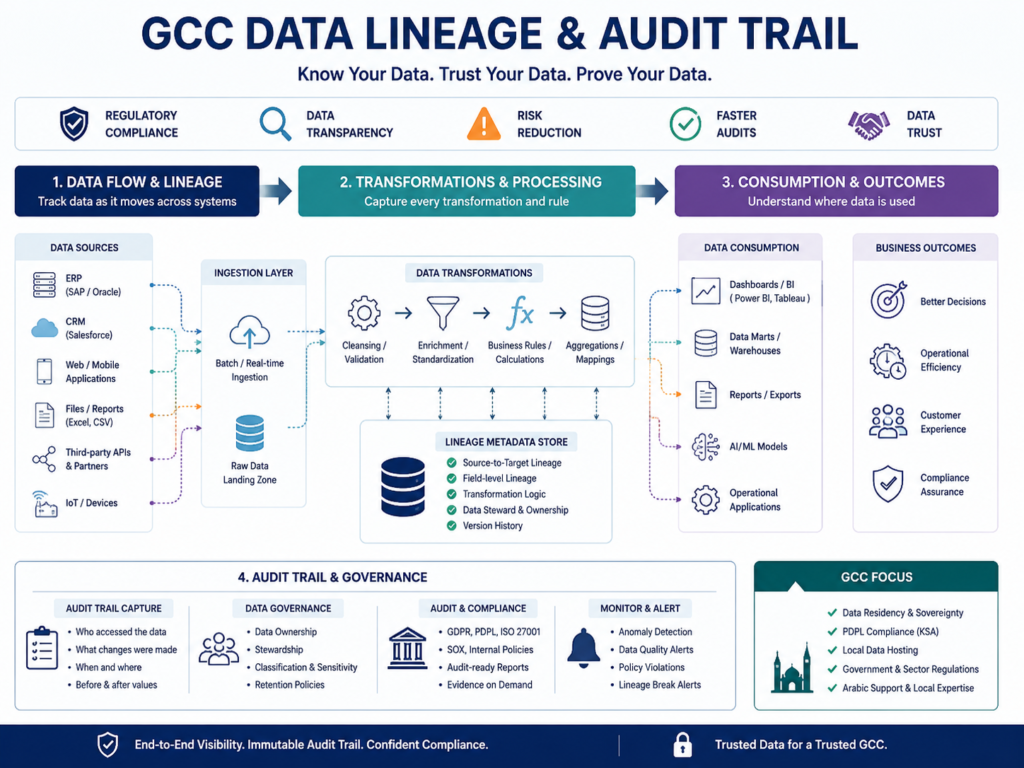
A trustworthy reporting chain should be traceable from beginning to end:
Source → Transformation → Dataset → KPI → Dashboard
Where practical, organizations should retain records of:
Data-source changes
Transformations
Timestamps
Report versions
Approvals
User actions
KPI-definition updates
Dataset refreshes
This makes disputed figures easier to investigate and reproduce.
If an executive challenges a revenue, customer, or operational KPI, the analytics team should be able to trace that number back through its reporting chain rather than manually reconstructing what may have happened.
Apply Role-Based Access and Segregation of Duties
No single employee should automatically control the KPI definition, underlying records, reporting logic, and final approval for sensitive metrics.
Role-based access can limit who is permitted to.
Modify source records
Change transformation logic
Edit KPI definitions
Publish reports
Approve sensitive changes
Access confidential datasets
Segregation of duties becomes particularly important in financial, regulated, and high-risk reporting environments.
GCC Data Governance and Compliance Considerations
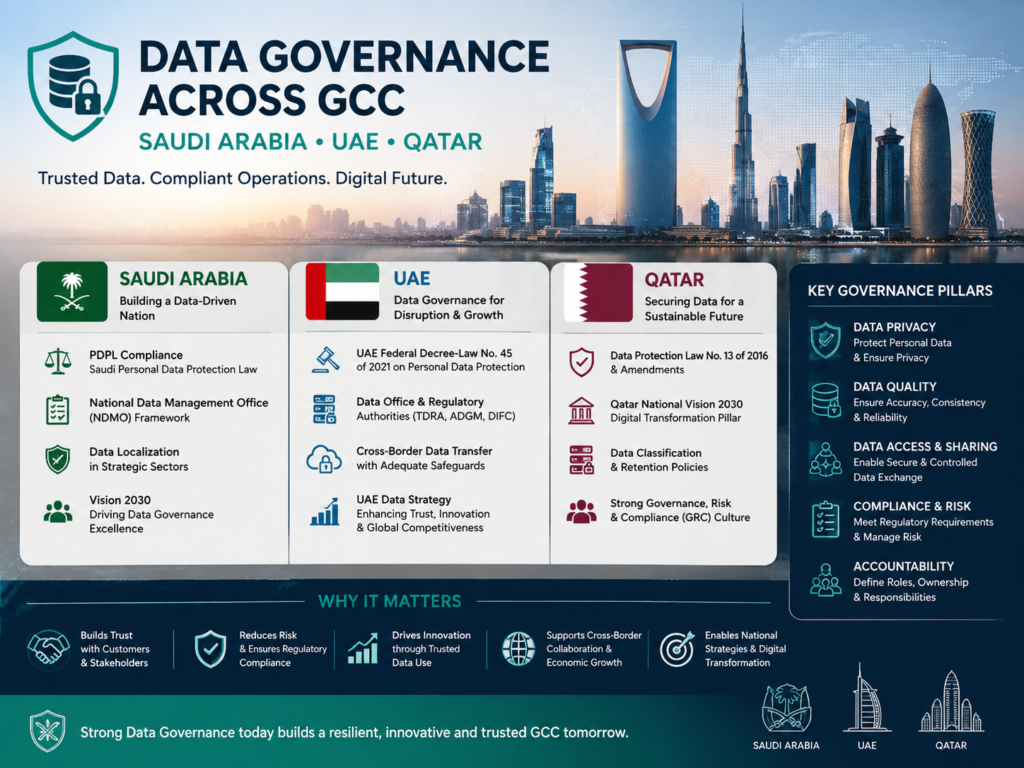
Governance requirements vary by country, sector, jurisdiction, and data type. Organizations should identify the rules that actually apply to their operations rather than relying on a single GCC-wide compliance model.
Saudi Arabia.
Saudi organizations handling analytics should consider applicable national data-governance expectations and personal-data requirements when their datasets contain identifiable information.
For companies operating in regulated environments, especially financial services, strong ownership, classification, monitoring, controlled access, and auditability are increasingly important parts of a trustworthy analytics environment.
A Riyadh fintech, for example, should be able to explain not only what a dashboard reports but also which systems supplied the information, who can modify it, and how important changes are reviewed.
UAE.
The UAE has multiple regulatory environments, so businesses should determine which legal and sector framework applies to their specific operations.
A company operating under a financial free-zone regime may face different data-protection or governance obligations from a business operating under another jurisdiction.
That makes jurisdiction mapping an important early step.
An Abu Dhabi financial company, for example, should avoid assuming that one authority represents every data-governance requirement that may apply to its analytics operations.
Qatar.
Qatar’s financial and digital environments also place strong value on information security, governance, and dependable data use.
For a Doha bank, enterprise, or public-sector organization, practical analytics controls may include.
Defined data ownership
Reconciliation
Controlled access
Monitoring
Documented lineage
Change records
Sector-specific compliance checks
The goal is not to create paperwork for its own sake. It is to ensure that important information can be trusted when management, auditors, regulators, or customers depend on it.
Building Trustworthy Analytics for GCC Operations
Strong data integrity in analytics is easier to maintain when integrity is designed into the operating model instead of added after dashboards are already in production.
Establish Clear KPI Ownership and Definitions
Every critical KPI should have a documented definition.
At minimum, teams should know.
Who owns the KPI
Which source is approved
How the metric is calculated
How frequently it refreshes
Which exclusions apply
Who can change its logic
How changes are approved
This prevents different teams from using the same KPI name for different calculations.
Design for Arabic and English Data Environments
Bilingual GCC data environments create practical challenges that organizations should address before analysis.
Arabic-English datasets may contain.
Multiple spellings of the same customer
Transliteration differences
Mixed Arabic and English labels
Inconsistent date formats
Duplicate company names
Different telephone formats
Inconsistent currencies or reference fields
Where possible, use stable identifiers rather than matching records only by names.
Master-data standards should also define how Arabic text, English transliteration, dates, contact information, and duplicate records are handled.
Applications collecting operational data should follow the same discipline. Reliable data from mobile app development services and SEO and measurement systems can support more dependable downstream reporting when tracking rules and data structures are clearly defined.
Govern AI and Advanced Analytics Inputs
AI does not remove the need for data integrity. It makes it more important.
Forecasting systems, machine-learning models, and generative AI applications can produce convincing outputs even when their underlying data is incomplete, manipulated, outdated, or poorly governed.
Before treating AI output as decision intelligence, organizations should establish.
Clear source provenance
Data lineage
Validation records
Controlled datasets
Defined access permissions
Version control
Review procedures
Reliable AI begins with reliable data.
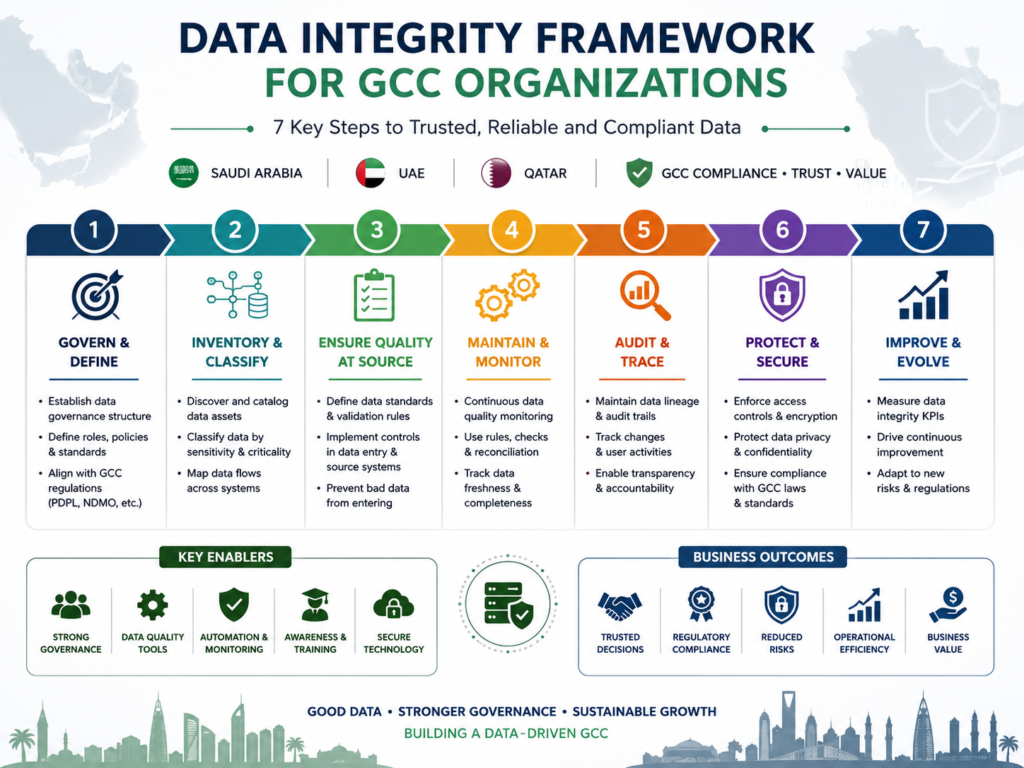
A Practical Data Integrity in Analytics Framework
Organizations do not need to solve every governance problem at once. A practical approach is to begin with the data and KPIs that carry the greatest business or compliance risk.
Identify Critical Data and KPIs
Start with the information that matters most, such as.
Regulatory reports
Financial metrics
Customer information
Executive dashboards
Operational performance indicators
AI and forecasting datasets
Prioritizing critical information keeps governance efforts focused on business risk rather than creating unnecessary controls everywhere.
Add Ownership, Controls, and Monitoring
Assign responsible owners and introduce appropriate safeguards, including.
Validation
Reconciliation
Role-based permissions
Audit logs
Data lineage
Anomaly alerts
Approval processes
Controls should match the sensitivity and business importance of the information being protected.
Audit and Continuously Improve
Analytics integrity is not a one-time project.
Teams should periodically review.
Failed reconciliations
Unauthorized or unusual changes
Stale datasets
Missing lineage
Data-quality exceptions
KPI-definition changes
Access privileges
Repeated reporting disputes
A useful maturity path is:
Uncontrolled reporting → Governed analytics → Trusted analytics → Auditable decision intelligence
The objective is not simply to generate more reports. It is to make important business numbers explainable, repeatable, and defensible.
Final Thoughts
Strong data integrity in analytics combines data quality, governance, validation, ownership, access control, lineage, reconciliation, and auditability.
For GCC organizations, these practices create something more valuable than cleaner dashboards: confidence that business decisions are based on information that can be traced, reviewed, and trusted.
Mak It Solutions can help organizations evaluate analytics workflows, KPI governance, application data flows, automation, and reporting controls. Contact Mak It Solutions to discuss a tailored data and analytics approach for Saudi Arabia, the UAE, Qatar, or wider GCC operations.
FAQs
Q : How can Saudi companies detect KPI manipulation in BI reports?
A : Compare important dashboard KPIs with their approved definitions, original source systems, reconciliation totals, and historical changes. Audit logs and independent review can also help identify changes to filters, formulas, datasets, or reporting periods.
Q : What analytics audit controls should UAE enterprises use?
A : Useful controls include access logging, dataset versioning, KPI documentation, source-to-report reconciliation, approval workflows, and records of important dashboard changes. Organizations should also identify which regulatory framework applies to their specific jurisdiction and data.
Q : How can Qatar financial institutions improve analytics data integrity?
A : Start with clear ownership, validation controls, segregation of duties, reconciliation, change logging, and documented data lineage. Sensitive KPIs should be traceable back to their approved source systems.
Q : How should GCC companies manage Arabic and English data inconsistencies?
A : Use shared identifiers wherever possible instead of relying only on customer or company names. Standardize Arabic text, English transliterations, dates, telephone formats, currencies, and duplicate-detection rules before combining data for analysis.
Q : Does data lineage help GCC enterprises prove reporting accuracy?
A : Yes. Data lineage shows how information moves from source systems through transformations and datasets to final KPIs and dashboards. Combined with reconciliation and audit trails, it makes important analytics easier to reproduce, investigate, and defend.