


Data Privacy Laws 2025: GDPR, CCPA and Beyond
Data Privacy Laws 2025: GDPR, CCPA and Beyond

Data Privacy Laws 2025: GDPR, CCPA and Beyond
Introduction
If you’re operating across the US, UK, Germany or the wider EU, data privacy laws 2025 are no longer a nice-to-have slide in a legal deck they shape how you design products, pick cloud vendors and roll out AI. Over 80% of the world’s population now lives under some form of national data privacy law, and that share keeps rising. At the same time, enforcement is sharper than ever: GDPR fines alone reached roughly €1.2 billion in 2024, and big-ticket cases continue into 2025.
For privacy, security and legal/compliance leaders, the question is no longer whether privacy laws apply it’s how to align overlapping regimes without drowning in admin. You’re juggling GDPR/DSGVO, UK-GDPR, CCPA/CPRA, an expanding patchwork of US state laws, sector rules like HIPAA and PCI DSS, and now AI-specific rules such as the EU AI Act.
This global compliance playbook gives you a practical view of the main data privacy laws in 2025, how new US and EU updates change the game, and what a future-proof privacy program looks like across US, UK and EU operations with checklists, examples and tooling guidance you can actually use.
Note
This guide is general information only and does not constitute legal advice. Always consult qualified counsel for your specific situation.
In 2025, most businesses need to navigate a dense landscape of data privacy laws. In practice, data privacy laws 2025 for most teams means GDPR/DSGVO, UK-GDPR, CCPA/CPRA and a fast-growing patchwork of US state, Brazilian (LGPD) and Chinese (PIPL) laws, plus strict cross-border transfer rules. To stay compliant, organisations should build a continuous privacy program that maps data flows, manages consent and data subject rights, governs AI and cross-border transfers, and uses tools like consent and privacy management platforms to automate repeatable controls.
What are the key data privacy laws businesses must comply with in 2025?
GDPR, CCPA/CPRA and beyond
In 2025, most global businesses must navigate GDPR/DSGVO, UK-GDPR, CCPA/CPRA and an expanding set of US state, Brazilian (LGPD) and Chinese (PIPL) laws, plus cross-border transfer rules like Standard Contractual Clauses (SCCs) and the EU–US Data Privacy Framework (DPF). Together, these laws define how you collect, use, store and share personal data across your footprint.
Core “pillar” laws and typical touchpoints.
GDPR / DSGVO (EU + EEA, incl. Germany)
Applies to controllers and processors in the EU/EEA and many non-EU companies that target or monitor people in the EU (for example, a New York SaaS platform serving Berlin and Munich customers).
UK-GDPR + Data Protection Act 2018 (UK)
Mirrors GDPR principles but under UK law and ICO enforcement; affects London or Manchester-based entities and any non-UK company targeting UK residents.
CCPA/CPRA (California)
Covers for-profit entities handling personal data of California residents above certain thresholds, with a strong focus on opt-outs, “sale/share” and targeted advertising.
Other US state privacy laws
Colorado, Virginia, Connecticut, Utah and a growing list of states (including Delaware, Minnesota, Maryland, Texas and others) now have GDPR-inspired, but not identical, laws.
LGPD (Brazil) and PIPL (China)
Often hit global SaaS, e-commerce or gaming firms that serve Brazilian or Chinese residents; they share concepts like consent, purpose limitation and data subject rights, but with local twists in enforcement and cross-border rules.
If you’re a cloud-hosted SaaS scale-up in Austin with customers in London, Berlin and São Paulo, you’re realistically in scope for GDPR/DSGVO, UK-GDPR, CCPA/CPRA, at least one other US state law, LGPD and sector-specific rules if you touch health or financial data.
This is where a strong data mapping and classification foundation often linked to analytics or BI stacks like those Mak It Solutions helps clients build – becomes critical to avoid blind spots. (Mak it Solutions)
Sectoral and security frameworks that sit alongside privacy laws
Data privacy laws rarely operate alone. Frameworks like HIPAA, GLBA, PCI DSS, SOC 2 and ISO/IEC 27701 add sector-specific requirements on top of your baseline obligations:
HIPAA (US) governs protected health information (PHI) for covered entities and business associates such as US hospital systems or telehealth platforms.
GLBA covers US financial institutions’ customer data, often alongside state privacy laws and GDPR for cross-border operations.
PCI DSS mandates cardholder data protection for merchants and payment processors globally; it’s particularly relevant to e-commerce and fintech platforms in New York, London or Frankfurt.
SOC 2 / ISO/IEC 27001 / ISO/IEC 27701 provide assurance frameworks around security and privacy management and are heavily requested in enterprise RFPs across the US, UK and EU.
Example mappings
A US hospital network using AI diagnostics and remote monitoring must align HIPAA, state health privacy rules, possibly GDPR for EU patients, and security frameworks like NIST and ISO/IEC 27001.
An EU or German bank in Frankfurt or Berlin typically sits under GDPR/DSGVO, BaFin guidance, PCI DSS for card payments, and now the Digital Operational Resilience Act (DORA) for ICT resilience.
Cross-border data transfers and the EU–US Data Privacy Framework in 2025
In 2025, cross-border data transfers are governed by a mix of adequacy decisions, SCCs, Binding Corporate Rules (BCRs) and the EU–US Data Privacy Framework. The EU’s 2023 adequacy decision for the DPF, upheld by the EU General Court in 2025, restores a more stable legal basis for transfers from the EU to certified US companies.
However, Schrems II sensitivities haven’t vanished. Many US, UK and German businesses still rely on updated SCCs, UK IDTA/addenda and Transfer Impact Assessments (TIAs) when using US-based services like cloud analytics or marketing platforms. EDPB guidance emphasises ensuring “essentially equivalent” protection and scrutinising third-country laws that might undermine privacy rights.
If you’re a London-based SaaS vendor with US-hosted infrastructure and German enterprise clients, expect detailed questions on your SCCs, DPF status, data localisation options (for example, EU data centres) and your approach to government access requests.
Why do GDPR and CCPA remain the anchor regulations for global data privacy strategies in 2025?
When GDPR and CCPA apply to US, UK, EU and global companies
GDPR and CCPA sit at the centre of most global data privacy laws 2025 strategies because they are broad in scope, extraterritorial, backed by high fines and active regulators, and many newer laws copy their definitions, rights and enforcement models.
GDPR/DSGVO applies whenever you.
Have an establishment in the EU/EEA, or
Offer goods/services to people in the EU, or
Monitor EU residents’ behaviour (for example, via tracking, profiling or analytics)
CCPA/CPRA applies to certain for-profit entities doing business in California that meet revenue, data volume or revenue-from-data thresholds and process California residents’ personal information.
Concrete scenarios:
A US SaaS platform in Austin with paying users in Berlin and Munich is very likely under GDPR/DSGVO, even without an EU office.
A UK retail brand in London running a direct-to-consumer site and ads targeting California consumers must consider CCPA/CPRA obligations.
A German fintech using US processors (for example, a New York-based payments gateway) must juggle GDPR/DSGVO, BaFin expectations and US processor contract clauses.
Risk, fines and enforcement trends that keep GDPR and CCPA at the center
GDPR and CCPA/CPRA are where regulators have the biggest tools and they’re using them. GDPR fines have repeatedly reached hundreds of millions of euros per case, with big tech and ad-tech in the spotlight, while total fines across Europe hit about €1.2 billion in 2024 alone.
In the US, the California Privacy Protection Agency (CPPA) and State Attorneys General are increasingly active, and multi-billion-dollar privacy settlements (for example, Texas vs Google) highlight how state enforcement can bite.
Boards and investors now view privacy metrics alongside cybersecurity and ESG.
The average global cost of a data breach reached around $4.88M in 2024 and remains above $4.4M in 2025, making prevention and fast response a financial imperative.
Around 53% of consumers are now aware of national privacy laws, and strong privacy rules increase their trust in AI and digital services.
This is why many US, UK and EU enterprises pair legal risk analysis with SOC 2, ISO 27001 and privacy-by-design programs something Mak It Solutions regularly supports when modernising cloud and analytics platforms. (Mak it Solutions)
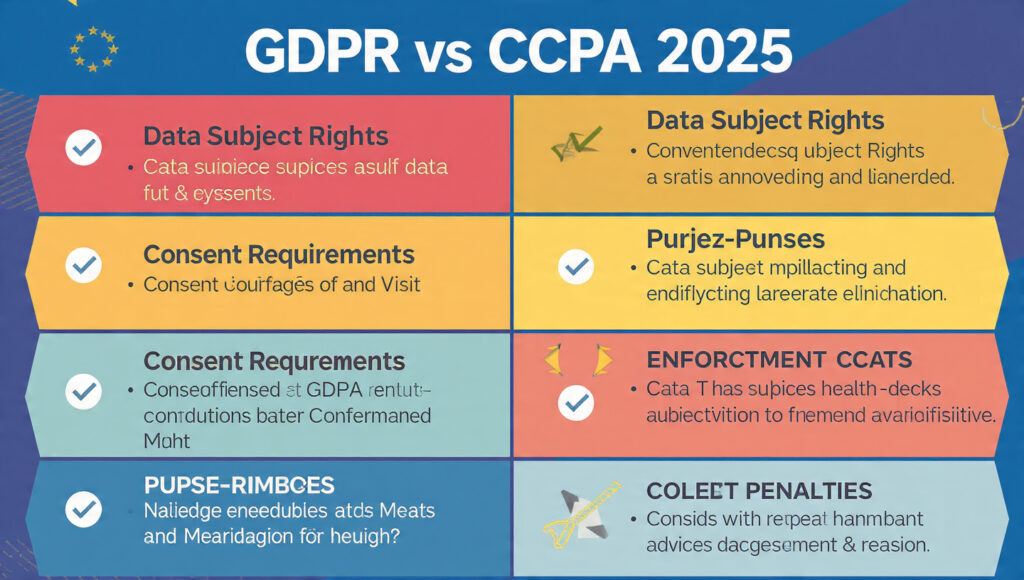
What are the main differences between GDPR and CCPA/CPRA in 2025?
GDPR is broader in scope and relies on lawful bases and DPO-style accountability, while CCPA/CPRA focus on consumer opt-outs, “sale/share” and targeted advertising, with different thresholds and penalty schemes.
At a glance.
Scope & thresholds
GDPR: applies to almost any personal data processing of individuals in the EU; no turnover threshold.
CCPA/CPRA: limited to certain for-profit businesses (revenue, data volume, revenue-from-data thresholds).
Legal basis vs opt-out model
GDPR: needs a lawful basis (consent, contract, legitimate interests, legal obligation, etc.) for each processing purpose.
CCPA/CPRA: more tolerant of collection by default but strong rights to opt-out of “sale/share” and targeted advertising, including via global opt-out signals like GPC.
Rights
GDPR: access, rectification, erasure, restriction, portability, objection, and rights around automated decision-making.
CCPA/CPRA: right to know, delete, correct, opt-out of sale/share and targeted ads, limit use of sensitive personal information, plus non-discrimination.
Penalties
GDPR: up to 4% of global annual turnover or €20M, whichever is higher.
CCPA/CPRA: mainly per-violation statutory penalties enforced by regulators, plus limited private actions around security breaches.
For many global organisations, the practical approach in 2025 is: design to GDPR/UK-GDPR standards, layer CCPA-style opt-outs and state-specific nuances on top, and then extend to LGPD, PIPL and others as needed.
US data privacy laws 2025.
Which US states have data privacy laws in 2025 and what do they require?
By the end of 2025, around 20 US states will have comprehensive privacy laws in force, covering a mix of GDPR-like rights and CCPA-style opt-outs.

Key examples.
California (CCPA/CPRA) the reference model: broad consumer rights, “Do Not Sell or Share” links, sensitive data controls, and CPPA enforcement.
Colorado, Virginia, Connecticut, Utah early adopters, often using GDPR-style rights with opt-outs for sale/targeted ads.
Delaware, Minnesota, Maryland, Texas and others newer laws with variations on data minimisation, sensitive data rules and profiling safeguards.
Rather than memorising each statute, most organisations treat them as a family of similar frameworks and design a baseline program covering:
Transparent notices
Access, deletion, correction and portability
Opt-outs of sale/share and targeted advertising
Extra protections for minors and sensitive data categories
Consumer privacy rights in US states vs GDPR-style rights
US state laws and GDPR give consumers many overlapping rights, but with different flavours.
Access & portability
Widely present in both GDPR and most US state laws; expect to deliver machine-readable exports within defined timelines.
Deletion & correction
Required under GDPR and most US state laws, subject to exceptions.
Opt-out of targeted advertising & sale/share
Stronger emphasis in US regimes like CCPA/CPRA and newer state laws.
Profiling & automated decisions
GDPR/DSGVO gives individuals specific rights where decisions have legal or similarly significant effects; US state treatments vary.
Minors & sensitive data
COPPA and new state “kids’ codes” plus heightened protections for health, biometric and precise location data.
For small US businesses and SaaS providers in New York, Austin or San Francisco, the most effective strategy is to implement a privacy UX that works for the strictest combination of these rights and to automate DSAR workflows wherever possible.
US data privacy laws 2025 checklist for small businesses and SaaS providers
A practical US data privacy checklist for 2025.
Map your data
Inventory systems, data flows and processors (including CDPs, analytics and ad platforms).
Update notices
Make privacy notices clear, layered and state-aware; flag California and other state-specific rights.
Implement “Do Not Sell or Share” & GPC
Add links/buttons and honour global privacy control signals where required.
Automate DSARs
Standardise intake, verification, response templates and logging across all states.
Lock down processors
Update DPAs and security addenda with US, UK and EU-aligned requirements.
Strengthen security
Align with NIST/ISO 27001 controls and have an incident playbook ready.
This is a natural place to bring in privacy management software and your existing observability stack; Mak It Solutions often helps teams align logging, ETL and BI pipelines with these operational privacy workflows. (Mak it Solutions)
EU, UK and Germany data protection laws 2025
GDPR, GDPR Procedural Regulation, AI Act and Data Act
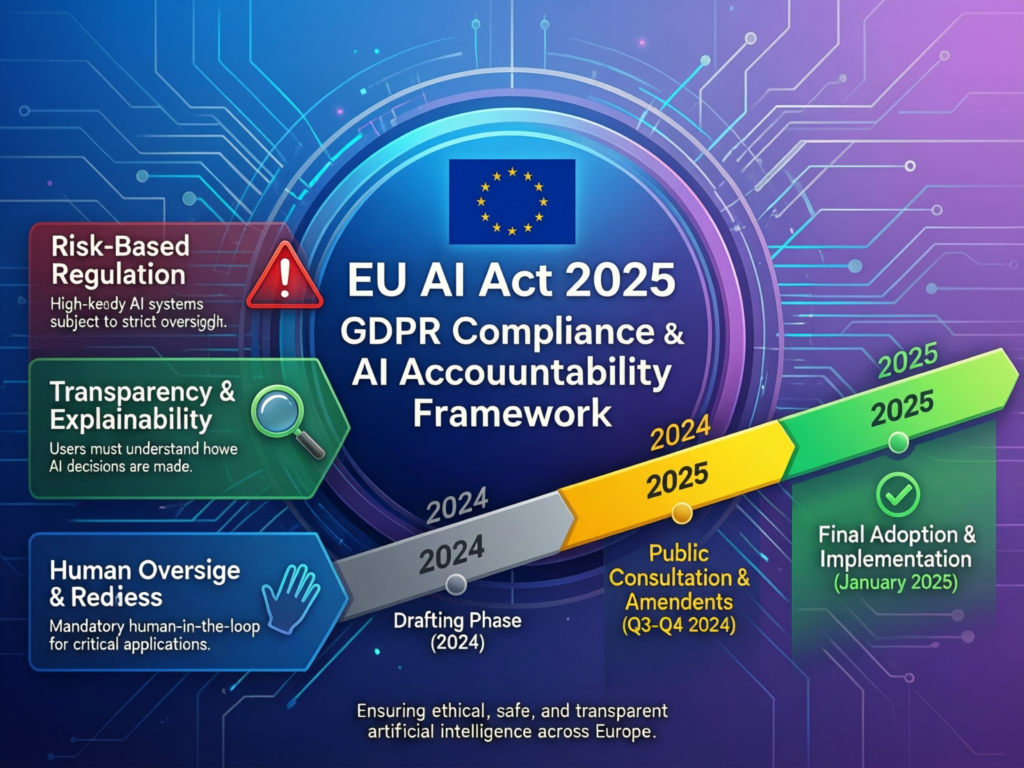
GDPR remains the baseline law for personal data across the EU/EEA, but 2025 brings two big shifts: a GDPR Procedural Regulation to harmonise cross-border enforcement, and the start of EU AI Act implementation.
The GDPR Procedural Regulation sets common timelines and rules for how Data Protection Authorities (DPAs) cooperate on cross-border cases – crucial for big cloud and ad-tech investigations.
The EU AI Act introduces risk-tiered rules for AI systems, with tough obligations for “high-risk” use cases like credit scoring, recruitment and some health applications.
The Data Act and DORA add data-sharing, interoperability and ICT-resilience duties, especially for financial services and data-rich IoT ecosystems.
If you’re a Berlin-based fintech using AI for fraud detection and cloud services from US hyperscalers, expect your privacy program to converge with AI governance, model risk and operational resilience under DORA.
UK-GDPR, Data Protection Act 2018 and sector rules (NHS, Open Banking)
Post-Brexit, the UK runs UK-GDPR plus the Data Protection Act 2018, enforced by the ICO. The core GDPR concepts remain – lawful basis, transparency, rights, DPIAs but with UK-specific guidance, particularly on cookies, ad-tech and AI.
Sector-specific examples:
NHS and health data
UK health bodies and vendors must meet tight confidentiality and security expectations, often going beyond legal minimums.
Open Banking / PSD2-style consent
London and Manchester financial services firms must reconcile strong consent and security requirements with analytics and personalisation.
UK-based SMEs often look for a pragmatic UK-GDPR compliance checklist that dovetails with EU and US obligations – a space where Mak It Solutions’ web and data teams often help unify consent, logging and analytics implementations across sites and apps. (Mak it Solutions)
DSGVO in Germany and BaFin expectations for financial services
In Germany, DSGVO (German term for GDPR) operates alongside the Bundesdatenschutzgesetz (BDSG) and a network of federal and state DPAs. Enforcement is often perceived as strict, especially around employee data, tracking and international transfers.
For banks and insurers in Frankfurt, Berlin and Munich, BaFin adds an extra layer:
Detailed expectations on outsourcing, especially to cloud providers
Requirements to know where data is stored
Ongoing monitoring of cloud security and resilience, aligned with DORA timelines.
If you’re selling SaaS into German financial services as a US or UK vendor, be ready with clear documentation on your controls, incident response and data residency and expect BaFin-related clauses in contracts and security questionnaires.
How are new US state privacy laws and EU updates changing compliance in 2025?
New US state laws and EU updates push companies toward continuous, risk-based privacy programs that combine harmonised policies, stronger AI governance and more robust cross-border transfer safeguards.
From one-off projects to continuous privacy programs
The days of “GDPR project 2018, CCPA project 2020, CPRA project 2023” are over. Between rolling US state go-lives and EU updates like the GDPR Procedural Regulation and DORA, regulators now expect ongoing privacy governance.
Continuous monitoring of laws and guidance
Regular policy and RoPA updates
Embedded DPIAs for new products and AI features
Evidence of training, audits and management oversight
US, UK, German and wider EU entities increasingly create a global privacy framework a single set of principles and controls with regional “overlays” (for example, stricter cookie rules for Germany, specific terminology for California).
AI, profiling and automated decision-making risk under GDPR and the EU AI Act
Profiling and automated decision-making have long been sensitive under GDPR; the EU AI Act now adds explicit risk-tiering and obligations for high-risk AI, including transparency, human oversight and data governance.
Typical high-risk scenarios.
Credit scoring for EU customers in Berlin or Paris
Fraud detection across EU and US payment flows
HR screening tools used in London and Munich for automated CV ranking
Healthcare AI in US and EU hospital networks
For these, expect to combine.
GDPR/DSGVO DPIAs focused on rights and freedoms
AI-specific risk assessments and model documentation
Clear human-in-the-loop review points
SCCs, BCRs, DPF and vendor due diligence
Cross-border transfers in 2025 are less chaotic than immediately after Schrems II, but still heavily scrutinised. Most mature programs combine:
SCCs / UK IDTA for routine vendor transfers
BCRs for large groups with complex intra-group processing
EU–US DPF participation (where suitable) to ease transfers to US vendors
Vendor due diligence focusing on security, government access and sub-processors.
Enterprise customers – from EU banks to NHS trusts to US healthcare networks now routinely demand detailed transfer documentation, TIAs and independent certifications (SOC 2, ISO 27001, ISO 27701).
What practical steps should US, UK and EU companies take to build a future-proof data privacy program in 2025?
A future-proof program aligns governance, data mapping, DPIAs, consent, DSARs and vendor management across jurisdictions, backed by clear ownership, KPIs and board-level visibility.
Foundation: data mapping, RoPAs, DPIAs and retention rules
Start with foundations that scale across GDPR, UK-GDPR, CCPA/CPRA and US state laws:
Data mapping & classification
Know which systems hold personal and sensitive data across your cloud, ETL and BI stacks. (Mak it Solutions)
Records of Processing Activities (RoPAs)
Maintain consistent RoPAs that capture purposes, legal bases, locations and processors for EU and UK requirements.
DPIAs/PIAs
Use them not just as a legal checkbox, but as a product-risk tool particularly for profiling, AI and cross-border use cases.
Retention & deletion rules
Define data lifecycles and automate deletion/archiving in your warehouses, lakes and logs wherever possible.
Mak It Solutions often integrates these foundations into broader data, BI and cloud modernization projects, so privacy isn’t bolted on later but baked into how you design pipelines and dashboards. (Mak it Solutions)
Operationalising consent, cookies, DSARs and marketing analytics
Next, turn principles into day-to-day workflows.
Consent & cookies
Implement region-aware consent banners (for example, stricter, opt-in-first banners for Germany and the wider EU; more flexible, disclosure-led approaches in some US contexts) and ensure they actually drive tag behaviour. (ICO)
DSARs (DSRs)
Standardise intake (web forms, email, phone), automate identity verification where possible, and set SLAs aligned with GDPR/UK-GDPR and US state timelines.
Marketing & analytics
Configure tools like Google Analytics and ad platforms to respect consent states, minimise identifiers where feasible and document your legitimate interests assessments where used.
If your tracking stack is already complex, this is a good moment to rationalise tags and consolidate platforms something Mak It Solutions has done repeatedly when tuning performance and cloud cost optimisation projects. (Mak it Solutions)
How can tools like consent management platforms and privacy management software help in 2025?
Well-implemented consent management platforms (CMPs) and privacy management platforms centralise preference logic, records, workflows and reporting, drastically reducing manual effort and error risk across GDPR and CCPA/CPRA obligations.
Where tools help most.
CMPs
Coordinate consent across web, mobile apps and backend systems; enforce region-specific policies; log consent events for audits. (Enzuzo)
Privacy management platforms
Maintain RoPAs, DPIAs, TIAs and vendor inventories; orchestrate DSAR workflows; provide dashboards for DPOs and CISOs.
Data discovery & classification
Scan warehouses, lakes and SaaS tools for personal data to prevent “shadow data” that often drives breach costs higher.
When evaluating vendors, look for.
GEO coverage across US, UK, EU and emerging regimes
Integrations with AWS, Azure, GCP and key SaaS platforms
Strong audit trails, role-based access control and reporting
Clear implementation and change-management support
From compliance cost to competitive advantage.
Demonstrating compliance to regulators, auditors and enterprise customers
Enterprise customers in New York, London or Berlin don’t just want to hear “we’re compliant” they want evidence. Typical proof points include:
DPIA and RoPA logs
Training records and policy acknowledgements
Incident registers and post-mortems
SOC 2 / ISO 27001 / ISO 27701 reports
Standardised Data Processing Agreements and SCC/IDTA packs
When privacy controls are aligned with your cloud, BI and software architecture rather than bolted on they become part of the story you tell in RFPs and due diligence, helping you stand out from less mature competitors. (Mak it Solutions)
Governance: roles for DPOs, CISOs, legal and product teams
Effective privacy programs are cross-functional.
DPO / privacy lead
Owns governance, RoPAs, DPIAs and regulator liaison.
CISO / security
Owns security controls, incident response and technical safeguards.
Legal & compliance
Monitors laws, drafts contracts and policies.
Product, data & engineering
Build privacy-by-design into systems, with clear ownership for consent, logging and minimisation.
Smaller companies might not need a full-time DPO but should still assign a privacy lead and know when to involve external counsel or specialist consultancies.
Building your 2025 data privacy action plan
A good 2025 action plan usually includes:
A current-state maturity assessment
A 90-day quick-win plan (for example, DSAR workflows, cookie compliance)
A 12- to 18-month roadmap for deeper refactors (data mapping, AI governance, vendor consolidation)
This is exactly the bridge between strategy and implementation where Mak It Solutions often works with privacy, security and legal teams across the US, UK, Germany and wider EU tying compliance goals to concrete changes in cloud, data and application architectures. (Mak it Solutions)

Key Takeaways
Data privacy laws in 2025 form a global web led by GDPR/DSGVO, UK-GDPR and CCPA/CPRA, plus fast-moving US state, Brazilian and Chinese regimes.
EU updates like the GDPR Procedural Regulation, AI Act, Data Act and DORA push organisations toward continuous, risk-based privacy and AI governance.
US state laws turn CCPA-style rights into a 50-state patchwork, making harmonised notices, DSAR workflows and opt-out mechanisms essential.
A future-proof program starts with data mapping, RoPAs, DPIAs and retention rules, then operationalises consent, cookies, DSARs and vendor management.
Consent management and privacy platforms can centralise global logic, integrate with AWS/Azure/GCP and drastically cut manual effort and error risk.
Treat privacy as a trust and sales asset: strong governance, documented controls and clear evidence increasingly decide who wins enterprise deals.
If you’re looking at your 2025 roadmap and realising data privacy is tangled up with cloud, analytics, AI and product growth, you’re not alone. The good news: you don’t need a separate “privacy project” for every law you need a smarter, unified architecture that stands up to data privacy laws 2025 and beyond.
Mak It Solutions already helps US, UK, German and EU teams redesign data pipelines, cloud environments and digital products with privacy baked in. If you’d like a practical view of what that looks like for your stack, get in touch with our team to scope a 2025 data privacy and data architecture assessment and turn compliance into a competitive advantage.( Click Here’s )
FAQs
Q : Does GDPR apply to US companies with no office in Europe in 2025?
A : Yes, GDPR can apply to US companies even if they have no office in Europe. If you offer goods or services to people in the EU (for example, a New York SaaS app with paying users in Berlin) or monitor their behaviour through tracking and profiling, GDPR’s rules on lawful basis, transparency and rights will generally apply.
Q : Is GDPR stricter than CCPA/CPRA for marketing cookies and tracking pixels?
A : In practice, yes. GDPR and the ePrivacy rules typically require consent before dropping non-essential cookies and many tracking pixels, especially in countries like Germany. CCPA/CPRA focuses more on transparency and opt-outs from sale/share and targeted advertising, with global privacy control signals playing a growing role. Many global companies therefore design their tracking UX to meet the stricter EU/UK expectations and then adapt for US variations.
Q : How does the EU AI Act change how we can use customer data for profiling and scoring?
A : The EU AI Act introduces risk-based rules for AI systems, making certain profiling and scoring uses like credit or employment decisions “high-risk.” That means you’ll need robust data governance, documentation, human oversight and testing on top of your GDPR obligations such as DPIAs and transparency. Low-risk uses (for example, simple product recommendations) are less heavily regulated but still need GDPR-compliant legal bases, notices and opt-outs where relevant.
Q : What’s the difference between a Data Protection Officer and a privacy lead in smaller companies?
A : A formal DPO is required under GDPR/UK-GDPR in specific cases, such as large-scale monitoring or public-sector bodies, and must have independence, expert knowledge and a direct reporting line to top management. A “privacy lead” in a smaller company may not meet those criteria or be legally mandated but still coordinates policies, training, RoPAs and DPIAs. Many SMEs in the US, UK and EU use an internal privacy lead plus external legal or consulting support to meet their obligations without appointing a full-scale DPO.
Q : How often should we review and update our data privacy program and documentation?
A : Most organisations now treat privacy as a continuous program rather than an annual project. Practically, that means reviewing core documents (RoPAs, DPIAs, policies, vendor inventories) at least annually, but also updating them whenever you launch new products, expand to new regions (for example, into Texas or Minnesota) or adopt new AI and analytics tools. With US state laws and EU guidance evolving quickly, many teams schedule quarterly governance check-ins with legal, security and product stakeholders.