
Diversity in Tech: Stats, Gaps and What Works 2025
Diversity in Tech: Stats, Gaps and What Works 2025
Diversity in Tech: Stats, Gaps and What Works 2025
In 2025, diversity in tech has improved but the gap is far from closed. Women still hold roughly one in four core tech roles globally, with even lower representation in leadership, AI and security. Progress is uneven across the US, UK, Germany and the wider EU, and companies that combine inclusive hiring, fair promotion and transparent reporting are the ones actually moving the numbers.
Introduction
Is the gender and diversity gap in tech finally closing in 2025? The honest answer is: progress is real but uneven, and the closer you get to leadership, AI and security roles, the wider the gap becomes. Women, people of colour, disabled and neurodivergent technologists, and those with migrant backgrounds are still underrepresented in the roles shaping the next wave of AI, fintech and health-tech.
Global benchmarks back this up. The World Economic Forum’s Global Gender Gap Report 2024 estimates that, at current speed, full gender parity is still more than a century away. In the EU, women make up only about one in five ICT specialists, despite being half the population. In the US and UK, women have gained ground in tech roles since 2019, but still sit well below parity.
2024–2025 reports from organisations like the European Centre for Women and Technology (ECWT), Tech Talent Charter, BCS, Reboot Representation and WEF all tell a similar story: the needle is moving, but mostly at entry level, and not fast enough where power, pay and AI decisions live.
In this guide, we’ll look at the latest diversity in tech statistics, why women and minorities still leave tech, which DEI programs actually work, how regulations like GDPR and the EU AI Act tie in, and a practical roadmap to 2030 for leaders in the US, UK, Germany and across Europe.
The 2025 Gender Gap in Tech.
In 2025, women still hold roughly one in four core tech roles worldwide, and their share shrinks further in senior leadership and AI-heavy jobs. Across advanced economies, the gender gap in tech has narrowed a little since 2019, but the UK, EU and Germany still lag far behind gender parity in ICT specialist roles.
Women in tech statistics 2025 US, UK, Germany and wider Europe
Zoom out globally and most estimates put women at around 25–28% of the tech workforce, with some surveys giving a slightly higher figure when you include adjacent “tech-enabled” roles. In the US, Financial Times analysis suggests women’s share of tech jobs rose from about 31% in 2019 to roughly 35% by 2023, helped by remote work and deliberate diversity hiring.
In the UK, BCS data and UK government research show that women account for roughly 20–22% of IT specialists, even though they’re about half of the working-age population. Tech Talent Charter’s 2024 report, based on data from around 230,000 UK tech employees, also highlights that women remain significantly underrepresented in software engineering and senior tech roles.
Across the EU, Eurostat reports that women comprised about 19–20% of ICT specialists in 2023–2024, with some countries like Bulgaria and Estonia above 26%, and others like Czechia closer to 13%. Germany broadly mirrors this EU picture: the absolute number of women ICT specialists is high (over 400,000), but they still represent a minority of the national tech workforce.
In short, the headline “percentage of women in tech 2025” still hovers around the one-in-four mark globally, with the US slightly ahead, the UK catching up in some roles, and Germany and wider Europe lagging in core specialist jobs.

Pipeline vs leadership where the gender gap in technology jobs is widest
The gender gap in technology jobs is narrowest in the early pipeline and widest in leadership, AI and data-intensive roles. WEF’s 2024 data shows that women now make up around 42% of the global workforce, but only about one-third of managerial and senior positions, and far fewer in top executive posts.
In tech, many companies boast near-parity in graduate intakes or junior software engineering cohorts in San Francisco, London or Berlin, but see dramatic drop-offs by mid-career. ECWT cites figures like “33% of the tech-related workforce are women” alongside stark stats: female founders receive just 2% of VC funding, and only a tiny fraction of women in tech identify as Black or Latinas.
Leadership and boardrooms remain stubbornly skewed. Some global compilations suggest that around 14% of tech leaders were women in 2023, up from 8% in 2015. In AI and data leadership roles across US, UK and EU markets, anecdotal and sector reports still describe all-male CTO benches and investment committees exactly where algorithmic hiring tools, AI fairness strategies and high-stakes risk decisions are made.
Global Gender Gap Report, ECWT, BCS and Reboot Representation
When you search “women in STEM statistics US / UK / Europe” or “percentage of women in tech 2025”, you’ll see slightly different numbers depending on who’s counting and what they include:
WEF Global Gender Gap Report 2024 looks at gender parity across the whole economy and estimates it will take about 134 years to reach full parity at current trends.
ECWT and Women in Digital (European Commission) focus on Europe, emphasising that only about one in five ICT specialists and one in three STEM graduates in the EU are women.
BCS diversity reports zoom in on UK IT specialists, where women are roughly 21–22% of the workforce and Black women make up less than 1%.
Reboot Representation tracks BLNA (Black, Latina and Native American) women in US computing, reporting that the number of BLNA women graduating with computing degrees more than doubled between 2017 and 2023.
Some reports define “tech roles” broadly (including digital marketing or product operations), while others focus narrowly on ICT specialists or core engineering. That’s why snippets and AI Overviews sometimes quote “one in four women in tech” and other times “one in five women in ICT”. The important thing is the pattern: pipelines are improving, but power and pay remain concentrated.
Race, Ethnicity, Disability and Intersectionality in Tech
Diversity in tech is not only about gender race, ethnicity, disability, migration background and neurodiversity all shape who gets hired, promoted and retained in US, UK, German and European tech teams. In 2025, you can’t talk about “diversity in tech” without acknowledging overlapping, intersectional gaps.
Black, Latina and Hispanic women in US tech.
Black and Latina women in tech face a double gap: underrepresentation in the pipeline and even steeper drop-offs in leadership and AI roles. Many US studies suggest that women of colour represent only a few percentage points of the overall tech workforce, and an even smaller share of technical leadership.
Reboot Representation’s coalition has shown that focused investment in computing pathways can work: BLNA women graduating with computing degrees more than doubled between 2017 and 2023. Yet many of those graduates still run into biased AI hiring tools, risk-averse managers in San Francisco or Austin, and “only one” experiences on data and security teams. The leaky pipeline into AI, security and platform engineering remains a critical problem.
Ethnic diversity in UK and European tech workforces
In the UK, London tech ecosystems often showcase diverse teams on the surface, but national data still shows women at only about one-fifth of tech roles, and underrepresentation of Black and Asian women in senior engineering and C-suite roles. Manchester, Cambridge and wider UK hubs echo similar patterns: diverse junior teams, non-diverse boards.
Across continental Europe, the conversation increasingly includes migrant women in German IT and diverse founders in Berlin and Munich startups. Eurostat highlights that only around 19–20% of ICT specialists in the EU are women, and there is limited disaggregated data by ethnicity or migration background, masking the specific experiences of Turkish, African, Middle Eastern or Eastern European women in German or Dutch tech roles.
European initiatives like WomenTech Network, Women Techmakers Berlin, Frauenloop in Berlin, and EU-funded programmes such as Femme Forward aim to plug these gaps with training and mentoring tailored to migrant and career-switching women.
Neurodiversity, disability and inclusive engineering teams
Neurodiversity and disability in tech roles remain under-measured but crucial for inclusive engineering teams. Many autistic, ADHD or dyslexic engineers bring pattern-recognition, debugging and systems-thinking strengths, but are pushed out by noisy open-plan offices, rigid 9–5 expectations or unstructured stand-ups.
Accessibility and disability inclusion are not “nice extras”; they shape products. Teams that include disabled engineers and UX designers are far more likely to build accessible banking apps, NHS portals, Open Banking journeys and AI interfaces that work for real users, not just for a narrow set of able-bodied testers. This is especially important under frameworks like UK-GDPR, GDPR/DSGVO and the EU AI Act, which implicitly expect organisations to consider fairness, non-discrimination and accessibility in digital products.

Why Women and Minorities Still Leave Tech in 2025
Women and underrepresented groups still leave tech at higher rates than men in 2025 not because of “lack of interest” but because of hostile or exclusionary cultures, unequal pay, stalled promotions and caregiving penalties. Attrition remains one of the biggest drags on diversity in tech statistics.
Everyday bias, harassment and unsafe cultures in engineering teams
Surveys across US, UK and European tech show that more than half of women in tech report experiencing harassment or sexism, and many say they have been talked over, sidelined or asked to do “office housework” (notes, admin, emotional labour) more often than male peers.
Tech Talent Charter and UK government research highlight that only a minority of women in UK tech plan to stay long term, with lack of career development and poor culture high on the list of reasons to leave. High-profile harassment and discrimination cases in Silicon Valley, Berlin and London remind everyone that if anti-harassment policies are not enforced, they are just slideware.
Pay gaps, stalled promotion and the motherhood / caregiving penalty
The tech sector has one of the most pronounced gender pay gaps in Europe; some research suggests European women in tech earn on average around 20–26% less than men. Legal frameworks like the US Equal Pay Act, Title VII, the UK Equality Act 2010 and EU pay transparency directives exist, but enforcement and transparency are uneven.
Maternity and parental leave intersect with promotion tracks. When returning from leave in New York, London or Munich, many women find their scope quietly reduced, their projects reassigned or their performance ratings dinged for having been “away”. Flexible or part-time roles often come with fewer promotion opportunities, even in companies loudly celebrating “work–life balance” on LinkedIn.
DEI backlash, ‘culture fit’ myths and psychological safety
DEI backlash is real. In some US states, political pressure has made companies rebrand DEI programs, reduce budgets or retreat from transparent reporting. In Europe, polarised debates about migration and identity also spill into tech, sometimes making leaders nervous about talking openly about race or gender.
At team level, the phrase “culture fit” is still used to reject candidates who don’t look, speak or think like the existing group. Reframing this as “culture add” — what new perspectives does this person bring to our AI safety team, our Open Banking product, our Germany-focused data analytics squad? — is key.
Psychological safety is the glue: when engineers from underrepresented groups can safely raise concerns about algorithmic bias, biased data, accessibility or security without being punished, they are far more likely to stay. If speaking up about a racist model output or inaccessible NHS interface gets you labelled as “difficult”, attrition is inevitable.
DEI Programs, Policy and Compliance for Tech Companies
The tech companies that truly move the needle on diversity in tech combine inclusive hiring, transparent data, accountable leadership and region-aware compliance. They don’t treat DEI as a one-off campaign; they embed it into how they hire, build products and handle risk.
Inclusive hiring for engineers and AI roles from job ads to shortlists
Inclusive hiring practices for software engineers start long before the interview. Practical moves include:
Rewriting job ads to remove gendered or exclusionary language and to focus on skills instead of “rockstar” culture.
Structured interviews with consistent questions and scoring rubrics to reduce “gut feel” bias.
Diverse panels so that candidates in San Francisco, London or Berlin don’t face all-male, all-white interview loops.
Skills-based assessments that focus on real-world tasks rather than puzzle interviews that reward those who’ve seen them before.
Big Tech employers like Apple, Microsoft, Google and AWS have published various inclusive hiring commitments and toolkits; many European scale-ups are now adopting similar practices for AI, data and security roles.
If your organisation is building or integrating AI hiring tools, you must treat them as high-risk: train them on representative data, monitor outcomes by gender and ethnicity, and align them with emerging AI Act obligations in the EU. Mak It Solutions can support here by integrating bias checks and explainability into your recruitment platforms and custom SaaS. (Mak it Solutions)
Retention levers that work.
Retention levers that actually work in 2025 include:
Formal mentoring and sponsorship programs where senior leaders actively open doors for women and minorities in AI, data and security.
Returnship programs for women in tech who stepped out for caregiving or health reasons, with paid placements in US, UK or German teams and clear conversion paths.
Employee Resource Groups (ERGs) with real budgets and senior executive backing, not just unpaid emotional labour.
Pioneering initiatives like GET Cities, WomenTech Network, regional Women in Tech bootcamps in New York, London and Berlin, and German programs such as Frauenloop show that structured pathways back into tech can dramatically increase retention and mid-career progression. (Women in Tech Network)
When you build women-in-tech career pathways across your engineering, data and product org — and tie them to clear promotion criteria you reduce the number of talented women quietly exiting to adjacent industries.
Transparency, reporting and risk from EEO-1 to GDPR and the EU AI Act
Diversity in tech leadership and boardrooms is increasingly a compliance and investor topic, not just an HR initiative.
In the US, Title VII and EEOC rules prohibit discrimination and require employers above certain thresholds to file EEO-1 reports by race, gender and job category
In the UK, the Equality Act 2010 and gender pay gap reporting regulations require many employers to publish pay data, and regulators like the FCA scrutinise board diversity in financial services firms.
In Germany and the wider EU, GDPR/DSGVO and the EU AI Act shape how you handle employee data, build AI-driven hiring tools, and manage profiling and fairness in products.(EUR-Lex)
At the same time, trust frameworks like PCI DSS, SOC 2, HIPAA and Open Banking standards remind regulated fintechs and health-tech startups that biased models or inaccessible interfaces aren’t just PR issues they can undermine security, consent and legal compliance.
Leading tech firms like Microsoft, Meta and Google previously published extensive diversity reports, but some have scaled back their public disclosures, raising accountability questions just as regulators and institutional investors are asking for more consistent ESG and human capital data.

How Diversity in Tech Drives Innovation, AI Fairness and Business Outcomes
Diverse tech teams ship better products, catch AI bias earlier and unlock new markets. For CTOs and CHROs in New York, London or Berlin, diversity in tech is increasingly seen as a competitive advantage, not just a “nice to have”.
From AI bias to better products why inclusive teams matter
Homogeneous teams tend to miss blind spots. There are many documented examples where AI models misclassified darker skin tones, degraded performance for non-English languages or produced biased credit and hiring decisions because the teams building them did not reflect the people affected.
When inclusive engineering teams collaborate with product, legal and compliance, they are better able to.
Challenge biased training data and labels.
Build AI fairness checks into CI/CD pipelines.
Align profiling and automated decision-making with GDPR, UK-GDPR and EU AI Act fairness requirements.
In regulated spaces like health-tech and med-tech, HIPAA and equivalent data protection rules add another layer: you can’t build trustworthy models for NHS or US hospital systems if the teams themselves don’t understand patient diversity and privacy expectations.
Boardrooms, leadership and investors.
Diversity in tech leadership and boardrooms is now on many investor checklists. Some analyses suggest that companies with diverse executive teams are roughly a quarter more likely to outperform on profitability.
Institutional investors in New York or London increasingly ask for:
Gender and ethnic breakdowns of senior leadership and the board.
Evidence that diversity metrics are tied to executive compensation.
Clear links between diverse teams and risk management, especially for AI-heavy business models.
Regulators like BaFin in Germany and the European Central Bank have also started examining board composition and diversity as part of governance assessments for banks and fintechs.
NHS digital teams, BaFin-regulated fintechs and Open Banking platforms
UK: NHS and NHSX digital teams
When clinician engineer teams are diverse by gender, ethnicity and disability, they’re more likely to spot accessibility issues, language barriers and cultural nuance in digital health portals and AI triage tools.
Germany/EU: BaFin-regulated fintechs
Fintechs in Frankfurt, Berlin or Munich must marry Open Banking innovation with rigorous compliance. Diverse product and security teams help align PSD2, Open Banking standards and BaFin expectations while catching edge cases in credit scoring and fraud models.
Open Banking ecosystems in US/UK/EU I
nclusive engineering and UX teams are better at designing flows that work for older users, people with disabilities and migrants sending remittances, directly affecting adoption and trust.
In all three cases, diverse teams aren’t just improving fairness they’re de-risking AI and data products that sit under tight regulatory scrutiny.
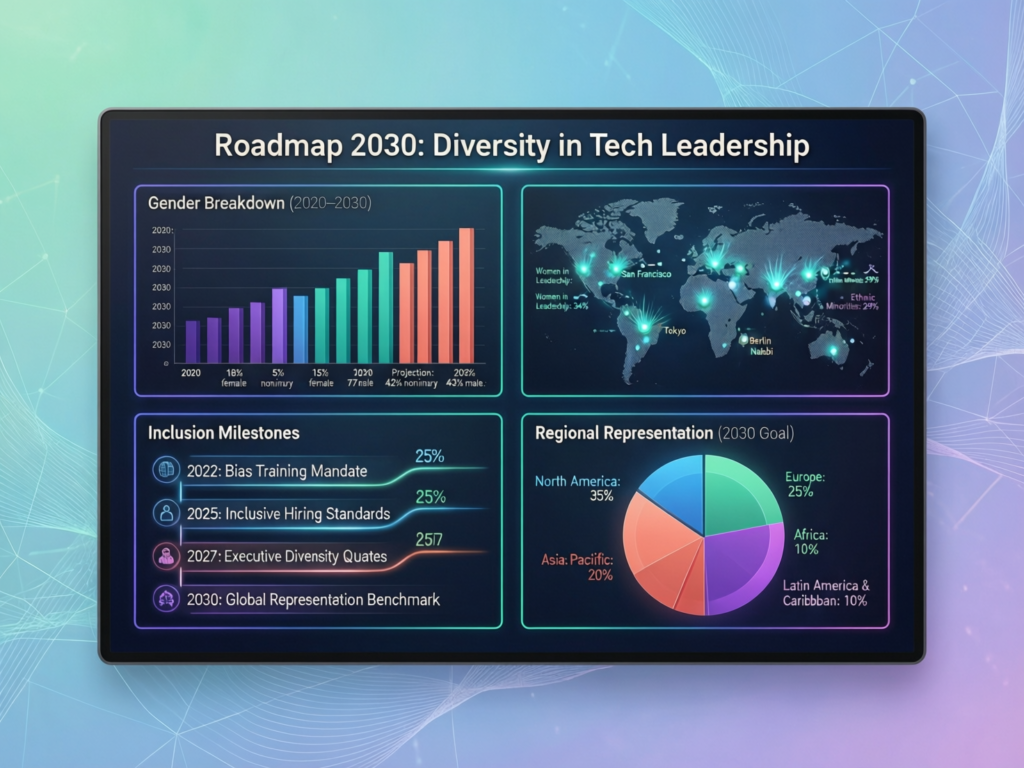
Roadmap 2030: How Tech Leaders in the US, UK and Europe Can Close the Gap
Closing the gender and diversity gap in tech by 2030 means setting region-specific targets, investing in pathways and publishing honest data every year. Waiting for the “pipeline” to magically fix itself is not a strategy.
Setting realistic, region-aware goals for US, UK, Germany and the wider EU
Start with your own baseline.
In the US, benchmark against sector data that put women at roughly one-third of tech jobs, with even lower representation in leadership and in cities like Seattle or Austin’s deep-tech clusters.
In the UK, use BCS, Tech Talent Charter and government data that show women at just over one-fifth of IT specialists and persistent ethnic gaps. (
In Germany and wider Europe, look at Eurostat and European Commission numbers roughly one in five ICT specialists are women, despite decades of awareness.
From there, set realistic, region-aware goals for “gender diversity in tech jobs in Germany 2025”, “women in European tech 2025” and beyond. Copy-pasting one global target onto all markets ignores different baselines, labour laws and available talent pools.
Building pathways.
To fix the pipeline and mid-career transitions, leaders should:
Partner with bootcamps and universities focused on women and underrepresented groups, such as WomenTech Network, Women Techmakers Berlin, Women in Tech meetups in London and Manchester, and local US programs like GET Cities.
Co-create apprenticeships and sponsored internships with community partners supporting migrant women entering IT in Berlin, Munich or Amsterdam.
Invest in regional coding bootcamps whether that’s women-focused programs in New York or future-facing initiatives like coding bootcamps in Saudi Arabia for Arab youth, which Mak It Solutions already explores. (Mak it Solutions)
These pathways should lead into real roles in engineering, data, product and security — including at vendors and partners like Mak It Solutions who build web, mobile and SaaS products for clients in the USA, UK, Germany and across Europe. (Mak it Solutions)
From slideware to dashboards.
Think of this section as the “how to” implementation guide for diversity in tech:
Define your core metrics
Track headcount, hiring, promotion, pay and attrition by gender, ethnicity, role family and region. Include specific cuts for women in AI, security and leadership.
Build a live diversity dashboard
Use BI tools (or a partner like Mak It Solutions’ business intelligence services) to build dashboards for HR, execs and the board. Filter by site (New York vs London vs Berlin), job family and seniority. (Mak it Solutions)
Publish an annual “Diversity in Tech” hub post
Treat this article as a living hub: update stats yearly (2025, 2026, 2027…) and show progress and setbacks openly. Link it from your careers site and ESG reporting.
Tie targets to incentives and compliance
Link diversity goals to leadership KPIs and explain how they support compliance with Title VII, the Equality Act, GDPR/UK-GDPR and the EU AI Act.
Benchmark against peers
Use reports from WEF, Tech Talent Charter, BCS, ECWT, Reboot Representation and sector snapshots (e.g. NHS digital, BaFin-regulated fintechs, Open Banking ecosystems) to benchmark your organisation.
If you don’t yet have the internal capacity to design these dashboards, Mak It Solutions can help you architect the data model, choose the right cloud stack and implement secure, SOC 2–aligned analytics pipelines. (Mak it Solutions)
Concluding Remarks
So, is the gender and diversity gap in tech finally closing in 2025? Not yet but we now know much more clearly what works and where progress is happening fastest.
Across the US, UK, Germany and the wider EU, the picture is consistent: pipelines are improving, especially for women entering tech, but leadership, AI roles and retention still show deep cracks. Intersectional gaps for Black, Latina, migrant, disabled and neurodivergent technologists remain stark.
The good news is that we are past the “awareness” stage. Inclusive hiring, mentoring and sponsorship, honest data reporting and alignment with frameworks like GDPR, UK-GDPR, HIPAA, PCI DSS, SOC 2 and the EU AI Act all reinforce the same message: diverse teams are safer, more compliant and more innovative.
For leaders in New York, London, Manchester, Berlin, Munich and wider European tech hubs, the challenge now is execution: audit your own data, publish your progress, and treat diversity in tech as a core part of your product, risk and innovation strategy not a side project.
If you’re a CHRO, CTO, CIO or DEI lead looking at your own numbers and seeing the same gaps, this is the moment to move from slideware to systems. Start by benchmarking your current diversity metrics, then design a region-aware roadmap to 2030 that links inclusive hiring, talent pathways and transparent reporting.
Mak It Solutions can help you turn that roadmap into real platforms from inclusive careers sites and candidate journeys to secure BI dashboards that keep leadership honest about progress. Share your current stack and goals, and we’ll help you scope a practical, budget-aware implementation for your US, UK, German and EU teams.( Click Here’s )
Key Takeaways
Globally, women still hold roughly one in four core tech roles in 2025, with even lower representation in leadership, AI and security especially in the UK, Germany and wider EU.
Intersectional gaps are severe: Black, Latina, migrant, disabled and neurodivergent technologists are underrepresented in the most powerful roles, despite targeted initiatives from groups like Reboot Representation, WomenTech Network and Frauenloop.
Attrition is driven by culture, not capability: hostile environments, pay gaps, stalled promotions and caregiving penalties push women and minorities out of tech long before retirement age.
Programs that work combine inclusive hiring, mentoring, sponsorship, returnships and transparent diversity dashboards tied to compliance regimes like Title VII, the Equality Act, GDPR and the EU AI Act.
Diverse teams are not just fairer; they materially improve AI fairness, product quality and regulatory resilience in sectors like health-tech, Open Banking, fintech and regulated SaaS.
Tech leaders in the US, UK, Germany and EU should treat diversity in tech as a core product and risk priority, with a clear roadmap to 2030, rather than a side project for HR alone.
FAQs
Q : What are examples of successful returnship programs for women in tech in the US, UK and Germany?
A : Returnship programs typically offer 3–6 month paid placements, mentoring and training for women who have been out of the workforce, with the explicit goal of conversion into permanent roles. In the US, some large tech and financial institutions in New York and Seattle partner with women-in-tech nonprofits to run structured returnships for software engineering and data roles. In the UK and Germany, similar programs often run in fintechs, consultancies and health-tech, sometimes supported by government reskilling funds or EU initiatives. Look for returnships tied to real headcount, with clear conversion metrics and sponsorship from senior engineering leaders.
Q : How often should tech companies publish diversity and inclusion data to build trust with employees and regulators?
A : At minimum, tech companies should publish diversity and inclusion data annually, aligned with EEO-1 filings in the US and gender pay gap reporting cycles in the UK and EU. Many high-trust organisations go further and share quarterly internal dashboards with employees, highlighting trends in hiring, promotion and attrition by gender and ethnicity. The key is consistency: pick a cadence, explain your methodology and stick to it. Sudden drops in transparency often create more reputational risk than modestly slow progress.
Q : What metrics beyond headcount should we track to understand diversity in tech teams (e.g. promotion, pay, attrition)?
A : Headcount is just the starting point. To really understand diversity in tech teams, you should track hiring funnel stages, time-to-promotion, performance ratings, pay bands, equity grants, engagement scores and voluntary attrition by demographic group and role family. For AI-heavy teams, monitor who gets staffed on high-visibility projects or model ownership roles. Combining these metrics into a BI dashboard helps you spot patterns for example, women plateauing at mid-level in Berlin or higher attrition among Black engineers in London.
Q : How can small startups in Berlin, London or Austin compete with Big Tech on diversity in tech hiring?
A : Small startups can’t always compete on cash, but they can compete on culture, flexibility and purpose. That means offering transparent salary bands, remote-friendly work across the EU/UK/US, flexible schedules for caregivers and real ownership of meaningful projects in AI, fintech or health-tech. Startups in Berlin, London or Austin can also partner with community organisations like WomenTech Network, Frauenloop or local meetups to access diverse talent early. A clear, inclusive hiring process and a public commitment to publishing diversity data even at small scale can be a strong differentiator vs opaque Big Tech employers.
Q : What are practical first steps for a tech company that has never had a formal DEI program before 2025?
A : If you’ve never had a formal DEI program, start small but concrete. First, measure your current state: gather anonymised data on gender and, where lawful, ethnicity by role, level and region. Second, fix obvious hygiene issues like non-inclusive job ads, unstructured interviews and missing anti-harassment training. Third, pick one high-impact initiative for example, a mentoring program for women in engineering or a returnship pilot and resource it properly. Finally, publish your intent and progress, and consider partnering with a specialist like Mak It Solutions to embed tracking into your web, mobile and SaaS platforms.