


Edge AI Smart City Architecture Guide for GCC Teams
Edge AI Smart City Architecture Guide for GCC Teams

Edge AI Smart City Architecture Guide for GCC Teams
Planning edge AI smart city architecture for Saudi, UAE & Qatar is no longer just a technology decision. It is an operational, privacy, and governance decision too.
For most GCC smart city programs, a privacy-first layered model works best: run time-sensitive inference on cameras and sensor nodes, use gateways for orchestration and fusion, and send only selective data to central platforms or the cloud. That approach usually delivers lower latency, better resilience, tighter bandwidth control, and stronger alignment with regional data-governance expectations.
Cloud-only analytics can work in a pilot. At city scale, it usually becomes expensive, noisy, and harder to govern. In Riyadh, Dubai, and Doha, public-sector teams often need a more practical model—one that supports real-time response without pushing every raw stream into a distant platform.
Why Edge AI Smart City Architecture Fits the GCC
Edge AI vs. cloud-only smart city analytics
Edge AI means processing video and sensor data close to where it is created—on the camera, on the device, or at a nearby gateway. Instead of transmitting every stream for centralized analysis, the system can detect events locally and send only alerts, metadata, or approved clips upstream.
That matters in the GCC for a few clear reasons.
Lower latency for time-sensitive decisions
Reduced bandwidth costs for high-volume video
Better resilience when links are unstable
Stronger control over privacy-sensitive data
Easier support for in-country processing requirements
For Saudi Arabia, the UAE, and Qatar, that is often more than a performance benefit. It is a governance advantage as well.
The four core layers of a modern edge AI stack
A strong smart city design usually includes four connected layers:
Capture layer
Cameras, microphones, environmental sensors, utility meters, and roadside devices collect data.
Edge inference layer
Smart cameras or embedded devices run immediate AI tasks such as object detection, people counting, incident flags, or anomaly alerts.
Gateway and orchestration layer
Local gateways handle buffering, protocol translation, sensor fusion, corridor-level logic, and security enforcement.
Platform and command layer
Municipal platforms, VMS tools, GIS systems, and SOC/NOC environments receive events, health signals, dashboards, and evidence for action.
This layered model is why many organizations connect edge computing in the Middle East, back-end integration services, and broader cloud strategy work into one delivery plan.
Why local inference comes first
In practice, GCC teams often prefer local inference first because it solves three problems at once:
It keeps sensitive processing close to the source
It reduces the need to move large volumes of raw footage
It gives operations teams faster, cleaner alerts
In Saudi Arabia, that maps naturally to stronger data handling discipline. In the UAE, it helps with interoperability and controlled access. In Qatar, it supports integration-ready design for national digital platforms and secure service environments.
Core Components of a Privacy-First Edge AI Stack
Smart cameras and sensor nodes
The device layer should do more than record.
A modern edge AI camera can detect movement patterns, count people, flag incidents, identify vehicles, or recognize unusual behavior. Environmental and infrastructure sensors can monitor air quality, noise, vibration, water flow, energy use, and other operational signals in real time.
The goal is simple: detect events at the source, not after the fact.
IoT gateways and sensor fusion
Gateways become essential when one decision depends on multiple devices.
A Riyadh traffic corridor may need several intersections to work as one system. A Dubai district may need parking, traffic, and public-safety feeds correlated together. A Doha logistics zone may need camera data and utility telemetry analyzed side by side.
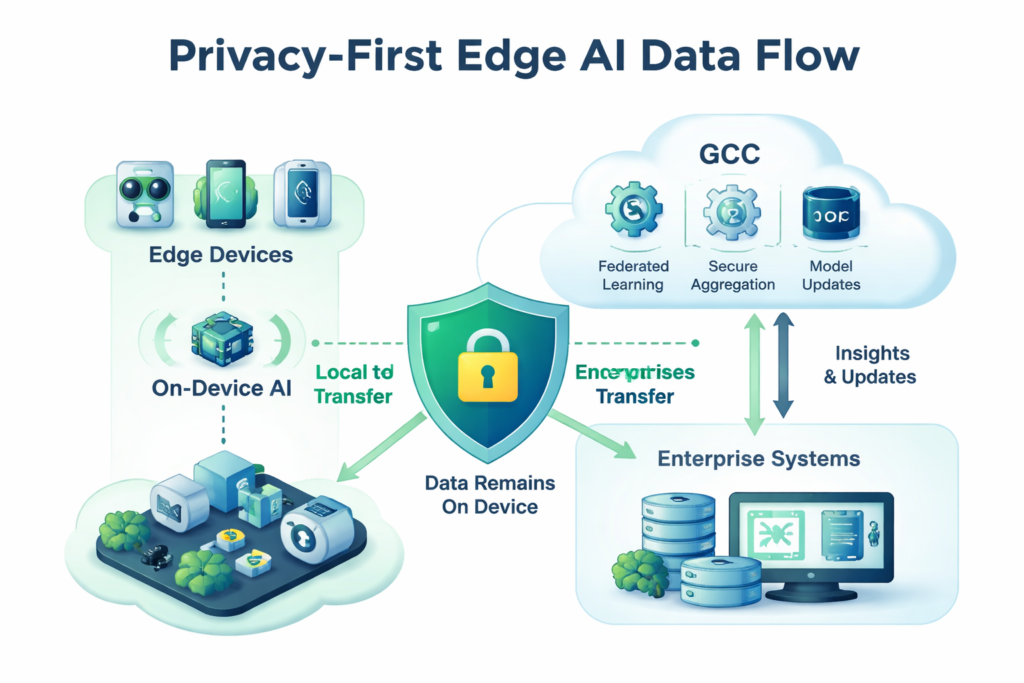
This is where gateways add real value.
Multi-camera correlation
Multi-sensor logic
Short-term local storage
Policy enforcement
Device orchestration
Secure handoff to central systems
That is also where custom software architecture and mobile app delivery can make field operations much more usable.
City platforms and command centers
At the upper layer, command environments should receive what operators actually need:
Alerts
Event metadata
Device health signals
Redacted or approved video clips
Audit logs
Dashboards and reports
They should not be overwhelmed with every raw stream by default.
For municipalities and regulated operators, that improves triage, supports accountability, and makes policy control easier.
Reference Architecture for Smart City Cameras and Sensors
The best model: on-camera inference + gateway logic + selective cloud
The strongest edge AI smart city architecture for Saudi, UAE & Qatar is usually hybrid.
Use
On-camera inference for privacy-sensitive, time-critical decisions
Gateway inference for multi-device logic and local orchestration
Central platforms for dashboards, reporting, policy, and fleet-wide control
Cloud environments for selective archival, model training, and long-range analytics
This is not an edge-versus-cloud decision. It is an edge-first, cloud-selective model.
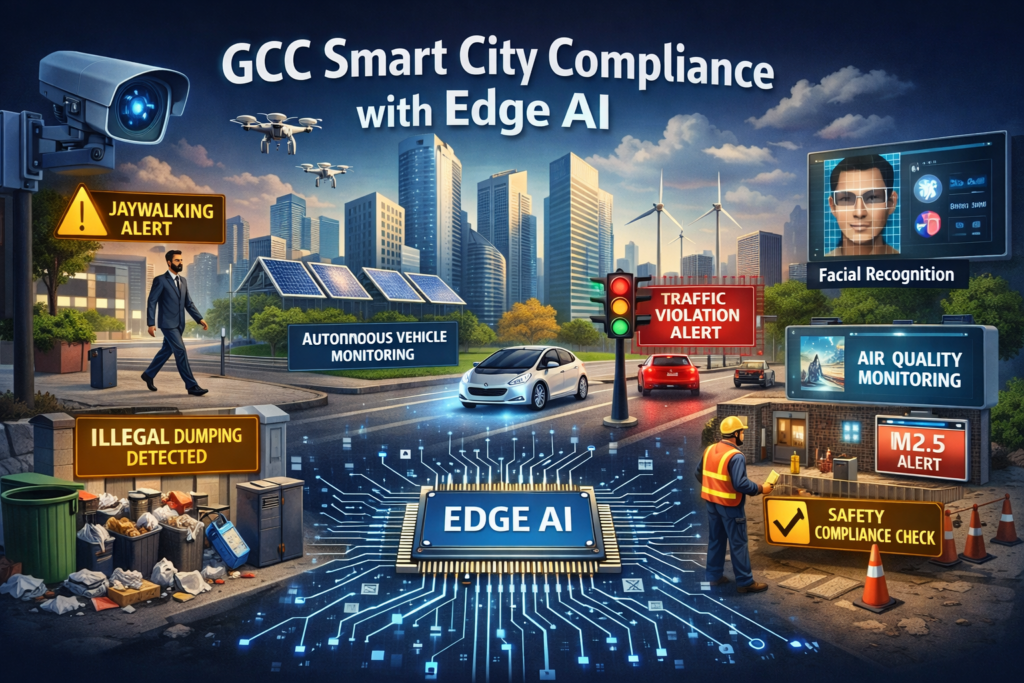
Typical data flow
A practical municipal data flow often looks like this:
Device → Gateway → Municipal Platform → Command Center
For example:
In Riyadh, traffic cameras can send event metadata into urban mobility workflows
In Dubai, public-safety alerts may flow into tightly controlled command environments
In Doha, smart city services can consume standardized outputs from multiple domains through a shared integration model
This keeps the system responsive without losing central oversight.
Where storage, APIs, and model management should sit
A balanced deployment usually places workloads like this.
| Function | Best Placement |
|---|---|
| Real-time inference | On camera or device |
| Multi-sensor decisions | Gateway |
| Short-retention video | Near edge |
| APIs and dashboards | Central platform |
| Model updates | Centralized management layer |
| Long-term archive | Selective regional/cloud storage |
| Training datasets | Central or cloud environment |
A regional cloud can still play a useful role, especially for non-real-time workloads. The key is not to treat it as the default destination for every stream.
GCC Compliance, Data Residency, and Governance by Design
Saudi Arabia.
Saudi Arabia should usually set the strictest baseline in a GCC deployment.
If a system handles video, identity-linked workflows, or location-sensitive data, teams should classify data early, minimize transfers, and document every approved movement path. For public-sector and regulated projects, governance decisions should happen during architecture planning—not after procurement.
A practical Saudi design should include.
Early data classification
Local processing wherever possible
Clear retention rules
Logged transfer paths
Access controls tied to operational need
UAE.
In the UAE, teams often need to think beyond pure AI performance.
Identity, interoperability, telecom pathways, and regulated operational environments can all affect how an edge AI design is approved and deployed. That becomes even more important where free-zone entities, public-sector integrations, or contractor access models are involved.
In practice, UAE deployments benefit from.
Clear separation of operational roles
Strong API governance
Identity-linked access for sensitive workflows
Controlled evidence handling
Documentation for cross-boundary data movement
Qatar
Qatar smart city programs increasingly benefit from platforms built for secure data sharing and service interoperability.
That makes architecture discipline especially important. Edge gateways, standardized outputs, secure authentication patterns, and central policy management all help when different municipal or national services need to work together.
For sensitive environments, teams should think carefully about.
Trusted identity patterns
Shared API standards
Cross-domain interoperability
Logging and accountability
Control boundaries for regulated workflows
Architecture Patterns for Public Safety, Traffic, and Urban Operations
Traffic monitoring and incident response
Traffic programs in Riyadh, Dubai, and other fast-growing corridors benefit from local decision-making.
On-camera AI can detect queue buildup, stalled vehicles, or unsafe movement patterns. Gateways can then correlate nearby intersections and trigger corridor-level actions. That reduces delay and prevents central systems from being flooded with unnecessary video.
Environmental and utility monitoring
For Doha, Jeddah, or industrial and logistics corridors, a multi-sensor pattern often works best.
Air quality, weather, vibration, utility, and infrastructure telemetry can be fused at the gateway to detect anomalies quickly. This is especially useful where municipal operations need early warning rather than after-the-fact reporting.
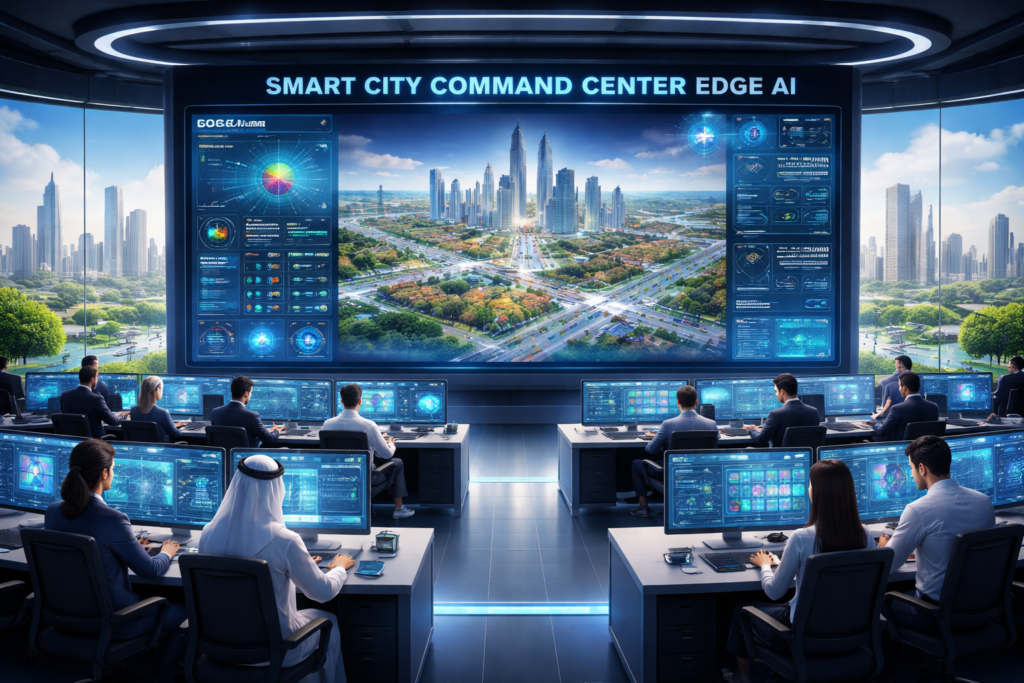
Command center integration
A citywide command center should not become a giant video dump.
A better model is event-driven integration into:
VMS platforms
GIS layers
Dispatch tools
Municipal dashboards
Security or operations workflows
This gives operators a cleaner picture of what matters right now.
How to Choose Between On-Camera, Gateway, and Centralized AI
Choose on-camera AI when.
Milliseconds matter
Connectivity is limited or costly
Privacy exposure must be minimized
The decision is local and repeatable
The use case is incident detection, people counting, or roadside alerts
Choose gateway AI when.
One decision depends on several feeds
A corridor, district, or campus acts as one environment
Sensor fusion is required
Temporary buffering and local resilience matter
Local policy enforcement is needed
This is often where multi-cloud governance and disaster recovery planning become operationally important.
Choose centralized AI when.
You need model training
You need citywide reporting
You manage large fleets of devices
Policies must be distributed consistently
Long-range trend analysis matters more than sub-second response
The right answer is rarely one layer only. Most successful projects use all three, with clear role boundaries.
Implementation Best Practices for Saudi, UAE & Qatar Projects
Design for Arabic UX and bilingual operations
A technically strong platform can still fail if operators struggle to use it.
Arabic-first dashboards, bilingual alerts, and clear field workflows improve adoption in real environments. In GCC projects, usability is not a “nice to have.” It directly affects response quality and operator confidence.
Build security and resilience into the foundation
Cybersecurity, uptime, segmentation, and device integrity should be part of the architecture from day one.
That includes.
Network segmentation
Device identity and authentication
Patch and firmware control
Role-based access
Encryption in transit and at rest
Failover paths for gateways and platforms
This is also where GCC cybersecurity planning and cloud security hardening become directly relevant.
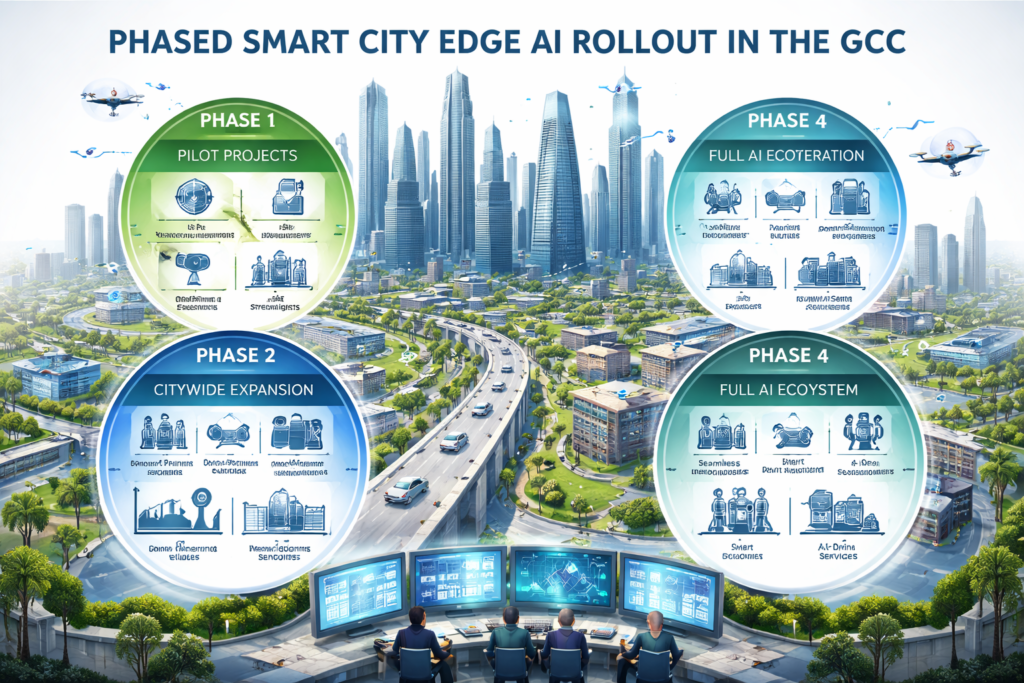
Roll out in phases, not all at once
A phased rollout is usually the safer path.
Start with a contained pilot. Then expand to a district, corridor, or service line. After that, standardize governance and scale citywide.
A practical rollout sequence looks like this:
Pilot one corridor or district
Validate models, gateway logic, privacy controls, and operator workflows.
Expand to a service cluster
Add more devices, refine integrations, and improve alert quality.
Scale with standard governance
Apply shared APIs, security baselines, model management, and reporting across the wider estate.
This approach reduces risk and fits procurement reality much better than a big-bang launch.
Common Mistakes in GCC Smart City Edge AI Deployments
Treating cameras and sensors as separate projects
That creates duplicated infrastructure, fragmented alerts, and operational blind spots.
A city should behave like one coordinated data fabric, not a collection of isolated deployments.
Leaving residency and transfer decisions until late
Late-stage compliance reviews often slow approvals and force redesigns.
For Saudi, UAE, and Qatar projects, residency, retention, and transfer policies should be defined during architecture planning.
Sending raw streams everywhere
This is one of the most expensive mistakes in smart city design.
When every stream is sent centrally by default, bandwidth costs grow, latency rises, and operators receive more noise than insight. Event-led design is usually faster, cleaner, and easier to govern.
Final Takeaway
The best edge AI smart city architecture for Saudi, UAE & Qatar is usually privacy-first, layered, and operationally realistic.
Run sensitive, time-critical decisions close to the source. Use gateways for orchestration and sensor fusion. Keep central platforms for visibility, governance, and model lifecycle management. And move only the data that genuinely needs to move.
For GCC public-sector and regulated environments, that architecture usually offers the strongest mix of speed, resilience, compliance readiness, and long-term scalability.
If your current environment still depends too heavily on raw-stream cloud analytics, now is a good time to reassess it. Contact Mak It Solutions to review your architecture, map real GCC deployment risks, and build a smarter edge AI strategy for Saudi Arabia, the UAE, and Qatar.( Click Here’s )
FAQs
Q : Is edge AI smart city architecture PDPL-friendly in Saudi Arabia?
A : Yes, it can be more PDPL-friendly than a cloud-only model because it supports local processing, data minimization, and selective transmission. In practice, Saudi teams should identify which outputs may contain personal data and keep sensitive inference as close to capture as possible.
Q : Do UAE smart city AI deployments need TDRA-aware planning?
A : In many cases, yes. Even when the project centers on AI cameras or sensors, connectivity, telecom pathways, interoperability, and identity-linked workflows can influence design and rollout decisions.
Q : How should Dubai municipalities connect AI cameras to command centers?
A : An event-driven pattern is usually the better option. Run inference locally, use gateways for corridor-level logic, and feed alerts, metadata, and approved evidence into VMS, GIS, dispatch, and operations platforms through secure APIs.
Q : Can Qatar smart city platforms use both edge gateways and central analytics together?
A : Yes. In fact, that hybrid model is often the strongest fit. Gateways handle local orchestration and resilience, while central platforms support policy control, reporting, and wider service integration.
Q : What data residency model works best for GCC public-sector video analytics?
A : A tiered residency model is often the most practical choice. Keep privacy-sensitive or high-volume data near the edge or in-country, retain only what is operationally necessary, and move aggregated insights or approved archives to central environments under clear governance rules.
[…] For GCC businesses, this is no longer a narrow technical issue. It sits at the intersection of operational resilience, safety, governance, and regulator expectations. In Saudi Arabia, industrial operators must think carefully about how NCA controls apply inside OT environments. In the UAE, resilience and trust expectations shape how connected infrastructure is designed. In Qatar, regulated sectors increasingly treat cybersecurity as part of service continuity, not just IT hygiene. […]