


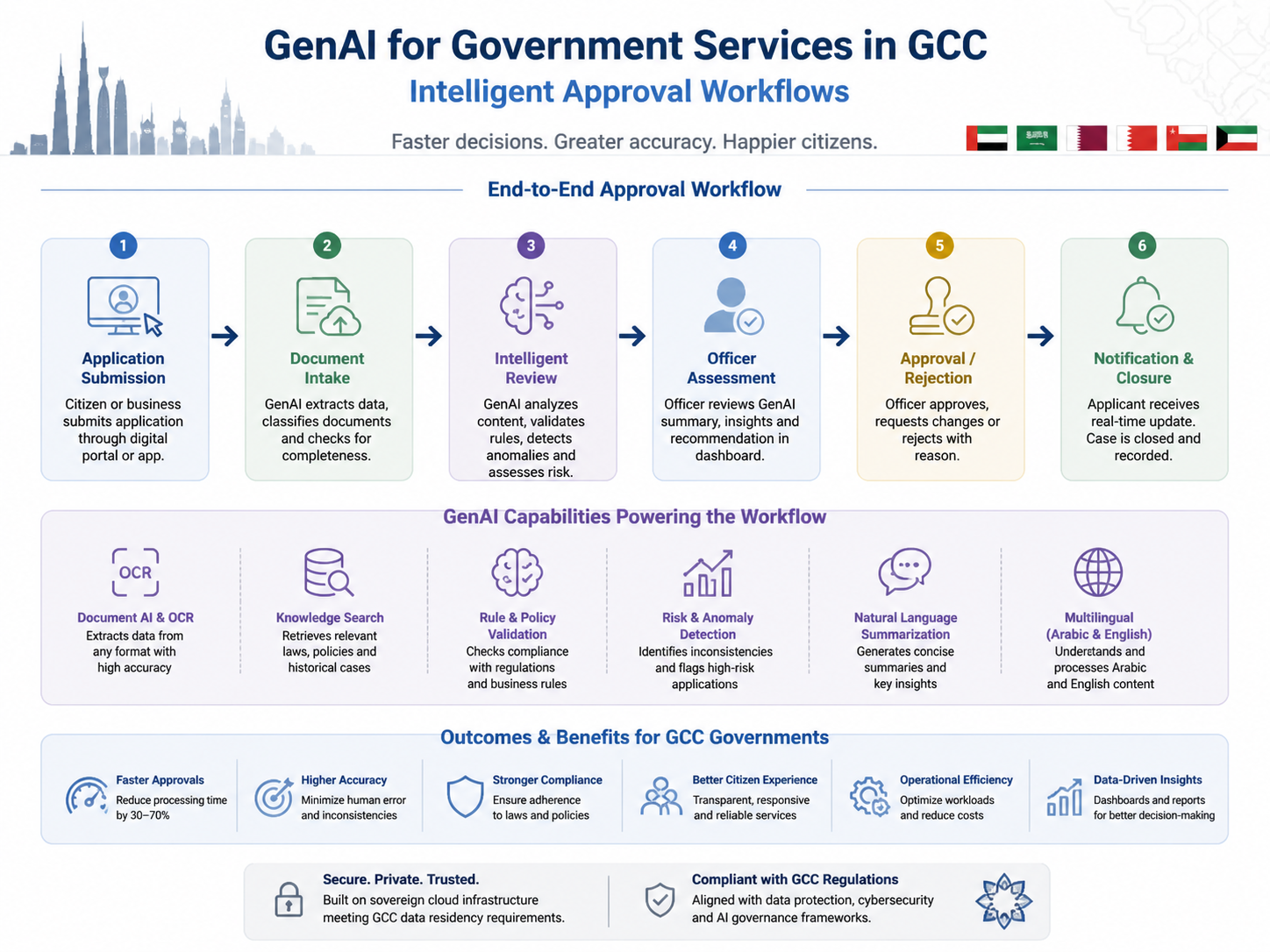
GenAI for Government Services in the GCC
GenAI for government services is becoming a practical way for GCC public-sector teams to speed up approvals, improve citizen support, review documents, and manage cases without removing human accountability. For Saudi Arabia, the UAE, and Qatar, the safest model is not “AI replacing government employees.” It is AI helping authorized teams work faster, more consistently, and with better audit visibility.
In practice, this means Arabic-English user journeys, verified government knowledge sources, sovereign data controls, secure integrations, and human-in-the-loop approvals. When these pieces are designed well, GenAI can improve public-service delivery while protecting citizen trust.
What Is GenAI for Government Services in the GCC?
From digital portals to intelligent public services
GCC digital government has already moved far beyond basic websites. Citizens and businesses now use portals, mobile apps, digital identity tools, and online payment journeys for many services.
GenAI adds a smarter layer on top of that experience. It can understand natural language, summarize long files, retrieve policy answers, draft service responses, and guide users through complex steps.
For example, a citizen may ask about a permit in Arabic, upload documents, and receive clear next steps. Behind the scenes, AI can detect missing fields, classify the request, and prepare a summary for the officer who makes the final decision.
Why Saudi Arabia, the UAE, and Qatar are prioritizing AI
Saudi Arabia’s Vision 2030, the UAE’s AI Strategy 2031, and Qatar’s Digital Agenda 2030 all point toward faster, smarter, citizen-centered services. SDAIA describes data and AI as contributors to Saudi Vision 2030 goals, while the UAE AI Strategy includes adopting AI across customer services to improve government and quality of life. Qatar’s MCIT GovAI Program is designed to support AI adoption across government entities and improve public-sector services.
For ministries, municipalities, regulators, and public entities, this creates a clear opportunity: use GenAI where it supports accuracy, speed, and service quality—but keep governance, compliance, and human responsibility at the center.
Where GenAI fits best
GenAI works best in public-sector workflows that are high-volume, repeatable, and information-heavy, such as.
Permit and license FAQs
Document completeness checks
Inspection checklists
Internal policy search
Citizen support requests
Case summaries
Appointment and service routing
Approval workflow recommendations
Mak It Solutions can support these systems through secure back-end development, business intelligence dashboards, and mobile app development.
How Agentic AI Improves Government Workflows and Approvals
What agentic workflows mean for ministries
Agentic AI refers to AI systems that can complete multi-step tasks under defined rules. In government services, that might include reading an application, checking requirements, asking for missing documents, updating a workflow system, and preparing a recommendation for review.
The important point is control. AI agents should work inside approved workflows, not outside them. Every action should be traceable, permission-based, and reviewable.
How AI agents support permits, licensing, and document review
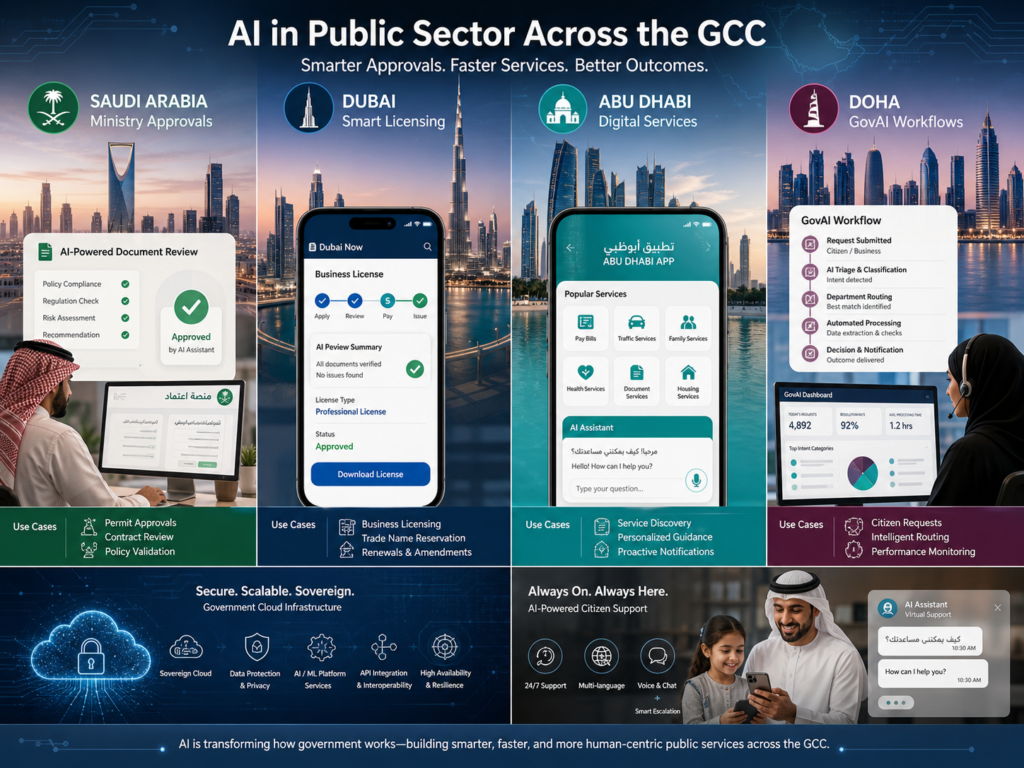
In a Riyadh licensing workflow, AI can pre-check commercial documents before an officer reviews them. In Dubai, AI workflow automation can route trade-license requests to the right department. In Doha, AI can support contract compliance, public-service triage, and knowledge search in line with Qatar’s broader GovAI direction.
Typical agentic AI tasks include.
Reading uploaded files and extracting key fields
Checking whether required documents are missing
Matching a request with the right department
Summarizing the case for a human reviewer
Flagging unusual risks or incomplete information
Creating draft responses for officer approval
This reduces repetitive work while keeping the actual decision with the right public-sector authority.
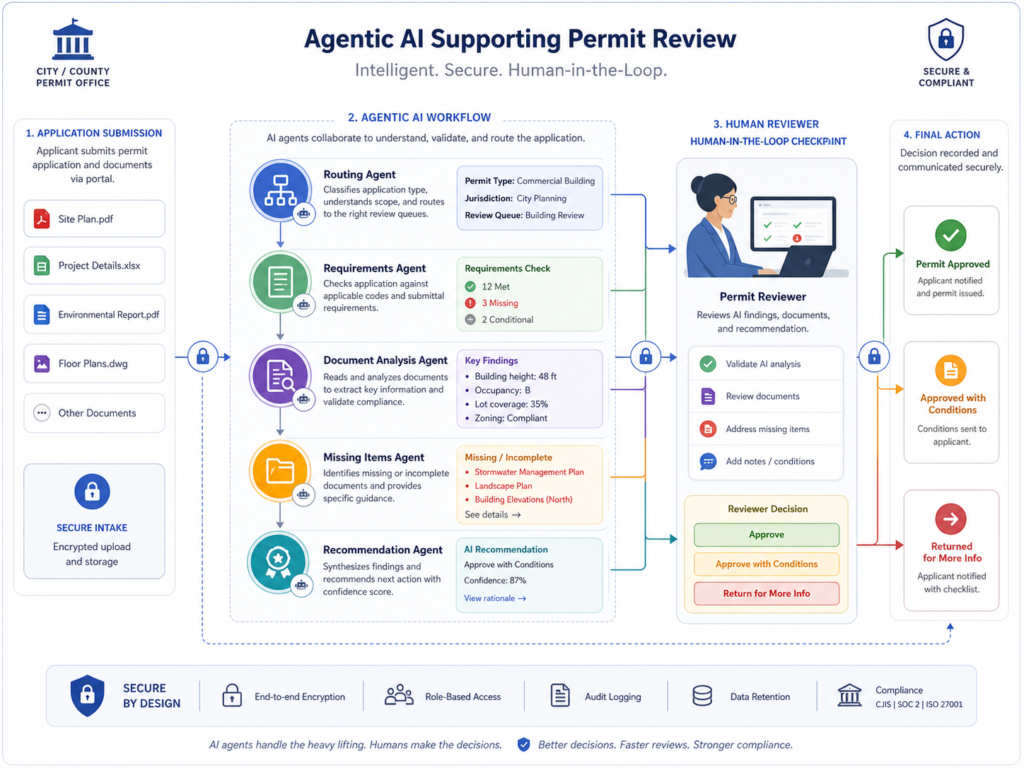
Why human-in-the-loop approvals matter
For GCC governments, human-in-the-loop approval is not optional. AI can recommend, summarize, classify, and flag risks, but final decisions should remain with authorized officials—especially in sensitive areas such as permits, fines, benefits, inspections, immigration, healthcare, and regulated financial services.
This model protects accountability. It also makes AI easier to trust because employees can see why a recommendation was made, correct it when needed, and keep a clear record of every decision.
GCC Compliance, Data Governance, and Responsible AI
Saudi Arabia.
In Saudi Arabia, GenAI projects need careful alignment with data governance, data sharing, classification, and privacy expectations. SDAIA is the national reference body for the data and AI sector, and NDMO-related materials cover areas such as data governance and classification.
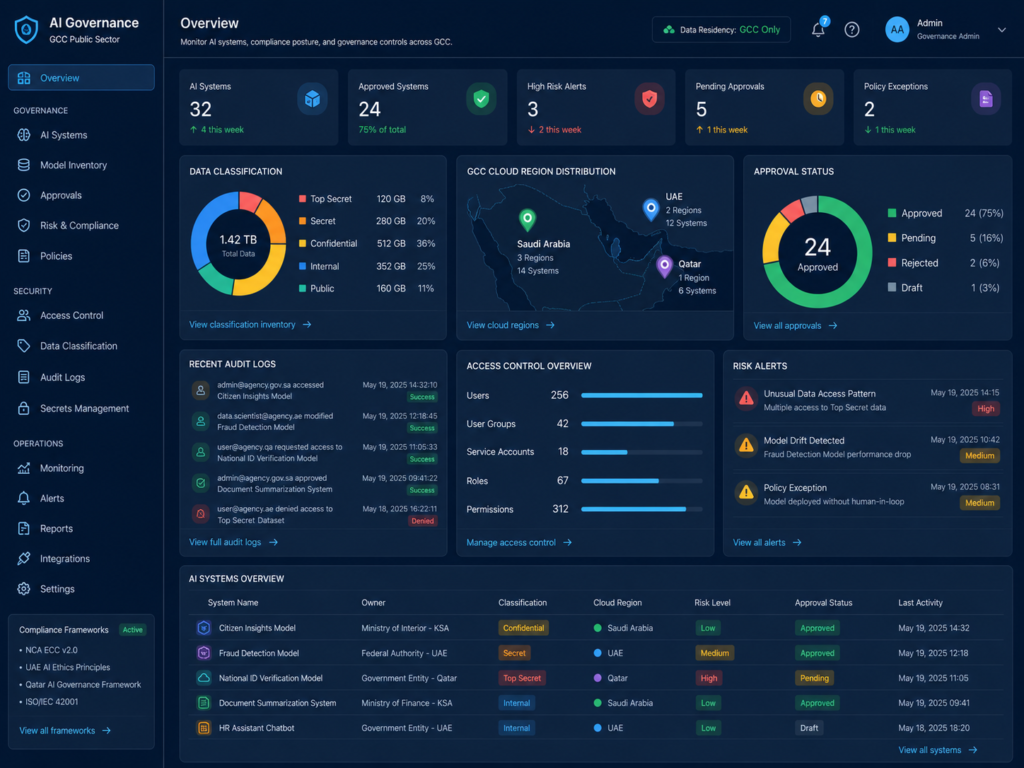
For government AI workflows, this means teams should define.
Which data AI can access
Which data is restricted or confidential
Where data is stored and processed
Who can approve AI-generated actions
How audit logs are retained
Which systems are allowed to integrate with the model
A safe Saudi GenAI deployment starts with low-risk workflows and expands only after controls are tested.
UAE.
In the UAE, GenAI for government services should support privacy-by-design, bilingual service flows, secure identity integration, and audit-ready records. UAE Pass is the national digital identity solution used to access services across government, semi-government, and private-sector platforms.
For Dubai and Abu Dhabi, practical design priorities include secure login, clear consent, Arabic-English UX, service-specific permissions, and strong records for regulated workflows. Where financial, legal, or corporate services are involved, teams should also consider the expectations of relevant free-zone and sector regulators.
Qatar.
Qatar’s MCIT describes GovAI as a program that supports the end-to-end AI adoption journey for government entities through investment, skilling, support, and impact assessment. The program is aligned with Qatar’s Digital Agenda 2030 and aims to improve public-sector services.
For Doha public entities, this creates a practical foundation for GenAI workflows such as document review, policy search, application triage, and case management. For financial or payments-related workflows, QCB compliance expectations should also be considered before connecting AI to regulated processes.
Arabic UX and Citizen Experience in GenAI Government Services
Arabic UX is not just translation
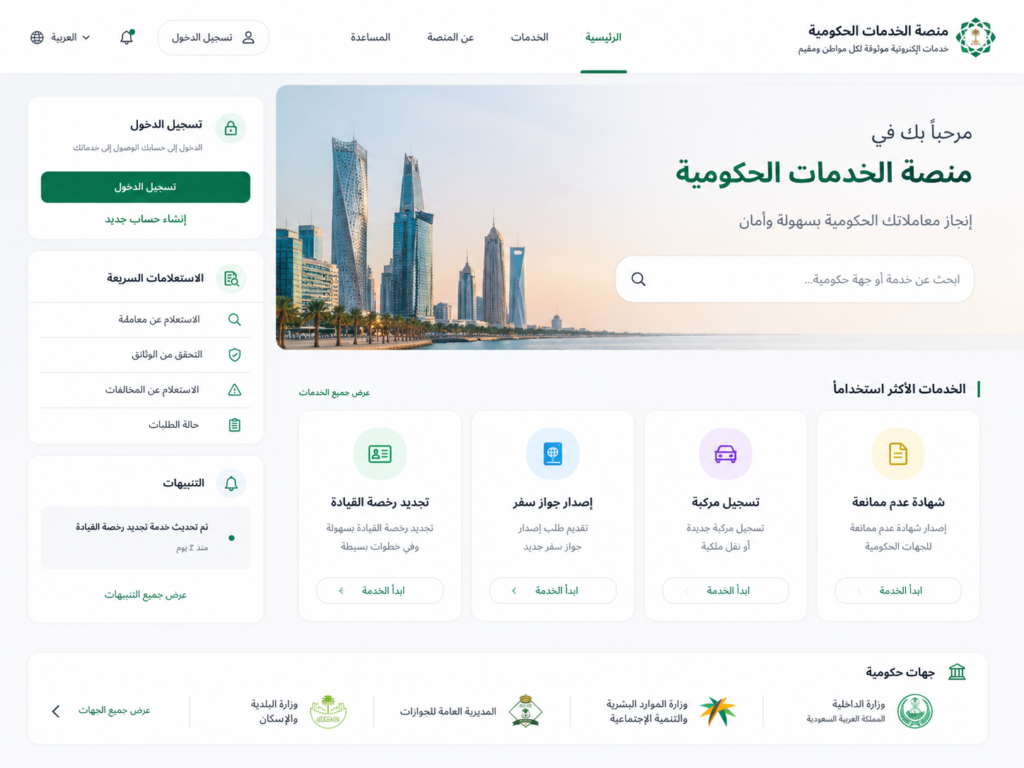
Arabic UX is not a translation layer. GCC users expect respectful tone, right-to-left design, local terminology, clear forms, and support for Arabic-English switching.
A weak Arabic AI assistant can damage trust quickly, especially in public services. Citizens should not feel like they are talking to a generic chatbot that does not understand local service language.
Strong Arabic UX should include.
Clear Modern Standard Arabic where appropriate
Local terminology for Saudi, UAE, and Qatar services
Right-to-left interface design
Arabic-English switching without breaking the flow
Simple instructions for elderly users and first-time applicants
Accessible design for mobile-first users
Reducing hallucinations with verified sources
Public-sector AI must be grounded in approved information. That means the assistant should answer from verified policy documents, official FAQs, internal knowledge bases, and approved service rules.
For safer answers, GenAI systems should use retrieval-based design, internal references, role-based access, and escalation paths. When the AI is unsure, it should say so and guide the user to the correct official channel.
Designing for Riyadh, Dubai, Abu Dhabi, and Doha users
A Riyadh user may expect alignment with familiar national-service journeys. A Dubai entrepreneur may want fast licensing guidance. An Abu Dhabi resident may expect a simple, unified digital experience. A Doha SME may care about Arabic support, digital identity, cloud residency, and clear compliance steps.
The best GenAI for government services adapts to these local expectations without creating separate, disconnected systems.
Real GCC Use Cases for GenAI in Public-Sector Services
Saudi Arabia.
A Saudi ministry can use GenAI to summarize case files, classify applications, and help officers respond faster. For a Riyadh-based regulated business, AI can pre-check documents, highlight missing fields, and prepare a decision brief while keeping approval human-led.
Useful Saudi use cases include.
Permit renewal support
Ministry case summarization
Arabic citizen-service assistants
Internal policy search
Inspection preparation
Document completeness checks
UAE.
In the UAE, GenAI can support licensing, form completion, service routing, and personalized user guidance. A Dubai e-commerce business building citizen-facing journeys can combine GenAI with e-commerce development and Flutter development to reduce abandoned forms and improve support.
UAE entities can also connect AI workflows with secure identity journeys, approval dashboards, and CRM tools to make service delivery smoother across departments.
Qatar.
In Qatar, GenAI can support MCIT-aligned GovAI workflows, internal knowledge search, application triage, and service automation. Qatar’s public-sector AI direction is especially relevant for entities that want measurable service improvements without weakening governance.
Cloud planning also matters. Microsoft lists Qatar Central, UAE North, UAE Central, and Saudi Arabia East among Azure regions, while Google Cloud has opened a Doha cloud region. AWS has also announced plans for a Saudi Arabia Region.
How to Implement GenAI Approval Workflows Safely
Start with high-volume, rules-based processes
Begin with workflows that have clear rules and manageable risk. Good starting points include permits, renewals, inspections, internal HR requests, appointment routing, document checks, and public FAQs.
Avoid starting with highly sensitive final decisions. Prove the model first in support tasks, then expand carefully.
Connect GenAI to trusted systems and audit logs
GenAI should not operate as a standalone chatbot. It should connect securely to approved databases, CRM or ERP platforms, workflow tools, identity systems, and audit logs.
Mak It Solutions’ Laravel development and PHP web development services can help build secure portals, APIs, and workflow integrations for public-sector and regulated environments.
Pilot, monitor, localize, and scale
Run a controlled pilot first. Measure accuracy, officer feedback, user satisfaction, security issues, escalation rates, and missed-document detection.
Then localize Arabic content, refine prompts, test role-based permissions, and scale department by department. Dashboards through business intelligence services can help monitor approval speed, error rates, and citizen satisfaction.
Choosing the Right GenAI Partner for GCC Government Services
What public-sector buyers should ask vendors
Before choosing a GenAI partner, government buyers should ask direct questions.
How do you handle Arabic UX and right-to-left design?
Can the system use approved government knowledge sources only?
How are hallucinations reduced and monitored?
Where is data stored and processed?
Can every AI action be logged?
How does human approval work?
Can the system integrate with legacy portals and workflow tools?
What access controls are available for sensitive data?
The right partner should understand both AI delivery and public-sector risk.
Why compliance, Arabic UX, and cloud residency matter
Government AI must respect where data is stored, who can access it, and how it moves between systems. AWS describes each Region as a physical location made up of Availability Zones, and its global infrastructure page notes announced plans for additional Regions, including the Kingdom of Saudi Arabia.
For Saudi Arabia, the UAE, and Qatar, cloud decisions should be made with legal, compliance, security, and procurement teams not only technical teams.
How to measure ROI
The value of GenAI for government services should be measured in practical outcomes, not hype.
Track metrics such as.
Shorter approval cycles
Fewer missing-document returns
Better first-contact resolution
Lower call-center pressure
Faster internal knowledge search
Improved citizen satisfaction
Stronger audit visibility
For visibility after launch, SEO services can also support public awareness and discoverability for digital service pages.
Concluding Remarks
GenAI for government services can help Saudi Arabia, the UAE, and Qatar deliver faster approvals, clearer citizen support, and more efficient public-sector workflows. But the strongest results come when AI is grounded in verified data, Arabic-ready UX, compliance controls, and human-in-the-loop decision-making.
Ready to explore GenAI for government services in Saudi Arabia, the UAE, or Qatar? Contact Mak It Solutions to discuss a secure, Arabic-ready, compliance-aware AI strategy for your public-sector or regulated workflow. You can also explore our services to plan your next GCC digital transformation project.
FAQs
Q : Is GenAI for government services allowed under Saudi data governance rules?
A : GenAI can be used in Saudi government services when it is designed around proper data governance, classification, access control, and human oversight. Public-sector teams should assess SDAIA, NDMO, DGA, and Saudi data-classification expectations before using sensitive data in AI workflows.
Q : How can UAE government entities use AI agents without removing human approvals?
A : UAE government entities can use AI agents as decision-support tools, not final decision-makers. AI can review forms, summarize documents, detect missing information, and route requests while a government employee approves or rejects the case.
Q : What makes Qatar GovAI relevant for public-sector AI workflows?
A : Qatar GovAI is relevant because it helps government entities adopt AI while improving service quality and operational efficiency. For Doha public entities, it supports practical workflows such as application triage, policy search, document review, and intelligent case management.
Q : Can Arabic GenAI assistants support citizens across Saudi Arabia, the UAE, and Qatar?
A : Yes, Arabic GenAI assistants can support citizens across Saudi Arabia, the UAE, and Qatar when they are built for regional language, tone, bilingual behavior, verified sources, and culturally respectful service journeys. A generic Arabic chatbot is usually not enough for high-trust public services.
Q : Which government approval workflows are best to automate first in the GCC?
A : The best first workflows are high-volume, repetitive, rules-based, and lower-risk. Examples include permit renewals, missing-document checks, appointment routing, inspection scheduling, internal HR approvals, and public FAQ support.