


Geopatriation in Enterprise IT Procurement: GCC Guide
Geopatriation in Enterprise IT Procurement: GCC Guide
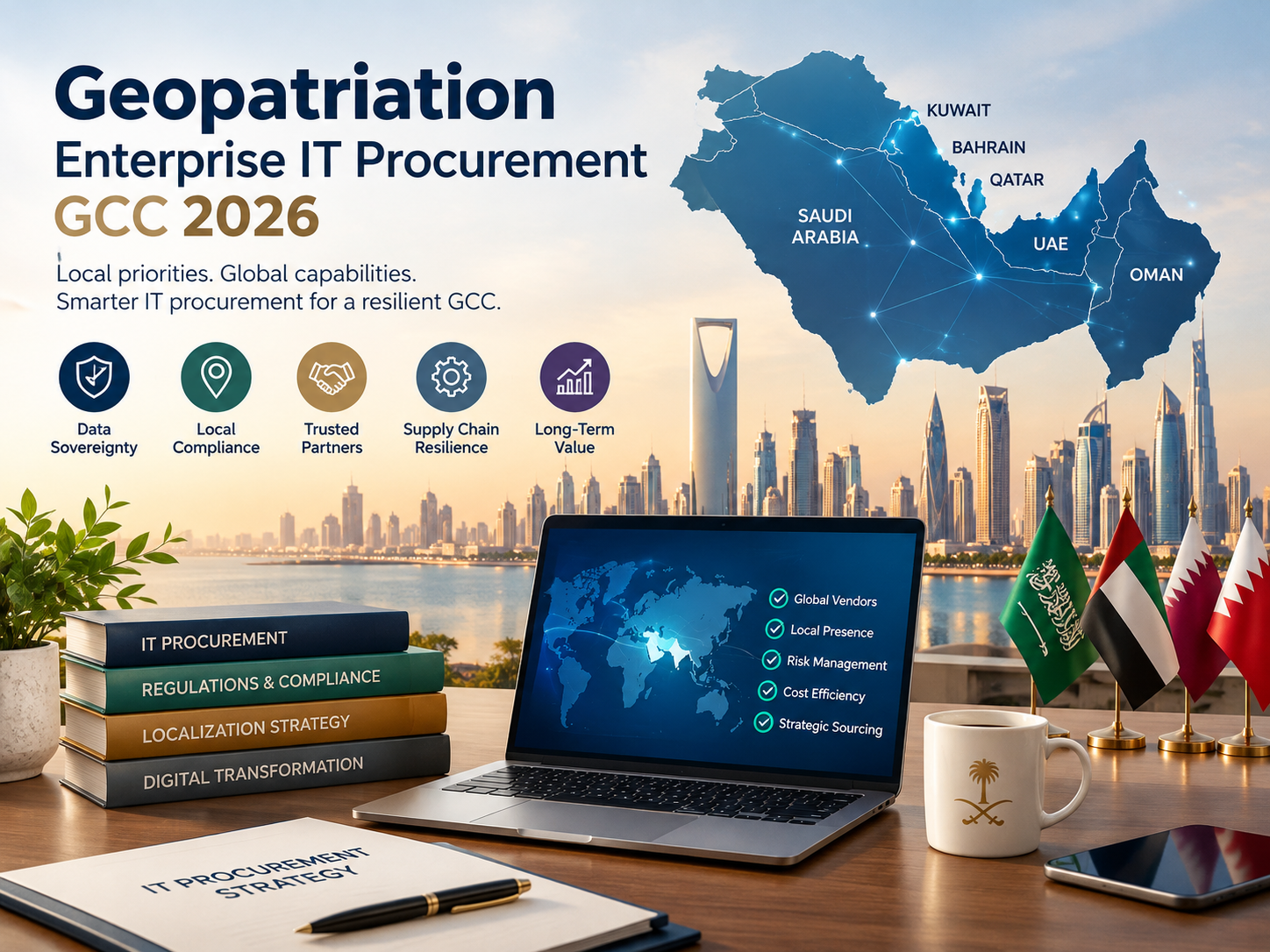
Geo patriation in Enterprise IT Procurement: GCC Guide
Cloud procurement across the Gulf is no longer just about finding the best price, performance, or service availability. Enterprises must also consider who controls their infrastructure, where sensitive data is processed, and which legal jurisdictions can influence their cloud providers.
Geo patriation in enterprise IT procurement addresses these concerns by shifting selected digital workloads toward sovereign, regional, or locally controlled infrastructure. The goal is to reduce geopolitical risk, strengthen data governance, and maintain operational resilience without giving up the benefits of cloud technology.
Recognized by Gartner as a strategic technology trend for 2026, geo patriation is becoming an important consideration for CIOs, IT procurement directors, and cybersecurity leaders across Saudi Arabia, the UAE, and Qatar.
For organizations supporting Saudi Vision 2030, UAE digital transformation, and Qatar’s technology ambitions, the challenge is choosing infrastructure that supports both innovation and long-term digital sovereignty.
What Is Geo patriation in Enterprise IT Procurement?
Geo patriation is the process of moving digital workloads from globally distributed cloud environments to sovereign, regional, or locally controlled infrastructure to reduce geopolitical and jurisdictional exposure.
In enterprise IT procurement, it means evaluating cloud suppliers not only on technical capabilities and cost, but also on regulatory accountability, operational control, data protection, and business continuity.
Geo patriation Explained for GCC IT Decision-Makers
For GCC enterprises, geo patriation is a sourcing strategy, not simply a cloud migration project.
Consider a Saudi financial institution managing sensitive customer records. It may choose infrastructure with stronger local governance and defined access controls for regulated workloads while continuing to use international cloud services for less sensitive applications.
The objective is not to eliminate global cloud providers. It is to place each workload in an environment appropriate to its risks and requirements.
Geo patriation vs. Cloud Repatriation and Data Residency
Although these concepts overlap, they address different business priorities.
|
Concept |
Primary focus |
|---|---|
| Geo patriation | Reducing geopolitical and jurisdictional risks |
| Cloud repatriation | Moving workloads to private or on-premises infrastructure |
| Data residency | Controlling where information is stored or processed |
A cloud platform located within Saudi Arabia or the UAE is not automatically sovereign.
Enterprises must also examine encryption-key ownership, administrative access, third-party subcontractors, and legal obligations that could affect control over their systems.
Why Geo patriation Matters Across the GCC
Cloud governance priorities differ across the region.
Saudi Arabia places significant emphasis on cybersecurity, regulated data, and applicable cloud controls. The UAE combines international cloud adoption with sovereign infrastructure initiatives. Qatar’s financial sector has specific requirements for cloud outsourcing and supplier oversight.
For enterprises operating across Riyadh, Dubai, Abu Dhabi, and Doha, these differences make jurisdiction-aware procurement especially important.
How Geo patriation Changes GCC Cloud Vendor Selection
Geo patriation changes a familiar procurement question.
Instead of asking only, “Which cloud provider offers the best price?”, organizations must ask, “Which provider can support our operational, security, and regulatory responsibilities over time?”
From Cost-Led Sourcing to Sovereignty-Based Evaluation
Traditional cloud purchasing often emphasizes infrastructure pricing, scalability, uptime, and technical features.
These remain important, but geo patriation introduces additional evaluation criteria:
Jurisdictional exposure and control over critical data
Regulatory compliance evidence and audit rights
Administrative access and encryption-key management
Incident response and disaster recovery capabilities
Supplier dependencies, portability, and contract termination rights
A vendor may offer excellent performance yet remain unsuitable for a specific regulated workload.
Sovereign Cloud vs. Global Hyper scalers
Comparison of common enterprise cloud sourcing models.
|
Cloud model |
Main advantage |
Key consideration |
|---|---|---|
| Sovereign or local cloud | Local governance and support options | Service maturity and scalability |
| Global hyper scaler | Broad capabilities and established ecosystems | Jurisdiction and access controls |
| Hybrid multi cloud | Flexible workload placement | Integration and governance complexity |
| Private cloud | Greater infrastructure customization | Maintenance and operational costs |
Regional providers enterprises may evaluate include Saudi-based sccc and stc Cloud, UAE-based Core42, and Qatar-based MEEZA.
International cloud infrastructure options include AWS Bahrain, Azure UAE Central, and Google Cloud Doha, subject to current regional service availability.
These are examples for comparison, not endorsements. Each provider should be assessed against the organization’s actual workload and compliance requirements.

Building a GCC Cloud Procurement Scorecard
A structured scoring model helps procurement teams compare suppliers consistently.
For example, an illustrative request-for-proposal (RFP) scorecard could use the following weighting.
|
Evaluation criterion |
Illustrative weighting |
|---|---|
| Security and compliance |
30% |
| Jurisdictional control |
25% |
| Resilience and continuity |
20% |
| Portability and exit readiness |
15% |
| Total cost |
10% |
These percentages are illustrative procurement weights, not industry benchmarks or regulatory requirements.
A Riyadh-based financial institution may prioritize sector-specific security controls, while a Dubai retailer may assign greater importance to scalability and application integration.
Organizations modernizing legacy systems should also evaluate back-end development and integration support before finalizing infrastructure decisions.
GCC Cloud Compliance and Data Sovereignty Requirements
Cloud compliance across the GCC is not governed by a single regional framework.
Applicable obligations depend on the country, industry, data classification, regulated activity, and contractual arrangements.
Saudi Arabia.
Saudi enterprises should begin by determining which cybersecurity, data governance, and sector-specific requirements apply to their operations.
The National Cybersecurity Authority’s Cloud Cybersecurity Controls (CCC-2:2024) establish relevant requirements for cloud service providers and tenants, including provisions related to data localization.
Other relevant authorities include:
CST: Cloud-service regulatory responsibilities
NDMO: National data governance and management frameworks
SAMA: Financial-sector supervisory requirements
For procurement teams, supplier claims of compliance should be supported by applicable assessments, contractual commitments, and documented security responsibilities.
UAE.
UAE businesses must consider federal personal-data protection obligations alongside applicable sector-specific and jurisdictional frameworks.
The Telecommunications and Digital Government Regulatory Authority (TDRA) has responsibilities within its regulatory remit, while ADGM and DIFC operate separate data protection regimes.
Cloud procurement teams should examine where information is processed, who can access it, and whether cross-border transfers meet the relevant legal requirements.
The UAE’s National Cloud Security Policy is another useful policy reference when reviewing cloud governance.

Qatar.
Qatar’s financial sector has a dedicated cloud regulatory framework.
The Qatar Central Bank Cloud Computing Regulation, effective April 15, 2024, addresses cloud-related governance, risk management, and security expectations for entities within its scope.
For QCB-regulated organizations, procurement due diligence should cover supplier oversight, auditability, contractual obligations, information security, and business continuity.
These requirements should not automatically be applied to every business operating in Qatar.
|
Country |
Relevant authorities |
Procurement priority |
|---|---|---|
| Saudi Arabia | NCA, CST, NDMO, SAMA | Cybersecurity and applicable data controls |
| UAE | TDRA, federal authorities, ADGM,DIFC | Privacy, jurisdiction, and access |
| Qatar | QCB and relevant authorities | Regulated outsourcing and supplier oversight |
Regulatory requirements can change. Enterprises should confirm the current rules applicable to their sector before making sourcing commitments.
Geo patriation Use Cases Across GCC Industries
The practical value of geo patriation becomes clearer when procurement decisions are connected to specific business workloads.
The following examples are hypothetical scenarios, not documented customer projects.
Fintech and Banking in Riyadh and Doha
A Riyadh fintech business evaluating cloud infrastructure may prioritize customer-data protection, audit evidence, and applicable SAMA requirements.
A Doha financial institution, meanwhile, may focus on QCB outsourcing obligations, payment-system resilience, and contractual accountability.
Although the business models may be similar, their regulatory obligations can differ considerably.
UAE Government and Sovereign AI Infrastructure
An Abu Dhabi government technology team considering sovereign AI infrastructure may evaluate administrator privileges, encryption controls, infrastructure dependencies, and recovery options.
The team may also require secure Python-based automation and data processing to support applications operating within the selected infrastructure.
Here, sovereignty involves more than the physical location of servers. It also depends on governance over sensitive information and operational access.
Retail and Logistics Across the GCC
Consider a Dubai e-commerce company expanding into Jeddah and Doha.
Its technology team might separate sensitive customer records from regional storefront services, product catalogs, and logistics applications.
A suitable e-commerce platform architecture should accommodate data-handling requirements while maintaining performance across markets.
Businesses may also need adaptable front-end application development to support Arabic-English interfaces and consistent customer experiences.
Geo patriation Costs, Risks and Cloud Migration Planning
Sovereign infrastructure can strengthen governance, but it is not automatically cheaper, safer, or more reliable than an international cloud platform.
The outcome depends on the architecture, supplier capabilities, and operational requirements.
Sovereign Cloud vs. Hyper scaler Total Cost of Ownership
Procurement teams should compare the full lifecycle cost of each option.
This includes infrastructure, software licensing, migration, network transfers, security operations, vendor support, compliance activities, and ongoing maintenance.
A lower initial hosting quotation may become less attractive if integration costs or operational dependencies are substantial.
For this reason, total cost of ownership should be assessed alongside risk reduction rather than independently.
Vendor Lock-In and Geopolitical Exposure
Reducing reliance on a particular cloud provider may improve resilience, but introducing multiple suppliers can also increase complexity.
A practical exit strategy should address.
Data extraction and application portability
Proprietary services and licensing dependencies
Contract termination and transition support
Backup independence and recovery testing
Subcontractor access and security responsibilities
The objective is to maintain realistic alternatives if a provider relationship, regulatory requirement, or business priority changes.
Phased Cloud Migration for GCC Enterprises
Large-scale migration does not need to begin with the most sensitive applications.
A phased approach allows teams to assess dependencies, test controls, and validate business continuity before wider deployment.
Legacy applications may require React modernization or Laravel development support to operate effectively within a revised cloud architecture.
Migration timelines should be determined by actual system complexity, approval requirements, data volumes, and testing outcomes rather than arbitrary deadlines.
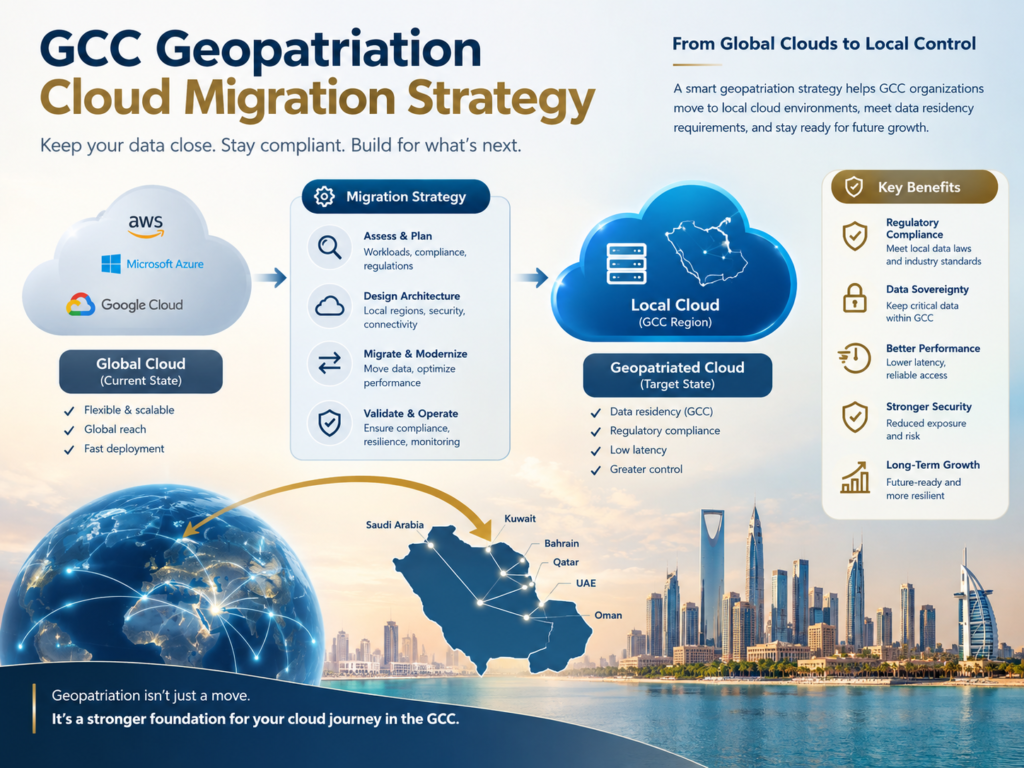
Geo patriation in Enterprise IT Procurement.
For GCC businesses, a successful geo patriation strategy begins with understanding which workloads genuinely require additional jurisdictional or operational control.
The following process provides a practical starting point.
Classify Data and Map Jurisdictional Risks
Identify business-critical systems, regulated information, backup locations, privileged administrators, encryption keys, and relevant country-specific obligations.
This helps distinguish workloads requiring stricter controls from applications that can continue operating on conventional cloud services.
Evaluate Vendors and Contractual Safeguards
Assess suppliers using consistent evidence-based criteria.
Review security assessments, contractual audit rights, subcontractor arrangements, incident notification procedures, support capabilities, and exit provisions.
Avoid treating local hosting or a marketing claim of sovereignty as sufficient proof of regulatory compliance.
Pilot, Validate and Monitor
Test a representative workload before expanding the migration.
Verify security configurations, data portability, recovery procedures, and application performance.
Once the solution is operating, establish periodic vendor reviews to identify new regulatory obligations or supplier risks.
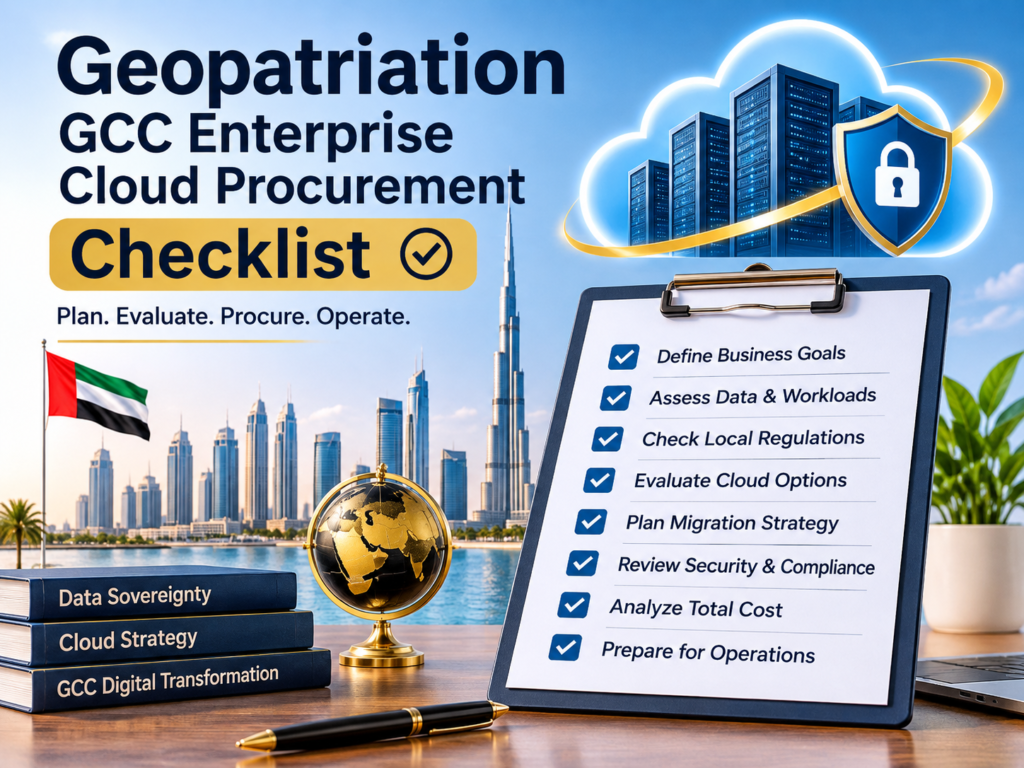
GCC Cloud Procurement Checklist
|
Procurement check |
Evidence to request |
|---|---|
| Data location | Hosting and processing locations |
| Security | Applicable control assessments |
| Access | Administrator and encryption-key governance |
| Resilience | Recovery and continuity test evidence |
| Supplier oversight | Subcontractor and audit provisions |
| Exit readiness | Data export and transition procedures |
A documented procurement assessment makes it easier for technology, legal, security, and finance teams to evaluate trade-offs together.
Concluding Remarks
Geo patriation in enterprise IT procurement is changing how GCC organizations think about cloud sourcing.
The goal is not to replace every international cloud provider with local infrastructure. It is to make deliberate decisions about where critical workloads belong, who controls them, and how the business can respond to regulatory or geopolitical disruption.
For enterprises across Saudi Arabia, the UAE, and Qatar, a balanced approach combines security, jurisdictional accountability, cost awareness, and operational flexibility.
Organizations that evaluate these factors early are better positioned to make informed procurement decisions while continuing their digital transformation.
Planning a cloud migration, application modernization project, or infrastructure-related technology initiative?
Explore Mak It Solutions’ development and technology services or contact our team to discuss technical dependencies, system integration, and application requirements.
A workload-specific assessment can help clarify the development and integration work needed to support your GCC cloud sourcing strategy.
FAQs
Q : Is locally hosted cloud infrastructure automatically sovereign in Saudi Arabia?
A : No. Local data hosting addresses physical location, but sovereignty also involves administrator access, encryption-key management, subcontractors, and legal jurisdiction.
Saudi enterprises should evaluate relevant NCA controls and any additional sector-specific obligations rather than relying on hosting location alone.
Q : Can UAE businesses use international cloud providers for sensitive workloads?
A : Yes, international providers may be appropriate depending on data classification, business activities, and applicable regulatory requirements.
Organizations should assess relevant privacy, security, and cross-border processing obligations, including any additional rules for regulated sectors.
Q : What should Qatar banks check before outsourcing cloud infrastructure?
A : QCB-regulated banks should review applicable cloud outsourcing requirements, supplier due diligence, audit rights, data protection, security monitoring, and business continuity.
They should also confirm any relevant approval or localization obligations before entering a cloud service agreement.
Q : How can Bahrain and Oman enterprises reduce cloud supplier concentration risk?
A : Businesses can identify critical provider dependencies, maintain appropriate backup arrangements, negotiate exit provisions, and test recovery procedures.
Regulated organizations should also consider applicable requirements from the Central Bank of Bahrain or Central Bank of Oman.
Q : Do GCC companies need bilingual Arabic-English cloud procurement contracts?
A : Not necessarily. Contract language requirements depend on the jurisdiction, type of agreement, government procurement rules, and applicable legal framework.
However, accurate Arabic-English documentation can improve clarity for regional procurement teams and international suppliers. Contracts should clearly specify the prevailing language if translations differ.