


Knowledge Hub vs Blog: GCC Authority Secrets
Knowledge Hub vs Blog: GCC Authority Secrets
Knowledge Hub vs Blog: GCC Authority Secrets
Knowledge Hub vs Blog is an important decision for GCC businesses looking to strengthen their Arabic SEO, build credibility, and attract qualified customers.
Imagine a Riyadh company publishing 50 blog posts but still struggling to establish authority in its industry. Meanwhile, a competitor organizes fewer, carefully researched articles into a connected knowledge hub that answers customer questions and guides visitors toward relevant services.
The difference isn’t necessarily content volume. It’s how that content is structured, connected, maintained, and presented.
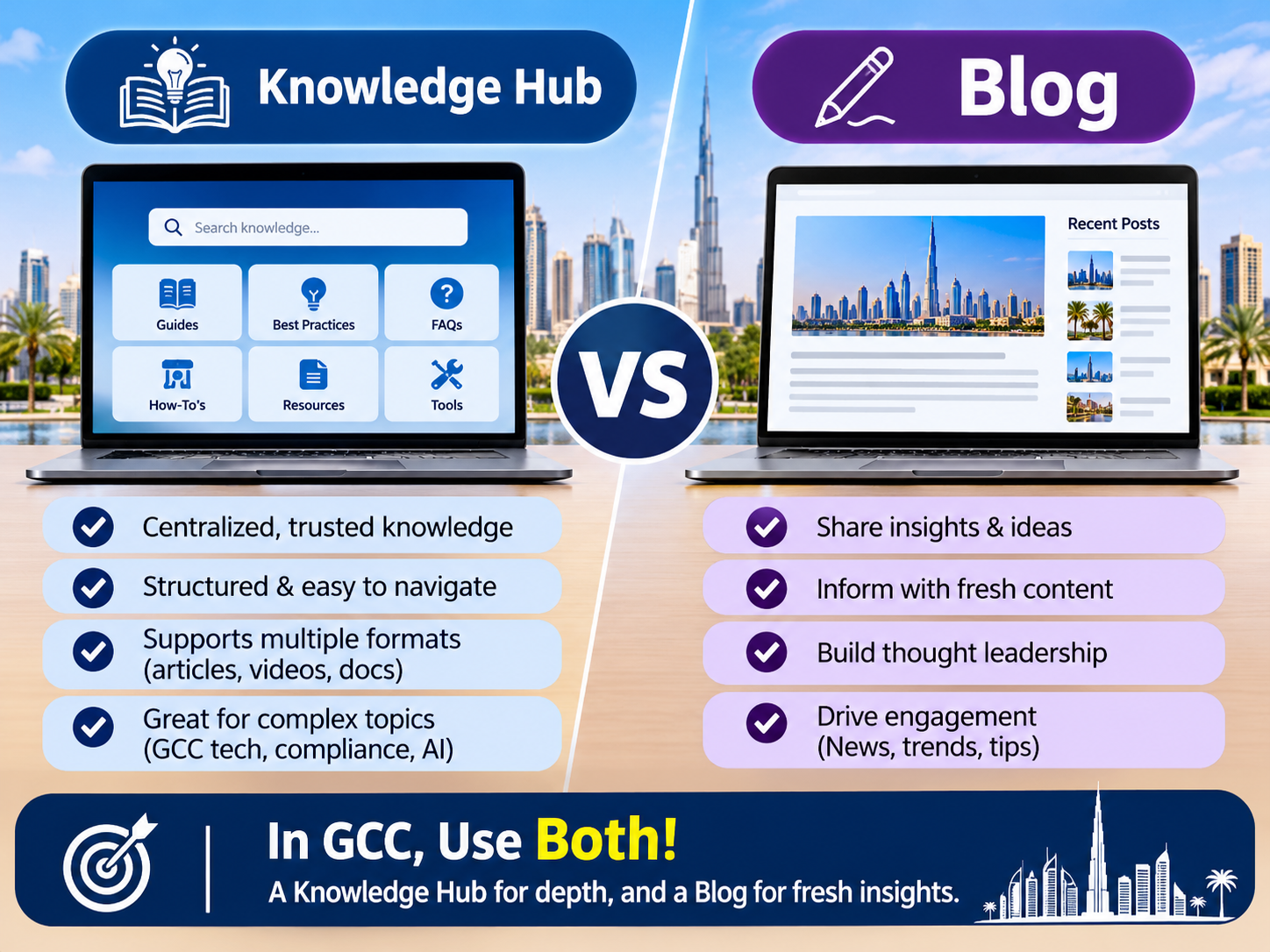
A knowledge hub organizes expert resources, pillar pages, guides, and FAQs around specific topics. A traditional blog typically publishes articles, news, and updates in chronological order. For businesses in Saudi Arabia, the UAE, and Qatar, combining both formats often creates a stronger foundation for topical authority, organic search visibility, and customer education.
But which approach makes more sense for your business?
Knowledge Hub vs Blog.
Both formats help businesses publish useful information. Their main differences lie in how visitors discover content and how individual resources support one another.
What Is an Arabic Knowledge Hub?
An Arabic knowledge hub is a structured collection of educational resources organized around specific subjects or customer needs.
Rather than presenting unrelated articles, it connects relevant information through pillar pages, supporting guides, FAQs, and contextual internal links.
For example, a Saudi e-commerce company could create a central Arabic guide about online shopping. Supporting resources might explain payment options, delivery procedures, product selection, and returns.
Visitors can move between these topics without repeatedly searching for information.
A well-planned knowledge hub can also support commercial pages. Professional SEO services can help businesses organize resources around relevant search intent and meaningful customer journeys.
How Does a Traditional Blog Work?
A traditional blog generally publishes articles in reverse chronological order, with the newest posts appearing first.
Blogs are particularly useful for.
Industry news and market updates.
Business announcements and product launches.
Expert opinions and commentary.
Campaign-related content.
Timely customer questions.
However, blogs aren’t limited to short-lived updates.
A properly organized blog can also contain evergreen guides, topic clusters, and strong internal links. The format itself doesn’t prevent a business from building authority.
Knowledge Hub vs Blog.
|
Feature |
Knowledge Hub |
Traditional Blog |
|---|---|---|
| Content structure | Topic-based organization | Usually chronological |
| Main purpose | Customer education and reference | Updates, insights, and education |
| Internal linking | Connected pillar pages and clusters | Contextual editorial links |
| Content maintenance | Regular resource reviews | New publishing and article updates |
| SEO potential | Supports interconnected topic coverage | Supports individual search-focused articles |
| User experience | Guided information discovery | Article browsing |
| Lead generation | Educational conversion journeys | Article-based conversions |
| Best suited for | Complex topics and evergreen resources | Timely news and ongoing commentary |
Key takeaway: A knowledge hub may make complex information easier to navigate, but neither format automatically earns better Google rankings. Content quality, relevance, usability, and credibility remain essential.
Which Builds More Topical Authority in the GCC?
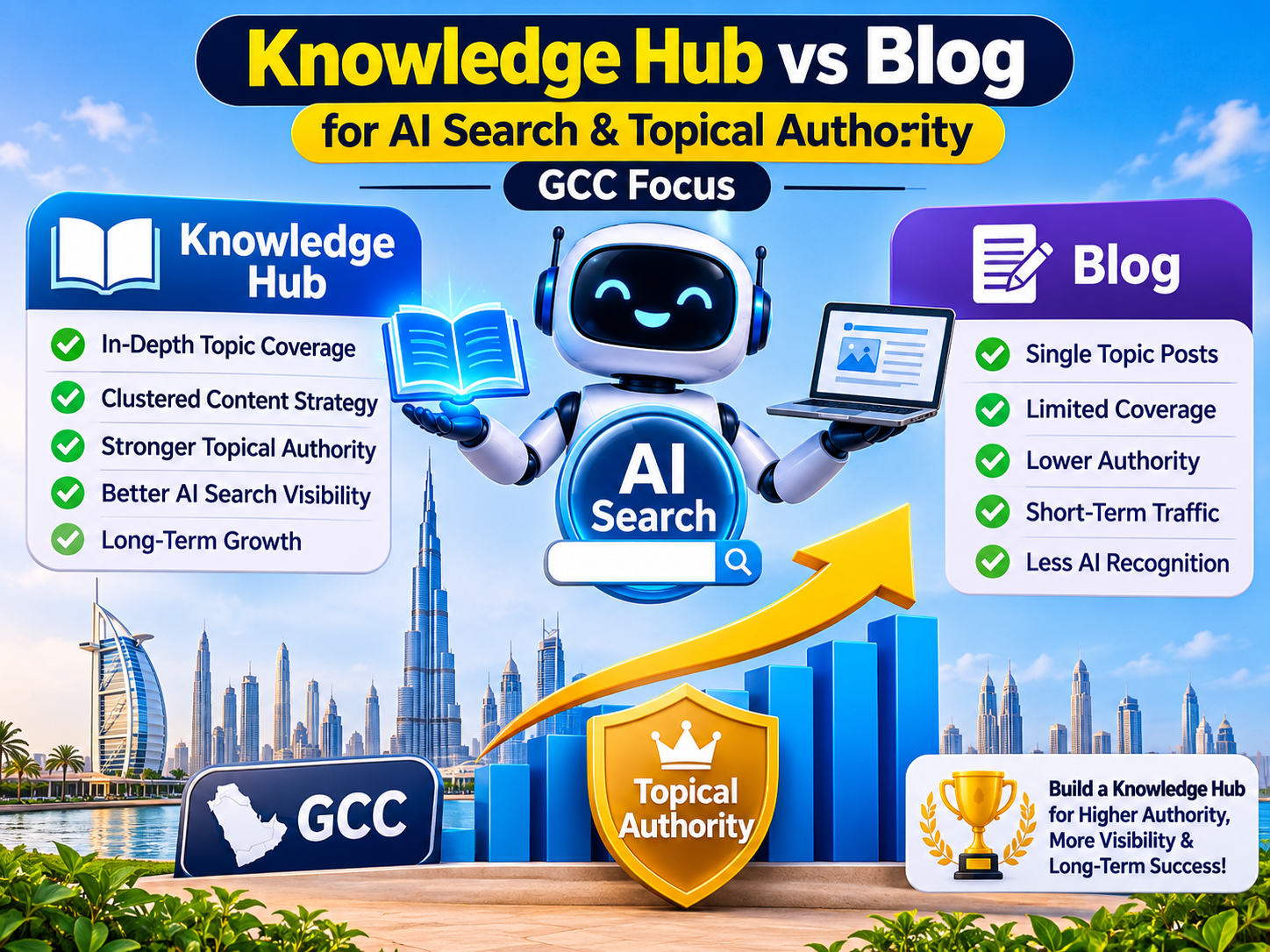
A knowledge hub can help establish topical depth by connecting related resources into a coherent information structure.
However, topical authority depends on more than content architecture.
Search engines and readers need useful information that demonstrates genuine knowledge, addresses search intent, and remains accurate over time.
Pillar Pages and Topic Clusters for Arabic SEO
Pillar pages explain broad subjects, while supporting articles address more specific questions.
Consider a Jeddah retailer selling products online.
Its Arabic knowledge hub might include a central guide to e-commerce purchasing, supported by detailed resources about secure payments, product comparisons, shipping, and returns.
These pages can link to one another and, where relevant, connect visitors with the company’s e-commerce solutions.
This makes the website more useful for customers while helping search engines discover related content.
E-E-A-T, Expert Authors, and Internal Linking
Google’s E-E-A-T concept refers to.
Experience: Relevant firsthand or practical knowledge.
Expertise: Subject-specific understanding and competence.
Authoritativeness: Recognition as a credible source.
Trustworthiness: Accuracy, transparency, and reliability.
E-E-A-T is not a standalone numerical Google ranking factor. It is a framework used in assessing content quality.
For GCC businesses, practical credibility signals include identifiable authors, reliable sources, accurate Arabic terminology, transparent editorial processes, and descriptive internal links.
Regulated subjects, including finance and legal compliance, require particular care.
Evergreen Resources vs Timely Blog Content
Evergreen content answers questions that remain useful over time.
Examples include product instructions, service explanations, technical tutorials, and educational guides.
Blog posts, meanwhile, can address market developments, regulatory announcements, and emerging industry trends.
A business doesn’t necessarily need to choose between them.
Maintaining evergreen resources alongside timely updates allows companies to serve customers at different stages of their decision-making process.
Arabic and Bilingual SEO Strategies for GCC Markets
Businesses operating across Saudi Arabia, the UAE, and Qatar face different language preferences, customer expectations, and commercial conditions.
A single English-language content strategy translated word for word into Arabic may miss important local search intent.
Saudi Arabia.
For companies targeting Saudi customers, Arabic-first educational resources can make services easier to understand and navigate.
A Riyadh fintech startup, for example, could create expert-reviewed Arabic guides explaining digital payments, account onboarding, cybersecurity awareness, and customer support.
Educational platforms such as Salla Academy, Zid Help Desk, and Monsha’at offer useful models of structured business information.
Arabic-first navigation, readable typography, and mobile-responsive website design can improve the overall experience.
UAE.
Dubai and Abu Dhabi businesses frequently serve customers from different language backgrounds.
Dedicated Arabic and English pages help these audiences find information in their preferred language.
Useful implementation practices include separate language URLs, appropriate hreflang annotations, accessible language switching, and content written for each audience rather than relying entirely on literal translations.
For example, a Dubai company might use /ar/services/ and /en/services/ for its language-specific service pages.
My Bayut and Property Finder are examples worth examining for their approaches to organizing property-related information.
Qatar.
For Doha businesses, specialized content can address practical questions that influence purchasing decisions.
A logistics provider might publish bilingual resources about shipping documents, delivery procedures, service requirements, and frequently asked operational questions.
Qatar Living and Hukoomi illustrate different approaches to presenting locally relevant information.
The right content depends on the business’s customers, services, and industry requirements.
GCC Content Strategy Comparison
|
Market |
Language approach |
Useful content priorities |
Business objective |
|---|---|---|---|
| Saudi Arabia | Arabic-first |
E-commerce, finance, customer services |
Enquiries and sales |
| UAE | Arabic and English |
B2B services and multilingual guidance |
Qualified leads |
| Qatar | Arabic and English |
Specialist services and local information |
Consultations |
These are practical starting points, not universal rules. Audience research should determine the final language and content priorities.
GCC Compliance, Trust, and Content Governance
Businesses publishing educational resources must consider accuracy, customer trust, and relevant legal requirements.
This becomes especially important when content discusses regulated activities or handles personal information.
Saudi Arabia.
Financial-content publishers in Saudi Arabia should consult relevant guidance from the Saudi Central Bank (SAMA).
For applicable data governance subjects, National Data Management Office (NDMO) publications can provide additional context.
Referencing official authorities improves research quality, but it doesn’t replace professional compliance assessment.
UAE and Qatar.
Depending on the subject matter, relevant authorities and frameworks may include:
UAE TDRA: Telecommunications and digital government matters.
ADGM and DIFC: Applicable financial and commercial regulatory frameworks.
Qatar Central Bank (QCB): Relevant financial-sector requirements.
These bodies do not generally regulate ordinary commercial blogging simply because a company publishes educational articles.
Their guidance becomes relevant when the subject matter or business activity falls within their respective areas of responsibility.
Arabic Accuracy, Privacy, and Expert Review
Arabic knowledge resources should follow a clear editorial review process.
Businesses should verify translations, cite reliable primary sources, assign content owners, and record meaningful updates.
If a website collects personal information, its operators should assess applicable privacy and data-processing requirements.
Cloud infrastructure options such as AWS Bahrain, Azure UAE Central, and Google Cloud Doha should also be evaluated against actual operational and data-residency needs rather than assumed legal obligations.
Editorial essentials: Reliable sources, appropriate expert approval, accurate translation, clear privacy information, and documented content reviews.
Looking to scale your store in UAE/Saudi Arabia? Contact our expert IT team today for a free consultation. ( Click Here’s )
How Knowledge Hubs Support AEO, GEO, and AI Search
Search behavior is expanding beyond traditional blue-link results.
Customers increasingly use conversational search tools to ask detailed questions, compare services, and understand unfamiliar topics.
A carefully maintained knowledge hub can make useful information easier to discover and interpret. However, its structure alone cannot guarantee visibility in AI-generated responses.
Answer Engine Optimization for Arabic Queries
Answer Engine Optimization (AEO) focuses on presenting useful information in ways that directly address user questions.
For Arabic content, this means using clear headings, precise terminology, concise answers, and helpful supporting explanations.
For example, a guide about online payments should answer the central payment question near the beginning rather than forcing readers through a lengthy introduction.
Relevant FAQs can also help readers locate specific answers.
Generative Engine Optimization and AI Discoverability
Generative Engine Optimization (GEO) concerns how content can be made useful and discoverable in AI-assisted search experiences.
Practical priorities include original information, clear authorship, accessible page structure, trustworthy references, and accurate explanations.
Google’s guidance indicates that established SEO best practices remain relevant to its AI search experiences.
Businesses should therefore prioritize genuine content quality instead of treating AI visibility as a separate shortcut.
Measuring SEO and AI-Search Performance
Useful performance indicators include organic search impressions, nonbranded clicks, engaged sessions, qualified enquiries, and assisted conversions.
Where reliable attribution is available, businesses can also monitor referral traffic from AI-assisted discovery platforms.
Avoid presenting speculative AI visibility scores as confirmed commercial outcomes.
A content strategy should ultimately be evaluated through meaningful customer engagement and business results.
Choosing the Right Content Model for Your GCC Business
The best publishing model depends on how customers research your products and services.
A knowledge hub is particularly useful when visitors need detailed explanations before making decisions.
A blog may be more appropriate when industry news, announcements, and frequent commentary are priorities.
For companies requiring both, a hybrid approach is often the most practical option.
A connected digital marketing strategy can help align educational resources, editorial updates, and commercial objectives.
When Should You Choose Each Model?
Choose a knowledge hub when.
Your products or services require detailed explanations.
Customers ask recurring technical or operational questions.
You publish substantial evergreen educational content.
Related articles need clearer navigation and internal links.
Choose a traditional blog when.
Timely publishing is a major business priority.
Your audience follows industry developments.
Announcements and expert commentary drive engagement.
Your team needs a straightforward editorial format.
Choose a hybrid model when.
You need both evergreen guidance and timely updates.
Your website serves different customer journeys.
You want educational resources connected with service pages.
Your business operates across several GCC markets.
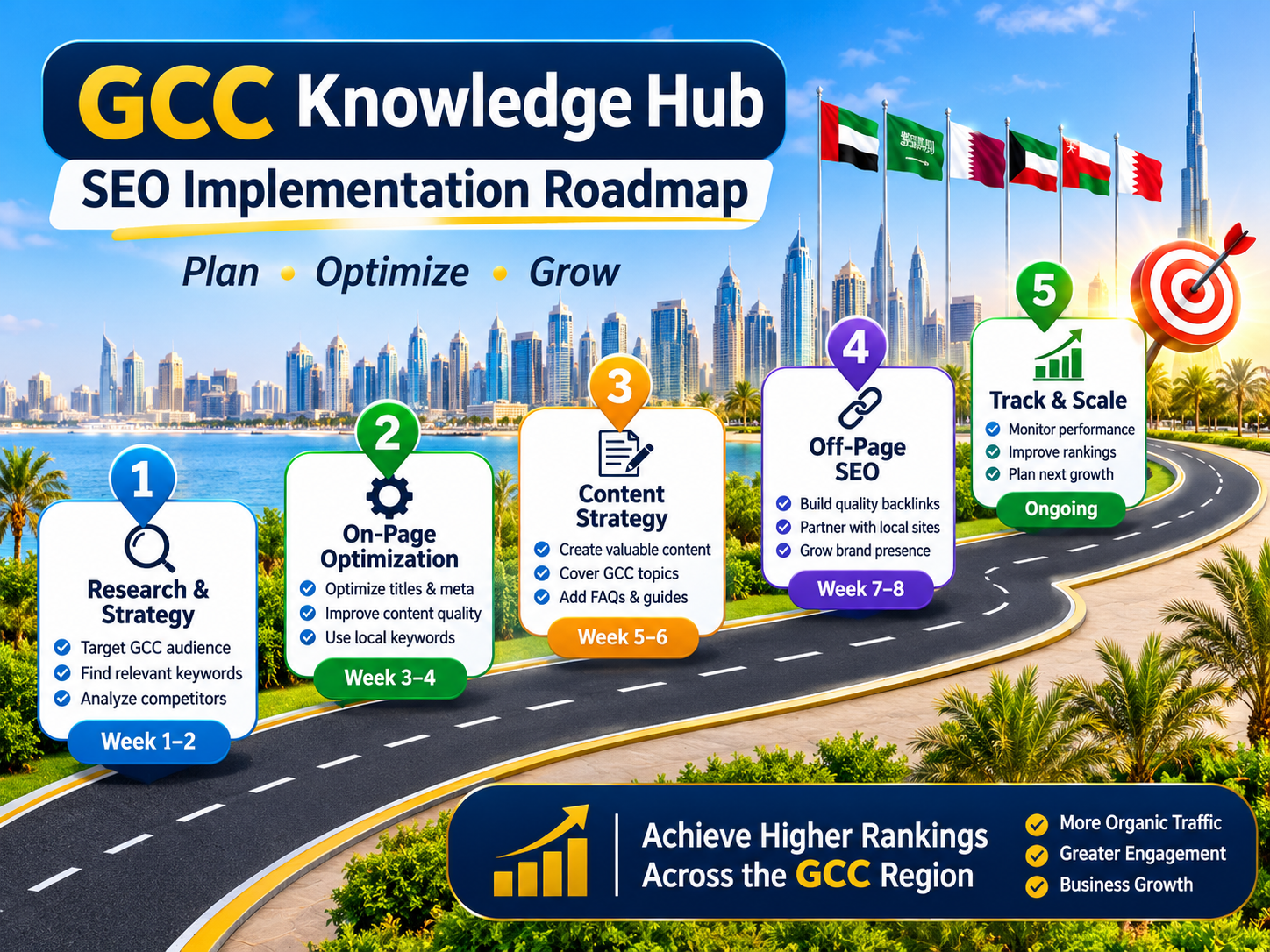
A Practical GCC Knowledge Hub Implementation Roadmap
A successful knowledge hub doesn’t necessarily require rebuilding an entire website.
Existing resources can often be reorganized into a clearer architecture.
Audit existing content. Review Arabic and English pages for relevance, accuracy, duplication, and outdated information.
Map customer search intent. Identify common questions from Saudi, UAE, and Qatar audiences using customer feedback and available search data.
Create topic clusters. Group related articles beneath relevant pillar pages and connect resources through useful internal links.
Organize language versions. Develop localized navigation, clear URL structures, and accessible pages. Appropriate WordPress development can support this architecture.
Assign editorial ownership. Establish responsibilities for subject-matter reviews, translation quality, relevant compliance checks, and content maintenance.
Measure and refine. Monitor organic discovery, engagement, qualified leads, and conversions, then improve resources based on actual performance.
This approach supports gradual improvement without prioritizing unnecessary content production.
Budget, Maintenance, and SEO ROI
The cost of creating a knowledge hub varies significantly.
Reorganizing an existing website may involve less development than building a multilingual content platform from scratch.
Common cost considerations include content research, Arabic localization, technical development, expert review, internal linking, and ongoing maintenance.
Rather than measuring success only through the number of published articles, businesses should examine lead quality, assisted revenue, and customer engagement.
Strong service-page SEO can also connect educational visitors with relevant commercial solutions.
To Sum Up
The Knowledge Hub vs Blog decision is ultimately about creating a better experience for customers while demonstrating credible expertise.
Knowledge hubs connect educational information into structured resources. Blogs provide flexible platforms for publishing updates, commentary, and useful articles. Mak It Sol
Neither guarantees higher search rankings or AI citations.
For many businesses in Saudi Arabia, the UAE, and Qatar, a hybrid approach offers a sensible balance: organized Arabic-first or bilingual resources supported by timely blog content, reliable references, and relevant internal links.
The priority should be publishing information that customers can actually use, not simply producing more pages.
Need a clearer content structure for your GCC business?
Contact Mak It Solutions to discuss an Arabic SEO and content architecture audit.
Our team can help you evaluate whether a dedicated knowledge hub, an improved traditional blog, or a hybrid publishing strategy best suits your audience and commercial goals.
Looking to scale your store in UAE/Saudi Arabia? Contact our expert IT team today for a free consultation. ( Click Here’s )
FAQs
Q : Can Saudi e-commerce brands turn existing blog posts into a knowledge hub?
A : Yes. Saudi e-commerce businesses can reorganize relevant articles into pillar pages and connected educational resources without rebuilding their entire websites.
A Riyadh retailer could group payment guides, delivery information, product tutorials, and returns policies beneath a central Arabic shopping resource. This approach can support customer education and broader digital-business objectives associated with Saudi Vision 2030.
Q : Do UAE businesses need separate Arabic and English URLs?
A : Google generally recommends distinct URLs for different language versions.
A UAE business might use /ar/services/ for Arabic content and /en/services/ for English content. Appropriate hreflang annotations, accessible language navigation, and properly localized text can help users and search engines understand the available versions.
Q : Which topics should Doha B2B companies prioritize in a knowledge hub?
A : Doha B2B businesses should begin with questions that affect customer purchasing decisions.
Examples include service capabilities, implementation procedures, procurement processes, pricing explanations, and relevant industry requirements. Priorities should reflect customer feedback, search demand, and the company’s actual expertise.
Q : How often should businesses in Bahrain and Kuwait update knowledge hub content?
A : There is no universal update schedule.
Stable educational material may need periodic checks, while regulatory guidance, prices, product details, and operating procedures often require more frequent reviews.
Businesses should assign content owners and update pages when important information changes.
Q : Can an Oman SME use one knowledge hub for the entire GCC?
A : Yes. An Oman-based SME can maintain a centralized knowledge hub while creating localized resources for individual GCC markets.
Shared educational guides can explain common product features or technical concepts, while country-specific pages clarify local terminology, service availability, payments, and relevant regulations.
This approach helps reduce unnecessary duplication without overlooking regional differences.
Looking to scale your store in UAE/Saudi Arabia? Contact our expert IT team today for a free consultation. ( Click Here’s )