


MENA B2B Case Study Template for GCC Brands
MENA B2B Case Study Template for GCC Brands
MENA B2B Case Study Template for GCC Brands
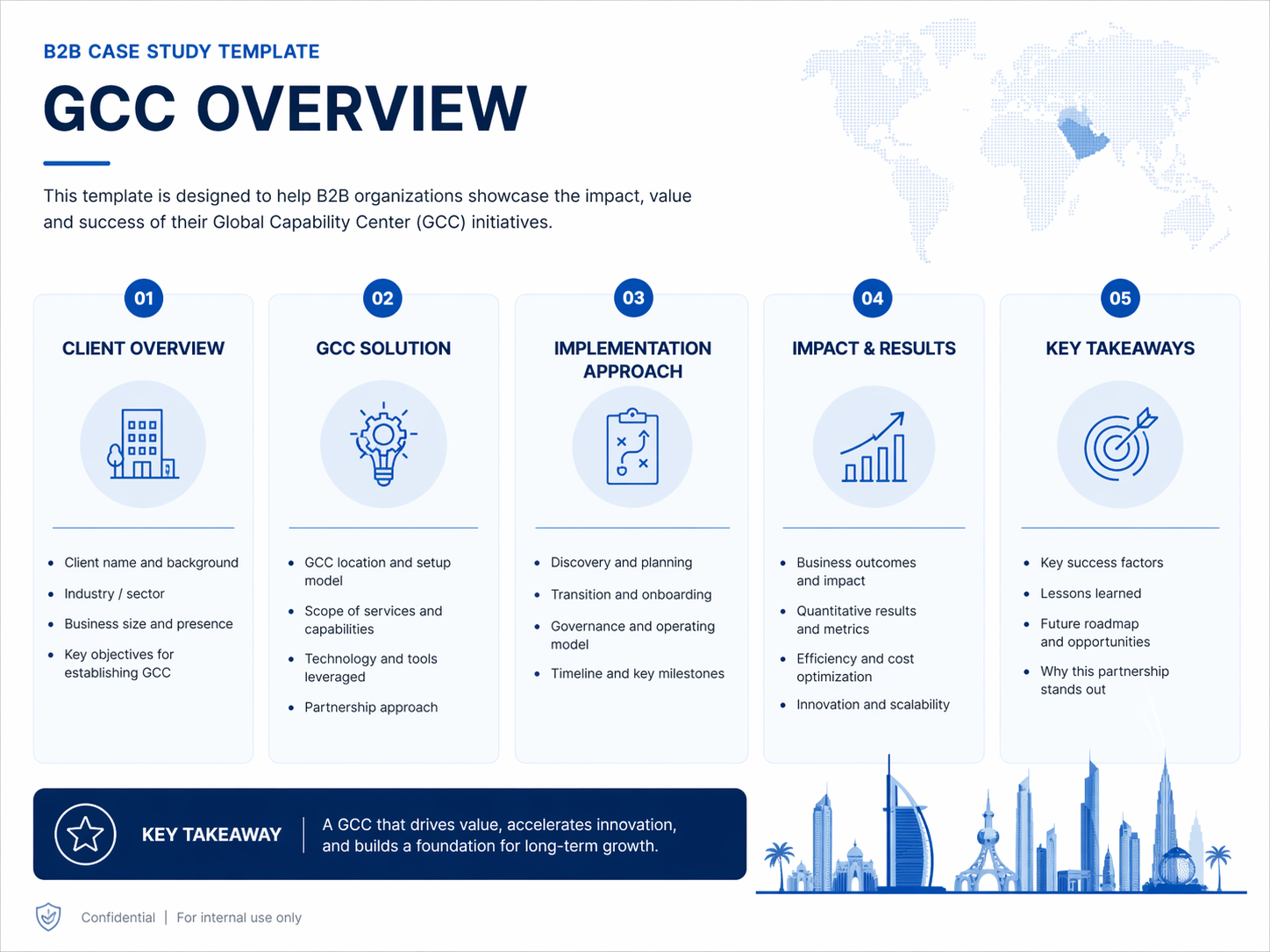
A strong B2B case study template can do more than showcase past work. In Saudi Arabia, the UAE, and Qatar, it can help your brand earn trust faster, answer buyer objections earlier, and support lead generation with proof that feels relevant to GCC decision-makers.
For most regional brands, the best format is simple: show the challenge, explain the solution, and prove the result. Then add the local signals buyers actually care about, such as bilingual readability, governance awareness, and a clear understanding of how businesses in Riyadh, Dubai, Abu Dhabi, and Doha evaluate vendors.
Why a B2B case study matters in the GCC
In GCC markets, polished claims alone rarely move serious buyers. Proof does.
That is why a well-structured B2B case study template often outperforms a generic service page or sales pitch. It gives procurement teams, founders, marketing leads, and enterprise stakeholders something concrete to review. It also reduces uncertainty, which is a major part of B2B decision-making across Saudi Arabia, the UAE, and Qatar.
Many imported case studies miss the mark because they feel too broad or too Western in tone. They talk about growth, innovation, and success, but skip the details local buyers notice first.
Business context
Delivery process
Arabic and English usability
Governance or compliance sensitivity
Measurable results that feel believable
When those elements are missing, even a strong project can feel less credible than it should.
What a B2B case study template should include
A practical template does not need to be complicated. It needs to be clear, structured, and easy to scan.
Core sections every template needs
A solid B2B case study template should include.
Client background
A short summary of who the client is, what sector they operate in, and what kind of market they serve.
The challenge
The business problem that needed to be solved. This could be low conversions, slow digital rollout, weak lead quality, limited Arabic UX, or fragmented operations.
The objective
What success looked like from the client’s point of view.
The solution
What your team delivered and why that approach was chosen.
Implementation
How the work was executed, including rollout, collaboration, timelines, localization, or integration details.
Results
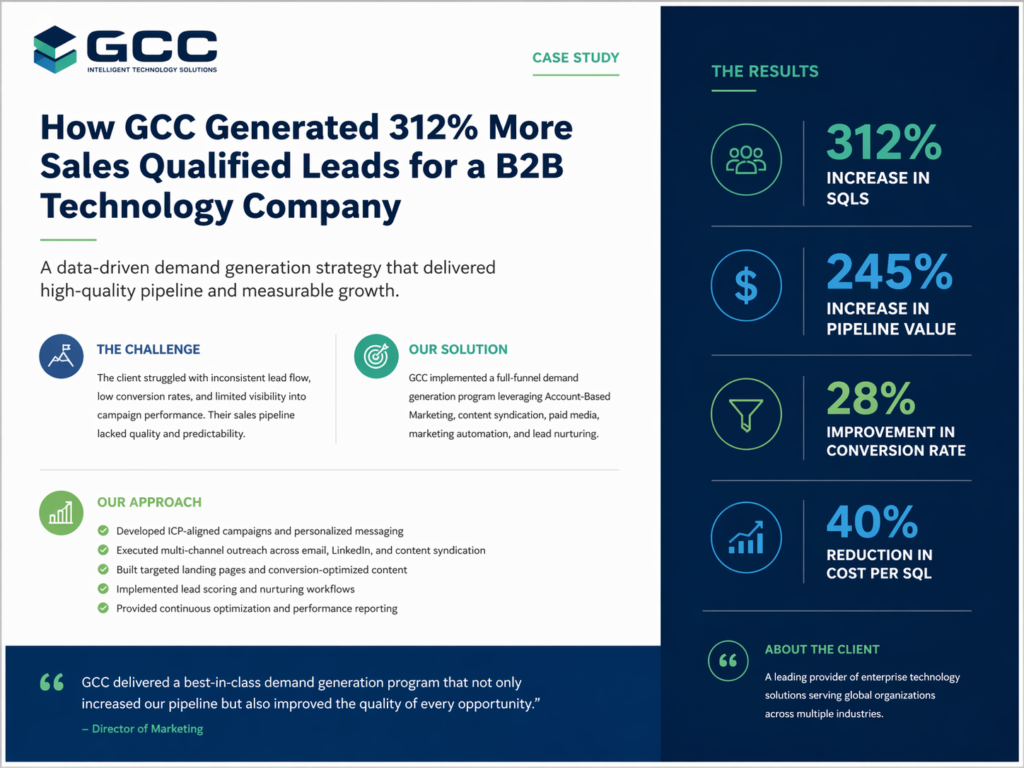
The measurable outcome, such as stronger conversion, lower acquisition cost, faster deployment, or improved retention.
Closing takeaway
A short summary that connects the result back to the buyer’s priorities.
This structure works because it mirrors how decision-makers think. First, they want context. Then they want evidence. Then they want confidence.
How GCC buyer behavior changes the format
The same case study should not be framed the same way for every market.
In practice, GCC buyers often want a shorter path to trust. They prefer clear summaries, visible proof, and reassurance that the vendor understands local business expectations. That can include language preferences, approval processes, sector sensitivity, and the overall tone of communication.
Here is what that often looks like.
| Market | What buyers often respond to |
|---|---|
| Saudi Arabia | Authority, clarity, trust, structured messaging |
| UAE | Speed, execution quality, innovation, business impact |
| Qatar | Detail, stakeholder alignment, controlled delivery, credibility |
This does not mean every buyer thinks the same way. It means your case study should feel region-aware rather than generic.
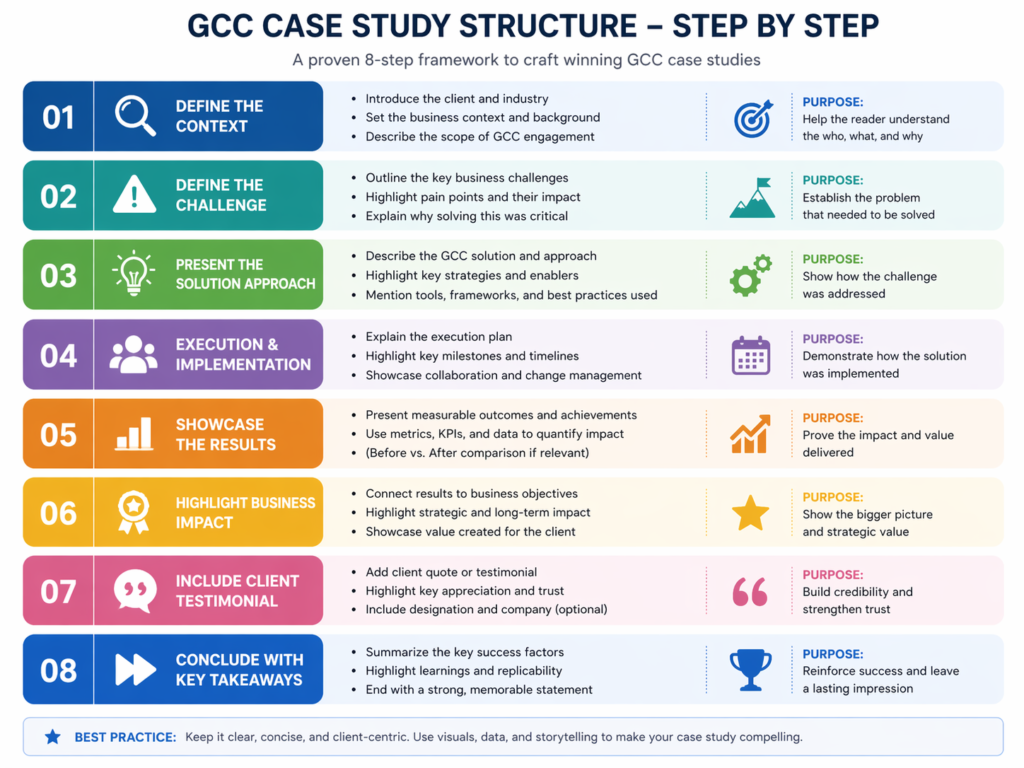
The ideal MENA case study structure step by step
Start with the challenge and business context
Open with the problem in plain language.
Avoid dramatic storytelling. Avoid vague lines like “the client wanted to transform their business.” Say what was actually happening. For example:
Lead quality was too low
The Arabic user journey was weak
Conversion rates had stalled
A digital product needed a more structured rollout
Regional expansion required a localized content and UX approach
This part should help the reader immediately understand why the project mattered.
Explain the solution clearly
Once the challenge is clear, explain what you did.
Focus on the logic behind the work, not just the deliverables. A better case study shows the thinking behind the execution. That could include:
Website redesign with Arabic UX considerations
Mobile-first commerce improvements
SEO and localized content planning
Shopify or Adobe Commerce development
Product rollout tied to governance or enterprise requirements
Keep this section readable. Long technical detail can be useful, but only when it supports the story.
Show the implementation process
This is where many case studies get thin.
A buyer does not only want to know what was delivered. They also want to know whether your team worked in a structured, reliable way. That is especially important in Saudi, UAE, and Qatar projects involving multiple stakeholders.
Useful details include.
Discovery and planning approach
Alignment with internal client teams
Localization or bilingual content workflow
Platform setup or migration process
Reporting and performance tracking
Phased launch or controlled deployment
A short implementation section can make your story feel far more credible.
Present measurable results
This is the section that carries the most weight.
Do not hide the results at the end. Make them easy to scan. Use bullets, subheads, or callout formatting so a busy reader can find them fast.
Examples of strong proof points.
Lower cost per qualified lead
Higher conversion rate
Faster launch time
Better mobile engagement
Improved retention
Stronger cross-channel consistency
More qualified sales conversations
If exact numbers are confidential, you can still be specific without overclaiming. The key is clarity.
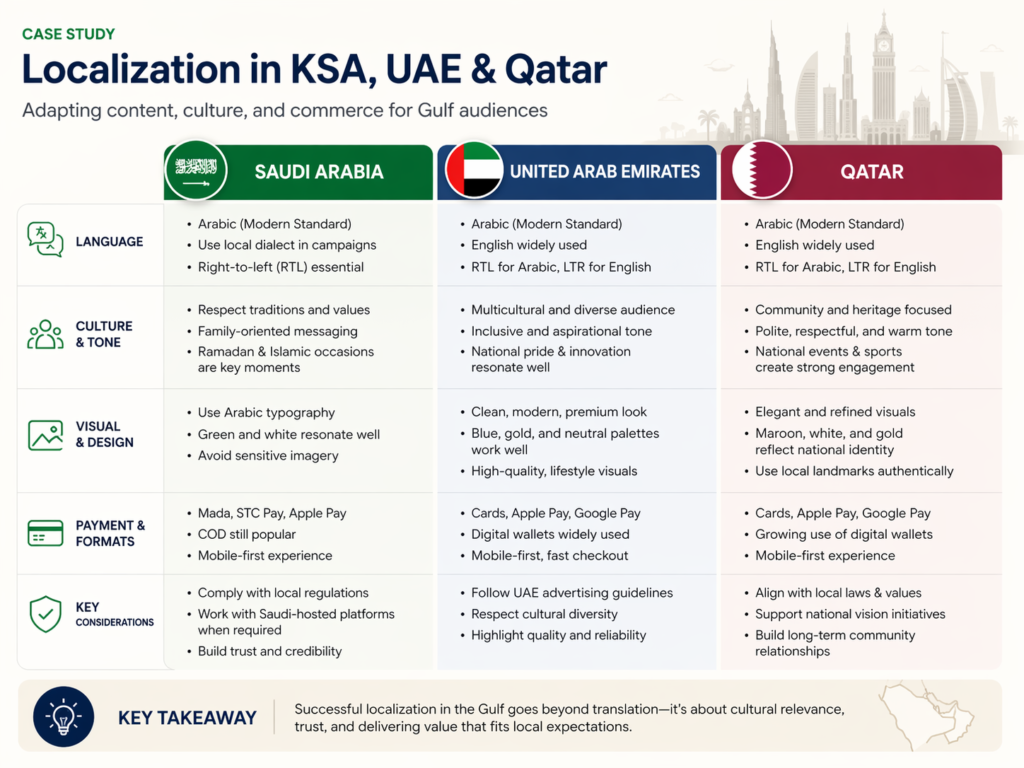
How to localize a case study for Saudi, UAE, and Qatar buyers
Localization is not just translation. It is relevance.
A GCC-ready case study should reflect how local buyers read, compare, and validate service providers.
Use a respectful, business-first tone
For Saudi Arabia, a calm and authoritative tone often works better than hype.
For the UAE, a sharper commercial angle may be more effective, especially when speed, growth, and execution quality are part of the project story.
For Qatar, a more structured and detailed presentation can be useful, particularly for enterprise-facing work or formal stakeholder review.
Make bilingual readability easier
A bilingual format does not mean turning the page into a wall of duplicate text.
A cleaner approach is to use.
English as the main narrative where appropriate
Arabic summaries for key sections
Dual-language headings or callouts
Clear result blocks that are easy for mixed-language teams to review
This supports internal alignment without hurting readability.
Match examples to the local market
Regional examples make the case study feel grounded.
A Riyadh fintech story might highlight trust, governance awareness, and a structured customer journey.
A Dubai e-commerce case might focus more on speed, mobile experience, and conversion uplift.
An Abu Dhabi enterprise project may benefit from a stronger emphasis on institutional credibility.
A Doha case study often works better when it shows disciplined implementation, stakeholder clarity, and data-awareness.
Trust signals that strengthen a GCC case study
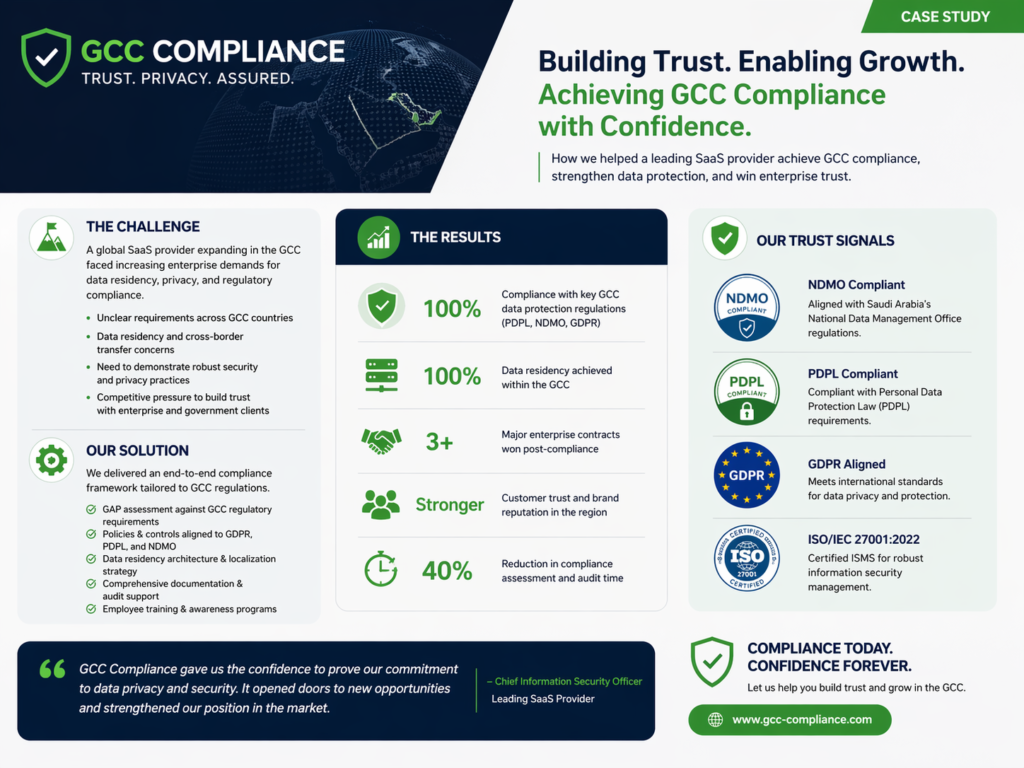
In GCC B2B marketing, trust signals matter almost as much as outcomes.
That does not mean stuffing your case study with logos, acronyms, or compliance language. It means using the right signals in the right places.
Signals that can improve credibility
Depending on the sector, useful trust signals may include.
Bilingual presentation
Governance-aware language
Enterprise-friendly delivery process
Data residency awareness
Procurement sensitivity
Stakeholder alignment
Sector-specific terminology
Clear, measurable outcomes
These details tell the reader your team understands how business gets evaluated in the region.
When regulated-market context matters
If you are writing for fintech, financial services, health, government, or enterprise technology, context matters even more.
You do not need to make legal claims. But you can show that the project was shaped by real business constraints, such as.
Formal approval processes
Data handling expectations
Multi-stakeholder review
Platform governance requirements
Market-specific communication standards
That alone can make the story feel safer and more credible.
Best use cases for a B2B case study template in the Gulf
A well-built template is flexible. It can work across sectors as long as the framing matches the buyer.
Fintech and financial services
These case studies should emphasize trust, onboarding quality, product clarity, and structured delivery. In Saudi and UAE markets, careful wording matters.
Retail and e-commerce
For Gulf retail brands, case studies should focus on conversion, mobile experience, customer journey improvements, and operational execution.
Logistics and operations
These stories usually work best when they highlight visibility, efficiency, reporting accuracy, and implementation discipline.
Enterprise and government-facing services
For these audiences, the case study should feel calm, clear, and evidence-led. Overly promotional writing usually weakens trust.
Common mistakes to avoid
Even good projects can sound weak when the case study is poorly framed.
Here are the mistakes that show up most often.
Using generic claims
“We improved growth” is too vague.
Say what changed and why it mattered.
Ignoring Arabic UX and stakeholder reality
A case study that reads well only for one audience may fail in internal review.
Overwriting the story
Long paragraphs and repeated claims make proof harder to find.
Hiding the result
If the buyer has to work too hard to find the outcome, the case study loses impact.
Forgetting the next step
A case study should support conversion, not just storytelling.
How to turn one case study into a lead generation asset
A strong B2B case study template should not live on a single page and stop there.
It can be repurposed into multiple sales and marketing assets, including.
Website proof pages
Proposal inserts
LinkedIn content
Sales decks
Email outreach support
Sector-specific landing pages
This is one of the easiest ways to get more value from a successful client story.
To make that work, build the case study with modular sections from the start. A concise summary, a clean results block, and a clear takeaway can be reused across channels without rewriting the whole story each time.
Final thoughts
A high-performing B2B case study template for Saudi, UAE, and Qatar brands is not flashy. It is clear, localized, and credible.
When you combine real business context, structured storytelling, bilingual readability, and measurable results, your case study becomes more than content. It becomes a sales asset that supports trust, shortens buyer hesitation, and helps your brand stand out in competitive GCC markets.
If your business wants stronger proof-led content for the Gulf, build case studies that speak the language of the buyer, not just the language of marketing.( Click Here’s )
FAQs
Q : Is a bilingual case study better for Saudi B2B audiences?
A : In many cases, yes. A bilingual structure can improve internal alignment, especially when commercial, technical, and executive stakeholders do not all prefer the same language. The key is keeping it clean and easy to scan.
Q : What matters most in a UAE case study?
A : UAE buyers often respond well to a mix of business impact and execution speed. Strong examples include better conversion, faster launch, stronger mobile performance, and a clear delivery process.
Q : How detailed should a Qatar enterprise case study be?
A : Usually more detailed than a standard marketing success story. Enterprise buyers often want context, delivery logic, and proof that the supplier understands a formal business environment.
Q : Can fintech brands mention compliance or governance context?
A : Yes, but carefully. The case study should reflect the operating environment without making unsupported legal or certification claims. Balanced wording builds more trust than overstated language.
Q : What is the ideal length for a GCC B2B case study?
A : For most website use cases, a range of 700 to 1,200 words works well. For enterprise sales, it can help to create both a shorter web version and a more detailed PDF or proposal version.