

Post-Quantum Cryptography: GCC Business Guide
Post-Quantum Cryptography: GCC Business Guide
Post-Quantum Cryptography: GCC Business Guide
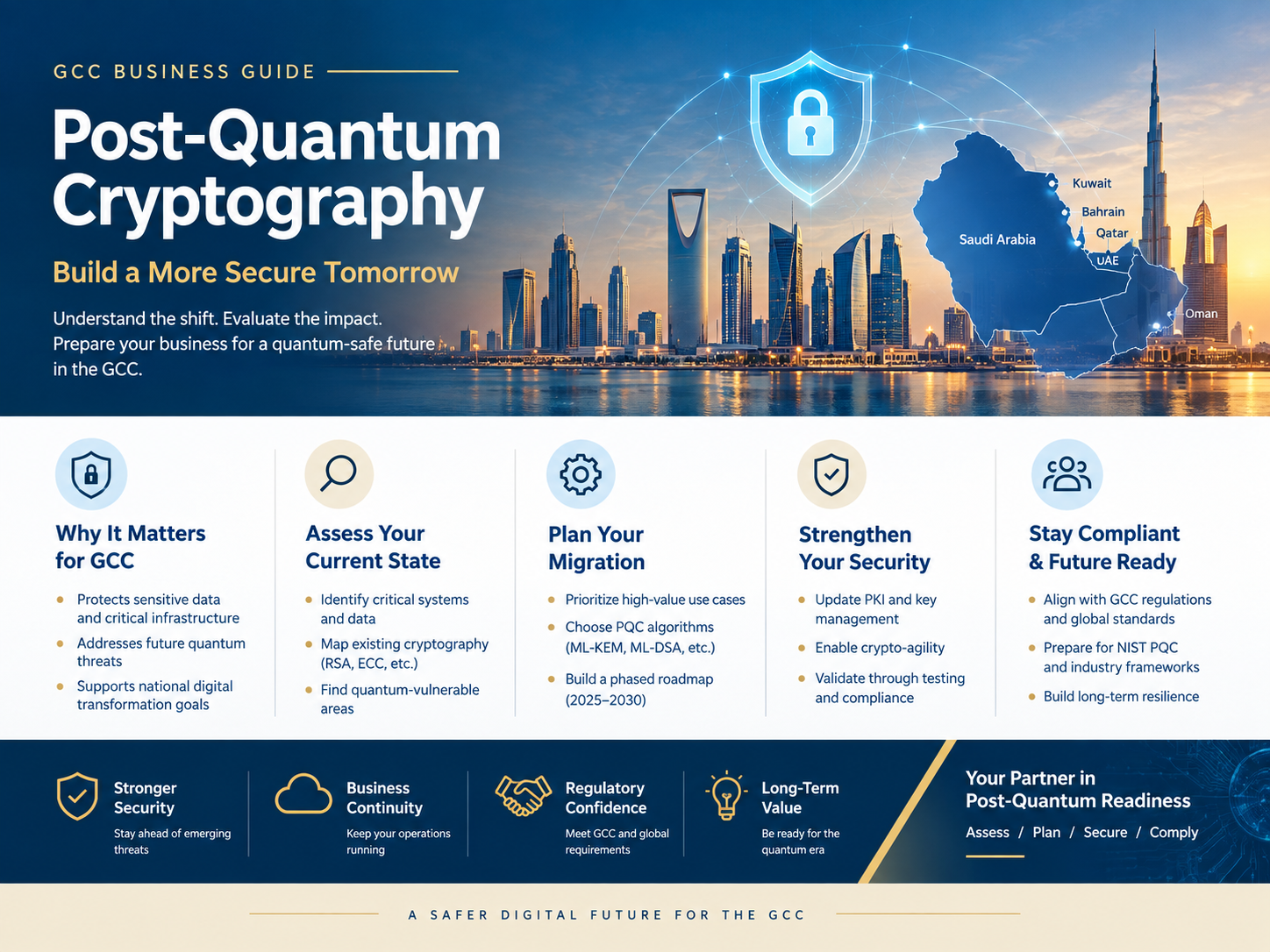
Quantum computing does not need to be commercially mature to create a cybersecurity risk today. Post-quantum cryptography is becoming increasingly relevant for GCC organizations because sensitive data stolen now could potentially be decrypted years later if future quantum computers weaken today’s RSA and ECC public-key cryptography.
For businesses in Saudi Arabia, the UAE and Qatar, the practical response is not a rushed replacement of every encryption system. It is to identify vulnerable cryptography, prioritize long-lived data, improve crypto agility and build a phased migration plan around emerging quantum-resistant standards.
What Is Post-Quantum Cryptography, and Why Does the GCC Need It?
Post-quantum cryptography (PQC) refers to cryptographic algorithms designed to remain secure against attacks from both classical computers and sufficiently capable quantum computers.
For GCC businesses, PQC is less about predicting when a powerful quantum computer will arrive and more about protecting information that may still be sensitive when that happens.
How quantum computing threatens RSA and ECC
The basic relationship is.
Quantum computing → Shor’s algorithm → RSA/ECC risk → post-quantum cryptography
RSA and elliptic-curve cryptography (ECC) are deeply embedded across enterprise environments. They support certificates, digital signatures, authentication, secure key exchange and public-key infrastructure.
That means quantum risk is not limited to one application or one cybersecurity product. It can affect multiple layers of an organization’s infrastructure.
Why “Harvest Now, Decrypt Later” creates a risk today
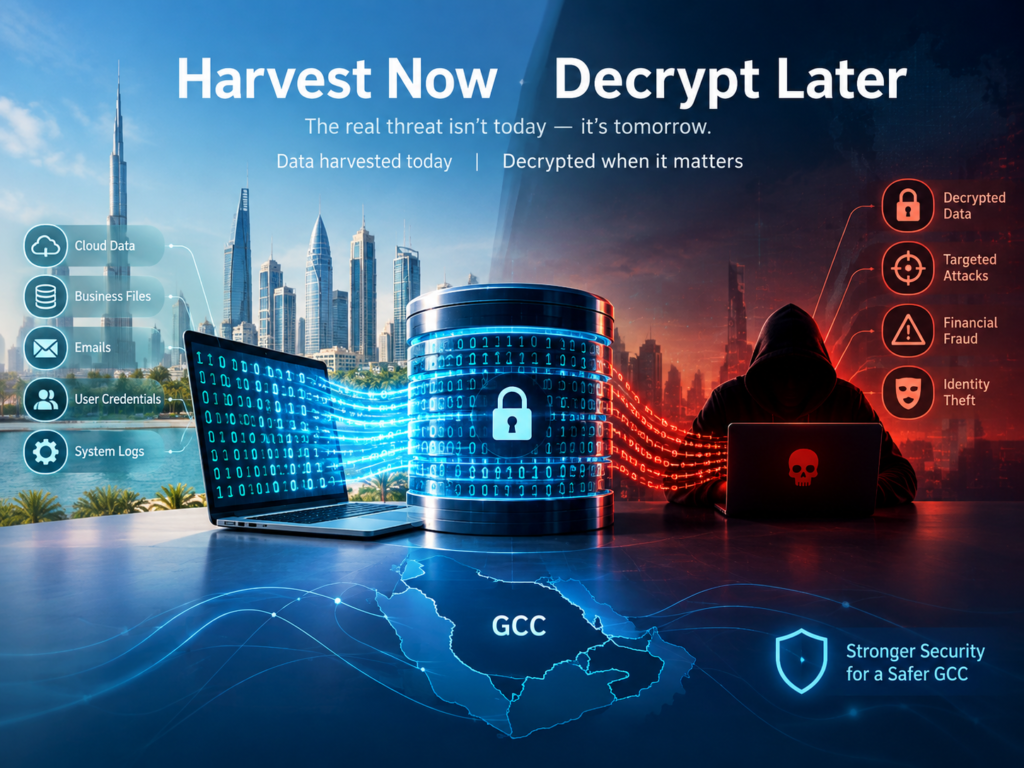
One of the most important quantum-security concerns is harvest now, decrypt later (HNDL).
An attacker may collect encrypted information today even if they cannot currently decrypt it. If that information remains valuable for many years, a future quantum computer capable of breaking vulnerable public-key encryption could make the stolen data useful later.
Government records, financial information, intellectual property and confidential communications are obvious examples.
Saudi Arabia’s Communications, Space and Technology Commission has highlighted this type of long-term threat, which is why preparation matters before practical quantum attacks become widespread.
Why GCC businesses should prepare early
Riyadh, Dubai, Abu Dhabi and Doha continue to expand their cloud, fintech, telecom, government and digital-service ecosystems.
That creates increasingly complex cryptographic environments involving cloud platforms, vendors, certificates, APIs, identity systems and legacy infrastructure.
In practice, finding and replacing vulnerable cryptography across such an environment can take far longer than changing a single algorithm. Building cryptographic agility early makes future migration more manageable.
How Serious Is the Quantum Cybersecurity Risk in Saudi Arabia, the UAE and Qatar?
Quantum risk is not identical across the GCC. Regulatory environments, infrastructure maturity and sector priorities differ, but all three markets have reasons to begin structured preparation.
Saudi Arabia.
Saudi Arabia already has an established cybersecurity and cryptographic governance environment.
The National Cybersecurity Authority’s National Cryptographic Standards address areas such as PKI, key lifecycle management and post-quantum cryptography. That makes PQC relevant to organizations operating in sectors including government, banking, fintech, telecom and critical infrastructure.
For example, a regulated fintech business should identify its RSA and ECC dependencies while also considering applicable Saudi Central Bank requirements and wider cybersecurity governance.
PQC should not be treated as a standalone compliance checkbox. It is part of a broader cryptographic-risk program.
UAE.
Dubai has moved beyond treating quantum security as a purely theoretical issue.
The Dubai Electronic Security Center has introduced post-quantum cryptography guidance intended to help prepare digital infrastructure for emerging quantum threats.
For organizations in Dubai and Abu Dhabi, this turns crypto discovery, certificate dependencies, vendor readiness and quantum-safe architecture into increasingly practical technology-management questions.
Banks, government entities and technology companies should also consider how migration interacts with relevant TDRA, ADGM, DIFC and sector-specific requirements.
Qatar.
Qatar is also showing visible movement around quantum-safe communications.
On May 31, 2026, Ooredoo Qatar, Hamad Bin Khalifa University and Qatar’s Ministry of Defence announced an operational quantum-safe communications link using quantum key distribution.
That does not mean every organization in Qatar faces the same PQC requirement today. It does, however, show that quantum-safe infrastructure has moved from theory into practical regional initiatives.
For banks, telecom providers and critical-infrastructure operators in Doha, that is a strong reason to start assessing cryptographic dependencies and vendor readiness.
Which Encryption Systems Are Most Exposed to Quantum Computing?
A post-quantum migration should begin with discovery.
Organizations need to know where vulnerable public-key cryptography exists before deciding what should be replaced, upgraded or monitored.
RSA, ECC and public-key infrastructure
A cryptographic inventory should look for dependencies including.
RSA and ECC
TLS certificates
Public-key infrastructure
Digital signatures
VPNs
APIs
Identity and authentication platforms
Cloud services
Databases and encrypted applications
Third-party and vendor systems
API dependencies should also be reviewed using established API security practices, because vulnerable cryptography can sit inside application integrations that are easy to overlook.
ML-KEM, ML-DSA and SLH-DSA explained simply
NIST finalized three major post-quantum standards in August 2024.
ML-KEM — FIPS 203: designed for secure key establishment.
ML-DSA — FIPS 204: designed for digital signatures.
SLH-DSA — FIPS 205: an additional digital-signature standard.
These standards give organizations a clearer technical foundation for migration planning.
However, adopting a standard is only one part of the challenge. Enterprises still need to understand compatibility, application dependencies, certificate architecture, performance requirements and vendor support.
Why crypto agility matters more than finding one “perfect” algorithm
Cryptographic agility is the ability to change algorithms, certificates and cryptographic components without rebuilding entire systems.
That matters because security standards will continue to evolve.
For a GCC enterprise operating across multiple clouds, legacy PKI platforms and numerous technology vendors, the ability to replace cryptographic components cleanly can be more valuable than betting everything on one algorithm.
How Should GCC Businesses Start a Post-Quantum Cryptography Migration?
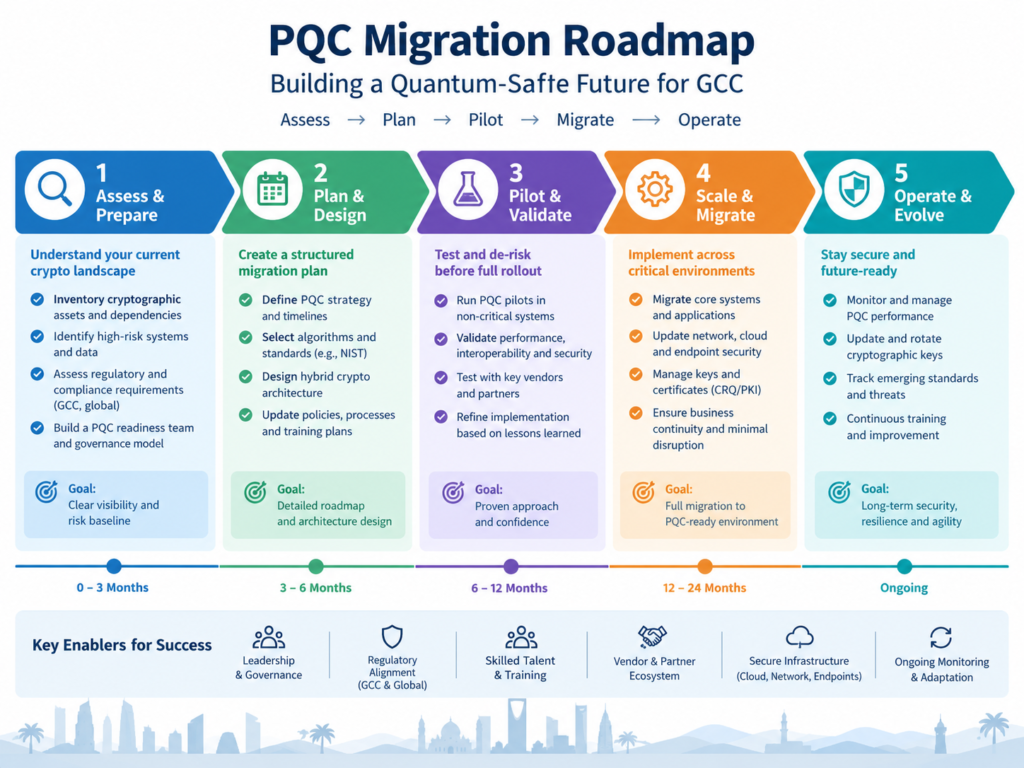
A sensible post-quantum cryptography migration starts with discovery and risk classification, not immediate replacement.
A practical sequence is.
Discover → Classify → Prioritize → Test → Migrate → Monitor
Build a cryptographic inventory
Document where cryptography is being used across the organization.
The inventory should cover.
RSA and ECC
Certificates
TLS
VPNs
APIs
Databases
PKI
Identity systems
Cloud services
Third-party applications
Embedded or legacy systems
A standard application inventory is rarely enough. Teams need visibility into the actual cryptographic components supporting those applications.
Prioritize long-lived and high-value data
Not every system needs the same urgency.
Prioritize assets based on factors such as.
Confidentiality lifetime
Data sensitivity
Business criticality
Regulatory exposure
Migration complexity
Vendor dependencies
A Saudi fintech platform holding long-retention financial records, for example, may deserve earlier attention than a low-risk internal application containing short-lived information.
The same principle applies to UAE government workloads and Qatar telecom infrastructure.
Build a phased PQC and crypto-agility roadmap
Once the inventory and risk classification are clear, organizations can begin controlled testing.
Hybrid approaches and pilot deployments are generally more manageable than attempting to replace every cryptographic system simultaneously.
A Dubai e-commerce company, for example, could begin by testing updated certificates and API dependencies while reviewing its cloud security configuration and backend architecture.
The objective is not speed for its own sake. It is a migration process that does not weaken reliability, compatibility or security.
What GCC Compliance and Data-Residency Issues Affect PQC Migration?
PQC migration does not happen in isolation from existing cybersecurity, cloud and data-governance requirements.
Organizations need to map cryptographic changes against the rules that already apply to their sector and infrastructure.
Saudi Arabia.
Saudi organizations should evaluate applicable requirements involving.
NCA cryptographic standards
Saudi Central Bank expectations
NDMO governance
PKI controls
Key-management practices
Data residency
System and data sensitivity
Businesses should not assume there is currently one universal PQC migration deadline that applies identically to every Saudi organization.
The better approach is to identify actual regulatory scope and then map the migration roadmap against it.
UAE.
UAE organizations may need to consider DESC guidance, TDRA requirements, financial free-zone obligations and cloud-provider dependencies.
Companies working with sovereign or highly sensitive environments can also review broader GCC private infrastructure considerations.
The important point is that quantum-safe migration should strengthen compliance architecture rather than create a separate technical program disconnected from it.
Qatar.
Organizations in Qatar should evaluate requirements relevant to their sector, including guidance or controls associated with QCB, the National Cyber Security Agency, MCIT and CRA.
A Doha SME using regional cloud infrastructure, for example, should not treat geographic hosting alone as proof of secure data residency.
Encryption-key ownership, vendor contracts, backup arrangements and recovery architecture still matter.
Which GCC Industries Should Prioritize Post-Quantum Cryptography First?
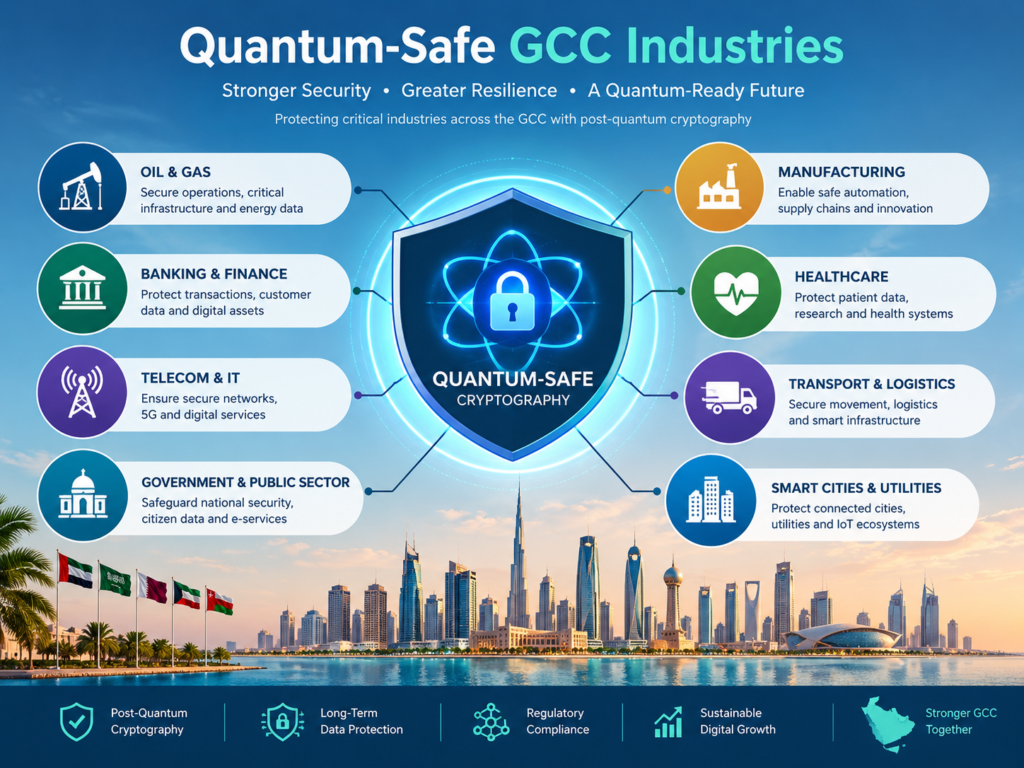
Financial services, government and critical infrastructure generally deserve early attention because they combine valuable information, strong regulatory expectations and long confidentiality periods.
Fintech and banking
Banks and fintech companies should pay particular attention to.
Customer identity systems
Payment infrastructure
Financial records
PKI
Certificates
Digital signatures
Authentication systems
This is especially relevant in environments governed by SAMA, QCB, ADGM, DIFC or similar regulatory frameworks.
Government and critical infrastructure
Citizen records, energy systems, telecom networks and government platforms may remain sensitive for decades.
That makes long-term confidentiality a central concern.
Organizations developing sovereign infrastructure can also compare wider GCC sovereign infrastructure approaches and regional AI data-centre considerations.
Retail and logistics
Retailers and logistics operators should not assume PQC only matters to governments and banks.
Their environments can contain cryptographic dependencies across.
Customer databases
E-commerce systems
Payment integrations
Warehouse IoT
Mobile applications
APIs
Logistics platforms
Supply-chain vendors
A mobile-first retailer in Dubai, for example, should include its mobile application estate in cryptographic discovery.
What Should a GCC Post-Quantum Readiness Plan Include?
A useful readiness plan should connect cryptography, business risk, regulation and architecture.
Post-quantum readiness checklist
Before large-scale migration begins, confirm that:
Cryptographic assets have been inventoried.
RSA and ECC dependencies are documented.
Long-lived and sensitive data is classified.
Critical systems have been prioritized.
Technology vendors have been asked about PQC roadmaps.
Applicable NIST standards have been mapped.
Test environments and interoperability plans exist.
Migration ownership is clearly assigned.
PKI and certificate dependencies are included.
Monitoring is in place for changing standards and vendor support.
Common PQC migration mistakes GCC businesses should avoid
Several mistakes can make migration more expensive or risky.
Avoid.
Waiting until a cryptographically relevant quantum computer is already available.
Replacing every system at once.
Ignoring cryptography embedded inside applications and appliances.
Treating PKI as a secondary concern.
Buying products labelled “quantum-safe” without an architecture plan.
Assuming vendors will handle the full migration automatically.
Separating PQC work from cloud, identity, resilience and compliance planning.
When specialist PQC support becomes useful
Specialist support can be valuable when an organization has complex PKI, multiple cloud environments, legacy systems, regulated information or significant third-party dependencies.
The same applies to organizations operating critical infrastructure or business systems where cryptographic changes could affect uptime.
PQC planning should therefore be coordinated with resilience measures such as GCC disaster-recovery architecture.
Concluding Remarks
GCC businesses do not need to predict the exact year practical quantum attacks will arrive.
A more useful question is whether the sensitive data, certificates, keys and cryptographic systems being deployed today will still matter if vulnerable public-key encryption becomes unsafe.
For Saudi Arabia, the UAE and Qatar, a practical post-quantum cryptography strategy starts with discovery, risk prioritization and crypto agility. From there, organizations can test standards, coordinate with vendors and migrate critical systems in controlled phases.
The organizations that understand their cryptographic estate early will be in a far stronger position than those forced into an emergency replacement program later.
Mak It Solutions can help technology teams assess digital architecture, cloud dependencies and migration risks as they prepare future-ready infrastructure.
Contact Mak It Solutions to discuss a tailored GCC readiness strategy for Saudi Arabia, the UAE or Qatar.
FAQs
Q : Does Saudi Arabia require businesses to use post-quantum cryptography yet?
A : Saudi Arabia has strong cryptographic governance, but organizations should not assume one universal standalone PQC deadline applies identically to every business. The NCA’s cryptographic standards already address post-quantum considerations, so organizations should begin inventory and risk-based preparation while mapping applicable NCA, SAMA and sector requirements.
Q : What does Dubai’s post-quantum cryptography guidance mean for UAE companies?
A : Dubai’s PQC activity signals a move from general awareness toward structured quantum-readiness planning. UAE companies should identify vulnerable cryptography, assess PKI and certificate dependencies, review vendor roadmaps and improve crypto agility while separately mapping relevant ADGM, DIFC, TDRA or sector-specific obligations.
Q : Are Qatar banks and telecom companies preparing for quantum-safe security?
A : There are visible signs of preparation, particularly in telecom. The May 31, 2026 quantum-safe communications initiative involving Ooredoo Qatar, HBKU and Qatar’s Ministry of Defence shows that the topic is becoming operational, although it does not create an identical migration requirement for every Qatari organization.
Q : Can GCC companies continue using RSA and ECC during a PQC transition?
A : Yes. Migration can be phased where existing cryptography remains permitted and appropriate. The priority is to identify where RSA and ECC are used, understand which data has long confidentiality requirements, and test interoperability and replacement options before production changes.
Q : How long does a post-quantum readiness assessment take for a GCC enterprise?
A : There is no reliable universal duration. Scope depends on cryptographic complexity, legacy PKI, cloud architecture, third-party systems, data sensitivity and regulatory requirements. A smaller modern environment will differ significantly from a major bank, government platform or telecom network, so completeness should take priority over an arbitrary timeline.