
Serverless Computing for SMEs in GCC: Smart Guide
Serverless Computing for SMEs in GCC: Smart Guide
Serverless Computing for SMEs in GCC: Smart Guide
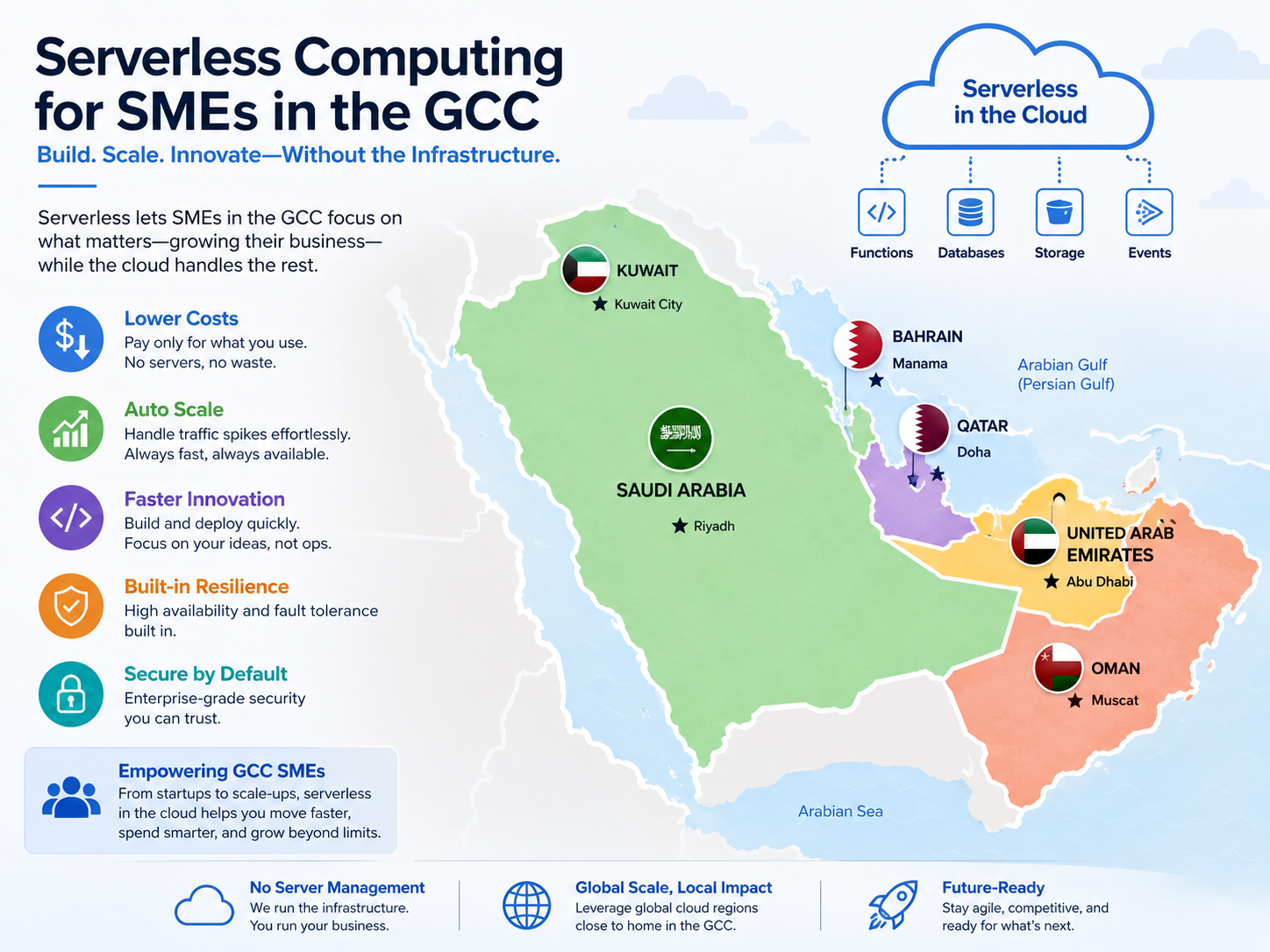
Serverless computing for SMEs helps GCC businesses build apps, APIs, automations, and customer portals without running their own server infrastructure. For companies in Saudi Arabia, the UAE, and Qatar, it works best for short, event-based workloads such as mobile backends, forms, webhooks, notifications, and scheduled jobs.
The direct answer: serverless is a strong choice when the workload is small, spiky, and easy to monitor. It needs extra review when it touches payment data, health records, national IDs, government integrations, or regulated financial systems, because region choice, data residency, access control, and audit trails matter.
This guide is written for SME founders, product owners, and IT teams planning cloud apps in Riyadh, Dubai, Abu Dhabi, Doha, Jeddah, and across the GCC. It is not legal or financial advice; regulated businesses should confirm requirements with their compliance team, legal counsel, and relevant regulator.
What Is Serverless Computing for SMEs?
Serverless, Explained Simply
Serverless does not mean “no servers.” It means the cloud provider manages the server layer while your team focuses on business logic, user experience, security, and customer flows. AWS describes Lambda as a serverless compute service that runs code without requiring teams to provision or manage servers.
For SMEs, that can reduce the operational burden of maintaining infrastructure too early. Instead of hiring a large DevOps team before product-market fit, a startup can launch a smaller feature, test it, monitor usage, and improve from there.
How Function-as-a-Service Works
In a Function-as-a-Service setup, a small piece of code runs only when something triggers it.
That trigger could be.
A customer submitting a form
A mobile app calling an API
A payment gateway sending a webhook
A file being uploaded
A scheduled report running each morning
A notification being sent after an order update
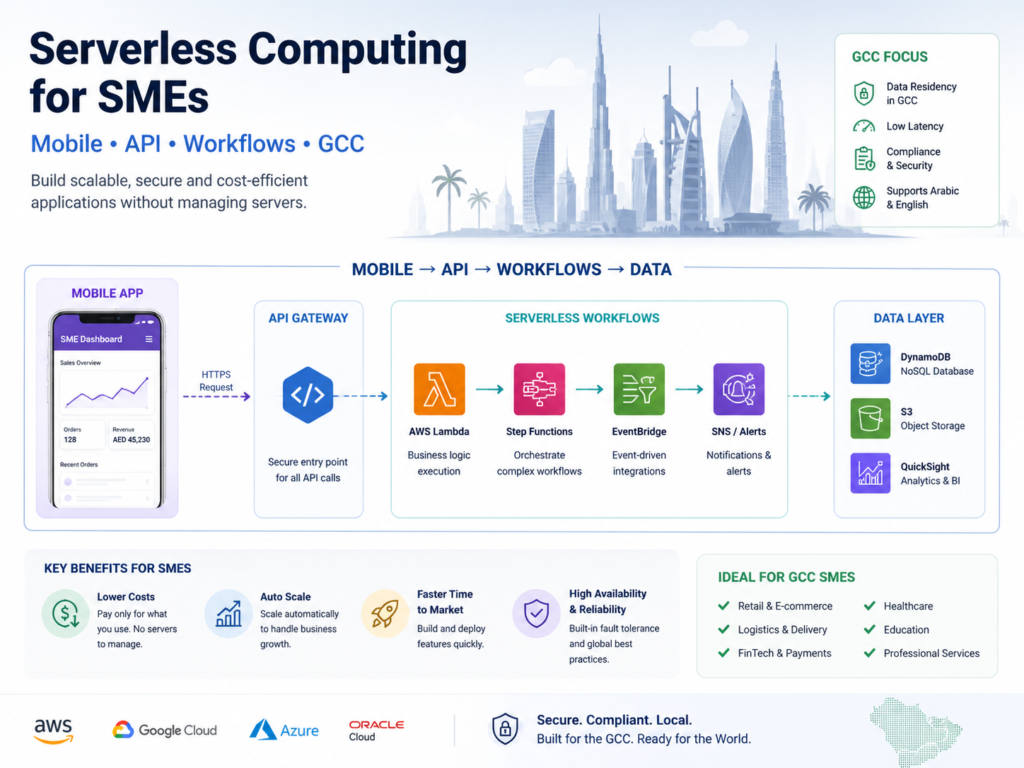
For example, an API Gateway can receive a request from a mobile app, trigger a function, check inventory, send an SMS, and update a dashboard. This model supports event-driven architecture and can help with cloud cost control when traffic is unpredictable.
Why Serverless Computing for SMEs Makes Sense in GCC
GCC founders often need to launch fast, support Arabic and English users, and keep cloud costs under control. A Riyadh fintech team may want to test onboarding flows. A Dubai retailer may need checkout notifications during campaign spikes. A Doha SME may want to automate customer forms without building a full infrastructure department.
Serverless is especially useful when the team needs speed but still wants a modern backend. It can support.
MVPs and proof-of-concept apps
Mobile app APIs
Customer portals
Booking systems
Lead forms and CRM updates
E-commerce webhooks
Notifications and reminders
Lightweight data processing
Internal automations
The key is to start with the right use case. Serverless is not a shortcut around security, compliance, or architecture. It is a tool that works best when the workload is clearly scoped.
Best GCC Use Cases for Serverless
Mobile APIs and Customer Portals
Serverless APIs are useful for booking apps, loyalty programs, bilingual dashboards, and customer self-service portals.
A Dubai e-commerce brand, for example, can connect mobile checkout events to inventory, payment confirmation, and delivery notifications. During Ramadan campaigns or White Friday traffic, serverless functions can scale around short bursts more easily than a fixed small server.
Webhooks, Forms, Notifications, and Reports
Low-risk workloads are usually the best place to begin.
Good starting points include.
Lead capture forms
Invoice reminders
Payment-status webhooks
CRM updates
WhatsApp-style notification triggers
Daily or weekly reports
Basic file processing
Internal approval workflows
These jobs are short, repeatable, and easier to monitor. They also let the business learn serverless patterns before moving into sensitive workloads.
Retail, Logistics, Fintech, and Government Suppliers
Retailers can sync orders. Logistics firms can trigger shipment updates. Fintech companies can automate non-sensitive checks. Government suppliers can process service requests or internal workflow events.
The higher the sensitivity of the data, the more planning is required. A public product inquiry form is very different from a workflow that processes financial records, national ID data, or confidential government documents.
Serverless in Saudi Arabia, UAE, and Qatar
Saudi Arabia.
Saudi SMEs should treat region choice and data residency as early architecture decisions, not last-minute deployment details.
For SAMA-regulated member organizations, SAMA’s cloud computing controls require risk assessment, cloud provider due diligence, approval before using cloud services or signing contracts, and data-location controls. The rulebook also states that, in principle, cloud services should be located in Saudi Arabia unless explicit SAMA approval is obtained for cloud services outside the country.
From a deployment point of view, AWS currently lists Bahrain and UAE as available Middle East Regions and lists the Kingdom of Saudi Arabia as a planned Region; Google Cloud documentation lists Dammam zones under and Google notes special region-access requirements for Dammam, including CNTXT purchase paths for KSA-based customers.
In practice, a Riyadh SME should ask three questions before going live: where will the data sit, who can access it, and what approval or documentation is needed for the workload?
UAE.
The UAE is a strong market for fast-moving serverless apps, especially in Dubai e-commerce, logistics, fintech, protect, and health-tech projects. Speed matters, but so does governance.
TDRA’s Cloud Service Provider initiative aims to gather details from cloud providers operating in or engaging with the UAE market, while improving transparency and the regulatory framework for cloud services.
Microsoft’s Azure region list includes UAE North in Dubai and UAE Central in Abu Dhabi, while AWS has an available Middle East UAE Region.
For ADGM or DIFC-related businesses, data protection and cyber-risk expectations should be reviewed early. DFSA says implementation of a firm’s cyber risk management framework depends on the nature, scale, and complexity of its business.
Qatar.
Qatar SMEs have stronger local-cloud options than before. Google Cloud documentation lists Doha zones under and Microsoft’s Azure region list includes Qatar Central in Doha.
For regulated financial entities, QCB’s Cloud Computing Regulation entered into force on 15/04/2024 and applies to QCB-regulated entities adopting or already using cloud deployments. It also requires governance, risk management, due diligence, controls, and accountability around cloud arrangements.
A Doha SME handling normal website forms has a different risk profile from a payment provider or financial platform. The more sensitive the data, the more important it is to map data flows before choosing the serverless platform.
Compliance, Security, and Data Residency Risks
When Serverless Is Usually Safe
Serverless computing for SMEs is usually safest for.
Public inquiry forms
Marketing automations
Basic notification systems
Read-only APIs
Non-sensitive customer portals
Internal reminders
Analytics events with minimal personal data
These workloads still need security controls, but they are easier to govern than regulated financial, health, or identity-heavy systems.
What to Check Before Handling Sensitive Data
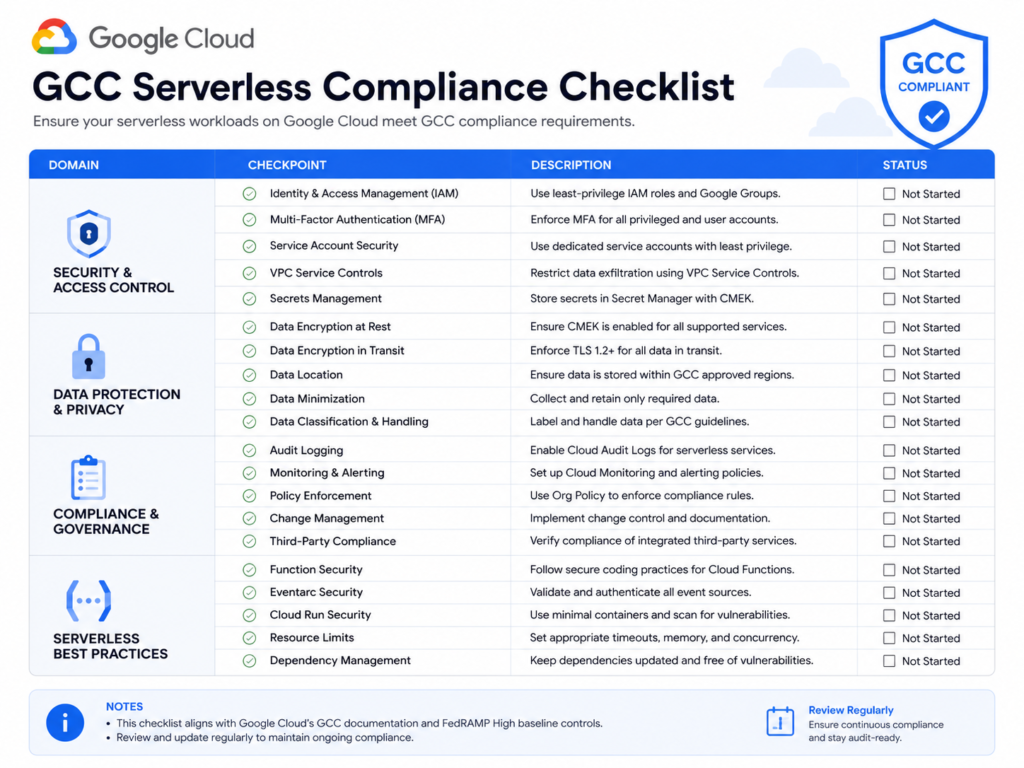
Before moving sensitive data into serverless, review.
Data classification
Cloud region and residency
Encryption at rest and in transit
Identity and access management
Secrets management
Logging and monitoring
Backup and recovery
Audit access
Incident response
Vendor exit planning
Regulator expectations
QCB’s cloud rules, for example, require QCB-regulated entities to maintain governance and risk controls for cloud arrangements, and state that entities remain accountable for their regulatory obligations even when using cloud arrangements.
A practical rule: do not move sensitive workloads just because serverless is fast. Move them only when the architecture, controls, documentation, and approvals are ready.
Common Serverless Risks
The most common serverless risks are not exotic. They are usually simple mistakes.
Over-permissive IAM roles
Exposed environment variables
Secrets stored in code
No log review
Weak API authentication
Poor error handling
Cold-start delays
Vendor lock-in
Unexpected costs from runaway functions
Too much sensitive data in logs
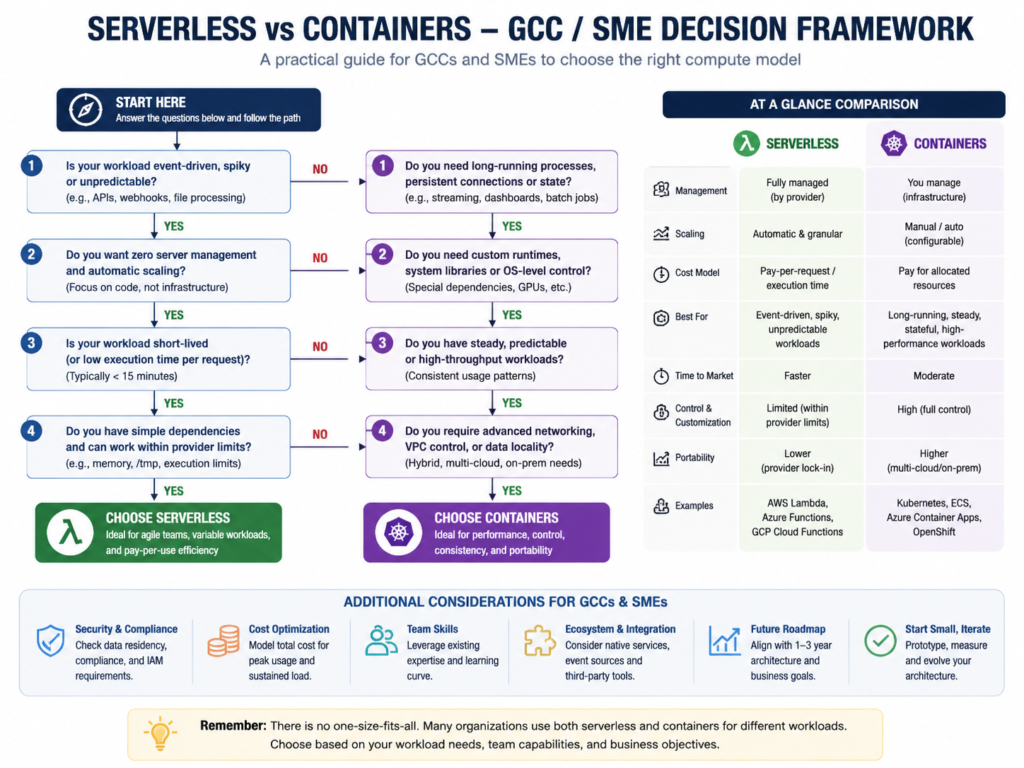
Serverless vs Containers vs Traditional Hosting
| Option | Best For | Watch Out For |
|---|---|---|
| Serverless | Short events, APIs, MVPs, webhooks, automations | Cold starts, vendor lock-in, poor monitoring |
| Containers | Long-running services, custom runtimes, portability | More operations work than serverless |
| Traditional hosting | Simple websites, low-change systems, predictable traffic | Limited flexibility for modern app workflows |
Serverless is often better when traffic is spiky, features are small, and the team wants less server administration. Containers are better when services run continuously, networking is complex, or portability is a priority. Traditional hosting still works for simple brochure websites and low-change systems.
Cost, Timeline, and Vendor Selection
What Affects Serverless Cost?
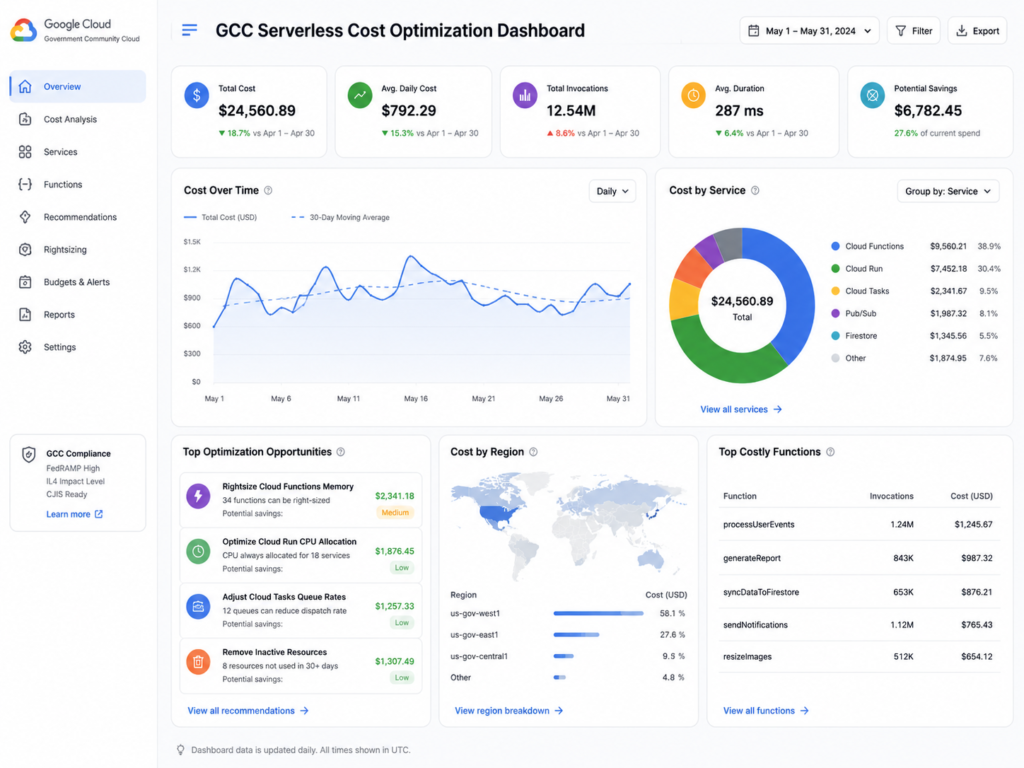
Serverless can be cost-friendly, but it is not automatically cheap. Cost depends on requests, execution time, memory, storage, database calls, monitoring, data transfer, and logs.
A low-traffic MVP may cost very little. A busy production system with heavy logging, inefficient functions, and frequent database calls can surprise the finance team.
Set budgets and alerts before launch. Review logs. Track the most expensive functions. Keep payloads small. Monitor database usage, not just function usage.
Choosing AWS, Azure, or Google Cloud
There is no single best provider for every GCC SME.
AWS may fit teams already using Bahrain or UAE infrastructure, with Saudi Arabia planning requiring extra review where data residency is sensitive.
Azure may fit Microsoft-heavy businesses, especially where UAE North, UAE Central, or Qatar Central are relevant. Microsoft also lists Saudi Arabia East among regions that are available or coming soon.
Google Cloud may fit Qatar- or Saudi-focused planning where Doha or Dammam regions are useful, subject to the right access, service availability, and compliance fit.
What to Ask a Serverless Development Partner
Before hiring a partner, ask.
Which cloud region will you use, and why?
How will Arabic and English journeys be handled?
How will APIs be authenticated?
Where will secrets be stored?
What gets logged, and what must never be logged?
How will costs be monitored?
What happens if we need to migrate later?
Which compliance documents will be prepared?
How will dependency and supply-chain risks be controlled?
Best Practices for Safe Serverless Adoption
Start With Low-Risk Workloads
Begin with forms, notifications, scheduled jobs, and non-sensitive APIs. This gives the team real production experience without placing sensitive workflows at risk too early.
A Doha SME, for example, can begin with a public inquiry form and a notification workflow, then expand after data flows and controls are documented.
Design for Arabic UX and Bilingual Journeys
Serverless is backend architecture, but user experience still matters. GCC apps often need Arabic-first design, right-to-left layouts, bilingual notifications, local payment flows, and culturally familiar customer journeys.
A technically strong backend will not save a product if the Arabic user journey feels like an afterthought.
Build a Cloud Governance Checklist
Before launch, document.
Data residency
Roles and permissions
Encryption approach
Logging rules
Backup and recovery
Incident response
Vendor exit steps
Cost alerts
Monitoring dashboards
Compliance owners
This does not need to be overly complex for a small business. It does need to be clear enough that the team can operate the system safely.
Concluding Remarks
Serverless computing for SMEs can help GCC businesses launch faster, automate repetitive workflows, and scale apps without managing traditional server infrastructure. It is especially useful for APIs, forms, webhooks, notifications, scheduled jobs, and lightweight customer portals. Mak It Solutions
For Saudi Arabia, the UAE, and Qatar, the real success factor is not just code. It is the combination of smart workload selection, data residency planning, secure architecture, cost monitoring, and regulator-aware governance.
Planning a serverless project in the GCC? Contact Mak It Solutions contact page to review your cloud architecture, app backend, API strategy, or automation roadmap.
FAQs
Q : Is serverless computing allowed for Saudi SMEs?
A : Yes, but regulated financial use cases need careful planning. For SAMA-regulated member organizations, cloud adoption should consider risk assessment, due diligence, approval expectations, and data-location controls before production.
Q : Can UAE startups use serverless for customer apps?
A : Yes. UAE startups can use serverless for customer apps, portals, e-commerce workflows, notifications, and APIs. The safer approach is to design for security, bilingual UX, cloud transparency, and governance from the beginning.
Q : Is AWS Lambda suitable for small businesses in Riyadh?
A : AWS Lambda can suit Riyadh SMEs for short, event-based workloads such as APIs, webhooks, file processing, and automation. Region choice and data residency should be reviewed carefully, especially for financial or sensitive workloads.
Q : Can Qatar SMEs host serverless apps with local data residency?
A : Yes, Qatar SMEs can plan local-hosting strategies using cloud regions such as Doha where services fit the workload. QCB-regulated entities need stricter review because QCB’s cloud rules apply to regulated entities adopting or already using cloud deployments.
Q : What serverless workloads should GCC companies avoid?
A : Avoid moving regulated financial data, health records, national ID data, confidential government integrations, or long-running performance-critical workloads to serverless without compliance and security review. Start with low-risk automation, then expand after governance is approved.