


Serverless Use Cases That Win in 2026
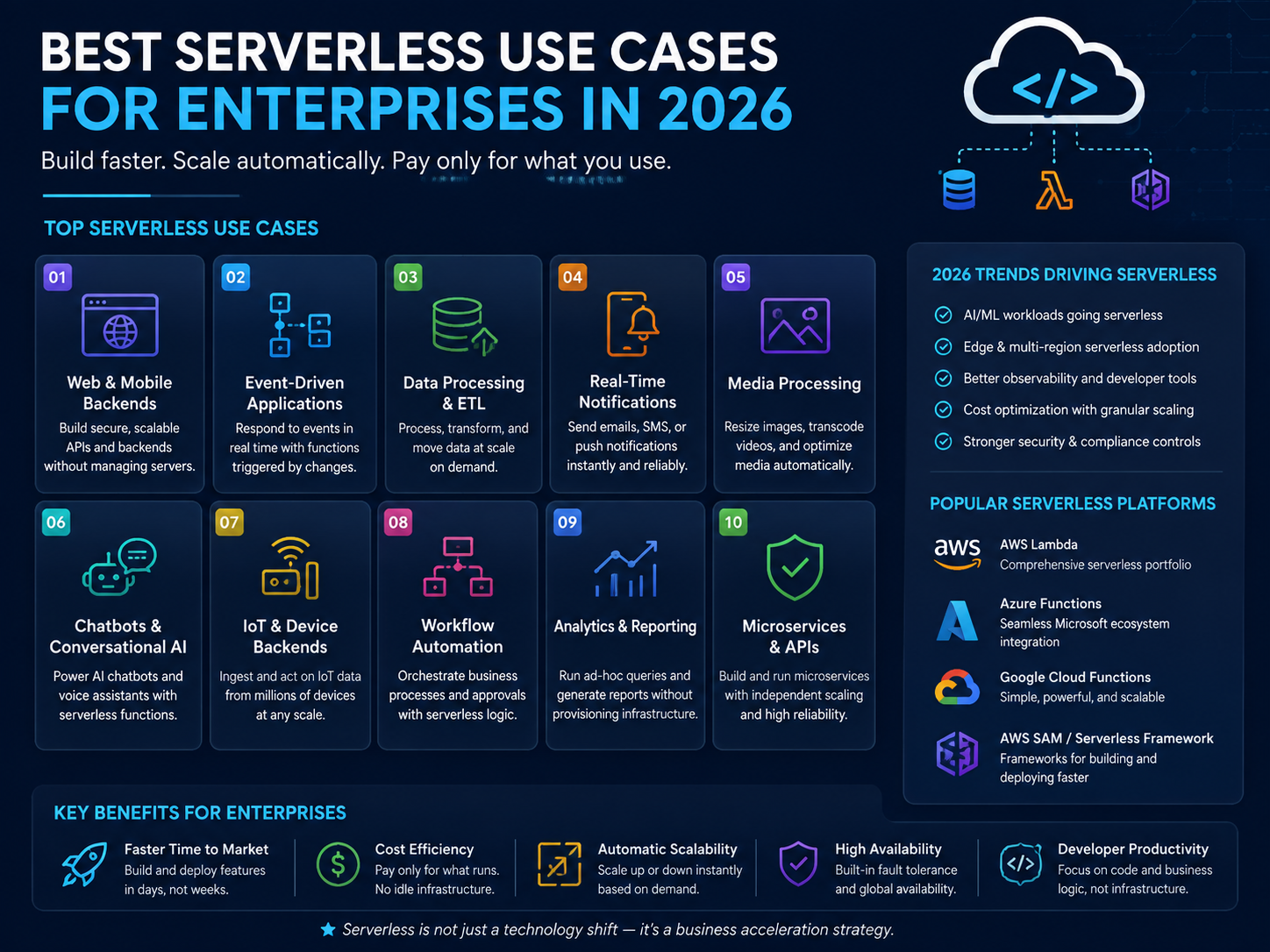
Serverless use cases now extend far beyond simple cloud functions. In 2026, enterprises are using Function as a Service (FaaS), serverless containers, and event-driven architecture for APIs, AI workflows, data processing, automation, and IoT systems.
The short answer: serverless works best for event-driven, intermittent, and independently scalable workloads. APIs, webhooks, ETL pipelines, scheduled jobs, AI orchestration, and IoT processing are strong candidates. Continuously busy, highly stateful, GPU-heavy, or extremely latency-sensitive applications often fit containers, Kubernetes, or managed compute better.
The real question is not whether serverless is modern. It is whether the workload behaves in a way that lets serverless deliver operational and economic value.
Best Serverless Use Cases in 2026
The best serverless use cases tend to share three characteristics.
Demand changes significantly over time.
Execution starts in response to an event.
Infrastructure does not need to remain active continuously.
That makes APIs, asynchronous processing, data pipelines, scheduled automation, and IoT workloads particularly good candidates.
Event-Driven APIs, Webhooks, and Microservices
Serverless is a natural fit for REST APIs, SaaS integrations, payment notifications, and independently deployable microservices.
For example, an incoming webhook can trigger a function that validates a request, updates a database, publishes an event, and returns a response without requiring a permanently running application server.
AWS Lambda integrates with a broad range of AWS event sources, while Azure Functions and Google Cloud Run functions provide comparable event-driven models.
For applications built around JavaScript APIs, Mak It Solutions’ Node.js development services can support the surrounding backend architecture.
Data Processing, ETL, and Media Pipelines
Files, images, documents, logs, and streaming data usually arrive asynchronously. That makes them well suited to event-driven processing.
A serverless function can.
Validate an uploaded file.
Resize or optimize an image.
Transform a database record.
Extract document metadata.
Enrich incoming data.
Send processed information to another system.
Instead of keeping compute active while waiting for work, processing starts when an event occurs.
This model can also complement analytics environments. Mak It Solutions’ Business Intelligence services can support the reporting and visualization layer that consumes processed data.
Bursty Workloads, Scheduled Automation, and IoT Backends
Serverless is especially useful when traffic is unpredictable.
A campaign may generate a sudden spike in API requests. An IoT platform may receive thousands of telemetry events during short periods. A scheduled task may need to run only once per hour or once per day.
In each case, serverless infrastructure can increase capacity when work appears and reduce it when activity falls.
That scale-to-zero model is one of the clearest advantages over permanently provisioned infrastructure for intermittent workloads.
Serverless AI and Data Workloads in 2026
AI is becoming one of the most practical areas for serverless architecture not necessarily for hosting large models themselves, but for coordinating the services around them.
Many AI workflows are inherently event-driven. A user submits a prompt, a document arrives, a queue receives a task, or a database record changes. Each event can trigger a short-lived workflow.
Serverless AI Inference, RAG, and Generative AI Orchestration
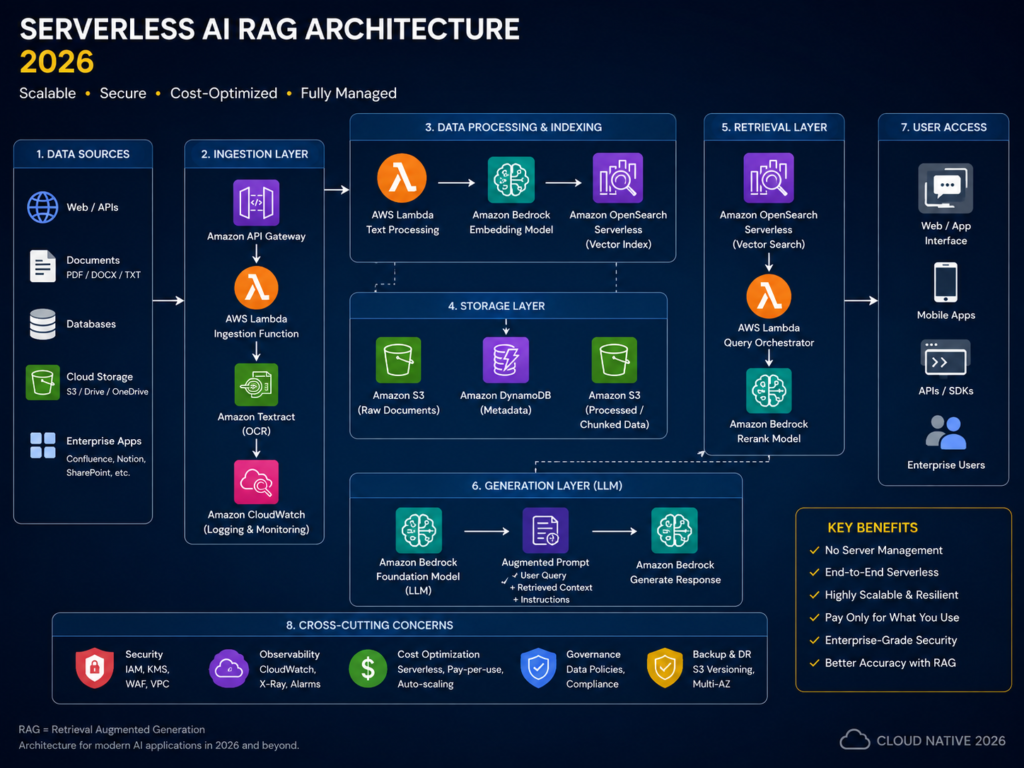
A serverless function can act as the orchestration layer in a Retrieval-Augmented Generation (RAG) workflow.
A typical flow might.
Receive a user request.
Authenticate the user.
Retrieve relevant context from a vector database.
Call a managed generative AI model.
Apply business rules or formatting.
Return the final response.
The function coordinates the workflow without needing to host the foundation model itself.
Microsoft includes AI inference, real-time processing, and event-driven workloads among common Azure Functions scenarios.
Python teams can combine these patterns with Django development or lightweight Flask development for surrounding application services.
Serverless ETL and Real-Time Data Processing
Database events, streams, uploads, and messages can trigger transformation and enrichment workflows almost immediately.
This makes serverless useful for pipelines where individual processing steps are short and can scale independently.
One event might validate data, another function could transform it, and a third could store the result or trigger downstream analytics.
The result is a modular architecture that can respond quickly without keeping every processing component online continuously.
Where Serverless AI Needs Caution
Serverless does have limits.
GPU-intensive inference, long-running model executions, and consistently heavy workloads may be more economical or predictable on dedicated accelerators, managed AI infrastructure, or containers.
Security is another consideration. Publicly exposed functions, overly broad IAM permissions, embedded secrets, and weak event validation can turn an otherwise simple architecture into a serious risk.
When to Use Serverless and When Not To
Serverless works best when a workload is intermittent, event-triggered, and horizontally scalable.
It should not become the default architecture simply because it reduces infrastructure management.
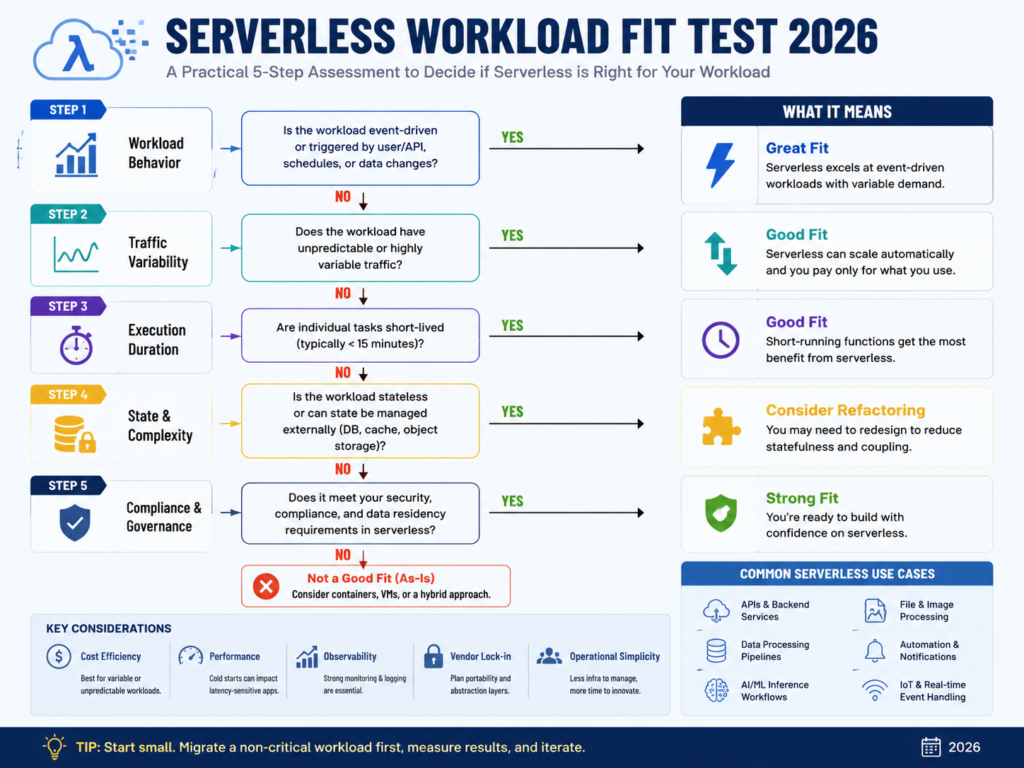
A Five-Point Serverless Workload Fit Test
Before choosing serverless, ask five questions.
Does traffic vary significantly?
Is execution triggered by an event?
Does each task finish relatively quickly?
Can persistent application state live outside the function?
Can the workload tolerate some startup variability?
If four or five answers are “yes,” serverless is usually worth benchmarking against other options.
When Serverless Loses.
A continuously busy application can reduce or eliminate the financial advantage of pay-per-use computing.
Serverless may be a weaker fit when an application requires.
Persistent in-memory state.
Constant CPU or GPU utilization.
Specialized networking.
Long-running processes.
Highly predictable low latency.
Extensive operating-system or runtime control.
In those cases, containers, Kubernetes, managed virtual machines, or specialized compute services may provide a better balance.
For performance-focused backend services, Mak It Solutions‘ Golang development services can also support architectures where predictable concurrency and low latency matter.
Cold Starts, Observability, Vendor Lock-In, and Cost Predictability
“Pay only for what you use” does not automatically mean “lowest total cost.”
Serverless bills can include more than function execution. Requests, memory allocation, duration, networking, API gateways, logging, queues, databases, storage, and provisioned concurrency can all affect the final cost.
Cold starts also remain relevant for workloads with strict response-time requirements, although their impact varies by provider, runtime, configuration, and architecture.
Observability deserves equal attention. When an application consists of dozens of small functions, tracing a single business transaction across queues, APIs, databases, and services can become difficult without centralized logs, metrics, and distributed tracing.
Serverless vs Containers and Kubernetes in 2026
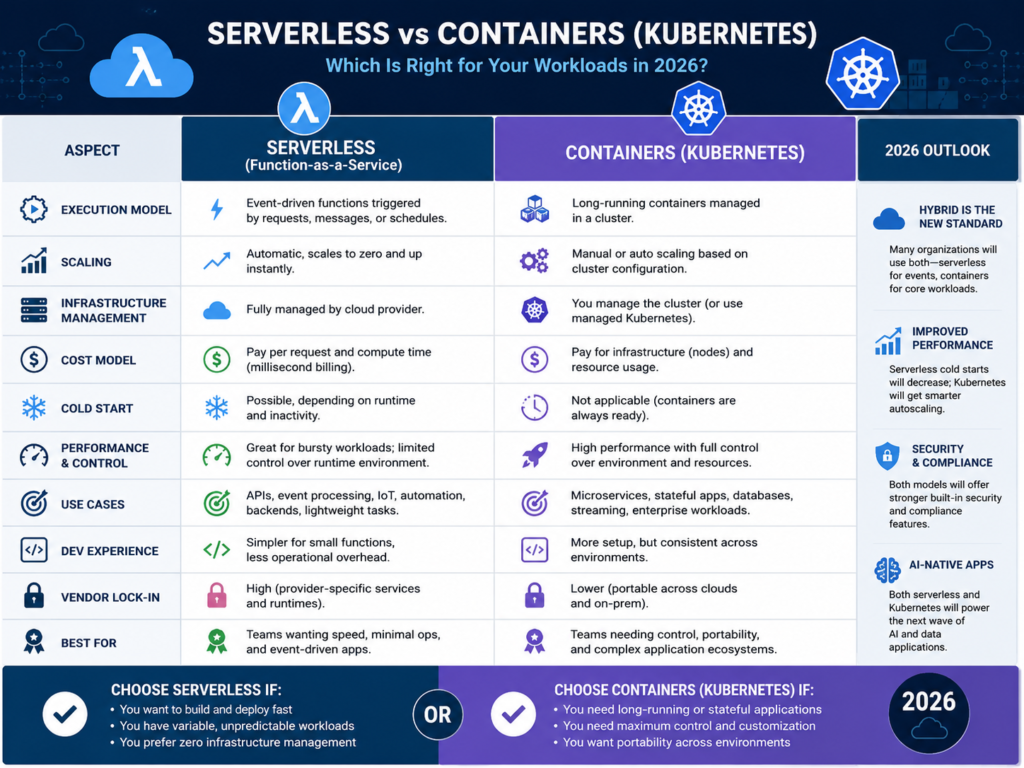
Serverless, containers, and Kubernetes solve different operational problems.
Serverless usually offers the lowest infrastructure-management burden for event-driven workloads. Containers provide greater runtime control and portability. Kubernetes adds sophisticated orchestration for environments that genuinely need it.
Serverless vs Containers: Control, Scale, and Operating Overhead
With FaaS, the cloud provider manages most of the underlying runtime environment.
Containers expose more runtime and operating-system configuration while keeping applications portable across compatible infrastructure.
In practical terms.
Serverless: less infrastructure management and automatic event-driven scaling.
Containers: more runtime control and portability.
Kubernetes: deeper orchestration and operational flexibility.
The right choice depends on the application rather than the popularity of the platform.
Serverless vs Kubernetes.
Kubernetes makes sense when teams need advanced networking, persistent workloads, custom scheduling, large-scale microservice orchestration, or significant control over deployment behavior.
That flexibility comes with additional operational responsibility.
For a few webhook handlers or scheduled jobs, maintaining a Kubernetes layer can add complexity without delivering equivalent value.
Hybrid Architectures.
Enterprises do not have to choose one model for every workload.
A business might use AWS Lambda or Azure Functions for webhooks and asynchronous queue processing while running a continuously active API or AI worker in containers.
This hybrid approach lets each component use the operating model that best matches its behavior.
Choosing the Best Serverless Platform for Enterprise Workloads
There is no universally best serverless platform.
The decision should account for
Existing cloud ecosystem.
Event integrations.
IAM and security controls.
Regional availability.
Runtime support.
Observability.
Latency requirements.
Pricing.
Internal engineering skills.
AWS Lambda vs Azure Functions vs Google Cloud Run Functions
AWS Lambda provides deep integration with AWS services and event sources.
Azure Functions fits naturally into Microsoft-heavy environments and supports multiple hosting options.
Google documents its current functions offering as Cloud Run functions, combining event-driven functions with the wider Cloud Run ecosystem.
Rather than choosing based on a generic cloud ranking, compare the platforms against your actual workload.
Serverless Containers and Multi-Cloud Architecture
Serverless containers sit between traditional FaaS and fully managed container infrastructure.
They can preserve container packaging while reducing some infrastructure-management overhead.
They may also help with portability, but multi-cloud should address a genuine business requirement such as resilience, regulation, procurement, or regional availability.
Duplicating workloads across providers simply to appear cloud-neutral can increase deployment, IAM, monitoring, and governance complexity.
Evaluate Platforms by Workload, Region, and Existing Cloud Stack
Benchmark representative workloads before committing.
Measure normal latency, cold-start behavior, concurrency, security integration, observability, regional services, and expected monthly usage.
The architecture that aligns with your team’s existing engineering and security practices is often easier to operate than a theoretically perfect stack that introduces unfamiliar tools everywhere.
Serverless Architecture Across the USA, UK, Germany, and EU
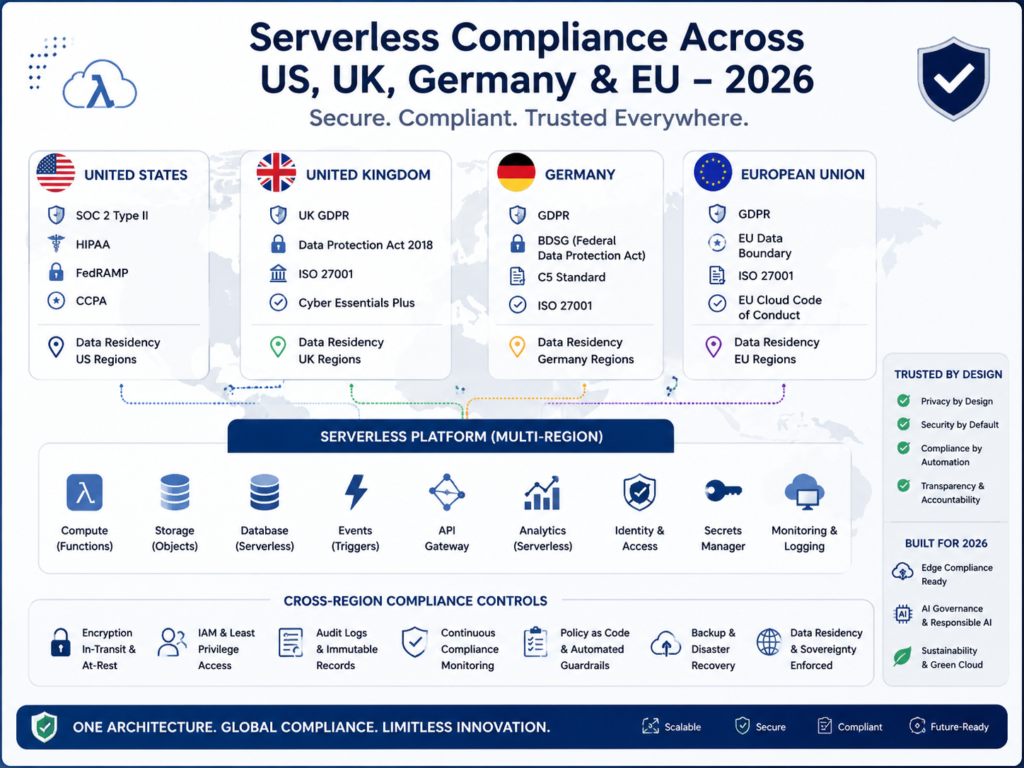
The serverless operating model is broadly similar across regions, but regulatory and data-governance requirements differ.
US enterprises may need to account for frameworks such as HIPAA and PCI DSS. UK organizations may need to consider UK GDPR, the Data Protection Act, and sector-specific requirements. German and EU organizations often place additional emphasis on GDPR/DSGVO, data residency, cross-border transfers, and sector regulations.
USA.
A US fintech platform could use serverless functions for payment webhooks while keeping payment data inside an architecture designed around applicable PCI DSS requirements.
Healthcare organizations can also use eligible cloud services for regulated workloads when identity controls, encryption, logging, access management, and required agreements are properly implemented.
Using serverless does not create compliance automatically. Compliance remains a property of the complete system.
UK.
UK fintech companies can use functions for Open Banking events, payment workflows, notifications, and integration tasks.
Healthcare-related platforms may also use event-driven services for integration and automation.
Teams still need to evaluate data protection, retention, auditability, access controls, UK GDPR obligations, and any industry-specific requirements relevant to their service.
Germany and EU
Organizations operating in Germany and the wider EU should map where personal data is processed, stored, replicated, and logged.
Cloud regions in cities such as Frankfurt, Dublin, Amsterdam, or Paris may form part of a regional architecture, but selecting an EU region alone does not guarantee compliance.
Teams must also consider data flows, international transfers, third-party services, access controls, and contractual safeguards.
For highly sensitive workloads, confidential computing architectures can provide an additional layer of protection for data in use.
Enterprise Serverless Security, Governance, and Cost Optimization
Serverless reduces infrastructure administration, but it does not remove the need for security or governance.
In fact, large environments with many small functions require particularly strong visibility and access controls.
Secure Functions with IAM, Secrets Management, and Audit Logging
Apply least-privilege IAM permissions and avoid long-lived credentials wherever possible.
Secrets should live in managed secret stores rather than source code or environment files that are difficult to govern.
Production environments should also centralize.
Authentication.
Dependency scanning.
Logs.
Metrics.
Distributed traces.
Audit events.
Security alerts.
Without centralized visibility, distributed functions can become difficult to monitor and investigate.
Data Residency, Compliance, and Multi-Region Resilience
Map data flows before deployment.
Teams should know where functions execute, where databases replicate, where logs are stored, and whether events or backups cross regional boundaries.
For regulated workloads, resilience plans must protect availability without unintentionally violating residency or transfer requirements.
FinOps for Serverless.
Function-level cost is only part of the picture.
A more useful FinOps approach measures the cost of the complete business transaction.
That may include.
Function execution.
API requests.
Queues.
Databases.
Object storage.
Observability.
Data transfer.
Third-party APIs.
Tracking cost per API request, document processed, customer workflow, or completed transaction provides better insight than looking only at the monthly FaaS bill.
A Practical Framework for Deciding if Serverless Fits
Serverless should be a workload-level decision, not an organization-wide doctrine.
Choose Serverless When Demand Is Variable and Event-Driven
Strong candidates include.
Webhooks.
APIs with uneven traffic.
File processing.
Event-driven ETL.
Scheduled automation.
IoT ingestion.
Notifications.
Queue consumers.
Generative AI orchestration.
The strongest case exists when automatic scaling and reduced infrastructure management create measurable operational value.
Choose Containers or Kubernetes When Control and Sustained Compute Dominate
Containers or Kubernetes may be better when services run continuously, require extensive runtime customization, maintain complex state, consume CPU or GPU resources steadily, or demand tightly controlled latency.
For mobile-facing platforms, backend architecture can also be paired with mobile app development or React Native development according to the required client experience.
Build a Workload-Level Business Case Before Migrating
Before migrating an existing application, benchmark real traffic and operational requirements.
Compare.
Request volume.
Execution duration.
Concurrency.
Latency.
Regional pricing.
Security controls.
Compliance requirements.
Observability costs.
Engineering effort.
The best architecture is the one that delivers acceptable performance, risk, maintainability, and total cost—not simply the one with the smallest infrastructure diagram.
To Sum Up
The best serverless use cases are determined by workload behavior, not by cloud trends.
If your APIs, AI workflows, data pipelines, or automation jobs are event-driven and experience variable demand, serverless can reduce infrastructure management while giving individual components room to scale independently.
If you are unsure whether serverless, containers, or a hybrid architecture provides the better fit, Mak It Solutions can help benchmark the options, map regional and security requirements, and build a scoped architecture and cost model before migration. ( Click Here’s )
Request a scoped consultation to evaluate your cloud-native application architecture.
Key Takeaways
The strongest serverless use cases include event-driven APIs, webhooks, ETL, automation, IoT processing, and AI orchestration.
Variable and intermittent workloads benefit most from automatic scaling and scale-to-zero behavior.
Sustained compute, persistent state, GPU-heavy workloads, and strict latency requirements may favor containers or Kubernetes.
AWS Lambda, Azure Functions, and Google Cloud Run functions should be evaluated against the workload, region, and existing cloud ecosystem.
US, UK, German, and EU deployments need appropriate privacy, security, compliance, and data-residency controls.
Serverless costs should be measured across the complete workflow rather than function execution alone.
FAQs
Q : Can serverless architecture handle high-traffic enterprise applications?
A : Yes. Serverless platforms can support substantial traffic when applications are designed for horizontal scaling and provider quotas, databases, and downstream services can handle the demand. High traffic alone is not a reason to reject serverless; sustained utilization, latency requirements, and total cost matter more.
Q : Is serverless cheaper than running containers continuously?
A : It can be. Serverless is often attractive for intermittent workloads because idle compute can be minimized. For continuously active services, container or reserved-capacity economics may be more competitive, so teams should compare the complete operating cost.
Q : How do serverless platforms handle persistent application state?
A : Persistent state should generally live outside the function environment. Managed databases, object storage, caches, queues, and workflow services allow individual functions to remain disposable and independently scalable.
Q : Can serverless applications meet GDPR and data-residency requirements?
A : Yes, when the complete architecture is designed accordingly. Teams need to choose suitable regions, document data flows, control cross-border transfers, implement appropriate access controls, and understand where databases, logs, backups, and third-party services process information.
Q : What causes unexpected serverless cloud costs?
A : Common causes include high invocation volumes, inefficient execution, excessive memory allocation, data transfer, API gateway usage, verbose logging, database requests, provisioned capacity, and retry loops. Measuring cost per completed business transaction can reveal issues that function-level billing alone may hide.