
FinOps Cloud Cost Optimization for US, UK & EU Teams
FinOps Cloud Cost Optimization for US, UK & EU Teams
FinOps Cloud Cost Optimization for US, UK & EU Teams
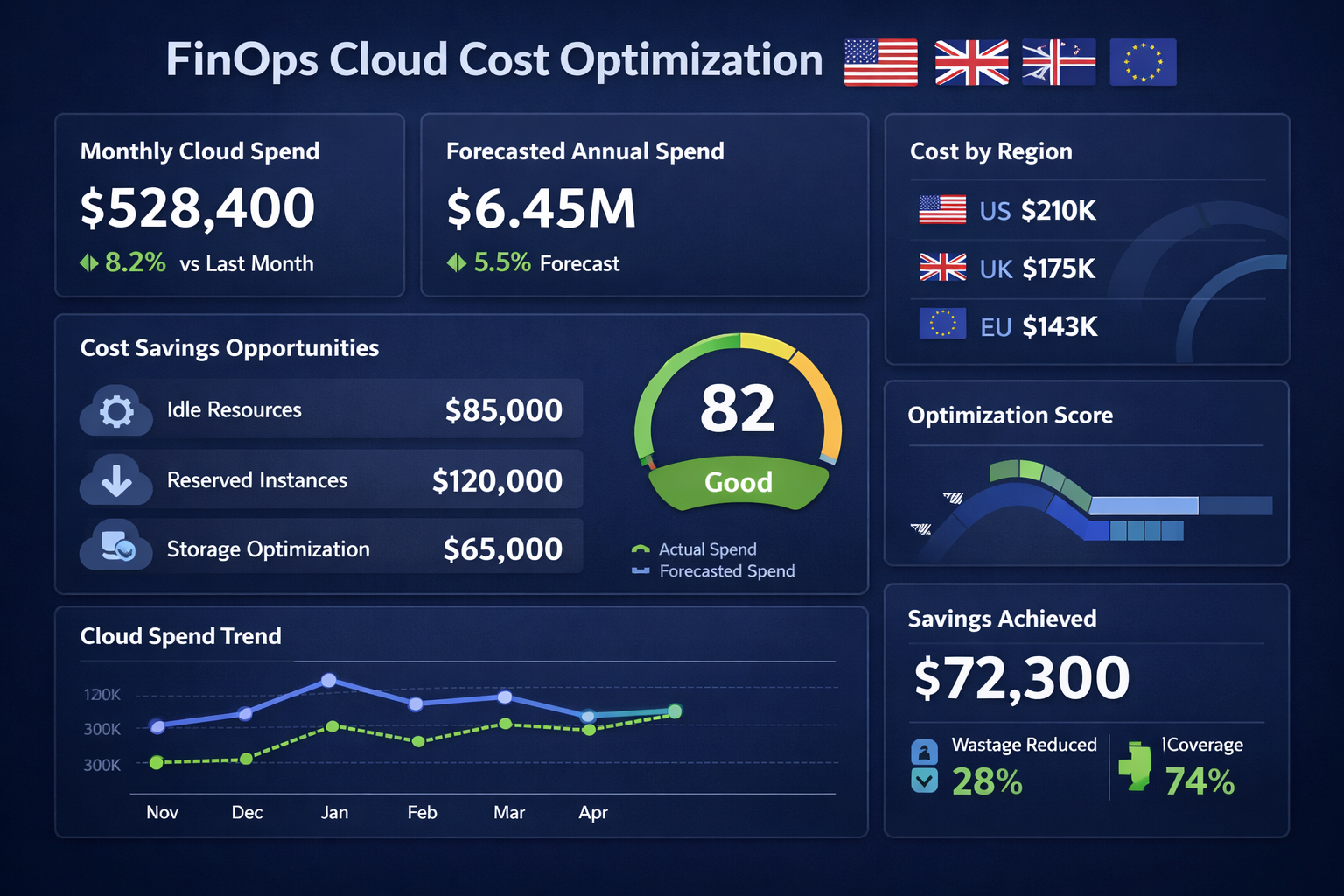
FinOps cloud cost optimization means using shared data, governance and KPIs so engineering, finance and product teams continuously tune cloud spend to real business value. Done well, it typically cuts around 20–30% of waste from AWS, Azure and GCP while keeping you compliant with GDPR, SOC 2, PCI DSS and other regulations.
Introduction.
Cloud bills in the United States, United Kingdom, Germany and wider European Union are still rising faster than most CFOs would like. At the same time, reports consistently show that 25–30% of cloud spend is pure waste—idle environments, oversized instances and forgotten storage. Cloud has become one of the largest IT line items, and boards from San Francisco to Frankfurt now expect real cost discipline, not just “cloud-first” slogans.
Recent research suggests cloud leaders believe roughly 27–30% of spend is wasted, while global public cloud budgets are heading toward hundreds of billions of dollars annually. State of FinOps data shows almost all mature teams now treat FinOps as a core operating model, not a side project.
FinOps cloud cost optimization responds to this reality. Instead of one-off cost-cutting exercises, it brings engineering, finance and product together around shared telemetry, shared language and shared KPIs for cloud financial management. This guide walks US, UK, German and EU teams through how to build that FinOps framework, stop hidden cost leakages and choose the right tools and partners.
The Scale of Cloud Waste in US, UK, Germany & EU
Many enterprises overspend 20–30% on cloud because their environments grow faster than their controls. Idle test clusters in Seattle, overprovisioned production in London and zombie storage volumes in Frankfurt quietly accumulate month after month.
Studies based on Flexera and analyst data estimate around 28% of cloud spending is reported as waste globally, with some 2025 estimates suggesting 30–47% of budgets are effectively burned. Only a small minority of CIOs say they spend less than planned, and “managing cloud spend” has been the top challenge for several years in a row.
FinOps gives you a language and process for this chaos. It turns vague complaints about “expensive cloud” into concrete unit metrics cost per customer, cost per API call, cost per AI experiment—and then drives continuous optimization against those numbers.
What Readers Will Learn in This Guide
In this guide you’ll get a practical view of what FinOps is in cloud cost optimization, how it actually stops cost leakages and how it differs from traditional IT cost management. We’ll break down the core FinOps lifecycle, the key personas and their responsibilities, and the tactical plays rightsizing, scheduling, anomaly detection and showback/chargeback that deliver the first 15–25% in savings.
You’ll also see how FinOps works across Amazon Web Services (AWS), Microsoft Azure and Google Cloud Platform (GCP) in US, UK and EU contexts; what to look for in FinOps tools and platforms; how governance links into GDPR, DSGVO, UK-GDPR, SOC 2, HIPAA and PCI DSS; and finally, a step-by-step roadmap to launch your own FinOps practice.
How FinOps Cloud Cost Optimization Stops Cost Leakages
FinOps in cloud cost optimization is a cross-functional operating model that aligns engineering, finance and product around shared visibility and accountability for cloud spend. It stops hidden leakages by making every workload’s cost and value transparent, then continuously tuning architecture, commitments and usage patterns based on real-time data. Instead of occasional “cost-cutting projects,” FinOps bakes optimization into day-to-day delivery.
What Is FinOps in Cloud Cost Optimization?
FinOps is a cloud financial management practice where engineers own usage, finance owns forecasting and budgets, and product leaders own value but all work from the same data. The FinOps Foundation frames it as a discipline that maximizes the business value of cloud through collaboration, not just cost reduction.
In practical terms, FinOps gives you timely, detailed cost visibility; normalizes data across providers; and sets clear KPIs (like cost per customer or coverage of reserved instances). With that baseline in place, you can systematically rightsize, re-architect and renegotiate rather than chasing line items on last month’s invoice.
Most Common Cloud Cost Leakages FinOps Can Fix
The most common sources of cloud waste are usually mundane: idle dev/test environments left running overnight, oversized instances chosen “just in case,” orphaned storage volumes, unused database snapshots and licenses, and misaligned discounts or commitments.
FinOps practices help you.
Identify and shut down idle non-production environments automatically.
Rightsize VMs, containers and databases based on real utilization.
Clean up orphaned storage and snapshots across regions.
Align Savings Plans, Reserved Instances and committed-use discounts with real usage on AWS, Azure and GCP.
By tackling these basics, organisations in New York, London or Berlin can often claw back 15–25% of cloud spend within the first few months.
Real-World Impact.
Consider a US SaaS company in San Francisco that migrated to a FinOps model and started with tagging, showback and rightsizing. Within nine months, it cut roughly 25% of waste, largely by downsizing instances and deleting unused storage while keeping performance SLAs intact.
A UK public sector digital programme delivering services to NHS regions used FinOps practices particularly showback dashboards and non-production scheduling to reduce monthly cloud run-rate by around 20% without impacting citizen-facing uptime.
A German bank headquartered in Frankfurt am Main, supervised by BaFin, adopted FinOps to standardise billing data across multiple clouds and regions. With stricter governance, commitment management and workload placement, the bank saw a 30–35% reduction in waste over 12 months while strengthening auditability for BaFin and internal risk committees.
FinOps Foundations for Cloud Cost Optimization
Enterprises need a FinOps framework because ad-hoc cost cutting can save a little money in the short term but usually damages reliability, slows engineers and erodes trust. A structured FinOps approach creates a repeatable lifecycle visibility, optimization, operations so cloud cost, performance and compliance improve together, not in conflict. It’s the difference between “turn something off” and “run cloud like a product with its own P&L.”
FinOps Principles and Lifecycle for Cloud Financial Management
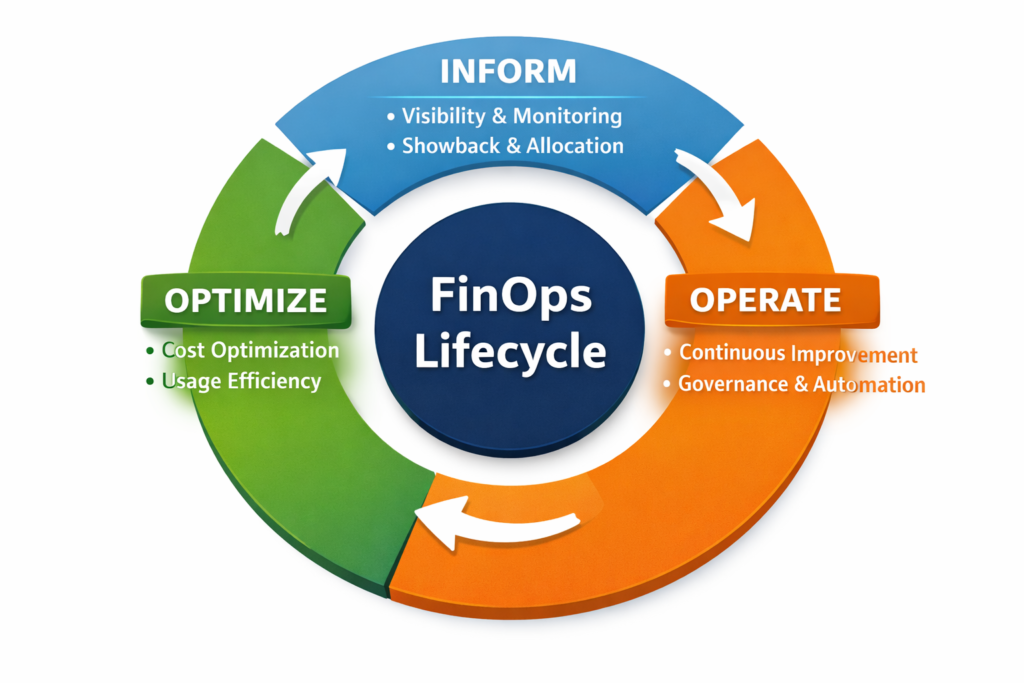
The FinOps Foundation describes three iterative phases: Inform, Optimize and Operate.
Inform
Build cloud cost visibility, accurate allocation and shared dashboards, including unit costs.
Optimize
Use that data to rightsize, clean up waste and choose optimal pricing models and architectures.
Operate
Embed FinOps into BAU governance, budgeting cycles, SLOs, sprint planning and release processes.
These phases loop continuously. In a Berlin or London team, different personas might be in different phases at once engineers optimizing workloads while finance updates forecasts and FinOps practitioners refine tagging policies.
FinOps Personas: Engineering, Finance and Product
FinOps explicitly recognises personas so responsibilities are clear.
Engineers own usage and technical choices (instance types, autoscaling, architectures)
Finance owns budgets, forecasting and financial reporting.
Product/Business leaders own value: they decide which features or SLAs justify higher spend.
Instead of siloed “cut the bill” mandates, FinOps creates shared KPIs such as cost per active user, gross margin by product, or cloud spend as a percentage of revenue. This aligns stakeholders in Austin, Manchester or Munich around outcomes, not finger pointing.
FinOps vs Traditional IT Cost Management
Traditional IT cost management is typically annual, centralized and hardware-centric: big budget cycles, capex-heavy decisions and relatively static capacity planning. Cloud blows that model up; capacity is elastic and spend can double in a quarter.
FinOps is cloud-native by design. It’s real-time, collaborative and integrated with DevOps, agile and product management rhythms. Instead of once-a-year negotiations with procurement, FinOps teams run monthly or even weekly cost reviews, adjust commitments dynamically and bake cost-awareness into CI/CD, infrastructure-as-code and runbooks.
Tactical FinOps Practices to Reduce Cloud Costs Fast
When you need quick wins, FinOps gives you a clear playbook. Most organisations can cut 15–25% from their cloud bills in the first 90 days by combining rightsizing, scheduling, storage lifecycle policies and smarter use of discounts. These are low-risk changes that don’t require complete re-architecture or vendor changes.
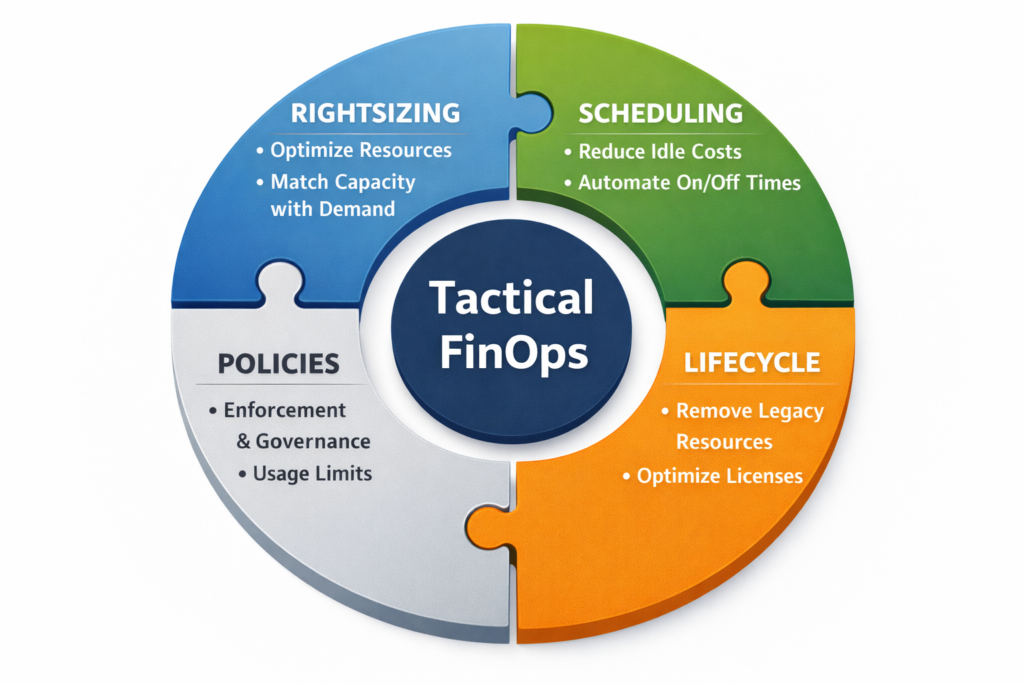
Rightsizing, Scheduling and Lifecycle Policies
Start with automated rightsizing: use utilisation data from your cloud provider or a FinOps platform to downsize underutilised instances, containers and databases. Rightsizing alone can remove a lot of “just in case” headroom that no one is actually using.
Next, apply scheduling to non-production environments so dev/test and staging are off outside working hours in places like London or Seattle. Then configure storage lifecycle policies—moving data from hot to infrequent access to archive tiers, and expiring logs and snapshots after sensible retention periods. Finally, align workloads with Reserved Instances, Savings Plans or committed-use discounts.
Together, these measures typically unlock the first 15–25% of savings without any visible impact on end users. (TechVZero)
Anomaly Detection and Cloud Waste Reduction
Anomaly detection is the FinOps safety net. By setting budget thresholds and anomaly alerts, you catch spending spikes before they become multi-million-dollar surprises. Good practice is to monitor by team, application and environment so you can quickly identify whether a spike is a legitimate launch, a misconfiguration or a rogue workload.
Dashboards that highlight daily and even hourly trends help you detect misconfigured autoscaling, infinite loops or runaway AI training jobs early. For regulated industries, anomaly detection also supports governance you can show auditors that there are controls to detect and act on abnormal spend patterns.
Showback/Chargeback and Cost Accountability Models
Technical fixes alone aren’t enough; people need to care. Showback exposes cloud costs to teams without directly billing them, building trust and literacy first. It’s usually the best starting point for US, UK and EU organisations new to FinOps.
Once teams are comfortable with the data, you can move to chargeback: allocating spend by product, business unit or cost centre. When leaders in New York, London or Frankfurt see cloud costs against their own P&L, behaviours change idle resources get cleaned up, experiments have explicit budgets and engineering roadmaps explicitly weigh cost vs. value.
FinOps Across AWS, Azure and GCP in US, UK & EU
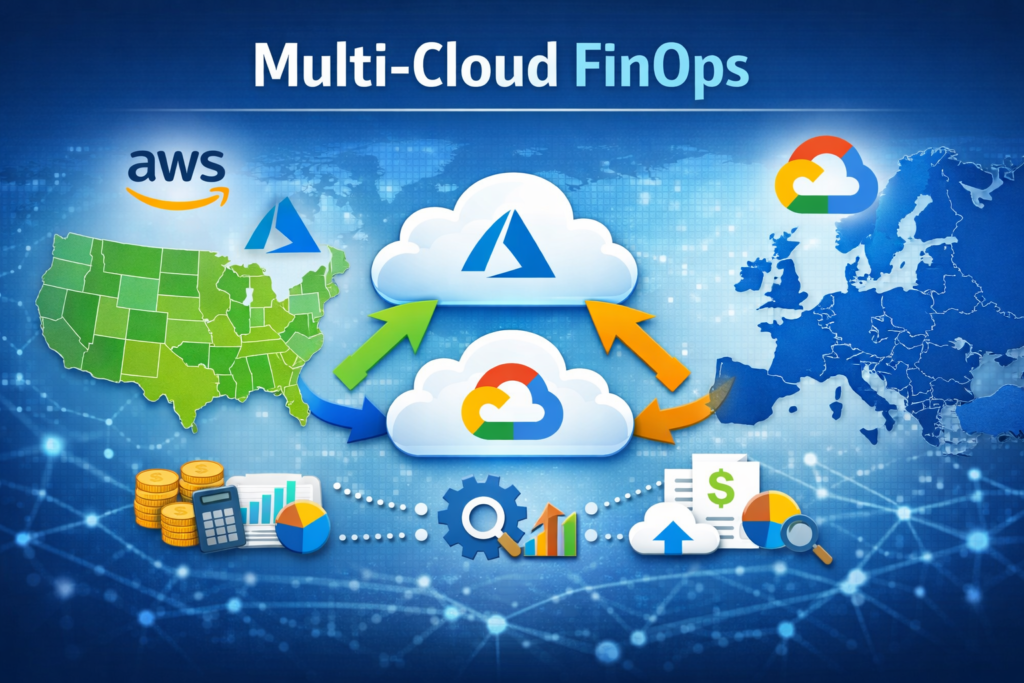
In multi-cloud environments, organisations need FinOps not just to cut costs but to compare true unit economics across clouds and regions. A euro of Azure spend in Frankfurt is not the same as a dollar of AWS spend in Virginia once you factor in FX, VAT and local discounts. FinOps creates a common view of usage, pricing and performance across providers so strategic decisions are evidence-based.
Multi-Cloud FinOps Patterns for AWS, Azure and GCP
Effective multi-cloud FinOps starts with consistent tagging and account structures. You standardise tags for application, owner, environment, cost centre and data sensitivity so workloads from AWS, Azure and GCP can be analysed side by side. Tools like cost category mappings and consolidated billing views then allow apples-to-apples comparison across providers.
Central teams can define a multi-cloud cost optimization strategy e.g., preferring one provider for data analytics, another for AI while still enforcing global guardrails. Over time, this supports smarter workload placement decisions and clearer negotiations with providers.
Data Residency, Tax/VAT and Billing Nuances in US vs EU
US enterprises often think in USD-only terms, with little VAT complexity, while EU and UK organisations must handle EUR/GBP billing, VAT and sometimes country-specific surcharges. For example, workloads in Frankfurt or Dublin may incur different effective unit costs than similar ones in a US region when FX and VAT are included.
FinOps teams normalise all this into consistent unit metrics like cost per vCPU-hour or per GB stored—across regions and providers. This is critical for complying with GDPR and DSGVO data residency requirements while still optimising spend, because workloads must sometimes stay in-region even if another region looks cheaper on list price.
Sector Examples.
US SaaS scaleup (San Francisco)
Focus on unit economics by product and growth efficiency (e.g., cloud spend vs. ARR), plus rapid iteration on commitments as usage explodes.
UK public sector / NHS suppliers
Emphasis on predictable budgets, value-for-money audits and strong governance evidence, alongside data residency and security expectations.
German/DACH financial services
Tight alignment with BaFin expectations, granular reporting by product line and region, and strong documentation of policies and controls around cloud spend.
In each case, the FinOps operating model is similar, but KPIs, policies and reporting packs are tailored to sector-specific governance.
Tools, Platforms and Services for FinOps Cloud Cost Management
Most teams start FinOps with native cloud cost tools, but quickly outgrow them as multi-cloud complexity, AI workloads and regulatory requirements increase. FinOps cloud cost optimization works best when your tools match your scale: native consoles for small footprints, then dedicated FinOps platforms and expert services as spend and complexity grow.
Built-In Cloud Cost Tools vs Dedicated FinOps Platforms
AWS Cost Explorer, Azure Cost Management and GCP Billing export are powerful starting points. They offer tagging, basic anomaly detection, recommendations and integration with budgeting features. For many SMEs and single-cloud teams, these are sufficient.
Dedicated FinOps platforms add advanced governance, forecasting, anomaly detection, automation and AI-assisted insights. They also normalise data across clouds, integrate with ticketing and CI/CD, and support complex chargeback and showback models. Vendors such as Oracle and specialist FinOps consultancies and platforms like Devoteam, T-Systems, USU and SVA are increasingly building FinOps-focused offerings for European enterprises.
Evaluating FinOps Platforms in the US, UK, Germany and EU
When evaluating FinOps platforms, prioritise.
Depth of AWS/Azure/GCP integration and data freshness.
Support for multi-currency, FX and US/UK/EU tax and VAT handling.
Out-of-the-box compliance reports and evidence for GDPR/DSGVO, UK-GDPR, SOC 2, PCI DSS and HIPAA.
Role-based dashboards for engineers, finance, product and leadership.
Strong APIs and automation hooks for “FinOps-as-code”.
For teams in New York, London or Berlin, vendor presence and enterprise support capabilities in your region also matter especially for regulated sectors.
When to Use FinOps Consulting or FinOps-as-a-Service
FinOps consulting or FinOps-as-a-Service makes sense when.
Your annual cloud spend is large (e.g., $5M+) and growing quickly.
You’re multi-cloud and/or heavily AI-driven but lack internal FinOps capacity.
You need to show fast progress to regulators, audit committees or investors.
Partners like Mak It Solutions can combine FinOps expertise with multi-cloud architecture, AI cost optimization and sovereignty consulting, so you don’t just get dashboards—you get actual savings and a durable operating model. For example, Mak It Solutions already helps teams with multi-cloud cost optimization, FinOps for AI GPU workloads and GenAI cost control in regulated regions. (Mak it Solutions)
Governance, Compliance & Reporting in FinOps
A well-run FinOps practice gives you auditable governance: clear roles, policy guardrails and cost KPIs that line up with risk and compliance expectations. This is where FinOps moves beyond “save money” and becomes a pillar of your cloud operating model for internal audit, regulators and customers.
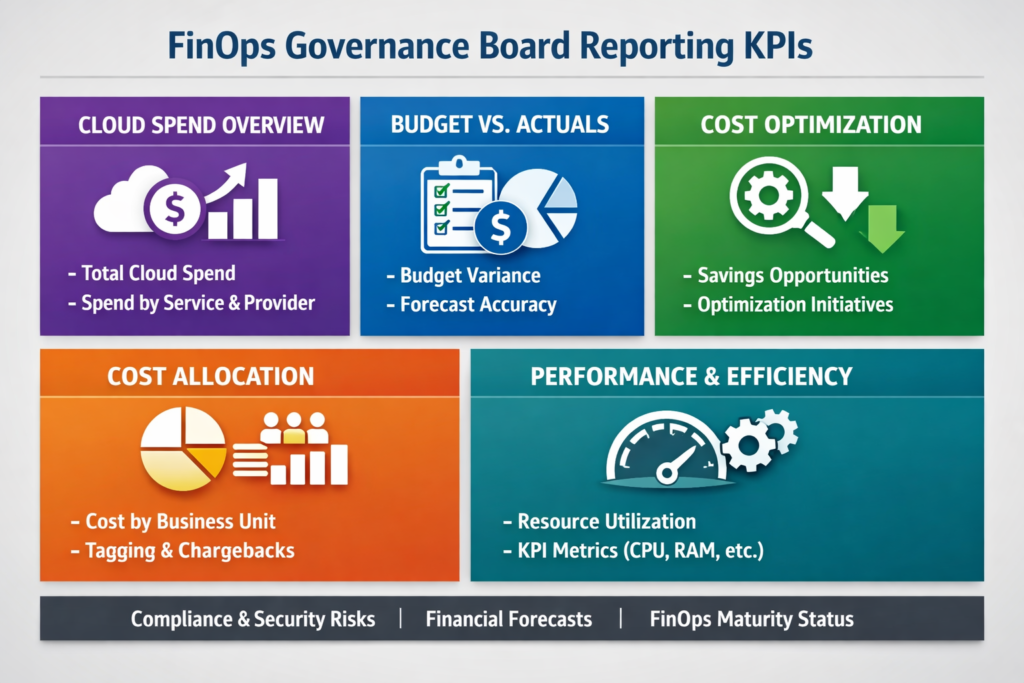
FinOps Governance Framework and Cloud Cost KPIs
A typical FinOps governance framework includes.
A steering committee with engineering, finance, security, data and product.
A clear RACI matrix for decision-making.
Policy guardrails (e.g., mandatory tagging, allowed regions, instance families, data classes)
KPIs such as
Unit economics (cost per user, per transaction, per API call)
Coverage and utilisation of commitments (Reserved Instances, Savings Plans)
Percentage of tagged spend and showback coverage.
Year-over-year cloud cost vs. revenue growth and margin trends.
These KPIs are reviewed regularly often monthly in US, UK and EU executive forums, alongside reliability and security metrics.
FinOps for Regulated Industries.
In healthcare, FinOps enables clear traceability between HIPAA-aligned workloads and their infrastructure spend, helping US organisations demonstrate to HHS and auditors that protected health information is both secure and cost-effective. In payments and fintech, FinOps makes it easier to maintain PCI DSS requirements while still optimising elasticity and performance.
For banks and regulated fintechs in Germany and across the EU, FinOps supports GDPR/DSGVO and UK-GDPR by enforcing region-specific policies and maintaining tamper-evident records of who changed what, when. It also provides auditors with clear evidence of controls around cloud cost governance spend anomaly alerts, approval workflows for new projects and documented tagging and budgeting policies.
Regional Reporting Examples.
US enterprises
Expect dashboards highlighting cloud spend vs. budget, margin by product line, unit costs and AI-related spend trends for board and audit committees.
UK NHS suppliers
Need evidence of predictable costs, value for money and robust controls for data residency and availability when bidding or renewing contracts.
German BaFin-regulated firms
Require granular breakdowns of cloud services used, regions, data classifications and associated costs, plus clear documentation of risk, controls and remediation processes.
FinOps cloud cost optimization becomes the backbone of these reporting packs, reusing the same data for financials, operations and compliance.
How to Launch a FinOps Practice.
Organisations can implement FinOps step by step by starting with visibility, then building accountability and finally embedding optimisation and automation into everyday delivery. The goal is not a massive “big bang” project but an iterative rollout over 90–180 days that proves value quickly while building a durable culture.
Step-by-Step FinOps Rollout for Multi-Cloud Teams
A practical rollout might look like this.
Days 0–30: Visibility & Baseline
Standardise tagging and account structures across AWS, Azure and GCP.
Centralise billing exports and create shared dashboards.
Establish an initial baseline: who spends what, where and on which workloads.
Days 31–60: Accountability & Quick Wins
Introduce showback by team, product and environment.
Run optimisation sprints for rightsizing, scheduling and storage cleanup.
Capture savings in a visible backlog to build momentum.
Days 61–90: Automation & Operating Model
Automate recurring optimisations (e.g., schedules, lifecycle policies, guardrails)
Formalise FinOps ceremonies (monthly reviews, quarterly roadmap planning)
Integrate FinOps into CI/CD, infra-as-code and architecture review processes.
For more advanced roadmaps like deciding when to repatriate workloads vs. optimise in place you can combine this with guidance from Mak It Solutions’ multi-cloud strategy and repatriation content. (Mak it Solutions)
Aligning Engineering, Finance and Product Around Shared KPIs
To keep everyone aligned, define joint OKRs that connect cloud costs to customer and revenue outcomes for example, “Improve gross margin for Product X by 5 percentage points while maintaining NPS and uptime.” Run regular FinOps ceremonies where engineering, finance and product review the same dashboards and agree on priorities and trade-offs.
Standard artefacts such as cost scorecards, savings backlogs and decision logs make it easy to onboard new stakeholders and provide evidence to auditors, investors or boards.
Measuring ROI.
Finally, treat FinOps itself like a product. Track.
Baseline vs. current cloud spend, normalised for growth.
Savings realised from FinOps actions (rightsizing, discounts, design changes)
Reinvestment into innovation (e.g., AI experiments, new digital products)
Impact on operating income or gross margin over 12–24 months.
Analyst data shows that organisations with mature FinOps capabilities achieve significantly higher savings and forecasting accuracy than those relying on ad-hoc cost reviews. (ResearchGate)
Concluding Remarks
A mature FinOps cloud cost optimization practice turns cloud from an opaque cost centre into a measurable value engine. Instead of sporadic “cut the bill” events, you get a continuous loop of visibility, optimisation and governance that supports growth, innovation and compliance across US, UK, German and EU operations.
Key Takeaways for US, UK, German and EU Organisations
FinOps gives US, UK, German and EU teams a shared language to manage cloud costs, performance and risk without undermining innovation. By standardising data, roles and KPIs, you can compare workloads across providers and regions, choose the right architecture and negotiate effectively with hyperscalers. Over time, FinOps becomes as core to your digital strategy as DevOps and security engineering.
Checklist to Take into Your Next FinOps Planning Meeting
Bring this checklist to your next steering committee or architecture forum:
Do we have reliable tagging and cost allocation across all clouds and regions?
Which dashboards do engineering, finance and product leaders actually look at today?
What are our top three KPIs for cloud financial management?
Which tools (native and third-party) do we use, and where are the gaps?
What are our first 90-day goals for visibility, quick wins and automation?
Which workloads are most sensitive for compliance (GDPR/DSGVO, HIPAA, PCI DSS, SOC 2) and how does FinOps help evidence their cost and governance?
When to Partner with a Specialist FinOps Provider
If your cloud spend is significant, multi-cloud complexity is rising, or regulatory pressure is intense, partnering with a FinOps-focused provider can accelerate your journey by 12–24 months. A specialist like Mak It Solutions can bring pre-built playbooks, dashboards and automation patterns for cloud, AI and data sovereignty, so your internal teams can focus on delivering customer value.
Whether you’re running SaaS in San Francisco, public services in London or financial platforms in Frankfurt and Berlin, FinOps cloud cost optimization can turn your cloud estate into a controllable, optimisable and transparent foundation for growth.
If your AWS, Azure or GCP bills keep climbing and you’re not sure where the waste is, it’s time to treat FinOps as a core capability, not a side project. Mak It Solutions can help you assess your current cloud financial management maturity, design a FinOps roadmap and implement the dashboards, policies and automations that deliver real savings.
Book a FinOps discovery call with our team, share your current cloud landscape and compliance constraints, and we’ll map a practical 90-day plan to reduce waste while protecting performance and regulatory posture across US, UK, German and EU regions.( Click Here’s )
FAQs
Q : Is FinOps cloud cost optimization only relevant for very large cloud budgets?
A : No FinOps principles apply whether you’re spending $20k a month or $20M a year. Smaller US, UK or EU organisations can start with simple tagging, shared dashboards and a monthly cost review to prevent bad habits from forming. As spend grows, those same practices scale into more formal governance, showback/chargeback models and dedicated FinOps roles. Starting early usually means fewer painful surprises and easier negotiations with cloud providers later.
Q : How often should FinOps teams review dashboards and reports to keep cloud costs under control?
A : Most teams benefit from weekly operational reviews for engineering and monthly executive reviews for leadership. Weekly reviews focus on anomalies, quick optimisation opportunities and new projects going live. Monthly reviews in New York, London or Berlin look at broader trends, commitment coverage, unit economics and alignment to budget and strategy. In very dynamic or AI-heavy environments, daily checks on anomaly alerts are common.
Q : What KPIs best show that FinOps cloud cost optimization is actually working?
A : Good FinOps KPIs combine cost, performance and value. Common examples include cost per active user or per transaction, coverage and utilisation of commitments, percentage of tagged spend, and year-over-year cloud spend vs. revenue growth. Many teams also track savings realised from FinOps actions and the proportion of workloads covered by showback or chargeback. Over time, you should see more predictable bills, better margins and fewer surprise spikes.
Q : Do startups and SMEs need a dedicated FinOps team, or can DevOps own it part-time?
A : In early stages, DevOps or a cloud lead can own FinOps responsibilities part-time, focusing on tagging, dashboards and a simple optimisation backlog. As cloud spend grows past a few hundred thousand dollars per year, it often makes sense to formalise the role either an internal FinOps lead or a partner providing FinOps-as-a-Service. The key is that someone has explicit responsibility and enough time to drive the work; otherwise, optimisation falls behind feature delivery.
Q : What skills and certifications should you look for when hiring a FinOps lead or partner?
A : Look for a blend of cloud engineering, finance and stakeholder management skills. Practical experience with AWS, Azure or GCP billing, commitment management and cost allocation is essential, alongside comfort with spreadsheets, dashboards and basic data analysis. Certifications from the FinOps Foundation, major cloud providers and relevant security/compliance bodies are a plus, but the ability to work with engineers, CFOs and product leaders in the same conversation matters even more. A good partner should bring battle-tested playbooks, not just tools.
[…] demand is spiky, SLAs are explicit, and strong managed services from AWS, Microsoft Azure, Google Cloud or IBM Cloud offset cold-start and lock-in […]