

Serverless Use Cases That Work for Enterprises
Serverless Use Cases That Work for Enterprises
Serverless Use Cases That Work for Enterprises
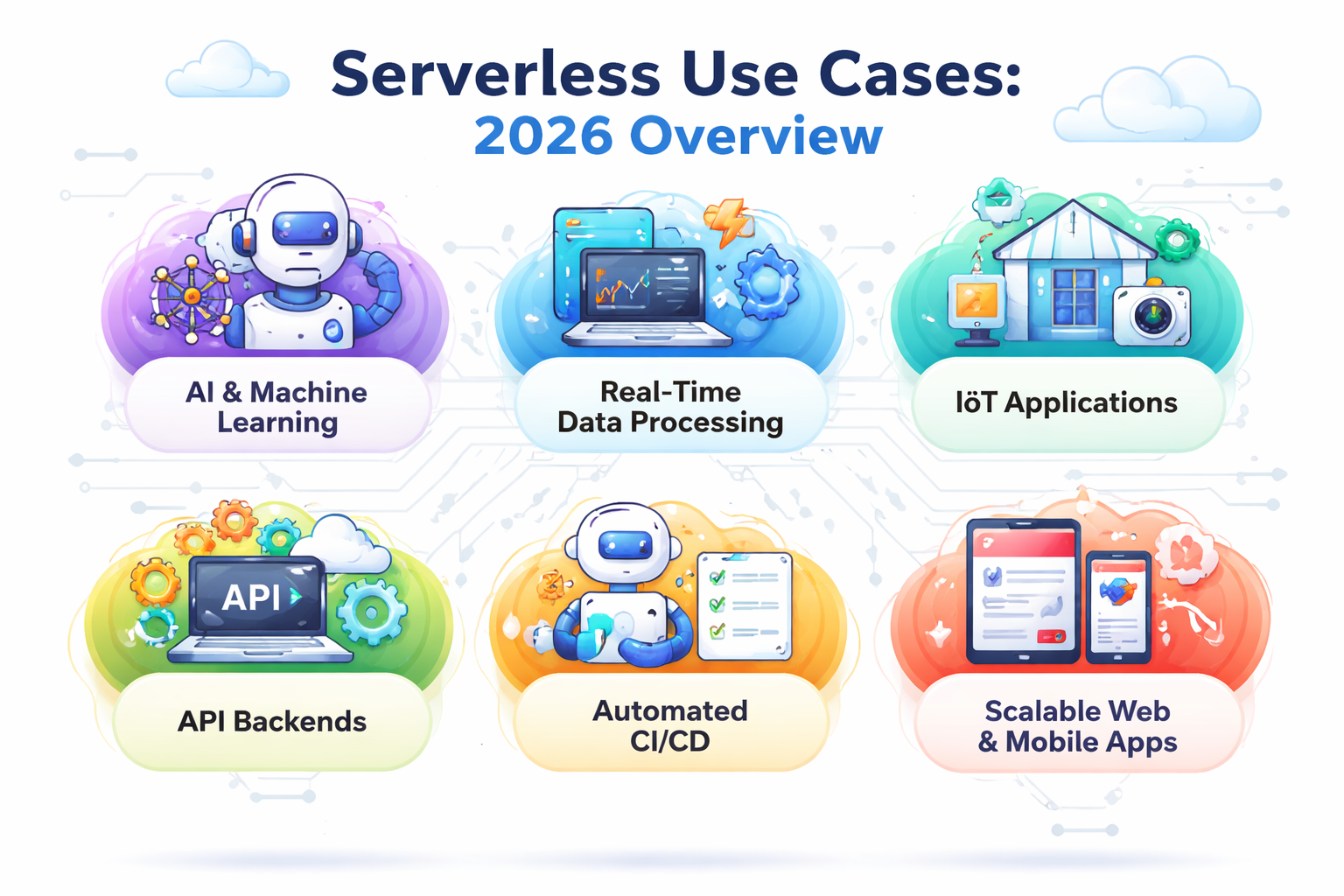
In 2026, the strongest serverless use cases are event-driven APIs, data pipelines, internal automation and selected regulated workloads in fintech, healthcare, ecommerce and IoT. For enterprises in the US, UK and EU, serverless wins when workloads are bursty, latency is acceptable, and the platform can meet GDPR/DSGVO, HIPAA, PCI DSS and SOC 2 requirements within a clear shared-responsibility model.
Introduction
If you’re running production workloads in 2026, the best serverless use cases cluster around event-driven APIs, data processing, automation, and industry-specific workloads in fintech, healthcare, ecommerce and IoT. For US, UK and EU enterprises, the decision usually comes down to latency expectations, cost profile, and how cleanly the platform supports GDPR/DSGVO, HIPAA, PCI DSS and SOC 2.
Analyst reports now put the global serverless architecture market somewhere around USD 15–20 billion in 2024, with projected growth above 20% annually into the early 2030s. At the same time, surveys suggest more than 70% of Amazon Web Services (AWS) customers and roughly 60% of Google Cloud customers already use at least one serverless service.
So the question is no longer “Is serverless real?” It’s: Which workloads actually win on a pay-per-use cloud computing model, and where should you stick with containers, Kubernetes or even on-prem?
Best Serverless Use Cases for Enterprises in 2026
When you zoom out across US, UK and EU enterprises, the most reliable serverless use cases 2026 tend to be customer-facing APIs, internal automation, data and analytics workflows, and a carefully chosen slice of regulated workloads. These shine when demand is spiky, SLAs are explicit, and strong managed services from AWS, Microsoft Azure, Google Cloud or IBM Cloud offset cold-start and lock-in concerns.
Quick-Win Serverless Use Cases for Modern Apps
The “classic” serverless computing use cases still deliver fast ROI in 2026: web and mobile backends, GraphQL/REST APIs, and backend-as-a-service (BaaS) patterns like authentication, file storage and messaging. An API layer built with Amazon API Gateway + AWS Lambda, Azure Functions or Google Cloud Functions lets you scale from a few hundred requests a day to millions without touching servers.
For early-stage startups in New York, London or Berlin, the pay-per-use cloud computing model often beats running idle EC2 instances or VMs. You only pay when users actually hit your API, which is ideal while you’re still searching for product–market fit. BaaS services like Firebase remain a good fit for MVPs where speed and iteration matter more than deep platform control.
As your app grows, these same serverless building blocks remain valuable for.
Public APIs and partner integrations
Auth flows (OAuth, SSO, social login)
Media processing (image resize, PDF generation)
Notification fan-out (email, SMS, push)
Best Serverless Use Cases for Enterprises & SaaS
For enterprises and SaaS platforms in the United States, United Kingdom and Germany, the best serverless use cases typically sit around customer portals, multi-tenant APIs, background jobs and reporting pipelines.
A New York–based SaaS vendor can run tenant-isolated API functions with per-tenant throttling and logging to meet SOC 2 and ISO 27001 expectations.
A London-based HR platform can push payroll exports, PDF generation and third-party integrations into serverless background jobs.
A Berlin SaaS scale-up can trigger tenant-level nightly reports on demand, instead of batch-processing every customer every night.
Fortune 500 organisations usually care most about compliance, observability and change management. German Mittelstand firms or UK SMEs tend to prioritise cost, simplicity and faster releases. Both groups benefit when serverless functions replace ad hoc scripts and fragile “pet servers” with repeatable, observable, event-driven components.
If you’re already wrestling with multi-cloud or hybrid, you can also combine serverless with strategies like multi-cloud cost optimization and cloud repatriation rather than treating it as an all-or-nothing bet. (Mak it Solutions)
Real World Serverless Use Cases by Region
To make this concrete, here are real world serverless use cases mapped to typical US/UK/EU contexts.
US fintech (San Francisco)
Card-not-present payments hitting a PCI-scoped API, with tokenization and risk scoring implemented as chained Lambda functions. PCI DSS controls are implemented via VPC isolation, encryption and hardened CI/CD pipelines rather than manual server patching.
UK healthcare (NHS pilot)
Anonymised patient-flow analytics running on serverless functions that consume event streams from EHR systems. PHI stays in a tightly controlled store; analytics functions only see de-identified or pseudonymised data to respect NHS and UK-GDPR expectations.
German Industrie 4.0 (near Frankfurt/Munich)
Telemetry ingestion for factory sensors lands in a serverless stream-processing pipeline, using region-pinned storage to stay GDPR/DSGVO-compliant while feeding OEE dashboards and maintenance alerts.
These patterns are repeatable across France, the Netherlands, Ireland and Switzerland, with regional variants driven mainly by local data-protection regulators and banking or health-sector rules.
Event-Driven & Data-First Serverless Patterns
Event-driven and data-processing workloads are the biggest serverless winners in 2026 because they’re naturally bursty, easy to express as small functions, and align perfectly with managed event sources like S3, Kafka, Kinesis and Pub/Sub. Teams in the US, UK and EU can pay only for execution while offloading scaling, failover and much of the operational toil.
Event-Driven APIs, Webhooks & BaaS
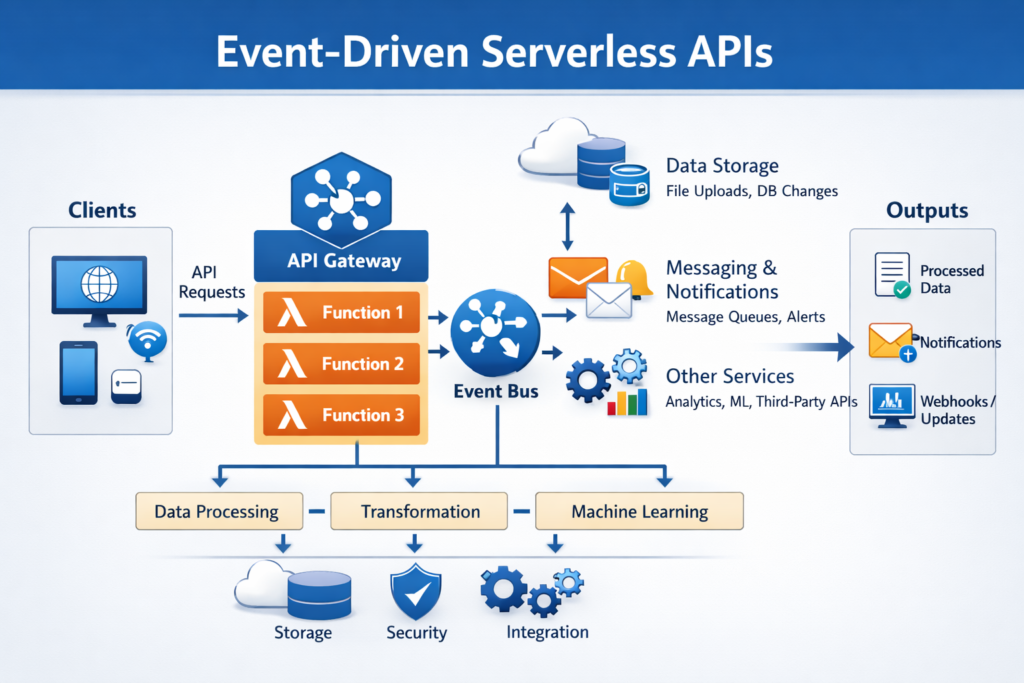
Many of the best serverless APIs and backend-as-a-service patterns follow the same blueprint: an API gateway at the edge, an authentication layer, and functions that act on discrete events.
Common event driven architecture patterns include.
API gateway or HTTPS endpoint → auth function → business logic function
Webhooks from SaaS tools (Stripe, Shopify, HubSpot) feeding into serverless handlers
BaaS-style auth providers issuing JWTs that functions validate on every call
These are textbook function as a service (FaaS) examples: each function is stateless, short-lived and mapped to a clear event. Backend-as-a-service use cases like document storage, chat or presence are often built with Firebase or similar platforms, then extended through custom serverless functions for business-specific logic.
Batch Jobs, Cron & Automation Workflows
Serverless batch processing and cron jobs are one of the simplest wins, especially for internal workloads. Instead of running a t2.micro in perpetuity just to handle crontab, you schedule functions.
Nightly revenue and churn reports
Hourly invoice generation and emailing
Data sync jobs between CRM, ERP and support tools
A US enterprise might schedule Lambda-backed automation to run after close of business in Eastern Time, while a Manchester-based SME does the same aligned to UK business hours. Alerts from CloudWatch, Azure Monitor or Google Cloud Monitoring are wired into incident management tools for mission-critical automations, so failed runs are visible rather than silently skipped.
Done well, this can remove dozens of under-managed VMs and shell scripts from your estate, which also helps if you’re exploring a more structured cloud migration or modernization plan. (Mak it Solutions)
Data Pipelines, ETL & Stream Processing
Data-first workloads are a natural fit for serverless data processing and ETL pipelines and serverless stream processing. Common patterns
Raw events land in object storage (for example, S3 or Google Cloud Storage)
A trigger launches ETL functions to clean, enrich and partition data into a data lake
Streaming services like Kafka, Kinesis or Pub/Sub feed near-real-time dashboards and alerts
Servrless data lake ingestion on AWS or Google Cloud is now common for GDPR/DSGVO-conscious teams that want detailed audit logs without managing clusters. You can pin data to EU regions like Frankfurt, Paris, Amsterdam or Dublin, combine encryption with access control, and keep the processing layer ephemeral.
These same pipelines also underpin analytics and ML inference workloads: from clickstream-based product recommendations on an ecommerce site to anomaly detection for IoT telemetry.
Regulated Industry & Compliance-Heavy Serverless Use Cases
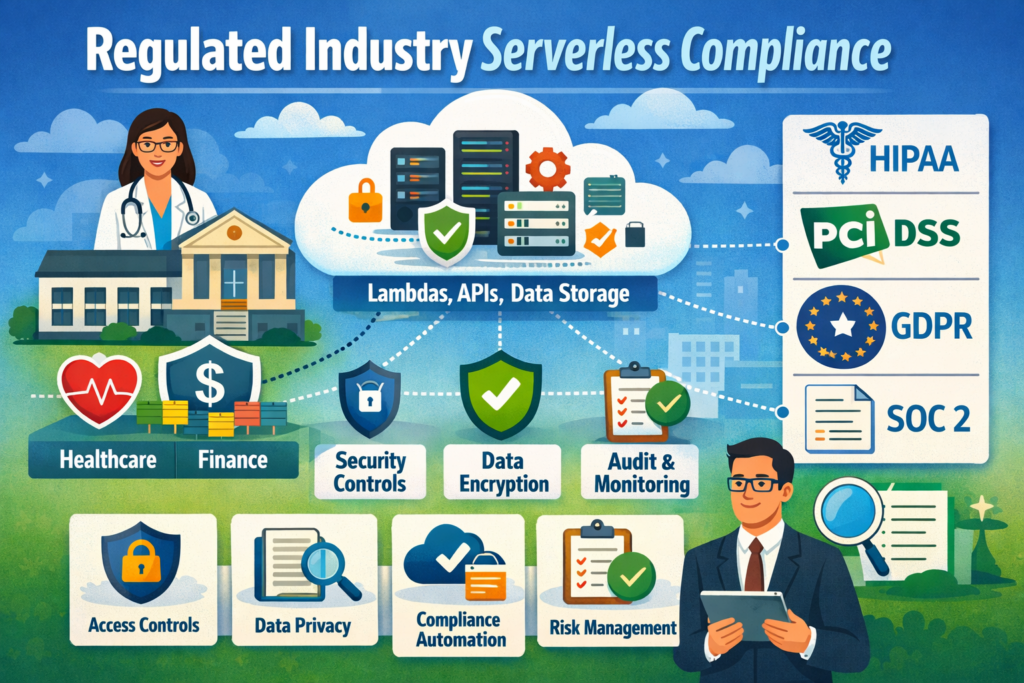
In regulated sectors, serverless is viable only when platforms offer clear shared-responsibility models, strong data residency guarantees, encryption and audit logging that satisfy GDPR/DSGVO, UK-GDPR, HIPAA, PCI DSS, BaFin and emerging rules like DORA and NIS2. None of the examples in this section are legal or regulatory advice; always work with your own compliance and legal teams.
Fintech & Payments (BaFin, PCI DSS, PSD2)
Typical fintech serverless use cases include.
Open banking APIs implementing PSD2/UK Open Banking standards
KYC/AML checks triggered when a new customer signs up
Real-time transaction scoring and fraud signals
For a London-based open banking provider, serverless is attractive because you can scale KYC checks and PSD2 APIs elastically while satisfying FCA and UK-GDPR. A Frankfurt fintech supervised by BaFin needs “BaFin-konforme” serverless architectures: cardholder data stays in a tightly scoped environment, PCI DSS controls are mapped explicitly to cloud services, and logs are retained according to German and EU rules.
In the US, banks lean on serverless more cautiously, often for non-core workflows (alerts, document processing, reconciliation) while keeping core ledger systems on well-understood platforms.
Healthcare & Public Sector (HIPAA, NHS, EU Health Data)
Healthcare serverless use cases (HIPAA-compliant) tend to focus on workflows around PHI, not raw storage of PHI itself. Examples:
Appointment scheduling and reminders via SMS/email
Secure patient–provider messaging where PHI is proxied or tokenised
Anonymised analytics on utilisation, wait times or population health
In the US, all of this must align with HIPAA’s privacy and security rules. In the UK, public-sector teams work closely with the NHS data governance model and tools like NHSX blueprints for analytics. Across the EU, GDPR/DSGVO and local interpretations (for example in France or Ireland) push health workloads into specific regions with strict consent and access-control models.
The pattern is consistent: keep PHI in tightly controlled core systems, and let serverless functions orchestrate and analyse de-identified data around the edges.
Ecommerce, IoT & Analytics / ML Inference
Ecommerce, IoT and analytics are where revenue meets innovation.
Ecommerce: Ecommerce serverless architecture examples include flash-sale backends, Black Friday traffic handling, and promo-code engines that spike a few times per year. AWS has already showcased how AWS Lambda handled around 1.3 trillion invocations during Prime Day 2024, which illustrates how far this model can scale.
IoT: IoT serverless backend use cases cover ingestion of sensor data from factories in Germany or energy grids in the Netherlands, plus edge triggers for immediate anomaly reactions. (Mak it Solutions)
Analytics & ML: Analytics & ML inference serverless use cases include recommendation engines, next-best-action logic and lightweight fraud detection models exposed as FaaS endpoints. LLM-based workloads may mix serverless APIs with GPU-backed managed services from cloud providers.
For teams exploring confidential workloads, serverless can be combined with approaches like confidential computing to add yet another security layer around model inference or sensitive analytics. (Mak it Solutions)
Serverless vs Containers/Kubernetes in 2026
Not every workload should move to serverless, even in 2026. Long-running jobs, ultra-low-latency trading systems, heavy stateful workloads, and tightly coupled monoliths with strict platform and residency requirements often fit better on containers or Kubernetes. Serverless frequently complements these platforms as glue code and event triggers rather than replacing them.
Serverless vs Containers for Microservices
When comparing serverless vs containers use cases and serverless vs Kubernetes for microservices, think in terms of control vs convenience.
Serverless
Great for sporadic traffic, simple scaling rules and quick releases. Cold starts and per-invocation pricing are the trade-offs.
Containers/Kubernetes
Better when you need full control over runtime, networking, sidecars and long-lived connections.
A US SaaS company might host latency-sensitive core microservices in containers but use serverless for background jobs and edge adapters. A UK startup might start fully serverless, then migrate a few hot services to containers as scale and latency demands grow. A German Mittelstand manufacturer might keep OT/SCADA-adjacent workloads on-prem or in a private Kubernetes cluster, then use serverless at the edge for telemetry ingestion and reporting.
Cost & Performance: Serverless vs Traditional Cloud
On cost, the picture is nuanced. Cost comparison serverless vs traditional cloud usually looks like this:
For bursty or low-throughput workloads, serverless often wins because you’re not paying for idle.
For high and predictable loads (for example, 24/7 APIs at very high RPS), containers or even reserved instances can be cheaper.
Networking, storage and ancillary services (databases, queues, logs) can dominate the bill regardless of compute model.
Recent analyses suggest the global serverless computing market could reach USD 50+ billion by 2032, reflecting growing production usage and optimisations like Arm-based runtimes that cut 20–30% off Lambda costs.But “Is serverless cheaper?” is still the wrong question; the better one is: “Is serverless the best cost-to-value model for this specific workload pattern?”
When Not to Use Serverless in 2026
There are still clear cases when not to use serverless in 2026:
Constant 24/7 high-throughput workloads where per-invocation pricing is punishing
Ultra-low-latency trading or gaming flows where cold starts are unacceptable
Complex, highly stateful systems that don’t map cleanly to FaaS
Workloads requiring specialised hardware (dense GPUs, large persistent memory)
Regulated EU workloads where DORA/NIS2 or sector rules demand deep infrastructure control and detailed failure-mode testing across providers
In these cases, containers, VM-based platforms or even on-prem/hybrid models (see cloud repatriation guidance) usually offer a better balance of control and risk. (Mak it Solutions)
How to Choose the Right Serverless Use Cases for Your US/UK/EU Team
For a UK, US or EU company choosing between serverless and containers for a new application in 2026, the starting point is business goals and compliance. Then you score candidate workloads on variability, latency tolerance, integration with managed services, and regulatory constraints (GDPR/DSGVO, HIPAA, PCI DSS, BaFin, NHS). Use pilots, TCO modelling and security reviews before scaling into production.
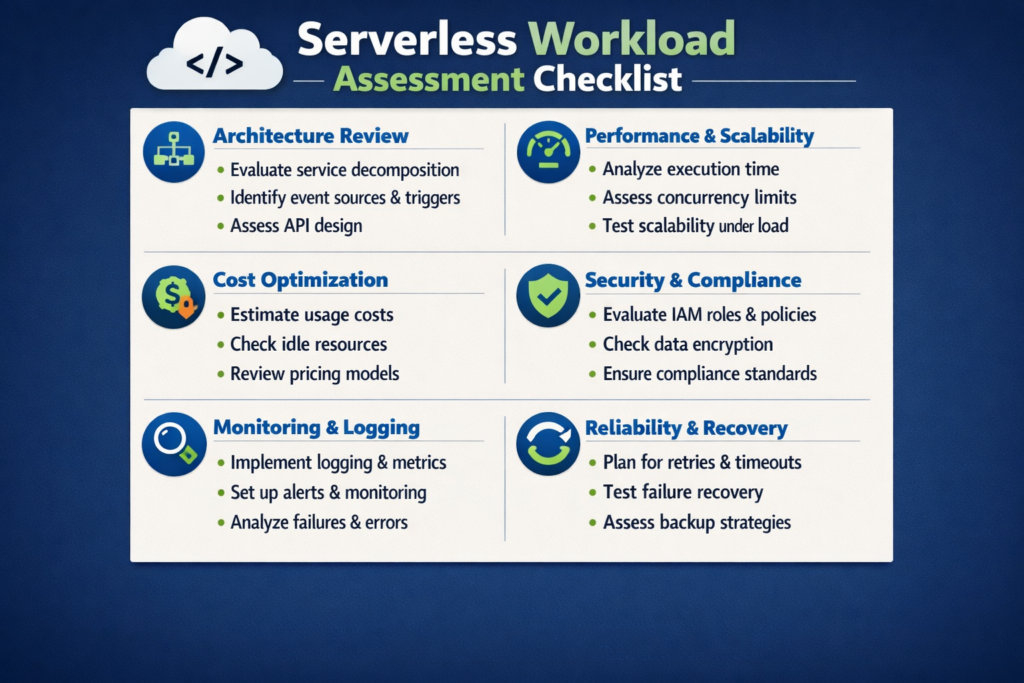
Workload Assessment Checklist
A simple, repeatable checklist to evaluate serverless architecture use cases vs lift-and-shift options:
Traffic pattern
Is demand spiky, unpredictable or event-driven? Serverless tends to win. Always-on, flat workloads lean towards containers or VMs.
Latency tolerance
Can you live with a few tens of milliseconds of extra latency or occasional cold starts? If not, consider containers.
Data sensitivity
What data is processed? Does it involve PHI, cardholder data or highly confidential IP? Map to GDPR/DSGVO, UK-GDPR, HIPAA and PCI DSS obligations.
Integration needs
Do you rely heavily on managed services like queues, object stores and identity platforms? If yes, serverless can simplify architecture.
Team skills
Are your teams more comfortable with infra-as-code and Kubernetes, or with application-level development and event-driven thinking?
Startups in San Francisco or Amsterdam may bias towards serverless for speed and lower operational overhead. Heavily regulated enterprises in London, Frankfurt or Paris often land on hybrid patterns that mix serverless, containers and even mainframe or on-prem systems.
GEO & Compliance Filters for US, UK, Germany & EU
Geography shapes serverless choices more than most architects admit.
United States
HIPAA, state privacy laws and sectoral regulations shape healthcare and financial workloads. HHS proposals are tightening security expectations for ePHI, which impacts how you design cloud and serverless architectures.
United Kingdom
UK-GDPR, FCA and NHS guidelines all influence how you handle personal and financial data. (ICO)
Germany & wider EU
GDPR/DSGVO, BaFin, CNIL and pan-EU rules like DORA and NIS2 push teams to think about data residency, operational continuity and concentration risk across hyperscalers. (EUR-Lex)
These filters don’t kill serverless; they just force you to design with explicit shared-responsibility matrices, regional isolation and multi-cloud failover in mind.
From Pilot to Production: Next 90 Days
A pragmatic 90-day path from idea to production.
Discovery workshop (Days 1–15)
Identify 3–5 candidate serverless use cases, map them to business outcomes and regulatory needs.
Pilot implementation (Days 16–60)
Build a thin slice on AWS, Azure or Google Cloud with production-grade security, logging and observability.
Production rollout (Days 61–90)
Harden cost controls, add runbooks and SLOs, and integrate with wider platform governance.
Many teams bring in a partner for architecture reviews, cost modelling and compliance mapping. If you don’t have deep in-house experience, this is often cheaper and safer than learning serverless, security and multi-region design by trial and error.
Key Takeaways
Serverless wins on event-driven APIs, automation and data pipelines where demand is bursty and ops headcount is limited.
Containers and Kubernetes remain better for long-running, stateful and ultra-low-latency workloads, especially in finance and real-time systems.
In regulated sectors, viable serverless use cases focus on orchestration, analytics and peripheral workflows rather than core ledgers or raw PHI storage.
GEO and compliance filters (GDPR/DSGVO, UK-GDPR, HIPAA, PCI DSS, BaFin, DORA/NIS2) shape where and how you deploy, not whether serverless is allowed at all.
A structured assessment checklist and 90-day pilot-to-production plan reduce risk and turn serverless from buzzword to measurable business value.
How We Help Teams in the US, UK & EU
At Mak It Solutions, we help teams in cities like New York, San Francisco, London, Manchester, Berlin, Amsterdam, Dublin and Frankfurt evaluate real-world serverless architecture use cases against containers, hybrid and even repatriation options. Our architects combine cloud platform expertise with data, security and compliance experience, so your roadmap covers more than just diagrams.
We’ve already supported clients on topics like multi-cloud strategy, cost optimisation, confidential computing and data analytics architectures. (Mak it Solutions) If you’re ready to map out your own serverless portfolio, we can help you design a pragmatic, regulator-friendly plan.
If you’re evaluating serverless use cases 2026 for your organisation in the US, UK or EU, this is a good moment to get specific. Share a short list of candidate workloads, and the Mak It Solutions team can help you score them against cost, latency and compliance, then propose a 60–90 day pilot plan.
You can then decide with real data whether serverless, containers or a hybrid approach will give you the best balance of performance, resilience and regulatory comfort.( Click Here’s )
FAQs
Q : Is serverless computing always cheaper than containers or VMs for enterprise workloads?
A : No. Serverless is usually cheaper for bursty or low-throughput workloads because you’re not paying for idle capacity, but it can become more expensive than containers or VMs for steady, high-volume traffic. Networking, storage and database charges also apply regardless of compute model. The only way to know is to model your specific workload patterns and compare end-to-end costs.
Q : Which cloud provider is best for GDPR/DSGVO-compliant serverless use cases in Europe?
A : There’s no single “best” provider; AWS, Microsoft Azure, Google Cloud and IBM Cloud all offer EU regions, encryption options and compliance attestations that can support GDPR/DSGVO. What matters is choosing EU regions that match your residency needs, configuring identity and logging correctly, and mapping each GDPR control to specific services and responsibilities. Many EU organisations also pair serverless with multi-cloud or repatriation strategies to reduce concentration risk.
Q : Can I run AI/ML inference or LLM workloads on serverless in production, and when does it make sense?
A : Yes, you can run smaller ML models and LLM-adjacent logic on serverless, particularly for on-demand inference where traffic is spiky and latency tolerances are moderate. It makes sense for tasks like personalisation, anomaly detection or routing calls to managed AI services. For very large models, high-QPS inference or workloads needing GPUs, dedicated containerised services or managed AI platforms are usually more cost-effective and easier to tune.
Q : How do serverless use cases differ for fast-growing startups vs heavily regulated banks or hospitals?
A : Fast-growing startups often use serverless as their default: it reduces infra overhead, speeds up iteration and scales naturally with demand. Heavily regulated banks or hospitals, by contrast, adopt serverless more selectively: they focus on workflows around core systems (notifications, analytics, orchestration) while keeping ledgers, PHI stores and critical transaction engines on platforms with deeper control and long governance histories. The technology is similar, but the blast radius and risk appetite are very different.
Q : What skills and team changes are needed before migrating critical workloads to serverless in the US, UK or Germany?
A : You’ll need strong foundations in cloud security, IAM, CI/CD and observability, plus developers who are comfortable with event-driven thinking and small, composable functions. Teams must get used to designing for limits (timeouts, payload sizes), dependency management and cost awareness. In regulated environments in the US, UK or Germany, you’ll also need compliance, legal and risk stakeholders involved early so shared-responsibility models, audit trails and policy updates keep pace with your new serverless footprint.
[…] AI inference means running trained AI models directly on user devices such as phones, AI PCs, gateways […]