
Arabic Call Center Voice AI for GCC Growth
Arabic Call Center Voice AI for GCC Growth
Arabic Call Center Voice AI for GCC Growth
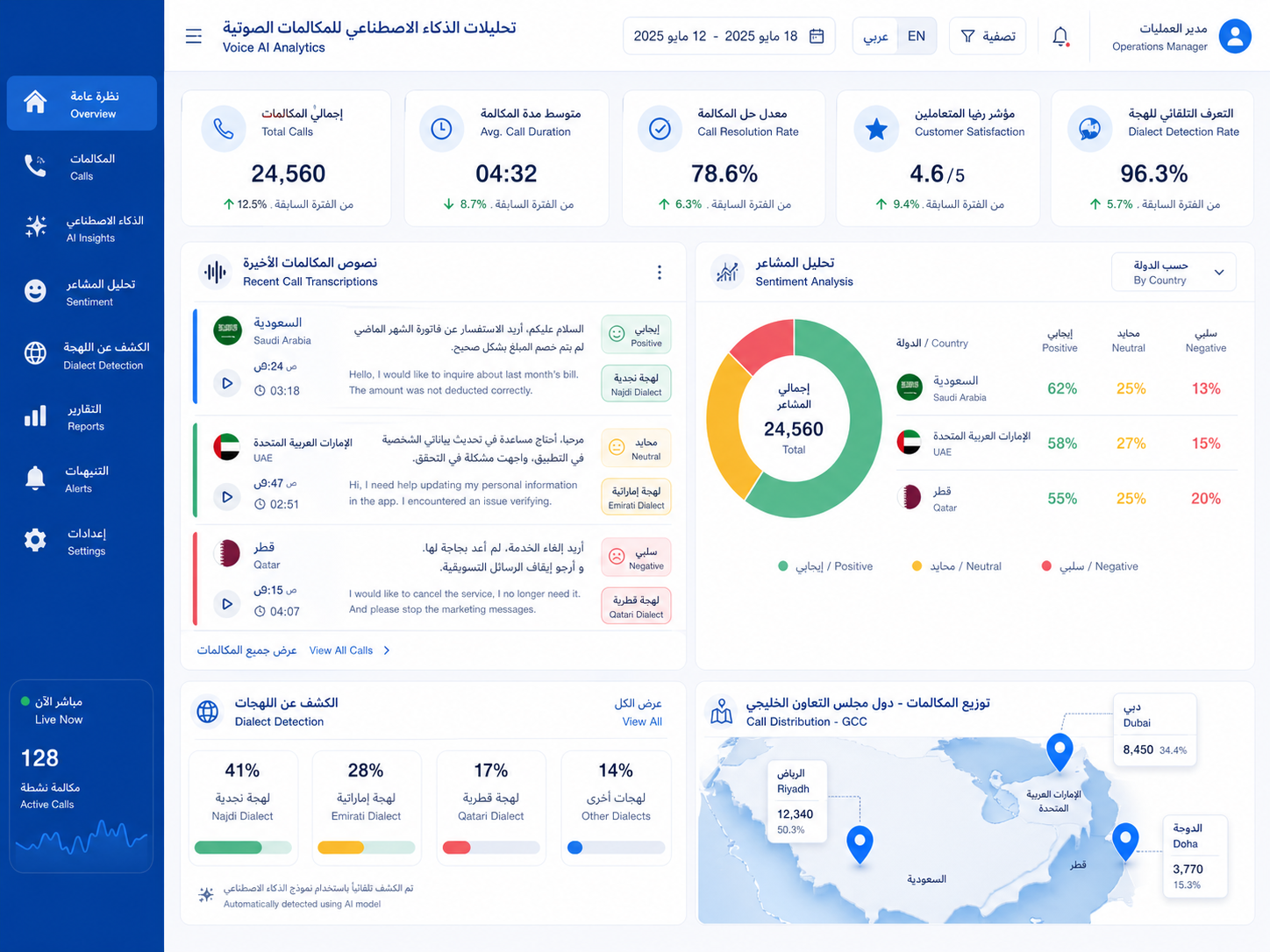
Arabic call center voice AI is no longer just a “nice-to-have” for GCC contact centers. For teams in Saudi Arabia, the UAE, and Qatar, it can reduce wait times, improve Arabic call transcription, support agents, and help customers get answers in the language they actually use.
At its best, Arabic call center voice AI handles Gulf dialects, Arabic-English code-switching, compliance requirements, and smooth human handoff. That matters because customer service in Riyadh, Jeddah, Dubai, Abu Dhabi, and Doha is rarely simple, scripted, or purely Modern Standard Arabic.
What Is Arabic Call Center Voice AI?
Arabic call center voice AI is a system that listens to customer calls, understands spoken Arabic, responds in a natural voice, transcribes conversations, and supports human agents during live interactions.
Unlike a basic IVR, it can detect intent, capture customer details, route calls, trigger workflows, and create Arabic call summaries for QA and compliance teams.
How Arabic Voice AI Works in Customer Calls
A strong setup usually combines.
ASR to convert speech into text
NLU to understand intent
TTS to speak back naturally
Workflow automation to update CRMs, tickets, payments, bookings, or helpdesk systems
For businesses modernizing their digital stack, this can connect naturally with custom software development support from Mak It Solutions.
Why It Matters for Saudi, UAE, and Qatar Contact Centers
For GCC businesses, the real value is not automation alone. It is better service in the customer’s language.
A Riyadh fintech may need careful, SAMA-aware call handling. A Dubai e-commerce brand may need fast Arabic and English order updates. A Doha clinic may want appointment reminders while keeping patient data under control.
Where It Fits in the Contact Center
Arabic call center voice AI can work as.
An IVR replacement
A first-line AI voice agent
A live-agent assistant
A QA and call-summary tool
An outbound reminder system
Many GCC teams start with controlled use cases, such as appointment confirmations, delivery updates, call summaries, and simple routing, before moving into sensitive banking or healthcare workflows.
Why Arabic Call Center Voice AI Needs Gulf Dialect Support
Modern Standard Arabic helps, but it is not enough for daily customer service in the Gulf.
Customers speak quickly, naturally, and often emotionally. When a payment fails, a package is late, or an appointment needs changing, the AI has to understand more than textbook Arabic.
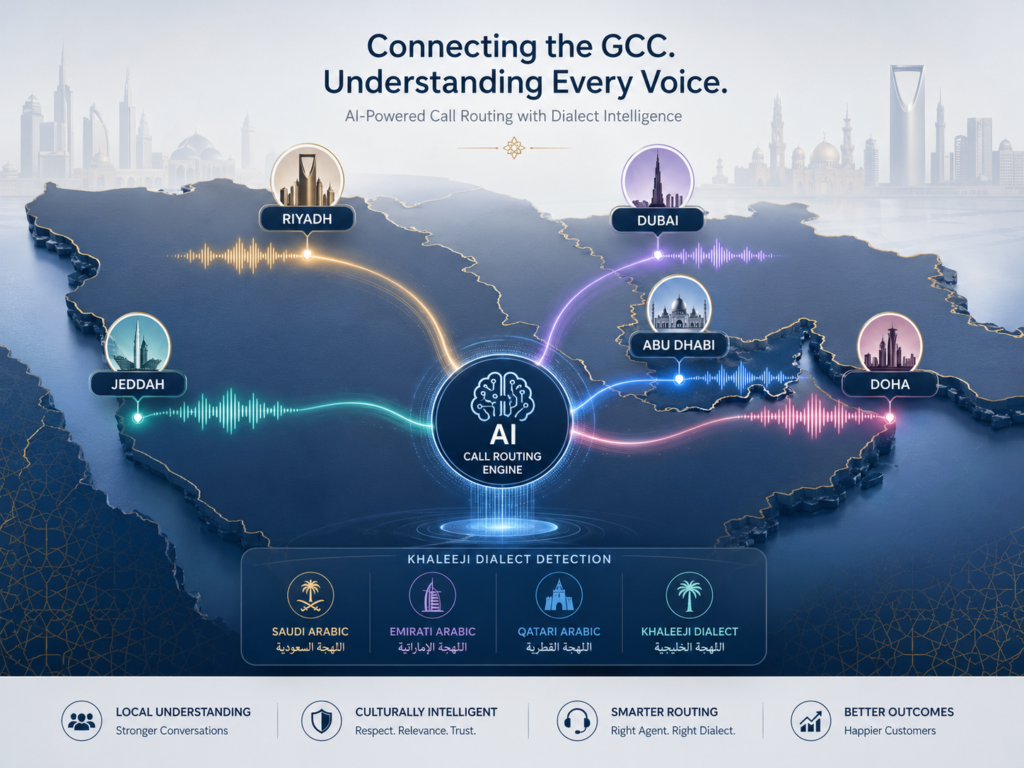
Saudi, Emirati, Qatari, and Khaleeji Arabic Differences
Saudi Arabic in Riyadh or Jeddah may sound different from Emirati Arabic in Dubai or Abu Dhabi. Qatari Arabic in Doha also has its own rhythm, phrases, and pronunciation patterns.
That is why Gulf Arabic dialect detection matters. A small transcription error can change the customer’s intent, sentiment, or requested action.
Arabic-English Code-Switching in GCC Calls
Many GCC callers switch between Arabic and English in the same conversation.
A customer might explain a delivery issue in English, give location details in Arabic, then mention an app feature or product name in English again. This is common in banking, telecom, retail, logistics, and technical support.
Good Gulf Arabic NLP should handle.
Arabic names
English app terms
Local city and district names
Product names
Numbers and dates
Mixed Arabic-English phrases
How to Test Dialect Accuracy Before Choosing a Vendor
Do not rely only on polished demo calls.
Before signing a contract, test the system with real anonymized calls from Saudi Arabia, the UAE, and Qatar. Include calm calls, angry calls, noisy calls, elderly speakers, fast speakers, and customers who switch between Arabic and English.
Track word error rate, intent accuracy, fallback rate, and whether the AI understands names, branches, districts, and local expressions.
Key Use Cases for Arabic Call Center Voice AI in the GCC
AI Call Answering for Banks, Clinics, Telecoms, and Retailers
Banks can automate balance-related routing, card activation guidance, branch information, and general FAQs. Clinics can confirm or reschedule appointments. Telecoms can handle package questions. Retailers can manage order status, returns, and delivery updates.
A Dubai online store scaling mobile-first commerce may also pair voice automation with mobile app development services for a smoother omnichannel experience.
Arabic Speech Analytics for QA and Sentiment Scoring
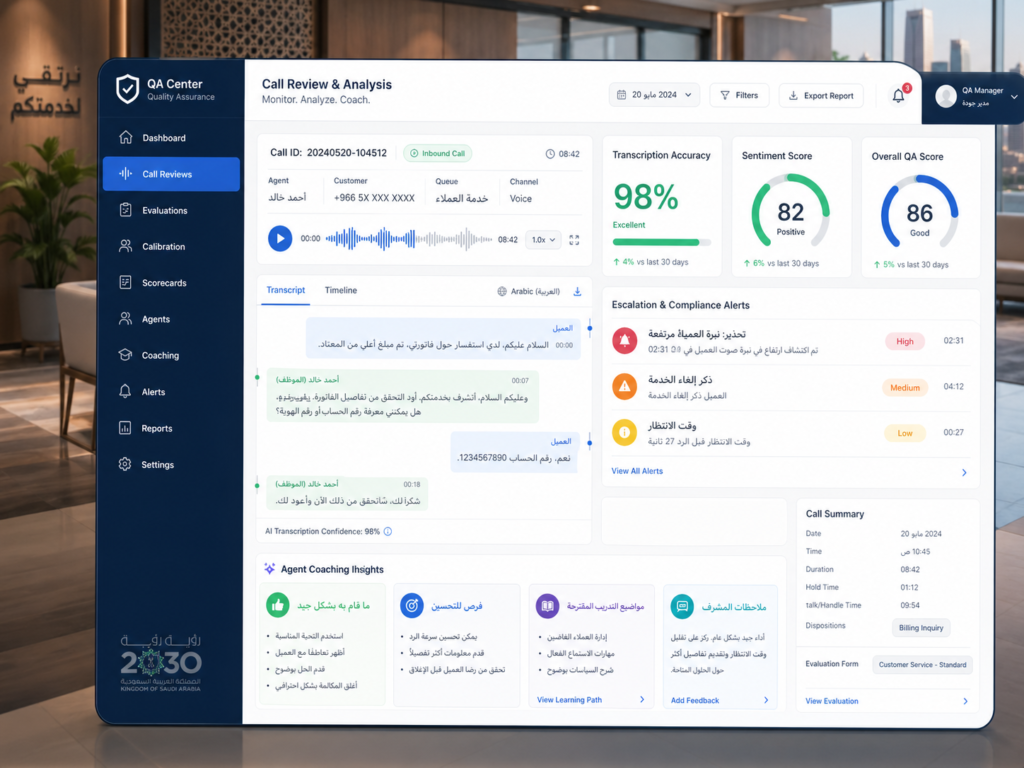
Arabic speech analytics can help QA teams review more calls than manual sampling alone.
It can flag complaint phrases, escalation risks, missed disclosures, long silences, repeated issues, and agent coaching opportunities. For leadership teams, this connects well with business intelligence services because call conversations become a source of operational insight.
Outbound Reminders and Service Updates
Outbound voice AI is especially practical for narrow, repeatable workflows.
Examples include delivery updates in Jeddah, clinic reminders in Doha, and payment reminders in Dubai. These are easier to control because the script is predictable, the compliance boundaries are clearer, and escalation rules can be defined in advance.
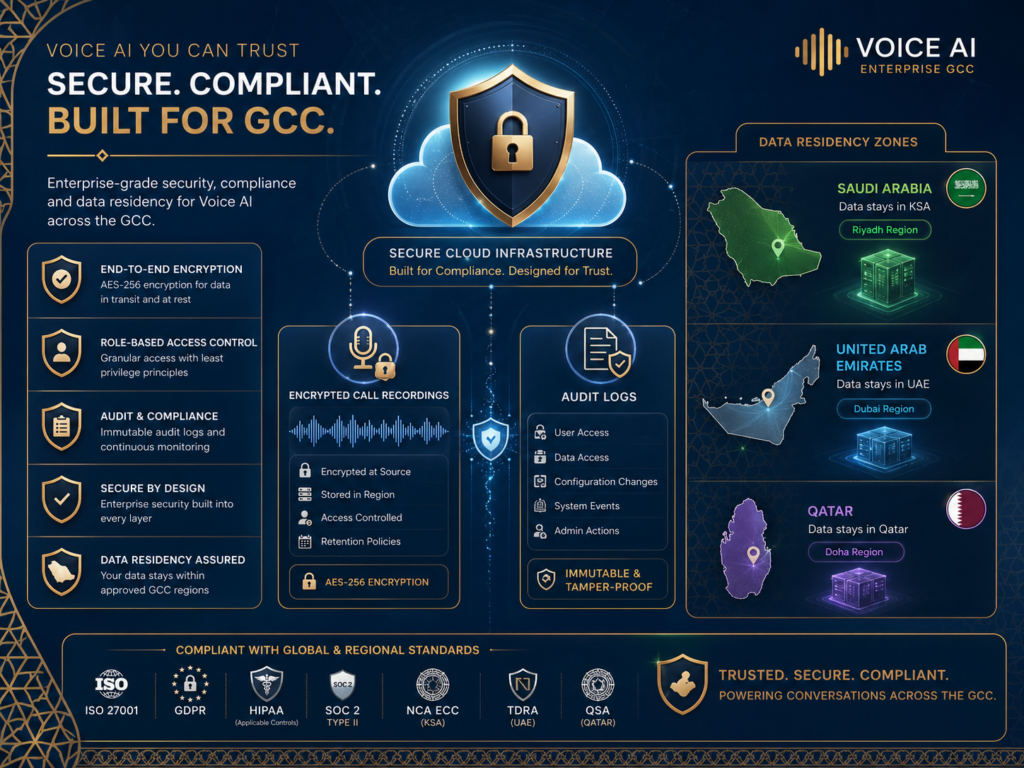
Compliance, Data Residency, and Trust in Saudi, UAE, and Qatar
Trust is often the real buying factor.
GCC enterprises need to know where recordings are stored, who can access transcripts, how long data is retained, and whether supervisors can review audit trails.
Saudi Compliance Signals.
For Saudi banks and fintech firms, confidentiality and data protection expectations are central. SAMA’s rulebook states that banks must maintain card and account-holder confidentiality, while other SAMA guidance also emphasizes confidentiality of client information and transactions.
A Riyadh fintech evaluating Arabic call center voice AI should ask about encryption, access controls, consent handling, retention policies, audit logs, and Arabic transcript review workflows.
UAE Compliance Signals.
In the UAE, enterprise buyers should consider federal data protection expectations, plus DIFC or ADGM requirements where relevant. The UAE official portal describes the Personal Data Protection Law as a framework for protecting information confidentiality and individual privacy, while ADGM guidance covers areas such as security of processing, data breaches, transfers, and individual rights.
For an Abu Dhabi financial services firm, vendor contracts should clearly define processing roles, transfer controls, audit rights, breach procedures, and data storage responsibilities.
Qatar Compliance Signals.
For Qatar, QCB has issued cloud computing regulations for licensed financial institutions, with the regulation entering into force on April 15, 2024.
A Doha bank or public-sector service team should prioritize local hosting options, audit logs, access rights, retention controls, and internal approval workflows before deploying Arabic voice AI at scale.
Deployment Options for GCC Enterprises
Cloud, Private Cloud, and On-Prem Arabic Voice AI
Cloud deployment is usually faster and easier to scale. Private cloud gives more control. On-prem deployment may suit highly regulated or sensitive workloads.
The right choice depends on call sensitivity, regulator expectations, latency, integration needs, and whether recordings include payment, health, identity, or financial data.
Data Residency in Saudi, UAE, and Qatar Cloud Regions
Data residency is now a board-level topic for many GCC companies.
Buyers often compare regional cloud options, hosting locations, and contract terms before choosing a platform. For cloud strategy planning, Mak It Solutions’ Middle East cloud providers guide can support internal discussions.
CRM, Helpdesk, and Contact-Center Integrations
Arabic voice AI becomes much more useful when it connects with the systems your teams already use.
That may include Salesforce, Zoho, HubSpot, Genesys, ticketing tools, WhatsApp workflows, and local BPO platforms. If a company also needs customer portals, dashboards, or secure web apps, front-end development and React Native development can help create a unified customer experience.
How to Measure Arabic Voice AI Success
Accuracy KPIs
Track accuracy by market and dialect, not only as one general Arabic score.
Useful KPIs include.
Dialect recognition accuracy
Intent accuracy
Word error rate
Fallback rate
Misunderstood intent rate
Silence handling
Arabic-English code-switching accuracy
Customer Experience KPIs
The goal is not to trap customers in automation. The goal is faster, clearer, more respectful service.
Measure.
Wait-time reduction
First-call resolution
CSAT
Complaint rate
Escalation quality
Whether agents receive useful call summaries
QA and Compliance KPIs
For regulated sectors, QA should support trust, not only cost reduction.
Track Arabic call transcription quality, compliance flag precision, missed-disclosure detection, supervisor review time, and agent coaching outcomes.
How to Choose the Right Arabic Call Center Voice AI Vendor
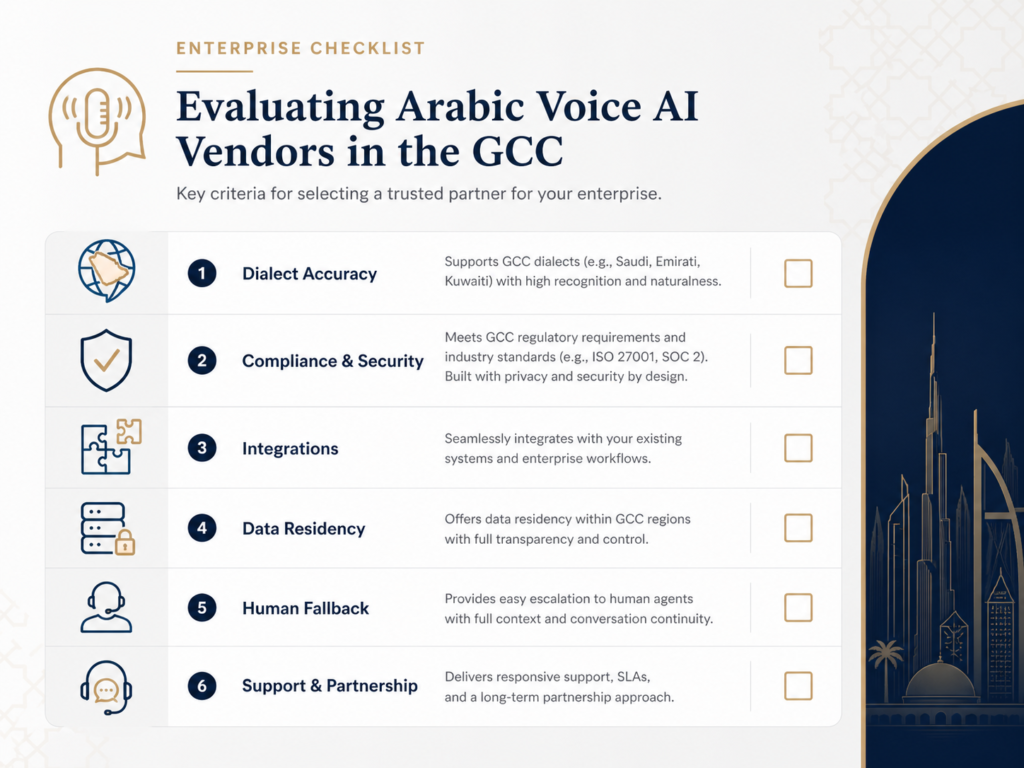
GCC Vendor Checklist
Choose a vendor that can prove performance in real Gulf Arabic conversations, not just scripted English or MSA demos.
Look for.
Saudi, Emirati, Qatari, and Khaleeji dialect testing
Arabic-English code-switching support
CRM and contact-center integrations
Data residency options
Audit logs and access controls
Human fallback design
Arabic-speaking implementation support
Clear retention and deletion policies
For broader modernization, explore Mak It Solutions’ service portfolio and the IT support guide for Riyadh, Dubai, and Doha.
Questions to Ask Before Booking a Demo
Ask practical questions before committing:
Which Gulf dialects have been tested?
Can we test anonymized local call samples?
Where are recordings and transcripts stored?
Can supervisors review and correct transcripts?
How does the system escalate to humans?
What happens when the AI is uncertain?
Can the vendor support our compliance and security review?
Common Mistakes GCC Teams Should Avoid
Do not buy based on English demos. Do not assume MSA support means Gulf Arabic accuracy. Do not skip compliance review. Do not launch without fallback paths.
Most importantly, do not remove the human touch from emotionally sensitive calls. A frustrated customer should always have a clear path to a real person.
Concluding Remarks
Arabic call center voice AI can help GCC businesses reduce wait times, improve QA, and serve Arabic-speaking customers with more care.
The best results come when teams design for Gulf dialects, compliance, data residency, customer experience, and human fallback from the beginning. To build a practical roadmap for Saudi, UAE, or Qatar operations, contact Mak It Solutions and request a custom GCC voice AI strategy across cloud, integrations, compliance, and customer experience.
FAQs
Q : Is Arabic call center voice AI suitable for Saudi banks and fintech companies?
A : Yes, but it should be designed around Saudi regulatory expectations from the start. A Riyadh fintech or Saudi bank should evaluate encryption, access controls, audit trails, retention policies, and confidentiality requirements before using Arabic call center voice AI for sensitive workflows.
Q : Can UAE call centers use Arabic voice AI with English code-switching?
A : Yes. In Dubai and Abu Dhabi, many customers naturally switch between Arabic and English during support calls. UAE teams should test real local speech patterns and review relevant data protection obligations before storing recordings, transcripts, or customer identifiers.
Q : Does Arabic voice AI support Qatari Arabic for Doha-based service teams?
A : It can, but Qatari Arabic should be tested separately. Doha banks, clinics, government services, and logistics teams should run pilots using local names, phrases, neighborhoods, and Arabic-English switching before expanding.
Q : What industries in the GCC benefit most from Arabic AI voice agents?
A : Banking, fintech, telecom, healthcare, government services, logistics, and e-commerce often benefit most because they handle high call volumes and repeatable service workflows. Regulated sectors need stronger controls for compliance, data residency, and human escalation.
Q : How accurate is Arabic speech analytics for Khaleeji customer calls?
A : Accuracy depends on dialect coverage, training data, audio quality, and code-switching support. GCC teams should test the platform with real Saudi, Emirati, Qatari, and Khaleeji call samples before choosing a vendor.