


Best IT Support Company in Riyadh, Dubai & Doha
Best IT Support Company in Riyadh, Dubai & Doha

Best IT Support Company in Riyadh, Dubai & Doha
Finding the right IT support company in Riyadh, Dubai, or Doha is not just about who can fix laptops fastest. GCC businesses usually need a partner that can keep users productive, respond quickly onsite when needed, communicate clearly in Arabic and English, and work within local compliance and data-handling expectations.
In practical terms, the best IT support company for a GCC business is one that combines fast helpdesk support, proactive monitoring, security discipline, and real familiarity with how companies operate in Saudi Arabia, the UAE, and Qatar. That mix matters more than flashy sales language.
Why GCC Businesses Choose IT Support Providers Differently
A company in Riyadh, Dubai, Abu Dhabi, or Doha often evaluates vendors through a wider lens than pure technical capability. Response speed matters, of course. So do stability, reporting, and day-to-day support quality.
But in the GCC, buyers also pay attention to things like.
Arabic-friendly communication
Onsite availability by city
Experience with regulated sectors
Confidence around data handling
Clear service levels and escalation paths
A provider’s ability to support both leadership and end users
That is why two providers can look similar on paper but perform very differently once the contract starts.
What an IT Support Company Actually Does
A modern IT support company usually covers far more than occasional troubleshooting. For most GCC businesses, support now includes a mix of reactive help and proactive management.
Core services most businesses expect
A strong provider will usually offer.
Helpdesk support for daily user issues
Device setup and user onboarding
Network monitoring and maintenance
Cloud administration
Backup and recovery support
Endpoint security management
Software patching and updates
Incident escalation for critical outages
Reporting and account management
For SMEs, this creates consistency. For larger companies, it reduces operational noise and helps internal teams focus on higher-value work.
Break-fix support vs IT AMC vs managed IT services
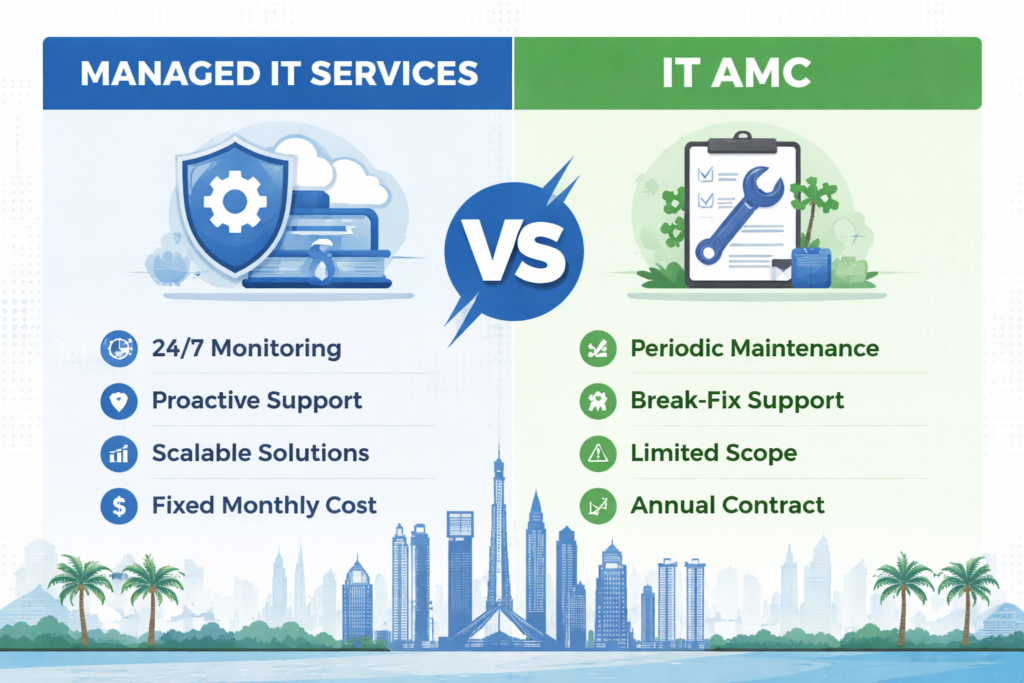
These models are often treated as if they are interchangeable. They are not.
| Support Model | How It Works | Best For |
|---|---|---|
| Break-fix | Problems are handled after they happen | Very small businesses with minimal IT needs |
| IT AMC | Scheduled maintenance with limited support scope | Companies that want basic upkeep |
| Managed IT Services | Ongoing monitoring, prevention, security, and SLA-backed support | Growing SMEs and multi-branch businesses |
For many companies in Riyadh, Dubai, and Doha, managed services are the safer long-term option because they reduce surprise downtime and improve accountability.
Why city-level presence matters
City-specific support still carries weight in GCC procurement. A buyer in Riyadh wants to know the provider can reach the site quickly. A Dubai business may need support that understands fast-moving commercial environments and cross-border operations. A Doha company may value tighter control, predictable processes, and stronger confidence around regulated workflows.
Local relevance often builds trust before technical discussions are even finished.
Why Businesses Search by Riyadh, Dubai, Abu Dhabi, or Doha
This is not only about SEO. It reflects how real buying decisions happen.
A company looking for an IT support company in Riyadh may care about Arabic communication, Saudi data expectations, and smoother stakeholder handling. A Dubai or Abu Dhabi business may care more about scalability, responsiveness, and support maturity for finance, retail, or digital businesses. In Doha, buyers often look for stability, controlled service delivery, and reassurance that the provider understands structured operating environments.
That is why city-based pages and city-based proof points often convert better than one generic regional page.
How to Evaluate the Best IT Support Company
The shortlist should not be based on price alone. A better approach is to judge providers on how they will actually support the business once day-to-day demands begin.
Check SLAs properly
Do not stop at “fast support” claims. Ask for specifics.
First-response time
Resolution targets
After-hours availability
Emergency onsite support
Escalation process for major incidents
A serious provider should be able to explain this without sounding vague.
Look for industry fit
Sector familiarity can save time and reduce mistakes.
For example.
A fintech startup in Riyadh may need stronger controls and cleaner audit discipline
A Dubai e-commerce brand may prioritize uptime during campaigns and integrations
A Doha logistics company may need reliable branch connectivity and cloud visibility
A government-linked project may require tighter process control and reporting discipline
In practice, industry fit often shows up in how the provider asks questions during discovery.
Test whether the provider can scale with you
A provider may support 20 users well and still struggle at 80, 150, or across multiple branches.
Look for signs of maturity such as.
Structured onboarding
Monitoring tools
Monthly reporting
Security processes
Cloud support capability
Clear documentation
Account management discipline
Growth exposes weak processes very quickly.
GCC Compliance and Trust Signals to Check
Businesses in Saudi Arabia, the UAE, and Qatar increasingly expect their IT partners to understand local trust signals, especially when support work touches user accounts, endpoints, backups, cloud workloads, or personal data.
Saudi Arabia
Saudi buyers often pay attention to.
PDPL awareness
Careful handling of personal data
Disciplined access and storage practices
Confidence around regulated-sector expectations
This matters not only for large enterprises. SMEs in e-commerce, health, logistics, and professional services are also becoming more aware of how routine support work can involve sensitive business and user data.
UAE
In the UAE, trust often comes from a provider’s understanding of.
Telecom and digital operating environments
Bilingual stakeholder communication
Enterprise-grade support expectations
More structured service delivery for finance, retail, and multi-location businesses
For Dubai and Abu Dhabi buyers, operational maturity often matters as much as technical depth.
Qatar
For Doha-based businesses, especially those tied to finance or regulated sectors, strong trust signals include:
Secure support workflows
Controlled change management
Clear reporting
Reliable escalation procedures
Better handling of sensitive workloads
A provider that answers with process rather than generic promises usually stands out.
What Makes an IT Support Company Better for Arabic-Speaking Teams
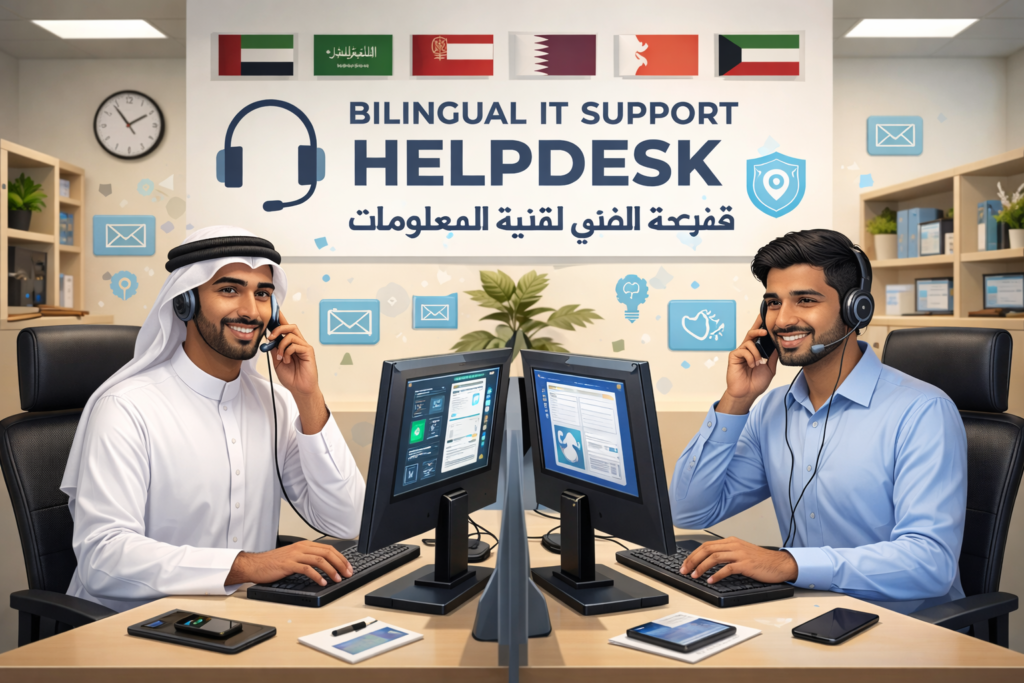
For many GCC businesses, bilingual support is not a bonus. It is part of service quality.
Bilingual communication reduces friction
Arabic-English support can improve.
User onboarding
Ticket updates
Approval workflows
Executive summaries
Vendor coordination
Monthly service reviews
This becomes especially useful when operational teams work mostly in English while leadership or admin teams prefer Arabic clarity.
English-first pages still need regional trust cues
An English website can still perform well in the GCC. But it usually works better when it includes.
City-specific references
Straightforward FAQs
Compliance awareness
Faster-response messaging
Proof of regional service fit
Language is often a trust signal, not just a content format.
Localized onboarding improves retention
A provider that adapts reporting, communication, and onboarding to how your team actually works is usually easier to retain. That is especially true when companies are growing quickly and need support that stays organized under pressure.
What Affects IT Support Pricing in Saudi Arabia, UAE, and Qatar
Pricing can vary widely, and the cheapest offer is not always the best deal.
Main cost factors
Most support contracts are shaped by.
Number of users
Number of devices
Branch count
Support hours
Required SLA speed
Security tooling
Backup scope
Cloud complexity
Onsite support needs
The wider the environment, the more structured the service usually needs to be.
IT AMC vs managed services on cost
An IT AMC may look more affordable at first. But managed services often create better value over time because they include proactive monitoring, patching, prevention, and clearer service accountability.
For growing businesses, lower upfront pricing can easily turn into higher long-term cost if support quality is weak.
Why the cheapest provider can be the riskiest
Low-cost support often leads to problems like.
Slow escalation
Weak documentation
Missed updates
Inconsistent reporting
Security gaps
Poor audit readiness
Limited ownership during outages
From a business point of view, that risk is usually more expensive than paying for a better-structured service model from the start.
Best Practices for a High-Converting GCC IT Support Page
If you are building or improving a service page for an IT support company, the goal is not just traffic. It is qualified trust.
Use city-specific proof
Create tailored sections for.
Riyadh
Dubai
Abu Dhabi
Doha
Each city page should reflect local priorities, service expectations, and buyer concerns rather than repeating the same generic copy.
Show proof that matters
The strongest trust builders are usually.
Testimonials
Response-time commitments
Service scope clarity
Industry examples
Compliance awareness
Simple FAQs
Clear CTAs
Vague “we deliver excellence” messaging rarely helps.
Final Takeaway
The best IT support company for a GCC business is not automatically the biggest provider or the lowest-cost one. It is the company that fits your city, your team structure, your language needs, your support expectations, and your operational risk profile.
If your business is comparing providers in Riyadh, Dubai, Abu Dhabi, or Doha, focus first on responsiveness, service maturity, bilingual usability, and confidence around local business expectations. That is usually where the real difference shows up.( Click Here’s )
FAQs
Q : Is an IT support company better than hiring an internal IT team for SMEs?
A : For many SMEs, yes. An external provider can deliver helpdesk support, monitoring, patching, and vendor coordination without the full cost of building a complete in-house team. A hybrid model can also work well when the company wants internal oversight with outsourced day-to-day support.
Q : What should Dubai businesses look for in a bilingual IT support provider?
A : They should look for more than just Arabic and English speaking ability. The provider should be able to manage bilingual onboarding, ticket communication, issue summaries, and stakeholder updates smoothly. Strong SLAs and support maturity are just as important.
Q : Are managed IT services different from a standard IT AMC?
A : Yes. IT AMC is usually maintenance-focused, while managed IT services are broader and more proactive. Managed services typically include monitoring, patching, reporting, security routines, and clearer accountability.
Q : How can a Doha business tell whether a provider understands regulated environments?
A : Ask practical questions about access control, incident escalation, change management, reporting, and support for sensitive systems. Providers with real experience usually explain process clearly instead of relying on vague claims.
Q : Do Saudi businesses need PDPL-aware IT support vendors?
A : In many cases, yes. Routine support work can involve personal data through user accounts, devices, backups, and helpdesk requests. That makes disciplined data handling an important part of day-to-day service quality.