



AI Data Leakage Prevention Guide 2026
AI data leakage prevention is now a core security priority for enterprises using GenAI, copilots, RAG systems, SaaS AI features, and AI agents. Sensitive data can move through prompts, uploads, APIs, plugins, model outputs, and automated workflows faster than traditional DLP programs were built to catch.
In simple terms, AI data leakage prevention protects company, customer, regulated, and intellectual property data from being exposed through AI tools. Enterprises reduce AI data leaks by combining AI-aware DLP, approved-tool governance, access controls, monitoring, employee training, and compliance mapping.
For US, UK, Germany, and EU teams, the goal is not to stop AI adoption. The goal is to make approved AI safer, more useful, and easier to govern.
IBM’s 2025 Cost of a Data Breach report lists the global average breach cost at USD 4.4 million, down 9% from the previous year, while also highlighting the security gap created by rapid AI adoption without proper oversight.
What Is AI Data Leakage Prevention?
AI data leakage prevention is the practice of stopping sensitive information from being exposed through AI systems, including prompts, model responses, uploaded files, APIs, copilots, plugins, AI agents, and RAG pipelines.
It extends traditional data loss prevention into AI-specific workflows.
Traditional DLP usually focuses on email, endpoints, cloud storage, file transfers, and network activity. AI DLP adds new channels, such as.
Employee prompts
AI-generated responses
Uploaded documents
Embeddings and vector databases
RAG retrieval results
Copilot-connected enterprise files
AI agent tool calls
Third-party AI integrations
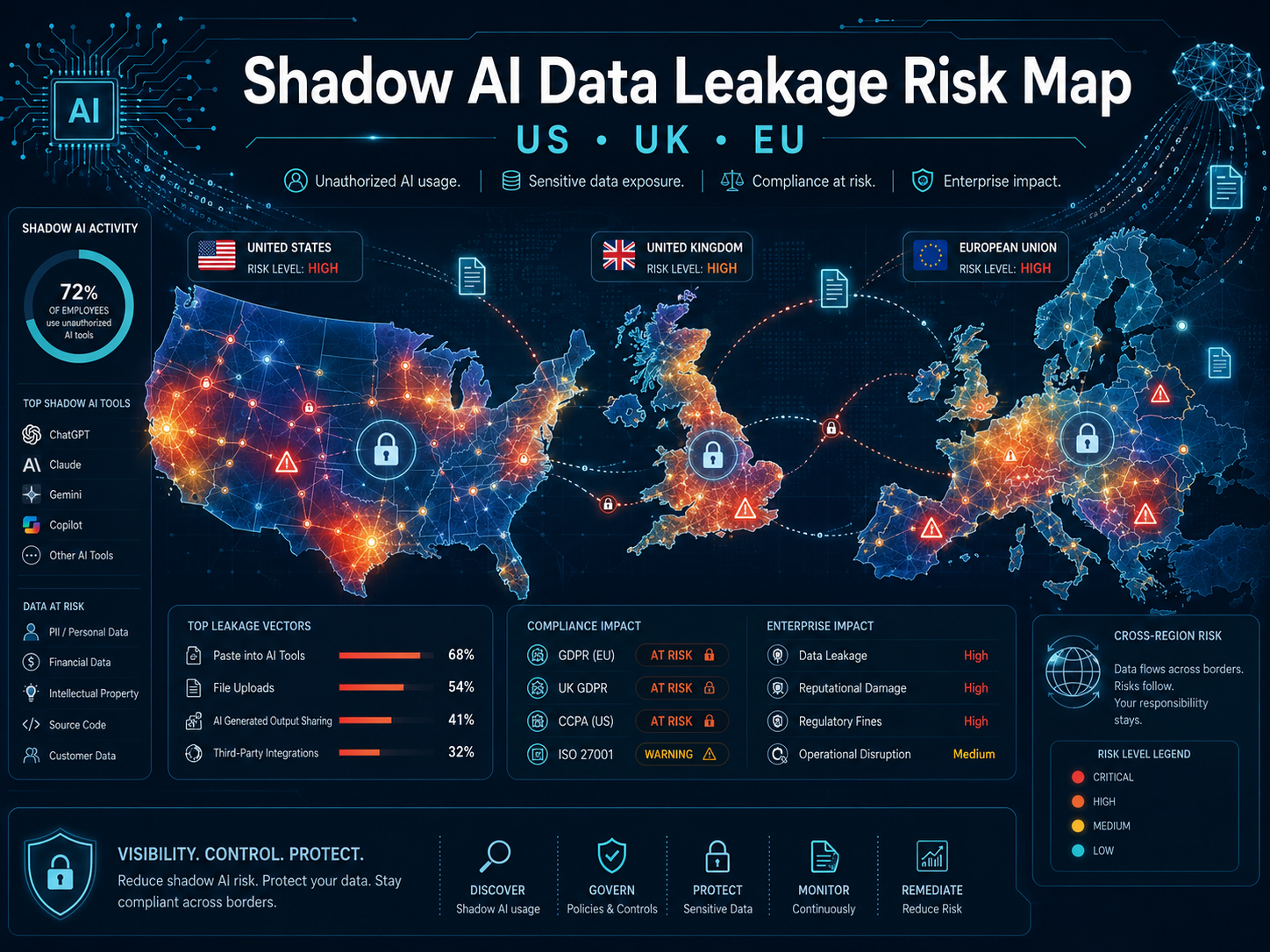
A traditional DLP rule may catch a credit card number in an email. AI DLP must also catch that same number when it is pasted into Chat GPT, uploaded into Gemini, sent through an API, retrieved by a RAG assistant, or repeated in a model response.
Why AI Apps Create New Data Exposure Risks
AI apps create new leakage risks because they make it easy for employees and systems to submit sensitive information into tools that may not have the right access, retention, monitoring, or compliance controls.
The risk grows when AI becomes part of everyday work.
A developer in San Francisco may paste proprietary source code into a coding assistant. A legal team in London may upload contracts for review. A finance team in Frankfurt may test payment data inside a spreadsheet copilot. A product team in Berlin may query a RAG assistant connected to internal documentation.
That activity may feel harmless, but it can involve HIPAA, PCI DSS, SOC 2, ISO 27001, GDPR, DSGVO, UK GDPR, FCA, FINRA, SEC, or HHS obligations depending on the data type, industry, and location.
Common AI Data Leakage Paths
The most common AI leakage paths include.
Employees pasting customer records into public AI tools
Source code uploaded for debugging
Credentials, API keys, or OAuth tokens shared in prompts
Overshared files exposed through copilots
RAG systems retrieving documents beyond a user’s permission level
Browser extensions capturing sensitive workflow data
AI agents calling external tools without strict guardrails
Model outputs revealing confidential snippets from retrieved content
Shadow AI makes the problem harder. It is not limited to big-name tools like Chat GPT, Gemini, or Copilot. Niche SaaS AI features, browser extensions, meeting bots, developer plugins, and unmanaged automation tools can also create leakage points.
Practical AI Data Leakage Prevention Controls
Practical AI data leakage prevention controls include prompt inspection, sensitive data detection, output filtering, approved-tool governance, access control, logging, alerting, and automated blocking.
The simplest model is.
Inspect inputs before data reaches the model.
Control access before retrieval happens.
Monitor outputs before content reaches the user.
Log activity for investigation and audit readiness.
Block or quarantine high-risk actions.
Prompt DLP and Sensitive Data Detection
Prompt DLP scans user inputs before they reach an AI model. It should detect PII, PHI, PCI data, credentials, secrets, source code, financial records, contracts, and confidential business content.
For example, a New York insurance company might block Social Security numbers and claim notes from public tools, while allowing anonymized summaries in an approved enterprise AI workspace.
In practice, prompt controls work best when they are specific. Blocking everything frustrates users. Allowing everything creates risk. The better approach is to classify data, define approved tools, and apply policy based on user role, data type, tool trust level, and business context.
AI Output Filtering and Response Monitoring
Output filtering checks whether model responses contain confidential, regulated, or unauthorized information.
This matters in RAG systems, customer support copilots, analytics assistants, and developer tools. A London fintech using Open Banking workflows should monitor whether a copilot returns customer account details to unauthorized staff. A Munich manufacturer should ensure an AI assistant does not expose restricted design files to a supplier user.
Output monitoring is especially important when AI tools generate summaries from internal sources. Even when a user never sees the original file, the model may still reveal sensitive details from it.
Audit Logging, Alerting, and Incident Response
AI security logs should answer five basic questions.
Who used the AI tool?
What data was submitted?
What did the model return?
Which system, file, or API was accessed?
What policy decision occurred?
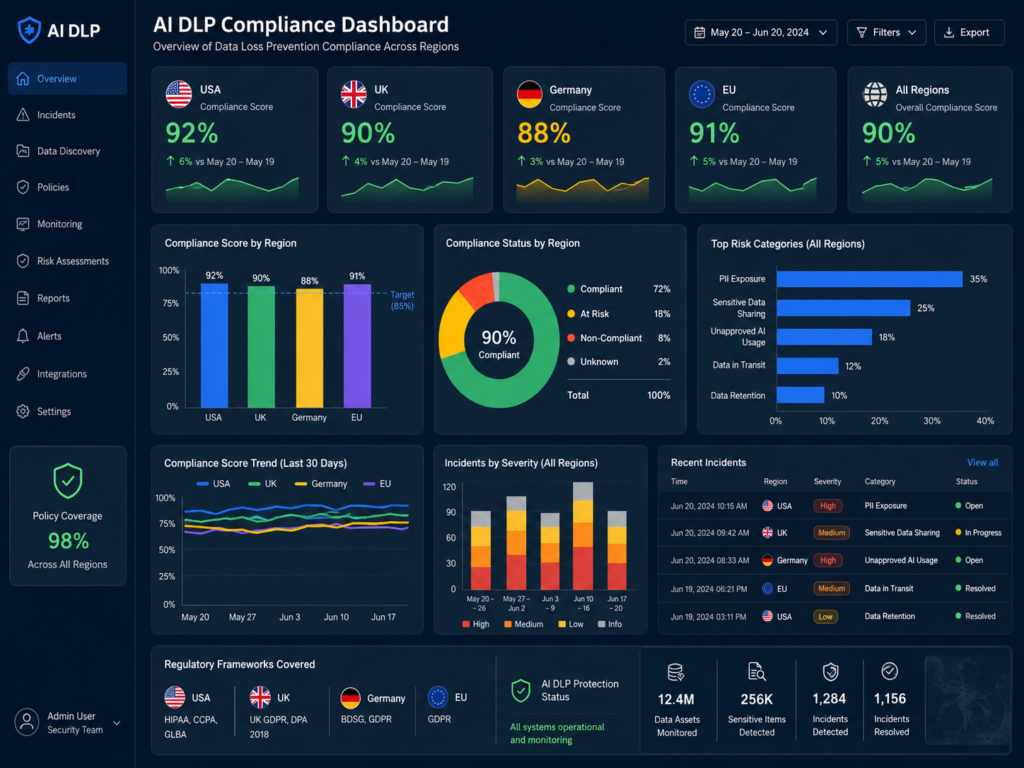
High-risk events should route into SIEM, CASB, SSE, SaaS security, or incident-response workflows. Logging also supports audit readiness for SOC 2, ISO 27001, GDPR, UK GDPR, HIPAA, and PCI DSS programs.
AI Governance, Compliance, and Regional Requirements
Compliance-focused AI data leakage prevention maps AI usage to data classification, access rules, consent, audit trails, and vendor risk controls.
This is not legal advice. Security and compliance teams should confirm obligations with qualified legal, privacy, and regulatory advisors.
USA.
US teams should treat AI data security as part of broader risk management.
HHS explains that the HIPAA Privacy Rule protects individually identifiable health information, including common identifiers such as names, addresses, birth dates, and Social Security numbers when linked to health information.
NIST’s AI Risk Management Framework helps organizations manage AI risks to individuals, organizations, and society, making it useful for AI governance programs.
For US healthcare, finance, SaaS, insurance, and enterprise software teams, AI DLP should be connected to data classification, approved AI tools, vendor reviews, access control, and audit evidence.
UK.
UK organizations should align AI usage with UK GDPR principles such as lawful basis, transparency, minimization, access control, and security.
For London and Manchester teams in fintech, healthcare, public-sector technology, and SaaS, AI DLP policies should clearly define which data can be used in AI tools, which tools are approved, and how sensitive outputs are monitored.
Open Banking, NHS data governance, FCA expectations, and internal risk policies should be considered early instead of added after rollout.
Germany and EU.
Germany and EU organizations should connect AI DLP with GDPR/DSGVO, BaFin expectations, BSI guidance, EDPB positions, CNIL scrutiny, and data residency decisions.
The EU AI Act entered into force on August 1, 2024, and is scheduled to become fully applicable on August 2, 2026, with some exceptions and phased dates.
For Berlin, Munich, Frankfurt, Hamburg, Amsterdam, Paris, Dublin, and Zurich operations, sensitive AI data should be classified before it is sent into AWS, Azure, GCP, SaaS copilots, RAG systems, or external LLM APIs.
RAG, Copilot, and AI Agent Data Leakage Prevention
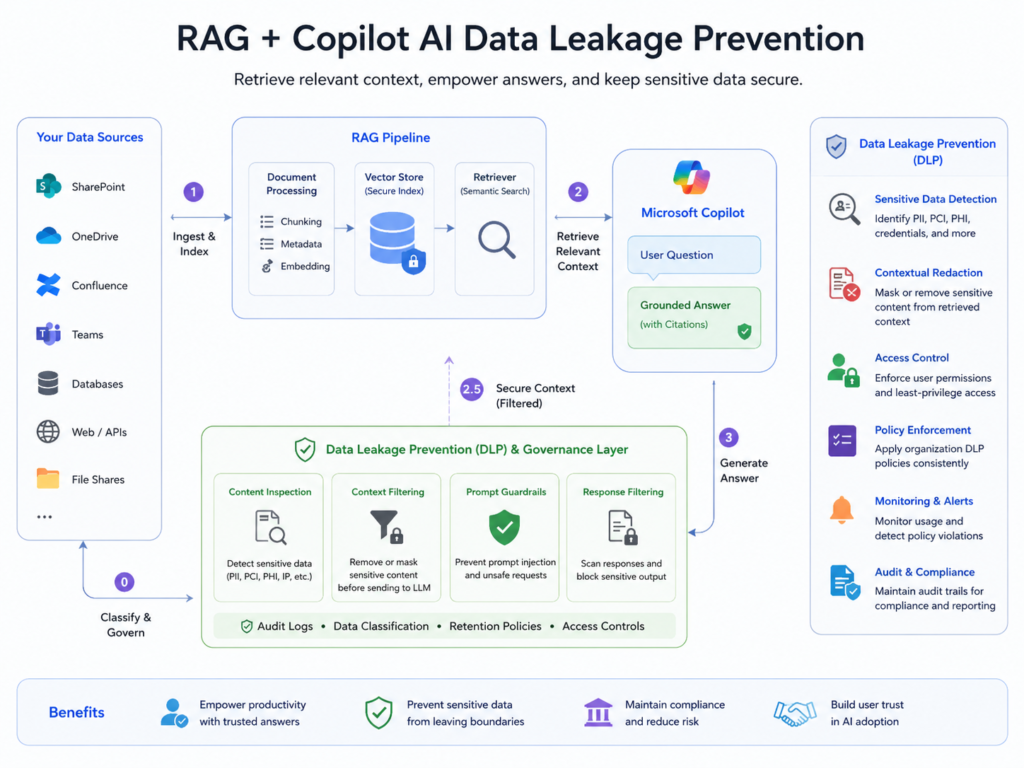
RAG, copilots, and AI agents need stronger controls because they can access enterprise knowledge, SaaS data, cloud systems, and live tools.
AI data leakage prevention should enforce permissions at the source, not only at the chatbot interface.
RAG Data Leakage Prevention
RAG systems should respect document permissions, tenant boundaries, department roles, and source-level access.
A sales user should not retrieve HR investigations. A contractor should not retrieve customer contracts. A support assistant should not expose engineering secrets.
Useful RAG controls include.
Source-level access enforcement
Document classification before indexing
Tenant and role boundaries
Retrieval filtering
Sensitive output checks
Audit logs for retrieved sources
Review processes for high-risk knowledge bases
For secure architecture planning, see Mak It Solutions’ guide on Domain LLM vs RAG.
Copilot Data Leakage Prevention
Copilot leakage often comes from overshared files, stale groups, weak sensitivity labels, and poor permission hygiene.
Microsoft Purview and similar tools can help, but the real work is usually access cleanup. Teams should review sharing links, legacy groups, sensitivity labels, retention rules, and audit logs before broad rollout.
A copilot does not magically create good governance. It reveals the governance problems that were already there.
AI Agent Security
AI agents add another risk layer because they can act across SaaS, email, ticketing, cloud, CRM, analytics, and developer systems.
AI agents should use.
Scoped OAuth permissions
Allow listed tools
Sandboxed execution
Approval checkpoints
Rate limits
Outbound data controls
Human review for sensitive actions
Clear logs for every tool call
For deeper planning, see Mak It Solutions’ article on AI agent identity security.
How to Build an AI Data Leakage Prevention Program
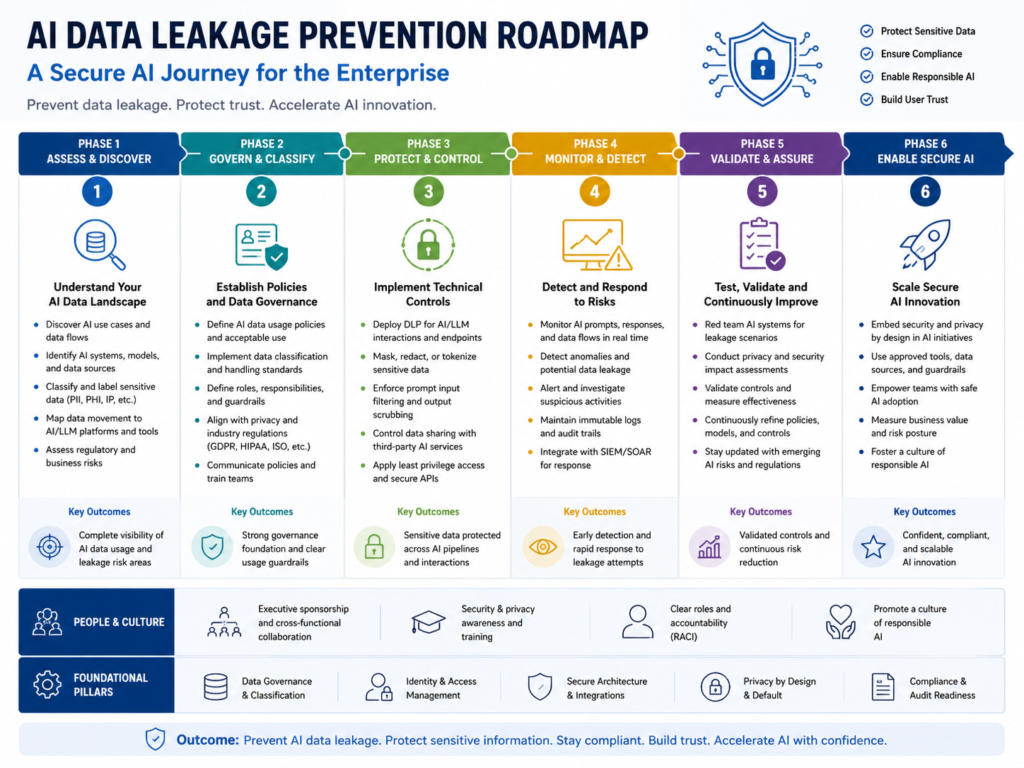
Companies can prevent employees from leaking sensitive data through AI tools by discovering AI usage, classifying data, enforcing AI-aware DLP policies, and training users with monitored exceptions.
The program should reduce risk without blocking useful AI adoption.
Discover Approved AI, Shadow AI, and High-Risk Workflows
Start by mapping AI tools across browsers, SaaS platforms, endpoints, cloud accounts, developer workflows, and procurement records.
Include Chat GPT, Gemini, Copilot, SaaS AI features, browser extensions, internal RAG apps, code assistants, meeting bots, and AI APIs.
Do not rely only on procurement data. Shadow AI often appears in browser activity, employee extensions, developer tools, and free SaaS trials.
Classify Sensitive Data Across SaaS, Cloud, Endpoints, and AI Apps
Classify PII, PHI, PCI data, credentials, source code, contracts, financial data, customer records, and confidential IP.
Classification should connect to policy enforcement. A spreadsheet of sensitive data categories is not enough if the controls do not recognize those categories inside prompts, uploads, outputs, and APIs.
Enforce AI-Aware DLP Policies
Apply controls across prompt entry, file uploads, model outputs, API requests, embeddings, retrieval results, and AI agent actions.
For web and app teams modernizing secure interfaces, Mak It Solutions’ front-end development services and services overview can support secure user experience design.
Train Employees and Monitor Exceptions
Training should explain what data is blocked, which tools are approved, and how employees can request exceptions.
Good training is practical. Show employees examples of risky prompts, safer alternatives, approved workflows, and escalation paths.
For teams in Seattle, London, Dublin, Berlin, and Paris, monitored exceptions can keep work moving without forcing employees into unsafe workarounds.
Choosing the Right Generative AI DLP Approach
Traditional DLP is still useful for email, endpoints, cloud storage, and network traffic. Generative AI DLP is needed when risk sits inside prompts, RAG retrieval, model responses, plugins, and agents.
Most enterprises need both.
Traditional DLP vs. Generative AI DLP
| Area | Traditional DLP | Generative AI DLP |
|---|---|---|
| Main focus | Email, files, endpoints, cloud storage | Prompts, uploads, outputs, RAG, agents |
| Common risk | File sharing or data transfer | Sensitive data submitted to or returned by AI |
| Control style | Detect, block, quarantine | Inspect, filter, govern, monitor |
| Best fit | Known data channels | AI apps, copilots, APIs, and retrieval systems |
What to Look for in AI App Data Security Controls
Strong AI app data security controls should include.
AI app discovery
Prompt inspection
Sensitive data detection
Output monitoring
SaaS and browser coverage
API visibility
SIEM forwarding
Policy simulation
Incident workflows
Regional data controls
RAG and copilot permission awareness
Vendor categories include enterprise DLP platforms, SSE/CASB providers, AI firewall tools, SaaS security platforms, code and endpoint telemetry tools, and AI governance suites.
Microsoft Purview, Zscaler, Cyberhaven, Lakera, F5, Qualys, Strac, and IBM represent different parts of that ecosystem.
Concluding Remarks
AI data leakage prevention helps organizations adopt GenAI safely by protecting sensitive data before, during, and after AI interactions.
Protect prompts before submission. Enforce access during retrieval. Monitor outputs after generation. Log activity for review. That lifecycle view is what separates practical AI security from policy documents.
Mak It Solutions helps teams connect AI strategy with secure cloud, SaaS, mobile, data analytics, and governance architecture. Explore the Mak It Solutions services or contact the team to scope a practical AI DLP roadmap for US, UK, Germany, and EU operations.
Key Takeaways
AI data leakage prevention extends traditional DLP into prompts, outputs, uploads, APIs, RAG, copilots, and agents.
The highest-risk data includes PII, PHI, PCI data, credentials, source code, contracts, customer records, and confidential IP.
US, UK, Germany, and EU teams should map AI usage to HIPAA, PCI DSS, UK GDPR, GDPR/DSGVO, NIST AI RMF, and the EU AI Act.
RAG and copilot security depend heavily on permissions hygiene, source-level access control, and audit logging.
A practical AI DLP program starts with discovery, classification, policy enforcement, training, and monitored exceptions.
Vendor choice should match the architecture: browsers, SaaS apps, endpoints, APIs, Microsoft 365, RAG systems, and AI agents.
FAQs
Q : Can employees safely use Chat GPT or Gemini with company data?
A : Yes, but only when the company defines what data is allowed, which tools are approved, and what controls apply. Employees should not paste regulated data, credentials, source code, contracts, customer records, or confidential IP into public AI tools unless the organization has reviewed retention, training, access, and compliance terms.
Q : What types of sensitive data should AI DLP policies block?
A : AI DLP policies should block or restrict PII, PHI, payment card data, passwords, API keys, OAuth tokens, customer records, payroll data, financial reports, legal contracts, source code, unreleased product plans, and regulated industry data. Prompts, uploaded files, embeddings, and generated outputs should all be treated as possible exposure points.
Q : Does Microsoft Copilot increase data leakage risk?
A : Microsoft Copilot can increase leakage risk if Microsoft 365 permissions are too broad, files are overshared, sensitivity labels are missing, or legacy groups still have access to confidential content. The main issue is usually permission hygiene, not the copilot alone.
Q : How does AI data leakage prevention support GDPR and UK GDPR compliance?
A : AI data leakage prevention supports GDPR and UK GDPR by helping enforce data minimization, purpose limitation, access control, transparency, security, vendor review, and auditability. It helps organizations show that personal data is not freely pasted into unmanaged AI tools or exposed through RAG systems, copilots, or agents without appropriate controls.
Q : What should security teams monitor in generative AI app usage?
A : Security teams should monitor approved and unapproved AI apps, prompt content, file uploads, sensitive data matches, model outputs, API activity, plugin usage, OAuth grants, RAG retrieval events, blocked actions, user exceptions, and unusual data movement. High-risk events should feed into SIEM, CASB, SSE, or incident-response workflows.