
GCC Cloud Strategy 2026: Saudi to UAE Guide
GCC Cloud Strategy 2026: Saudi to UAE Guide

GCC Cloud Strategy 2026: Saudi to UAE Guide
GCC cloud strategy 2026 is no longer just an IT migration plan. For enterprises in Saudi Arabia, the UAE, and Qatar, it is now a board-level decision about data residency, sovereign cloud, AI readiness, cybersecurity, and regulatory confidence.
A strong GCC cloud strategy 2026 helps businesses decide which workloads should run in public cloud, which need sovereign or local control, and where hybrid cloud makes more sense. The best approach is practical: classify your data, map compliance requirements, design for AI, and build resilience before moving critical systems.
Why GCC Cloud Strategy Must Change in 2026
GCC enterprises are past the basic question of “Should we move to cloud?”
In Riyadh, Dubai, Abu Dhabi, Doha, and Jeddah, leadership teams are asking sharper questions.
Where should our regulated data live?
Which cloud model fits our industry?
Can our infrastructure support AI safely?
What happens if a provider region, network, or service fails?
Are we ready for audit, data residency, and vendor exit requirements?
This shift matters because cloud is now tied directly to digital growth, customer experience, and risk control. AWS has announced plans for a Saudi Arabia cloud region in 2026 with more than $5.3 billion in investment, while Google Cloud’s Doha region has strengthened Qatar’s cloud ecosystem.
For GCC companies, the right cloud strategy must be business-led, regulator-aware, and flexible enough to support AI, Arabic-first products, and regional expansion.
What Is GCC Cloud Strategy 2026?
A GCC cloud strategy 2026 is a structured plan for using cloud infrastructure across Saudi Arabia, the UAE, Qatar, and wider Gulf markets.
It covers where workloads run, how sensitive data is protected, which providers are suitable, and how compliance, security, cost, and performance are managed.
Cloud Strategy Is Now a Board-Level GCC Decision
Cloud is no longer only about servers, storage, or cheaper hosting.
It now affects.
Risk management
Regulatory approval
AI adoption
Customer data protection
Business continuity
Audit readiness
Digital product delivery
That means CIOs, CFOs, compliance teams, security leaders, and boards need one shared governance framework before selecting cloud platforms.
For hands-on implementation, GCC firms can connect cloud planning with custom software development services so architecture, applications, APIs, and compliance controls move together.
How Saudi, UAE, and Qatar Cloud Needs Differ
Each GCC market has its own cloud priorities.
Saudi organizations often focus on SAMA, NCA, NDMO, DGA, SDAIA, Cloud First priorities, and Vision 2030 digital transformation.
UAE firms in Dubai and Abu Dhabi usually consider TDRA, CBUAE, ADGM, DIFC, Dubai Digital, UAE Pass, and sector-specific outsourcing expectations.
Qatar businesses look closely at QCB, MCIT Qatar, Qatar Digital Government, Qatar Digital ID, and Doha-based cloud options.
The mistake is treating GCC cloud as one generic market. In practice, a Riyadh fintech, Abu Dhabi government supplier, and Doha healthcare platform may need three different workload placement models.
Why Sovereign Cloud and AI Changed the Conversation
Sovereign cloud GCC planning has become more important because AI uses sensitive inputs: prompts, models, embeddings, inference logs, customer records, Arabic language data, and analytics pipelines.
For regulated cloud workloads, sovereignty is not just a political topic. It is operational risk control.
Businesses need to know who controls infrastructure, where data is processed, how logs are stored, and whether AI workloads can be audited later.
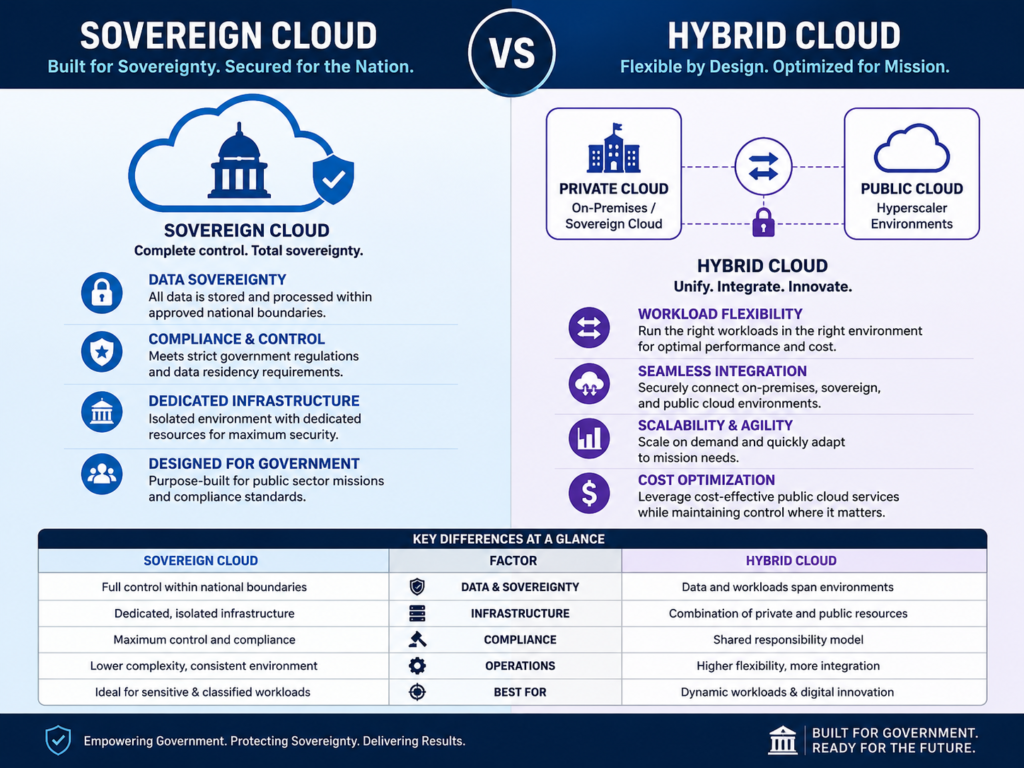
Sovereign Cloud vs Public Cloud vs Hybrid Cloud in GCC
Cloud strategy becomes clearer when each workload is matched to the right model.
When Public Cloud Works for GCC Enterprises
Public cloud works well for workloads that need scale, speed, and flexible capacity.
Good examples include.
Mobile apps
E-commerce platforms
Customer portals
Marketing websites
Analytics dashboards
Non-sensitive collaboration tools
Bilingual Arabic-English user experiences
A Dubai retail brand scaling customer-facing web and mobile platforms, for example, may benefit from elastic public cloud and web development services.
Public cloud is often the fastest path to innovation, but it should not be the default home for every dataset.
When Sovereign Cloud Is Better for Regulated Data
Sovereign cloud is more suitable when data control, location, access, and auditability are central to the business.
It is especially relevant for.
Banking
Fintech
Healthcare
Government
Critical infrastructure
Identity platforms
Sensitive citizen or customer data
In Saudi banking, SAMA’s cloud computing guidance expects member organizations to define and monitor controls for cloud services, including risk assessment and due diligence.
That does not mean every Saudi workload must automatically sit in a sovereign cloud. It means regulated organizations need documented decisions, clear controls, and risk-based workload placement.
Why Hybrid Cloud May Be the Safest 2026 Model
For many GCC enterprises, hybrid cloud is the most realistic model.
Hybrid cloud lets businesses keep sensitive workloads in-country, private, or tightly controlled environments while using public cloud for scale, analytics, customer apps, and innovation.
This works well for.
| Workload Type | Recommended Cloud Model |
|---|---|
| Public website or marketing platform | Public cloud |
| Customer mobile app | Public or hybrid cloud |
| Payment data | Sovereign, private, or tightly governed hybrid cloud |
| Healthcare records | Sovereign, private, or regulated hybrid cloud |
| AI experimentation with non-sensitive data | Public cloud with governance |
| AI using regulated customer data | Sovereign or controlled hybrid cloud |
| Disaster recovery | GCC-aware hybrid or multicloud design |
For a Riyadh fintech, Abu Dhabi public-sector vendor, or Doha healthcare provider, hybrid cloud can balance compliance, speed, and resilience.
Data Residency and Compliance Across Saudi, UAE, and Qatar
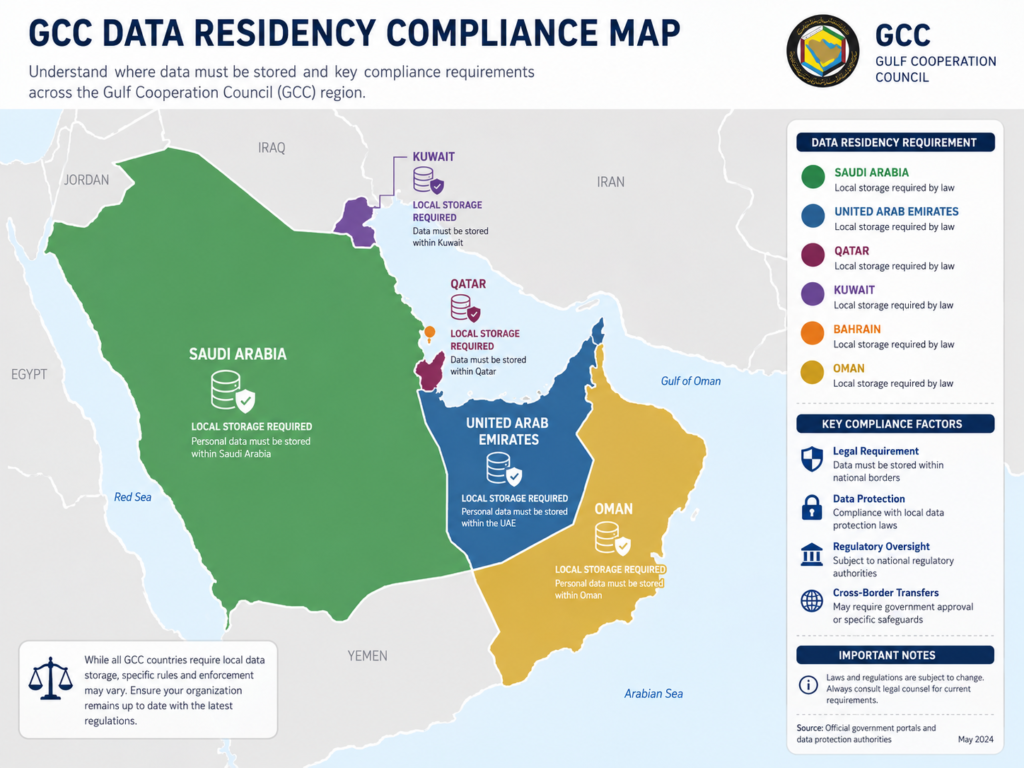
Cloud compliance in the GCC is not one checklist. It depends on the country, sector, workload, data type, outsourcing model, and customer base.
This section is a practical orientation, not legal advice. Regulated organizations should validate decisions with legal, compliance, and cybersecurity teams before migration.
Saudi Cloud Compliance Signals to Consider
Saudi cloud planning should consider SAMA, CST, NCA, NDMO, DGA, SDAIA, Saudi Cloud First Policy, and data classification requirements.
Saudi Arabia’s Cloud First Policy was designed to encourage government entities to consider cloud options when making IT investment decisions.
For Saudi enterprises, the practical starting point is simple.
Classify data before migration
Identify regulated systems
Review vendor risk
Confirm approval requirements
Keep audit trails
Plan incident response and disaster recovery
For Vision 2030-aligned businesses in Riyadh, Jeddah, Dammam, and NEOM-linked ecosystems, cloud readiness is also AI readiness.
UAE Cloud Compliance Signals to Consider
In the UAE, cloud decisions should align with TDRA, CBUAE, ADGM, DIFC, Dubai Digital, UAE Pass, and industry-specific cybersecurity expectations.
A Dubai e-commerce company may have more flexibility for public cloud customer experience workloads. An Abu Dhabi financial service or government supplier may need stronger controls around identity, outsourcing, hosting location, encryption, and monitoring.
The UAE cloud market is mature, but maturity does not remove governance work. It makes governance more important because companies have more provider and architecture choices.
Qatar Cloud Compliance Signals to Consider
Qatar-ready cloud migration plans should consider QCB, MCIT Qatar, Qatar Digital Government, Qatar Digital ID, and local cloud region options.
Google Cloud’s Doha region supports local cloud adoption and strengthens conversations around latency, modernization, and data residency.
Still, data residency alone is not a complete compliance strategy.
Qatar businesses also need.
Identity and access controls
Vendor due diligence
Encryption policies
Audit logs
Backup testing
Exit planning
Clear ownership between business, IT, and compliance teams.
How GCC Enterprises Should Design Workload Placement
The strongest GCC cloud strategies do not start with a provider shortlist. They start with workload classification.
Classify Workloads Before Choosing Cloud Providers
Before selecting AWS, Azure, Oracle, Google Cloud, sovereign providers, or local data centers, classify your data and systems.
A practical model can include.
Public
Internal
Confidential
Regulated
Critical
AI training data, payment information, health records, national identity data, and customer verification records should never be treated like ordinary marketing assets.
Once classification is clear, cloud placement becomes easier and less emotional.
Match Each Workload to the Right Cloud Model
Use each cloud model for what it does best.
Public cloud is useful for speed and scale. Sovereign cloud supports regulated and sensitive workloads. Private cloud gives stronger control. Hybrid cloud connects these models into one operating strategy.
For secure APIs, payment workflows, and fintech customer platforms, review API security guidance for GCC fintech.
Plan Disaster Recovery Inside the GCC
Cloud strategy should include regional resilience, not only migration.
A strong GCC workload placement plan should cover.
GCC-based failover
Backup location and frequency
Recovery time objectives
Recovery point objectives
Latency checks
Provider dependency reviews
Exit planning
Regular disaster recovery testing
Recent regional disruption concerns around Middle East cloud and AI infrastructure show why resilience deserves board-level attention, not just technical documentation.
AI Cloud Infrastructure and Sovereign AI in the GCC
AI is one of the biggest reasons GCC cloud strategy needs to mature before 2026.
Why AI Increases Cloud Sovereignty Pressure
AI introduces new data exposure points.
Sensitive information can appear in.
Prompts
Training datasets
Fine-tuning files
Embeddings
Vector databases
Model outputs
Inference logs
Analytics dashboards
Developer testing environments
For Arabic-first businesses, this matters even more. Customer conversations, identity records, financial behavior, health information, and government-service interactions may all include sensitive Arabic and bilingual data.
Sovereign AI infrastructure can reduce exposure when models and data need stricter regional control.

Saudi, UAE, and Qatar AI Cloud Opportunities
Riyadh, NEOM, Dubai, Abu Dhabi, and Doha are becoming important AI-cloud hubs.
Reuters has reported major AI and cloud investment activity across the Middle East, including AWS investment plans in Saudi Arabia and Microsoft-linked AI expansion in the UAE.
For GCC enterprises, the opportunity is clear: cloud infrastructure can support Arabic AI products, automation, analytics, and smarter customer platforms.
The risk is also clear: moving too fast without governance can create compliance, security, and vendor lock-in problems.
Arabic UX and Bilingual Cloud Applications
Cloud strategy should also support Arabic-first product delivery.
GCC applications often need.
Arabic-English workflows
RTL layouts
Local identity integrations
Nafath and Absher considerations in Saudi contexts
UAE Pass support in UAE services
Qatar Digital ID alignment for Qatar platforms
Local payment and notification flows
Low-latency user experiences
For product delivery and scalable architecture, explore backend development services.
Cloud Geopatriation and Multicloud Strategy in GCC
Cloud adoption is not always a one-way journey from on-premises to hyperscale public cloud.
What Cloud Geopatriation Means for GCC Companies
Cloud geopatriation means moving selected workloads back into GCC-based infrastructure for sovereignty, latency, legal, AI, or cost-control reasons.
It does not mean abandoning public cloud.
It means deciding which systems should stay close to the market, regulator, customer, or business operation.
How Multi cloud Reduces Vendor Lock-In
A multi cloud strategy can reduce dependency on one provider, but only when it is designed carefully.
GCC companies may compare AWS Bahrain and Saudi plans, Azure UAE, Oracle Riyadh, Google Cloud Doha, and regional providers.
For a deeper regional comparison, see Middle East cloud providers for KSA, UAE, and Qatar CIOs.
The goal is not to use every cloud. The goal is to avoid being trapped.
A practical multi cloud plan should include.
Portable architecture
Container strategy where useful
Clear data ownership
Documented exit plans
Consistent identity controls
Central monitoring
Cost governance
Security baselines across providers
When Repatriation Makes Business Sense
Cloud repatriation or geopatriation may make sense for.
Banking platforms
Healthcare systems
Government workloads
High-volume Arabic customer platforms
Logistics operations
AI systems using sensitive regional data
Workloads with strict latency or audit needs
From a business point of view, the question is not “cloud or no cloud?” The better question is: “Which cloud model gives us the right balance of control, speed, cost, and compliance?”
Building a 2026 GCC Cloud Roadmap
A strong GCC cloud roadmap should be simple enough for leadership to understand and detailed enough for technical teams to execute.
Start With Governance, Not Migration
Define ownership before moving systems.
Your governance model should answer:
Who approves workload migration?
Who owns data classification?
Who reviews vendor risk?
Who monitors compliance?
Who signs off AI use cases?
Who manages incident response?
Who controls cloud cost?
Without governance, migration becomes a technical project with business risk hidden inside it.
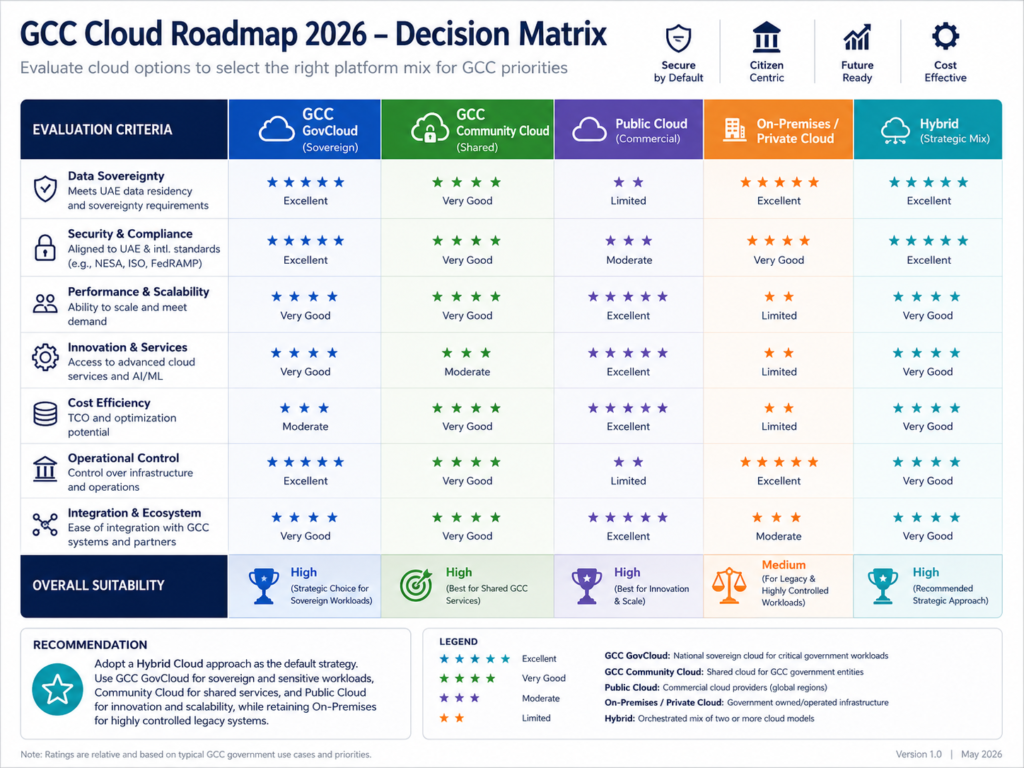
Create a Saudi-UAE-Qatar Decision Matrix
Build a decision matrix before selecting cloud providers.
Compare.
Data residency needs
Regulators involved
Workload sensitivity
Latency requirements
Cost expectations
Provider availability
AI readiness
Disaster recovery options
Local identity requirements
Exit complexity
This is especially useful for businesses operating across Riyadh, Dubai, Abu Dhabi, Doha, and Jeddah.
Define KPIs for Cloud Success
Cloud success should be measured beyond migration completion.
Useful KPIs include:
Cost optimization
Uptime
Application performance
Arabic UX speed
AI readiness
Audit readiness
Security incident response
Compliance confidence
Disaster recovery testing
Vendor exit readiness
For AI security planning, review AI model theft prevention guidance.
GCC Cloud Strategy 2026 Checklist
Before committing to a cloud roadmap, GCC enterprises should confirm:
Data is classified by sensitivity and regulation.
Workloads are mapped to public, private, sovereign, or hybrid cloud.
Saudi, UAE, and Qatar compliance signals are reviewed separately.
AI data flows are documented.
Identity and access controls are standardized.
Disaster recovery is tested, not only planned.
Vendor lock-in risks are documented.
Internal teams understand ownership and approval paths.
Arabic UX, RTL design, and local identity needs are included.
Cloud KPIs are tied to business outcomes.
Concluding Remarks
GCC cloud strategy 2026 should help your business move faster without losing control.
For Saudi, UAE, and Qatar enterprises, the winning model is rarely “put everything in public cloud.” A stronger approach is to classify workloads, protect regulated data, use sovereign or hybrid cloud where needed, design for AI governance, and build resilience across the region.
Mak It Solutions can help your team design a practical GCC cloud roadmap for Saudi Arabia, the UAE, and Qatar. Book a consultation, explore our technology services, or request a custom strategy for cloud, AI, compliance, and Arabic-first digital platforms. ( Click Here’s )
FAQs
Q : Does Saudi Arabia require cloud data to stay inside the Kingdom?
A : Not every workload automatically needs to stay inside Saudi Arabia. Regulated and sensitive workloads require careful review, especially for financial services, government, healthcare, and critical systems. Saudi organizations should classify data first, then decide whether in-Kingdom hosting, sovereign cloud, private cloud, or hybrid design is required.
Q : Is sovereign cloud required for UAE government or banking data?
A : It depends on the workload, regulator, data type, and outsourcing model. UAE government and financial workloads may need stronger controls because TDRA, CBUAE, ADGM, DIFC, and Dubai Digital expectations can affect cybersecurity, identity, hosting, and data handling. Sovereign cloud is not always mandatory, but it is often a safer architecture discussion for sensitive workloads.
Q : Which cloud model is best for Qatar regulated businesses?
A : Hybrid cloud is often a strong starting point for Qatar regulated businesses because it balances compliance, performance, and scalability. QCB-regulated financial services, healthcare platforms, and government suppliers in Doha should classify workloads before choosing public, private, or sovereign cloud. Local cloud availability helps, but governance, audit logs, identity controls, and disaster recovery still matter.
Q : How can GCC companies reduce vendor lock-in with multicloud?
A : GCC companies can reduce lock-in by using portable architecture, documenting exit plans, separating data layers, and avoiding unnecessary proprietary services for critical workloads. Multi cloud can improve resilience and negotiation power, but it needs strong governance. Without ownership, monitoring, and security standards, multi cloud can become expensive and difficult to manage.
Q : Why are Saudi enterprises reviewing cloud strategy before 2026?
A : Saudi enterprises are reviewing cloud strategy because AI adoption, cloud region expansion, data classification, SAMA expectations, and Vision 2030 digital transformation are converging. AWS’s planned Saudi region in 2026 makes workload placement more strategic for fintech, healthcare, government, retail, logistics, and Arabic-first digital platforms. The smart move is to prepare governance and workload decisions before migration pressure increases.