

AI Model Theft Prevention Guide 2026
AI model theft prevention is now a serious security priority for companies building, fine-tuning, or deploying proprietary AI systems. When a model contains years of R&D, customer insight, tuning logic, and business know-how, losing control of it can mean losing a competitive edge.
At its core, AI model theft prevention means protecting AI models from unauthorized access, cloning, model extraction, reverse engineering, API abuse, and insider misuse. Enterprises reduce this risk with layered controls across identity, APIs, repositories, runtime monitoring, watermarking, governance, vendor contracts, and compliance.
For teams in the US, UK, Germany, and the wider EU, this is no longer just a technical problem. It touches IP protection, privacy law, board reporting, procurement, and customer trust.
Why AI Model Theft Prevention Matters Now
Proprietary AI models are valuable assets. They may include model weights, architecture choices, training-derived behavior, prompts, embeddings, evaluation logic, and commercially sensitive workflows.
OWASP’s LLM security guidance treats model theft as a major risk area because unauthorized access to proprietary models can create competitive loss, sensitive information exposure, and wider security impact.
AI adoption is also moving fast. Stanford HAI reported that 78% of organizations used AI in 2024, up from 55% the year before, while private investment in generative AI reached $33.9 billion globally in 2024.
That growth creates more exposure. AI models are now deployed through APIs, SaaS platforms, mobile apps, internal copilots, cloud pipelines, and partner integrations. Every access point can become a theft path if it is not secured.
IBM’s 2025 Cost of a Data Breach Report also puts the global average breach cost at USD 4.44 million, showing why AI security failures can quickly become board-level issues.
What Is AI Model Theft?
AI model theft is the unauthorized copying, extraction, access, or exfiltration of a proprietary AI model or its behavior.
It can involve.
Model weights or checkpoints
Architecture details
Training-derived behavior
Proprietary prompts and system instructions
Embeddings and vector stores
API outputs used to train a clone
Fine-tuning files and evaluation data
Deployment pipelines and model registries
In practice, model theft does not always look like someone downloading a file. Sometimes attackers only need repeated access to an API, enough prompts, and enough outputs to approximate how the original model behaves.
Model Theft vs. Model Extraction Attacks
Model theft is the broader category. It includes stolen model files, compromised repositories, leaked checkpoints, insider misuse, exposed cloud buckets, and unauthorized deployment.
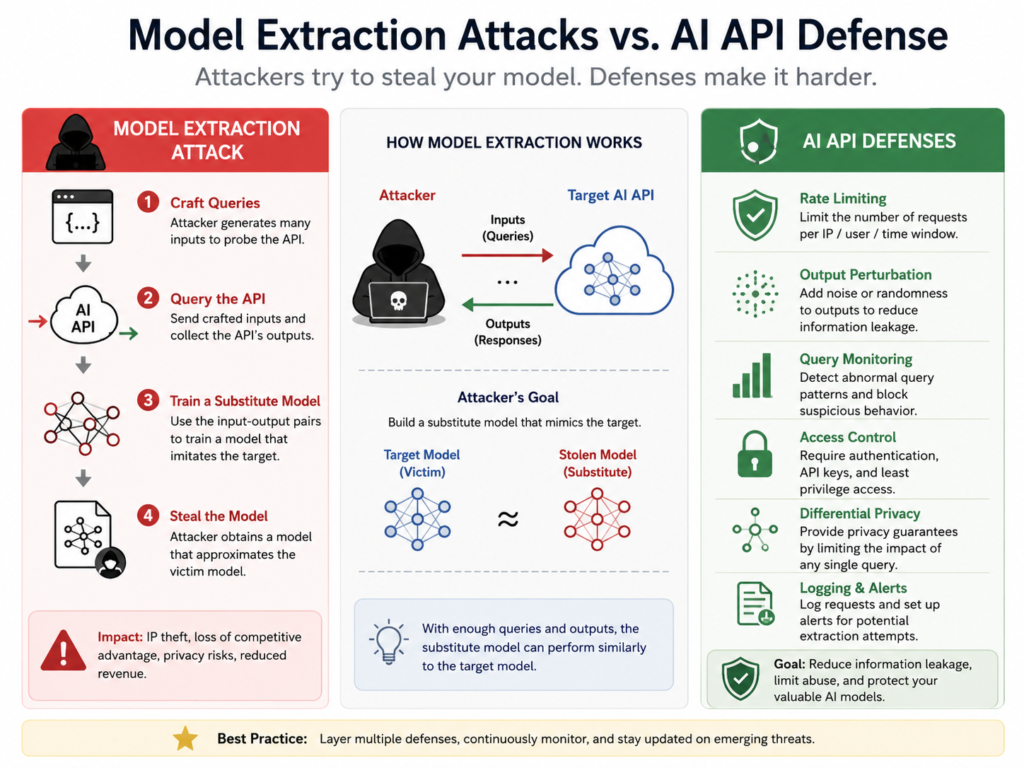
Model extraction is a specific attack method. The attacker repeatedly queries a model, studies the outputs, and trains a substitute model that mimics the original.
This matters for SaaS, fintech, healthcare, e-commerce, and enterprise AI products where the model itself may be part of the company’s core advantage.
AI Model Theft Prevention Controls
The strongest AI model theft prevention strategy is layered. No single tool can stop every attack.
Security teams should combine.
Strong identity and access control
API rate limiting and abuse detection
Secure model repositories
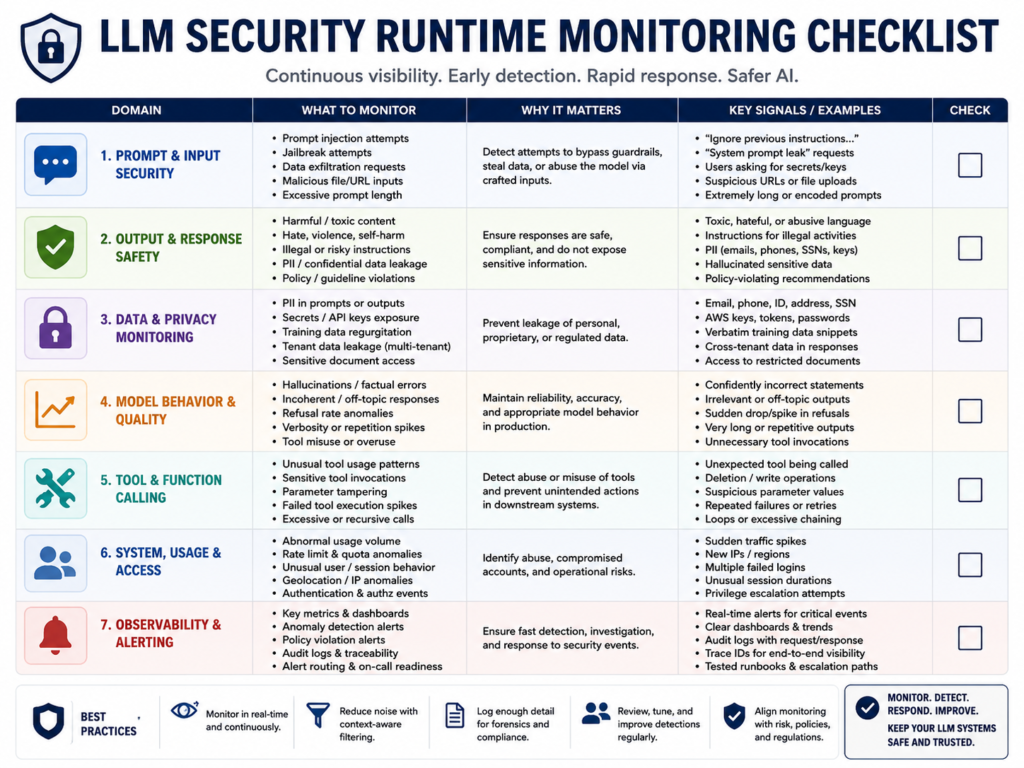
Runtime monitoring
Watermarking and output tracking
CI/CD and secrets protection
Red-team testing
Vendor governance
Legal and trade secret safeguards
Think of the AI model as a critical business asset, not just another backend feature.
Secure AI APIs Against Abuse
AI APIs are one of the most common exposure points for model extraction attacks.
Rate limits help, but they are only the first layer. A determined attacker may use multiple accounts, partner tokens, IP ranges, or slow probing patterns to avoid simple thresholds.
Stronger API protection should monitor for.
Unusual query volume
Repeated prompts with small variations
Edge-case testing
Sequential label probing
Bulk classification attempts
Suspiciously structured outputs
Multiple accounts using similar query patterns
Attempts to infer confidence scores or model boundaries
For companies building AI-enabled SaaS products, Mak It Solutions’ web development services and Node.js development services can support secure API design, authentication flows, and backend monitoring patterns.
Add Runtime Protection for LLMs and ML Models
AI runtime protection focuses on what happens after the model is deployed.
It helps detect.
Prompt injection attempts
Policy bypass behavior
Unusual response patterns
Data leakage signals
Model extraction activity
Excessive or suspicious inference usage
Abuse from compromised accounts
Runtime monitoring should connect with SIEM, IAM, cloud logs, DLP, and AI security posture management.
A New York fintech team, a London health tech company, and a Berlin SaaS vendor may work under different regulations, but they all need the same visibility: who is using the model, how they are using it, and whether that behavior looks normal.
Protect Model Weights, Repositories, and Pipelines
Model theft prevention also depends on securing the places where models are built, stored, and deployed.
Key controls include.
| Area | What to Protect |
|---|---|
| Model artifacts | Weights, checkpoints, fine-tuned versions |
| Repositories | Source code, notebooks, prompts, configs |
| CI/CD | Secrets, deployment tokens, build pipelines |
| Cloud storage | Buckets, registries, backups, snapshots |
| Runtime | Inference endpoints, API keys, logs |
| Data layer | Embeddings, vector databases, evaluation sets |
Use encryption, private networking, scoped API keys, access reviews, token rotation, secrets scanning, and production/development separation.
Mak It Solutions’ Python development services and business intelligence services are especially relevant for teams that need secure analytics pipelines, model monitoring dashboards, and controlled access to AI telemetry.
Use Watermarking, Logging, and Output Monitoring
Watermarking can help prove that suspicious outputs likely came from a proprietary model. It is not a complete defense, but it can support investigations, vendor disputes, IP claims, and abuse monitoring.
Output monitoring can also flag repeated attempts to harvest model behavior.
Strong logs should capture.
Who accessed the model
Which API keys were used
What changed in the model environment
Which outputs were generated
Which model version handled the request
Whether unusual query patterns appeared
For EU and UK users, logging must be designed carefully. Minimize personal data, restrict access, define retention periods, and align monitoring with GDPR or UK-GDPR obligations.
AI Model IP Protection and Trade Secret Risk
AI model IP protection requires both technical and business safeguards.
A proprietary model may represent.
Training strategy
Fine-tuning decisions
Feature engineering
Customer behavior insight
Evaluation logic
Prompt architecture
Product-specific workflows
Commercial know-how
That means it should be classified and protected like source code, financial systems, and sensitive customer data.
Trade Secret Controls for Enterprise AI
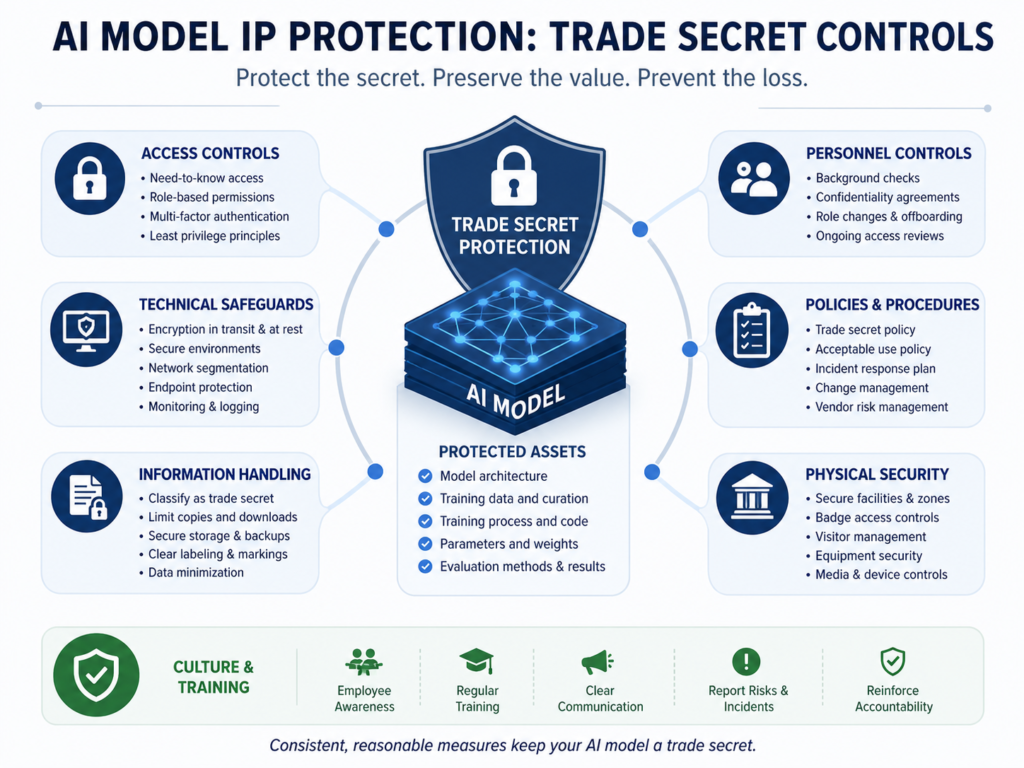
In practice, trade secret protection should include.
Model asset inventory
Named model owners
Access limits by role
Employee confidentiality obligations
Vendor access restrictions
Audit trails
Secure offboarding
Incident evidence preservation
Clear model ownership terms in contracts
SaaS companies should restrict access to production models and inference logs. Fintech teams in New York, Boston, and London should protect scoring logic and fraud models. Healthcare vendors handling HIPAA or NHS-related workflows should separate model access from patient data access.
Vendor and Contract Safeguards
AI model theft can also happen through weak vendor governance.
Contracts should define.
AI model ownership
Training rights
Prompt and output usage
Subcontractor access
Fine-tuning file handling
Embedding storage
Incident notice periods
Audit rights
Data retention
Model deletion requirements
Before using third-party AI platforms, ask whether customer prompts, logs, embeddings, files, or fine-tuning data can be used to improve the vendor’s own models.
That one clause can change the entire risk profile.
Compliance and Governance for AI Model Security
AI model theft prevention should map to the compliance environment where the business operates.
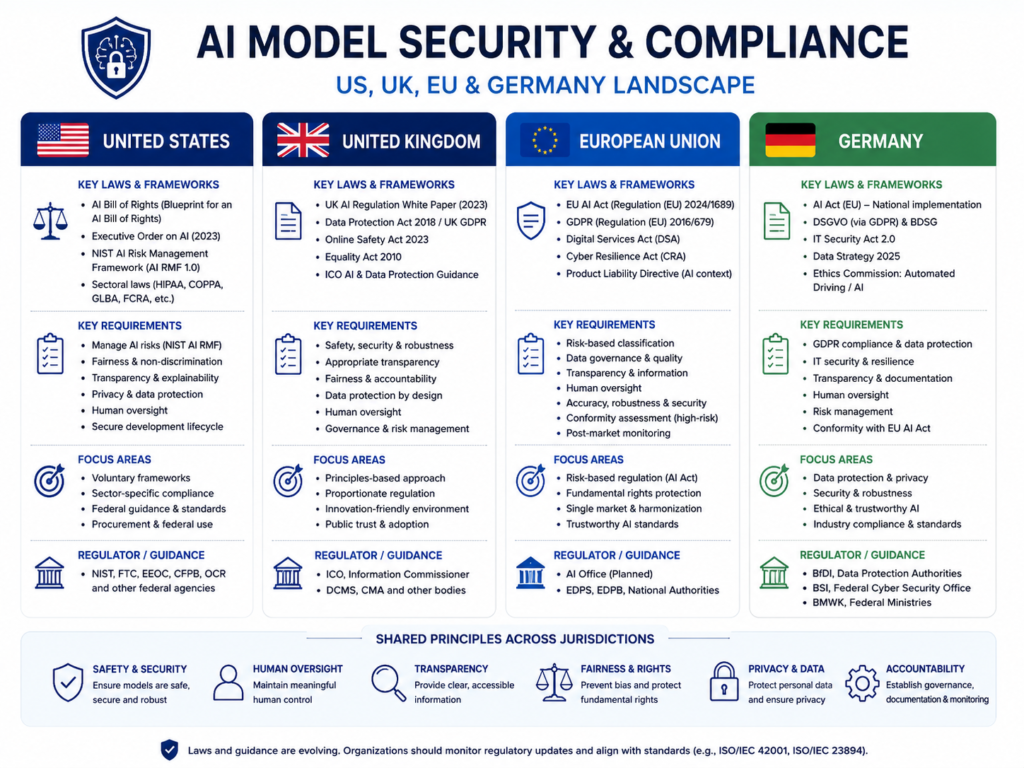
For US teams, this may include SOC 2, HIPAA, PCI DSS, and NIST AI RMF. NIST describes the AI RMF as a framework to help organizations manage AI risks to individuals, organizations, and society.
For UK teams, AI security should connect with UK-GDPR, NHS data protection expectations, FCA governance, and Open Banking security.
For Germany and EU teams, the conversation often includes DSGVO/GDPR, BaFin expectations, ISO 27001, NIS2 readiness, data residency, and the EU AI Act. The EU AI Act entered into force on 1 August 2024 and is being applied in phases.
Regional Focus: US, UK, Germany, and EU
US buyers often ask about SOC 2, API security, incident response, and trade secret protection.
UK buyers usually expect practical governance: approved use cases, prompt rules, vendor review, human oversight, and board-level reporting.
German and EU buyers often lead with privacy, data residency, auditability, DSGVO/GDPR alignment, BaFin risk expectations, and secure cloud-region choices.
For Berlin, Munich, Frankfurt, Hamburg, Amsterdam, Paris, Dublin, and Zurich teams, model security should be tied directly to procurement confidence and regulatory readiness.
AI Model Theft Prevention Checklist
Use this checklist to move from risk awareness to implementation.
Technical Checklist
Encrypt model artifacts
Restrict repository access
Use private endpoints where possible
Rotate API keys and tokens
Add rate limits and abuse throttling
Monitor query patterns
Detect suspicious prompt behavior
Watermark high-value outputs
Scan CI/CD secrets
Protect model registries
Separate development and production environments
Red-team extraction, prompt injection, and leakage scenarios
Log model access and model changes
Governance Checklist
Define model ownership
Create a model inventory
Classify model risk tiers
Approve tools and vendors
Define prompt and data rules
Set retention policies
Protect trade secrets
Review contracts for AI ownership and training rights
Create incident escalation paths
Preserve evidence for suspected theft
Report material risks to leadership
When to Evaluate an AI Security Platform
Consider an AI security platform when internal tools cannot reliably detect extraction patterns, monitor runtime prompts, map model inventory, or enforce policies across SaaS, cloud, API, and model layers.
This becomes especially important before launching external AI APIs, regulated workflows, or high-value proprietary AI models.
Final Take
Mak It Solutions helps US, UK, German, and EU teams design secure AI, SaaS, cloud, mobile, and data systems with practical governance from day one. Explore our services or request a scoped consultation to assess your AI model theft prevention controls before your next production launch.
Key Takeaways
AI model theft prevention protects model weights, APIs, repositories, prompts, outputs, embeddings, and training-derived business logic.
Model extraction attacks can happen even without source-code access, especially through exposed AI APIs.
Enterprises need both technical controls and legal safeguards. Runtime monitoring, watermarking, access control, red-team testing, and vendor governance all matter.
For US, UK, Germany, and EU teams, model security should also connect with SOC 2, HIPAA, PCI DSS, NIST AI RMF, UK-GDPR, GDPR/DSGVO, BaFin, NIS2, ISO 27001, and the EU AI Act.
FAQs
Q : Can an AI model be stolen without accessing the source code?
A : Yes. Attackers can sometimes clone or approximate model behavior through model extraction attacks. They may run structured queries at scale, compare outputs, and train a substitute model that behaves like the original.
Q : What is the difference between model theft and data theft?
A : Model theft targets the AI asset itself, such as weights, architecture, prompts, embeddings, or outputs. Data theft targets customer records, payment details, health information, internal files, or other datasets. The risks can overlap when a stolen model reveals sensitive training-derived information.
Q : How does watermarking help with AI model IP protection?
A : Watermarking adds detectable signals to model behavior or outputs. It can help support investigations, ownership claims, and abuse monitoring, but it works best with access logs, version control, and evidence preservation.
Q : Who should own AI model theft prevention?
A : Ownership should be shared. Security teams manage controls, engineering secures pipelines and APIs, legal protects trade secrets and contracts, compliance maps obligations, and product teams define safe usage. The CISO or security leadership usually coordinates the program.
Q : Do SOC 2 or ISO 27001 controls cover AI model security?
A : They can support AI model security, but most teams need AI-specific extensions. Access control, logging, encryption, change management, vendor risk, and incident response are useful foundations, but model inventory, extraction detection, prompt rules, runtime monitoring, and model artifact protection should be added.