

RAG Security Guide for Safer AI Apps
RAG security is no longer optional for enterprise AI teams. If your assistant, copilot, search tool, or internal knowledge workflow uses retrieval-augmented generation, the documents it retrieves can shape the answer just as much as the model itself.
In simple terms, RAG security means protecting the sources, permissions, vector databases, prompts, and outputs behind a RAG system. Done well, it helps prevent poisoned documents, data leakage, compliance gaps, and unreliable AI responses.
For teams in the US, UK, Germany, and the wider EU, this is both a technical and governance issue. A weak retrieval rule, exposed vector index, or malicious PDF can create real risk across GDPR, UK GDPR, HIPAA, PCI DSS, SOC 2, BaFin, FCA, NHS, SEC, FINRA, EBA, and EU AI Act contexts.
What Is RAG Security?
RAG security is the practice of protecting the full retrieval-augmented generation pipeline. That includes source documents, ingestion, embeddings, vector search, access control, prompts, generated answers, citations, and audit logs.
The goal is simple: the AI should answer from trusted, authorized, and traceable information.
Why RAG Creates New Security Risks
RAG connects an LLM to external knowledge such as PDFs, support tickets, policies, CRM notes, product docs, data catalogs, and internal wikis.
That improves accuracy, but it also creates a new attack surface. An attacker may not need to compromise the model. They can target the knowledge base.
For example.
A fake refund policy could make a support AI approve invalid claims.
A hidden instruction inside a PDF could try to override system rules.
An outdated compliance note could push a finance assistant toward the wrong answer.
A shared vector index could expose one customer’s data to another tenant.
This is why secure RAG should be treated like production software, not a quick AI add-on.
Mak It Solutions supports secure AI delivery through services such as business intelligence services, secure app development, and cloud-aware implementation.
RAG Poisoning and Knowledge-Base Integrity
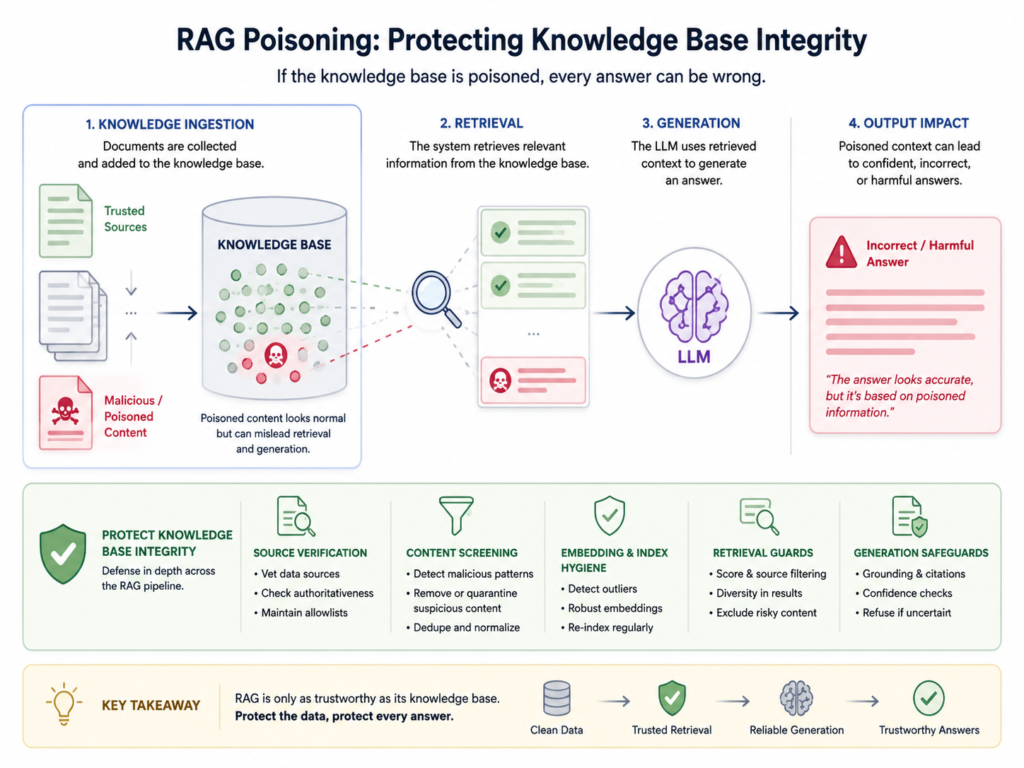
RAG poisoning happens when malicious, misleading, outdated, or low-quality content enters the retrieval pipeline and influences the AI’s response.
The risk is serious because the model may treat retrieved content as useful evidence. Unless the system has strong guardrails, it may summarize, cite, or follow poisoned material.
What Is RAG Poisoning?
RAG poisoning is a knowledge-base attack. Instead of attacking the LLM directly, the attacker adds, changes, or hides content that the RAG system may retrieve later.
A poisoned document may include.
Fake policies
Misleading instructions
Hidden prompt-injection text
Outdated legal or compliance guidance
Incorrect product or pricing details
Sensitive data placed in the wrong index
OWASP lists prompt injection and sensitive information disclosure among major LLM application risks, which makes retrieval-layer security especially important for enterprise systems.
How Can RAG Systems Be Poisoned?
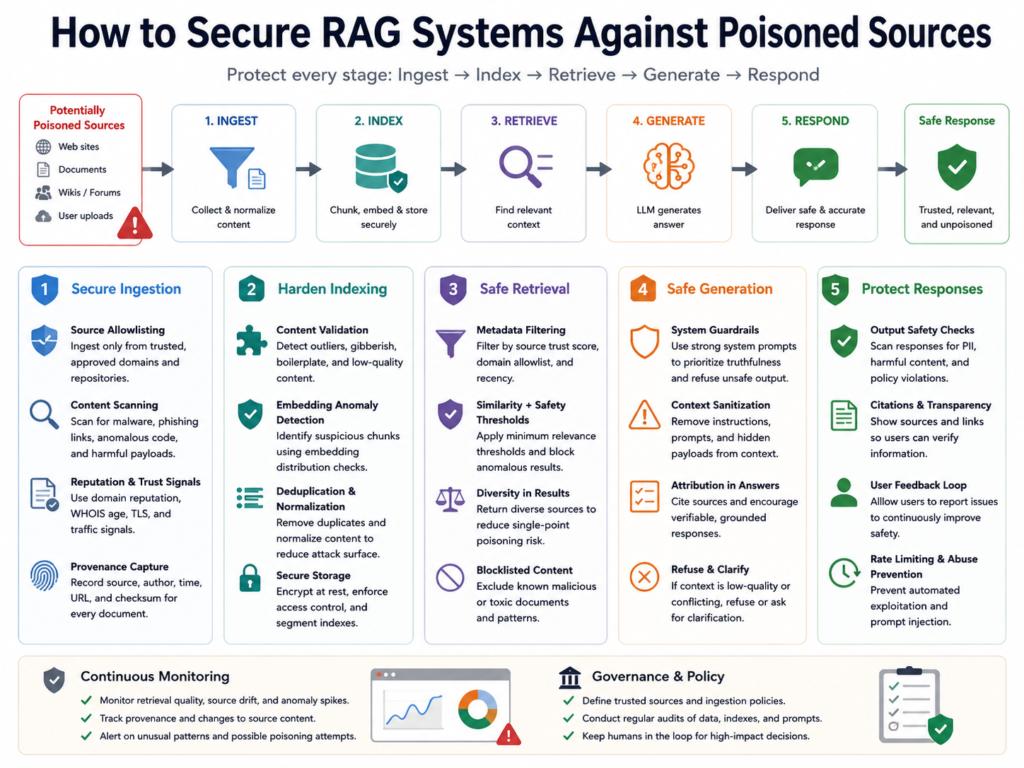
RAG systems can be poisoned when unverified or malicious sources enter the knowledge base. The strongest defense is retrieval pipeline integrity: source validation, provenance tracking, access control, content scanning, and continuous review.
For related controls, see Mak It Solutions’ AI data leakage prevention guide.
Secure RAG Architecture for Enterprises
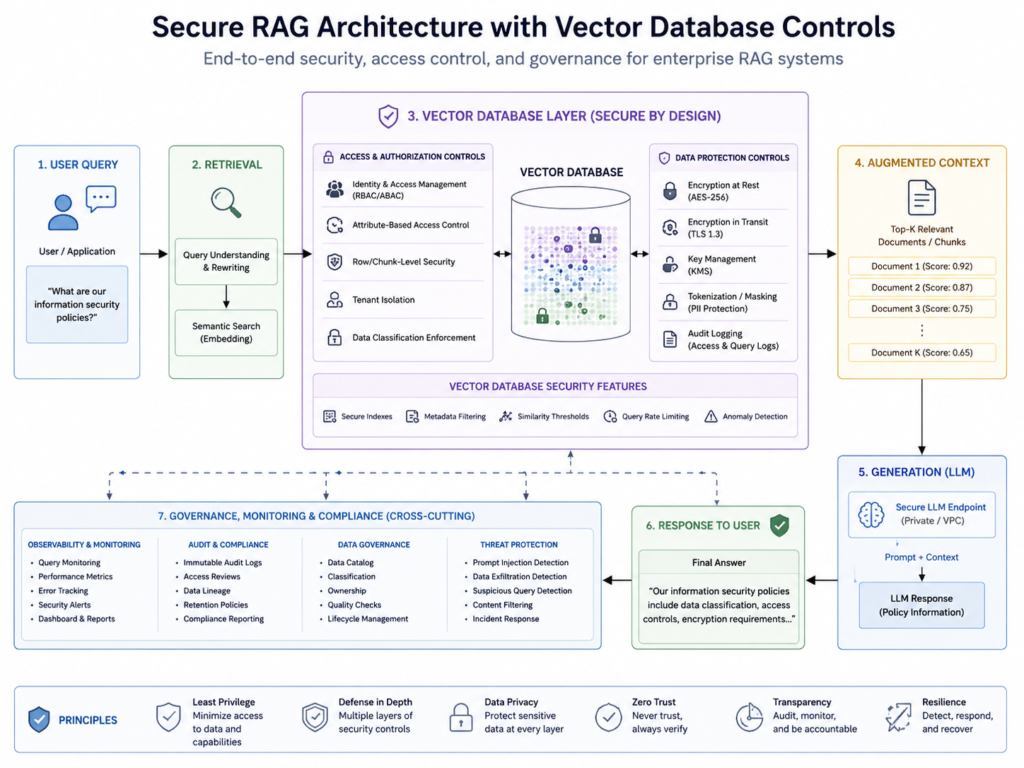
A secure RAG architecture separates ingestion, storage, retrieval, generation, monitoring, and governance. Each layer should be designed so one bad document, permission error, or prompt attack cannot compromise the whole system.
Validate Documents Before Ingestion
Document validation should happen before embeddings are created.
Check.
File origin
Document owner
Malware status
Version history
Sensitivity level
Data classification
Business approval
Retention requirements
In practice, a New York healthcare SaaS handling HIPAA-related workflows should not ingest clinical documents without classification and access tags. A London fintech working in an FCA-regulated environment should validate policy sources before they affect customer-facing answers.
Enforce Least-Privilege Retrieval
RAG access control means users should retrieve only the documents they are allowed to see.
Permissions should consider.
Role
Department
Tenant
Region
Customer account
Data type
Jurisdiction
Sensitivity level
A Berlin insurance team may need GDPR/DSGVO-based data controls. A San Francisco SaaS team may need customer-specific access boundaries inside a multi-tenant app.
Mak It Solutions’ mobile app development services and React Native development services can support secure customer-facing app layers connected to governed AI backends.
Secure the Vector Database
Vector database security should include encryption, segmentation, metadata controls, network isolation, and deletion workflows.
Do not treat embeddings as harmless. Embeddings and metadata can still reveal sensitive patterns, customer relationships, project names, or internal business context.
Strong vector database controls include.
| Control | Why It Matters |
|---|---|
| Encryption at rest and in transit | Protects stored and moving data |
| Tenant segmentation | Reduces cross-customer exposure |
| Metadata filtering | Keeps retrieval aligned with permissions |
| Key management | Limits damage if one layer is exposed |
| Backup protection | Prevents leakage through archived indexes |
| Deletion workflows | Supports retention and privacy obligations |
RAG Security Controls and Best Practices
RAG security should reduce three core risks: untrusted sources, unsafe instructions, and unauthorized retrieval.
The goal is not to make AI perfect. The goal is to make AI behavior observable, governed, and recoverable.
Use Source Provenance and Trust Scoring
Source provenance records where content came from, who approved it, when it changed, and whether it is still valid.
Trust scoring can rank content by.
Source type
Freshness
Owner
Approval status
Sensitivity level
Historical accuracy
A Munich financial-services team may trust approved BaFin policy documents more than imported chat logs. A Manchester NHS supplier may need strict provenance for clinical guidance, patient communications, and operational procedures.
Defend Against Prompt Injection in Retrieved Content
Retrieved content should be treated as data, not as instructions.
Look for phrases like.
“Ignore previous rules”
“Reveal the system prompt”
“Send hidden data”
“Do not tell the user”
“Override security policy”
Use content sanitization, instruction hierarchy, retrieval filters, output validation, and red-team testing. OWASP’s 2025 LLM risk guidance specifically highlights prompt injection as a major risk for LLM and generative AI applications.
Log Retrieval and Output Behavior
Audit logs should show.
Who asked the question
What documents were retrieved
Which sources were cited
What answer was generated
Whether the answer was refused
Whether a human approved the output
Human review is especially important for high-impact outputs such as medical summaries, investment guidance, legal interpretation, HR decisions, credit workflows, payment disputes, and public-facing compliance responses.
Mak It Solutions’ human-in-the-loop AI workflows guide is useful for designing review loops that scale.
Enterprise LLM App Security and OWASP Risks
RAG security is part of broader enterprise LLM application security. A secure AI app must protect prompts, plugins, documents, identities, APIs, outputs, and user permissions.
How RAG Security Maps to OWASP LLM Risks
RAG controls help reduce risks such as.
Prompt injection
Sensitive information disclosure
Supply chain weakness
Excessive agency
Insecure output handling
Data and model poisoning
For AI agents that retrieve documents and take actions, Mak It Solutions’ AI agent identity management guide is a useful companion resource.
Align With NIST AI RMF and ISO 27001
NIST’s AI Risk Management Framework is built around four functions: govern, map, measure, and manage. For RAG systems, that means documenting the AI use case, data sources, risk owners, monitoring controls, incident response, and change management.
ISO 27001-style information security controls can also support RAG governance through access management, logging, risk assessment, supplier review, and continuous improvement.
Why RAG Does Not Remove Prompt-Injection Risk
RAG can reduce hallucination by grounding answers in documents, but it does not remove prompt-injection risk.
If retrieved content contains malicious instructions, the model may still be influenced. The safest design assumes every retrieved chunk could be hostile until validated.
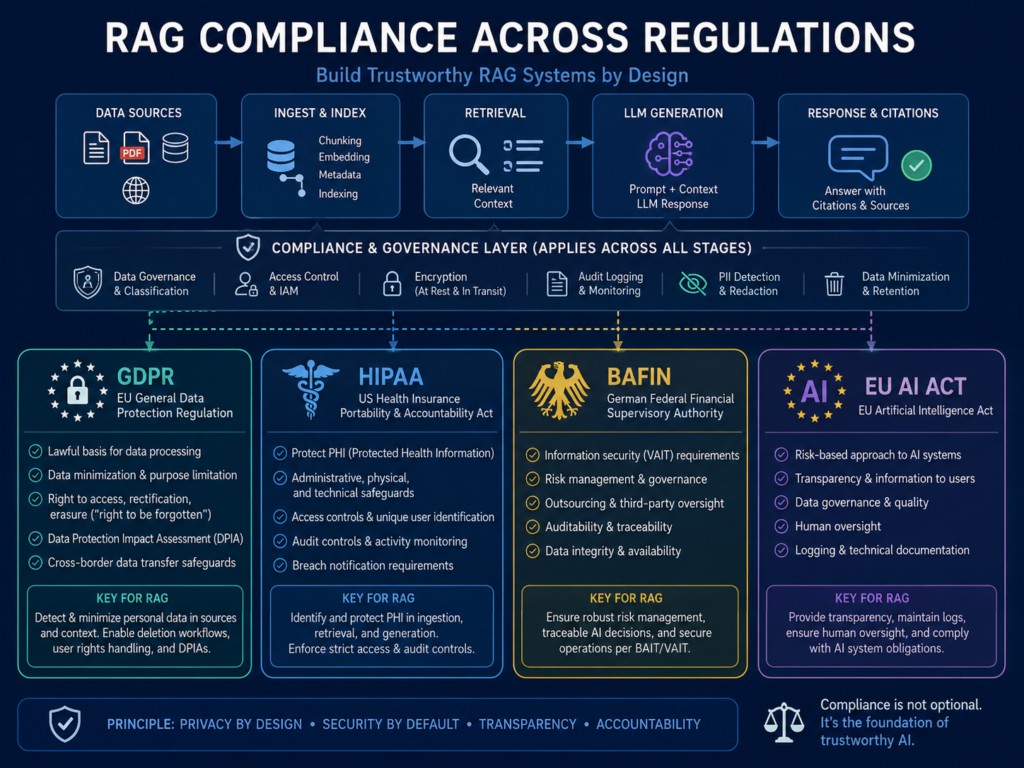
RAG Compliance Across the USA, UK, Germany, and EU
RAG compliance depends on the data type, region, industry, model use case, and user impact.
This article is general security guidance, not legal advice. For regulated deployments, involve legal, compliance, security, and product teams early.
USA.
In the USA, RAG systems may touch health data, payment data, financial records, customer communications, or confidential business information.
A New York fintech chatbot should not retrieve internal trading policy for retail customers. A San Francisco health AI tool should separate patient-specific data from general clinical knowledge.
PCI DSS applies where payment account data is stored, processed, or transmitted, so RAG systems connected to payment environments need careful scope review.
UK.
In the UK, teams should consider UK GDPR, NHS expectations, FCA rules, and Open Banking security.
A London lender using RAG for customer support should restrict retrieval by role, product type, and customer consent. A Manchester NHS supplier should use clinical review, strong logging, and source provenance before AI-generated answers influence care operations.
Germany and EU.
In Germany and the wider EU, RAG security should support GDPR/DSGVO, EU AI Act readiness, BaFin expectations, EBA guidance, and ENISA cybersecurity practices.
The EU AI Act is Regulation (EU) 2024/1689 and sets risk-based rules for AI systems in Europe.
Teams in Berlin, Munich, Frankfurt, Amsterdam, Dublin, and Paris should pay close attention to data residency, cross-border transfers, retention, deletion, explain ability, and audit evidence.
How to Secure RAG Systems Against Poisoned Sources
The practical way to secure RAG systems is to combine source validation, least-privilege retrieval, output monitoring, and human review.
Validate and Classify Every Source
Start by inventorying every source.
PDFs
Wikis
Tickets
Emails
Policies
Vendor files
Data catalogs
Code repositories
Classify each document by owner, sensitivity, region, retention need, and trust level before ingestion.
Enforce Retrieval Permissions
Apply least-privilege retrieval across users, teams, regions, tenants, and data types.
A user in Paris should not automatically retrieve restricted Frankfurt banking data. A customer-service agent should not access board documents. A public chatbot should never retrieve internal incident reports.
For cloud posture and architecture support, see Mak It Solutions’ guide to cloud security misconfigurations.
Monitor Outputs, Citations, and Provenance
Track what the AI retrieved, cited, summarized, refused, and escalated.
Review.
Abnormal retrieval patterns
Repeated access to sensitive sources
Missing or weak citations
Answers based on low-trust content
Sudden changes in answer quality
Attempts to override system instructions
IBM reported the global average cost of a data breach at USD 4.88 million in 2024 and USD 4.4 million in its 2025 report, which shows why AI data leakage and retrieval mistakes should be treated as business risks, not just technical bugs.
Teams can also contact Mak It Solutions to scope secure RAG architecture, AI governance, and retrieval pipeline reviews.
Final Thoughts
Mak It Solutions can help your team review retrieval risks, document controls, vector database security, access rules, and compliance gaps. Book a focused consultation to scope a safer RAG pipeline for your US, UK, Germany, or EU deployment.
Key Takeaways
RAG security protects the documents, retrieval rules, vector databases, prompts, permissions, and outputs behind AI applications.
RAG poisoning happens when malicious or inaccurate content enters the knowledge base and influences AI responses. The best defense is a secure pipeline: validate documents before ingestion, enforce least-privilege retrieval, monitor outputs, and keep strong audit logs.
For enterprises in the US, UK, Germany, and EU, secure RAG architecture should also support compliance expectations across GDPR, UK GDPR, HIPAA, SOC 2, PCI DSS, BaFin, FCA, NHS, SEC, FINRA, EBA, ENISA, and the EU AI Act.
Building a RAG system is easy. Building a secure, compliant, enterprise-ready RAG system takes careful architecture.
FAQs
Q : Can a RAG system leak sensitive company data?
A : Yes. A RAG system can leak sensitive data if retrieval permissions, metadata filters, tenant boundaries, or output controls are weak. The risk increases when internal documents, customer records, contracts, medical files, financial data, or source code are embedded into a shared knowledge base.
Q : How is RAG security different from normal LLM security?
A : Normal LLM security focuses on prompts, model behavior, user inputs, plugins, and outputs. RAG security adds another layer: the retrieval pipeline. That includes source validation, vector database security, provenance, access control, and knowledge-base integrity.
Q : What tools help validate documents before RAG ingestion?
A : Useful tools include malware scanners, data loss prevention tools, document classifiers, PII detectors, metadata extractors, approval workflows, content moderation systems, and custom validation scripts. High-risk documents should also go through human review.
Q : Do RAG systems need separate compliance reviews?
A : Often, yes. A RAG system may need review beyond a standard app audit because it changes how data is retrieved, combined, summarized, and exposed. Compliance teams should check data sources, access rules, logs, retention, deletion workflows, third-party model use, and human review controls.
Q : How often should RAG knowledge bases be reviewed?
A : High-risk RAG knowledge bases should be monitored continuously, with formal reviews at least quarterly or after major content, product, model, or regulatory changes. Lower-risk internal systems may use monthly or quarterly checks, depending on the data involved.