


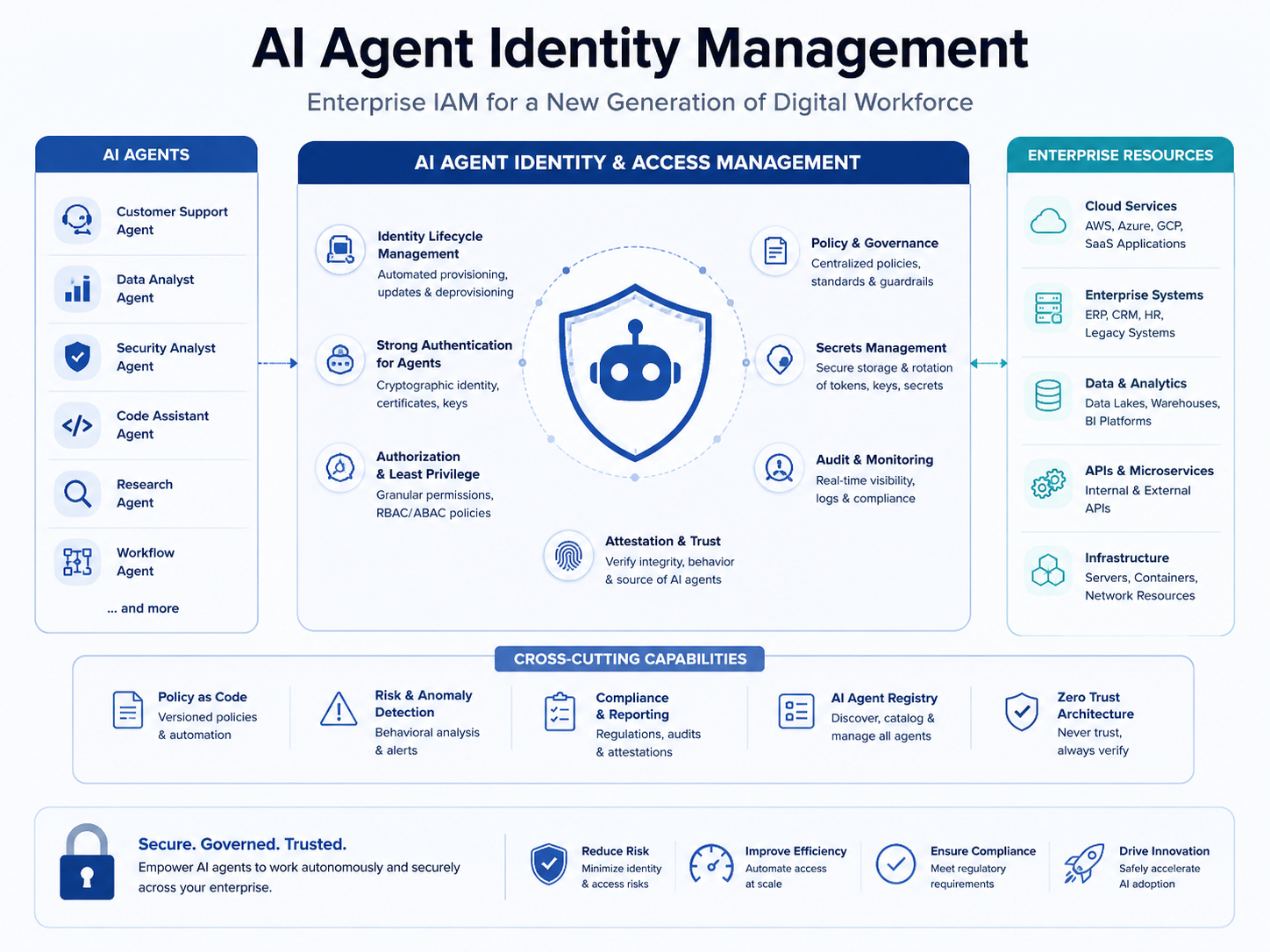
AI Agent Identity Management Guide
AI agent identity management is now a serious enterprise security issue because autonomous AI agents can access SaaS tools, cloud platforms, APIs, databases, ticketing systems and sensitive workflows at machine speed. If those agents are not governed, they can quietly become over-permissioned, hard to audit and difficult to shut down.
In simple terms, AI agent identity management means giving every autonomous AI agent a unique identity, controlled permissions, monitored activity and a clear human owner. For enterprises in the USA, UK, Germany and wider EU, it is becoming essential for security, compliance and operational trust.
IBM’s 2025 breach research reported a global average breach cost of USD 4.4 million and highlighted the risk created when AI adoption moves faster than security governance. That is exactly why AI agents should not be treated like generic scripts or shared service accounts.
What Is AI Agent Identity Management?
AI agent identity management is the process of assigning, authenticating, governing, monitoring and revoking identities for autonomous AI agents.
An enterprise AI agent may read documents, update CRM records, trigger workflow actions, summarize patient records, create support tickets or call internal APIs. That makes it closer to a non-human identity than a chatbot.
A secure AI agent identity program should answer five basic questions.
Which agent performed the action?
Who owns the agent?
What systems can it access?
Why was access granted?
When should access be reviewed or revoked?
Without those answers, teams lose visibility fast.
For organizations modernizing cloud, SaaS and data platforms, this connects naturally with secure Mak It Solutions Services, back-end development services and business intelligence services.
Why AI Agents Are Enterprise Identities, Not Just Tools
Traditional bots and service accounts usually perform narrow, predictable tasks. AI agents are different.
A support agent might summarize a customer ticket, search a knowledge base, update Salesforce, email the customer and open a Jira issue. A finance agent might review an invoice, check vendor details and trigger an approval workflow.
That flexibility is useful. It is also risky.
AI agents can plan, call tools, chain actions and adapt based on context. So their identity controls need more than a username and password. They need scope, purpose, owner, environment, runtime policy and revocation rules.
In practice, every production AI agent should have.
A unique identity
A named human owner
Approved systems and data access
Least privilege permissions
Activity logging
Review and deletion rules
Why Traditional IAM Is Not Enough for AI Agents
Traditional IAM was built mainly for human users, static roles and predictable application access. AI agents behave more like dynamic digital workers.
That means standard IAM alone may not be enough.
Shared Service Accounts Create Blind Spots
Shared service accounts are one of the biggest problems. When multiple agents use the same credential, it becomes difficult to prove which agent acted, who approved the action or why it happened.
That is a serious issue during SOC 2 audits, HIPAA reviews, PCI DSS assessments and GDPR investigations.
PCI DSS provides baseline technical and operational requirements to protect payment account data, so agent access to payment systems must be tightly controlled.
Autonomous Agents Need Runtime Controls
AI agents should not receive broad standing access. They need delegated authorization based on task, user, system, sensitivity, location and risk.
For example.
A San Francisco SaaS company may allow an AI agent to summarize support tickets but block customer data exports.
A London fintech may allow account lookup but require step-up approval before payment-related actions.
A Munich insurer may require stricter review before agents process employee or policyholder data.
CyberArk’s 2025 machine identity research reported that machine identities can outnumber human identities by more than 80 to 1 in enterprise environments, which shows how quickly non-human access can become difficult to manage.
AI agents add another layer to that identity problem.
Teams should connect agent identity controls with secure cloud security remediation and AI agent identity security planning.
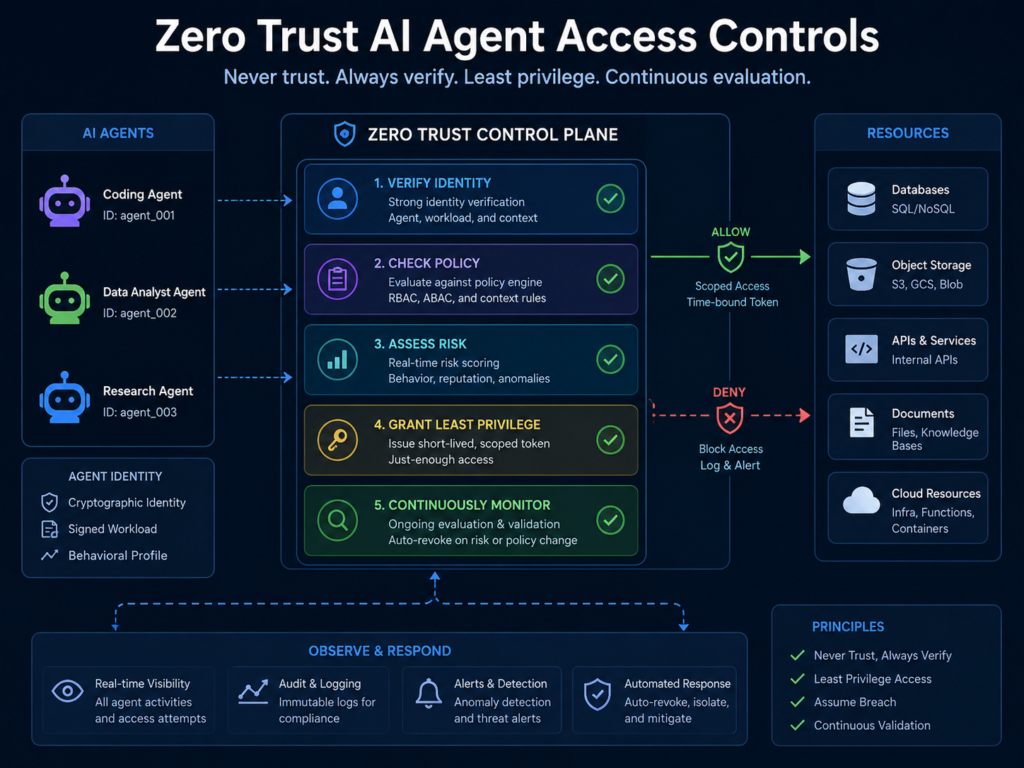
Zero Trust Patterns for AI Agent Identity Management
The safest pattern is identity-first Zero Trust.
Do not assume an AI agent is safe just because it runs inside an approved tool, cloud account or internal network. Authenticate it, authorize it by context and monitor what it actually does.
Use Unique Identities Per Agent, Task and Environment
Each production AI agent should have its own identity. High-risk agents should be separated by task, environment and owner.
A test agent should not have production data access. A finance agent should not inherit engineering permissions. A customer support agent should not quietly gain admin rights because it was connected to the wrong integration.
Apply Least Privilege and Just-in-Time Access
Least privilege means the agent receives only the access needed for the approved task.
Just-in-time access means elevated permissions are temporary, logged and automatically revoked when the task ends.
Policy-based authorization should evaluate context such as.
User role
Data sensitivity
Business purpose
Region or location
Device or workload posture
Agent behavior
Approval status
Microsoft Entra, Okta, Ping Identity, IBM, Strata Identity, Beyond Trust, AWS, Azure, Google Cloud, SIEM, PAM, IGA and CSPM tools may all play a role depending on the architecture.
For teams building customer-facing AI into web or mobile products, these controls should be designed early through secure mobile app development services and scalable web development services.
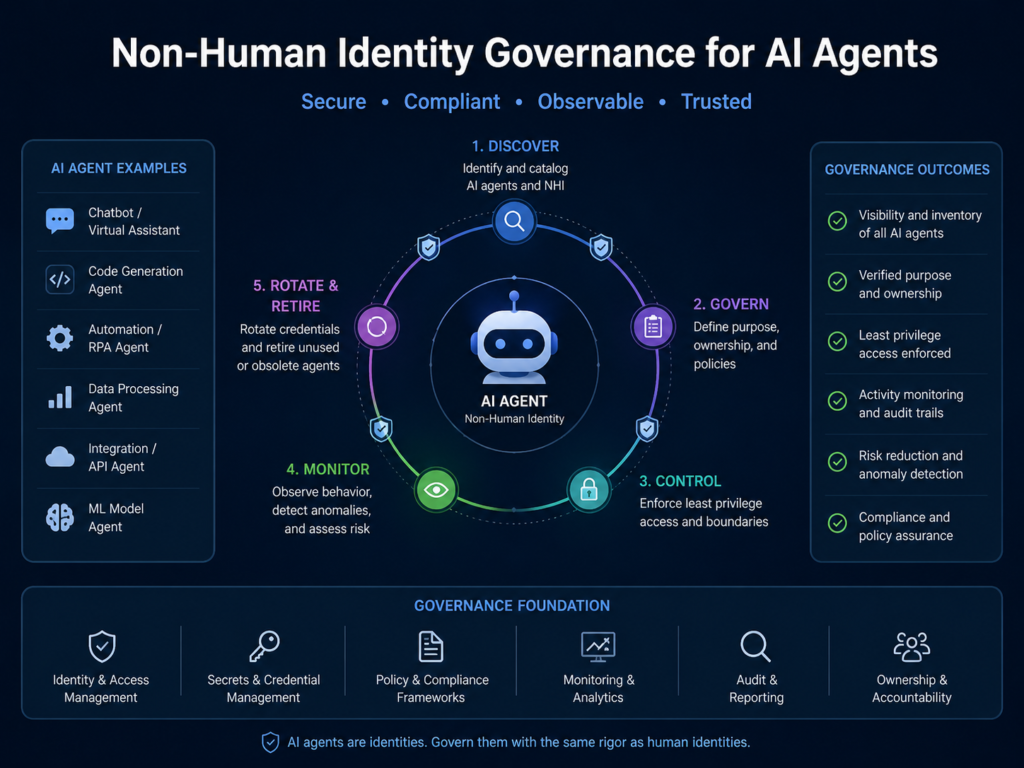
Non-Human Identity Governance for AI Agents
Non-human identity governance means managing AI agents alongside service accounts, workloads, bots, API keys, containers, cloud functions and automation scripts.
The goal is simple: every non-human actor should be discoverable, owned, reviewed and removable.
A mature program should not keep AI agents in a spreadsheet. They should be part of the same governance model used for other machine identities.
AI Agent Lifecycle Controls
Every AI agent should move through a formal lifecycle.
Register the agent and its business purpose.
Assign a human owner and technical owner.
Approve access scope and connected systems.
Rotate credentials and secrets.
Monitor behavior and exceptions.
Suspend or delete the identity when no longer needed.
Access reviews should be more frequent for privileged agents. A low-risk marketing content agent may only need normal review cycles. A healthcare agent touching ePHI or a banking agent touching transaction systems may need tighter monitoring, monthly review and privileged access approval.
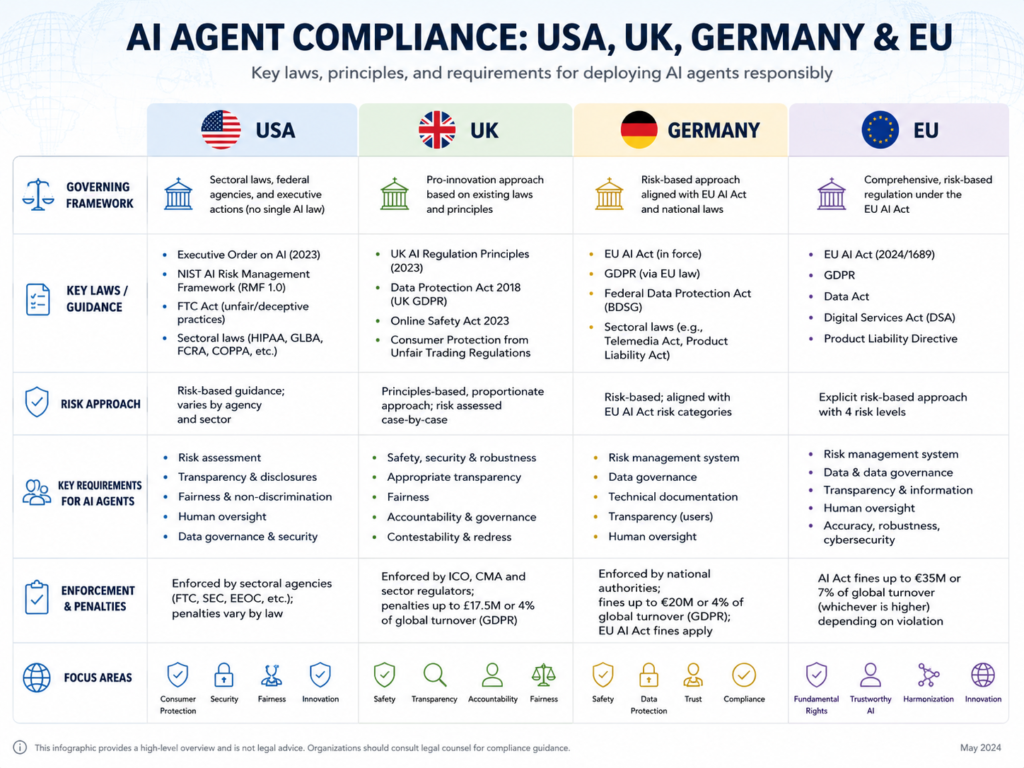
Compliance and Audit Trails for USA, UK, Germany and EU Teams
AI agent access governance should prove who owns the agent, what it accessed, why access was granted and when access was revoked.
Auditors will not only ask whether the AI model works. They will ask whether the agent’s access was justified and controlled.
USA.
In the USA, healthcare teams must consider HIPAA if agents access electronic protected health information. HHS states that the HIPAA Security Rule requires administrative, physical and technical safeguards for electronic protected health information.
SaaS companies pursuing SOC 2 need evidence around access control, logging, change management and vendor oversight. Payment workflows must consider PCI DSS. Public-sector and federal vendors may also need FedRAMP-aligned controls.
UK.
In the UK, AI agent access should align with UK GDPR principles, supplier risk management and FCA expectations where financial services are involved.
The ICO lists UK GDPR principles including data minimization, integrity and confidentiality, and accountability. For AI agents, that means access should be limited, logged and tied to a clear business purpose.
For NHS-related systems, agent access should be narrow, auditable and connected to a clinical or operational need. Open Banking agents require extra care around consent, account data and payment initiation.
Germany and EU.
In Germany, teams in Berlin, Munich and Frankfurt should consider DSGVO, BaFin expectations, BSI IT-Grundschutz and works council requirements where employee data is involved.
Across the EU, GDPR applies to personal data processing. DORA applies to digital operational resilience in the financial sector, including financial entities and ICT third-party service providers.
The EU AI Act entered into force on August 1, 2024, and the European Commission says it is designed to support responsible AI development and deployment in the EU. The Act becomes fully applicable on August 2, 2026, with some exceptions and phased obligations.
For AI agent identity management, the practical takeaway is clear: keep evidence. Track owner approvals, access grants, system calls, data touched, outputs created, exceptions raised and access revoked.
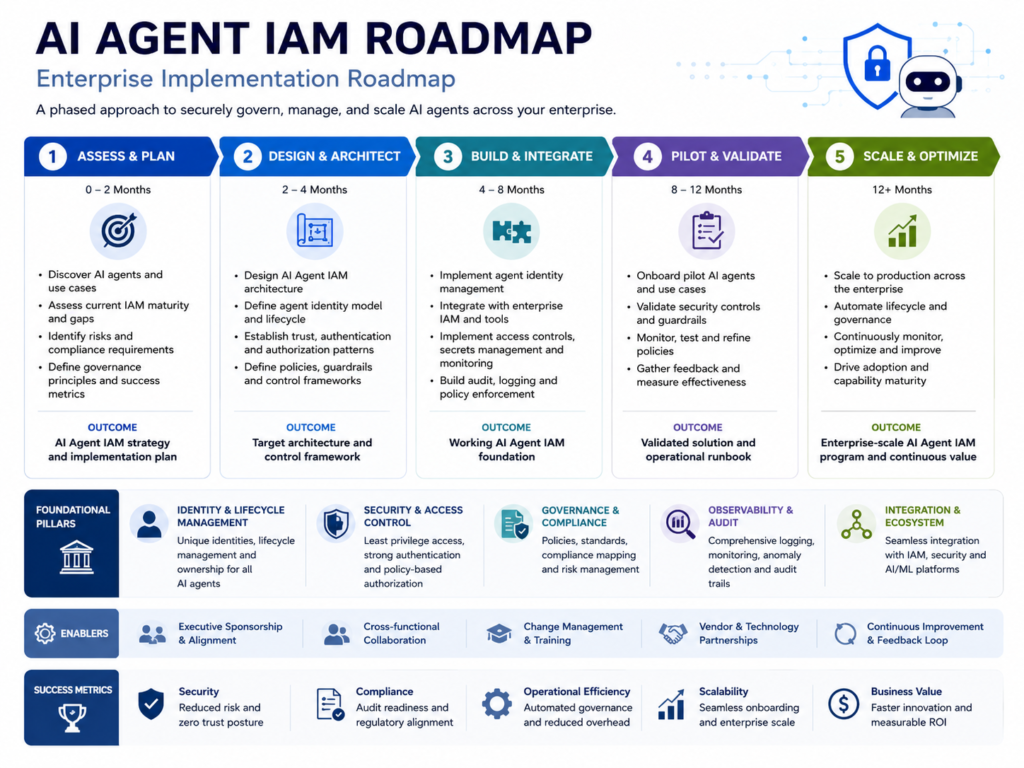
Enterprise Implementation Roadmap
An enterprise AI agent identity management roadmap should start with discovery, then move into registry, access design, tool integration, risk prioritization and continuous monitoring.
Start with the highest-risk agents before expanding across the business.
Build an AI Agent Registry
Create a central AI agent registry. Each entry should include.
Agent name
Human owner
Technical owner
Model or platform
Business purpose
Connected systems
Permissions
Data classes
Environment
Region
Risk level
A Frankfurt bank might tag agents connected to payments as high risk. A Dublin SaaS company might tag support agents that access customer PII as medium or high risk. A New York healthcare provider should treat ePHI access as high risk by default.
Integrate Agents With IAM, PAM, IGA, SIEM and Cloud Identity Tools
AI agent identity should connect with your existing security stack.
IAM handles authentication. PAM manages privileged actions. IGA governs lifecycle and access reviews. SIEM collects event logs. CSPM detects cloud exposure. Cloud identity tools manage workload access across AWS, Azure and Google Cloud.
Business leaders also need dashboards. Business intelligence services can help turn agent access logs, exceptions, approvals and risk metrics into readable governance reports.
Prioritize High-Risk AI Agent Use Cases
Do not try to govern every agent perfectly on day one. Start where the risk is highest.
Prioritize agents that touch.
Regulated data
Customer records
Payment flows
Identity systems
Production cloud
Healthcare records
Financial workflows
Admin consoles
Public-sector systems
This risk-first approach helps security teams show progress quickly without slowing every AI experiment.
Practical AI Agent Access Control Checklist
Use this checklist before moving an AI agent into production.
Does the agent have a unique identity?
Is there a named human owner?
Are permissions limited to the approved task?
Is privileged access time-limited?
Are credentials stored and rotated securely?
Are all system calls logged?
Can the agent be suspended quickly?
Is access reviewed on a defined schedule?
Is sensitive data access justified?
Is there evidence for audit and compliance?
This is not legal, financial or compliance advice. Treat it as a practical security planning guide and confirm requirements with your internal legal, compliance and risk teams.
Wrap It Up
AI agent identity management is about secure scale.
Every AI agent should have a unique identity, least privilege access, a human owner, monitored activity and a clean revocation path. Without those basics, autonomous agents can become hidden access paths across SaaS, cloud, APIs and sensitive business systems.
Before launching more agents, assess your current non-human identities. Look for shared accounts, unmanaged API keys, orphaned service accounts, excessive permissions, missing logs and unclear ownership.
Mak It Solutions can help teams connect AI strategy with secure cloud, SaaS, mobile and data architecture. Start with a scoped assessment through the Mak It Solutions contact page and build an AI agent identity management roadmap for USA, UK, Germany and EU operations.
FAQs
Q : What is AI agent identity management?
A : AI agent identity management is the practice of giving autonomous AI agents unique identities, controlled permissions, monitored activity and clear ownership. It helps enterprises control what agents can access, prove accountability and revoke access when needed.
Q : Can AI agents use existing service accounts safely?
A : Usually, no. Existing service accounts are often shared, over-permissioned and poorly documented. Production AI agents should have unique identities so teams can trace actions, apply least privilege and revoke access cleanly.
Q : How often should AI agent permissions be reviewed?
A : High-risk AI agent permissions should be reviewed monthly or continuously through automated policy checks. Medium-risk agents may be reviewed quarterly. Low-risk agents can follow normal access review cycles.
Q : What is the difference between AI agent identity and machine identity?
A : Machine identity is a broad category that includes service accounts, workloads, devices, certificates, bots, containers and API credentials. AI agent identity is a newer subset focused on autonomous or semi-autonomous agents that can reason, call tools and act across systems.
Q : Do AI agents need privileged access management?
A : Yes, AI agents need PAM when they perform privileged actions such as changing configurations, accessing production systems, exporting sensitive data, modifying user accounts or triggering financial workflows. PAM can enforce approval, session logging, time-limited access and automatic revocation.
[…] It Solutions’ AI Agent Identity Management Guide provides additional context for managing these non-human […]
[…] For a broader identity foundation, see Mak It Solutions’ AI Agent Identity Management Guide. […]
[…] company network or has access to an employee’s credentials. Mak It Solutions’ guide to AI agent identity management explores the wider governance challenge; here, the focus is specifically on authentication […]