

GenAI Vendor Risk Due Diligence Guide
GenAI vendor risk due diligence is the process of reviewing an AI provider’s security, privacy, model governance, data handling, compliance posture, and third-party dependencies before purchase or deployment. A strong GenAI Vendor Risk Due Diligence Checklist helps procurement, legal, security, privacy, and TPRM teams decide whether to approve, conditionally approve, or reject an AI vendor.
Generative AI tools are not “just another SaaS app.” They may process prompts, customer records, source code, contracts, support tickets, embeddings, audit logs, and regulated data. That creates new risk paths that traditional vendor reviews often miss.
Why GenAI Vendor Risk Due Diligence Matters Now
Enterprise teams in New York, San Francisco, London, Berlin, Dublin, Amsterdam, and Paris are buying GenAI tools for customer support, software development, compliance search, Open Banking workflows, healthcare administration, marketing, and analytics.
The business value is real. So is the exposure.
IBM’s 2025 breach research reported a global average breach cost of around $4.4 million and highlighted gaps in AI oversight and access controls.
Traditional SaaS reviews usually focus on access control, encryption, uptime, SOC 2, ISO 27001, and contractual privacy terms. GenAI due diligence must go further.
Teams now need to ask.
Are prompts retained?
Is customer data used for training or fine-tuning?
Where are embeddings stored?
Which foundation models are used?
Can the vendor explain hallucination, bias, and prompt-injection controls?
Are model providers and sub processors disclosed?
Can data be deleted across logs, backups, and fourth parties?
This checklist is designed for procurement, legal, privacy, security, compliance, and enterprise AI governance teams operating across the United States, United Kingdom, Germany, and the wider European Union.
GenAI Vendor Risk Due Diligence Checklist
A GenAI vendor should provide evidence, not just polished sales claims. At minimum, request security reports, data processing terms, sub processor lists, model documentation, privacy controls, DPIA support, incident response procedures, and AI governance documentation.
Company, Product, and AI System Overview
Start with the basics.
Ask what the product does, which AI features are included, which foundation models power the system, and whether the vendor is a model provider, application provider, reseller, integrator, or deployer.
Request a plain-language architecture summary covering.
Model APIs
Hosting providers
Vector databases
Retrieval systems
Logging and monitoring
Human review workflows
Administrative access
Customer data flows
A GenAI contract review tool used by a law firm in London carries different risk from an internal marketing assistant used by a SaaS team in Austin. Context matters.
Data Usage, Retention, and Model Training Questions
This is where many AI vendor reviews succeed or fail.
Ask whether the vendor uses customer prompts, uploaded documents, outputs, metadata, feedback, or logs for model training, fine-tuning, analytics, or product improvement.
Your questionnaire should include.
What customer data is collected?
Is customer data used to train or fine-tune models?
Can customers opt out by default?
Where are prompts, files, embeddings, and outputs stored?
How long is data retained?
Can admins configure retention?
Are deletion requests honored across backups and sub processors?
Can customers export audit logs?
Is data shared with model providers?
Are human reviewers able to access customer content?
In practice, “we do not train on your data” is not enough. Ask what happens to logs, telemetry, embeddings, support tickets, and feedback data too.
Required Evidence Before Vendor Approval
Do not rely on marketing language.
Useful evidence includes.
SOC 2 Type II report
ISO 27001 certificate or audit evidence
ISO/IEC 42001 alignment or certification, where available
Penetration test summary
Data processing agreement
Sub processor list
Model cards or AI system documentation
Retention and deletion policy
Incident response plan
Security architecture overview
Access control policy
Vulnerability management evidence
DPIA support documentation
Uptime and resilience history
AI governance and monitoring process
Teams building AI-enabled platforms can also align vendor checks with secure cloud and analytics architecture through Mak It Solutions’ Business Intelligence Services and Confidential Computing for Sensitive Cloud Workloads.
AI Third-Party Risk Management for GenAI Vendors
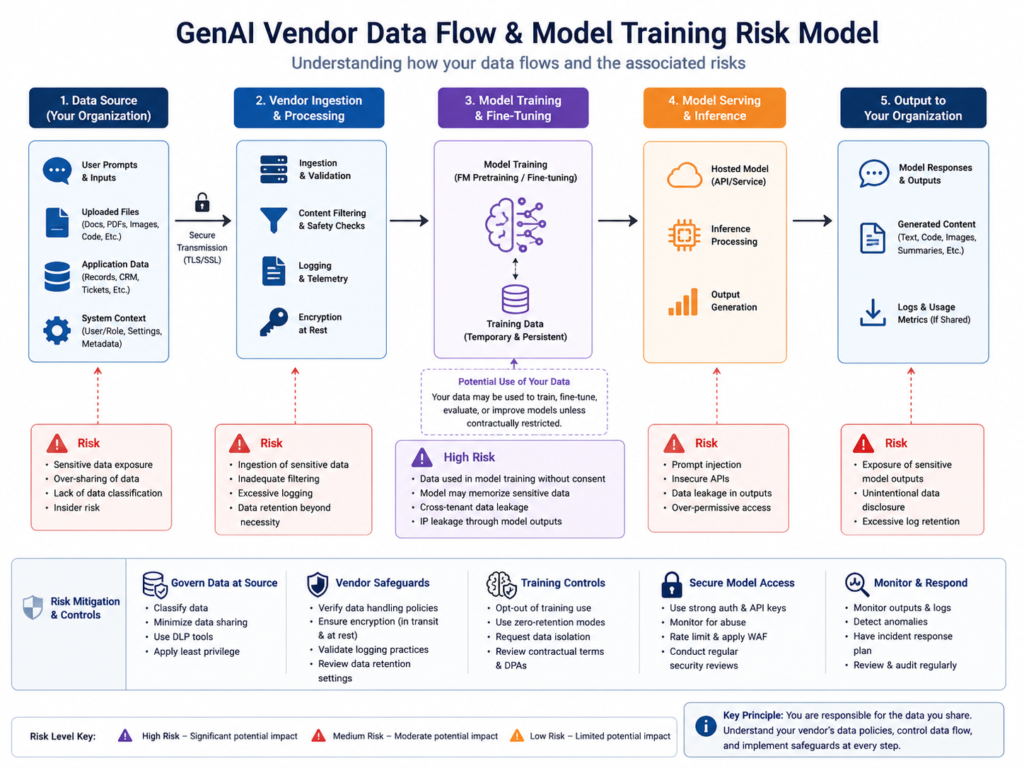
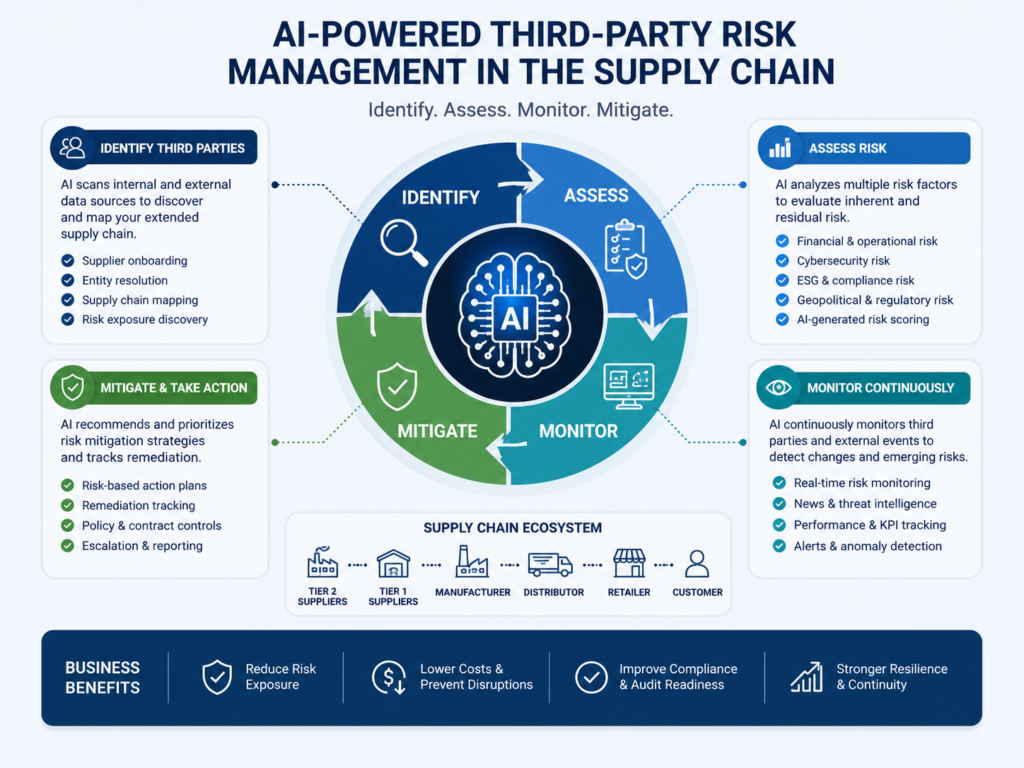
GenAI due diligence changes third-party risk management because the risk is not limited to the vendor’s application. It may also involve foundation models, cloud regions, vector databases, content moderation APIs, monitoring tools, labeling vendors, and offshore support teams.
How GenAI Changes Third-Party Risk Workflows
AI third-party risk management should begin before a pilot uses real company data.
A low-risk writing assistant may only need standard SaaS review. A GenAI claims triage tool in US healthcare, a credit-support assistant in financial services, or a chatbot connected to internal systems needs deeper legal, privacy, security, and model-risk review.
Classify the use case first. Then decide the depth of review.
Fourth-Party, Foundation Model, and AI Supply Chain Risks
Many GenAI vendors depend on fourth parties, including.
Foundation model providers
Cloud hosting providers
Vector databases
Monitoring tools
Analytics platforms
Support platforms
Content safety APIs
Data labeling or review vendors
These dependencies matter because the vendor may not fully control where data flows, how models are updated, or who can access logs.
For teams designing RAG systems or AI copilots, Mak It Solutions’ Domain LLM vs RAG guide can help compare architecture choices before procurement.
Vendor Risk Questionnaire Questions for Procurement Teams
Ask direct questions.
Which foundation models are used?
Can the customer select hosting or model regions?
Are prompts logged?
Are outputs monitored by humans?
Is customer data shared with model providers?
Are sub processors disclosed before changes?
Are model updates tested before release?
Can the vendor support audit requests?
Can high-risk features be disabled?
Does the vendor offer tenant-level isolation?
These questions turn AI supply chain risk into evidence that legal, security, privacy, and procurement can actually review.
Security, Privacy, and Data Protection Checks
A strong GenAI vendor risk due diligence checklist should verify whether customer data is used for model training, where data is stored, how long prompts and outputs are retained, and whether deletion and audit rights are contractually available.
LLM Security Assessment and Access Control Review
An LLM security assessment should cover.
Authentication
Role-based access control
Encryption
Secrets handling
Tenant isolation
Prompt injection defenses
Output filtering
Rate limits
Admin controls
Audit logging
Abuse monitoring
Secure tool use
For GenAI systems connected to internal knowledge bases, ask whether the model can expose restricted documents through weak retrieval permissions.
If a chatbot can access HR, legal, finance, and engineering repositories, access control must be enforced at the document, user, and session level.
Mak It Solutions’ AI Red Teaming Guide for GenAI Security is a useful companion for testing prompt injection, jailbreaks, data leakage, unsafe tool use, and model abuse scenarios.
AI Data Privacy, Retention, and Customer-Data Training Risks
Privacy review should map every data flow.
Prompt
Upload
Metadata
Embedding
Output
Feedback
Telemetry
Logs
Backup
Deletion workflow
For GDPR, DSGVO, and UK-GDPR contexts, this supports DPIAs, lawful basis review, data minimization, and data subject rights.
The UK Information Commissioner’s Office is the UK regulator for data protection and information rights. HHS explains that HIPAA protects medical records and other identifiable health information in covered US healthcare contexts.
Sub processors, Cross-Border Transfers, and Data Residency
Sub processor transparency is essential for EU and UK buyers.
Ask whether the vendor uses AWS, Azure, GCP, model APIs, analytics tools, support platforms, or offshore reviewers. Then ask where each party stores or accesses data.
Germany-based teams in Berlin, Munich, or Frankfurt may require EU or German-region hosting. Financial firms may also consider BaFin expectations, DORA operational resilience requirements, and data residency commitments.
Healthcare, fintech, and SaaS teams should review whether data can remain in approved regions such as Frankfurt, Dublin, London, Paris, Amsterdam, or US regions.
Compliance Frameworks.
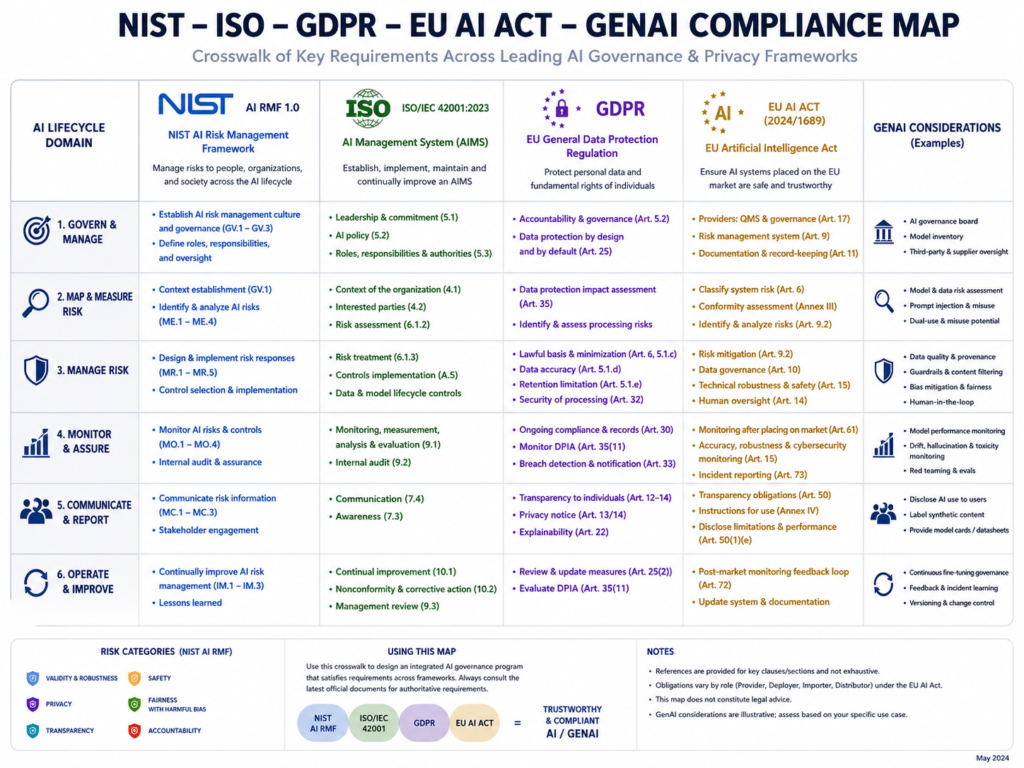
A strong GenAI vendor review should align with NIST AI RMF, ISO/IEC 42001, ISO 27001, GDPR/DSGVO, UK-GDPR, and the EU AI Act.
Mapping GenAI Vendor Due Diligence to NIST AI RMF
NIST developed the AI Risk Management Framework to help organizations manage risks to individuals, organizations, and society from AI systems. NIST also released a Generative AI Profile that uses Govern, Map, Measure, and Manage functions for GenAI-specific risks.
Map vendor questions to those functions.
| NIST AI RMF Function | Vendor Review Focus |
|---|---|
| Govern | Ownership, policies, accountability, escalation |
| Map | Use case, context, users, data sensitivity |
| Measure | Accuracy, bias, robustness, security, privacy |
| Manage | Remediation, monitoring, incident response, lifecycle review |
ISO/IEC 42001 and ISO 27001 Controls for AI Vendors
ISO/IEC 42001 is the world’s first AI management system standard and provides a structured way to manage AI risks and opportunities.
ISO 27001 remains important because GenAI vendors still need classic security controls, including asset management, access control, supplier management, incident response, business continuity, encryption, and risk assessment.
The best vendors can explain how AI governance connects with information security governance.
GDPR, DSGVO, UK-GDPR, and EU AI Act Considerations
The EU AI Act sets risk-based rules for AI developers and deployers, and the European Commission describes it as part of a wider trustworthy AI policy package focused on safety, fundamental rights, and human-centric AI.
In practice, vendor review should cover.
AI role classification
High-risk use cases
Transparency duties
Human oversight
Logs and technical documentation
Bias controls
Data protection obligations
Model provider dependencies
Post-deployment monitoring
GEO-Specific Due Diligence: USA, UK, Germany, and EU
Different regions prioritize different review points. The core risk questions stay similar, but evidence expectations can change.
USA.
In the United States, buyers in New York, San Francisco, Austin, and Washington DC often ask for SOC 2, NIST alignment, cyber insurance, incident commitments, and sector-specific terms.
US healthcare teams should review HIPAA when protected health information is involved. Payment workflows should account for PCI DSS, and the PCI Security Standards Council states that it develops and drives adoption of data security standards for safe payments worldwide.
UK.
UK buyers in London and Manchester should assess UK-GDPR obligations, DPIAs, processor terms, transfer mechanisms, and FCA or NHS-related expectations where relevant.
For NHS or health-tech use cases, vendor due diligence should be stricter around clinical safety, data access, audit logs, and human review. For FCA-regulated firms, explainability, outsourcing controls, resilience, and recordkeeping are especially important.
Germany and EU.
Germany and EU buyers should review DSGVO/GDPR, BaFin expectations for financial firms, DORA operational resilience, cross-border data transfers, and EU AI Act readiness.
For a Munich insurer, Frankfurt bank, Berlin SaaS provider, or Paris-based enterprise, the vendor should explain whether data stays in the EU, whether sub processors operate in approved regions, and whether model providers can access customer content.
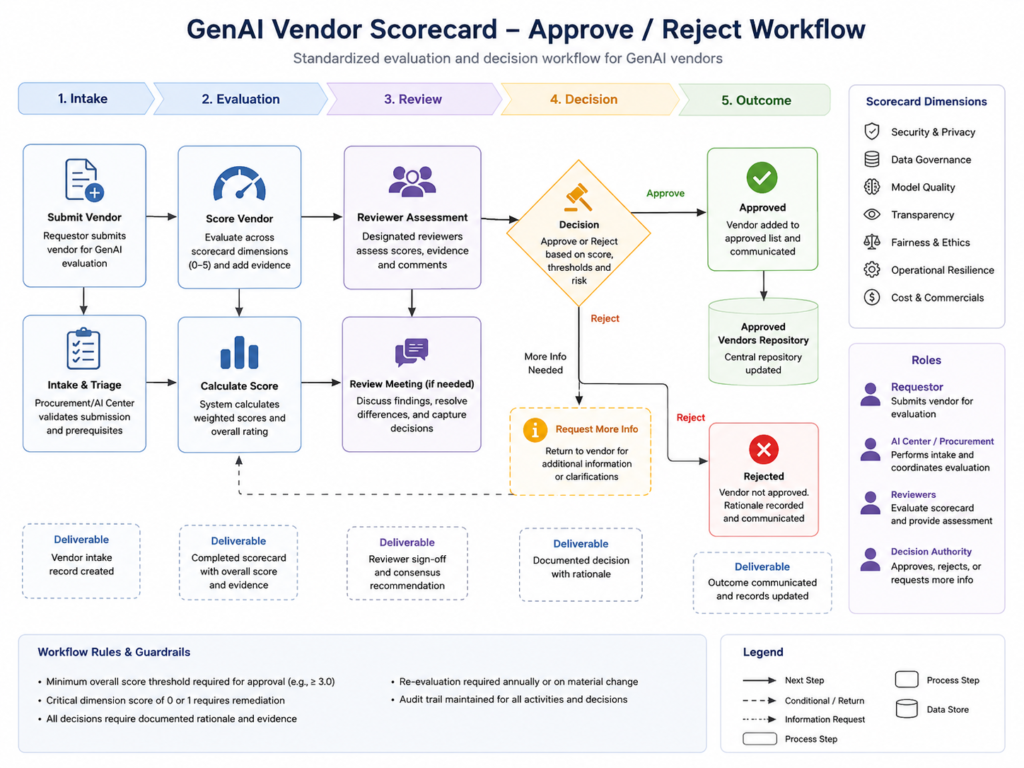
How to Score, Approve, or Reject a GenAI Vendor
High-risk GenAI vendors should be escalated when they process sensitive data, lack sub processor transparency, use customer data for model training by default, cannot support GDPR rights, lack audit evidence, or provide weak incident response commitments.
Score Risk by Use Case, Data Sensitivity, and AI Autonomy
Use three practical dimensions.
| Risk Dimension | What to Review |
|---|---|
| Use case risk | Internal productivity, customer support, regulated decision support, healthcare, finance, employment |
| Data sensitivity | Public data, confidential business data, personal data, PHI, payment data, source code, legal records |
| AI autonomy | Suggestions only, human-approved actions, system-triggered actions, autonomous agents |
A summarization tool for public marketing copy may be low risk. A GenAI agent that triggers payments, edits production code, reviews medical records, or supports credit decisions is high risk.
The more sensitive the data and the more autonomous the AI action, the stronger the approval controls should be.
Red Flags That Should Trigger Escalation
Escalate when the vendor.
Cannot answer basic model and data questions
Refuses to disclose sub processors
Lacks audit evidence
Trains on customer data by default
Uses vague retention terms
Cannot support deletion
Avoids incident response commitments
Has no audit logs
Cannot explain model providers
Claims full compliance without evidence
Be especially careful with vendors that claim EU AI Act, HIPAA, GDPR, or PCI DSS compliance without explaining scope, role, controls, and proof.
Approve, Conditionally Approve, or Reject
Approve low-risk vendors with strong evidence, clear contracts, and limited data access.
Conditionally approve vendors that need remediation, such as region controls, updated DPA terms, improved logging, or stronger retention commitments.
Reject vendors that cannot meet minimum security, privacy, compliance, or governance requirements.
For complex AI workflows, use Mak It Solutions’ AI Data Leakage Prevention Guide and Human-in-the-Loop AI Workflows to strengthen controls before rollout.
Downloadable GenAI Vendor Risk Questionnaire CTA
A GenAI vendor risk questionnaire turns scattered answers into a scorecard that legal, security, privacy, procurement, and business owners can use consistently.
Turn Checklist Answers Into a Vendor Scorecard
Create weighted categories for.
Security
Privacy
Compliance
Model governance
Operational resilience
Data residency
Commercial dependency
Evidence quality
Assign each answer a risk score and evidence status. A weak answer with no documentation should not receive the same score as a documented control.
Use the Questionnaire During Procurement, Renewal, and Monitoring
GenAI vendor review should not stop after onboarding.
Reassess vendors during.
Renewals
Major feature changes
Model provider changes
Sub processor updates
Security incidents
New regulated use cases
New data connections
AI products can change quickly. A safe approval from six months ago may not reflect today’s product architecture.
Align Security, Legal, Privacy, and Procurement
The best approval workflow is cross-functional.
Security reviews technical controls. Legal reviews contract terms. Privacy reviews data protection. Procurement reviews supplier risk. The business owner confirms intended use.
Planning to buy, renew, or deploy a GenAI vendor across the USA, UK, Germany, or EU? Mak It Solutions can help you turn this GenAI Vendor Risk Due Diligence Checklist into a practical vendor scorecard, AI governance workflow, and secure deployment roadmap. Start with a scoped estimate through the Mak It Solutions contact page or explore Mak It Solutions services.
Final Thoughts
A strong GenAI Vendor Risk Due Diligence Checklist helps teams move beyond standard SaaS reviews and assess the real risks behind AI tools. By reviewing data usage, model training, sub processors, retention, security controls, compliance evidence, and AI governance, organizations can make safer procurement decisions before sensitive data enters the system.
For teams across the USA, UK, Germany, and EU, the goal is not to block innovation. It is to approve the right vendors with the right safeguards. Use this checklist to score risk, close evidence gaps, and build a reliable approval workflow.
Key Takeaways
GenAI vendor risk due diligence must cover security, privacy, model governance, data use, retention, and AI supply chain dependencies.
Traditional SaaS reviews are not enough when vendors use LLMs, foundation models, embeddings, RAG, model APIs, or autonomous AI agents.
US teams should consider NIST AI RMF, SOC 2, HIPAA, and PCI DSS.
UK and EU teams should prioritize UK-GDPR, GDPR/DSGVO, DPIAs, data residency, and EU AI Act readiness.
Strong vendor evidence includes SOC 2, ISO 27001, ISO/IEC 42001 alignment, sub processor lists, DPIA support, incident response plans, model documentation, and audit logs.
Approve, conditionally approve, or reject vendors based on use case risk, data sensitivity, AI autonomy, and available evidence.
FAQs
Q : What questions should procurement ask before buying a GenAI tool?
A : Procurement should ask what data the tool collects, whether customer data is used for model training, where prompts and outputs are stored, which foundation models are used, and which sub processors are involved. Teams should also request SOC 2, ISO 27001, data processing terms, incident response procedures, retention settings, deletion rights, and AI governance documentation.
Q : Should GenAI vendors be reviewed during renewal as well as onboarding?
A : Yes. GenAI vendors should be reviewed during onboarding, renewal, major feature changes, new data connections, model provider changes, and sub processor updates. AI products can change quickly, so an approval from six months ago may not reflect the current risk.
Q : What are the biggest red flags in an AI vendor risk assessment?
A : Major red flags include vague data usage terms, customer-data training by default, no sub processor list, weak retention controls, no deletion process, missing SOC 2 or ISO evidence, unclear model providers, no DPIA support, poor incident response terms, and no audit logs.
Q : Do GenAI vendors need ISO 42001 certification?
A : Not always. ISO/IEC 42001 certification is helpful because it signals a structured AI management system, but it is not universally required for every GenAI vendor. Buyers should treat it as strong evidence, not the only evidence.
Q : How often should companies reassess high-risk AI vendors?
A : High-risk AI vendors should usually be reassessed at least annually, and sooner if the vendor changes models, hosting regions, subprocessors, retention terms, or product features. Reassessment should also happen after security incidents, regulatory changes, or expansion into sensitive use cases such as healthcare, finance, employment, identity, payments, or automated decision support.