



AI Security Monitoring Guide for Safer AI
AI security monitoring is now a board-level priority because GenAI systems can expose data, trigger tool actions, and leave compliance evidence gaps faster than traditional applications. For SaaS, fintech, healthcare, retail, and enterprise AI teams across the USA, UK, Germany, France, the Netherlands, Ireland, and the wider EU, the real question is no longer, “Are we using AI?” It is, “Can we prove our AI systems are secure?”
AI security monitoring helps teams detect risky AI activity by tracking prompts, outputs, users, APIs, model behavior, infrastructure, and audit trails. It gives SOC, compliance, and governance teams the evidence they need to reduce LLM risk, investigate incidents, and prepare for audits.
IBM’s 2025 breach research puts the global average breach cost at USD 4.44 million and warns that AI adoption is moving faster than security and governance in many organizations. Verizon’s 2026 breach reporting also highlights AI-driven exploitation and shadow AI as growing cybersecurity concerns.
That is why AI logs, audit trails, prompt injection detection, AI observability, and model telemetry now belong in the same conversation as SIEM, SOAR, IAM, DLP, and cloud security.
What Is AI Security Monitoring?
AI security monitoring is the continuous tracking of AI systems to detect misuse, leakage, abuse, and compliance gaps. It watches how users, prompts, models, retrieval systems, APIs, tools, and agents behave under real-world conditions.
Traditional application monitoring focuses on uptime, latency, errors, and infrastructure health. AI security monitoring goes deeper. It asks.
Who used the AI system?
What data did the model access?
What prompt or tool action created risk?
Was sensitive data exposed?
Did the system follow policy?
Can the team prove what happened later?
A web app in New York or London may only need standard authentication, access, and error logs. A GenAI assistant connected to CRM, payments, HR files, or clinical records needs stronger controls because a malicious prompt can manipulate outputs, retrieve sensitive context, or trigger unauthorized actions.
AI Security Monitoring vs AI Observability vs SIEM
AI security monitoring, AI observability, and SIEM monitoring overlap, but they are not the same thing.
| Area | Main Focus | Example Use |
|---|---|---|
| AI security monitoring | Threats, misuse, leakage, audit evidence | Detect prompt injection or unsafe tool use |
| AI observability | Performance, quality, cost, latency, drift | Track model errors or rising token costs |
| SIEM monitoring | Enterprise security events | Correlate AI activity with IAM, cloud, and endpoint logs |
The strongest setup connects all three. AI observability explains what the model is doing. SIEM adds enterprise context. AI security monitoring maps AI-specific risks like prompt injection, unsafe outputs, unauthorized retrieval, and agent misuse.
OWASP’s LLM guidance gives teams a practical vocabulary for risks such as prompt injection, sensitive information disclosure, insecure output handling, and excessive agency.
AI Security Logs Every Team Should Collect
Teams should keep AI security logs for prompts, outputs, API calls, user actions, model changes, data access, agent behavior, and security alerts. These logs help detect abuse, investigate incidents, and prove that controls existed before and after an event.
The goal is not to collect everything forever. The goal is to collect reliable, privacy-aware evidence.
User, Session, Identity, and Access Logs
Start with identity. Log.
User ID
Role and privilege level
Tenant or organization ID
Session ID
IP address
Device details
Authentication method
Failed access attempts
Admin actions
Region or geolocation where appropriate
For a SaaS platform in Austin, Dublin, or London, this helps answer the basics: Who used the AI system? Were they authorized? Did they access the correct tenant? Did privilege escalation happen before the incident?
Teams building secure portals can connect this with Mak It Solutions web development services and broader software supply-chain security planning.
Prompt, Response, Model, API, and Tool-Use Logs
AI security monitoring should capture prompt metadata, response metadata, model version, system prompt version, retrieval source IDs, API endpoint, tool call, function arguments, response classification, policy decision, refusal reason, and human override.
That does not mean every raw prompt should be stored forever. In practice, many teams are better served by redacted snippets, hashes, classifications, metadata, and risk scores.
Avoid blindly storing credentials, PHI, PCI data, source code, confidential IP, or unnecessary personal data.
Infrastructure, Cloud, Vector Database, and SIEM Logs
AI systems are not just models. They include cloud infrastructure, APIs, vector databases, retrieval pipelines, embeddings, secrets, containers, CI/CD workflows, and human review tools.
Log.
Cloud runtime events
Container and Kubernetes changes
Serverless execution
Database queries
Vector database retrievals
Embedding updates
Secrets access
Network flows
CI/CD changes
SIEM and SOAR alerts
For EU deployments, region placement also matters. A company using Frankfurt, Dublin, Amsterdam, or other EU cloud regions should log where AI data is processed, stored, and replicated. For analytics-heavy teams, Business Intelligence Services can help turn telemetry into usable dashboards.
AI Audit Logs for Forensics and Incident Investigation
AI audit logs matter because they create a traceable record of who used the AI system, what data was accessed, what actions were taken, and why an incident occurred.
During an investigation, logs separate assumptions from evidence.
A New York fintech may need to know whether PCI data was exposed. A London health tech handling NHS-related workflows may need proof of access control and data minimization. A Munich manufacturer may need to show whether an AI agent accessed regulated operational data.
What AI Audit Logs Prove
Strong AI audit logs can prove.
User identity
Access scope
Prompt and response history
Retrieval sources
Tool actions
Model version
Approval status
Policy decisions
Containment steps
Human review activity
They also help teams understand whether an incident came from malicious use, insecure retrieval, misconfiguration, excessive permissions, or unsafe automation.
LLM Audit Logs for Agents, Tools, and Human Approvals
LLM agents need detailed audit trails because they do things, not just say things.
For agents, log every planned action, tool call, permission check, API response, failed attempt, approval request, and human decision.
For RAG systems, log source document IDs, vector matches, confidence scores, tenant filters, and retrieval denials.
Human-in-the-loop systems should also record reviewer identity, timestamp, decision, escalation, and override reason. Mak It Solutions has covered scalable oversight patterns in its guide to human-in-the-loop AI workflows.
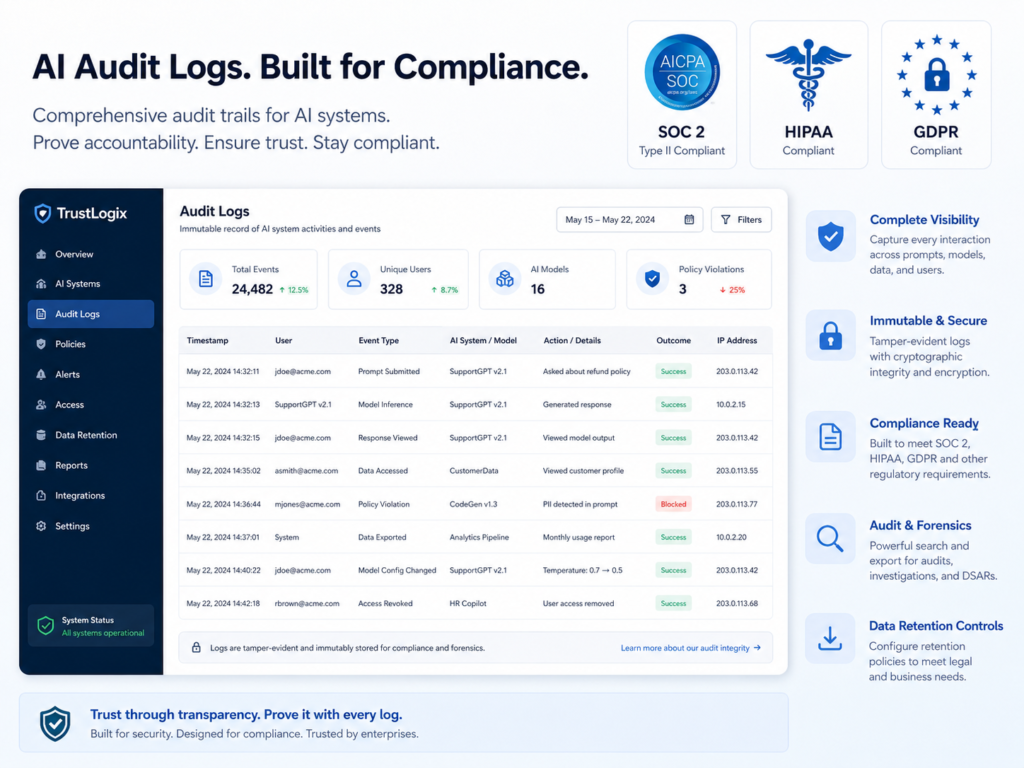
How Audit Trails Support SOC 2, HIPAA, ISO 27001, and PCI DSS
AI audit trails can support SOC 2 evidence, HIPAA security controls, ISO 27001 monitoring, PCI DSS access tracking, and incident response documentation.
For healthcare environments, HHS explains that the HIPAA Security Rule requires administrative, physical, and technical safeguards to protect electronic protected health information.
Without AI audit logs, teams may know something went wrong but not who caused it, what data moved, or which control failed.
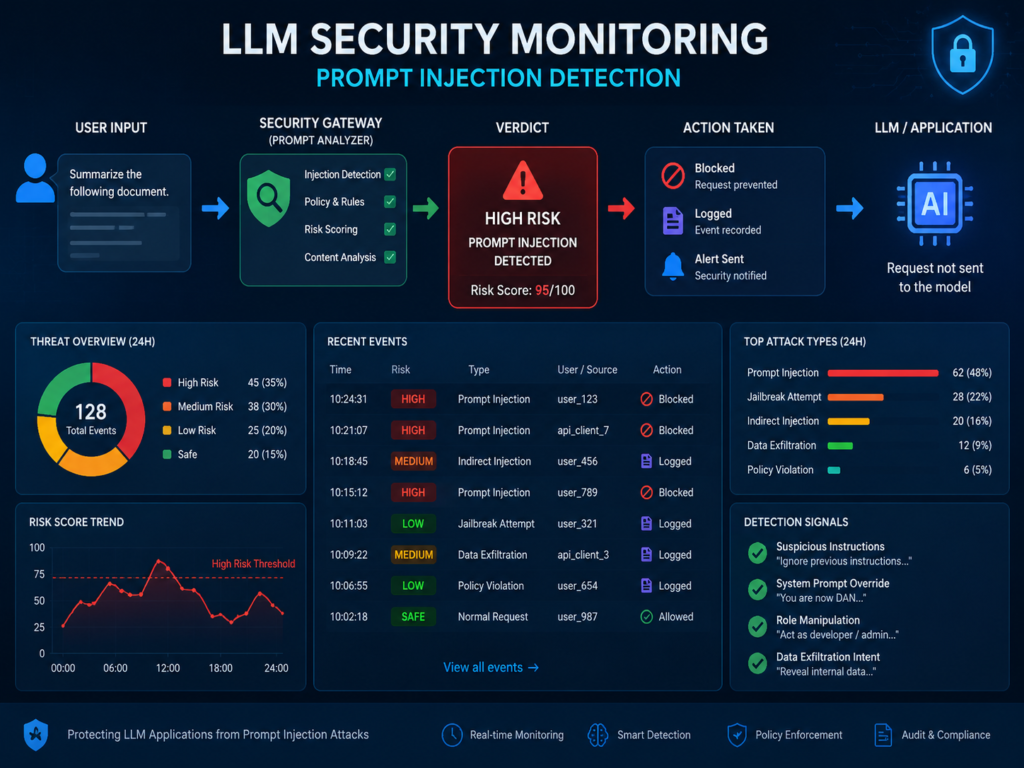
LLM Security Monitoring for Prompt Injection and Data Leakage
LLM security monitoring helps detect prompt injection, data exfiltration, abnormal usage, unsafe outputs, and abuse of connected tools or agents.
It should inspect both user intent and system behavior. Keyword matching alone is not enough.
Detecting Prompt Injection, Jailbreaks, and Policy Bypass
Prompt injection detection should monitor attempts to.
Override system instructions
Reveal hidden prompts
Ignore role boundaries
Bypass safety policies
Manipulate retrieved documents
Extract confidential rules
Trigger unauthorized tools
Watch for repeated jailbreak patterns, encoded instructions, unusual language shifts, and prompts that ask the AI to ignore previous instructions.
Monitoring Sensitive Data Exposure
Monitor for PII, PHI, PCI data, secrets, credentials, source code, contracts, confidential documents, and regulated records in prompts and outputs.
IBM’s 2025 report highlights the AI oversight gap, including the risk of organizations adopting AI faster than they can govern and secure it.
Strong AI data controls should connect with AI data leakage prevention, DLP, IAM, tenant isolation, and retrieval-level permissions.
AI Agent Monitoring for Tool Abuse
AI agents need stricter monitoring because they can take actions.
Log every tool request, permission check, API call, transaction, file access, email draft, database query, and human approval.
A San Francisco SaaS agent should not delete records without approval. A Frankfurt finance assistant should not move regulated customer data outside approved regions. A Paris support bot should not generate legal, medical, or financial advice without escalation.
For pre-launch testing, teams can use AI red teaming to find weaknesses before production.
AI Compliance Logging Across the USA, UK, Germany, and EU
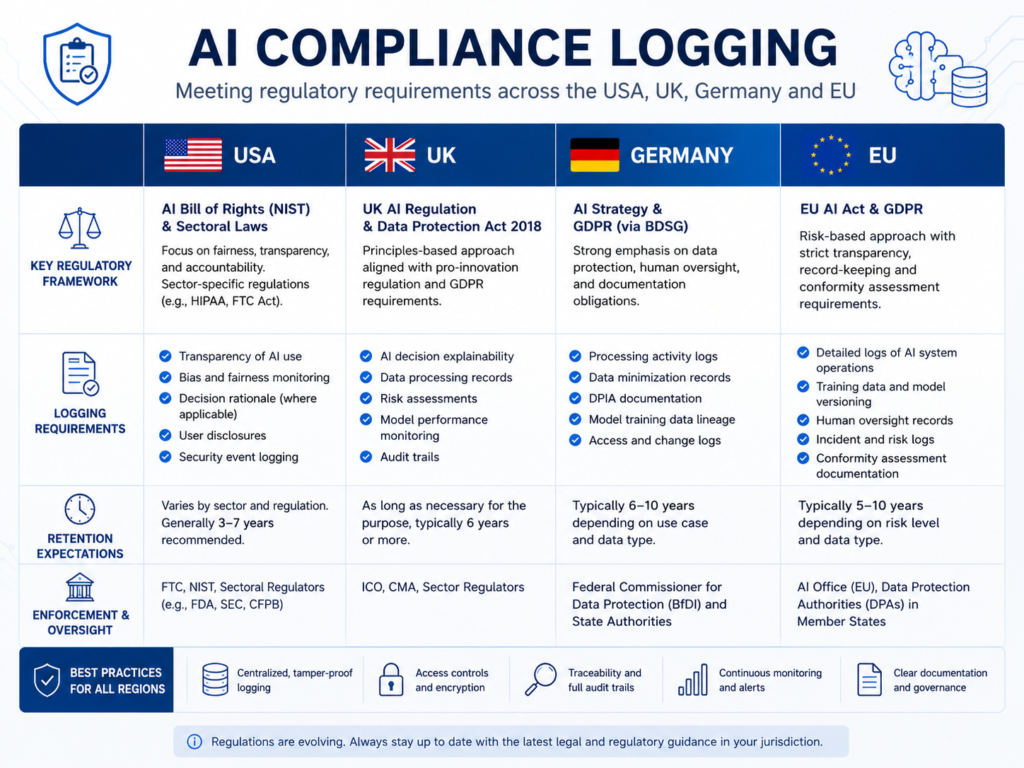
AI compliance logging should support accountability, retention, incident response, access control, and regulatory evidence without violating privacy or data minimization rules.
The right logging plan depends on geography, sector, data type, and AI risk level.
USA.
US SaaS teams often map AI logs to SOC 2 security, availability, confidentiality, privacy, and processing integrity.
Healthcare teams need to account for HIPAA expectations. Public companies and financial firms may also need to consider cyber disclosure, board reporting, vendor risk, and incident documentation.
In New York fintech or Austin SaaS environments, logs should show access control, vendor oversight, incident response, admin actions, and AI data handling.
UK.
UK teams should align logging with UK-GDPR, ICO expectations, NHS data requirements where relevant, FCA oversight, Open Banking security, and operational resilience.
A London health tech or Manchester fintech should avoid excessive prompt retention while still keeping enough evidence for investigation and compliance.
Germany and EU.
Germany and EU teams should design logs around GDPR/DSGVO, BaFin, DORA, NIS2, BSI, KRITIS, data residency, and EU AI Act obligations.
The EU AI Act entered into force on 1 August 2024, with phased application dates and many rules becoming applicable from 2 August 2026, subject to specific exceptions and later timelines. The Act also includes logging expectations for certain high-risk AI systems, including automatically generated logs.
For Berlin, Frankfurt, Munich, Amsterdam, Dublin, and Paris deployments, use region-aware cloud architecture and privacy-by-design principles. Mak It Solutions’ work on confidential computing for sensitive cloud workloads is relevant where encryption, region placement, and regulated analytics matter.
AI Security Monitoring Best Practices for Enterprise SOC Teams
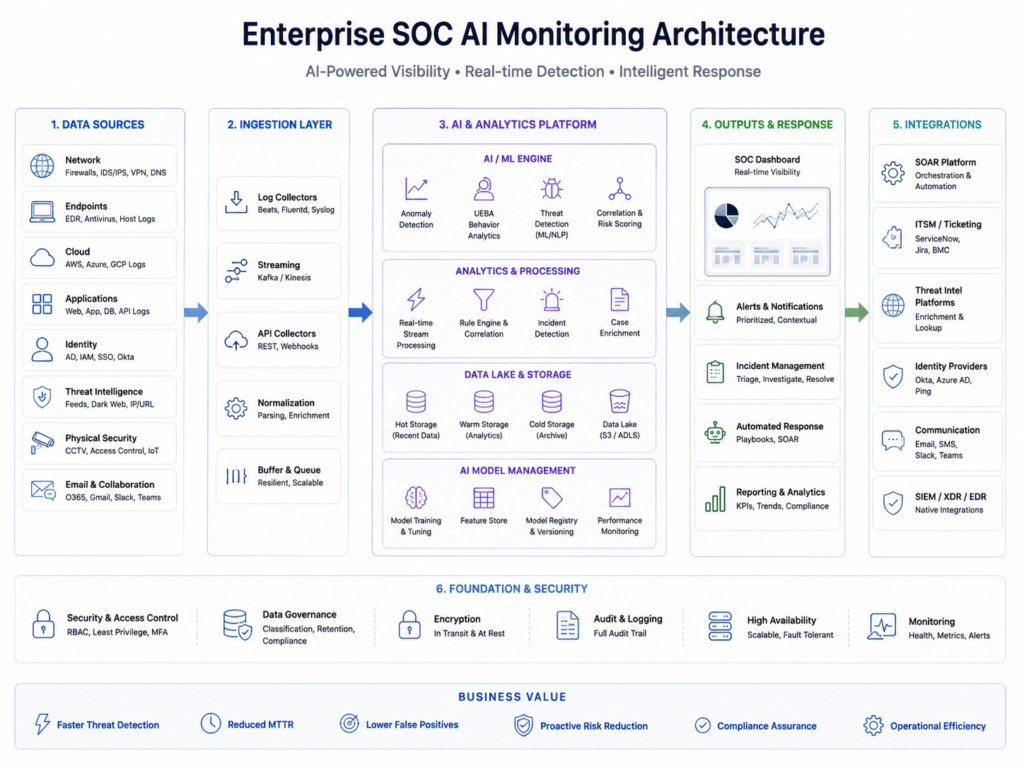
Best practice is to centralize AI telemetry, normalize log formats, redact sensitive data, monitor for abuse patterns, and map alerts to incident response playbooks.
SOC teams should treat AI systems as production attack surfaces, not experimental side projects.
Connect AI Logs to SIEM, SOAR, IAM, DLP, and Cloud Telemetry
Feed AI events into Splunk, Microsoft Sentinel, IBM QRadar, Elastic, Chronicle, or your preferred SIEM/SOAR stack.
Connect identity signals from IAM, data signals from DLP, and runtime signals from AWS, Azure, or Google Cloud.
Define Retention, Redaction, Access Controls, and Alert Thresholds
Set retention periods by data class and jurisdiction. Redact secrets, access tokens, payment data, health data, and unnecessary personal information.
Limit audit log access to authorized security, legal, and compliance users.
Alert on.
Unusual prompt volume
Repeated refusals
Retrieval spikes
Cross-tenant access attempts
Abnormal tool calls
Geographic anomalies
Policy bypass attempts
Unexpected model or system prompt changes
Use NIST AI RMF, OWASP LLM Guidance, and Internal Risk Controls
NIST’s AI Risk Management Framework helps organizations manage AI risks to individuals, organizations, and society. Its core functions are Govern, Map, Measure, and Manage.
Pair it with OWASP LLM guidance, ISO 27001 controls, SOC 2 criteria, and your internal risk register.
For customer-facing AI in mobile or web channels, combine monitoring with secure delivery practices across mobile app development and modern web architecture.
Choosing an AI Security Monitoring Solution
Choose an AI security monitoring solution that fits your AI stack, compliance obligations, data sensitivity, and SOC maturity.
SIEM alone is useful, but it often lacks prompt visibility, RAG context, agent behavior tracking, and model-level telemetry.
Build vs Buy
Build when your use case is narrow, your AI systems are mostly internal, and your engineering team can maintain detection logic.
Buy when you need faster deployment, compliance reports, prompt risk scoring, agent monitoring, vendor support, and integrations across cloud, IAM, DLP, and SIEM.
Features to Evaluate
Look for.
Prompt injection detection
Sensitive data redaction
Model telemetry
Anomaly detection
Retrieval logging
Tool-call controls
Audit exports
Retention rules
Regional hosting
SIEM and SOAR integration
Compliance reporting
Agent monitoring
A readiness assessment should map your AI systems, data flows, logs, risks, compliance obligations, and detection gaps. It should end with a practical roadmap: what to log, what to redact, what to alert on, and what evidence to keep.
Final Thoughts
AI security monitoring is not just another dashboard. It is the evidence layer that helps teams detect risk, investigate incidents, protect sensitive data, and prove that AI systems are governed.
Planning a GenAI assistant, RAG workflow, AI agent, or enterprise copilot? Mak It Solutions can help you scope an AI security monitoring readiness assessment across cloud, SaaS, mobile, data analytics, and compliance architecture.
Start with a practical review of your current AI logs, audit trails, and SOC workflows through the Mak It Solutions contact page.
Key Takeaways
AI security monitoring tracks prompts, outputs, users, APIs, tools, agents, infrastructure, and model telemetry.
AI audit logs help prove who accessed data, what actions occurred, and how incidents unfolded.
LLM monitoring should detect prompt injection, jailbreaks, sensitive data exposure, abnormal retrieval, and tool abuse.
USA, UK, Germany, France, the Netherlands, Ireland, and EU teams must balance compliance evidence with privacy and data minimization.
SOC teams should connect AI logs to SIEM, SOAR, IAM, DLP, cloud telemetry, and incident playbooks.
Vendor selection should prioritize prompt visibility, anomaly detection, compliance reporting, agent monitoring, and regional data controls.
FAQs
Q : How long should AI security logs be retained?
A : AI security log retention depends on your industry, geography, data type, and audit obligations. Many teams keep security logs for 90 days to one year, while regulated sectors may need longer retention for SOC 2, HIPAA, PCI DSS, financial services, or EU AI Act evidence.
Q : Should AI prompts and outputs be stored in audit logs?
A : Prompts and outputs can be stored, but not always in raw form. Store metadata, risk scores, model version, policy decisions, retrieval sources, and redacted snippets where needed. Avoid keeping unnecessary personal data, credentials, PHI, PCI data, or confidential IP.
Q : Can AI security monitoring help with SOC 2 evidence?
A : Yes. AI security monitoring can support SOC 2 evidence by showing access control, monitoring, incident response, change management, vendor oversight, data protection, and risk assessment activity. It does not replace a SOC 2 audit, but it gives auditors stronger evidence that AI systems are controlled, monitored, and reviewed.
Q : What is the difference between AI observability and AI security monitoring?
A : AI observability focuses on performance: latency, cost, accuracy, drift, token usage, model quality, and failures. AI security monitoring focuses on threats: prompt injection, data leakage, unauthorized access, unsafe outputs, agent misuse, and compliance evidence.
Q : How do companies reduce privacy risk when logging AI activity?
A : Companies reduce privacy risk by logging only what they need, redacting sensitive data, encrypting logs, limiting access, separating tenants, defining retention periods, and reviewing logs against GDPR, UK-GDPR, HIPAA, PCI DSS, and internal policies.