

AI Policy as Code for Enterprise Control
AI policy as code is becoming essential as enterprises move from AI pilots to production AI systems, copilots, and autonomous agents. It turns AI governance rules into machine-readable controls that can be tested, enforced, logged, and audited automatically.
In simple terms, AI policy as code helps enterprises govern models, prompts, data access, AI agents, and approval workflows at scale. Instead of relying only on spreadsheets, review boards, and manual sign-offs, governance teams can enforce responsible AI rules directly inside real business systems.
For companies in New York, London, Berlin, Munich, Frankfurt, Paris, Amsterdam, Dublin, Zurich, and San Francisco, the pressure is rising. AI adoption is accelerating, while regulators, auditors, customers, and boards expect stronger AI risk management, machine-readable governance, and AI auditability.
Stanford HAI reported that 78% of organizations used AI in 2024, up from 55% the year before. The same report found that generative AI attracted $33.9 billion in global private investment in 2024.
What Is AI Policy as Code?
AI policy as code means converting AI governance rules into machine-readable policies that can automatically enforce controls, approvals, audit logs, and compliance checks across AI systems. It makes AI governance operational, not just theoretical.
AI Policy as Code Explained in Simple Terms
Think of AI policy as code as a digital rulebook that software can understand.
A human policy might say: “Do not send protected health information to an unapproved model.”
A code-based policy can check the model, user role, data type, consent status, and region before the request is allowed.
For example, a healthcare SaaS platform serving US clinics could block HIPAA-sensitive prompts unless the model endpoint, logging setup, and business associate controls are approved. A fintech team in London could require human approval before an AI agent sends customer-facing investment guidance.
How It Differs from Traditional AI Governance
Traditional AI governance often depends on committees, policy documents, model inventories, and periodic reviews. Those practices still matter, but they can lag behind fast-moving product teams, AI agent deployments, and cloud-based workflows.
AI policy as code adds automation.
It can check rules at runtime, during deployment, or inside CI/CD pipelines. That means governance teams can move from “review after the fact” to “prevent, detect, and prove.”
Why Machine-Readable AI Policies Matter
Machine-readable AI policies matter because modern AI systems operate across APIs, SaaS platforms, databases, vector stores, and cloud services. Manual review cannot reliably inspect every prompt, model response, tool call, data transfer, and agent action.
This is where business intelligence and analytics capabilities become useful. Governance teams need dashboards, evidence trails, and risk signals that turn technical events into decisions executives can understand.
Why Enterprises Need AI Policy as Code Now
Enterprises need AI policy as code because AI risk now spans compliance automation, agentic AI governance, auditability, and scalable controls across business units.
The more AI becomes embedded in workflows, the harder it becomes to govern with manual approvals alone.
Manual AI Governance Cannot Scale with AI Agents
AI agents can summarize contracts, trigger workflows, query databases, write code, open tickets, send emails, and call external tools. That creates speed, but it also creates new risk.
A public sector team in Washington DC, an insurance company in Manchester, or a SaaS vendor in Amsterdam may have hundreds of AI-enabled workflows running across departments. Without automated controls, governance teams are forced to chase exceptions instead of preventing them.
Reducing Risk Across Models, Data, Prompts, and Workflows
AI policy as code helps reduce risk across the full AI stack.
Model selection
Prompt handling
Data access
Tool use
User permissions
Output review
Retention
Human approval
This is especially important where sensitive data is involved, such as healthcare, financial services, insurance, and enterprise SaaS.
IBM’s 2025 Cost of a Data Breach Report placed the global average breach cost at $4.4 million. IBM also highlighted an “AI oversight gap,” noting that ungoverned AI systems are more likely to be breached and more costly when they are.
From Responsible AI Principles to Enforceable Controls
Responsible AI principles are important, but principles alone do not stop a risky agent from accessing restricted data.
AI policy as code turns principles such as fairness, explain ability, privacy, security, and human oversight into enforceable logic.
For enterprises building AI-enabled platforms, custom software development and web systems can embed these controls directly into applications instead of treating governance as a separate checklist.
AI Governance Automation and Control Architecture
AI governance automation uses automated controls, monitoring, workflows, and audit trails to reduce manual governance effort and improve oversight.
It gives legal, compliance, security, product, and engineering teams a shared control layer for AI risk management.
AI Control Planes, Guardrails, and Policy Engines
An AI control plane is the governance layer that coordinates policies, permissions, model access, monitoring, and evidence.
It may include.
Policy engines
Guardrail services
Identity systems
Logging pipelines
Model registries
GRC integrations
Human approval workflows
Guardrails can block unsafe prompts, redact sensitive information, restrict model use by geography, require escalation for high-risk outputs, or route decisions to a human reviewer.
Policy engines such as Open Policy Agent can help express rules consistently, although not every enterprise needs OPA or Rego on day one.
Automated AI Risk Management Using NIST AI RMF
The NIST AI Risk Management Framework gives organizations a structured way to govern, map, measure, and manage AI risks. It is voluntary, but useful for enterprises that need a common AI risk language across product, security, compliance, and executive teams.
For example, a San Francisco SaaS company might map AI use cases, score model risks, monitor drift, and enforce escalation policies for customer-impacting workflows.
A New York financial services firm might connect policy checks to SOC 2 controls, FINRA expectations, SEC recordkeeping, and internal model risk management.
Where Policy as Code Fits in an AI Governance Framework
Policy as code fits between governance design and operational enforcement.
The framework defines what must happen. The code-based policy helps make it happen repeatedly.
It works best when connected to identity management, cloud logs, data classification, model registries, ticketing, and audit reporting. Teams using React development services or enterprise portals can also expose policy decisions clearly to reviewers, admins, and business users.
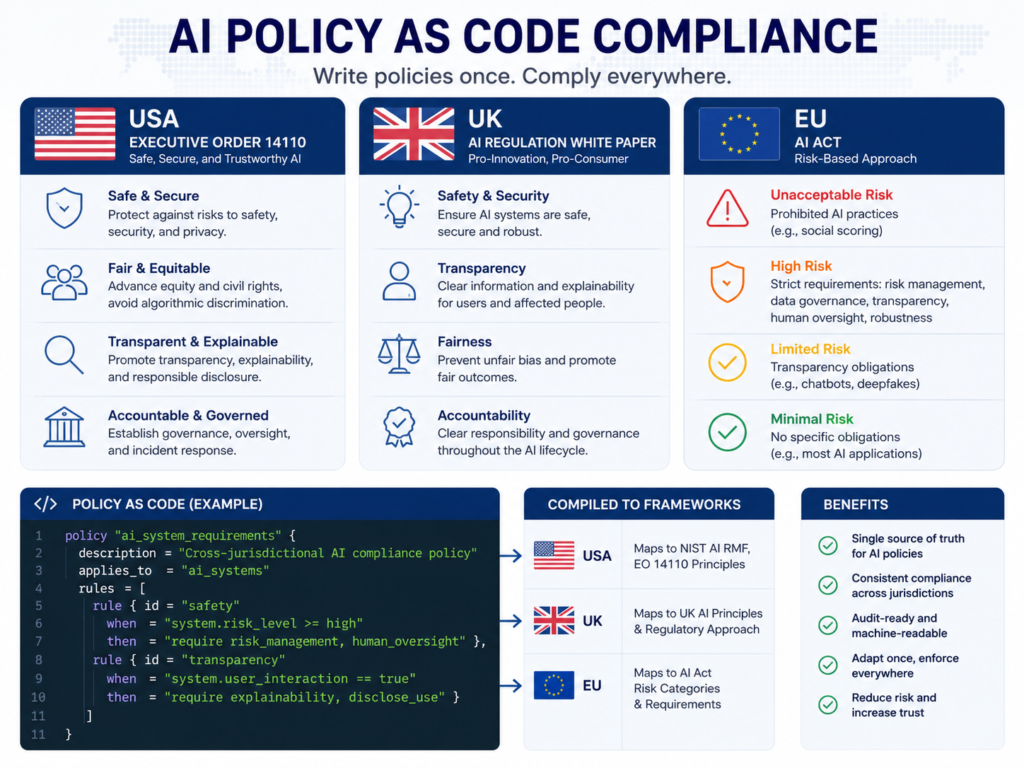
AI Policy as Code for Compliance Across the USA, UK, and EU
AI policy as code helps compliance teams create repeatable evidence, enforce risk controls, and document AI decisions for audits across sector-specific and regional regulations.
It does not replace legal advice, but it can make compliance more measurable and easier to prove.
USA.
In the USA, AI governance often intersects with NIST AI RMF, SOC 2, HIPAA, PCI DSS, FINRA, SEC expectations, and sector-specific security programs.
Healthcare organizations should align AI controls with HIPAA/HHS privacy and security requirements, especially when models process protected health information.
A hospital technology vendor in New York could use policy as code to block unapproved PHI transfers, require encryption, record access events, and enforce human review before an AI-generated clinical communication is sent.
UK.
In the UK, AI policy as code can support UK GDPR accountability, FCA and PRA operational resilience, and NHS AI assurance practices.
The UK ICO has published guidance on AI and data protection, including topics such as accountability, transparency, lawfulness, fairness, security, data minimization, and individual rights.
A fintech in London could enforce policies that prevent AI agents from making regulated recommendations without an approved workflow. A health tech team in Manchester could log dataset provenance, clinical safety checks, and approval steps for NHS-facing tools.
Germany/EU.
For Germany and the EU, AI policy as code is especially relevant to the EU AI Act, GDPR/DSGVO, BaFin expectations, and DORA.
The EU AI Act entered into force on August 1, 2024. The European Commission describes it as the first-ever comprehensive legal framework on AI worldwide, with a risk-based approach for developers and deployers.
How does AI policy as code help with EU AI Act readiness?
It can support.
Risk classification
Technical documentation
Human oversight
Logging
Access control
Data governance
Post-market monitoring
Incident evidence
A bank in Frankfurt, an insurer in Munich, or a cloud platform in Dublin can use code-based policies to prove that high-risk AI workflows follow approved controls.
DORA also raises the importance of ICT risk management and operational resilience for financial entities in the EU. For regulated enterprises, this makes AI auditability and control evidence just as important as model performance.
Agentic AI Governance and AI Agent Guardrails
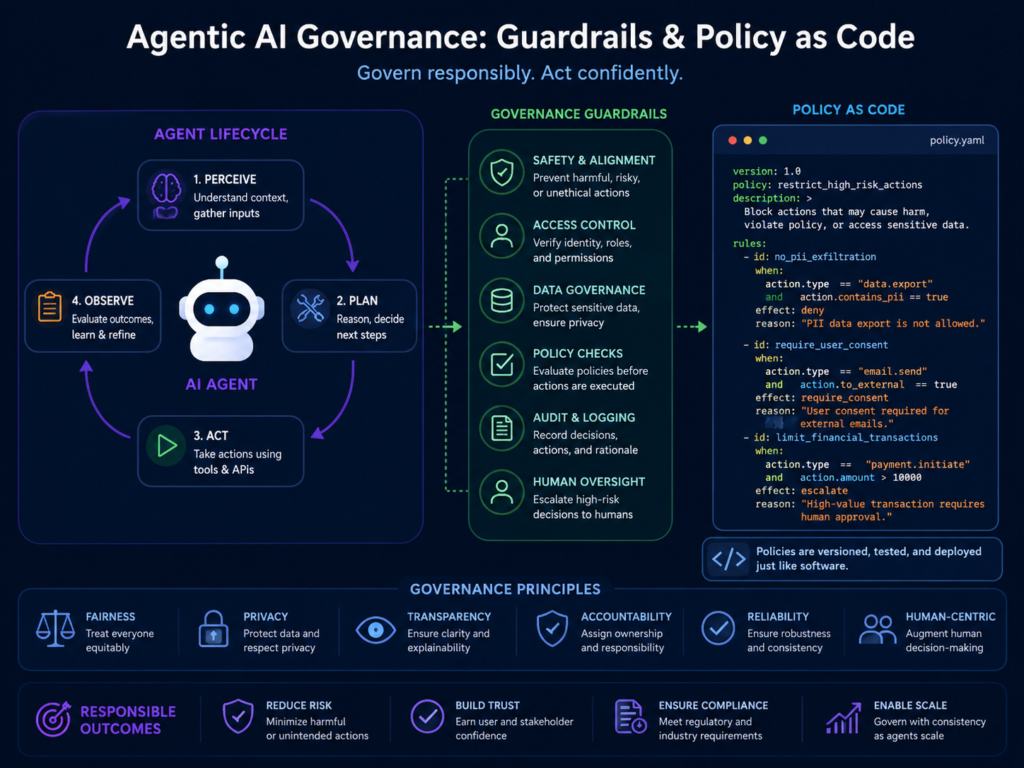
Agentic AI governance requires policies that can limit autonomous actions, enforce approvals, log decisions, and prevent agents from exceeding business or compliance boundaries.
Enterprises need policy as code for AI agents because agents can act, not just answer.
Why AI Agents Need Deterministic Controls
AI agents are probabilistic in reasoning, but they must operate within deterministic business boundaries.
An agent may choose different paths to complete a task, but it should not bypass approval, access restricted records, or trigger payments beyond its authority.
For example, an insurance claims agent can summarize documents and recommend next steps, but a policy should require human approval before denial, payout, or customer notification.
Policy Enforcement for Tool Use, Data Access, and Human Approval
Agent policies should define:
| Control Area | What the Policy Should Decide |
|---|---|
| User access | Who can use the agent |
| Tool access | Which systems and tools the agent can call |
| Data access | Which records, files, or databases are allowed |
| Approval rules | When a human reviewer must step in |
| Prohibited actions | What the agent must never do |
| Evidence | What must be logged for audit review |
This matters in financial services, healthcare, SaaS support, public sector services, and enterprise AI agent deployments.
A Berlin enterprise using AI agents for procurement could block vendor changes without approval. A Zurich wealth management firm could prevent agents from sending investment advice. A cloud support team in Austin could restrict agents from accessing production secrets.
Logging, Monitoring, and Kill-Switch Patterns for AI Agents
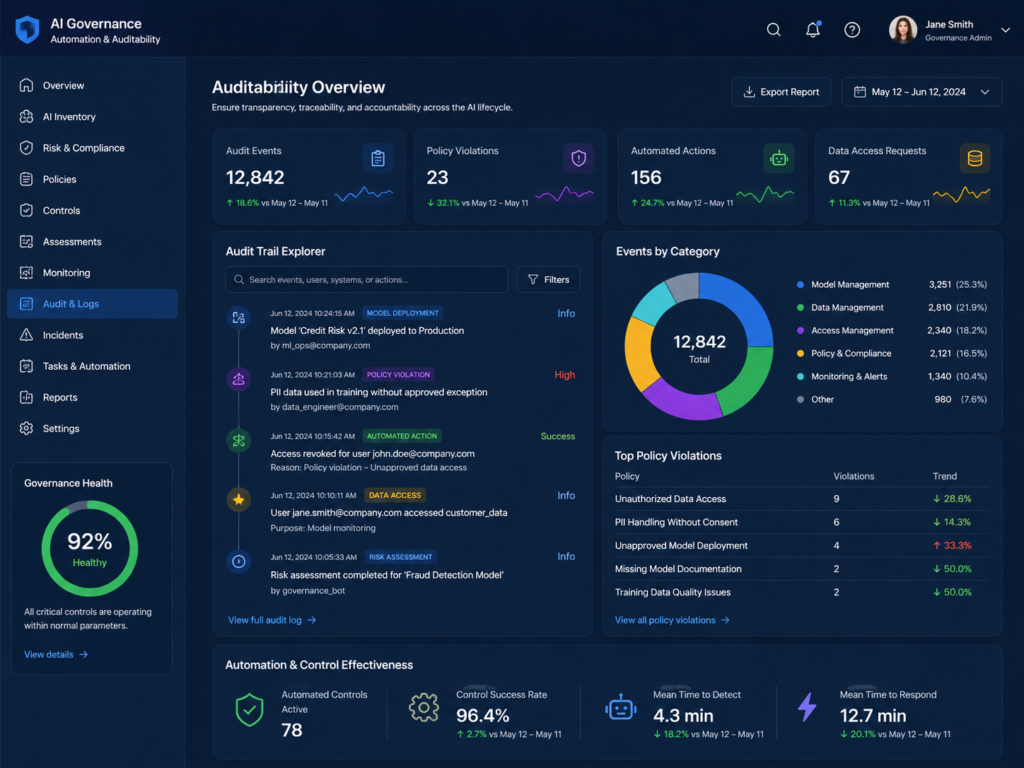
AI agents need logs that capture prompts, retrieved data sources, tool calls, policy decisions, approvals, errors, and final outputs.
They also need monitoring for abnormal behavior, excessive permissions, unexpected data access, and policy violations.
A kill switch is a practical safety pattern. If an agent begins calling tools too frequently, accessing restricted systems, or producing unsafe outputs, the platform can pause the agent, revoke tokens, notify security, and preserve evidence.
How to Implement AI Policy as Code at Scale
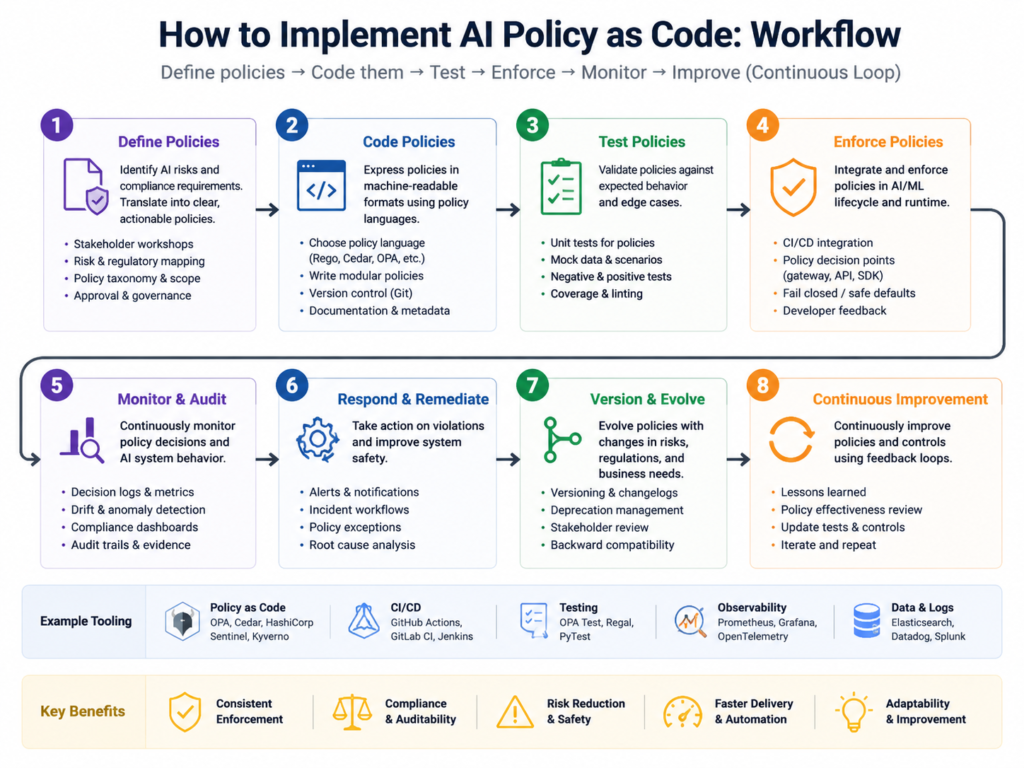
To implement AI policy as code, enterprises should map risks, define policy logic, integrate controls into AI workflows, monitor enforcement, and maintain audit-ready evidence.
Start with high-risk use cases rather than trying to automate every policy at once.
Map AI Use Cases, Risks, and Regulations
Begin by creating an AI system inventory.
List.
Models
Prompts
Datasets
Venors
Business owners
User groups
Jurisdictions
Downstream impacts
Then map risks against NIST AI RMF, EU AI Act, GDPR, UK GDPR, HIPAA, PCI DSS, SOC 2, ISO/IEC 42001, ISO 27001, DORA, FCA, PRA, BaFin, FINRA, SEC, NHS, and HHS requirements where relevant.
ISO/IEC 42001 is the world’s first AI management system standard. It specifies requirements for establishing, implementing, maintaining, and continually improving an AI management system within organizations.
Translate Governance Rules into Code-Based Controls
Next, turn policy statements into testable rules.
For example:
“Customer PII must not be sent to unapproved models” becomes a policy that checks data classification, model approval status, region, consent, and purpose.
“High-risk outputs require human review” becomes a workflow rule that blocks completion until an authorized reviewer approves the action.
Teams building AI-enabled apps can use mobile app development services and secure API architecture to embed these controls into customer-facing and internal products.
Monitor, Audit, and Improve Policies Continuously
Policy as code is not a one-time setup.
AI systems change. Regulations evolve. Business use cases expand. Models drift.
Monitor blocked requests, false positives, exceptions, approval delays, data access events, and agent actions. Feed that evidence into dashboards, audit packs, and risk reviews.
For executive reporting, SEO and analytics-led digital visibility work is different from AI governance, but the same principle applies: measure what matters, then optimize continuously.
Choosing the Right AI Policy-as-Code Strategy
The best AI policy-as-code strategy depends on regulatory exposure, AI maturity, audit requirements, and whether the company needs custom controls, vendor tooling, or hybrid governance architecture.
Regulated enterprises should prioritize auditability, integration depth, and operational ownership.
Build vs. Buy.
Building gives engineering teams flexibility, especially when AI workflows are deeply embedded into proprietary SaaS, cloud, or data platforms.
Buying can accelerate implementation through prebuilt controls, dashboards, model inventories, and regulatory mapping.
Many enterprises choose a hybrid approach: policy engines and custom integrations for runtime enforcement, plus GRC or AI governance tools for documentation, approvals, and audit workflows.
Evaluation Checklist for Regulated Enterprises
When comparing AI policy-as-code tools or architectures, look for support across.
Policy testing
Role-based access
Model inventories
Prompt logging
Evidence retention
Human approval workflows
Data residency
Cloud regions
AWS, Azure, and GCP integrations
SIEM, CI/CD, and ticketing integrations
Also confirm whether the approach supports EU AI Act readiness, NIST AI RMF mapping, GDPR/UK GDPR workflows, SOC 2 evidence, ISO/IEC 42001 alignment, and sector needs such as HIPAA, PCI DSS, FCA, BaFin, FINRA, or SEC requirements.
When to Prioritize AI Compliance Automation First
Prioritize AI compliance automation first when AI touches regulated data, customer decisions, financial transactions, healthcare workflows, employee monitoring, insurance underwriting, credit decisions, or public sector services.
A company with several low-risk internal copilots may start with inventory and logging. A fintech, health tech, or insurance platform using AI agents should move faster toward deterministic approvals, policy enforcement, and audit-ready evidence.
Final Thoughts
AI policy as code gives enterprises a practical way to govern AI at the same speed they deploy it. It helps teams move beyond static policies and into enforceable controls for models, prompts, data, agents, approvals, and audit evidence.
For regulated businesses in the USA, UK, Germany, and the EU, this matters now. AI is already inside customer workflows, internal operations, and decision systems. Governance has to be just as operational.
Mak It Solutions helps businesses design secure, scalable software systems, data workflows, and digital products that support modern AI governance needs. Explore our software and technology services or contact the team to request a scoped estimate for your AI governance, compliance automation, or enterprise platform project.
Key Takeaways
AI policy as code turns responsible AI principles into enforceable, machine-readable governance controls.
Enterprises need it most when AI systems handle regulated data, customer-impacting decisions, or autonomous agent actions.
Policy engines, guardrails, AI control planes, monitoring, and audit logs work together to support scalable AI governance.
NIST AI RMF, EU AI Act, GDPR, UK GDPR, HIPAA, PCI DSS, SOC 2, ISO/IEC 42001, DORA, FCA, BaFin, FINRA, and SEC requirements can all influence policy design.
Build, buy, or hybrid strategies should be chosen based on AI maturity, audit pressure, integration needs, and regulatory exposure.
Strong implementation starts with use-case mapping, risk classification, code-based controls, monitoring, and continuous improvement.
FAQs
Q : Is AI policy as code the same as AI governance automation?
A : Not exactly. AI governance automation is the broader operating model for automating approvals, reviews, monitoring, reporting, and evidence collection. AI policy as code is one method inside that model: it converts governance rules into machine-readable logic that systems can enforce.
Q : Can policy as code support both NIST AI RMF and the EU AI Act?
A : Yes. Policy as code can support both NIST AI RMF and EU AI Act readiness by translating risk controls into repeatable checks. A shared policy layer can map controls to both frameworks, reducing duplicate work across US and EU compliance teams.
Q : Which teams should own AI policy-as-code implementation?
A : Ownership should be shared. Legal and compliance define obligations, risk teams set control requirements, security manages access and monitoring, data teams classify information, and engineering implements runtime enforcement. Product owners should also be involved because policies affect user experience and workflow design.
Q : Does AI policy as code require Open Policy Agent or Rego?
A : No. Open Policy Agent and Rego are common options, but they are not mandatory. Some companies use custom rule services, cloud-native policy tools, GRC platforms, feature flag systems, workflow engines, or AI governance products.
Q : How does AI policy as code improve audit readiness?
A : AI policy as code improves audit readiness by creating consistent evidence. Instead of relying only on interviews and screenshots, teams can show policy logic, enforcement logs, approvals, exceptions, access records, and monitoring history.