


Multi-Cloud Strategy MENA: Win in GCC Markets
Multi-Cloud Strategy MENA: Win in GCC Markets
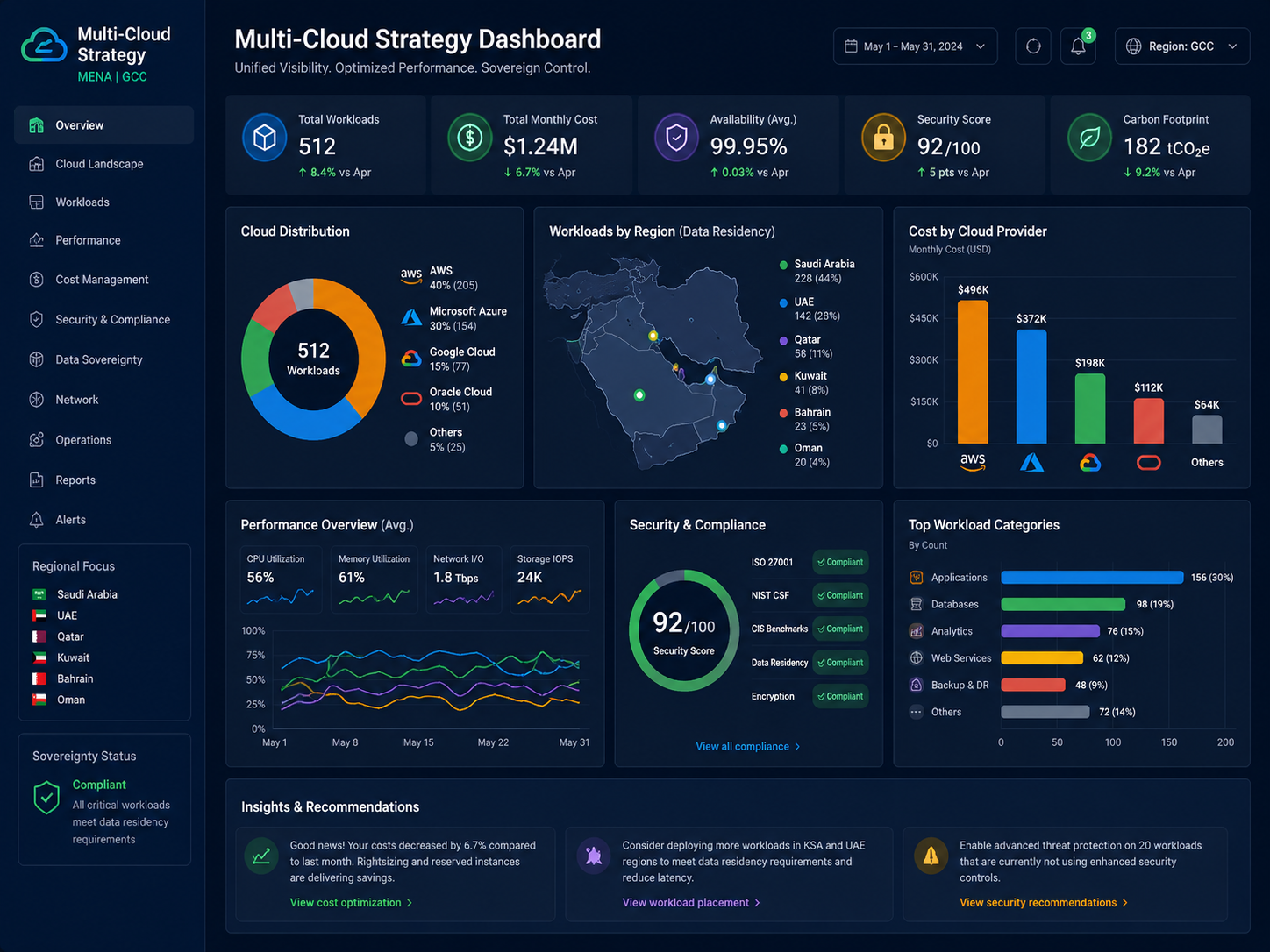
Multi-Cloud Strategy MENA: Win in GCC Markets
A multi-cloud strategy MENA helps GCC businesses use more than one cloud provider to improve resilience, compliance, performance, and workload flexibility. It works best when teams in Saudi Arabia, the UAE, and Qatar decide governance, cost control, data residency, and vendor risk before migration.
For many GCC companies, multi-cloud is not about using every cloud available. It is about choosing the right cloud for the right workload, with clear rules for security, compliance, cost, and business continuity.
Introduction
GCC companies are scaling quickly across Riyadh, Dubai, Abu Dhabi, Jeddah, and Doha. For CIOs and business leaders, a multi-cloud strategy MENA is no longer just a technical preference. It affects uptime, customer experience, compliance confidence, and long-term vendor flexibility.
Used well, multi-cloud can reduce dependency on one provider and improve resilience. Used badly, it can create cost duplication, identity sprawl, fragmented monitoring, and more compliance pressure.
That is why Saudi, UAE, and Qatar teams need a practical decision framework before spreading workloads across AWS, Azure, Google Cloud, Oracle Cloud, local GCC clouds, private infrastructure, or on-premise systems.
For digital teams, this should connect with broader custom software development and GCC IT support planning, not sit as a separate infrastructure project.
What Is Multi-Cloud Strategy in MENA?
A multi-cloud strategy MENA means using two or more cloud environments to run applications, data, analytics, AI, backups, or disaster recovery across Middle East and North Africa markets.
In practice, a Riyadh fintech may use one cloud for enterprise systems, another for scalable customer apps, and a local or sovereign option for regulated data. A Dubai retailer may use one platform for mobile commerce and another for analytics. A Doha financial services company may keep sensitive systems under strict Qatar-specific controls while using cloud-native tools for reporting or customer engagement.
Multi-Cloud vs Single Cloud in GCC Markets
A single-cloud model places most workloads with one provider. It can be simpler to manage, easier to govern, and often more cost-efficient for smaller teams.
Multi-cloud spreads selected workloads across more than one provider. This can help with resilience, negotiation power, data placement, and workload fit. But it also requires stronger governance.
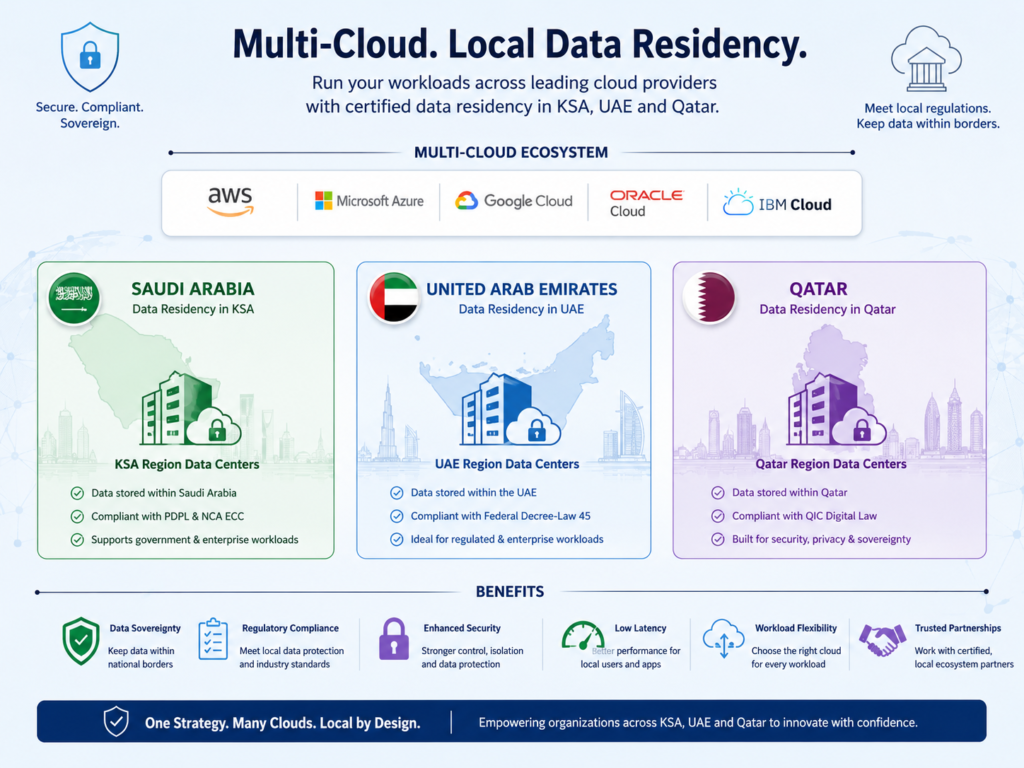
AWS lists Middle East regions in Bahrain and the UAE, Microsoft Azure lists UAE and Qatar regions, Google Cloud lists global regions with Dammam access documentation, and Oracle lists Saudi and UAE cloud regions including Riyadh, Jeddah, Dubai, and Abu Dhabi.
Multi-Cloud vs Hybrid Cloud in GCC
Multi-cloud means using multiple cloud providers.
Hybrid cloud means connecting cloud with private infrastructure, on-premise systems, or dedicated environments.
For example, a Qatar bank may keep sensitive core banking systems in a controlled private environment while using public cloud for analytics, testing, or customer-facing services. Many GCC companies eventually use both models together.
When Multi-Cloud Helps GCC Companies
Better Resilience Across Riyadh, Dubai, and Doha Workloads
Multi-cloud helps when downtime would damage revenue, trust, or regulatory confidence.
For example, a customer-facing platform serving users in Saudi Arabia, the UAE, and Qatar may need disaster recovery across regions, availability zones, and providers. The goal is not just to “have another cloud.” The goal is to keep critical services running when one environment has an outage, network issue, configuration failure, or contract limitation.

Reduced Vendor Lock-In for Fast-Growing MENA Firms
Vendor lock-in becomes risky when one provider controls too much of your pricing, tooling, architecture, migration path, and roadmap.
A well-designed multi-cloud approach gives procurement and technology teams more room to negotiate. It also supports workload portability when systems are built with containers, open APIs, infrastructure-as-code, and clear exit plans.
The key phrase is “well-designed.” Moving workloads between clouds is rarely simple unless portability is planned from the start.
Better Workload Fit Across Finance, Retail, Government, and Logistics
Different clouds are strong in different areas. Some teams may choose a provider for enterprise productivity integration. Others may prefer a platform for AI, analytics, ERP, compliance features, or regional availability.
A Riyadh fintech may prioritise SAMA-aligned controls. A Dubai e-commerce brand may need mobile app development support and scalable cloud APIs during peak campaigns. A Doha logistics SME may use business intelligence services while keeping regulated data under local review.
From a small business point of view, multi-cloud only makes sense when each cloud has a clear job.
When Multi-Cloud Hurts Saudi, UAE, or Qatar Businesses
Cloud Cost Duplication and Weak FinOps
Multi-cloud can quietly become expensive.
Teams often duplicate monitoring tools, backup storage, security platforms, test environments, and support contracts. Egress fees, idle resources, poor tagging, and unclear workload ownership can make monthly cloud bills difficult to explain.
A GCC company should not adopt multi-cloud before it can answer a simple question: who owns cost governance across every cloud?
Fragmented Security Across Multiple Cloud Platforms
Identity sprawl is one of the biggest risks.
If every cloud has separate admin accounts, access rules, logs, encryption settings, and monitoring tools, attackers have more gaps to exploit. This is where zero trust planning for GCC SMEs becomes practical rather than theoretical.
A strong multi-cloud setup needs one security model, not three disconnected ones.
Skills Shortages and Operational Complexity
Multi-cloud needs mature cloud operations, DevOps, security monitoring, compliance evidence, and architecture discipline.
Without these skills, a business may create complexity instead of resilience. For many GCC SMEs, the smarter first step is not “use more clouds.” It is to improve cloud governance, documentation, monitoring, and incident response.
GCC Compliance, Data Residency, and Sovereign Cloud
Saudi Cloud Requirements.
Saudi cloud planning should consider regulatory and governance expectations from bodies such as CST, SAMA, NDMO, and NCA, depending on the sector and workload.
For financial entities, SAMA’s rulebook expects member organizations to define, approve, implement, monitor, and evaluate cybersecurity controls for hybrid and public cloud services. It also refers to risk assessment, due diligence, and approval before cloud use or contract signing.
The NCA Cloud Cybersecurity Controls also define cloud service and deployment models, including SaaS, PaaS, IaaS, private cloud, public cloud, community cloud, and hybrid cloud.
In practice, Saudi teams should classify data first, then decide which workloads can move to cloud, which require local hosting, and which need extra approval or evidence.
UAE Cloud Security.
In the UAE, Dubai and Abu Dhabi firms should consider national cloud security expectations, sector rules, TDRA/FedNet context, and free-zone obligations such as ADGM or DIFC requirements where relevant.
The UAE National Cloud Security Policy was developed to strengthen cloud security by defining cloud security principles, requirements, and oversight responsibilities.
For UAE businesses, the practical question is not only “which cloud is fastest?” It is also “where is the data stored, who can access it, how is it encrypted, and what evidence can we show during audit or vendor review?”
Qatar Cloud Compliance.
Qatar financial institutions should treat cloud as a regulated outsourcing and risk-management decision.
Qatar Central Bank’s Cloud Computing Regulation entered into force on 15 April 2024. The regulation was issued to control cloud use in the financial sector, protect financial-sector data, and support digitalization and innovation.
For QCB-licensed entities, cloud contracts, due diligence, exit planning, data protection, and operational risk should be reviewed before moving regulated workloads.
How to Build a Multi-Cloud Decision Framework for MENA
Classify Workloads by Risk, Data, and Business Value
Start with workload classification.
Group systems by:
Customer data
Payment data
Regulated data
Uptime requirement
Business criticality
Arabic UX needs
Cross-border data transfer risk
Recovery time expectations
This stops teams from treating every workload the same. A public marketing website, a payroll system, a payment gateway, and a core banking platform do not need the same cloud strategy.
Match Cloud Providers to GCC Use Cases
Once workloads are classified, match each one to the most suitable provider.
Use a simple decision table.
| Use Case | Cloud Decision Factor |
|---|---|
| Customer apps | Latency, scalability, uptime, CDN support |
| ERP workloads | Integration, licensing, support model |
| AI and analytics | Data tools, governance, model controls |
| Regulated finance | Compliance, audit rights, approval process |
| Disaster recovery | Region diversity, recovery objectives |
| Government-related work | Sovereign expectations, local controls |
This keeps provider selection tied to business need, not hype.
Define Governance Before Migration
Governance should come before production migration.
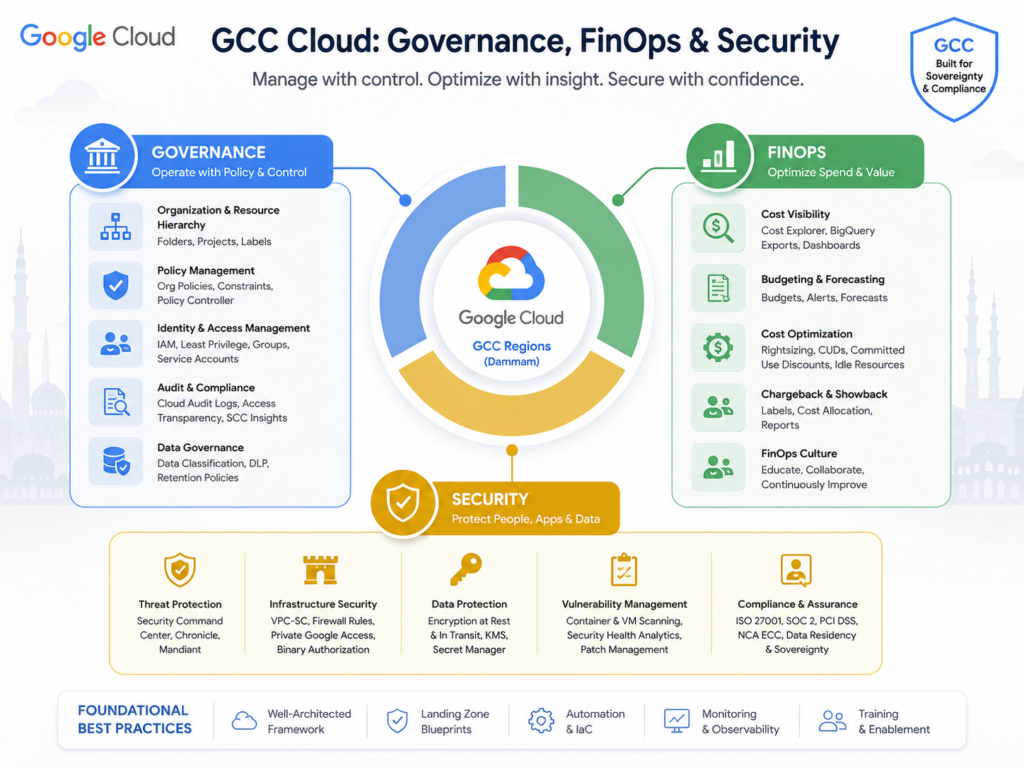
At minimum, define.
IAM and privileged access
MFA and admin controls
Encryption and key management
Backup and recovery rules
Logging and SIEM integration
FinOps ownership
Vendor review process
Incident response workflow
Compliance evidence collection
Exit and portability planning
If these controls are missing, multi-cloud can become a risk multiplier.
Cloud Provider Selection in Saudi, UAE, and Qatar
AWS, Azure, Google Cloud, Oracle, and Local GCC Clouds
Large hyperscale’s offer strong regional infrastructure, mature services, and global ecosystems. Local GCC providers may support sovereign cloud needs, Arabic support, local procurement, and sector-specific hosting preferences.
Many companies use system integrators to connect cloud, security, apps, and web development services into one operating model.
The best provider is not always the biggest provider. It is the provider that fits the workload, compliance requirement, budget, support expectation, and exit plan.
Data Residency and Latency by Market
Riyadh and Jeddah workloads may favor Saudi-based infrastructure when data residency or low latency matters.
Dubai and Abu Dhabi applications may priorities UAE hosting, regional performance, and free-zone compliance review.
Doha financial systems may require Qatar-specific review under QCB expectations before cloud adoption.
A practical approach is to separate workloads into three groups: must stay local, can run regionally, and can run globally with proper controls.
Questions to Ask Before Signing a Cloud Contract
Before signing a cloud contract, ask.
Where will data be stored and processed?
What are the SLA and support commitments?
What are the exit terms?
How are encryption keys managed?
What audit rights are available?
Where is support delivered from?
Are Arabic support and local documentation available?
Which certifications apply?
Who are the sub-processors?
What happens during a breach or service outage?
These questions help business, legal, compliance, and technology teams make the same decision together.
Best Practices for Multi-Cloud Governance in GCC
Build One Security and Identity Model
Use one security model across every cloud.
This usually includes central IAM, privileged access management, MFA, SIEM integration, policy-as-code, unified logging, vulnerability management, and consistent encryption rules.
Do not allow every team to create its own cloud access pattern. That is how multi-cloud becomes difficult to secure.
Use FinOps to Control Multi-Cloud Cost
FinOps is essential in a multi-cloud setup.
Set budgets, tagging rules, chargeback or show back reporting, reserved capacity reviews, egress alerts, and monthly rightsizing sessions.
In practice, a Dubai retailer may need extra capacity during major sales campaigns. A Riyadh fintech may need highly controlled environments for regulated APIs. A Doha SME may choose local hosting for trust and data placement. Each case needs cost visibility before growth accelerates.
Keep Arabic UX, Support, and Compliance Documents Ready
Multi-cloud is not only infrastructure.
For GCC customers, Arabic-first journeys, bilingual notices, local support expectations, and audit-ready documentation matter. This connects naturally with digital marketing strategy and AI governance policy planning.
A cloud setup can be technically strong and still fail the business if users, auditors, and internal teams cannot understand how it works.
Final Verdict
Use a multi-cloud strategy MENA when there is a clear business case: regulated workloads, resilience needs, regional growth, provider bargaining power, disaster recovery, or strategic workload portability.
Avoid multi-cloud when governance is immature. If your team lacks cloud operations, security monitoring, FinOps, compliance ownership, and architecture standards, adding more providers will likely add more risk.
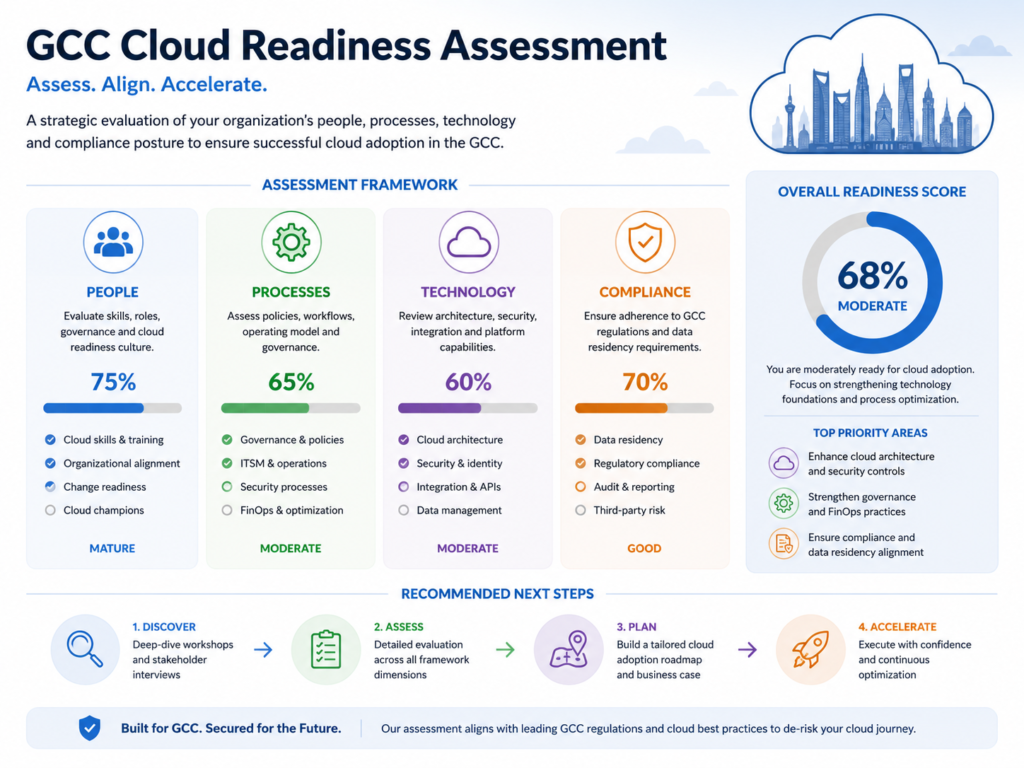
The safest next step is a GCC cloud readiness assessment. Review workload risk, compliance exposure, provider fit, cost governance, security maturity, and migration sequence before making the move.
Planning cloud growth across Saudi Arabia, the UAE, or Qatar? Contact Mak It Solutions to assess your workloads, compliance exposure, and provider options. You can reach the team or explore services for a custom GCC-ready cloud strategy. ( Click Here’s )
FAQs
Q : Is multi-cloud allowed for Saudi financial institutions under SAMA expectations?
A : Yes, but Saudi financial institutions should treat cloud adoption as a controlled, risk-managed process. SAMA expects cloud-related cybersecurity controls to be defined, implemented, monitored, and reviewed for hybrid and public cloud services.
Q : How should UAE companies handle data residency in a multi-cloud setup?
A : UAE companies should classify data first, then decide where each workload should run. Dubai and Abu Dhabi businesses should review national cloud security expectations, sector rules, cloud contracts, encryption, audit rights, and whether sensitive data should stay in UAE-based or controlled environments.
Q : Do Qatar banks need QCB approval before using cloud services?
A : QCB-licensed entities should review the Cloud Computing Regulation carefully before signing cloud contracts or moving regulated financial workloads. The regulation entered into force on 15 April 2024 and applies to cloud use by QCB-licensed entities.
Q : Which industries in Dubai benefit most from multi-cloud architecture?
A : Dubai e-commerce, fintech, logistics, travel, retail, and digital government suppliers can benefit when uptime, scale, analytics, or regional customer experience matters. The benefit is strongest when each cloud has a clear role.
Q : Is multi-cloud more expensive than single-cloud for GCC startups?
A : It can be more expensive if governance is weak. Startups may duplicate tools, ignore egress fees, or run unused environments. With FinOps, tagging, budget alerts, and workload-specific design, multi-cloud can still be justified for resilience, compliance, and growth.