

Confidential Computing Cloud Security in GCC
Confidential Computing Cloud Security in GCC
Confidential Computing Cloud Security in GCC
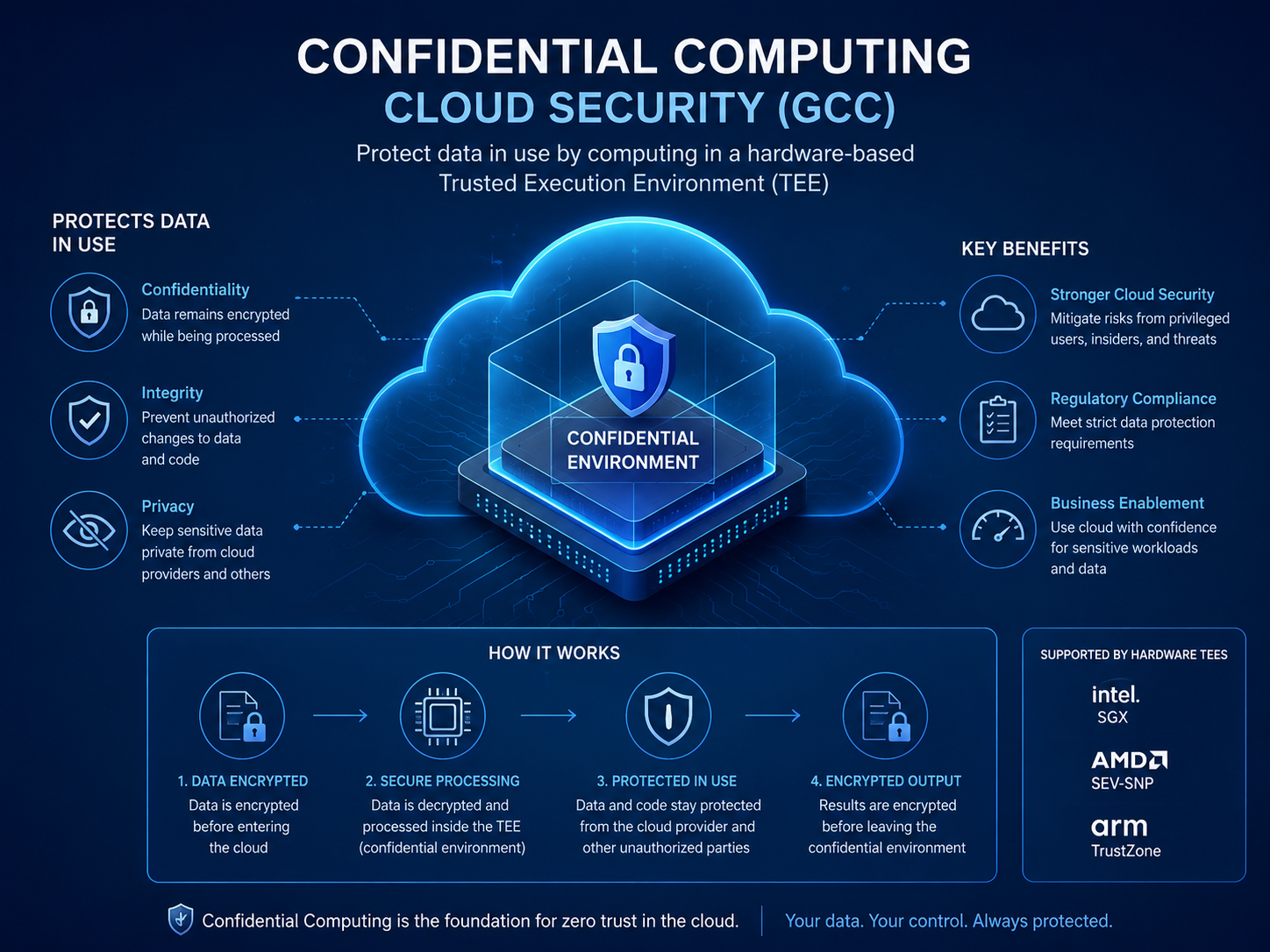
Confidential computing cloud security helps GCC organizations protect sensitive data while it is being processed, not just when it is stored or transferred. For firms in Saudi Arabia, the UAE, and Qatar, this matters because cloud workloads now include banking data, health records, AI models, citizen services, and customer identity systems.
In simple terms, confidential computing adds a stronger trust layer for regulated cloud use. It can reduce infrastructure-level exposure, support audit evidence, and make sensitive workloads safer to run across modern cloud environments.
Why GCC Firms Need Confidential Computing Cloud Security
GCC businesses are moving fast into cloud-based banking platforms, digital government services, e-commerce systems, AI tools, and healthcare applications. Standard encryption still matters, but it does not fully protect data while an application is actively using it.
That is the gap confidential computing fills.
For decision makers in Riyadh, Dubai, Abu Dhabi, Doha, and Jeddah, the real questions are practical:
Who can access our data during processing?
Can cloud administrators see sensitive workloads?
Where is the data hosted?
How do we prove security to regulators and boards?
Saudi financial institutions, for example, must think carefully about cloud contracts, data location, and approval requirements when using cloud services outside Saudi Arabia. Qatar’s Cloud Computing Regulation for QCB-licensed entities entered into force on 15 April 2024, making cloud governance a serious issue for banks and fintech firms.
What Is Confidential Computing Cloud Security?
Confidential computing cloud security is a model that protects data in use. It uses hardware-backed isolation so sensitive code and data can run inside a protected environment, often called a.
Trusted Execution Environment
Secure enclave
Confidential virtual machine
Isolated execution environment
Think of it as a sealed room inside a cloud server. Applications can process sensitive information inside that room, while the surrounding infrastructure has limited visibility.
Confidential Computing vs Traditional Encryption
Traditional cloud encryption usually protects data in two states.
| Data State | What It Means | Standard Protection |
|---|---|---|
| Data at rest | Data stored in databases, disks, or backups | Storage encryption |
| Data in transit | Data moving between systems | TLS/HTTPS encryption |
| Data in use | Data being processed by an app or workload | Confidential computing |
This third layer is important for GCC workloads that involve payment records, patient files, customer identity, logistics intelligence, Arabic customer interactions, AI training data, or confidential analytics.
How Confidential Computing Protects GCC Cloud Workloads
Secure Enclaves and Trusted Execution Environments
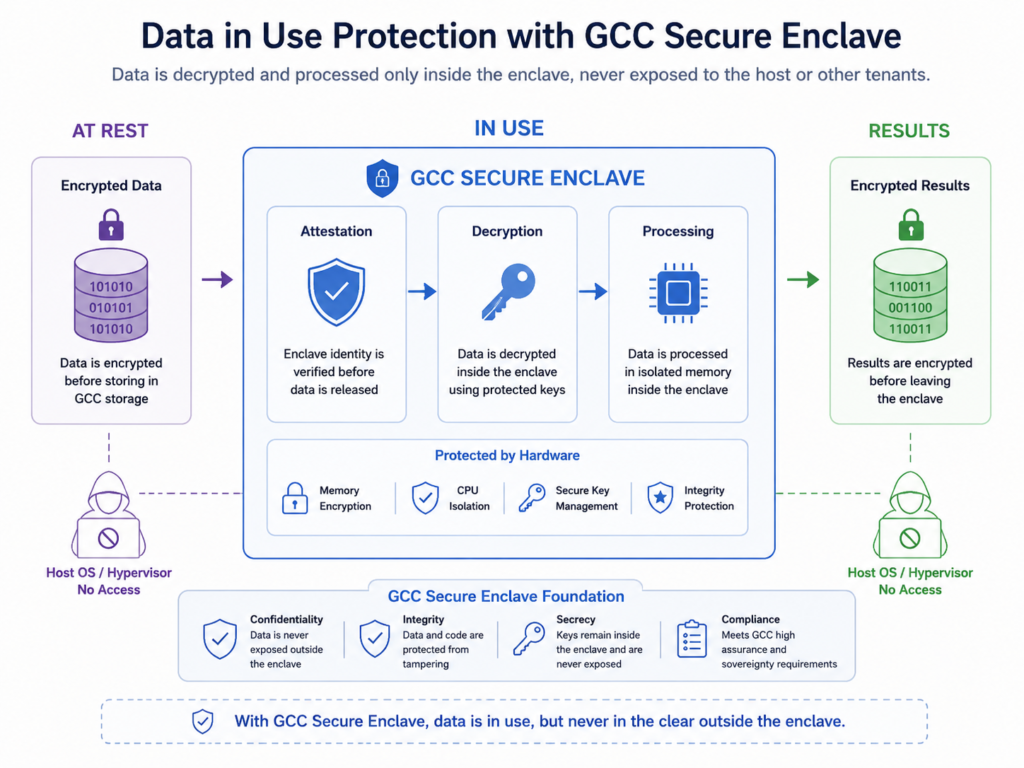
A Trusted Execution Environment isolates sensitive workloads from other parts of the server. Even if other workloads are running nearby, the protected environment helps reduce exposure to administrators, hypervisors, and neighboring tenants.
This is especially useful for regulated sectors where customer trust, outsourcing control, and audit readiness matter.
Remote Attestation for Cloud Trust
Remote attestation gives proof that a workload is running in an approved, trusted environment before secrets or sensitive data are released.
For GCC compliance teams, this can support.
Audit preparation
Vendor risk reviews
Board-level security reporting
Cloud migration approvals
Evidence-based security governance
Reducing Insider and Infrastructure Risk
Confidential computing is not a magic shield. It does not replace IAM, SIEM, HSM, DevSecOps, zero trust, or incident response.
But it can reduce important cloud risks, including.
Cloud administrator visibility
Compromised infrastructure layers
Multi-tenant exposure
Sensitive data leakage during processing
Weak trust between cloud provider and workload owner
For secure platform builds, Mak It Solutions’ mobile app development services and business intelligence support can help connect user-facing systems with protected back-end architecture.
GCC Compliance, Data Residency, and Sovereignty Considerations
Saudi Arabia.
Saudi firms should treat confidential computing as part of a broader governance model, not a standalone compliance shortcut.
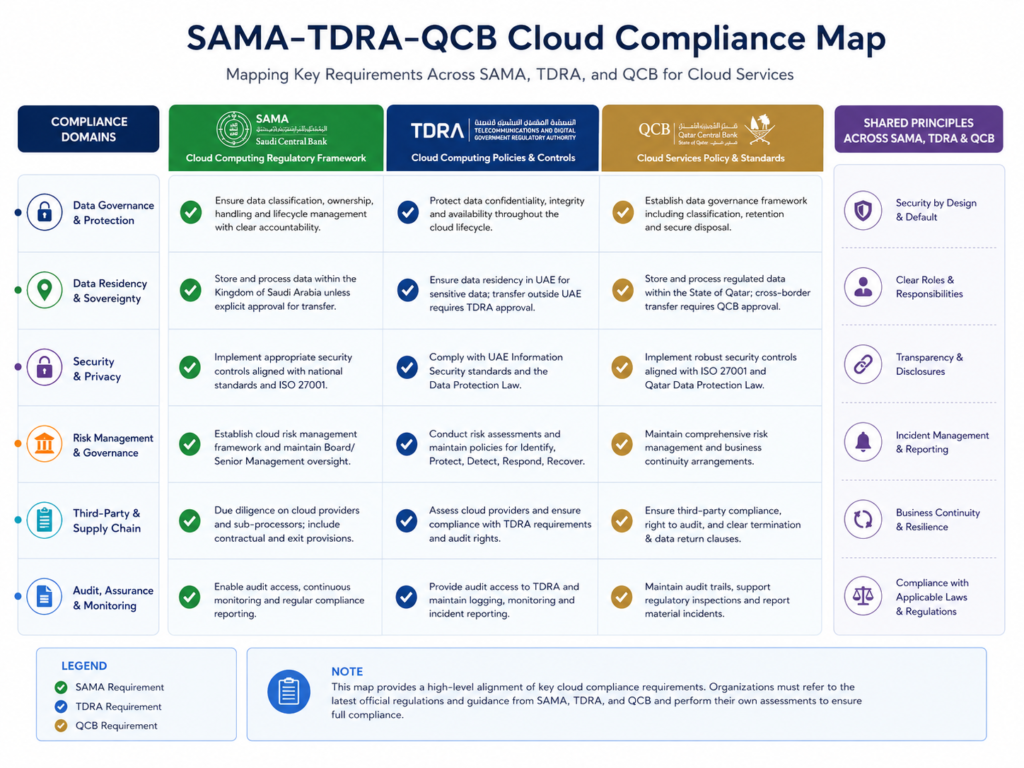
SAMA’s cloud guidance highlights controls such as contracts, cybersecurity requirements, data location, and explicit approval when cloud services are used outside Saudi Arabia.
In practice, Saudi organizations should combine confidential computing with:
Data classification
Cloud residency review
Strong IAM
Encryption at rest and in transit
Key management
Third-party risk management
Clear evidence for audits
NCA, NDMO, and DGA expectations also point organizations toward stronger classification, accountable cloud adoption, and better control over sensitive data.
UAE.
In the UAE, cloud security is closely tied to information assurance, regulated data, outsourcing, and auditability. Dubai and Abu Dhabi firms operating in regulated environments such as ADGM or DIFC should treat confidential computing as one layer of a wider cloud assurance strategy.
For UAE fintech, insurance, healthcare, and e-commerce companies, confidential computing cloud security can support sensitive processing such as fraud analytics, customer profiling, payment workflows, and AI-driven personalization.
It works best when combined with:
Zero trust architecture
Consent management
Strong identity controls
SIEM monitoring
Key management
Incident response planning
Qatar.
Qatar banks and fintech firms should connect confidential workloads with QCB’s cloud risk expectations, including outsourcing control, auditability, recovery, data hosting, and security governance.
Google Cloud lists Doha, Qatar as a Middle East region, and Microsoft lists Qatar Central in Doha among Azure regions. This gives Qatar-based organizations more regional architecture options when planning sensitive workloads.
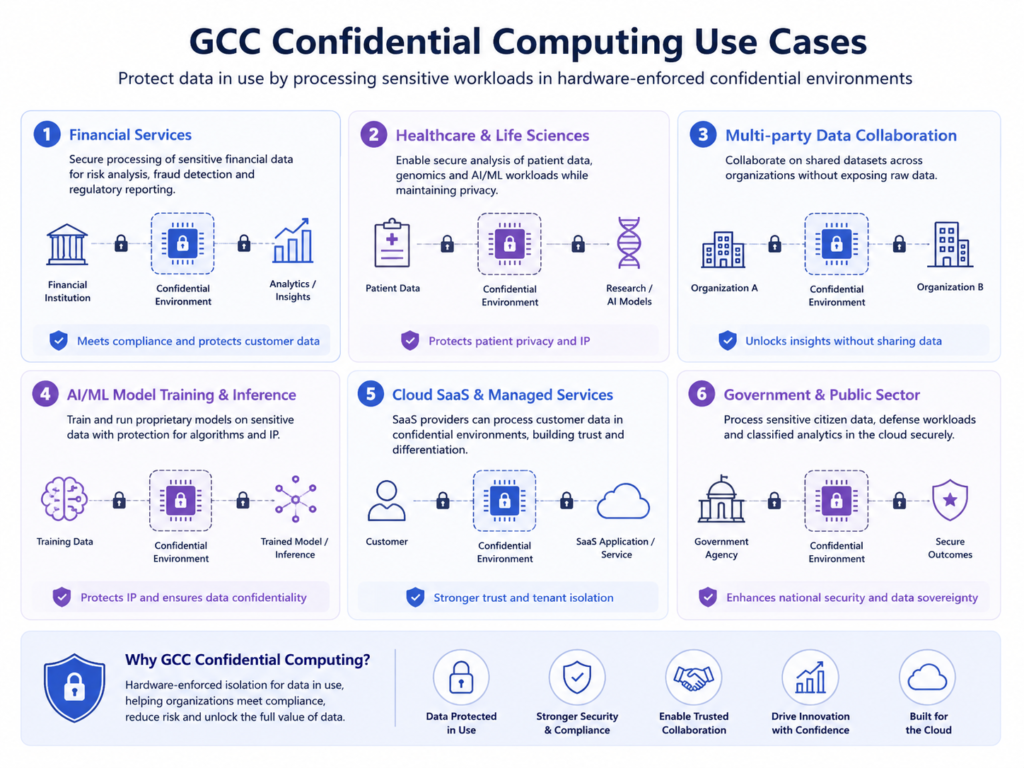
Best Use Cases for Confidential Computing in Saudi, UAE, and Qatar
Fintech and Banking
A Riyadh fintech handling open banking APIs can use confidential virtual machines to protect identity checks, fraud models, payment analytics, and customer risk scoring.
This is useful where customer trust, SAMA governance, and secure outsourcing all matter.
Government and Public Sector
Government workloads may include citizen data, digital identity, procurement records, tax systems, and sensitive case files.
In Saudi digital government programs, UAE Pass-connected services, or Qatar Digital ID-related ecosystems, confidential computing can reduce unnecessary exposure during processing.
Healthcare and AI
Hospitals, clinics, and health tech platforms may process patient files, diagnostic data, appointment records, and AI models.
Confidential computing can help protect sensitive health data while analytics or machine learning workloads are running.
Retail and E-Commerce
A Dubai e-commerce brand using personalization, loyalty systems, or payment analytics can benefit from stronger processing protection.
Mak It Solutions’ e-commerce development experience can support secure digital commerce experiences that connect front-end journeys with safer back-end cloud systems.
Logistics and Business Intelligence
A Jeddah logistics company may use dashboards for route planning, shipment optimization, and operational intelligence.
Confidential computing can help protect that business-sensitive data while analytics run in the cloud. For broader secure digital builds, explore Mak It Solutions’ custom digital services.
How to Choose a Confidential Computing Cloud Security Solution in GCC
Check Cloud Provider and Region Availability
Before choosing a solution, confirm whether confidential computing features are available in your preferred region.
Google Cloud’s region documentation lists Doha and Dammam zones, with AMD SEV support shown for selected zones and machine families. Microsoft lists UAE Central, UAE North, and Qatar Central among Azure regions.
Do not assume every feature is available everywhere. Region availability can affect compliance, latency, recovery planning, and cost.
Prioritize Arabic UX and Bilingual Support
Security fails when people cannot understand the workflow.
For GCC teams, Arabic-friendly user experiences, bilingual documentation, and clear approval flows can make a real difference. Compliance, IT, product, finance, and executive teams should all understand what the system protects and what it does not.
Integrate With Existing Security Architecture
Confidential computing cloud security should fit into the wider architecture, including.
IAM
SIEM
HSM
Key management
DevSecOps
Workload protection
Zero trust
Backup and recovery
Vendor risk management
Mak It Solutions’ web design services and React Native development services can support secure front-end experiences connected to protected cloud systems.
Costs, Timelines, and Implementation Challenges
What Affects Confidential Computing Cost in GCC?
Cost depends on several factors.
Workload complexity
Cloud region availability
Compliance scope
Performance requirements
Vendor licensing
Migration effort
Managed service support
Recovery and backup design
AI workloads, financial analytics, and multi-region architectures usually need more planning than basic web applications.
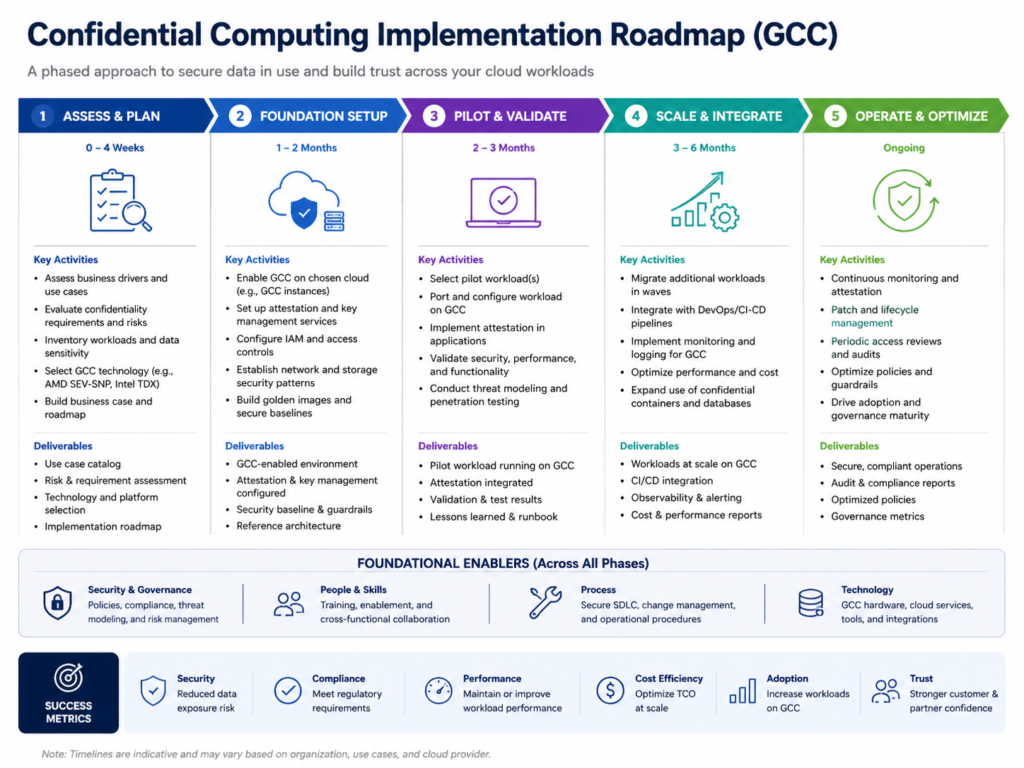
A Practical Implementation Roadmap
A simple roadmap usually looks like this.
Discover sensitive workloads.
Classify data by risk and regulation.
Choose one high-value pilot.
Confirm cloud region and feature availability.
Test secure enclave or confidential VM performance.
Validate remote attestation.
Review compliance evidence.
Migrate gradually.
Monitor cost, latency, and security.
Optimize after production feedback.
This approach makes confidential computing measurable instead of theoretical.
Common Mistakes to Avoid
GCC companies should avoid.
Treating confidential computing as a compliance shortcut
Skipping data classification
Ignoring attestation evidence
Choosing cloud regions without residency review
Forgetting key management
Moving sensitive workloads without legal and compliance input
Hiring vendors with no GCC regulatory understanding
Is Confidential Computing Worth It for GCC Enterprises?
For regulated GCC firms, confidential computing cloud security is worth serious evaluation.
It is a strong fit for.
Banking
Fintech
Insurance
Healthcare
Government
AI privacy
Confidential analytics
Customer identity
Cross-border collaboration
It may not be necessary for every workload. A public marketing website, simple brochure platform, or low-risk content system may only need standard encryption, access controls, backups, and monitoring.
The best approach is selective adoption. Start with the workloads where exposure would create the highest financial, legal, operational, or reputational risk.
Final Recommendation
Confidential computing cloud security gives GCC organizations a stronger way to protect sensitive workloads while data is being processed. For Saudi, UAE, and Qatar firms, it can support cloud trust, data residency planning, audit readiness, and safer AI or analytics adoption.
The key is to pair it with governance, local compliance review, Arabic user enablement, and practical implementation support.
Planning secure cloud workloads for Saudi Arabia, the UAE, or Qatar? Contact Mak It Solutions to discuss your cloud security roadmap, compliance needs, and implementation priorities. You can also explore our service page SEO and digital marketing services if you want GCC technology content that ranks, explains, and converts. ( Click Here’s )
FAQs
Q : Is confidential computing required for Saudi cloud compliance?
A : No, confidential computing is not automatically required for every Saudi cloud project. However, it can support stronger protection for sensitive financial, fintech, payment, and analytics workloads when mapped to SAMA expectations and internal risk assessments.
Q : Can UAE fintech companies use confidential computing for customer data?
A : Yes. UAE fintech companies can use confidential computing cloud security to protect customer identity, payment events, fraud analytics, credit scoring, and AI-driven personalization while data is being processed. It should still be combined with IAM, encryption, logging, consent management, and incident response.
Q : Does confidential computing help Qatar banks manage QCB cloud risk?
A : Yes, it can help Qatar banks improve workload isolation, audit evidence, and sensitive processing protection. QCB’s Cloud Computing Regulation entered into force on 15 April 2024, so licensed entities should connect confidential computing with wider cloud governance and approval requirements.
Q : Which GCC industries benefit most from confidential computing cloud security?
A : The strongest fit is usually fintech, banking, insurance, healthcare, government, logistics, retail, and AI-driven businesses. These sectors often process sensitive customer, citizen, financial, operational, or model data.
Q : How is confidential computing different from normal encryption?
A : Normal encryption protects data when it is stored or moving between systems. Confidential computing protects data while software is actively using it inside secure enclaves, confidential virtual machines, or Trusted Execution Environments.
[…] sensitive workloads, PQC can also complement controls such as confidential computing, which addresses data-in-use risks that post-quantum cryptography does not solve by […]