
Cloud Disaster Recovery GCC: Safer Gulf IT
Cloud Disaster Recovery GCC: Safer Gulf IT
Cloud Disaster Recovery GCC: Safer Gulf IT
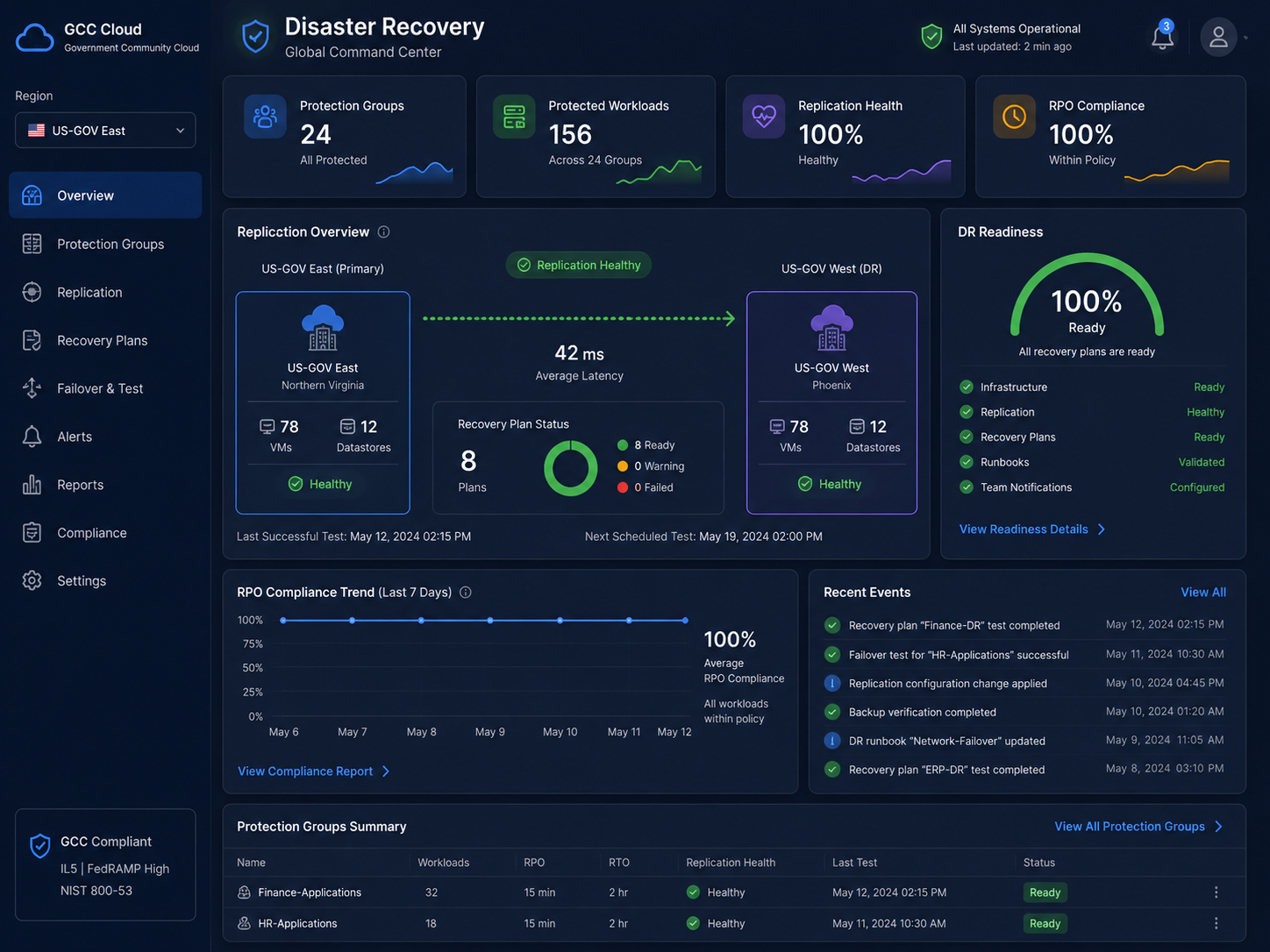
For companies in Riyadh, Dubai, Abu Dhabi, Jeddah, and Doha, cloud disaster recovery GCC is no longer just an IT backup task. It is a business continuity priority because payment systems, government portals, logistics platforms, healthcare apps, and e-commerce stores now depend on always-on cloud infrastructure.
Direct answer: Cloud disaster recovery GCC helps Saudi, UAE, and Qatar businesses restore critical systems after outages, ransomware, cyber incidents, cloud failures, or regional disruptions. A strong plan combines clear RTO/RPO targets, tested failover, compliant cloud-region choices, immutable backups, and evidence that auditors or regulators can review.
This guide explains the practical DR patterns, compliance points, and provider questions Gulf businesses should consider before choosing a recovery model.
What Is Cloud Disaster Recovery GCC?
Cloud disaster recovery means restoring applications, data, networks, and customer-facing services after disruption using cloud infrastructure, automation, replication, backups, and failover.
For GCC businesses, the plan needs local context. That includes data residency, Arabic-English operations, regulator expectations, customer communication, weekend coverage, and cloud-region availability across Saudi Arabia, the UAE, Qatar, and nearby markets.
A useful cloud DR plan answers questions like.
Which systems must recover first?
How much downtime can the business tolerate?
How much data loss is acceptable?
Who approves failover?
Where is recovery evidence stored?
Does the recovery region meet legal, contractual, and regulatory requirements?
Backup protects data. Disaster recovery restores operations. A backup may help you recover files, but a DR plan defines who acts, what fails over, how fast it happens, how much data may be lost, and how the business proves the process worked.
Why GCC Disaster Recovery Needs Local Planning
A generic global DR template is rarely enough for Gulf businesses.
Saudi financial firms need to consider SAMA business continuity and IT disaster recovery expectations. SAMA’s BCP guidance includes predetermined recovery objectives such as RTO and RPO, while its IT DRP section expects defined, approved, implemented, and maintained recovery planning aligned with business impact analysis.
In the UAE, organizations may need to align with TDRA services, FedNet-related requirements, or financial-zone expectations. TDRA describes Disaster Recovery as a Service for entities with systems hosted in digital infrastructure or on FedNet, including DR drills to support availability and business continuity compliance.
In Qatar, QCB-regulated firms should treat cloud DR as governance, not just hosting. QCB’s cloud regulation expects CSP due diligence, RTO/RPO recovery checks, BCP integration, and in-country processing for PII and financial information.
Cloud-region choices also matter. AWS lists Middle East regions in Bahrain and the UAE, Microsoft lists Qatar Central, UAE Central, and UAE North, and Google Cloud documentation lists Doha and Dammam locations for supported services.
For broader architecture planning, connect DR decisions with Mak It Solutions’ GCC cloud strategy guidance.
Key Cloud DR Patterns for Saudi, UAE, and Qatar Companies
Different workloads need different recovery models. A payroll dashboard, payment API, hospital portal, and marketing website should not all receive the same budget or recovery target.
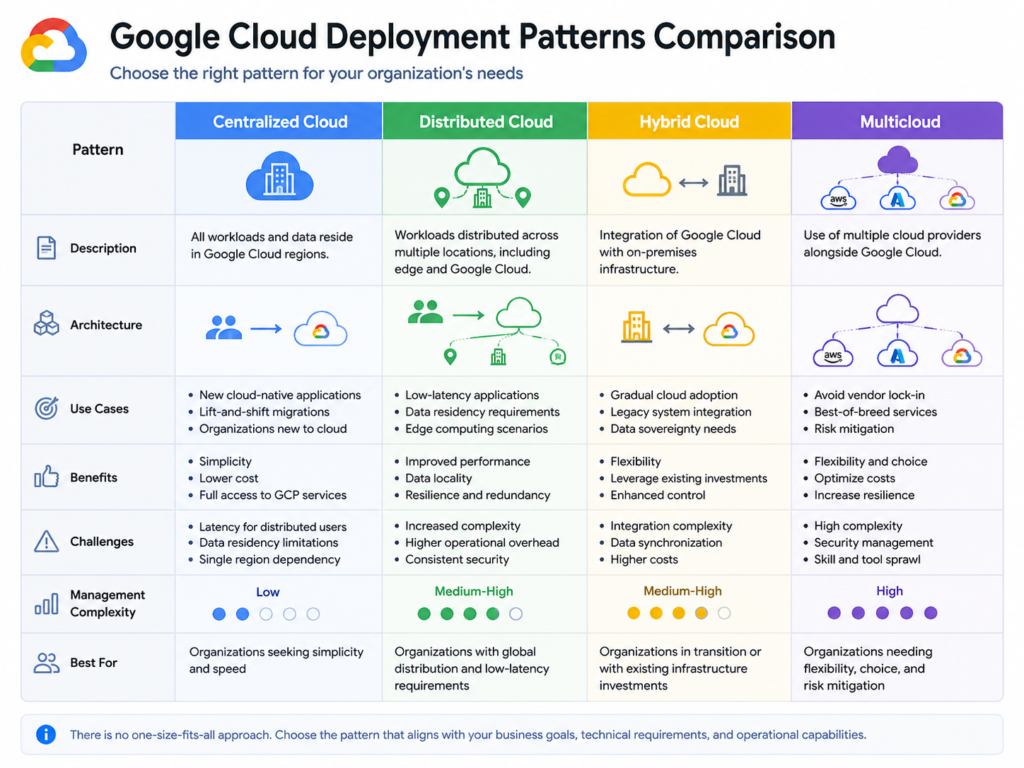
| DR Pattern | Best For | Recovery Speed | Cost Level | GCC Fit |
|---|---|---|---|---|
| Backup and restore | Low-risk systems, internal tools, small websites | Slower | Lower | Good for cost-conscious SMBs |
| Pilot light | Important apps with core services ready | Moderate | Medium | Useful for growing regulated workloads |
| Warm standby | Scaled-down live environment | Faster | Higher | Strong fit for fintech, healthcare, and suppliers |
| Active-active | Mission-critical platforms | Fastest | Highest | Best for banks, payment gateways, and national platforms |
| DRaaS | Managed recovery with testing support | Varies | Subscription-based | Useful where teams need expert support |
Backup and Restore for Cost-Conscious GCC SMBs
Backup and restore works well for non-critical websites, internal dashboards, small retail systems, and low-volume logistics tools. It is usually cheaper, but recovery takes longer.
A Jeddah SME may accept several hours of downtime for an internal reporting tool, especially if that tool is supported by clean data and reporting workflows such as business intelligence services.
Pilot Light and Warm Standby for Regulated Workloads
Pilot light keeps the core components ready so the full environment can be rebuilt faster. Warm standby keeps a smaller live environment running, ready to scale when needed.
These patterns suit fintech, healthcare, and government suppliers that need stronger recovery than basic backup but may not need full active-active cost.
Active-Active for Critical Gulf Operations
Active-active architecture keeps services running across more than one environment. It is expensive, but it can reduce downtime for high-impact platforms.
This model fits banks, payment gateways, airports, national platforms, and high-volume e-commerce. A Dubai e-commerce brand, for example, may combine active-active checkout systems with resilient back-end development services and regional failover.
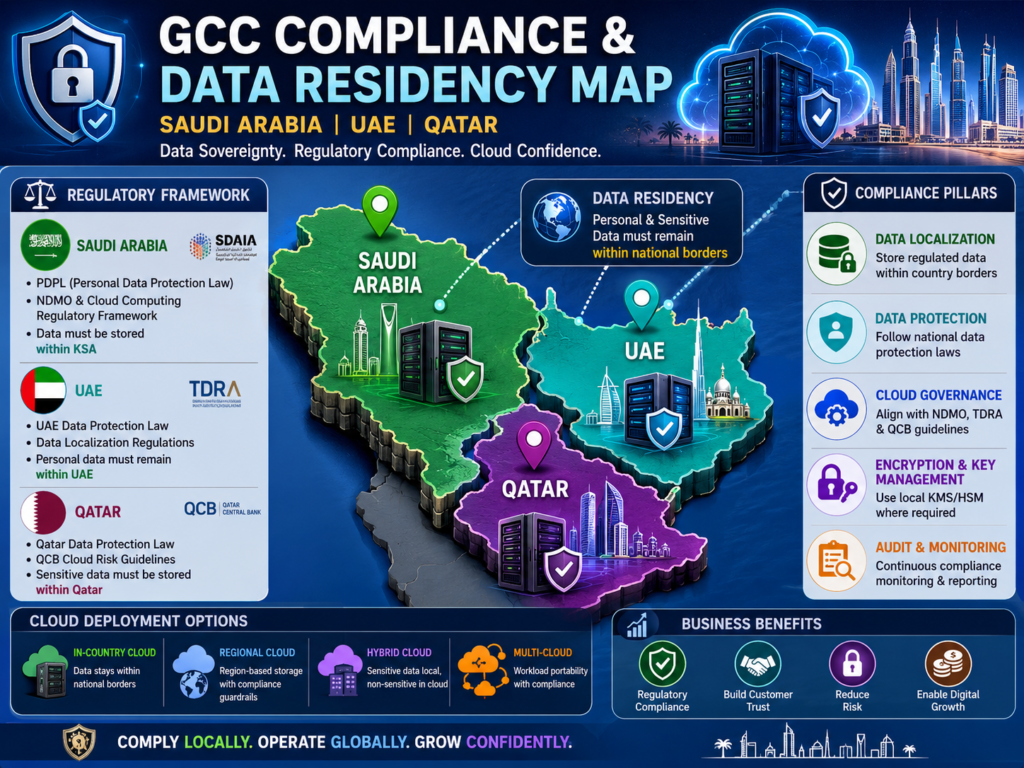
Compliance and Data Residency in Cloud Disaster Recovery GCC
Saudi Arabia.
For a Riyadh fintech or financial institution, DR planning should begin with business impact analysis, workload classification, recovery objectives, alternative recovery capability, offsite backups, third-party continuity arrangements, and regular effectiveness evaluation.
SAMA’s IT DRP guidance expects recovery plans for technology services and infrastructure, backup and recovery processes, offsite backup storage, continuity clauses for third parties, monitoring, and yearly effectiveness evaluation.
Saudi organizations should also consider NCA cybersecurity controls where applicable. NCA Cloud Cybersecurity Controls include secure disaster recovery and business continuity procedures related to cloud computing.
UAE.
UAE organizations should check whether their workloads are government-linked, financial-zone regulated, or subject to specific contractual data expectations.
TDRA’s DRaaS service is aimed at government-sector entities connected to FedNet with compatible infrastructure, and it supports disaster recovery drills for availability and business continuity.
For DIFC firms, the DFSA’s cyber-risk supervision approach focuses on governance, hygiene, and resilience, including the ability to respond to, recover from, and adapt to cyber incidents.
Qatar.
For a Doha financial services firm, the cloud DR decision should cover more than uptime.
QCB expects entities to verify the CSP’s ability to recover outsourced systems and IT services within stipulated RTO/RPO targets. It also requires entities to ensure PII and financial information is processed within Qatar only, with QCB approval before entering a cloud arrangement.
That means recovery region, subcontractors, encryption, logs, exit planning, and audit rights should be reviewed before migration, not after an incident.
This article is general guidance, not legal or regulatory advice. Regulated organizations should confirm requirements with their compliance team, legal counsel, cloud provider, and relevant authority.
How to Build a Cloud Disaster Recovery GCC Plan
Define RTO and RPO by Workload
Start with business impact. Not every system deserves the same recovery target.
Classify workloads by.
Revenue impact
Customer harm
Safety or healthcare risk
Regulatory exposure
Operational dependency
Data sensitivity
Recovery complexity
A payment API may need very fast recovery. A marketing landing page may tolerate longer downtime. A customer database may need a tighter RPO than an internal report.
Choose the Right DR Pattern and Cloud Region
Match the recovery model to business risk.
Use backup and restore for low-risk systems. Use pilot light for important apps. Use warm standby for regulated or revenue-sensitive workloads. Use active-active for systems where downtime creates serious customer, financial, or operational damage.
Before choosing a region, review data residency, latency, service availability, contract clauses, and regulator expectations. For sensitive workloads, compare sovereign cloud versus hyperscaler choices before deciding where data should sit.
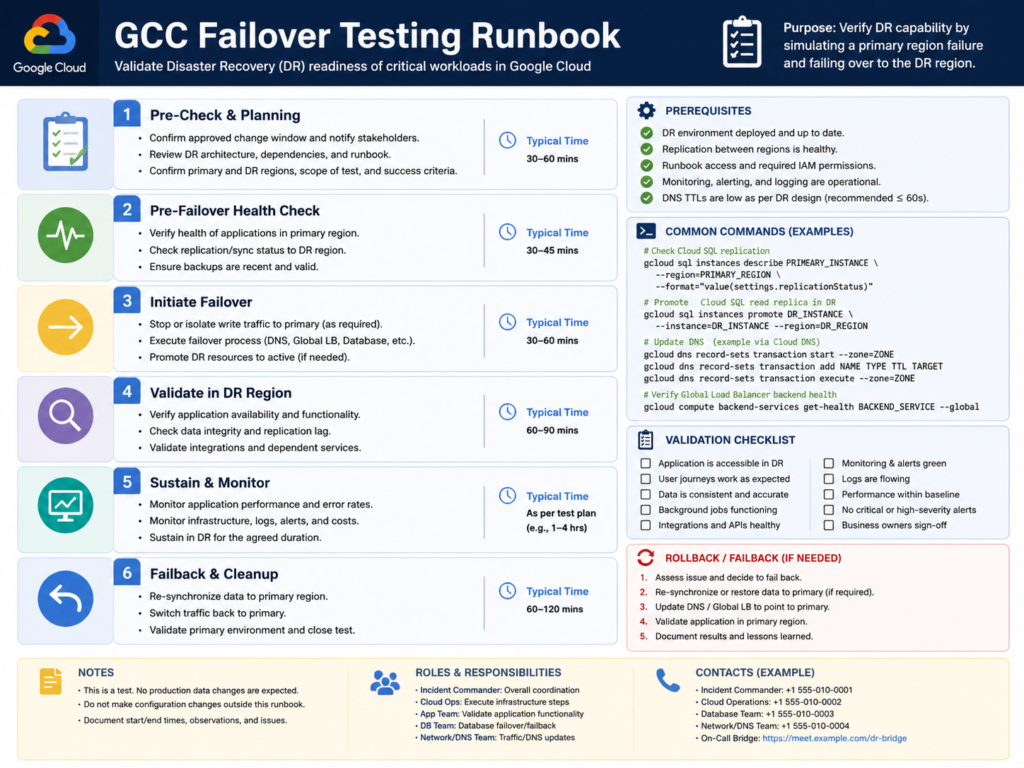
Create Runbooks, Test Failover, and Store Evidence
A DR plan that only exists in a document is not enough.
Create Arabic-English runbooks where needed. Assign system owners, business owners, security leads, communications contacts, and escalation paths. Then test failover and failback in realistic conditions.
Keep evidence such as.
Test dates and results
Screenshots
Logs
Approval records
Incident reports
Lessons learned
Recovery timing
Access-control changes
Also connect recovery with zero trust security controls so restored systems do not reopen compromised access.
DRaaS, Managed Recovery, and Cloud Backup Options in the GCC
DRaaS can be useful when the internal IT team is lean, workloads span multiple clouds, ransomware risk is high, or auditors expect formal testing reports.
It also helps companies that need practical recovery without building a full resilience department.
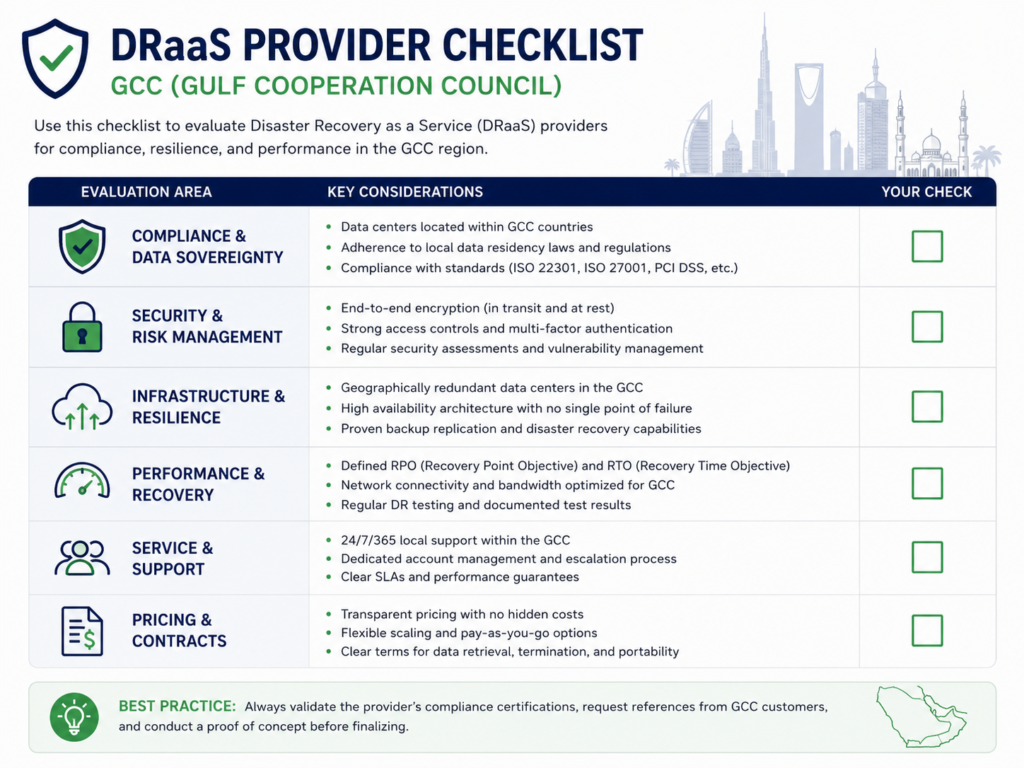
What to Compare in a GCC DRaaS Provider
When reviewing DRaaS providers, compare.
SLA clarity
RTO/RPO commitments
Local or regional data center options
Arabic-English support
Immutable backup capability
Failover and failback testing
Security reporting
Cloud-platform experience
Sector-specific experience
Exit support and data return process
For software businesses, align DRaaS with secure software supply chain planning so recovery includes code, dependencies, CI/CD access, secrets, and deployment pipelines.
Cost Factors Across Saudi Arabia, UAE, and Qatar
Cloud DR cost depends on storage volume, replication frequency, cloud region, application complexity, security controls, testing cadence, and managed support.
In practice, many GCC companies overspend on recovery they do not test, or underspend on the systems that hurt most when they go down. Use cloud cost optimization GCC guidance to balance resilience with budget discipline.
Best Practices for Cloud Disaster Recovery GCC Success
Use Immutable Backups Against Ransomware
Immutable backups help prevent attackers or insiders from deleting recovery points. For Gulf organizations handling payments, patient records, government contracts, or financial data, backup isolation is essential.
Do not keep backup access tied to the same identities used in production. Separate privileges, monitor changes, and test restoration regularly.
Avoid Single-Region and Single-Vendor Risk
Single-region recovery can fail when the regional problem is bigger than expected. Single-vendor recovery can also create concentration risk.
Where compliance allows, reduce dependency through multi-zone design, cross-region planning, tested exports, or a controlled secondary strategy. The right answer depends on the workload, data rules, latency, and budget.
Localize Recovery for Real GCC Operations
Recovery is not only servers.
A strong GCC DR plan also covers Arabic customer notices, call-center scripts, Ramadan and sale-season peaks, regional weekend coverage, executive approvals, and vendor escalation paths.
For regulated industries, documentation should be written clearly enough for auditors, not only engineers.
Concluding Remarks
The right cloud disaster recovery GCC model depends on workload criticality, compliance obligations, budget, and operational maturity.
Backup and restore may be enough for low-risk systems. Pilot light and warm standby support regulated or revenue-sensitive operations. Active-active protects critical platforms. DRaaS helps teams that need managed recovery, testing support, and clearer audit evidence.
Start by assessing workloads, defining RTO/RPO targets, reviewing compliance gaps, and testing a real failover. Mak It Solutions can help connect disaster recovery planning with broader technology services for Saudi, UAE, and Qatar operations.( Click Here’s )
FAQs
Q : Is cloud disaster recovery required for Saudi financial companies?
A : Saudi financial organizations should treat cloud disaster recovery as a serious business continuity and regulatory requirement. SAMA’s BCM and IT DRP guidance expects recovery planning, backup processes, alternative recovery capability, monitoring, and effectiveness evaluation.
Q : Can UAE companies use DRaaS for Fed Net-related workloads?
A : Yes, where eligibility, infrastructure compatibility, service ownership, and regulatory context are confirmed. TDRA describes DRaaS as a service for protecting systems hosted in digital infrastructure or on FedNet at a remote site, with DR drills supporting availability and business continuity compliance.
Q : What should Qatar firms check before moving DR to the cloud?
A : Qatar firms should review CSP due diligence, recovery capability, data classification, RTO/RPO targets, audit rights, BCP integration, exit planning, and data-location requirements. QCB expects PII and financial information to be processed within Qatar only for regulated entities.
Q : Do GCC companies need local data residency for backup and DR?
A : Many do, but the answer depends on the country, sector, data type, regulator, and contract. Even when local residency is not mandatory, businesses should document why a cloud region was chosen, how data is encrypted, who can access it, and how recovery evidence will be shown during an audit.
Q : Which industries in Riyadh, Dubai, and Doha need faster RTO and RPO targets?
A : Industries with direct customer, safety, revenue, or regulatory impact usually need tighter recovery targets. This includes fintech, banking, healthcare, energy, aviation, logistics, public services, payment platforms, and high-volume e-commerce.
[…] RAG, monitoring and disaster recovery should be designed together. Mak It Solutions’ GCC cloud disaster recovery guide covers related resilience […]
[…] organizations can review cloud disaster recovery planning for Saudi, UAE and Qatar environments and GCC AI infrastructure considerations when assessing the wider […]
[…] Dubai bank modernizing its infrastructure can also connect PQC planning with GCC cloud disaster-recovery guidance and broader resilience […]