


E-commerce Fraud Prevention GCC: UX That Converts
E-commerce Fraud Prevention GCC: UX That Converts
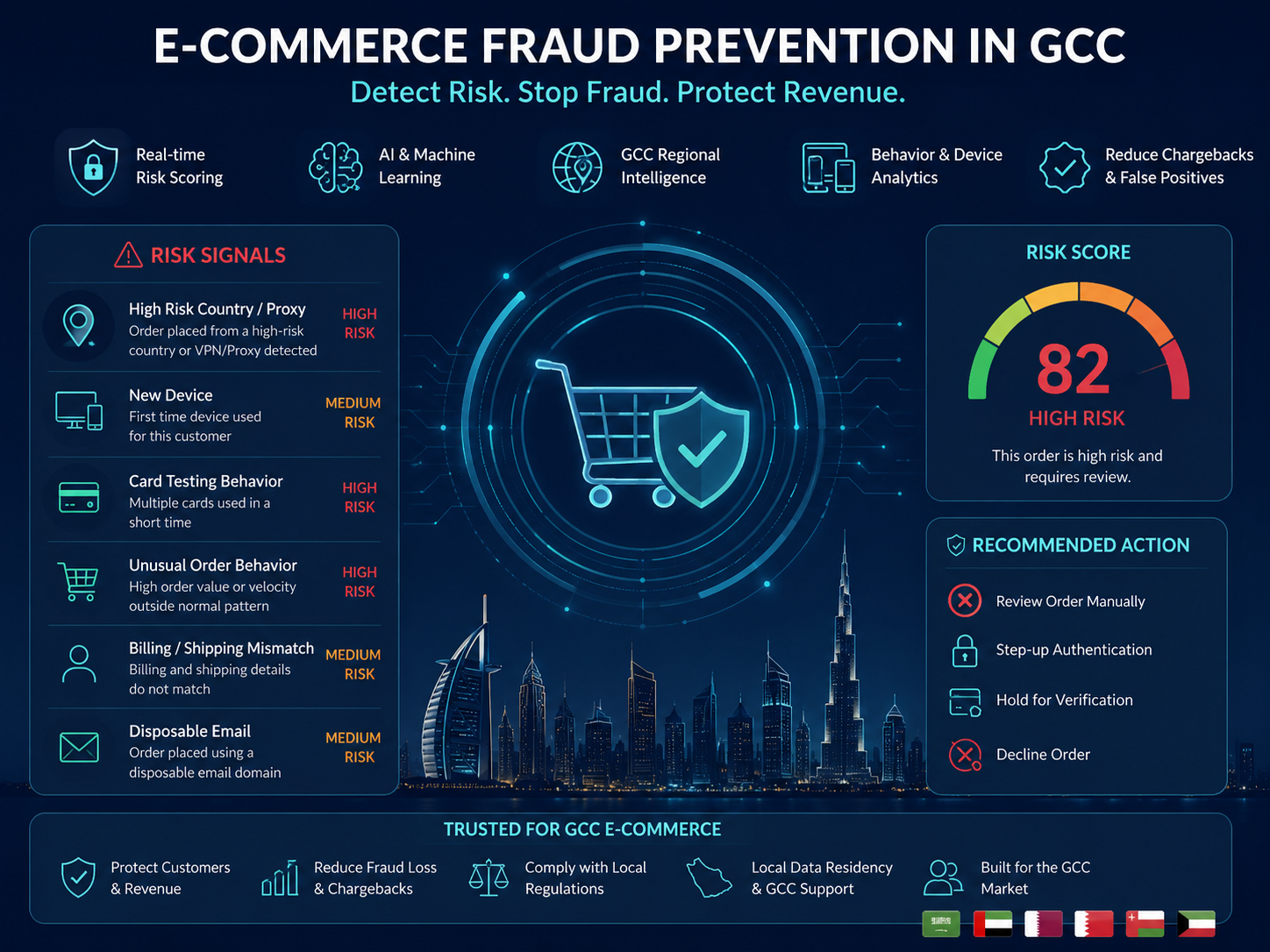
E-commerce Fraud Prevention GCC: UX That Converts
Effective e-commerce fraud prevention in the GCC is not about blocking every unusual order. It is about identifying genuine risk while allowing legitimate customers to complete their purchases with as little friction as possible.
The strongest approach combines identity, device, network, behavioral, transaction, and fulfilment signals. Trusted orders move forward, elevated-risk purchases receive targeted verification, uncertain cases go to review, and clearly malicious activity is blocked.
For merchants in Saudi Arabia, the UAE, and Qatar, this balance matters. Fraud controls must account for multilingual customers, foreign-issued cards, regional travel, shared devices, local payment methods, and Arabic-English checkout journeys.
What Is E-commerce Fraud Prevention in the GCC?
E-commerce fraud prevention is the use of technology, operational controls, and customer verification to detect suspicious activity before it causes financial loss, chargebacks, delivery abuse, or reputational damage.
A well-designed programme protects more than payment revenue. It also protects customer accounts, promotional campaigns, refund processes, fulfilment operations, and the overall checkout experience.
How GCC E-commerce Fraud Differs From Global Fraud
GCC e-commerce is mobile-first, multilingual, and highly international.
A legitimate customer in Dubai may use a card issued in another country. A family in Riyadh may share a device. A buyer in Doha may enter an address that does not match the rigid format expected by a global fraud platform.
Arabic-English name variations also create complications. The same legitimate customer may appear under different transliterations across an account, payment card, and delivery address.
Cross-border purchasing, expatriate populations, frequent regional travel, and cash-on-delivery behavior can make generic fraud rules unreliable. Merchants therefore need locally tuned e-commerce solutions rather than blanket country or card restrictions.
Common Fraud Types Affecting GCC Merchants
Fraud risks vary by sector, payment method, and product category, but common threats include.
Stolen-card purchases
Card testing
Account takeover
Friendly fraud
Promotion and coupon abuse
Triangulation fraud
Refund manipulation
Digital-goods fraud
Cash-on-delivery refusals
Suspicious delivery rerouting
Payment teams should not work in isolation. Customer support, logistics, fulfilment, and refund data can reveal abuse that payment-only systems miss.
Why Fraud Loss Is Not the Only Metric That Matters
A low fraud-loss rate may look positive while hiding a serious false-decline problem.
For example, a merchant may reduce chargebacks by rejecting more international orders. However, if many of those orders are legitimate, the business may lose revenue, frustrate customers, and increase support requests.
Fraud performance should therefore be measured alongside.
Payment approval rates
Confirmed fraud losses
Chargeback rates
False declines
Manual-review volumes
Authentication completion
Checkout abandonment
Customer-support contacts
A useful fraud programme protects total revenue. It does not simply reject more transactions.
Which Signals Indicate E-commerce Fraud?
GCC merchants should assess several signal categories together. No single mismatch proves that a customer is fraudulent.
Identity and Account Signals
Identity and account indicators may include.
Account age
Email reputation
Phone verification status
Disposable contact details
Repeated identities across accounts
Failed one-time password attempts
Sudden profile changes
Recent password or address changes
Unusual login activity
Arabic-English transliteration mismatches require particular care. Names such as “Mohammed,” “Muhammad,” and “Mohamad” may refer to the same legitimate person.
A name mismatch should therefore contribute to a wider risk assessment rather than trigger an automatic rejection.
Device, Network, and Behavioral Signals
Device fingerprinting can help identify trusted devices, emulators, repeated account creation, and sudden changes in device characteristics.
Network signals may include.
IP reputation
VPN or proxy use
Geolocation inconsistencies
Impossible travel patterns
Repeated activity from suspicious networks
Multiple payment attempts from one connection
Behavioral analytics adds another layer. Bot-like browsing, rapid account creation, abnormal navigation, repeated copying into payment fields, and unusually fast checkout activity may indicate automation or abuse.
These signals should raise or lower an order’s risk score. They should rarely cause rejection on their own.
Transaction and Fulfilment Signals
Transaction-level warning signs may include.
Unusual order values
High-risk basket combinations
Rapid transaction velocity
Several cards used on one account
Repeated declines followed by approval
Billing, card, and delivery-country mismatches
Freight-forwarder or reshipping addresses
Sudden changes in purchasing behavior
Fulfilment data is equally important.
Repeated cash-on-delivery refusals, delivery rerouting, unusual pickup requests, failed delivery patterns, and suspicious refund activity can reveal abuse that is invisible at payment authorization.
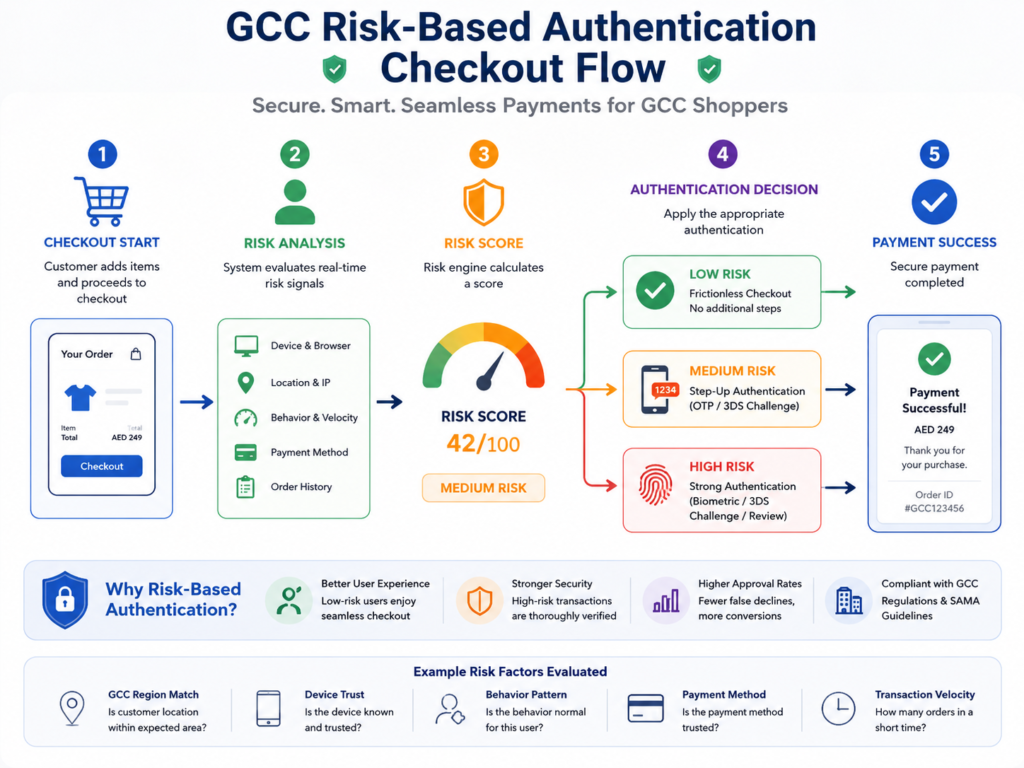
How Risk-Based Authentication Protects Checkout UX
Risk-based authentication applies friction only when the available evidence suggests that additional verification is justified.
This is especially important in GCC markets, where legitimate transactions may appear unusual to globally configured fraud tools.
Let Low-Risk GCC Customers Check Out Normally
A returning customer in Riyadh using a trusted mobile device and a familiar made payment pattern should not face unnecessary document requests.
Likewise, a known customer in Dubai should not be rejected simply because an international card was issued abroad.
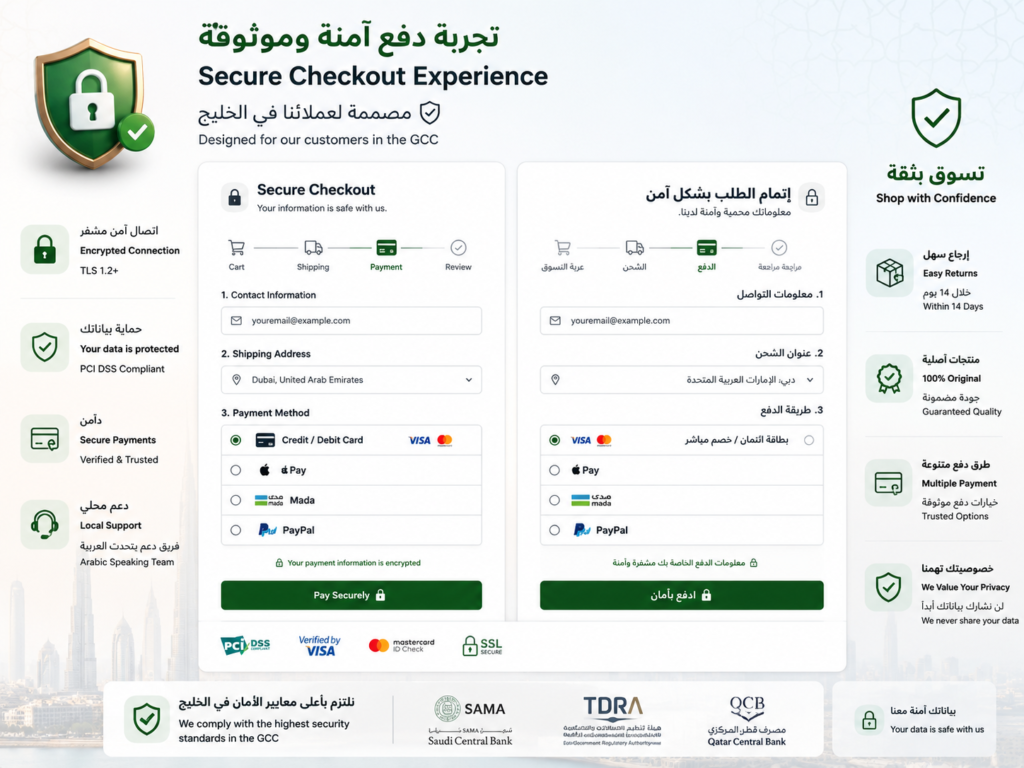
Passive signals, tokenization, account history, and trusted-device recognition can help low-risk customers complete checkout smoothly. Secure mobile app development also allows these controls to be built directly into the customer journey.
Use 3D Secure 2 and OTP When Risk Increases
Medium-risk transactions may require EMV 3-D Secure, 3DS2, an OTP, or another contextual check.
The verification method should reflect.
The payment method
The order value
The customer’s history
The device and network context
The type of goods being purchased
The merchant’s fraud exposure
A challenge should be proportionate. Asking every customer for the same verification can create unnecessary abandonment without delivering a matching reduction in fraud.
Saudi payment environments, UAE acquirers, and Qatar’s domestic payment infrastructure may involve different technical or regulatory requirements. SAMA’s counter-fraud framework supports risk-based and proportionate controls for organizations within its scope, but merchants should confirm which obligations apply to their specific entity and payment arrangement.
Design Fraud Messages for Arabic and English Customers
Verification messages should explain the next step without accusing the buyer of fraud.
Merchants should test.
Right-to-left Arabic layouts
English left-to-right layouts
Local phone-number formats
Address-field flexibility
OTP retry paths
Error messages
Support links
Delayed-order notifications
A customer whose order is under review should receive a clear explanation in the appropriate language.
Strong front-end development can reduce abandonment while preserving necessary verification controls.
GCC Compliance, Payments, and Data Considerations
Payment, privacy, and fraud-prevention obligations vary by jurisdiction, business activity, payment provider, and company structure.
Merchants should treat operational guidance as a starting point, not as a substitute for advice from qualified legal, compliance, and payment specialists.
Saudi Arabia.
Saudi merchants may need to consider.
SAMA-regulated payment arrangements
made integrations
Saudi Personal Data Protection Law obligations
NDMO data-governance principles
Data minimization
Purpose limitation
Retention controls
Access and security controls
Fraud platforms often collect device, identity, transaction, and behavioral information. Businesses should ensure that data collection is proportionate and tied to a defined fraud-prevention purpose.
SAMA requires regulated payment organizations within scope to maintain appropriate counter-fraud capabilities. Its requirements should be interpreted according to the merchant’s role, payment-provider relationships, and regulated activities.
UAE.
UAE merchants may operate within different regulatory environments depending on their company structure and activities, including Central Bank, DIFC, or ADGM contexts.
Dubai and Abu Dhabi businesses often serve highly international customer bases. Foreign cards, overseas billing addresses, regional travel, and expatriate customer profiles should not automatically be treated as fraud.
Rules should be calibrated to actual customer behavior and reviewed separately for domestic and cross-border transactions.
TDRA may be relevant where communications or digital systems fall within its remit, but it should not be treated as the regulator for every payment or fraud decision.
Qatar.
Qatar merchants should assess the requirements and capabilities of QCB-regulated providers, QPay authentication, NAPS processing, and Hayman acceptance.
Local gateway scoring should be tested against actual domestic purchasing patterns rather than copied directly from another market.
Device recognition, transaction history, fulfilment behavior, and supported authentication methods should work together to form a locally relevant risk assessment.
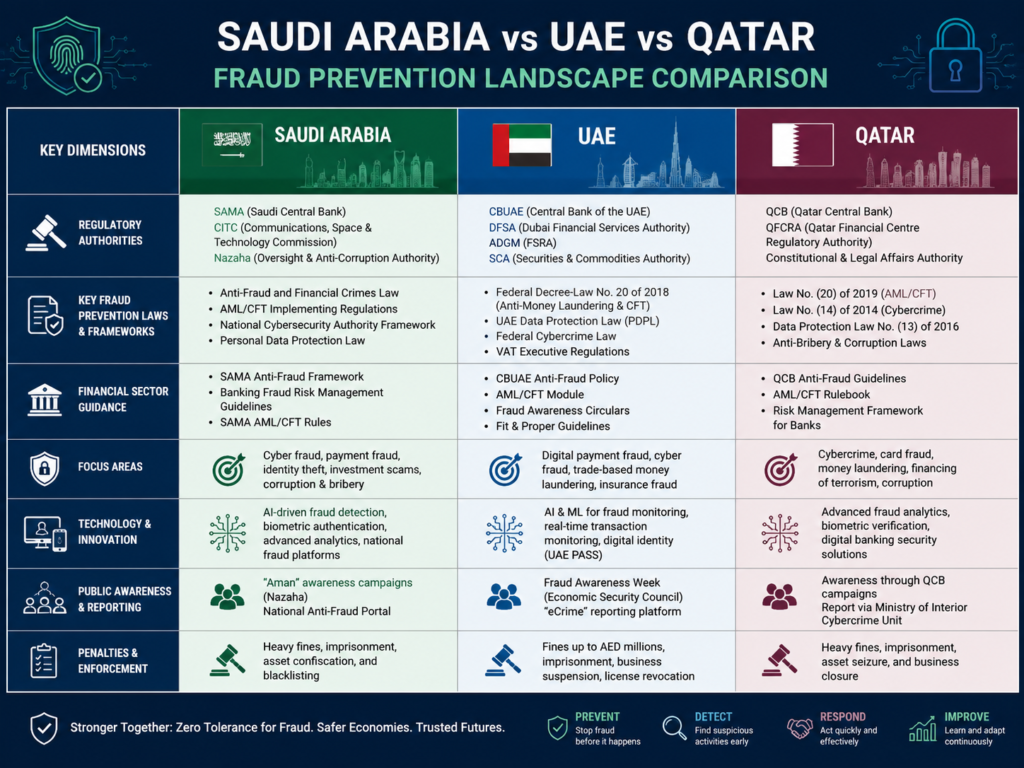
How to Build a GCC E-commerce Fraud-Prevention Workflow
A practical fraud workflow should cover the full customer journey rather than focusing only on payment authorization.
Map Fraud Risks Across the Customer Journey
Review each stage where fraud or abuse may occur.
Account creation
Login
Browsing
Checkout
Payment authorization
Fulfilment
Delivery
Refunds
Chargebacks
Document where customer behavior differs across Saudi Arabia, the UAE, and Qatar.
For example, foreign-issued cards may be more common in one customer segment, while cash-on-delivery refusals may create greater operational risk in another.
Score Orders Using Multiple Signal Layers
Combine.
Identity signals
Account history
Device intelligence
Network reputation
Behavioral patterns
Transaction data
Fulfilment history
Blocking every foreign IP address would create unnecessary false positives in expatriate-heavy and travel-heavy markets.
Secure back-end development and business intelligence services can help connect these data sources and reveal how fraud rules affect revenue.
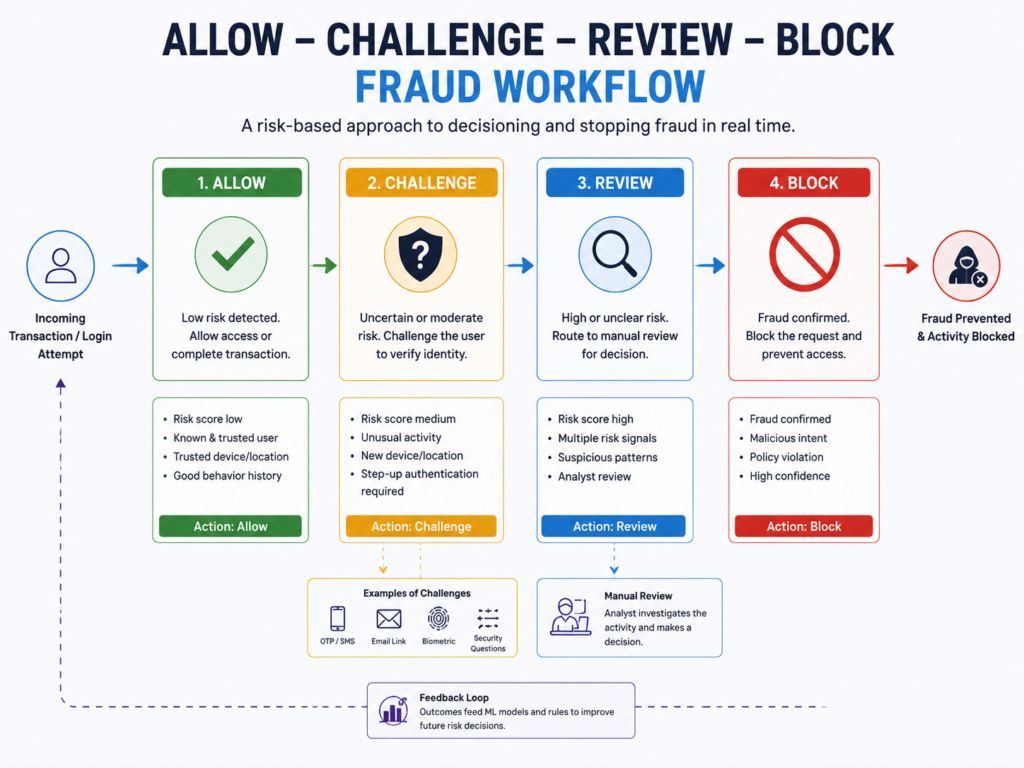
Create Allow, Challenge, Review, and Block Paths
Every order should move into a clearly defined decision path.
Allow.
Approve trusted, low-risk orders with minimal friction.
Challenge.
Request proportionate verification when risk rises.
Review.
Send genuinely uncertain or high-value cases to a trained reviewer.
Block.
Stop clearly malicious activity supported by strong evidence.
Ownership should be shared across fraud, payments, customer service, and fulfilment teams. Unclear cases should not remain in an unmonitored queue while customers wait for updates.
How to Reduce False Declines in GCC E-commerce
False declines occur when legitimate customers are rejected because fraud controls misunderstand normal behavior.
Reducing them requires local tuning, careful measurement, and regular rule reviews.
Tune Rules for Saudi, UAE, and Qatar Customer Patterns
Fraud rules should account for.
Foreign-issued cards
Shared household devices
Frequent regional travel
Arabic-English identity variations
Non-standard address formats
Cross-border shipping
High-value seasonal shopping
New-device purchases from returning customers
A mismatch may be meaningful, but several weak mismatches should not automatically outweigh strong evidence that a customer is genuine.
Use Manual Review Selectively
Manual review is most useful for high-value or genuinely ambiguous transactions.
Reviewers should have access to relevant signals, but they should not collect excessive personal information. Clear decision guidelines and service targets are also necessary so legitimate orders are not delayed indefinitely.
Where possible, review teams should record why an order was approved or rejected. This feedback can improve future rules and model performance.
Measure Fraud and Conversion Together
Track results by country, payment method, device, customer type, and product category.
Important measurements include.
Fraud loss
Chargebacks
Approval rates
False declines
Challenge completion
Manual-review rates
Review turnaround
Checkout conversion
Customer complaints
This combined view helps teams identify controls that reduce fraud without damaging legitimate sales.
Choosing a GCC Fraud-Prevention Approach
Merchants can use rules engines, machine-learning models, device-intelligence platforms, behavioral analytics, manual review, or a combination of these tools.
Rules Engines, Machine Learning, and Hybrid Models
Rules remain useful for known patterns such as.
Card-testing velocity
Repeated failed payments
Excessive account creation
Known malicious devices
Previously abused delivery addresses
Machine-learning and behavioral systems may be better at detecting changing patterns or combinations that fixed rules miss.
In practice, hybrid systems are often the most adaptable. They combine rules, predictive models, device intelligence, gateway data, and human review.
Questions to Ask Fraud and Payment Providers
Before selecting a provider, ask.
Does the platform support Arabic customer journeys?
Can it handle GCC address formats?
Does it support mada, QPay, or relevant local integrations?
Can rules be adjusted by country and payment method?
Are decisions explainable?
Can false declines be measured?
Where is customer data stored and processed?
How are models retrained?
How quickly can fraud rules be changed?
What support is available during an active attack?
The strongest provider is not necessarily the one that rejects the most orders. It is the one that helps the business make better, measurable decisions.
When a GCC Fraud and Checkout Audit Makes Sense
A fraud and checkout audit may be valuable when.
Chargebacks are increasing
Card-testing activity is rising
3DS abandonment is growing
Approval rates are falling
Manual-review queues are expanding
Customer complaints mention unexplained payment failures
The business is entering a new GCC market
An audit can combine payment architecture, web-development controls, Arabic UX, fulfilment processes, and secure software supply-chain practices.
Concluding Remarks
Successful e-commerce fraud prevention in the GCC does not maximize friction. It uses layered evidence to make proportionate decisions.
The practical model is straightforward:
Allow trusted orders.
Challenge elevated-risk purchases.
Review genuinely uncertain transactions.
Block clearly malicious activity.
Merchants that measure fraud, conversion, authentication, fulfilment, and false declines together are better positioned to protect both revenue and customer trust.
Assess your current fraud signals, checkout friction, and false-decline rate before adding more rules. Contact Mak It Solutions to discuss a tailored fraud and checkout strategy for Saudi Arabia, the UAE, and Qatar.( Click Here’s)
FAQs
Q : How can Saudi merchants prevent fraud on made transactions?
A : Saudi merchants should combine transaction-velocity checks, device intelligence, account history, authentication, and fulfilment signals. They should avoid rejecting customers because of one isolated mismatch and confirm applicable obligations with their licensed payment and legal advisers.
Q : Why are legitimate UAE e-commerce orders falsely declined?
A : Legitimate UAE orders may be declined when global fraud rules misinterpret foreign-issued cards, VPN use, frequent travel, expatriate customer profiles, or differences between IP, billing, and delivery countries. Evaluating several signals together is usually more reliable than blocking every international mismatch.
Q : Which fraud controls should Qatar online stores use for QPay?
A : Qatar merchants should combine device recognition, transaction velocity, account history, supported authentication, and locally calibrated gateway scoring. Delivery changes, refund abuse, and fulfilment history should also be monitored.
Q : How can GCC retailers stop card-testing attacks?
A : Retailers can detect card testing through rapid low-value attempts, repeated declines, multiple cards used from one device, automated account creation, and concentrated requests from suspicious networks. Rate limits, bot controls, device fingerprinting, and velocity rules can reduce these attacks.
Q : Does Arabic checkout design affect fraud-prevention performance?
A : Yes. Unclear Arabic instructions, broken right-to-left layouts, and confusing OTP messages can cause legitimate customers to abandon authentication. Localized fields, neutral verification language, visible retry options, and accessible support improve completion rates.