


Arabic Social Listening for GCC Brands: AI Guide
Arabic Social Listening for GCC Brands: AI Guide
Arabic Social Listening for GCC Brands: AI Guide
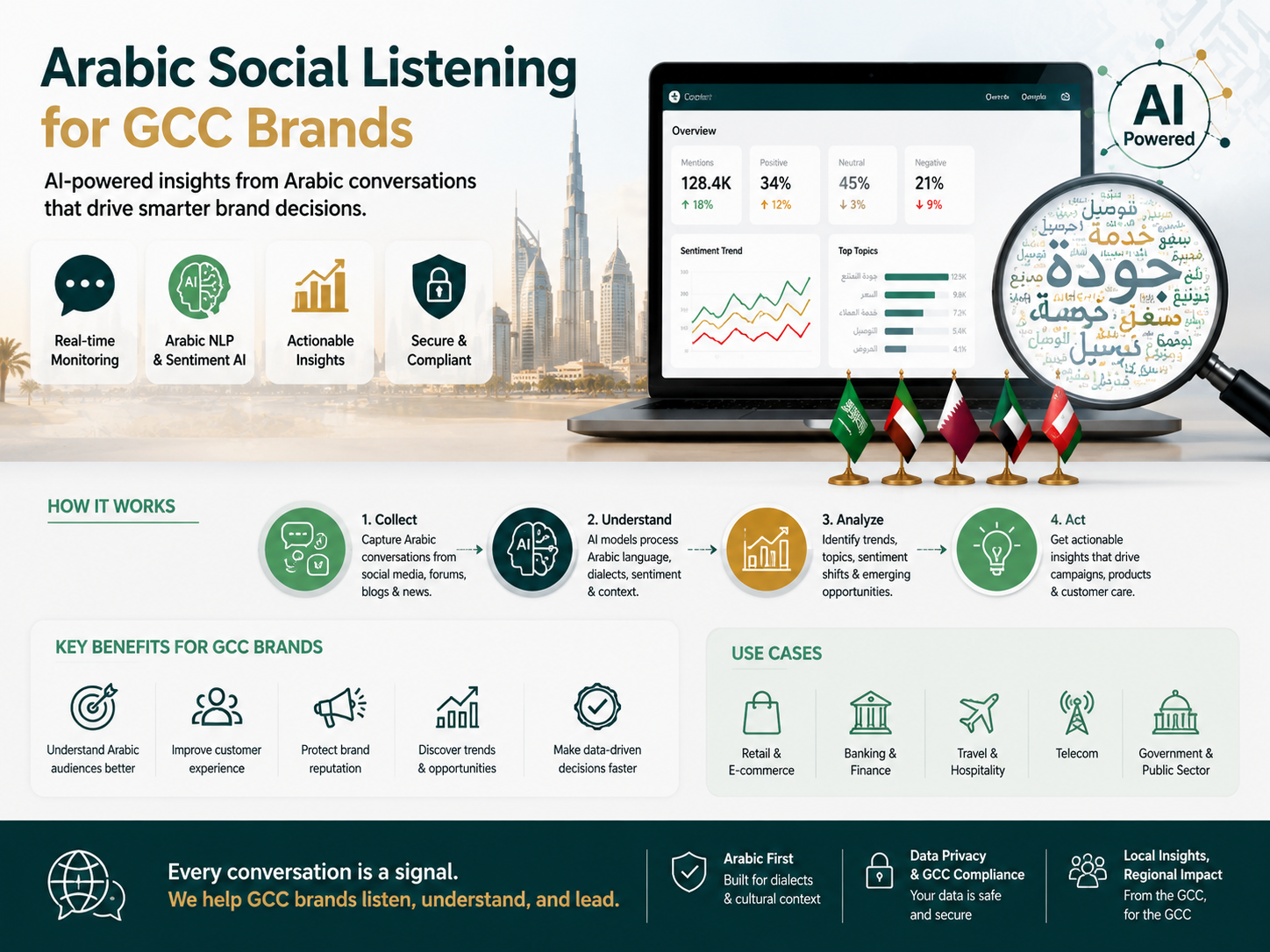
A reputation issue can move from one customer post in Riyadh to wider conversations across Dubai, Doha and the GCC remarkably quickly. Arabic social listening helps brands detect those conversations, understand their meaning and identify potential reputation risks before they become harder to manage.
At its core, Arabic social listening combines brand-mention tracking, Arabic NLP, sentiment analysis, AI-powered alerts and regional human judgment. For Saudi, UAE and Qatar organizations, that means going beyond simple keyword monitoring to understand Gulf dialects, Arabizi, sarcasm and Arabic-English code-switching.
What Is Arabic Social Listening for GCC Brands?
Arabic social listening is the process of collecting and interpreting relevant Arabic and bilingual digital conversations to understand customer sentiment, emerging narratives, intent and reputation risk.
Traditional monitoring tells a team where a brand was mentioned. Social listening goes further by asking.
Why is the conversation changing?
Is sentiment moving in a meaningful direction?
Which topics are driving the shift?
Who is amplifying the conversation?
Does the issue require a response?
That distinction matters for organizations managing reputation across Saudi Arabia, the UAE and Qatar.
Brands already investing in digital marketing strategies can also use listening insights to refine campaigns, messaging and customer responses.
How AI Turns Arabic Conversations Into Brand Intelligence
A practical Arabic social listening workflow looks like this.
Detect → Understand → Prioritize → Alert → Respond
AI and Arabic NLP can help with tasks such as.
Brand and entity recognition
Topic and narrative clustering
Sentiment classification
Conversation-volume anomaly detection
Influencer or high-reach account identification
Issue prioritization
Alert routing
The technology is most useful when it helps teams focus on the conversations that actually deserve attention.
Human review still matters, particularly when Arabic language is ambiguous, sarcastic or highly localized. A scalable human-in-the-loop AI workflow can help organizations combine automation with regional judgment.
Why Arabic Context Matters in Riyadh, Dubai and Doha
Arabic conversations across the GCC are not linguistically identical.
A customer in Riyadh may use Saudi slang. A Dubai user may switch between Arabic and English in the same post. Someone in Doha may mention a brand through a transliterated name, abbreviation or local expression.
Effective Arabic social listening for GCC brands therefore needs to account for.
Modern Standard Arabic
Gulf Arabic dialects
Arabic-English code-switching
Arabizi
Alternative spellings
Brand transliterations
Emojis and sarcasm
Local cultural context
Treating Arabic as one uniform dataset can hide important differences in meaning.
Why Is Arabic Social Listening Harder Than English?
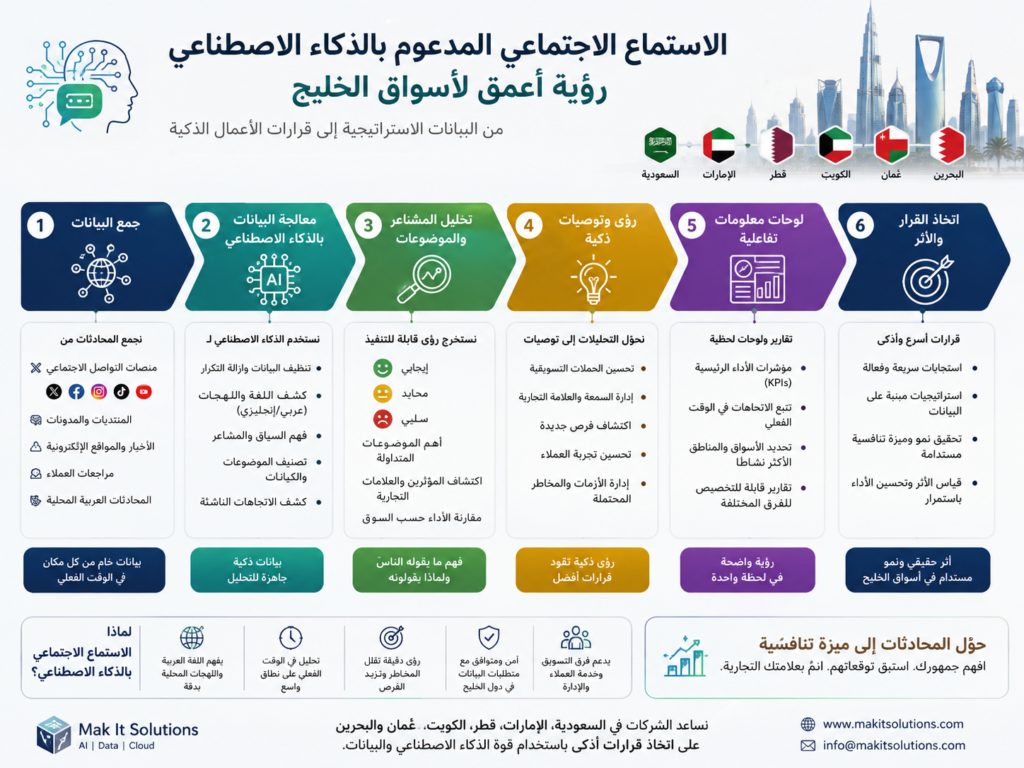
Arabic social listening becomes challenging because the system is not simply identifying Arabic words. It is trying to determine what people mean in conversations shaped by dialect, tone, spelling, humor and local context.
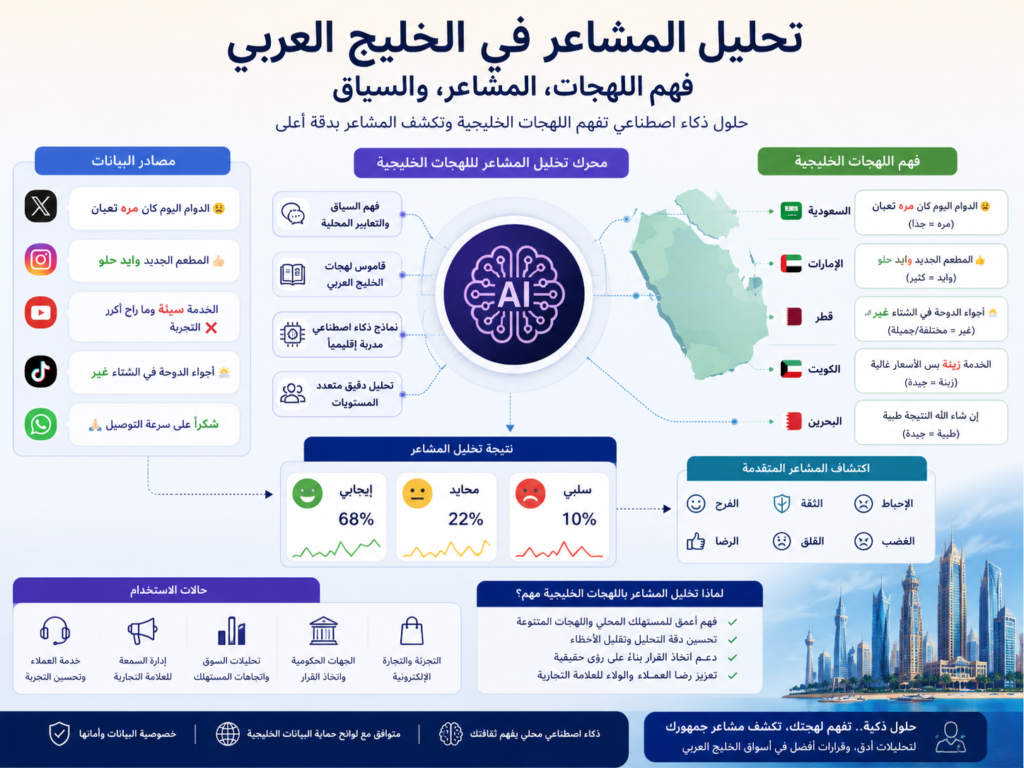
Gulf Dialects and Regional Vocabulary
Saudi, Emirati, Qatari, Kuwaiti, Bahraini and Omani audiences can express similar ideas in different ways.
A listening platform that performs well on Modern Standard Arabic may still struggle with informal Gulf conversations. That is why real-world testing with relevant regional language is more useful than relying only on a vendor’s generic claim that a platform “supports Arabic.”
Sarcasm and Arabic Sentiment Analysis
Sentiment is especially difficult when people use sarcasm, indirect criticism or humor.
A sentence may appear positive when analyzed word by word while actually expressing frustration. Emojis, punctuation and surrounding conversation can completely change the intended meaning.
For high-impact reputation alerts, automated sentiment should therefore be treated as a decision-support signal rather than unquestionable truth.
Arabizi, Misspellings and Arabic-English Code-Switching
A single brand may appear online as.
Its official English name
Its Arabic name
An Arabic transliteration
An English transliteration of Arabic
A shortened nickname
A hashtag
An abbreviation
A common misspelling
Strong brand-query libraries need to capture these variants. Otherwise, a dashboard may look comprehensive while missing relevant conversations.
How Does AI Reputation Monitoring Work for GCC Brands?
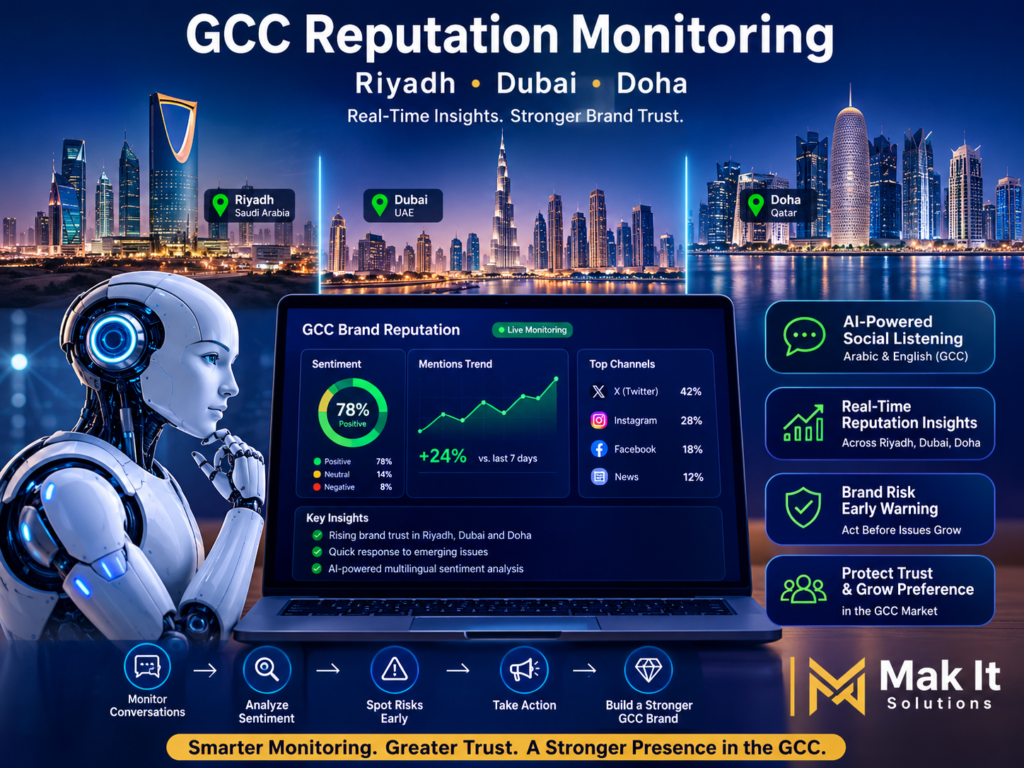
AI reputation monitoring works by establishing what normal conversation looks like, detecting unusual changes and then evaluating whether those changes represent a meaningful customer or reputation issue.
A useful framework is.
Baseline → Volume spike → Sentiment shift → Influential amplification → Narrative cluster → Human validation → Escalation
The goal is not to collect the largest possible number of mentions. It is to identify meaningful deviations early enough for communications, customer experience, compliance or leadership teams to make informed decisions.
Detecting Reputation Risks Before They Become Crises
Suppose complaints about a service normally appear at a steady rate. Suddenly, a specific Arabic complaint starts appearing repeatedly, receives engagement from larger accounts and develops into a recognizable narrative.
That combination may deserve more attention than a temporary increase in unrelated brand mentions.
Useful alerts can consider several signals together, including:
Mention velocity
Sentiment movement
Repeated complaint themes
Narrative growth
Influential amplification
Geographic concentration
Customer intent
Severity of the underlying issue
For organizations using AI in sensitive or regulated environments, these workflows should also sit within appropriate AI governance controls.
Monitoring X, Instagram, TikTok, News and Other Sources
Depending on lawful access, technical availability and individual platform restrictions, organizations may consider conversations appearing across channels such as X, Instagram, TikTok, YouTube, LinkedIn, Reddit, online news, reviews and forums.
Coverage should be evaluated source by source. Public visibility of a post should not automatically be interpreted as unrestricted permission to collect, retain or process its data for every purpose.
Turning Brand Mentions Into Reputation Intelligence
Raw mention counts tell only part of the story.
More useful outputs may include.
Sentiment movement
Share of voice
Recurring customer concerns
Competitor narratives
Emerging topics
Reputation alerts
Campaign response
Customer-experience insights
Executive-level summaries
For example, a GCC logistics company might detect a recurring Arabic conversation about delayed deliveries before the issue develops into a larger public narrative.
Arabic Social Listening in Saudi Arabia, UAE and Qatar
The underlying listening process may be similar across the GCC, but the language, audience mix and governance context can differ from one market to another.
Saudi Arabia.
Saudi organizations benefit from strong recognition of Saudi Arabic vocabulary, expressions and sentiment.
A Riyadh fintech, retailer or service provider could use listening to identify recurring complaints, product questions or changes in customer sentiment while also considering how personal data is handled within the monitoring workflow.
Saudi Arabia’s National Data Management Office operates under SDAIA and has responsibilities connected to data management, governance and personal-data protection. SDAIA also publishes relevant data-management and personal-data-protection regulations and standards.
Organizations designing AI monitoring workflows can also review Mak It Solutions’ AI governance guidance.
UAE.
For many Dubai and Abu Dhabi organizations, Arabic-English analysis is particularly valuable because online customer conversations may shift between languages.
A Dubai e-commerce business, for example, could connect reputation signals with its e-commerce infrastructure to identify repeated concerns around products, delivery or checkout experiences.
UAE organizations should assess privacy, information security, permitted data access and any sector-specific requirements relevant to their use case. TDRA publishes internet and digital-safety guidance, including information related to social-media reporting and online safety.
Qatar.
A Doha organization can use social intelligence to identify customer concerns, media narratives, emerging service problems and rapidly spreading conversations.
For financial-sector organizations, governance deserves particular attention. Qatar Central Bank publishes information-security materials that include data-handling, protection and technology-risk requirements for relevant regulated entities.
Infrastructure teams considering data-location and cloud architecture can also explore GCC sovereign-cloud approaches.
GCC Data Governance for Arabic Social Listening
Social listening can involve usernames, posts, opinions, identifiers and other information associated with individuals. Governance should therefore be designed into the workflow rather than added only after a tool has been deployed.
Saudi Data Governance and SDAIA
Saudi organizations should assess factors such as.
What data is being collected
Why it is being processed
Whether personal data is involved
Who can access the information
How long data is retained
Where processing takes place
What vendors or processors are involved
What security controls are required
SDAIA’s published materials cover data management, governance and personal-data protection, including standards and the Personal Data Protection Law framework.
UAE Governance for Digital Monitoring
UAE organizations should similarly evaluate privacy, security, access permissions and the purpose of monitoring.
Requirements can differ by organization, sector, jurisdiction and processing model, so teams should avoid treating generic social-listening settings as a complete governance framework.
Security architecture may also be strengthened through broader controls such as those discussed in Mak It Solutions’ Zero Trust strategy.
Qatar Considerations for Regulated Organizations
For organizations operating in Qatar, particularly regulated financial institutions, governance may need to cover data access, confidentiality, retention, security and processing arrangements.
QCB publishes dedicated data-handling and information-security requirements for relevant financial institutions and payment-service providers.
Compliance note.
Requirements depend on the organization’s sector, jurisdiction, data sources and specific processing activities. Social listening programs should be reviewed against applicable legal, regulatory and platform requirements rather than relying on general guidance alone.
How to Choose an Arabic Social Listening Tool
Not every platform that lists Arabic as a supported language will perform equally well on real GCC conversations.
The best evaluation is practical.
Test Whether It Understands Gulf Arabic
Create a representative test dataset containing the language your customers actually use.
Include examples of.
Saudi, Emirati and Qatari expressions
Arabic-English code-switching
Arabizi
Sarcasm
Misspellings
Brand nicknames
Emojis
Hashtags
Indirect complaints
Then review both false positives and missed conversations.
Compare Alerts, Sentiment and Competitor Intelligence
Depending on your use case, evaluate capabilities such as:
Arabic sentiment analysis
Real-time alerts
Topic and narrative clustering
Share of voice
Competitor tracking
Bilingual dashboards
Data exports
API access
Historical analysis
Human review workflows
Platforms such as Lucidya, CARMA, Talkwalker, Brandwatch and Crowd Analyzer may be worth evaluating according to business requirements. This is not a universal ranking; suitability depends on language performance, available data sources, governance requirements, integrations and workflow needs.
Evaluate Governance and Regional Support
A polished dashboard should not be the only buying criterion.
Also ask.
Where is data processed?
How long is it retained?
What access controls are available?
Can high-risk alerts be reviewed by a person?
Is model behavior explainable enough for your team?
Is Arabic-speaking support available?
Can the platform fit existing PR, CX and escalation processes?
The right tool should support better decisions, not simply produce more charts.
Best Practices for Arabic Social Listening in the GCC
A strong implementation starts with good queries, reliable baselines and clear escalation rules.
Build Arabic and English Brand-Query Libraries
Use this process.
Define official English and Arabic brand names.
Add transliterations, abbreviations and common misspellings.
Include products, executives and relevant hashtags.
Add colloquial references and competitor terms.
Establish normal conversation patterns.
Configure alerts, validate important sentiment signals and escalate credible risks.
A query library should be treated as a living resource. New product names, campaign phrases, slang and customer terminology can emerge over time.
Create Reputation Baselines and Crisis Thresholds
Before deciding what counts as a crisis, understand what normal looks like.
Track typical.
Conversation volume
Sentiment distribution
Customer topics
Complaint patterns
High-reach accounts
Geographic signals
Response patterns
A sudden increase becomes much easier to interpret when the team has a realistic baseline for comparison.
A Riyadh fintech might spot a rapidly growing complaint cluster. A Dubai e-commerce brand could notice repeated checkout frustration. A Doha business might identify a service issue that begins with a small group of customers but starts receiving wider amplification.
Combine AI Detection With Human GCC Context
AI is valuable because it can surface large volumes of conversations quickly.
Human regional expertise becomes valuable when the question changes from “What did the model detect?” to “What does this actually mean for the brand?”
That distinction is especially important for.
Sarcastic posts
Local humor
Indirect criticism
Sensitive cultural references
Ambiguous dialect
Executive-level alerts
Potential crisis escalation
The most practical model is usually not AI or humans. It is AI for scale, with human judgment where context and consequences matter most.
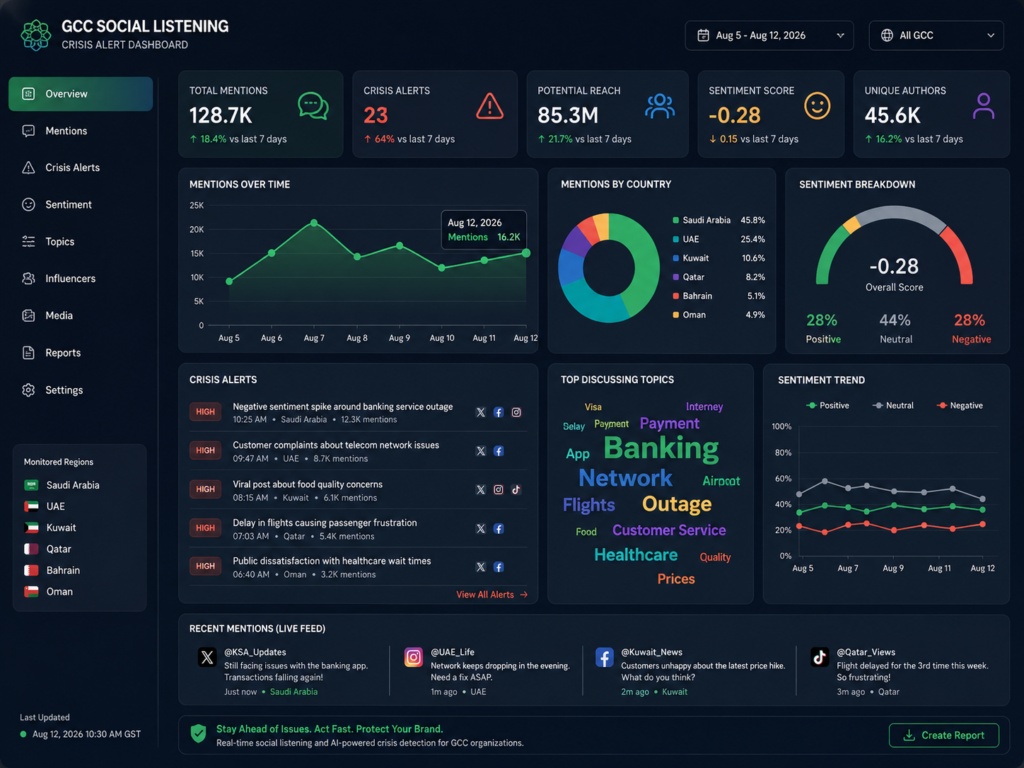
To Sum Up
The strongest Arabic social listening capability does more than claim to support the Arabic language. It recognizes Gulf dialects, bilingual conversations, alternative spellings and cultural context, then turns those signals into useful reputation intelligence.
The workflow is straightforward:
Arabic conversations → AI/NLP → sentiment and narratives → reputation intelligence → alerts → human judgment → response
For GCC brands, the competitive value comes from understanding relevant conversations earlier and responding with better context.
Organizations can also connect listening insights with SEO services and broader Mak It Solutions technology insights to align reputation intelligence with content and digital strategy.
Want to build an Arabic social listening and reputation-monitoring strategy designed for Saudi Arabia, the UAE and Qatar?
Contact Mak It Solutions to discuss Arabic AI, monitoring workflows, data governance and digital requirements for your organization.
FAQs
Q : Can AI understand Saudi Arabic sentiment accurately?
A : AI can analyze Saudi Arabic, but performance varies by model, training data, context and use case. Local slang, sarcasm and indirect criticism can still cause errors, so important alerts benefit from human validation.
Q : What should UAE brands look for in an Arabic social listening platform?
A : UAE brands should look for strong Arabic-English analysis, Gulf dialect support, sentiment validation, useful alerts, appropriate source coverage, competitor intelligence and clear governance controls. They should also evaluate where data is processed and who can access it.
Q : How can Qatar companies detect a reputation crisis early?
A : Start by establishing normal conversation volume, sentiment and topic patterns. Alerts can then highlight unusual spikes, fast-growing negative narratives or influential amplification, after which teams can validate the signal and follow internal escalation procedures.
Q : Can social listening monitor different Arabic dialects across the GCC?
A : Yes, but performance can vary considerably by dialect and platform. Saudi, Emirati, Qatari, Kuwaiti, Bahraini and Omani expressions should be tested separately instead of assuming generic Arabic support will perform equally across every GCC market.
Q : Which platforms should GCC brands monitor for reputation risks?
A : The right mix depends on where the organization’s customers and stakeholders actually communicate. Relevant sources may include X, Instagram, TikTok, YouTube, LinkedIn, online news, forums and review platforms, subject to lawful access, technical availability and each platform’s rules.