
Cloud Vendor Lock-In: How to Reduce Contract Risk
Cloud Vendor Lock-In: How to Reduce Contract Risk
Cloud Vendor Lock-In: How to Reduce Contract Risk
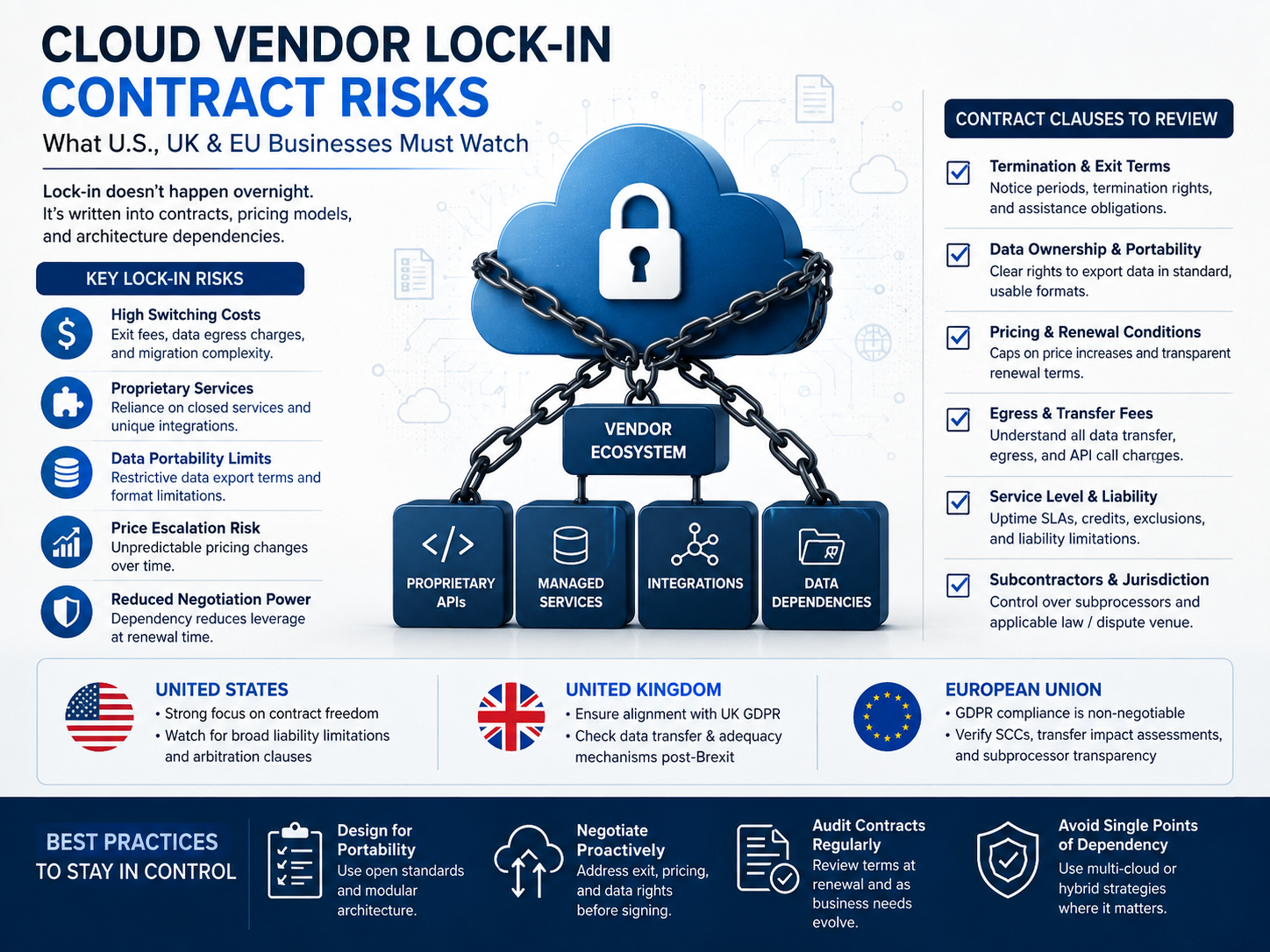
Cloud vendor lock-in can turn a sensible cloud decision into an expensive constraint. The risk is not limited to architecture: contracts, committed spend, data-transfer costs, proprietary services, and weak exit rights can all make changing providers harder than expected.
In practical terms, cloud vendor lock-in happens when technical, financial, operational, or contractual dependencies make switching cloud providers difficult or costly. Businesses can reduce that risk by negotiating clear portability rights, predictable switching costs, migration support, and a workable exit strategy before signing or renewing a contract.
A company may choose AWS, Microsoft Azure, or Google Cloud because the platform offers the right performance, managed services, security capabilities, or regional coverage. That decision can deliver real value. Problems appear later when proprietary APIs, committed-spend agreements, integrations, or data-transfer economics leave the organization with few realistic alternatives.
The scale of cloud adoption makes this increasingly important. Gartner forecast worldwide public-cloud end-user spending at roughly $675 billion in 2024, while Synergy Research Group estimated that cloud infrastructure service revenue reached about $330 billion for full-year 2024.
The goal is not to avoid hyperscalers. It is to use them without giving up meaningful strategic choice.
What Is Cloud Vendor Lock-In and Why Does It Matter?
Cloud vendor lock-in occurs when moving workloads, data, or operations to another provider becomes disproportionately expensive, disruptive, or technically difficult.
Switching rarely means simply copying files from one storage system to another. Organizations may need to refactor applications, replace proprietary services, rebuild integrations, retrain teams, renegotiate commercial terms, and maintain security and compliance throughout the transition.
The Four Main Types of Cloud Vendor Lock-In
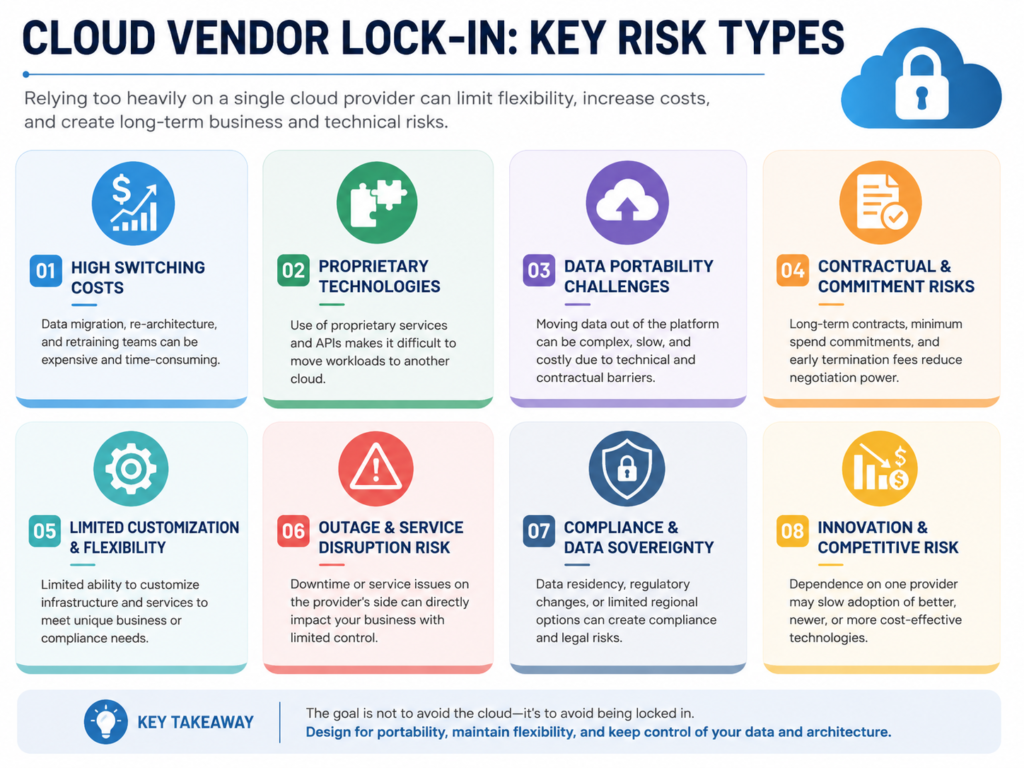
Cloud dependency usually develops across several areas at once.
Technical lock-in.
Proprietary APIs, databases, serverless functions, data formats, identity systems, or managed services make workloads difficult to reproduce elsewhere.
Contractual lock-in.
Weak portability rights, restrictive termination terms, or inadequate migration assistance make leaving operationally difficult.
Financial lock-in.
Committed spend, volume discounts, migration expenses, egress costs, or unfavorable termination economics reduce the commercial appeal of switching.
Operational lock-in.
Internal skills, monitoring, support processes, automation, and workflows become deeply tied to one cloud ecosystem.
A strong multi-cloud strategy can reduce certain dependencies, although supporting additional platforms can introduce its own cost and complexity.
How AWS, Microsoft Azure, and Google Cloud Dependencies Develop
Provider-specific technology is not automatically a problem. Managed databases, AI services, security platforms, analytics tools, and serverless products can save substantial development time and create genuine business value.
The risk appears when nobody can clearly explain how a critical dependency would be replaced.
Before adopting deeply proprietary services, teams should understand.
How data can be exported
Which APIs would need replacement
Whether equivalent services exist elsewhere
What configuration information is portable
How much application refactoring would be required
How long a realistic migration could take
The objective is not perfect portability. It is informed dependency.
The Real Business Cost of Cloud Switching
Cloud switching costs extend well beyond the provider’s invoice.
A migration may involve engineering labor, application refactoring, data extraction, testing, temporary parallel environments, staff retraining, downtime exposure, security validation, and business-continuity measures.
For a data-intensive organization in New York or San Francisco, a migration can be technically possible yet commercially unattractive if these costs were never modeled.
Regular cloud cost optimization should therefore examine exit economics as well as day-to-day consumption.
7 Cloud Vendor Lock-In Contract Risks to Avoid
The best time to address cloud vendor lock-in is before the agreement is signed or renewed. Contract language cannot eliminate technical dependency, but it can determine whether your organization has enough access, time, information, and support to execute an exit.
A Weak or Unclear Cloud Exit Clause
A cloud exit clause should clearly define what happens when the relationship ends.
At minimum, review termination triggers, notice periods, transition timelines, renewal conditions, continued service obligations, and each party’s responsibilities during migration.
A common problem is discovering after termination that access will end before workloads can be safely moved. Critical systems may require an agreed transition period that keeps essential services operating while a replacement environment is built and validated.
Vague Data Portability Rights
A contract stating that the customer “owns” its data is not enough.
The agreement should define what the customer can actually retrieve and in what form. Depending on the service, that may include.
Customer data
Metadata
Configuration information
Logs
Schema information
API documentation
Commonly usable or machine-readable export formats
The EU Data Act is particularly relevant for organizations operating in the European Union because its cloud-switching provisions address portability, switching, interoperability, and access to export mechanisms.
Undefined Migration and Termination Assistance
Cloud migrations often require active cooperation from the existing provider.
The contract should explain what assistance is available, who provides it, how long it remains available, and what it costs.
A detailed termination-assistance schedule can address.
Data extraction
Migration tooling
Technical support
Resource availability
Egress charges
Documentation
Post-termination access
Data-deletion confirmation
The objective does not have to be free migration. It should be predictable migration.
Unpredictable Egress and Data-Extraction Costs
A technically portable workload can still be commercially locked in.
Before signing, document normal transfer prices, bulk extraction charges, migration-specific fees, and any provider switching programs that may apply.
Model more than one scenario, including.
Normal contract termination
Partial workload migration
Full cloud exit
Regulatory-driven relocation
Provider disruption or failure
Knowing what leaving could cost makes it much easier to evaluate the real value of a long-term discount.
Overly Restrictive Committed-Spend Terms
Committed-spend agreements can generate meaningful savings, but they can also restrict future choice.
Review.
Minimum commitments
Ramp schedules
Renewal conditions
Shortfall rules
Credits
Price-change protections
Early-termination economics
An oversized commitment may force a business to keep workloads with the same provider even when another option becomes commercially or technically preferable.
Missing Portability Documentation and Interface Rights
Portability is difficult when essential information is available only informally or through provider-specific tooling.
Where relevant, contracts should protect access to technical documentation, APIs, interfaces, configuration data, export mechanisms, and other information needed to reconstruct or migrate the service.
Open interfaces and commonly used formats can reduce friction, particularly for workloads expected to remain in service for many years.
No Clear Data Return and Deletion Obligations
Leaving a provider involves more than retrieving information.
The agreement should explain when data can be downloaded, how long it remains accessible after termination, what happens to backups, and how deletion is handled once the migration is complete.
For regulated or sensitive workloads, the organization may also need documented confirmation that data has been deleted or otherwise processed according to applicable contractual and regulatory requirements.
How to Build a Cloud Exit Strategy Before You Need One
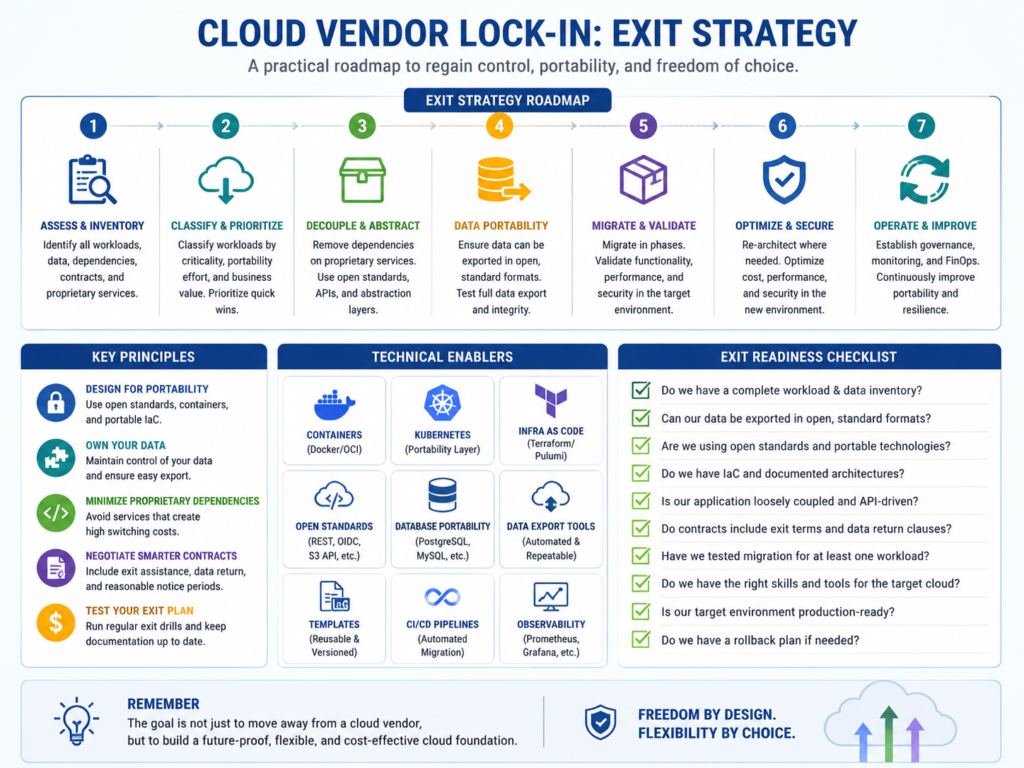
A cloud exit strategy should explain what needs to move, how workloads and data will be extracted, which dependencies must be replaced, who supports the transition, what switching could cost, and how essential services will remain available.
Companies reduce cloud vendor dependency most effectively when portability becomes part of normal operations rather than an emergency project.
Create a Cloud Vendor Lock-In Risk Assessment
Start with an inventory of.
Applications and workloads
Data volumes
Managed services
Proprietary APIs
Integrations
Licensing dependencies
Cloud-specific skills
Contractual commitments
Recovery requirements
Compliance obligations
Then classify workloads by migration difficulty.
A relatively simple web application may be straightforward to reproduce elsewhere. A large analytics environment built around provider-native databases, identity systems, AI services, and data pipelines could require substantial redesign.
Mak It Solutions’ Business Intelligence Services may be relevant where data platforms and reporting layers form part of the dependency assessment.
Test Workload and Data Portability
Do not rely on contract wording alone.
Test exports, backups, restoration procedures, deployment automation, dependency inventories, and recovery processes in practice. A successful export matters only if the exported data can actually be reconstructed or used somewhere else.
Testing can expose issues such as missing metadata, undocumented formats, incompatible versions, or hidden service dependencies long before a real exit is required.
Decide Where Multi-Cloud or Open Standards Add Value
Containers, infrastructure as code, portable databases, open interfaces, and abstraction layers can reduce switching friction.
However, portability is not free. Designing every workload to run identically across multiple cloud providers can increase engineering effort, security overhead, and operational complexity.
Use portability where concentration risk, regulation, business continuity, or negotiating leverage justifies the investment.
For application teams, strong back-end development practices can also reduce unnecessary coupling between business logic and cloud-specific infrastructure.
How Cloud Switching Rules Differ in the US, UK, and EU
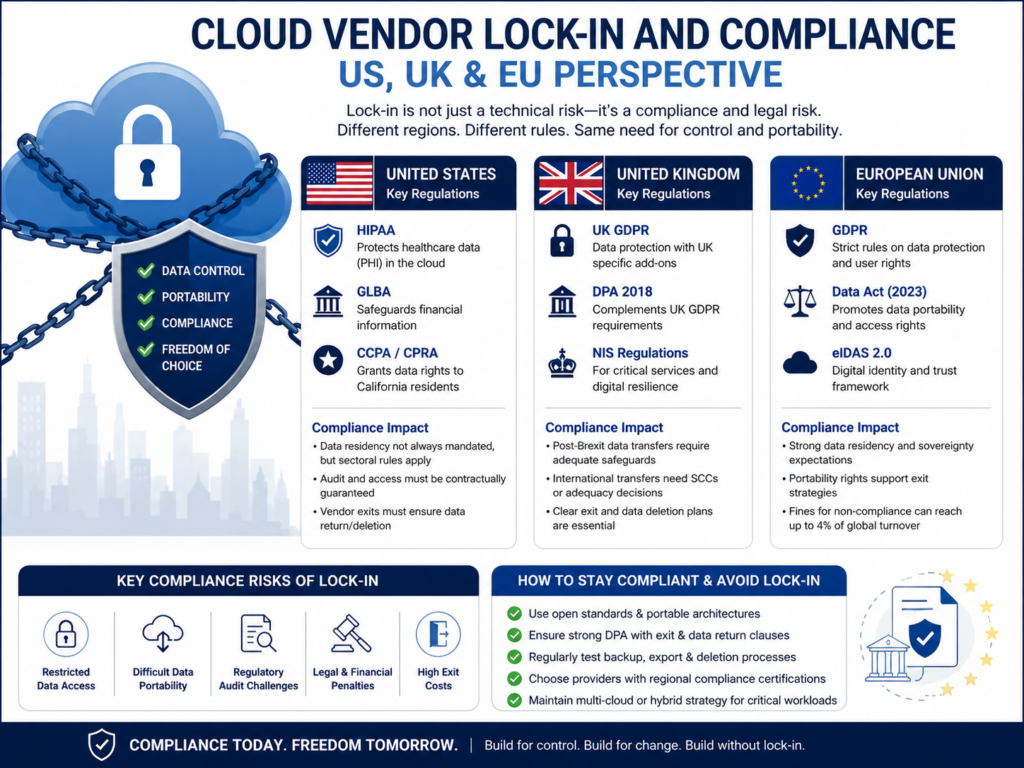
Cloud procurement priorities vary by jurisdiction and industry. US organizations often focus heavily on contractual protections and sector-specific requirements, while the UK and EU add important competition, privacy, resilience, interoperability, and cloud-switching considerations.
USA.
A New York healthcare platform handling electronic protected health information, for example, should align its cloud arrangements with applicable HIPAA safeguards and business-associate responsibilities. HHS remains the principal federal source for HIPAA privacy and security requirements.
Payment environments may also need to consider PCI DSS requirements maintained by the PCI Security Standards Council.
Depending on the business and workload, cloud contracts should clearly address.
Data ownership
Sub processors
Security and audit evidence
Incident support
Data return and deletion
Portability
Transition assistance
SOC 2 reports can also play a role in vendor assurance, although the exact compliance obligations will depend on the organization, data, and services involved.
UK.
UK buyers should examine switching costs, licensing, concentration risk, interoperability, and data protection as part of cloud procurement.
The UK’s Competition and Markets Authority cloud-services investigation, which followed an Ofcom referral in October 2023, reached its final decision in July 2025 and examined competition in public cloud infrastructure services.
London fintech firms, FCA-regulated businesses, NHS suppliers, and other organizations processing sensitive information should also evaluate UK GDPR requirements and relevant sector-specific obligations.
In practice, the commercial question is straightforward: if a supplier becomes more expensive, less suitable, or harder to work with, can the organization realistically move?
Germany and the EU.
For organizations operating in Frankfurt, Berlin, Munich, Paris, Amsterdam, Dublin, and other EU markets, Anbieterabhängigkeit, Anbieterwechsel, Datenportabilität, Wechselkosten, Exit-Strategie, and digitale Souveränität have become practical procurement concerns.
The EU Data Act has applied since September 12, 2025. Its cloud-switching provisions are designed to make it easier for customers to move between data-processing services and improve interoperability.
The European Commission also states that switching charges, including relevant data-egress charges, are to be removed from January 12, 2027, with transitional cost-based charges permitted beforehand.
Depending on the organization and workload, GDPR/DSGVO, DORA, BaFin expectations, data-residency obligations, and other sector-specific requirements may add further considerations.
For regulated environments, legal and compliance teams should review the current rules before relying on a particular contract structure or migration plan.
What Should You Negotiate on Pricing, Egress, and Committed Spend?
Commercial flexibility matters almost as much as technical portability.
Procurement teams should understand what leaving costs before calculating the financial benefit of staying.
Make Egress and Data-Extraction Costs Predictable
Document standard data-transfer pricing, bulk extraction costs, migration-specific charges, and any switching support available from the provider.
Model the cost of several realistic exit scenarios rather than relying on a single best-case assumption.
Avoid Commitments That Remove Future Choice
Long-term commitments can make sense when usage is predictable.
Problems arise when the commitment exceeds realistic demand or prevents the organization from moving workloads for business, technical, or regulatory reasons.
Before signing, compare the expected discount with the potential cost of reduced flexibility.
Use Portability to Strengthen Renewal Negotiations
Perform dependency inventories and portability tests before renewal discussions.
Once a major multi-year commitment has been signed, negotiating leverage may decline. A credible alternative architecture gives procurement a stronger position, even when remaining with the existing provider is still the best decision.
7Cloud Vendor Lock-In Risk Checklist for Procurement and IT
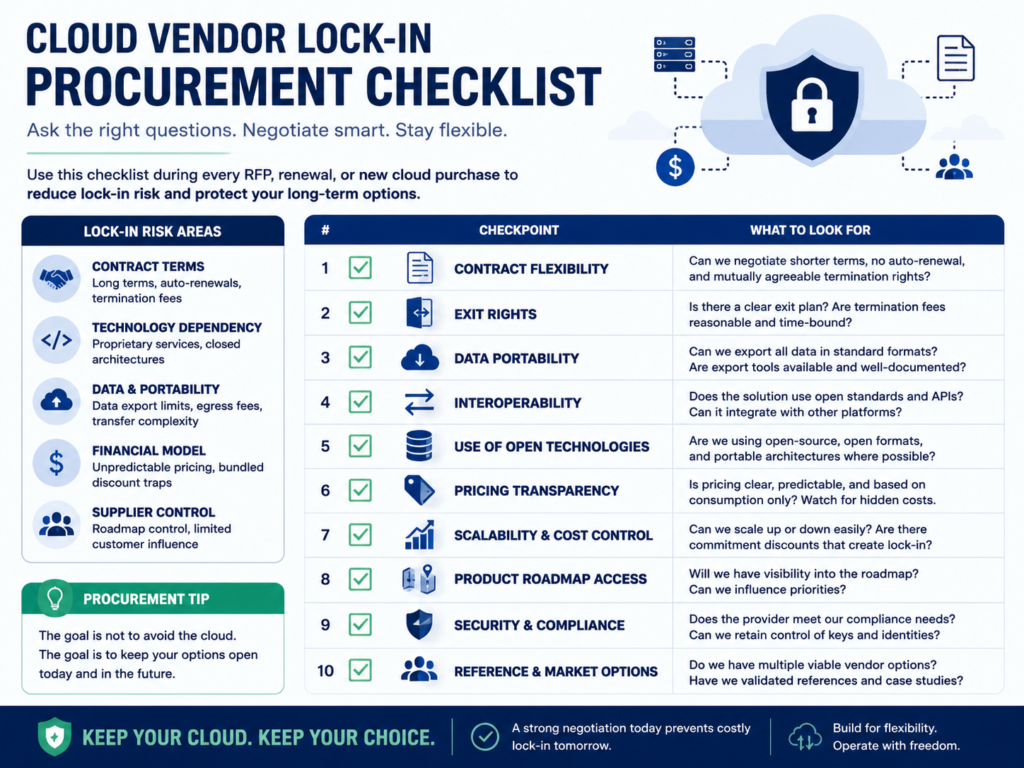
A useful cloud vendor lock-in review should cover technology, contracts, commercial terms, compliance, governance, and the practical ability to leave.
Technical and Data Portability Questions
Can customer data be exported in usable formats?
Which proprietary APIs or managed services would need replacement?
Can configuration and metadata be exported?
Are workloads reproducible through infrastructure as code?
Have backup, restore, and portability procedures actually been tested?
Contract and Commercial Questions
Aretermination rights and transition periods clear?
Is termination assistance contractually defined?
Are migration rates and egress fees predictable?
What happens to committed spend after termination?
Are audit rights, SLA remedies, and price-change protections sufficient?
Compliance and Governance Questions
Confirm data locations, sub processors, return and deletion obligations, audit evidence, retention periods, and relevant sovereignty requirements.
Depending on the workload, map applicable requirements under frameworks such as GDPR/DSGVO, UK GDPR, HIPAA, PCI DSS, DORA, BaFin, FCA, and other sector-specific rules.
Security dependencies should also be reviewed alongside cloud security misconfiguration risks and, for highly sensitive workloads, confidential computing architectures.
When Should You Renegotiate or Plan a Cloud Provider Exit?
Organizations should reconsider their cloud arrangement when dependency becomes commercially or operationally significant not only when the contract is about to expire.
Warning Signs That Cloud Vendor Lock-In Is Becoming Material
Watch for.
Rapidly increasing switching costs
Growing dependence on proprietary services
Weak or untested portability
Unpredictable data-transfer costs
Shrinking commercial leverage
Compliance concerns
Unclear termination assistance
An inability to produce a credible migration plan
None of these signs automatically means the organization should leave. They do mean the dependency deserves attention.
Renegotiation vs. Migration
Migration is not always the best response.
Renegotiation may produce stronger portability rights, improved pricing, revised commitments, better migration assistance, or more favorable interoperability terms.
In other cases, selectively diversifying workloads may reduce concentration risk without the disruption and cost of a complete cloud exit.
What to Prepare Before Your Next Cloud Contract Negotiation
Bring six things to the table.
A dependency inventory
Clear exit requirements
Portability standards
A migration cost model
A compliance matrix
Ranked negotiation priorities
That preparation turns cloud vendor lock-in from an abstract technical concern into a measurable business risk.
Concluding Remarks
The best time to manage cloud vendor lock-in is before your organization urgently needs to leave.
Planning a major cloud renewal, migration, or long-term AWS, Microsoft Azure, or Google Cloud commitment? Mak It Solutions can help assess architecture dependencies, portability requirements, migration risks, and cloud cost assumptions before they become expensive constraints.( Click Here’s )
Explore Mak It Solutions and request a scoped cloud vendor lock-in and exit-readiness assessment.
Key Takeaways
Cloud vendor lock-in can be technical, contractual, financial, and operational.
Strong contracts define termination rights, data portability, migration support, switching costs, deletion requirements, and transition periods.
Portability should be tested rather than assumed.
Multi-cloud can reduce concentration risk, but unnecessary complexity can create new costs.
US, UK, and EU organizations may face different contractual, compliance, and regulatory considerations.
Exit readiness should be reviewed before renewal, while commercial leverage is strongest.
FAQs
Q : Can a company avoid cloud vendor lock-in completely?
A : Usually not without giving up useful cloud capabilities. A more practical goal is manageable dependency: use proprietary services where they create real value, while documenting exports, replacement options, migration procedures, and contractual protections for high-risk workloads.
Q : Does Kubernetes automatically prevent cloud vendor lock-in?
A : No. Kubernetes can improve portability at the container-orchestration layer, but applications may still depend on provider-specific databases, IAM, storage, networking, monitoring, serverless platforms, AI APIs, and data services. Portability needs to be assessed across the entire application stack.
Q : Who should own a cloud exit plan?
A : Cloud exit planning should be cross-functional. IT and architecture teams understand technical dependencies, procurement manages commercial leverage, legal reviews termination and liability provisions, and security and compliance teams evaluate applicable regulatory requirements. A senior business owner should ensure those workstreams produce one executable plan.
Q : How often should cloud portability be tested?
A : Critical workloads should generally be reviewed at least annually and before major renewals, architecture changes, acquisitions, or significant regulatory events. Higher-risk systems may justify more frequent testing depending on business impact and operational complexity.
Q : What should a cloud provider supply when a contract ends?
A : A well-designed agreement should address access to customer data, relevant metadata, configurations, technical documentation, APIs, export formats, transition support, billing, deletion obligations, and any agreed confirmation that retained copies have been handled appropriately.