


EU Data Residency vs US: The Smarter Choice
EU Data Residency vs US: The Smarter Choice
EU Data Residency vs US: The Smarter Choice
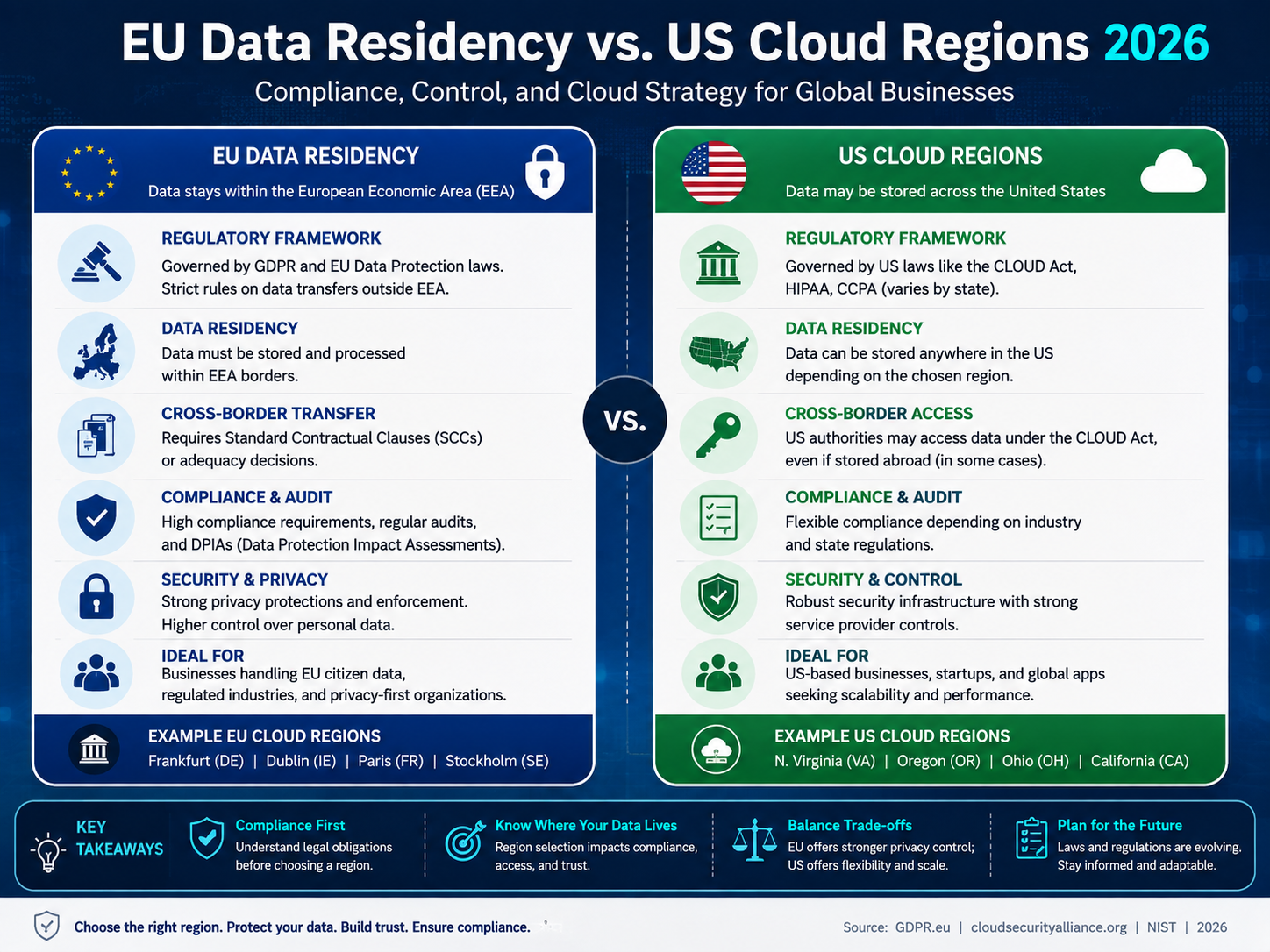
Choosing EU data residency vs US infrastructure is not simply a matter of putting a database in Frankfurt instead of Virginia. The real decision involves legal jurisdiction, international transfers, provider control, support access, backups, encryption keys, latency and contractual commitments.
In practical terms, EU data residency may reduce cross-border transfer and procurement concerns, while US hosting can make more sense for US-centric workloads. Neither option guarantees compliance on its own. The stronger choice depends on who uses the system, where personal data flows, which provider controls the environment and what legal or technical safeguards are in place.
Importantly, GDPR does not impose a blanket rule requiring all EU personal data to remain physically inside the European Union. Instead, Chapter V governs transfers to third countries and provides legal mechanisms and safeguards for permitted transfers.
Cloud adoption has made these questions increasingly practical. Eurostat reported that around 45% of EU businesses purchased cloud services in 2023. Among large EU businesses, usage was about 78%, while the figure for SMEs was roughly 44%.
EU Data Residency vs US Data Residency.
EU data residency vs US data residency primarily describes where information is geographically stored or processed. It does not automatically tell you which laws apply, who can access the information or whether an international transfer is legally permitted.
Data residency means where data is stored and processed
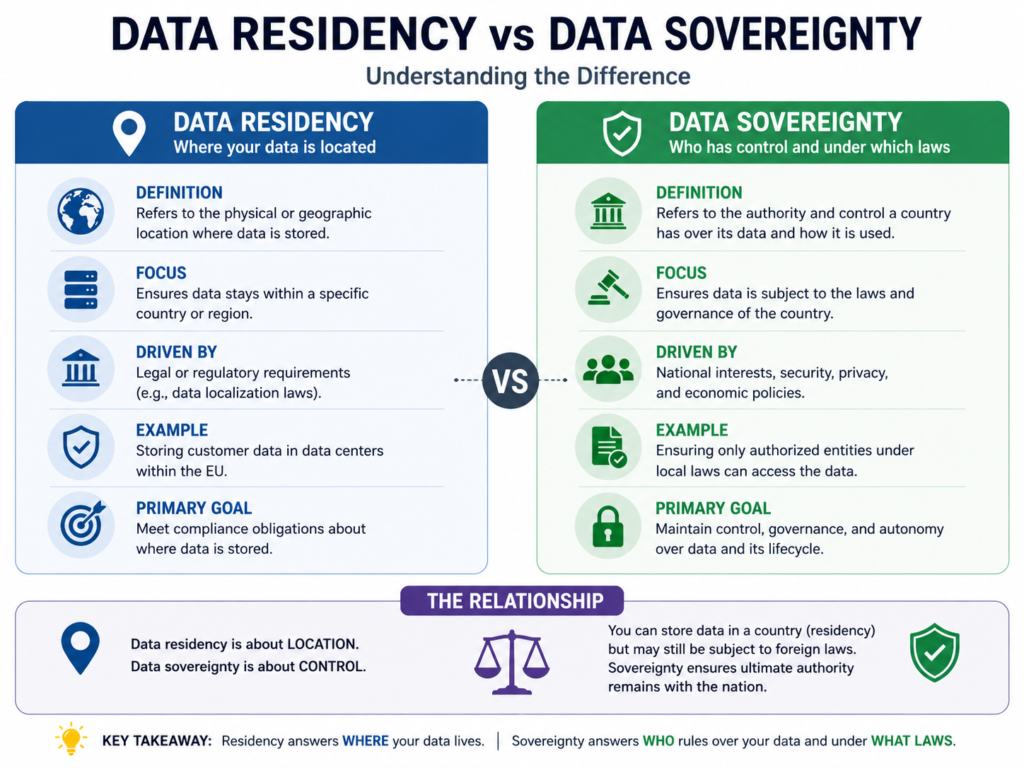
Data residency refers to the geographic location where an organization stores or processes information.
For a SaaS platform, that can include much more than the main production database.
Object storage
Database replicas
Disaster-recovery copies
Application logs
Security logs
Telemetry
Metadata
Analytics systems
AI prompts or model inputs
Support systems
A database running in Frankfurt does not necessarily mean every related data element remains in Germany. Backups might replicate to Ireland, support telemetry might reach another jurisdiction, or an AI service might process prompts in a different region.
For architecture-heavy environments, Mak It Solutions‘ guide to data localization architecture patterns shows why the full data flow matters more than the location of the primary database alone.
Data residency vs data sovereignty vs data localization
Residency is not the same as sovereignty.
Data residency focuses on physical location. Data sovereignty focuses on the laws, jurisdiction and control affecting the data. Data localization generally refers to requirements that certain information remain within a defined geographic boundary.
That distinction is increasingly important in European conversations around digital sovereignty, Datensouveränität, Datenresidenz and sovereign-cloud models.
Why an EU server may not remove US jurisdiction questions
Using an EU region operated by a US-owned provider can still raise questions about ownership, custody, operational control and lawful government requests.
The US Department of Justice explains that the CLOUD Act can apply to providers subject to US jurisdiction where responsive information is within their possession, custody or control, regardless of where it is stored. That does not mean authorities have unrestricted access, nor does every deployment create the same exposure.
This is why technical controls matter alongside geography. Customer-managed encryption keys, confidential computing, strict privileged-access controls and strong separation of duties can materially change the risk profile.
Mak It Solutions discusses related safeguards in its guide to confidential computing for sensitive cloud workloads.
GDPR and EU-US Data Transfer Requirements
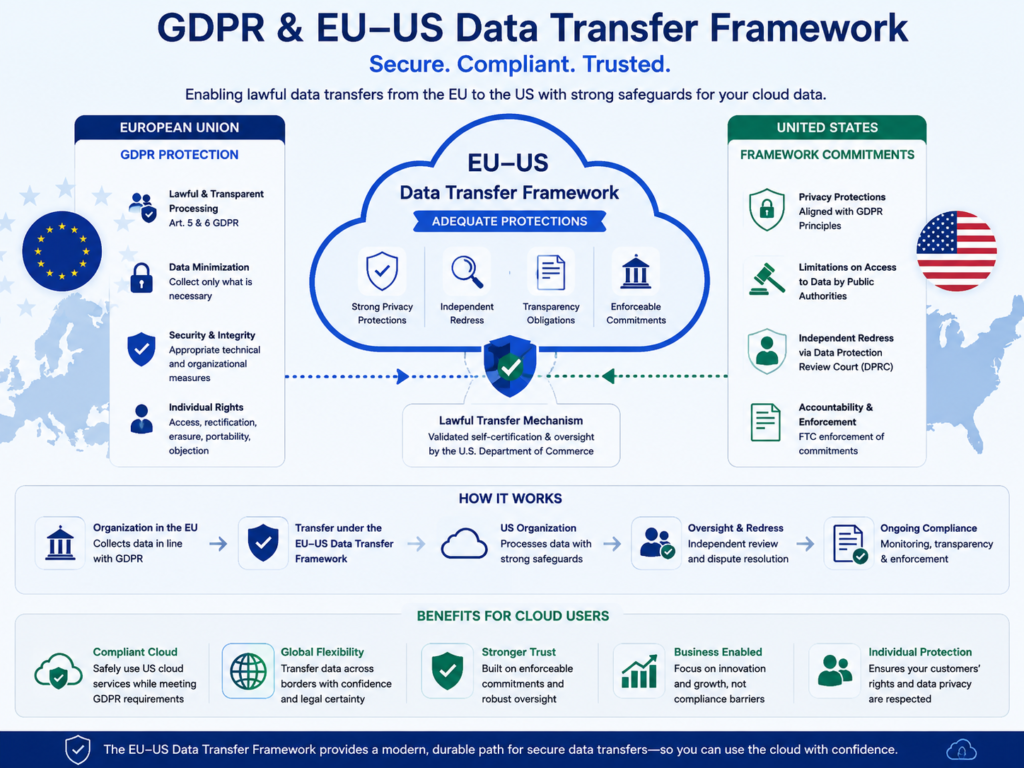
GDPR regulates cross-border transfers of personal data, but EU data residency is not universally mandatory.
When personal information is transferred outside the EEA, organizations need to determine whether the transfer is covered by an adequacy decision, appropriate safeguards or another lawful Chapter V mechanism
Does GDPR require EU data residency?
No. GDPR does not categorically require every piece of EU personal data to be stored inside the EU.
A SaaS company may therefore operate infrastructure in the United States while serving European customers. The important question is whether the underlying processing, transfer mechanism, security controls and contractual arrangements satisfy the relevant GDPR requirements.
EU-US Data Privacy Framework, SCCs and BCRs
Organizations transferring personal data to qualifying US recipients may be able to rely on the EU-U.S. Data Privacy Framework (DPF) where the recipient is properly participating in the framework. The official DPF list can be used to verify participating organizations.
Other commonly relevant mechanisms include:
Standard Contractual Clauses (SCCs)
Binding Corporate Rules (BCRs) for eligible intra-group transfers
Other mechanisms permitted under GDPR where their requirements are satisfied
The mechanism alone is not always the end of the analysis. Depending on the transfer, organizations may also need to examine practical risks, government-access rules and supplementary technical or organizational measures.
Germany, the UK and the US need different compliance lenses
Germany applies GDPR as DSGVO, but German enterprise buyers often look beyond formal GDPR compliance. Procurement reviews may focus heavily on Datenübermittlung USA, Datensouveränität, provider ownership, encryption-key custody and administrative access.
For financial organizations, EU digital-resilience requirements can add another layer. DORA has applied since January 17, 2025, making ICT third-party risk particularly relevant to regulated firms.
The UK requires its own analysis under UK GDPR and ICO international-transfer rules. ICO guidance explains that restricted transfers generally need UK adequacy regulations, appropriate safeguards such as the IDTA or UK Addendum, BCRs, or a relevant exception.
US workloads can also involve sector-specific obligations, including HIPAA for certain healthcare environments and PCI DSS controls for payment-card systems.
EU vs US Cloud Hosting.
The better cloud region depends on more than regulatory labels. A sound EU data residency vs US decision should consider jurisdiction, provider ownership, sub processors, support access, encryption, resilience and workload economics together.
Legal jurisdiction and provider ownership
Compare the actual operating model rather than relying on the provider’s brand name.
A useful assessment may include:
An EU-headquartered provider
A US provider operating in a US region
A US-owned provider operating in an EU region
A sovereign-cloud offering with additional operational controls
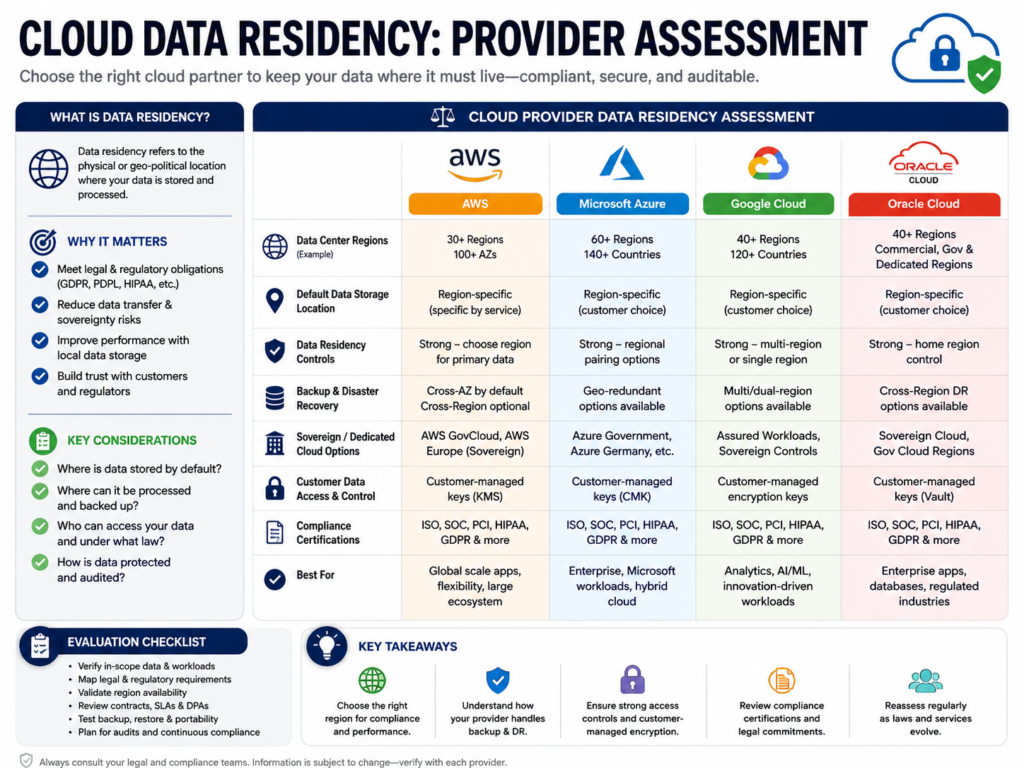
AWS, Microsoft Azure, Google Cloud, IBM and Oracle all offer regional infrastructure, but the legal and operational analysis should focus on the specific service, architecture and contract being used.
A broader cloud repatriation strategy can also help when compliance, cost or architectural requirements make a cloud-first assumption too restrictive.
Sub processors and support access
Ask where administrators and support teams are located and whether they can view customer information in plaintext.
Remote support access can matter even when the production database remains inside Europe.
Backups and disaster recovery
Primary data may sit in Frankfurt while disaster-recovery copies are stored elsewhere.
Residency claims should therefore cover backups, replicas, snapshots and restoration procedures—not only production systems.
Encryption-key control
Who can decrypt the information?
Customer-managed keys, external key management and well-designed HSM or KMS architectures can strengthen sovereignty controls by reducing dependence on the infrastructure provider.
Logs, telemetry and AI data flows
For AI-enabled products, the data map should also cover:
Model prompts
Inference regions
Embeddings
Vector databases
Prompt histories
Model telemetry
Safety and diagnostic logs
Strong Zero Trust controls can further reduce unnecessary administrative access across these systems.
Latency and customer location
Region choice affects performance.
Frankfurt, Dublin, Paris, Amsterdam and London can offer sensible proximity for many European users, while Virginia, Ohio and Oregon may reduce latency for North American workloads.
The best option depends on where customers actually connect from.
Feature availability and regional cost
Do not assume that every cloud service has identical functionality, pricing or availability in every region.
Before committing, check service availability, data-egress costs, failover design, network architecture and customer proximity.
EU Data Residency Advantages and Trade-Offs
Companies often choose EU residency when European customer expectations, regulatory sensitivity, contractual commitments or sovereignty concerns outweigh the operational advantages of US hosting.
When EU hosting is the stronger choice
EU hosting can make procurement conversations easier with GDPR-sensitive organizations, public-sector buyers and enterprise customers that expect regional control.
For example, a Berlin SaaS vendor serving German financial institutions may choose Frankfurt-hosted customer records, European backup locations and customer-controlled encryption keys.
A London-based company serving both UK and EU customers might instead separate workloads so UK and EU data can follow distinct governance models.
Why Germany can raise the sovereignty bar
German buyers may ask more than “Wo sind die Daten?”
They may also want to know.
Who owns the provider?
Who controls the infrastructure?
Where do administrators work?
Who holds the encryption keys?
Can overseas entities compel disclosure?
Where are backups and logs processed?
For regulated organizations, DSGVO Cloud Datenstandort, Datenresidenz Deutschland, BaFin requirements and sovereign-cloud expectations can turn seemingly minor architecture choices into procurement issues.
EU residency limitations
EU residency is not a compliance certificate.
A system may be marketed as “EU-hosted” while still using.
Non-EU sub processors
Overseas support personnel
Global telemetry platforms
External AI services
Disaster recovery outside Europe
Those dependencies need to be examined before making an “EU-only” commitment to customers.
US Data Residency Advantages and Trade-Offs
US hosting can be a sensible option when customers, users and operational teams are predominantly American.
When US hosting makes operational sense
Consider a SaaS company based in Austin or New York whose users are overwhelmingly in the United States.
A US cloud region may simplify operations, improve user proximity and provide better alignment with the services the engineering team relies on, while still supporting appropriate SOC 2, HIPAA or PCI DSS controls where applicable.
Mak It Solutions’ backend development services can support region-aware application architectures where APIs, databases and access controls must follow defined workload boundaries.
What changes when EU customer data is stored in the US?
US hosting is not automatically prohibited by GDPR.
However, transferring European personal data to the United States requires an applicable legal basis under GDPR’s international-transfer framework and appropriate safeguards.
That can involve verifying DPF participation where the framework is relied upon, implementing SCCs where appropriate and reviewing the relevant technical and organizational protections.
CLOUD Act concerns for European buyers
European procurement teams may still ask whether a US provider could be compelled to disclose information under lawful US process.
That question is separate from the location of the physical disk.
Customer-managed encryption keys, restricted privileged access and a clear analysis of possession, custody and control can therefore be just as important as choosing Frankfurt instead of Virginia.
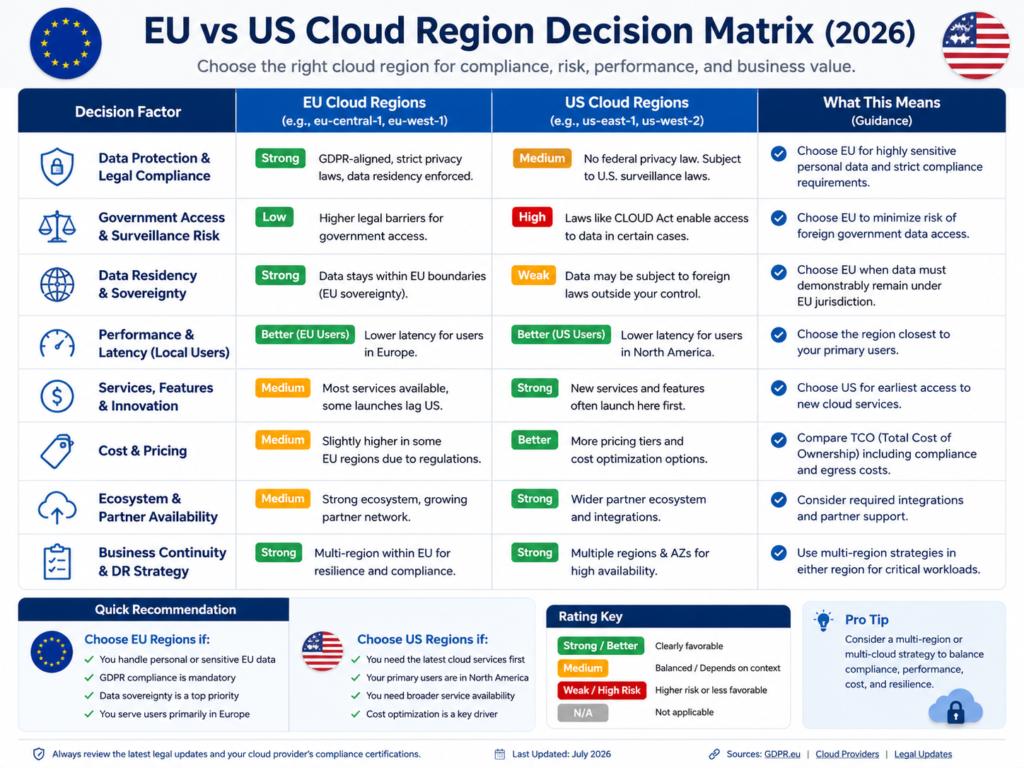
EU or US Cloud Region? A Practical Decision Matrix
Choose an EU region when European customer expectations, regulatory sensitivity or contractual residency obligations dominate. Choose a US region when the workload is primarily US-centric and European transfers are limited and properly governed. Use hybrid or sovereign architecture where a single-region approach creates unnecessary legal or operational trade-offs.
| Question | EU Hosting | US Hosting | Control to Verify |
|---|---|---|---|
| Where is primary data stored? | EU region | US region | Contract and architecture |
| Are EU-US transfers involved? | Sometimes | Usually for EU data | DPF, SCC or BCR basis |
| Does provider jurisdiction matter? | Yes | Yes | Ownership and custody/control |
| Where are backups stored? | Verify EU-only claim | Verify selected US region | DR configuration |
| Where can support staff access data? | Verify | Verify | Privileged-access controls |
| Who controls encryption keys? | Customer or provider | Customer or provider | KMS/HSM architecture |
| Typical fit | EU-heavy or regulation-sensitive workloads | US-heavy or US-centric workloads | Workload-specific assessment |
Choose EU residency when
EU hosting is usually the stronger candidate when European data subjects dominate, German procurement scrutiny is high, contracts promise European residency, sovereign-cloud requirements apply or reducing cross-border administrative access is a priority.
Choose US residency when
US hosting may fit when customers and staff are primarily US-based, European transfers are limited, transfer mechanisms are documented, and US-region latency, services or economics materially improve the workload.
Choose hybrid or sovereign architecture when one region is not enough
A hybrid design can keep EU customer records and encryption keys in Europe while serving US customers from US infrastructure.
Logs, backups, privileged-access systems and analytics pipelines can also be separated by region.
For data-heavy applications, Business Intelligence services can support region-specific data pipelines instead of forcing every dataset into a single global environment.
How to Evaluate an EU or US Data Residency Provider
A reliable assessment maps every important location and access path, then verifies the contractual and technical controls behind them.
The goal is to replace a vague “EU-hosted” or “US-hosted” promise with an architecture your technical, security and compliance teams can actually defend.
Ask for a complete data-location map
Document where each of these components operates.
Production databases
Replicas
Backups
Logs
Metadata
Telemetry
AI services
Support systems
Sub processors
Encryption-key infrastructure
A provider that cannot clearly explain these flows may make future security and compliance reviews significantly harder.
Verify contractual and technical controls
Review the DPA, applicable SCCs, DPF participation where relied upon, sub processor terms, deletion processes, data portability, key management and privileged-access controls.
For higher-risk workloads, request relevant audit evidence such as SOC 2 or PCI DSS reports rather than treating marketing language as proof of compliance.
Assess residency by workload
Customer records, HR information, healthcare systems, financial data, analytics pipelines, AI inference and development environments do not necessarily need identical residency rules.
Mak It Solutions’ Python development services can support data-processing and automation architectures where residency boundaries need to be built into the application before those choices become difficult to change.
Final Decision
The right EU data residency vs US strategy depends on your customers, contracts, regulatory exposure and architecture not on a simple assumption that one geography is always more compliant than the other.
Map the complete data flow first. Then examine jurisdiction, transfer mechanisms, support access, sub processors, backups and encryption-key control before choosing a region.
Unsure whether Frankfurt, London or a US cloud region fits your SaaS or data platform? Contact Mak It Solutions for a scoped architecture and data-residency assessment covering workload boundaries, transfers, vendor controls and regional trade-offs.
Key Takeaways
EU data residency vs US is not simply a server-location choice. Jurisdiction, access, provider control and contracts matter too.
GDPR allows qualifying international transfers; it does not universally require EU-only storage.
EU hosting can improve alignment with European procurement, sovereignty and residency expectations.
US hosting can remain practical for US-centric workloads when European transfers are appropriately governed.
Backups, logs, telemetry, sub processors, support access and encryption keys should be reviewed alongside production databases.
Hybrid or sovereign-cloud architecture can be more defensible than forcing every workload into one global region.
FAQs
Q : Can a US SaaS company keep EU customer backups in the United States?
A : Yes, potentially. GDPR does not create a blanket prohibition on storing EU personal data in the United States, but transferring backups there can trigger Chapter V requirements.
The organization should identify an appropriate transfer mechanism, document relevant safeguards and make sure backup access and restoration procedures receive the same level of attention as production data.
Q : Does using a Frankfurt cloud region guarantee GDPR compliance?
A : No. Frankfurt hosting can support residency commitments and reduce some cross-border data movement, but data residency alone does not guarantee GDPR compliance.
Organizations still need to examine lawful processing, security, retention, sub processors, administrative access and international transfers.
Q : Do encryption keys need to stay in the same region as customer data?
A : Not in every case. The appropriate location depends on regulatory requirements, contractual commitments and the organization’s threat model.
However, regional or customer-controlled keys can strengthen sovereignty because they reduce the number of parties capable of decrypting protected information.
Q : Are application logs and metadata covered by data residency commitments?
A : They can be.
Logs, IP addresses, user identifiers, traces, telemetry and support records may contain personal or commercially sensitive information. Residency reviews should therefore cover observability, security and analytics systems rather than focusing only on the main database.
Q : Can technical support staff outside Europe access EU-resident customer data?
A : Potentially, but that access needs to be analyzed rather than treated as harmless.
Remote access by an organization outside the relevant jurisdiction can raise international-transfer considerations. Appropriate controls may include role-based permissions, approval workflows, session logging and restrictions on whether support teams can view plaintext customer data.