

Edge AI Inference: Edge vs Cloud Decisions
Edge AI Inference: Edge vs Cloud Decisions
Edge AI Inference: Edge vs Cloud Decisions
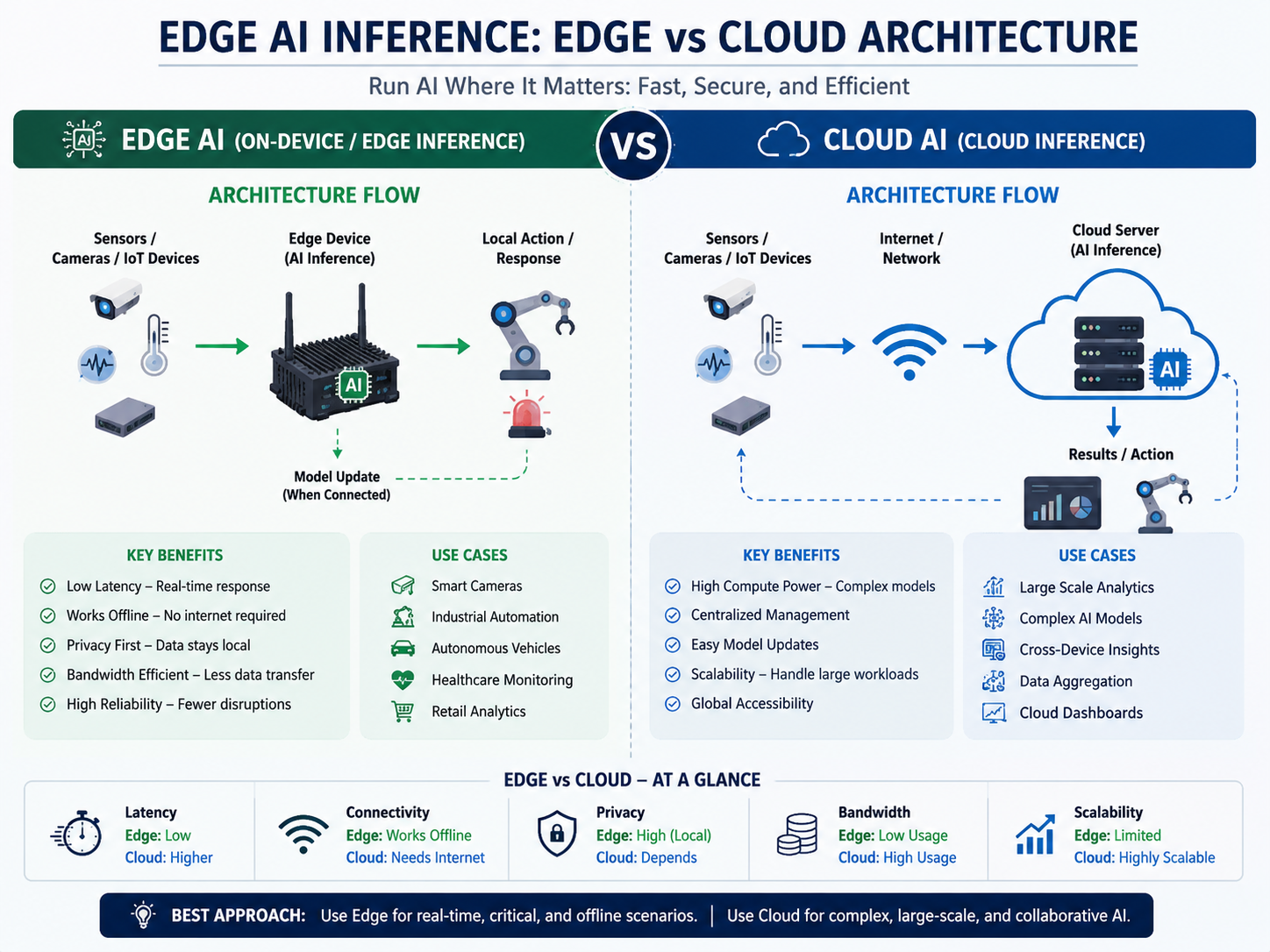
Edge AI inference can be the better choice when an application needs near-instant responses, offline operation, lower bandwidth use, or tighter control over sensitive data. Cloud inference still wins when teams need very large models, elastic compute, centralized management, or shared context across many users and devices.
The important question is not “edge or cloud?” in isolation. It is where each inference workload should run based on latency, privacy, connectivity, hardware limits, security, and total cost. In many production systems, the strongest answer is a hybrid architecture.
What Is Edge AI Inference?
Edge AI inference is the execution of a trained machine-learning model close to where its input data is generated, instead of sending every request to a centralized cloud platform.
That processing can happen directly on a smartphone, camera, vehicle, robot, or IoT device. It can also happen on nearby infrastructure such as a gateway or local server.
Edge AI, On-Device AI, and Edge Inference
These terms overlap, but they are not identical.
Edge AI is the broadest concept. It covers AI processing performed close to users, sensors, equipment, or other data sources.
On-device AI or on-device inference is more specific: the model runs directly on the endpoint itself.
Local AI processing can refer either to the endpoint or to nearby computing infrastructure.
In other words, AI running “at the edge” does not necessarily mean the model lives on the end device.
Where Machine-Learning Inference Can Run
Most production inference workloads fit into four locations.
Endpoint.
Smartphone, camera, robot, vehicle, or IoT sensor
Local edge.
Gateway, factory server, branch appliance, or local cluster
Regional edge.
Infrastructure geographically closer to the user
Central cloud.
Large-scale AWS, Azure, Google Cloud, or similar infrastructure
A mobile product built through Mak It Solutions’ mobile app development services could, for example, detect speech locally while sending only more demanding requests to a cloud model.
Training vs. Inference at the Edge
Training teaches a model from data and can require substantial compute. Inference takes an already trained model and uses it to classify, predict, generate, or make a decision.
Lightweight personalization or fine-tuning can happen locally, but the architecture question discussed here is primarily about inference: the workload that must repeatedly deliver acceptable speed, accuracy, reliability, and cost.
Edge AI vs. Cloud AI.
Choose edge AI inference when latency, offline resilience, bandwidth, or local data control are hard requirements. Choose cloud inference when model capability, elastic compute, centralized updates, or cross-device coordination matter more.
| Factor | On-Device / Edge | Cloud |
|---|---|---|
| Response time | Often lower | Network latency applies |
| Internet dependency | Low or optional | Usually higher |
| Raw-data transmission | Can be minimized | Often required |
| Bandwidth usage | Usually lower | Can be higher |
| Compute capacity | Hardware-limited | Highly scalable |
| Model updates | Fleet management required | Easier to centralize |
| Model size | Constrained | Supports much larger models |
For robotics, machine vision, industrial control, and safety alerts, eliminating a network round trip may matter more than accessing the largest available cloud model.
Cost, Scalability, and Model Capability
Cloud inference removes the need to place specialized accelerators in every endpoint and makes centralized scaling much easier. The tradeoff is that high-volume workloads can accumulate ongoing inference, bandwidth, and storage costs.
On-device inference shifts those economics. More cost moves into device hardware, optimization, testing, security, and fleet management, while recurring cloud usage can fall.
The same workload-first logic applies to broader infrastructure decisions discussed in Mak It Solutions’ guide to cloud repatriation. The useful comparison is not “cloud-first versus edge-first,” but performance and total cost for the actual workload.
When Hybrid Edge-Cloud AI Makes More Sense
Hybrid architecture is often the practical middle ground.
A device might perform immediate classification, redact sensitive information, or handle routine requests locally. Only requests requiring greater context or compute are escalated.
A common pattern looks like this:
local inference → edge escalation → cloud reasoning
This gives users fast local behavior without giving up the capabilities of larger cloud models.
Benefits of On-Device Edge AI Inference
On-device inference is most compelling when local execution materially improves responsiveness, availability, privacy, or operating economics without exceeding the device’s limits.
Lower Latency and Offline Operation
Latency matters in systems where a delayed response is not merely annoying.
Industrial inspection, robotics, driver-assistance systems, interactive mobile experiences, and real-time monitoring can all benefit from processing close to the source.
Local models can also keep working in warehouses, rural areas, moving vehicles, or field environments where connectivity is intermittent.
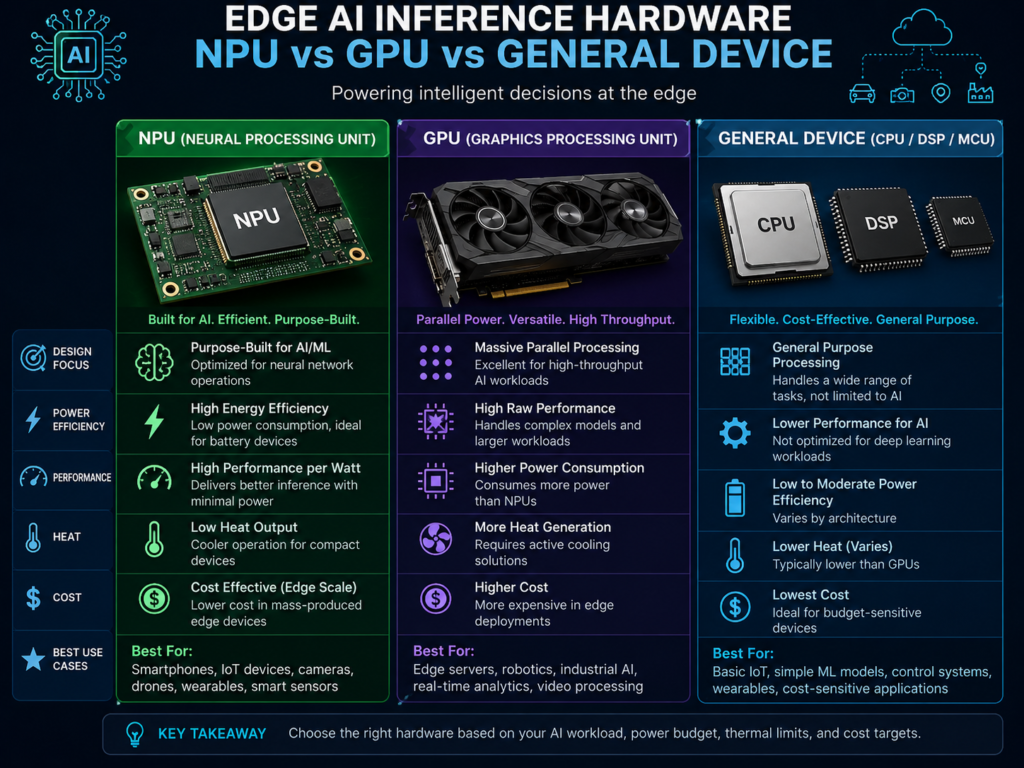
A 2024 benchmarking study comparing heterogeneous edge platforms found NPU-based execution was 3.2× faster for certain tested video-classification and large-language-model workloads, while other workload types favored GPUs or CPUs. The key lesson is that accelerator performance is highly workload-dependent rather than universally superior.
Privacy-Preserving AI and Reduced Data Transfer
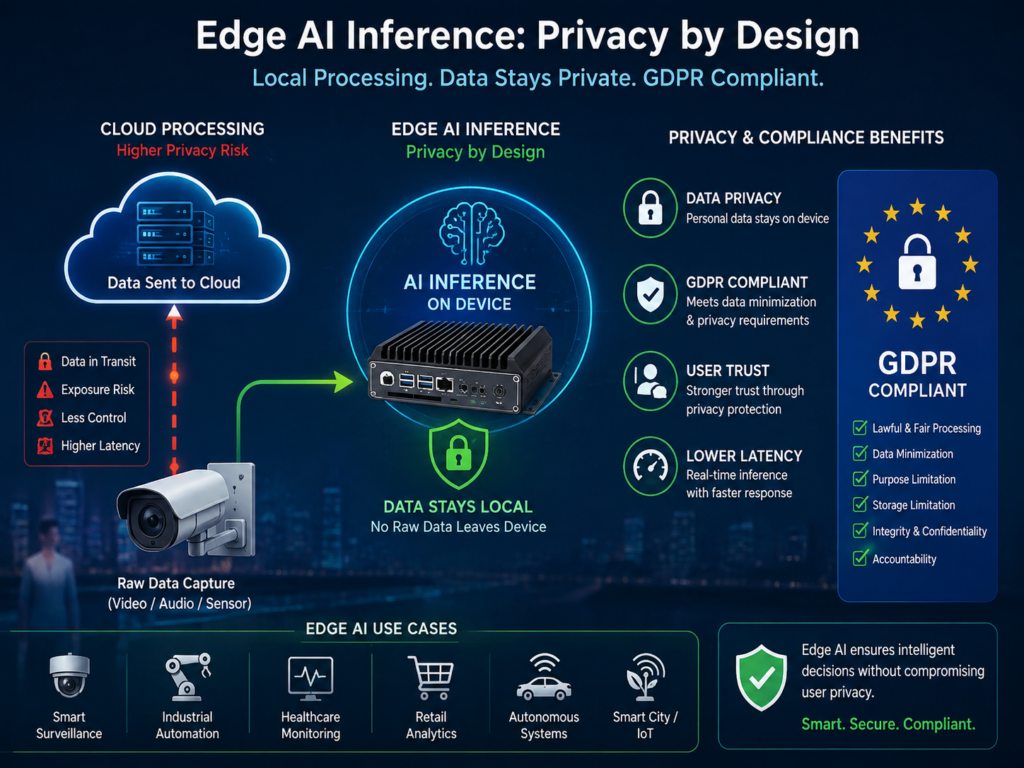
Keeping processing local can reduce the amount of raw audio, imagery, sensor information, or operational data sent elsewhere.
That can support privacy-by-design and data-minimisation strategies, particularly for UK and EU deployments.
Local processing, however, does not automatically make a system GDPR or UK GDPR compliant. Organizations still need to consider lawful processing, security, retention, governance, transparency, and accountability across the complete data lifecycle.
For teams dealing with sensitive AI pipelines, Mak It Solutions’ guide to AI data leakage prevention covers related controls.
Lower Cloud Inference and Bandwidth Costs
Frequently repeated inference tasks can become good candidates for local execution.
Doing more work on the endpoint may reduce.
Cloud API requests;
Continuous upstream data transfers;
Bandwidth consumption;
Dependency on external inference services; and
Cloud compute consumption.
The economics are strongest when workloads are frequent and reasonably predictable.
For sporadic requests or applications that depend on large, rapidly evolving models, cloud inference may remain simpler and cheaper overall.
Edge AI Hardware and Model Optimization
A model belongs on-device only if its real-world latency, memory use, compute demand, power consumption, and thermal behavior fit inside the target hardware’s operating envelope.
CPU, GPU, NPU, MCU, and AI Accelerators
Edge hardware ranges from tiny microcontrollers to powerful embedded AI computers.
Possible execution targets include.
CPUs
GPUs
NPUs
MCUs
Dedicated inference accelerators
Arm-based hardware, Qualcomm platforms, and NVIDIA Jetson systems are familiar examples, but processor branding alone does not determine the best architecture.
Computer vision, speech recognition, sensor classification, and generative AI place very different demands on hardware.
Quantization, Compression, and Model Size
Model optimization can turn an impractical deployment into a realistic one.
Common techniques include.
INT8 and other low-precision quantization
Parameter pruning
Knowledge distillation
Model compression
Smaller task-specific architectures
A 2024 study examining generative AI on Raspberry Pi-class infrastructure reported approximately 5–12 generated tokens per second for selected lightweight models and configurations. That result demonstrates feasibility under the study’s setup, not a universal Raspberry Pi performance guarantee.
Memory, Power, and Thermal Limits
A headline TOPS figure is not enough.
An accelerator with impressive peak throughput may still run into.
Insufficient RAM.
Memory-bandwidth bottlenecks;
Battery drain;
Cooling constraints; or
Thermal throttling during sustained workloads.
Benchmark the actual production model on representative hardware. Short synthetic tests can hide the problems that appear after a device has been running continuously.
Edge AI Privacy, Security, and Compliance
Moving inference closer to users can reduce unnecessary data movement, but it introduces its own security and governance requirements.
GDPR, DSGVO, and UK GDPR
For Germany and the wider EU, GDPR principles include data minimisation and data protection by design. UK organizations operate under corresponding UK GDPR requirements.
Local inference may help reduce unnecessary collection or transmission of personal data, but compliance depends on the entire processing activity not simply on whether the model runs locally.
Mak It Solutions also discusses protected processing patterns in its guide to confidential computing for sensitive cloud workloads.
HIPAA, PCI DSS, and Enterprise Data Controls
A healthcare provider in Boston or a health platform serving New York users might use local inference to reduce movement of sensitive inputs. That architectural decision does not replace HIPAA security obligations where protected health information is involved.
Likewise, payment environments must evaluate PCI DSS wherever relevant account data is stored, processed, or transmitted.
As of August 2026, the PCI Security Standards Council continues to identify PCI DSS v4.0.1 as the current version while work on its next iteration is underway.
Security risk also has a financial dimension. IBM’s 2024 Cost of a Data Breach research reported a global average breach cost of $4.88 million for that year.
On-Device AI Has Its Own Security Risks
Edge deployment reduces some forms of data movement but creates a different attack surface.
Risks can include.
Model extraction;
Stolen or compromised devices;
Adversarial inputs;
Reverse engineering;
Tampered model packages; and
endpoints that miss critical updates.
Production systems should consider signed models, secure boot where available, encrypted storage, strong device identity, controlled updates, telemetry, and rollback mechanisms.
Related security practices are covered in Mak It Solutions’ preemptive cybersecurity guide.
Edge AI Inference Across the USA, UK, and Europe
Architecture choices also vary with industry, regulation, infrastructure, and local deployment conditions.
USA.
US teams working in healthcare, retail, manufacturing, and connected products often compare edge inference against cloud API costs, endpoint diversity, deployment scale, and sector-specific security requirements.
In industrial computer vision, continuously uploading raw video can be inefficient. Local processing can identify relevant events first and transmit only the information that needs central analysis.
Healthcare applications may have a different priority: limiting unnecessary movement of sensitive information while still maintaining appropriate security and compliance controls.
UK.
The UK’s embedded-computing ecosystem makes on-device AI particularly relevant to product and engineering teams.
For fintech, healthcare, and other data-sensitive applications, local processing may also support data-minimisation goals when it genuinely prevents unnecessary collection or transmission.
The benefit needs to be designed intentionally. Simply moving a model onto a device does not remove wider privacy obligations.
Germany and the EU.
Germany’s automotive and industrial ecosystem makes Edge KI, lokale KI Verarbeitung, Embedded KI, and KI Inferenz am Edge especially relevant.
Manufacturers in cities such as Stuttgart or Munich may prioritize low-latency machine vision and resilient factory systems, while fintech and software teams in Berlin may place more weight on privacy, security, and governance.
Across EU deployments, these requirements are easier to manage when they are considered during architecture design rather than added after the inference pipeline is already in production.
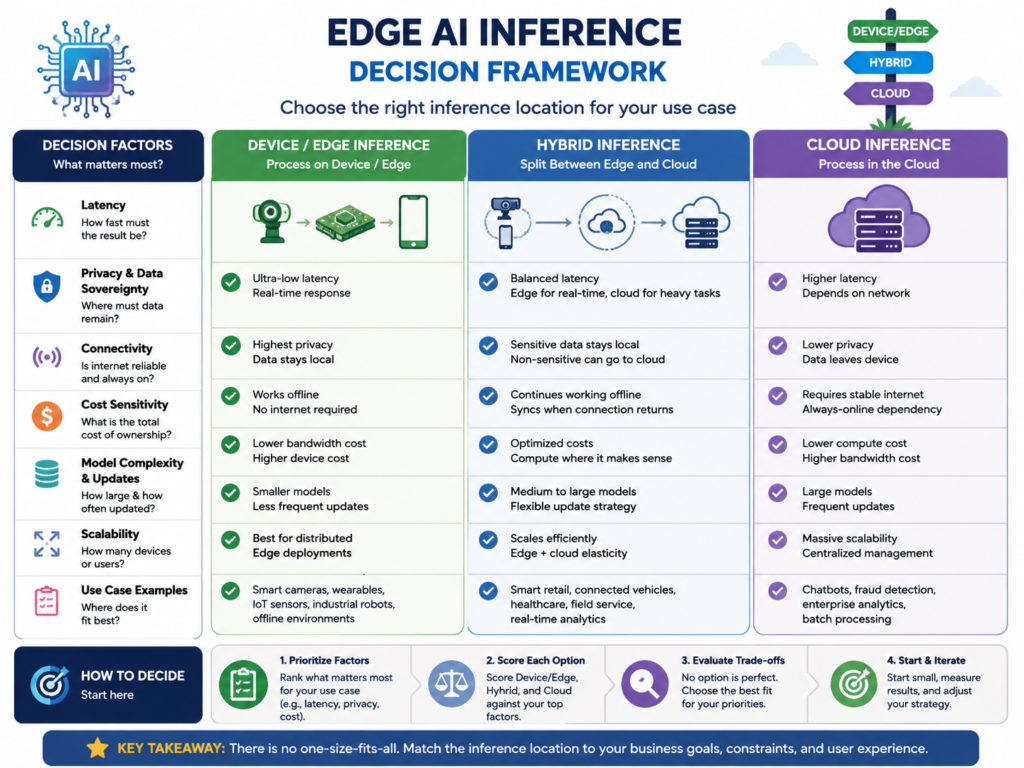
A Practical Edge AI Inference Decision Framework
The right inference location is the one that meets latency, reliability, privacy, model capability, and total-cost requirements with the fewest operational compromises.
Choose On-Device AI When.
Response time is highly latency-sensitive;
Connectivity can disappear;
Raw inputs are sensitive;
Constant uploads would consume too much bandwidth;
Inference volume is frequent or predictable; and
The optimized model fits available memory, power, and thermal limits.
Choose Cloud AI When.
Cloud inference usually makes more sense when the application needs.
Very large models;
Elastic computing capacity;
Rapid centralized model updates;
Shared or global context;
Coordination across many users;
Rapidly changing workloads; or
Capabilities that endpoint hardware cannot deliver consistently.
Cloud can also simplify deployment when the device fleet is too fragmented to support the same optimized model reliably.
Use Hybrid AI When Requirements Conflict
When neither approach satisfies the complete workload, use a layered path:
device first → local or regional edge → cloud escalation
Before committing to production, benchmark.
Model accuracy;
P95 and p99 latency;
Peak and sustained memory use;
Battery or power draw;
Thermal behavior;
Bandwidth consumption;
Failure behavior; and
Total cost of ownership.
Teams that need an analytics layer around device and cloud outputs can also explore Mak It Solutions’ Business Intelligence Services.
Final Thoughts
Edge AI inference is not automatically better than cloud AI, and cloud inference is not automatically more scalable in every meaningful sense. Each workload has its own constraints.
Benchmark the production model on realistic hardware. Test network failures. Compare local and cloud operating costs. Measure sustained latency, memory, power, and thermal behavior. Then evaluate security and compliance across the full system.
That evidence will tell you whether inference belongs on the device, at the edge, in the cloud, or across all three.
Mak It Solutions can help assess AI workloads, compare device and cloud architectures, and build a proof of concept around representative hardware. Contact Mak It Solutions to discuss an edge AI architecture assessment for on-device, cloud, or hybrid deployment.
Key Takeaways
Edge AI inference works best when low latency, offline resilience, bandwidth reduction, or local data control are hard requirements.
Cloud AI remains strong for very large models, elastic workloads, centralized updates, and shared context.
CPU, GPU, or NPU specifications cannot predict production performance on their own.
Memory, sustained power consumption, and thermal behavior should be tested on real hardware.
Local inference can support privacy and data-minimisation strategies, but it does not automatically provide GDPR, HIPAA, or PCI DSS compliance.
Hybrid edge-cloud architectures often provide a better balance than forcing every workload into a single location.
Hardware and architecture decisions should be based on representative benchmarks and full lifecycle TCO.
FAQs
Q : Does edge AI inference work without an internet connection?
A : Yes. Fully on-device edge AI inference can operate without an active internet connection when both the model and inference runtime are stored locally.
The wider application may still need periodic connectivity for software updates, model releases, synchronization, telemetry, or cloud escalation.
Q : How much memory does an on-device AI model need?
A : There is no universal memory requirement. It depends on model architecture, parameter count, numerical precision, runtime overhead, input size, and intermediate activations.
Measure peak RAM and storage consumption on the actual target device rather than treating the model file size as the complete memory requirement.
Q : Can edge AI reduce generative AI inference costs?
A : It can. Frequently repeated workloads running on hardware that is already deployed may reduce cloud API usage, network traffic, and data-transfer costs.
Those savings still need to be compared with hardware, model optimization, monitoring, security, updates, and fleet-management costs.
Q : Is an NPU required for on-device AI inference?
A : No. CPUs, GPUs, microcontrollers, and dedicated accelerators can all run AI inference depending on the workload.
An NPU can improve efficiency for compatible neural-network operations, but real-world latency, memory, power consumption, and model compatibility matter more than the processor label.
Q : How do companies update AI models across large edge-device fleets?
A : Typical approaches include signed model packages, version control, staged over-the-air deployments, device authentication, health monitoring, and rollback capabilities.
Teams should also account for devices that stay offline for long periods and maintain compatibility between models, runtimes, application versions, and hardware generations.