


Schema Markup for Arabic Websites: GCC SEO Blueprint
Schema Markup for Arabic Websites: GCC SEO Blueprint
Schema Markup for Arabic Websites: GCC SEO Blueprint
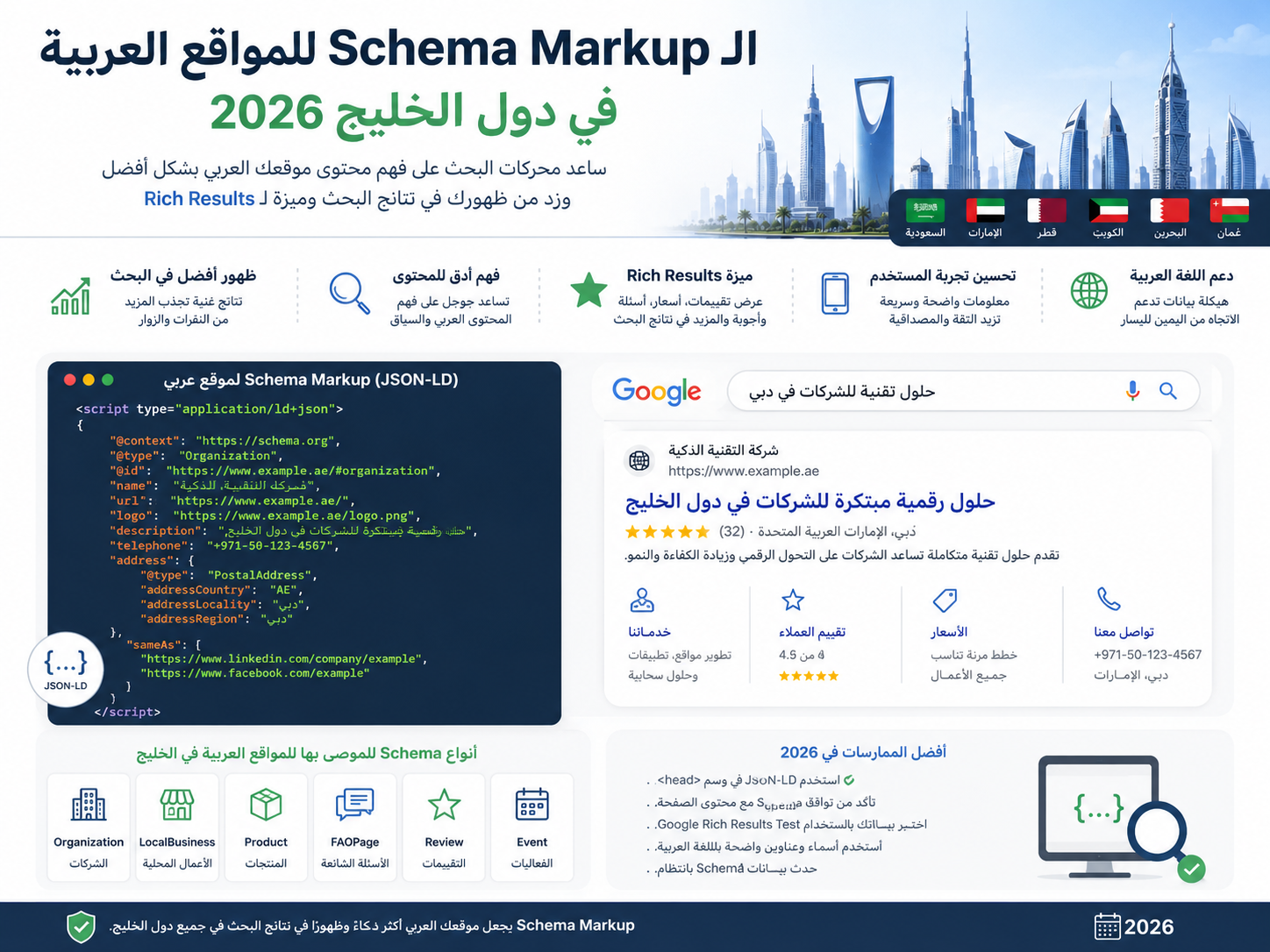
For bilingual GCC businesses, schema markup for Arabic websites is not simply English JSON-LD translated into Arabic. The goal is to help search engines and AI systems understand that your Arabic and English pages represent the same company, services, authors, locations, and content.
For most Saudi Arabia, UAE, and Qatar websites, the practical approach is simple: build a consistent entity structure around your Organization, services, editorial content, and visible FAQs, then keep those entities aligned across both languages.
There is also an important 2026 change to understand. Google stopped showing its dedicated FAQ rich-result feature on May 7, 2026. FAQPage still exists in Schema.org, but businesses should no longer treat FAQ schema as a guaranteed way to earn expandable FAQ results in Google Search.
How Schema Markup for Arabic Websites Should Work
Structured data works best when it confirms what the page already tells visitors.
For a typical GCC business website, the structure may look like:
Organization → Service → Article/BlogPosting → visible FAQ content
These entities should connect logically rather than exist as isolated pieces of markup.
If a business has Arabic and English versions of the same website, the language can change while the underlying company identity remains consistent.
Schema.org, JSON-LD, and Structured Data
Schema.org provides the vocabulary used to describe entities such as organizations, people, services, articles, products, and locations.
JSON-LD is one of the most common ways to add that information to a webpage.
Useful properties may include.
@Type
@Id
Name
Alternative Name
URL
Logo
SeamAs
In Language
Provider
Area Served
Author
Publisher
The purpose is not to add as many properties as possible. It is to describe real entities clearly and consistently.
For websites where structured data needs to be built directly into page templates, Mak It Solutions’ web development services can support the technical implementation.
Arabic vs English Structured Data on Bilingual Sites
An Arabic page should normally use Arabic-facing names, descriptions, and content that match what visitors actually see.
The English version can use the corresponding English wording.
That does not mean you should create two unrelated organizations.
Instead, maintain stable signals such as:
The same primary organization @id
The same canonical domain
The same official logo
Consistent verified social profiles
Legitimate Arabic and English brand-name variants
Correct language-specific page URLs
This should work alongside your broader bilingual setup, including hreflang, canonical URLs, and proper RTL/LTR page architecture.
Localize the Entity, Not Just the Translation
GCC localization goes beyond replacing English words with Arabic ones.
A Riyadh fintech, Dubai retailer, and Doha consultancy may have different.
Physical addresses
Service areas
Regulators
Contact information
Languages
Branch structures
Customer-facing service descriptions
The structured data should reflect those real differences.
Organization Schema for Saudi Arabia, UAE, and Qatar
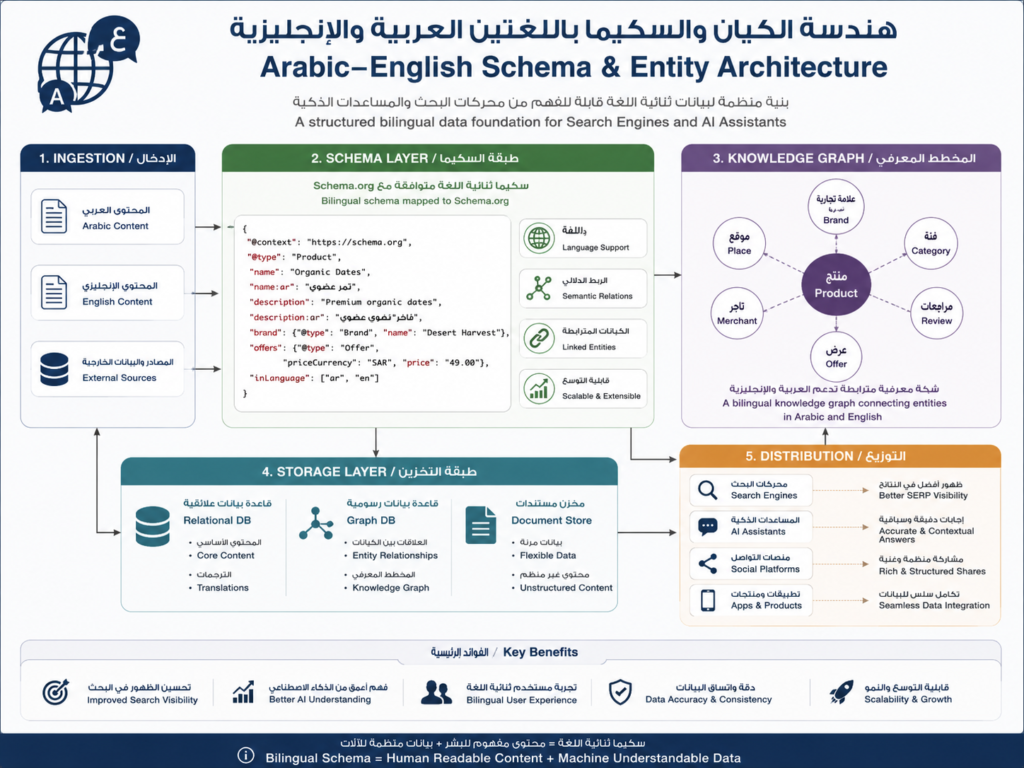
Your Arabic and English pages should normally point back to one underlying organization entity.
If different language versions accidentally introduce different company names, IDs, URLs, or social profiles, machines may have a harder time understanding that they represent the same business.
What Organization Schema Should Include
Where applicable, Organization markup can include:
Official business name
Legitimate alternate name
Website URL
Logo
Contact information
Verified same As profiles
Relevant identifiers
Stable organization @id
That organization identifier can then be reused by services, articles, authors, and other connected entities.
Organization vs Local Business
Use organization when describing the company itself.
A suitable local business subtype can make sense when a genuine customer-facing physical location is central to the page for example, a retail shop, clinic, restaurant, or branch.
A Riyadh technology company should not automatically be marked as a LocalBusiness simply because it has an office address.
For companies rebuilding their bilingual technical foundation, Mak It Solutions also provides WordPress development services.
Keep One Entity Across Arabic and English Pages
Customer-facing text can change by language. The underlying entity should remain recognizable.
For example, an Arabic page may prioritize the company’s official Arabic name while an English page displays its Latin-script brand name. A legitimate alternative name can be added where appropriate.
Do not invent translated company names solely for SEO.
Service Schema for GCC Business Pages
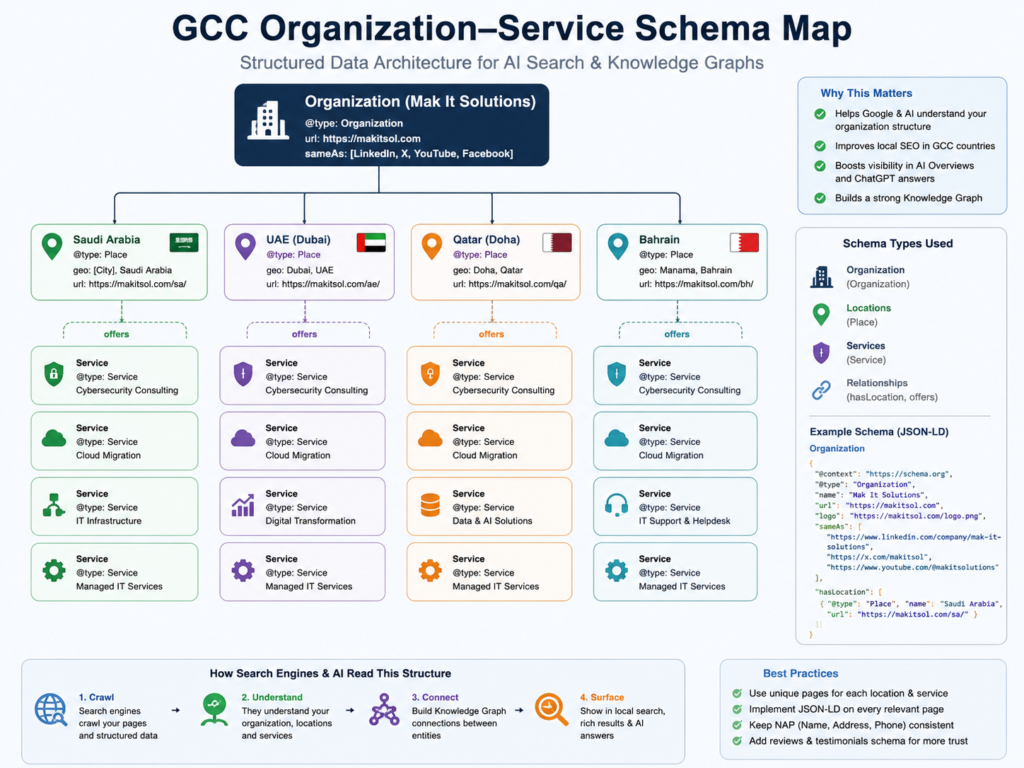
Service markup can help machines understand what a company actually provides and where those services are available.
Connect Every Service to Its Real Provider
A service entity may include properties such as.
Provider
Service Type
Area Served
Offers
Available Channel
The provider should connect back to the primary Organization entity rather than creating a new business entity for each service page.
Define Saudi, UAE, and Qatar Service Areas Accurately
Use locations that reflect real operations.
Examples might include.
Riyadh and Jeddah
Saudi Arabia nationwide
Dubai and Abu Dhabi
UAE-wide service
Doha
Qatar nationwide
Do not list every GCC country simply because you want to rank there.
Area served is an entity property, not a geographic keyword-stuffing field.
What Service Schema Can—and Cannot—Do
Service is useful Schema.org vocabulary, but Google’s current structured-data gallery does not list it as a dedicated rich-result feature.
That means its main value is semantic clarity, not a guaranteed special appearance in Google Search. Google also makes clear that even valid structured data does not guarantee a rich result.
For a wider organic and paid acquisition strategy, see Mak It Solutions’ digital marketing services.
Article and FAQ Schema for Arabic AEO
Structured data should support good content not replace it.
For AEO and AI-search visibility, your page still needs clear answers, recognizable entities, useful context, and trustworthy sources.
Article and Blog Posting Schema for Arabic Content
For Arabic and English editorial pages, keep important properties accurate, including.
Headline
Author
Image
Date published
Date modified
Mainentityo page
Publisher
In language
Authors and publishers should reference the correct entities across both language versions.
Avoid creating fake author profiles just to make the schema look more complete.
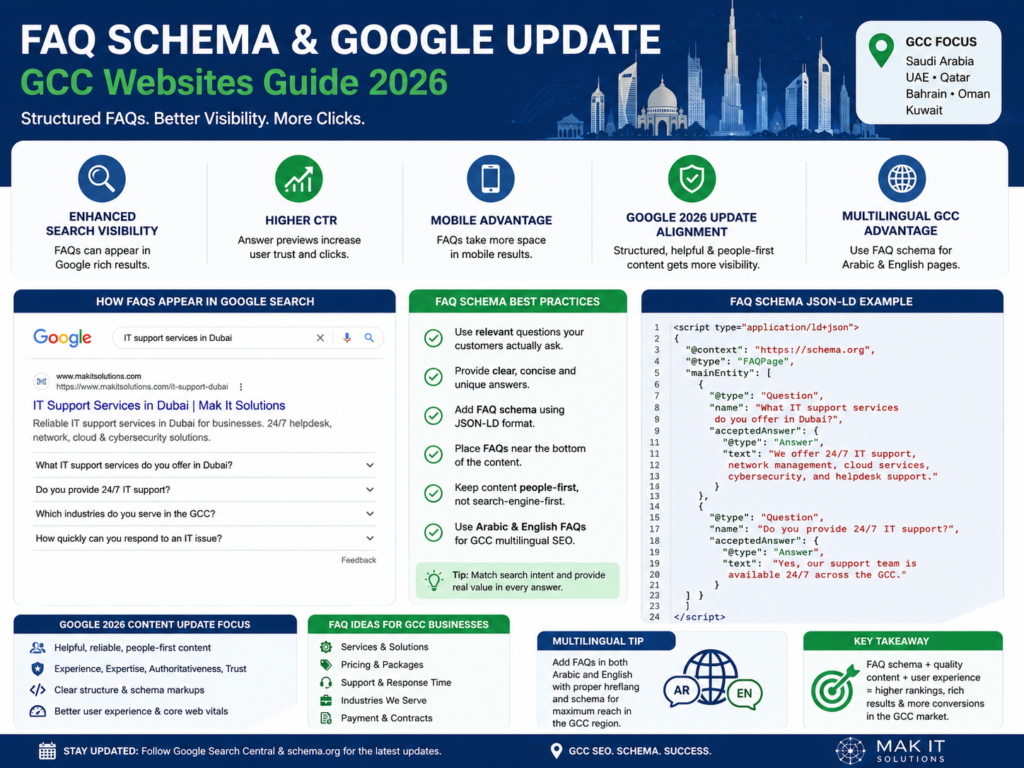
What Changed With FAQ Schema in 2026?
Google states that its FAQ rich-result feature no longer appears in Search starting May 7, 2026.
That creates an important distinction:
Schema.org validity: FAQ Page remains a recognized Schema.org type.
Google rich-result eligibility: the former dedicated Google FAQ rich result has been discontinued.
You can therefore still mark up genuine FAQ content where appropriate, but it should not be sold internally or to clients as a guaranteed expandable-SERP feature.
Structure Arabic Content for AI Overviews and AEO
For important questions, give the reader the answer quickly.
A useful pattern is.
State the direct answer in one or two sentences.
Explain the context.
Add evidence, conditions, or examples.
Link the answer back to a clearly defined entity.
This format is easier for human readers to scan and gives search and AI systems cleaner passage-level information to interpret.
Consistent Arabic-English terminology also matters. If a service, regulator, product, or organization has an official name, use it consistently rather than changing terminology from page to page.
A solid content foundation can be supported by professional SEO services.
GCC Compliance, Regulators, and Entity Trust
Structured data can describe regulatory relationships, but it should never manufacture them.
For regulated businesses, every licensing, compliance, supervisory, or jurisdictional claim should match the visible page and the company’s real position.
When to Reference GCC Regulators
Mention authorities only where they are genuinely relevant.
Examples include.
SAMA for relevant Saudi financial-services and fintech topics
NDMO for appropriate Saudi data-governance contexts
DGA for relevant Saudi digital-government topics
TDRA for applicable UAE telecommunications and digital matters
QCB for Qatar financial-sector topics
SAMA’s current functions include regulating and supervising financial institutions as well as fintech-related platforms within its scope of competence.
Qatar Central Bank likewise maintains a FinTech Supervision Department responsible for regulating QCB-licensed fintech companies.
ADGM and DIFC Should Not Be Treated as Generic “UAE Regulation”
For financial content in the UAE, jurisdiction matters.
Abu Dhabi Global Market and Dubai International Financial Centre should be identified accurately where applicable rather than reducing every regulatory reference to a generic statement about “UAE law.”
The same principle applies throughout the GCC: structured data should make regulatory context clearer, not less precise.
Cloud Location Does Not Automatically Mean Compliance
Hosting location can matter, but a regional cloud deployment by itself does not prove regulatory compliance or satisfy every data-residency requirement.
For example:
AWS lists a Middle East region in Bahrain as me – south – 1.
Microsoft lists UAE Central with Abu Dhabi as its physical location.
Google Cloud lists Doha as me centrall
Those are infrastructure facts not blanket compliance certifications.
Regulatory and data-residency requirements should always be assessed against the specific business, workload, sector, and applicable rules.
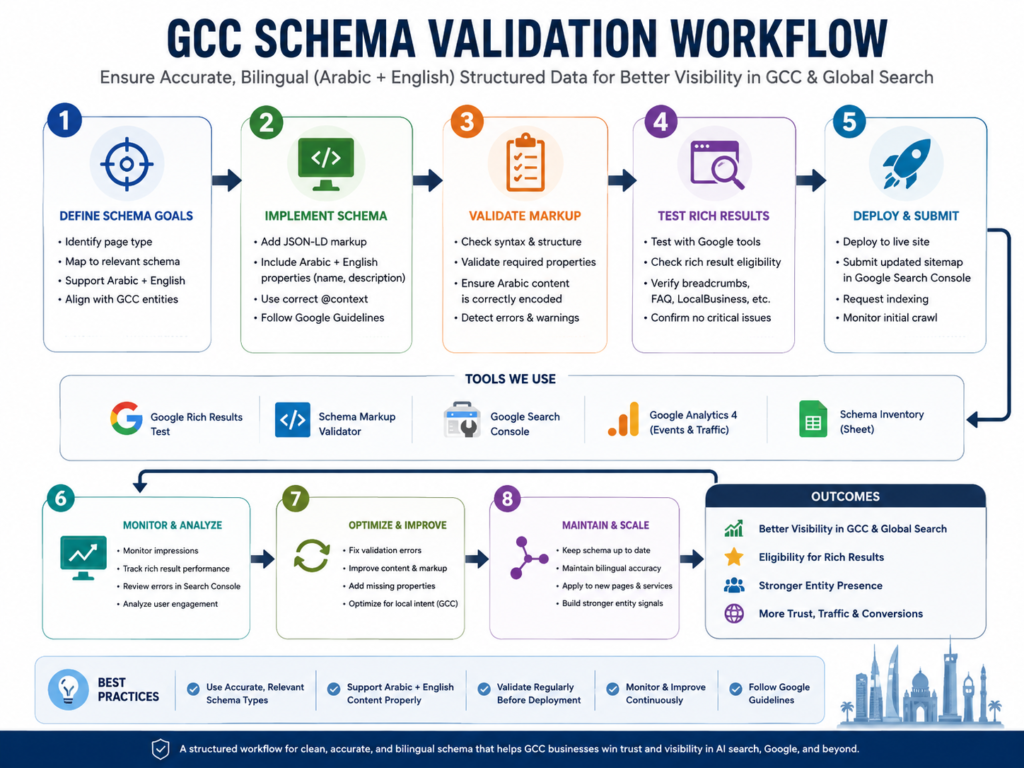
How to Implement Schema Markup for Arabic Websites
A practical workflow is.
Audit → Connect → Validate → Monitor
Audit Existing Entities and Page Types
Start by inventorying.
Arabic URLs
English URLs
Organization entities
Service pages
Articles
Authors
FAQs
Locations
Brand-name variants
Look for duplicated organizations, inconsistent company names, obsolete URLs, unsupported service areas, and conflicting author or publisher information.
Build Connected JSON-LD Entities
Create relationships instead of disconnected markup.
Typical connections include:
Organization → Service
Organization → publisher
Organization → brand
Person → author
Article → author
Article → publisher
Article → mintinyo page
Service → provider
Reuse stable identifiers wherever possible.
A company should not become a completely new entity every time it appears on another URL.
Validate the Markup
Use different tools for different purposes.
Schema Markup Validator helps check general Schema.org syntax and vocabulary.
Google Rich Results Test focuses on structured-data types supported by Google’s rich-result features.
Google Search Console helps monitor eligible implementations and structured-data issues.
Remember: valid Schema.org markup and Google rich-result eligibility are not the same thing.
Google explicitly notes that correctly marked-up content is not guaranteed to appear as a rich result.
Complex implementations may also benefit from Mak It Solutions’ business intelligence services where analytics and entity architecture overlap.
GCC Schema Markup Best Practices for 2026
Prioritize Entity Clarity Over Schema Quantity
More markup is not automatically better.
A small, accurate graph is generally more useful than a large graph full of duplicated, speculative, or irrelevant entities.
Focus first on.
The business
Its genuine services
Its real locations
Its authors
Its published content
Relationships between those entities
Keep Arabic and English Brand Signals Consistent
Check the details that frequently drift apart on multilingual websites.
Brand spelling
Arabic and Latin names
Domain references
Logo URLs
Social profiles
Author identities
Service names
Service areas
Branch addresses
Small inconsistencies across hundreds of URLs can create a much bigger entity-management problem.
Use GCC Context Only Where It Is Real
Good localization might look like.
A Riyadh fintech mentioning SAMA where financial supervision is relevant
A Dubai e-commerce company synchronizing Arabic and English service entities
A Doha business evaluating Google Cloud’s Doha region as part of its infrastructure planning
A Bahrain logistics platform considering AWS Bahrain without claiming that hosting there automatically creates regulatory compliance
These examples add regional relevance without inventing authority signals.
Know When Specialist Help Is Worth It
Specialist support becomes more useful when the website includes.
Multiple languages
Multiple countries
Multiple branches
Large service catalogs
Regulated fintech content
E-commerce entities
Site migrations
Conflicting legacy schema
Custom CMS templates
Large-scale programmatic pages
Mak It Solutions’ full technology service portfolio can support broader implementation work, while its mobile app development services may be relevant when the structured-data project is part of a wider digital platform.
Last Words
Effective schema markup for Arabic websites is less about adding every available schema type and more about giving search engines and AI systems a clean, consistent picture of your business.
For Saudi Arabia, UAE, and Qatar websites, keep Arabic and English entities connected, describe only genuine services and locations, use regulators accurately, and make sure structured data reflects what users can actually see.
If your GCC website has conflicting Arabic-English entities, duplicated organization markup, or outdated structured data, Mak It Solutions can help assess the technical foundation. ( Click Here’s )
Book a consultation, explore our services, or request a custom bilingual GCC structured-data and entity strategy.
Regulatory examples in this guide are provided for general technical context and are not legal or compliance advice. Confirm sector-specific obligations with the relevant authority or qualified adviser.
FAQs
Q : Should a Saudi company use Organization or Local Business schema?
A : Use organization for the overall corporate entity. A suitable Local Business subtype may be appropriate when a genuine customer-facing physical location needs to be represented.
For regulated financial businesses, the schema type does not replace licensing requirements, and regulatory claims should match the visible website and real SAMA status.
Q : Can a Dubai service business use UAE-wide area Served?
A : Yes if the company genuinely provides the service throughout the UAE.
A Dubai agency that regularly serves customers in Abu Dhabi, Sharjah, and other emirates may reasonably describe UAE-wide coverage. A company that operates only in Dubai should not use area Served to exaggerate its footprint.
Q : Does Qatar-specific schema improve Doha search visibility?
A : It can improve geographic and entity clarity, but adding “Doha” or “Qatar” to structured data does not guarantee better rankings.
Local relevance also depends on visible content, genuine business information, language, authority, technical SEO, and overall search quality.
Q : Should Arabic JSON-LD use Arabic or English brand names?
A : Use the real brand representation that matches the visible page language.
An Arabic page can prioritize an official Arabic brand name while keeping stable URLs, IDs, logos, and legitimate alternative names connected to the same organization. Do not invent translated company names simply to add Arabic keywords.
Q : Can GCC businesses still use FAQ Page schema in 2026?
A : Yes. FAQ Page remains Schema.org vocabulary when it accurately describes visible FAQ content.
However, Google stopped displaying its dedicated FAQ rich-result feature starting May 7, 2026, so valid FAQPage markup should not be presented as a guaranteed method for earning expandable FAQ snippets.
[…] GCC Businesses Need a Content Refresh Strategy in […]