


Internal Linking Strategy for Saudi & GCC Websites
Internal Linking Strategy for Saudi & GCC Websites
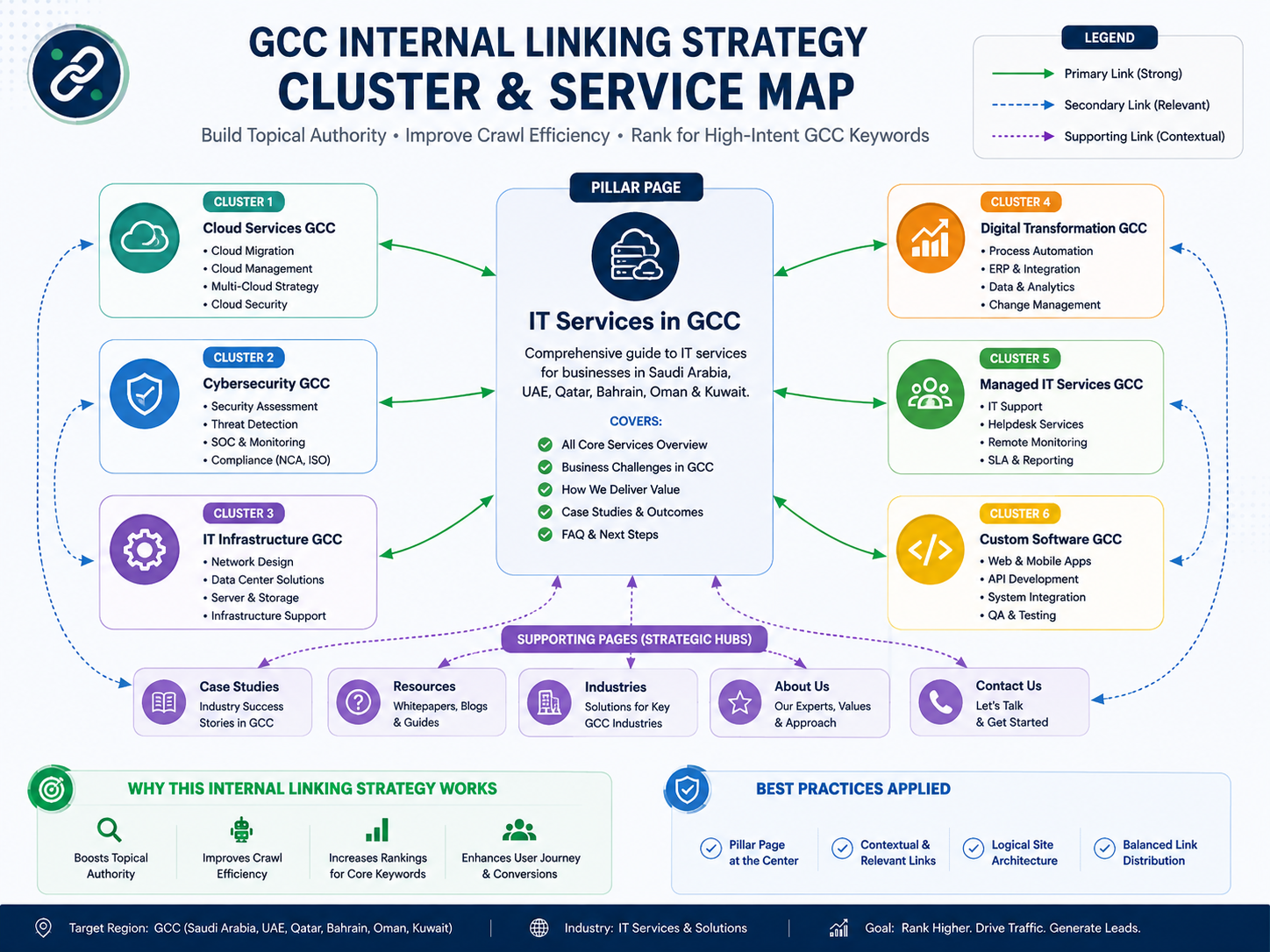
Internal Linking Strategy for Saudi & GCC Websites
Most Saudi and GCC websites do not have an internal-link shortage. They have a routing problem.
A strong internal linking strategy connects useful content to relevant topic hubs, pillar pages, services, and intent-matched CTAs. For websites targeting Saudi Arabia, the UAE, and Qatar, a practical model is:
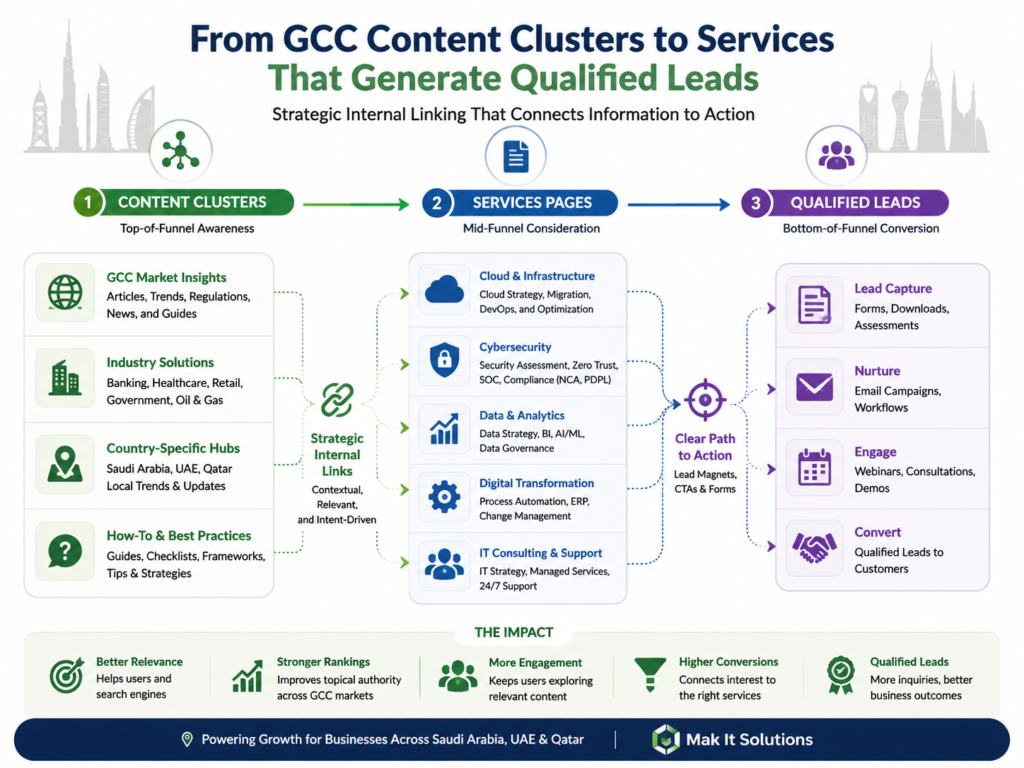
Question → Topic Cluster → Pillar Page → Service Page → Qualified CTA
This structure helps search engines understand your site hierarchy while giving visitors a natural path from research to action. It becomes especially important for businesses managing Arabic and English content, regional landing pages, multiple services, and mobile-first journeys across Riyadh, Jeddah, Dubai, Abu Dhabi, and Doha.
Mak It Solutions’ existing internal linking SEO guide provides a useful foundation for building this type of structure.
What Is an Internal Linking Strategy for GCC Websites?
An internal linking strategy is a deliberate system for connecting related pages within the same website.
Done well, those connections clarify.
Site architecture
Topical relationships
Page hierarchy
Crawl paths
Commercial priorities
The next useful step for visitors
The goal is not to place as many links as possible. It is to make every important page easier to discover and every link feel relevant to the reader.
Internal Links vs. Random Website Links
Not every internal link carries the same purpose.
Contextual links can help readers explore a topic in more depth. Breadcrumbs clarify where a page sits within the site. Navigation exposes important sections, while pillar-to-cluster links establish topical relationships.
Commercial links have another job: they connect relevant informational content with the service that solves the reader’s problem.
Random linking creates noise. Strategic linking creates a journey.
Why GCC Websites Need a Regional Linking Structure
A Riyadh service page, a Dubai landing page, and a Doha article may serve different search intent even when they discuss a similar service.
Arabic and English users may also search differently, move through different navigation paths, or require market-specific information. That means a GCC website should not simply duplicate one generic internal-link journey across every country and language version.
Mak It Solutions’ technical SEO checklist for Arabic GCC websites covers the wider bilingual architecture considerations behind these relationships.
How Internal Linking Supports Crawlability and Page Hierarchy
Commercially important URLs should not sit several disconnected steps away from the content that supports them.
When strong articles link naturally into topic hubs, pillars, and services, search engines can more easily understand which pages are related and which URLs hold greater importance within the site’s architecture.
For users, the benefit is equally practical: fewer dead ends and clearer next steps.
How a Cluster-to-Service Internal Linking Strategy Works
The Cluster-to-Service CTA Map gives each informational cluster a logical commercial destination instead of sending every article to every service page.
Think of it as a five-stage route:
Question Content → Topic Cluster → Pillar Page → Service Page → Qualified CTA
Connect Question Content to Its Topic Cluster
Suppose someone searches.
“How does SEO work for Saudi startups?”
That article could sit inside a broader Saudi SEO strategy cluster alongside content about technical SEO, local visibility, bilingual search, and service-page optimization.
Each supporting article should reinforce the relevant cluster before jumping into unrelated services.
Route the Cluster to a Relevant Service Page
Once the topical relationship is clear, connect the cluster with the service most closely aligned to its intent.
For example.
Internal linking → SEO strategy
Site architecture → Technical SEO
Anchor text → On-page SEO
Topic clusters → Content SEO
Conversion-focused content → SEO/CRO
Mak It Solutions’ core SEO services are a natural commercial destination for content discussing audits, technical optimization, on-page SEO, and organic growth.
Add an Intent-Matched CTA
A CTA should reflect what the reader is ready to do next.
Someone reading a technical article may respond better to audit weak internal-link paths than a generic “contact us” message. A content strategist may find build your GCC topic map more relevant.
For additional guidance on connecting rankings with conversion intent, see the service page SEO strategy.
Internal Linking Strategy for Saudi, UAE, and Qatar Websites
The fundamentals stay consistent across the GCC, but the supporting content and regional journeys should reflect each market.
Saudi Arabia.
Saudi websites often need to connect Arabic and English educational content with locally relevant commercial pages.
A Riyadh fintech company, for example, may have clusters covering technical SEO, digital banking, product education, and compliance-related topics. Those clusters should connect to the right service based on intent rather than mixing SEO and regulatory content simply because both relate to Saudi Arabia.
Where a finance article genuinely involves regulation, an authoritative source such as the Saudi Central Bank regulatory guidance can add useful context.
UAE.
Dubai and Abu Dhabi businesses often compete in crowded search results, making clear content relationships particularly valuable.
An e-commerce brand might connect category optimization, Core Web Vitals, technical SEO, content strategy, and conversion content into a focused commerce cluster before directing qualified users to the relevant service.
The same relevance rule applies to external references. Infrastructure content may naturally reference Microsoft’s Azure regions documentation, but such references should appear because they help the reader not merely as regional SEO signals.
Qatar.
A Doha SME may benefit more from a smaller number of tightly connected, high-quality clusters than dozens of loosely related articles.
Technical SEO, service architecture, buyer intent, and local commercial pages can support each other without creating unnecessary complexity.
Infrastructure-focused content can also reference relevant resources such as Google Cloud location documentation where it genuinely supports the subject.
For commercial-page optimization, see Mak It Solutions’ Qatar service page SEO guide.
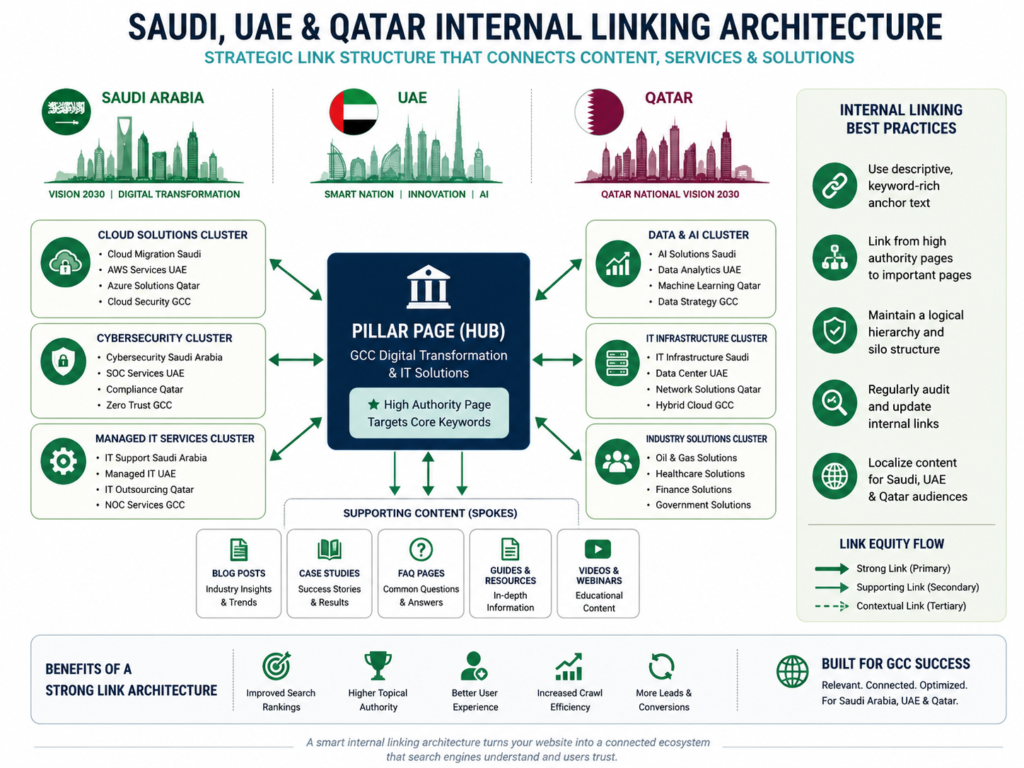
Anchor Text and Bilingual Internal Linking Best Practices
Anchor text gives both users and search engines context about the destination of a link. It should describe what comes next without sounding forced.
Use Descriptive Contextual Anchors
Instead of vague wording such as “click here,” use anchors that describe the destination naturally.
Examples include.
Technical SEO audit
GCC content strategy
Topical authority strategy
Service-page optimization
Bilingual SEO architecture
Exact-match keywords do not need to appear in every link. Repeating the same anchor throughout a site can make the content feel mechanical.
Structure Arabic and English Internal Links Carefully
Internal links and hreflang solve different problems.
Internal links help users and crawlers navigate the website. Hreflang helps search engines understand localized or language-specific alternatives.
A strong bilingual architecture should align.
Arabic RTL and English LTR navigation
Regional URL structures
Hreflang implementation
Canonical signals
Contextual internal links
Market-specific content
Mobile UX
Mak It Solutions’ AI SEO guidance for MENA companies also explores the importance of clean Arabic-English architecture.
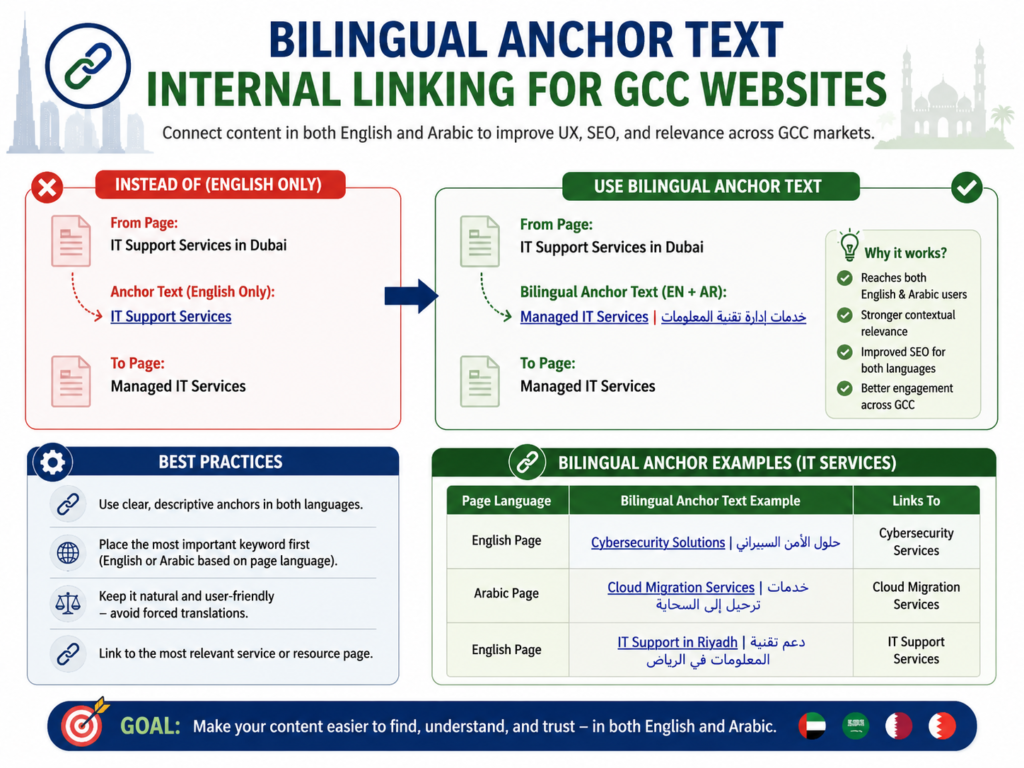
Match Anchor Text to Search Intent
An educational anchor should usually lead to an educational resource. A commercial anchor should lead to a service or conversion-focused page when the context supports it.
Relevance matters more than forcing a service link into every section.
How to Audit Your GCC Internal Linking Structure
A practical audit can be handled in six steps.
Audit existing internal links and crawl paths.
Identify clear content clusters.
Assign one primary commercial destination to each cluster.
Choose descriptive contextual anchors.
Add intent-matched CTAs.
Monitor rankings, crawling, engagement, and leads.
Find Orphan Pages and Weak Hubs
Use tools such as Google Search Console, Screaming Frog, Ahrefs, or SEMrush to look for.
Orphan URLs
Important pages with very few internal links
Broken links
Excessive click depth
Weak or disconnected content hubs
Services that are difficult to reach from relevant articles
Orphan pages often appear after redesigns, migrations, campaign launches, or new content publishing.
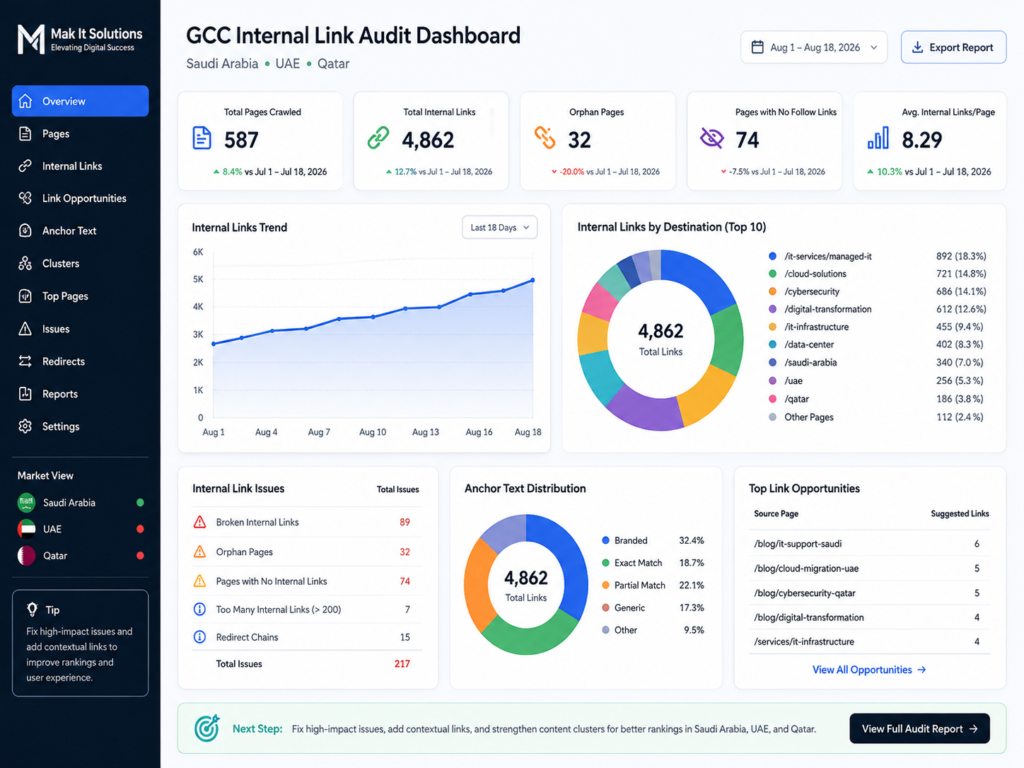
Map Each Cluster to a Primary Commercial Destination
A simple mapping model could look like this.
| Content Cluster | Primary Destination |
|---|---|
| Internal Linking | SEO Strategy |
| Topic Clusters | Content SEO |
| Site Architecture | Technical SEO |
| Anchor Text | On-Page SEO |
| Conversion Content | SEO/CRO |
The map does not prohibit secondary links. It simply gives every cluster a clear commercial priority.
Measure Movement, Not Just Link Counts
A successful internal linking strategy should improve how people and search engines move through the website.
Useful signals can include.
Service-page visibility
Search impressions
Indexed URLs
Engagement
CTA clicks
Assisted conversions
Qualified enquiries
Adding more links is not automatically an improvement. The links must improve discovery, context, or progression.
GCC Internal Linking Mistakes to Avoid
Linking Every Blog Post to Every Service
This is one of the easiest ways to weaken contextual relevance.
A better rule is.
One cluster → one primary commercial destination.
Secondary links can still be used where useful, but they should not turn each article into a directory of company services.
Forcing GCC Entities Into Unrelated Content
Regional references only add value when they genuinely support the topic.
SAMA belongs in relevant Saudi banking or fintech discussions. UAE or Qatar regulatory entities should likewise appear only when their remit relates to the subject being discussed.
A location name or regulator mention is not a substitute for meaningful regional relevance.
Ignoring Arabic UX and Mobile Journeys
A strong internal-link plan can still fail if the surrounding experience is fragmented.
Common problems include.
Disconnected Arabic and English versions
Duplicate Riyadh, Dubai, or Doha pages with little differentiation
Broken hreflang
Inconsistent navigation
Poor mobile CTA placement
Important pages buried too deeply
Website development and SEO architecture should support the same journey. Mak It Solutions’ guide to modern web development for SEO explains that connection in more detail.
Build an Internal Linking Strategy That Generates GCC Leads
The strongest internal linking strategy is not built around link volume. It is built around relevance, hierarchy, and the reader’s next logical action.
Use the same route consistently.
Question → Cluster → Pillar → Service → CTA
Start by choosing the service pages that matter most to the business. Then strengthen those pages with relevant clusters, descriptive contextual links, and CTAs that fit the visitor’s intent.
In practice, improving the routes within existing content can be more valuable than publishing another disconnected batch of articles.
Before increasing content volume, audit the pages you already have and build a clear Cluster-to-Service CTA Map. If internal linking is part of a wider acquisition strategy, align it with your digital marketing services and conversion goals.
Last Words
A strong internal linking strategy helps GCC websites turn scattered content into a clear, purposeful journey for both users and search engines. By connecting questions to topic clusters, pillar pages, service pages, and relevant CTAs, businesses in Saudi Arabia, the UAE, and Qatar can improve crawlability, strengthen important pages, and guide visitors toward the information or service they need without forcing unnecessary links. Contact Mak It Solutions
The best results come from relevance, not link volume. Prioritize high-value pages, use descriptive anchors, maintain clean Arabic and English journeys, and regularly audit orphan pages and crawl depth. Strong structure turns GCC content into SEO value. Mak It Solutions
FAQs
Q : How many internal links should a Saudi business website use per page?
A : There is no universal number. One useful page may need three contextual links while another may naturally need ten because it covers a broader topic.
Focus on relevance, descriptive anchors, mobile usability, and a clear commercial path rather than chasing a fixed link count.
Q : Should Arabic and English pages link to each other on GCC websites?
A : Yes, when the link helps users switch languages or reach an equivalent localized experience.
Internal linking does not replace hreflang. Bilingual GCC websites should combine clear language navigation with appropriate hreflang, canonical signals, consistent URL structures, and links that preserve user intent.
Q : How can Dubai websites avoid over-optimizing anchor text?
A : Use natural variations based on the surrounding sentence and the destination page.
Instead of repeating an exact phrase such as “SEO services Dubai,” use relevant alternatives such as “technical SEO support,” “service-page visibility,” or “GCC search strategy” when those phrases accurately describe the linked page.
Q : What causes orphan pages on Qatar business websites?
A : Orphan pages often appear when new articles, services, campaign pages, or localized URLs are published without links from navigation, topic hubs, related content, or relevant service pages.
Website redesigns and migrations can also remove existing paths while leaving the old pages live.
Q : Should every GCC blog post link directly to a service page?
A : No.
An informational article should link to the most useful next destination. Sometimes that is a service page; in other cases, a topic cluster or pillar page is the better next step.
The stronger model remains:
Question → Cluster → Pillar → Service → CTA
[…] Schema for GCC Business […]