


Sovereign AI Infrastructure Reshapes the Gulf
Sovereign AI Infrastructure Reshapes the Gulf
Sovereign AI Infrastructure Reshapes the Gulf
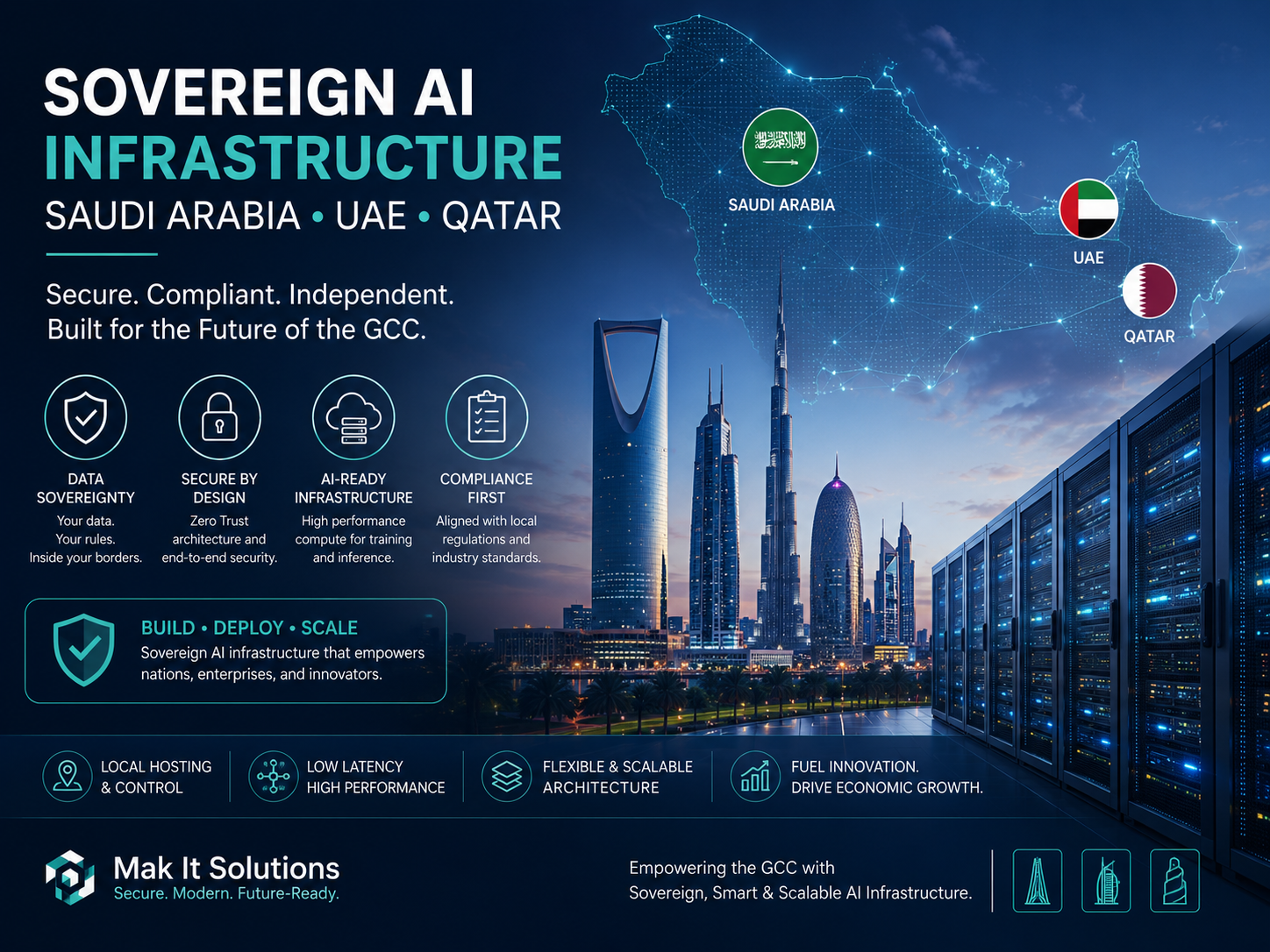
Saudi Arabia, the UAE, and Qatar are turning sovereign AI infrastructure into strategic national capacity. Instead of relying entirely on overseas compute, they are investing in local GPUs, data centers, sovereign cloud platforms, power, cooling, and the governance frameworks needed to run AI closer to home.
For GCC governments and businesses, the practical benefit is greater control over where sensitive workloads run, more predictable access to accelerated computing, stronger support for Arabic AI, and additional options for regulated industries. Sovereign AI does not mean cutting ties with global technology companies; in the Gulf, it increasingly means combining domestic control with international technology partnerships.
Why AI Compute Is Becoming a National Asset
AI infrastructure is no longer just another IT procurement decision.
Large-scale AI depends on a physical chain of GPUs, electricity, cooling, networking, data centers, cloud platforms, models, and applications. If one part of that chain is constrained, the ability to train or deploy AI at scale can be constrained with it.
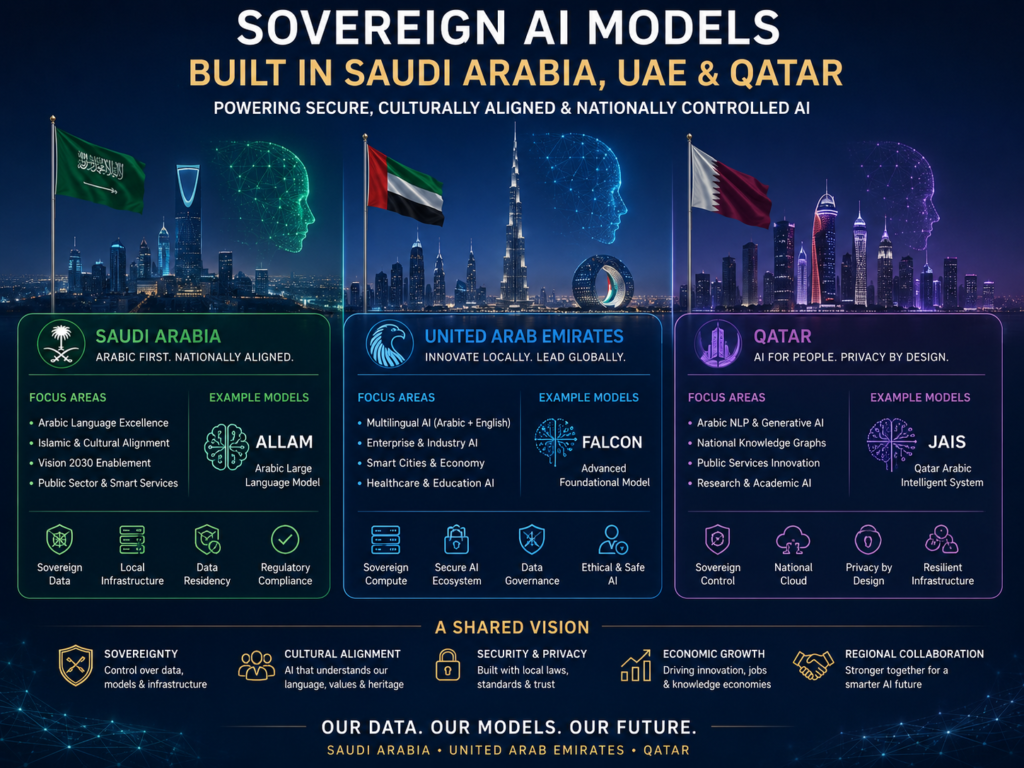
That helps explain the emergence of projects such as HUMAIN in Saudi Arabia, Stargate UAE in Abu Dhabi, and Qatar’s expanding sovereign cloud ecosystem.
For companies building applications on top of this infrastructure, the software layer matters just as much. Secure back-end development capabilities are essential when applications must connect enterprise data, AI models, APIs, identity systems, and cloud environments.
What Is Sovereign AI Infrastructure?
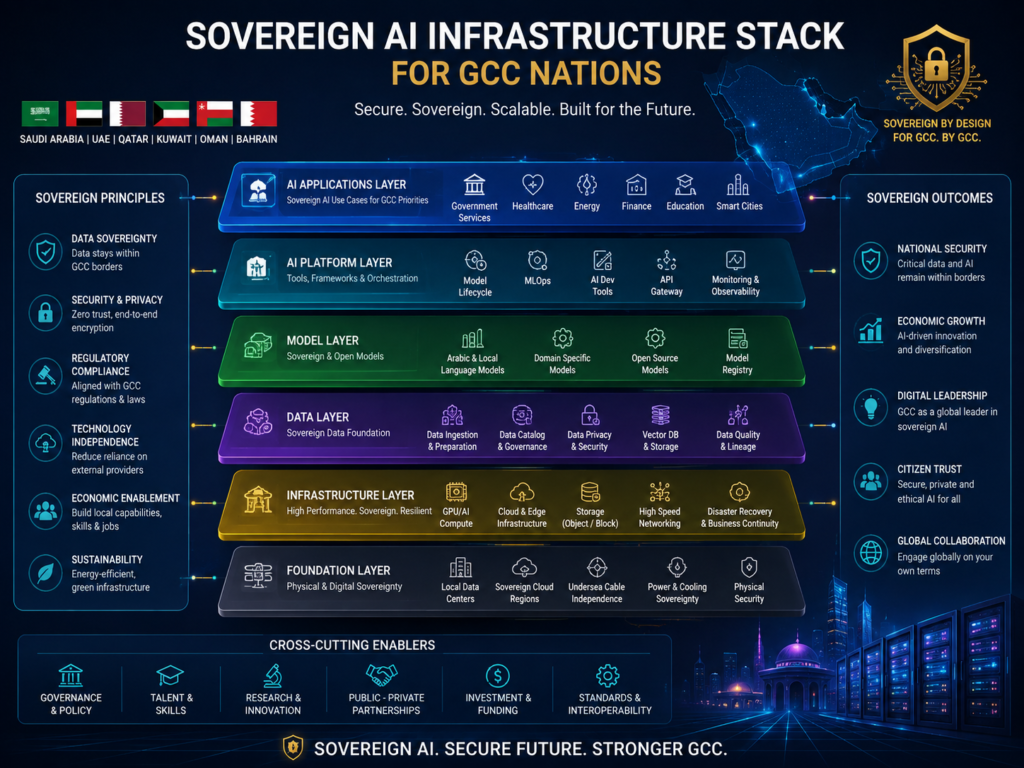
Sovereign AI infrastructure is computing capacity that is locally controlled, operated, or governed so organizations can run AI with greater control over infrastructure, data, access, and policy requirements.
That capacity can include national data centers, GPU clusters, sovereign cloud platforms, high-performance networking, AI models, cybersecurity controls, and the applications built on top of them.
From GPUs to AI Models.
A simplified sovereign AI stack looks like this:
GPUs → electricity → cooling → fiber → data centers → cloud → AI models → applications
The model is only the visible layer. Behind it sits expensive physical infrastructure that must deliver enough power, cooling, bandwidth, and compute capacity to keep AI workloads running reliably.
Why National AI Compute Capacity Matters
Local compute can give governments and businesses more control over.
Where sensitive workloads are processed
Access to GPU capacity during periods of high demand
Latency for regional applications
Cybersecurity and governance
Arabic-language model development
Business continuity and resilience
Long-term AI capability inside the country
The value is especially clear for governments and regulated sectors, where infrastructure decisions may need to align with data-classification, cybersecurity, and sector-specific requirements.
Sovereign AI Does Not Mean Technological Isolation
Gulf sovereign AI projects still depend heavily on international technology ecosystems.
NVIDIA, AMD, Microsoft, AWS, Oracle, Cisco, and other global providers can remain part of the stack. The distinction is that critical infrastructure or workloads can be operated within an environment where the country or organization has stronger control over data, capacity, governance, and deployment.
Saudi Arabia’s HUMAIN illustrates that approach: PIF describes the company as operating across the AI stack, including data centers, infrastructure and cloud platforms, advanced AI models, and applications.
Why Saudi Arabia Is Building Sovereign AI Infrastructure
Saudi Arabia is linking sovereign AI infrastructure to economic diversification, national technology capability, data governance, and the broader ambitions of Vision 2030.
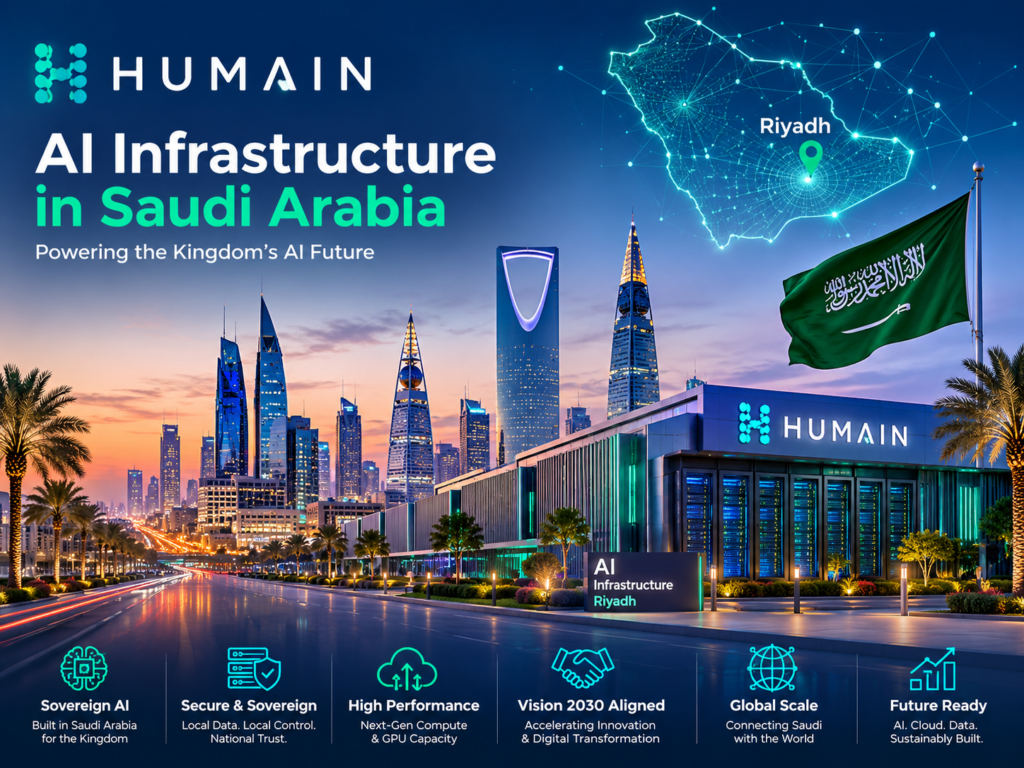
HUMAIN and Saudi Arabia’s Full-Stack AI Ambition
PIF launched HUMAIN in May 2025 to build capabilities across the AI value chain.
Its scope includes next-generation data centers, high-performance infrastructure and cloud platforms, AI models such as ALLAM, and AI applications. That makes HUMAIN more than a data-center initiative: the strategy connects physical compute with the models and services that eventually use it.
Sovereign AI Infrastructure and Vision 2030
For Riyadh, expanding domestic AI capacity can support several goals at once.
It can give startups and enterprises access to infrastructure closer to their market, help government entities modernize digital services, attract international technology investment, and strengthen local skills and intellectual property.
PIF explicitly positions HUMAIN as part of Saudi Arabia’s economic diversification and transition toward a knowledge-based economy.
Companies developing services around this ecosystem may also need scalable web development and mobile application development to turn infrastructure investment into products people can actually use.
Saudi Data Governance, NDMO, and Regulated AI
Saudi AI infrastructure also sits within a developing governance environment.
The National Data Management Office, a sub-entity of SDAIA, develops and supports policies, regulations, standards, and controls covering data governance and the protection of personal and sensitive data.
Financial institutions have additional considerations. Under SAMA’s Cyber Security Framework, regulated member organizations must address cloud-provider due diligence, cybersecurity controls, contracts, and data location. The framework states that cloud services should in principle be located in Saudi Arabia, while use of cloud services outside the Kingdom requires explicit SAMA approval.
That does not mean every AI workload in Saudi Arabia automatically has the same localization requirement. The correct approach is to assess the organization, sector, data classification, and applicable rules before selecting infrastructure.
How the UAE Is Building Frontier-Scale AI Compute
The UAE is taking a partnership-heavy approach: build large-scale domestic capacity while connecting it to some of the world’s biggest AI and infrastructure companies.
Stargate UAE and Abu Dhabi’s Compute Strategy
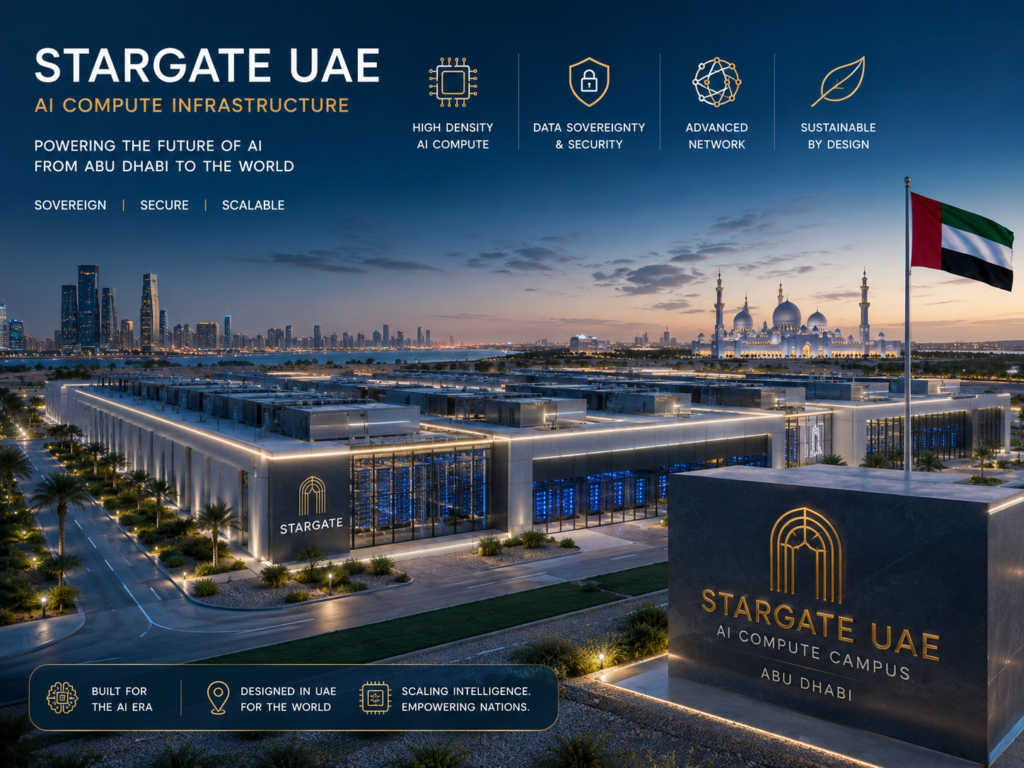
OpenAI announced Stargate UAE on May 22, 2025, describing it as the first international deployment of its Stargate AI infrastructure platform.
The initiative brings together G42, Oracle, NVIDIA, Cisco, and SoftBank around frontier-scale compute capacity in the UAE.
The physical infrastructure story is centered on Abu Dhabi rather than Dubai—a useful distinction when discussing the UAE’s AI strategy.
G42, Khazna, and the UAE AI Infrastructure Ecosystem
The UAE already has an ecosystem spanning data centers, cloud services, capital, enterprise technology, and AI development.
G42 and related infrastructure players give Abu Dhabi a platform for large-scale computing, while international partnerships provide access to technologies that would be difficult or inefficient to recreate entirely inside one country.
Dubai plays a different but complementary role, particularly through its enterprise, startup, financial-services, and DIFC ecosystems.
Why the UAE Model Matters
The UAE model shows that sovereignty and international collaboration are not opposites.
A country can build locally governed infrastructure while continuing to use global chips, networking equipment, software platforms, cloud services, and technical expertise.
That combination may become one of the defining features of Gulf AI infrastructure.
Why GCC Countries Need Local GPUs and Sovereign Cloud
Saudi Arabia, the UAE, and Qatar are investing in sovereign AI infrastructure because local capacity can improve data control, availability, latency, resilience, and regional AI development.
The business case becomes stronger when AI shifts from experimentation to mission-critical use.
Data Sovereignty and Regulated Workloads
Government, financial-services, healthcare, and other sensitive sectors often face tighter controls around information handling.
Local infrastructure gives organizations another deployment option when data residency, auditability, security, or contractual restrictions matter.
However, regulations differ by country and industry. NDMO, SAMA, UAE regulators, and Qatar’s sector regulators should be assessed according to the specific workload rather than treated as one GCC-wide rulebook.
Mak It Solutions’ guide to preemptive cybersecurity covers related issues around cloud exposure and AI-enabled infrastructure.
Latency, Availability, and Strategic Resilience
Running inference closer to Riyadh, Abu Dhabi, Dubai, or Doha can reduce the distance between users, data, and computing resources.
Local capacity can also reduce dependence on scarce overseas GPU availability and give large organizations more predictable options for capacity planning.
It does not eliminate global supply-chain risk, but it changes how much of that risk must be absorbed at the application level.
Local Compute for Arabic AI Models
Arabic AI is another important part of the equation.
Training, fine-tuning, and serving models for regional language use cases requires both datasets and computing capacity. Saudi initiatives involving ALLAM show how infrastructure investment can be connected with Arabic-focused AI development.
The opportunity extends beyond translation. Regional models can be adapted for government services, customer support, finance, education, and enterprise workflows where language and local context matter.
Energy, Cooling, and the Economics of Gulf AI Data Centers
AI infrastructure may be digital in purpose, but its constraints are extremely physical.
Turning Energy Capacity Into Compute Capacity
High-performance GPU clusters require substantial electricity, reliable grids, cooling infrastructure, networking, and backup systems.
In that sense, sovereign AI infrastructure is becoming an industrial asset as much as a technology asset.
Countries that can combine energy capacity, capital, suitable sites, network connectivity, and long-term infrastructure planning may have an advantage in attracting compute-intensive workloads.
Cooling AI Infrastructure in Riyadh and Abu Dhabi
The Gulf climate makes cooling particularly important.
Riyadh, Abu Dhabi, and Doha regularly operate in demanding heat conditions, so new AI facilities need efficient thermal engineering. Liquid cooling, facility design, power efficiency, and responsible water management can materially affect the economics of high-density computing.
Capital Intensity and GPU Obsolescence Risk
More infrastructure is not automatically better.
AI accelerators can become outdated quickly, data centers require large upfront investment, and demand forecasts can change before a facility reaches full utilization.
Operators therefore need to balance national capacity goals against.
GPU refresh cycles
Energy costs
Cooling requirements
Facility utilization
Network availability
Cloud interoperability
Customer demand
Vendor concentration
Underused compute can become expensive stranded capacity.
Saudi Arabia vs UAE vs Qatar.
Saudi Arabia, the UAE, and Qatar are moving toward the same broad goal through different models.
| Market | Current Direction | Strategic Strength |
|---|---|---|
| Saudi Arabia | Full-stack national AI capacity | Infrastructure, models, governance, applications |
| UAE | Frontier compute with international partners | Capital, partnerships, large-scale infrastructure |
| Qatar | Sovereign cloud and accelerated computing | Local hosting, cloud services, expanding data-center capacity |
Saudi Arabia.
Saudi Arabia’s model connects PIF-backed investment, HUMAIN, SDAIA, governance, infrastructure, and Arabic AI development.
It is the broadest full-stack national model of the three.
UAE.
The UAE is leaning heavily into partnership-led scale.
Stargate UAE demonstrates how Abu Dhabi can combine local capital and infrastructure with technology from major international providers rather than trying to vertically integrate every component.
Qatar.
Qatar’s model is increasingly centered on sovereign cloud and locally hosted accelerated computing.
Ooredoo announced NVIDIA-powered sovereign AI cloud services in July 2025, built on NVIDIA Hopper GPUs and hosted in local data centers.
Santy’s has also expanded Qatar’s hyperscale data-center footprint. In January 2026, it announced the acquisition of Q Data facilities, adding 12.5 MW of capacity and taking its live IT capacity in Qatar to 26 MW.
Ooredoo then expanded its sovereign-cloud strategy with Oracle Alloy. Oracle announced on February 16, 2026 that the platform would allow Ooredoo to offer locally operated sovereign AI and cloud services from its own data centers in Qatar.
What Sovereign AI Infrastructure Means for GCC Businesses
For most companies, the important question is not which country has the biggest AI announcement. It is which infrastructure model best fits the workload.
Fintech and Government AI
A Riyadh fintech deploying AI for fraud analytics may need to combine accelerated computing with SAMA-aligned cloud and cybersecurity controls.
An Abu Dhabi or Dubai financial firm may face a different regulatory structure depending on where it operates and which authority supervises it.
The infrastructure decision should therefore come after data classification, regulatory analysis, and security requirements—not before them.
Retail, Logistics, and Enterprise AI
The same infrastructure can support less regulated commercial workloads.
A Dubai e-commerce platform could run Arabic customer-service inference closer to regional users. Logistics businesses in Riyadh, Abu Dhabi, or Doha could use AI for demand forecasting, routing, warehouse planning, or document processing.
But secure implementation still depends on the application layer. Controls such as AI agent identity management and appropriate agentic AI security become increasingly important as AI systems gain access to business tools and sensitive data.
What GCC Companies Should Evaluate Before Choosing AI Infrastructure
Before committing to a sovereign or hybrid AI environment, evaluate.
Data residency: Where can the workload and its data legally or contractually run?
GPU availability: Is sufficient compute available when the business needs it?
Latency: Does local inference materially improve the user experience?
Cybersecurity: Who controls access, encryption, monitoring, and incident response?
Cloud interoperability: Can workloads move between local and international platforms?
Arabic AI support: Does the environment support regional models and datasets?
Cost: Is sovereign capacity economically justified for the workload?
Power and resilience: Can the facility deliver reliable capacity at scale?
Vendor lock-in: How difficult would it be to change providers or architectures later?
Infrastructure should follow the workload not the hype.
Concluding Remarks
The Gulf’s AI infrastructure race is not simply about owning the largest number of GPUs. It is about controlling enough compute, cloud capacity, data governance, and technical capability to decide what governments and businesses can build next.
Saudi Arabia represents full-stack national ambition. The UAE is pairing frontier-scale infrastructure with global partnerships. Qatar is expanding a locally governed sovereign-cloud and accelerated-computing model.
For GCC businesses, sovereign AI infrastructure creates more choices but also makes architecture, cybersecurity, interoperability, and regulatory planning more important. ( Click Here’s )
Turning that infrastructure into useful products requires strong digital development services and performance-focused modern web architecture.
Build an AI Platform for the GCC
Building an AI, cloud, or digital platform for Saudi Arabia, the UAE, or Qatar requires more than choosing a GPU or cloud provider.
Mak It Solutions can help businesses evaluate application architecture, development, security, scalability, and integration requirements around a GCC technology strategy.
Explore our services or contact our team to discuss a custom roadmap.
FAQs
Q : Does Saudi Arabia require AI data to stay inside the Kingdom?
A : Not every AI workload is automatically required to remain inside Saudi Arabia. Requirements depend on the organization, sector, data classification, and applicable regulations. For SAMA-regulated member organizations, the Cyber Security Framework states that cloud services should in principle be located in Saudi Arabia, while overseas cloud use requires explicit SAMA approval.
Q : What role does HUMAIN play in Saudi Arabia’s AI infrastructure strategy?
A : HUMAIN is a major part of Saudi Arabia’s full-stack AI strategy. Launched by PIF in May 2025, its remit spans next-generation data centers, high-performance infrastructure and cloud platforms, advanced AI models including ALLAM, and AI applications.
Q : Is Stargate UAE located in Abu Dhabi or Dubai?
A : Stargate UAE is centered in Abu Dhabi, not Dubai. Open AI announced the initiative in May 2025 as the first international deployment of its Stargate AI infrastructure platform, with partners including G42, Oracle, NVIDIA, Cisco, and SoftBank.
Q : How is Qatar developing sovereign AI cloud infrastructure?
A : Qatar is expanding local AI capacity through Ooredoo, Santy’s, NVIDIA-powered accelerated computing, and Oracle Alloy. Ooredoo launched locally hosted NVIDIA-based sovereign AI cloud services in 2025, while further data-center and sovereign-cloud expansion continued in 2026.
Q : Can GCC companies still use overseas cloud platforms?
A : Yes. Sovereign AI does not necessarily require abandoning international cloud providers. Companies can use local, overseas, or hybrid environments where regulations, contracts, security policies, and data-governance requirements permit them. The right architecture depends on the workload and the regulator involved.
[…] AI Infrastructure GCC Growth Matters […]