


AI Agents vs SaaS: The Per-Seat Pricing Shake-Up
AI Agents vs SaaS: The Per-Seat Pricing Shake-Up
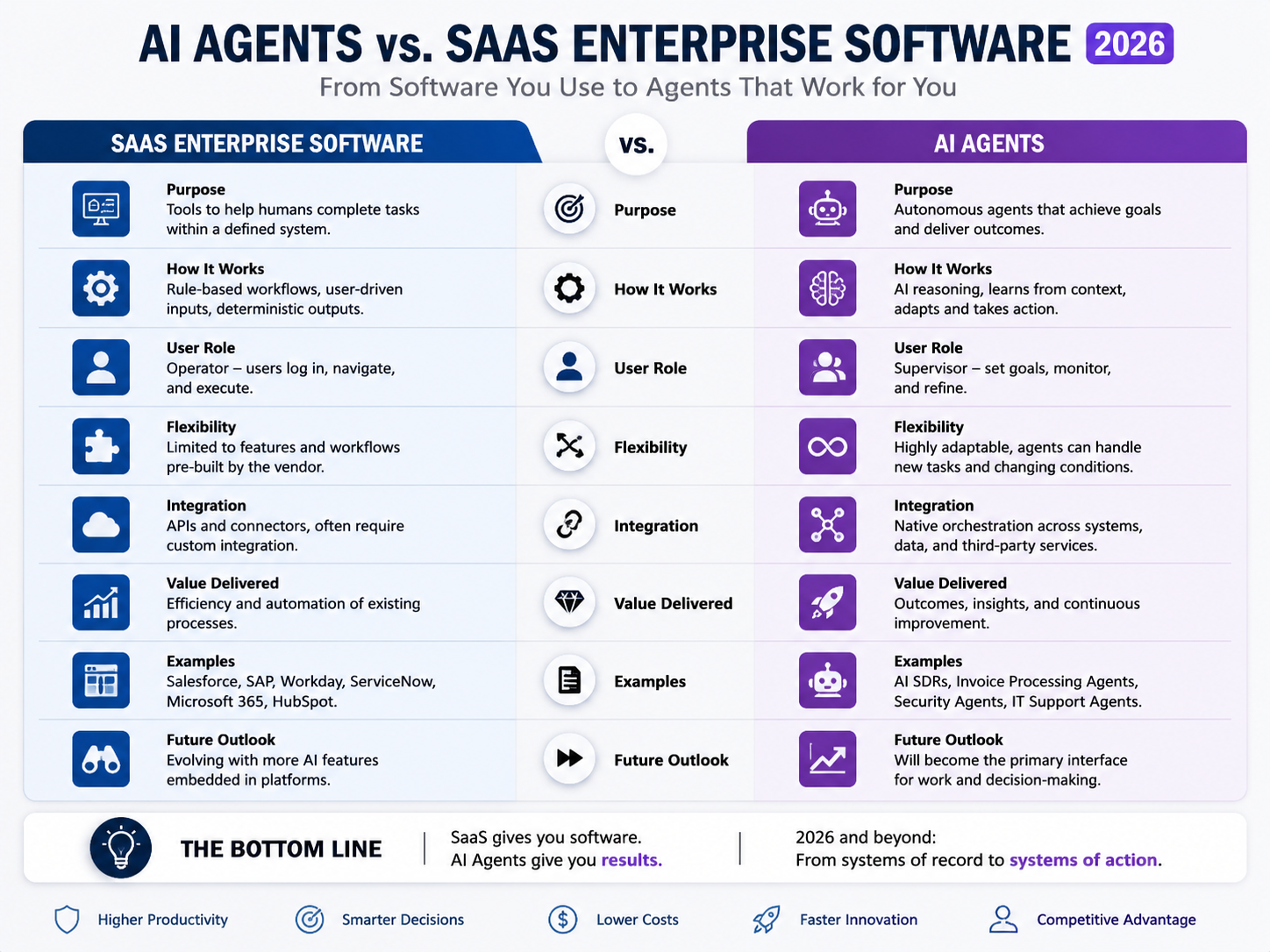
AI Agents vs SaaS: The Per-Seat Pricing Shake-Up
AI agents vs SaaS is no longer a theoretical software debate. As autonomous agents take over repetitive research, data entry, record updates and cross-platform workflows, enterprises may need fewer human software seats even while their overall software consumption continues to grow.
The short answer: AI agents are unlikely to kill SaaS. They are more likely to compress selected SaaS seats and change how software is accessed and priced. Systems of record, governance platforms and compliance-critical applications will remain important, but per-seat licensing may increasingly give way to usage-, agent-, transaction- and outcome-based models.
The shift matters because enterprise software is still a huge and growing market. Gartner reports that worldwide enterprise application SaaS revenue reached $218.5 billion in 2024, up 16.7% year over year. At the same time, Stanford’s 2025 AI Index reports that 78% of surveyed organisations used AI in 2024, compared with 55% in 2023.
What Is the Difference Between AI Agents and SaaS?
Traditional SaaS gives people software they operate directly. AI agents can interpret a goal, decide which actions to take and execute multi-step workflows with less human intervention.
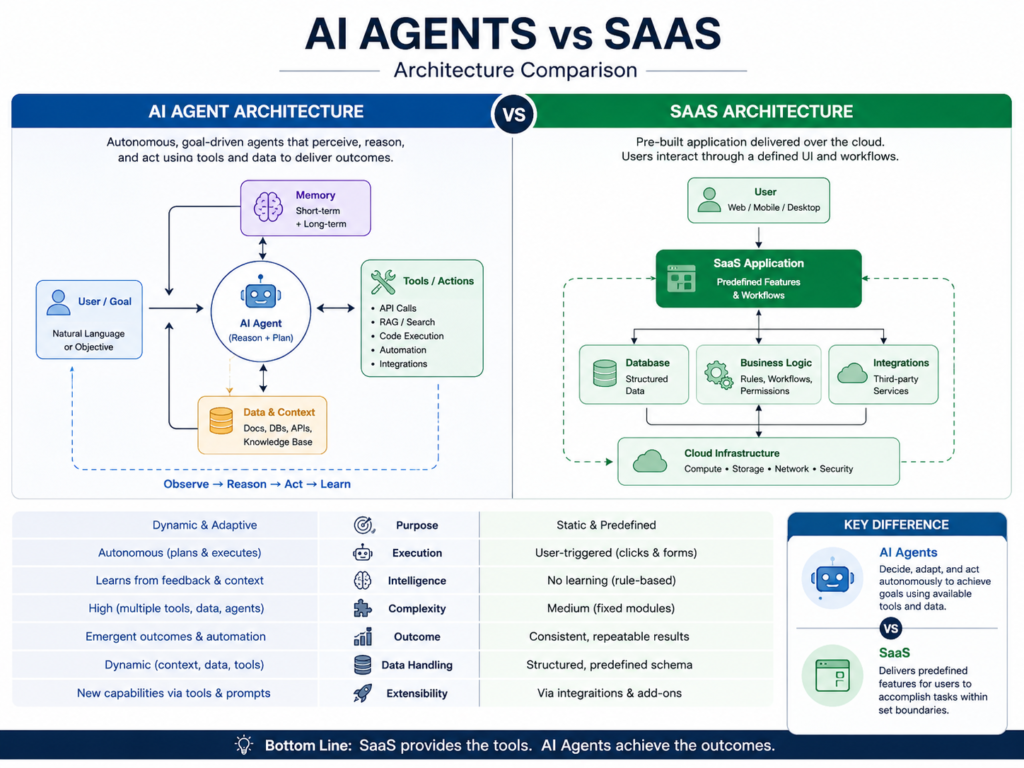
In practice, AI agents vs SaaS is rarely an either-or choice. The more realistic enterprise architecture puts agents on top of SaaS platforms, APIs and systems of record.
User-Driven SaaS vs Autonomous AI Execution
Traditional SaaS usually depends on dashboards, menus, forms and user-driven workflows. An employee logs in, finds the right record, performs an action and moves to the next task.
An AI agent can work differently. It may receive an objective, select the appropriate tools, call APIs, update multiple systems and continue until the task is complete or until it reaches a point that requires human approval.
The important difference is not simply automation. It is the ability to coordinate actions across several systems.
How Agents Use APIs, Tools and Systems of Record
Agents can connect through APIs and integrations to platforms such as Salesforce, SAP, Workday, ServiceNow or Microsoft 365.
Those applications may remain the authoritative systems of record even if fewer employees open their interfaces every day. The agent changes the interaction layer; it does not necessarily replace the underlying software.
That makes secure integration critical. Mak It Solutions’ API security guidance and backend development services cover the architecture required for controlled API-driven workflows.
AI Agents vs SaaS Comparison
| Factor | Traditional SaaS | AI Agents |
|---|---|---|
| Primary interaction | Human-operated interface | Goal- or workflow-driven |
| Autonomy | Low to moderate | Moderate to high |
| Workflow scope | Usually centred on one platform | Often spans multiple platforms |
| Typical pricing | Per seat or subscription | Usage, task, agent or outcome |
| Integration requirement | Moderate | High |
| Auditability | User and application logs | Agent actions, tool calls and system logs |
| Scaling model | More users and seats | More automated executions |
| Human control | Direct operation | Approval and escalation checkpoints |
Which SaaS Seats Can AI Agents Actually Replace?
AI agents are most likely to reduce seats that exist mainly to support repetitive, measurable and rules-based work. They are less likely to eliminate access to regulated systems of record, specialist applications or collaboration platforms.
That means enterprises should expect selective SaaS seat compression, not universal software replacement.
High-Compression Workflows: Support, Sales Ops and Back Office
Good candidates include.
Support-ticket classification and triage
CRM record updates
Routine sales research
Report preparation
Data entry and reconciliation
Back-office administration
Standard follow-up workflows
Information gathering across internal systems
For example, an agent could move between HubSpot, Zendesk and internal databases while one employee supervises exceptions instead of manually processing every step.
The value comes from replacing workflow effort, not simply removing a login.
Durable SaaS Categories.
Platforms such as Salesforce, SAP, Workday, ServiceNow and Microsoft 365 can remain strategically important because businesses still need trusted data, permissions, collaboration, governance and workflow state.
An AI agent might reduce how often users interact with those applications directly, but the underlying platforms may become even more important as machine activity increases.
For organizations planning this transition, Mak It Solutions’ enterprise AI adoption roadmap offers a broader framework for moving AI workloads into production.
The Keep-or-Replace Test for Every SaaS Seat
Before cutting a license, ask.
Is the underlying work repetitive and predictable?
Can the required functions be accessed securely through APIs or approved integrations?
Can success and failure be measured clearly?
How often does the workflow require human judgment?
Are approval, compliance and audit requirements manageable?
Does the application remain a critical system of record?
A seat should be removed only when the workflow behind it has genuinely changed—not simply because an AI tool exists.
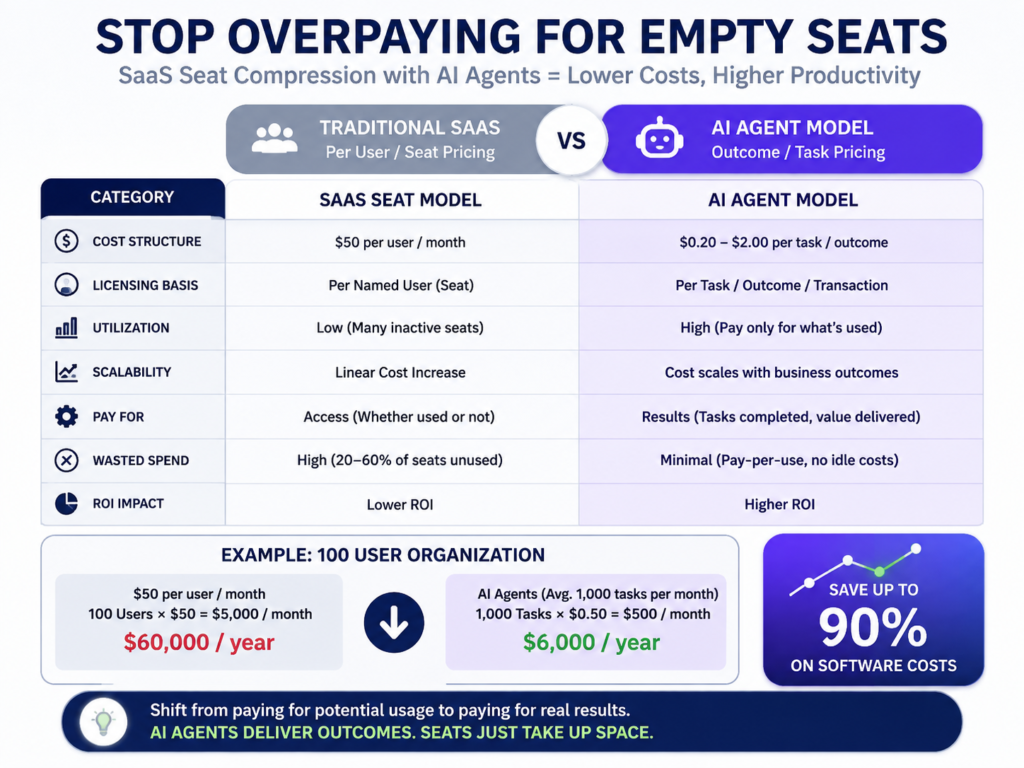
How AI Agents Break Seat-Based SaaS Pricing
One of the biggest consequences of AI agents vs SaaS is economic.
Traditional SaaS pricing often assumes a fairly simple relationship:
More employees → more software users → more seats → more revenue.
AI agents weaken that connection. A smaller team can potentially execute far more workflows without adding an equivalent number of human logins.
Why “Employee = Seat = Revenue” Is Weakening
If an operations team can automate research, CRM updates, reporting and routine service requests, its output may grow without its seat count growing at the same pace.
That creates pressure on vendors whose revenue models depend heavily on named-user license’s.
It does not necessarily mean lower software spending. The spending may simply shift elsewhere.
Usage-, Agent-, Value- and Outcome-Based Pricing
Several pricing approaches fit agent-driven software better than traditional seats.
Usage pricing: fees based on calls, credits, compute or workflows.
Agent pricing: charges for deployed digital workers or autonomous agents.
Transaction pricing: fees linked to completed actions or transactions.
Outcome pricing: charges connected to measurable results.
Hybrid pricing: a predictable subscription combined with variable consumption.
Mak It Solutions’ AI agent pricing guide explores how these commercial models may change enterprise AI economics.
The New CFO Equation.
CFOs should increasingly compare total cost per successful workflow, rather than looking at seat price alone.
That calculation can include.
Software licenses
Model inference and token usage
API charges
Infrastructure
Failed attempts and retries
Implementation costs
Human review
Monitoring and governance
This matters in an enterprise software market that Gartner says reached $899.9 billion in 2024, with cloud subscriptions representing 60.1% of overall revenue.
Mak It Solutions’ Business Intelligence Services can support the reporting layer needed to track automation costs and workflow-level ROI.
Do AI Agents Need Their Own Software Licenses?
Sometimes.
An AI agent can still create licensing obligations depending on the vendor contract, authentication model, API terms and definition of an authorized user. Replacing a human click with an automated API call does not automatically remove the commercial obligation.
Procurement, legal, security and IT teams should therefore review non-human access before changing license counts.
Non-Human Identities, Named Users and API Access
Agents may authenticate through.
Service accounts
Machine identities
OAuth clients
Dedicated agent identities
Vendor-specific API credentials
Contract terms can treat these access methods differently. Some vendors may permit machine access under existing subscriptions, while others may meter APIs or require separate entitlements.
The contract not the technology alone determines the commercial position.
SaaS License Optimization Without Creating Contract Risk
Start with genuinely unused human licenses. Then confirm whether replacing human interaction with machine access changes the vendor’s licensing rules.
A saving based on the wrong interpretation of a contract can become an unexpected cost or negotiation problem at renewal.
Permissions, Least Privilege and Agent Audit Trails
Every production agent should have.
A clearly owned identity
Minimum necessary permissions
Approved credentials
Detailed activity logs
Human approval gates for sensitive actions
Credential rotation procedures
Rapid revocation capability
Mak It Solutions’ AI agent identity management guide provides a practical model for governing non-human identities.
Licensing and regulatory requirements vary by vendor, jurisdiction and use case. This article provides general technology and commercial guidance, not legal advice.
What Does the Future of SaaS Look Like With Agentic AI?
The most likely future is hybrid.
AI agents become an interaction and execution layer, while SaaS applications continue to store trusted data, enforce business rules, manage permissions and maintain workflow state.
SaaS Becomes the System of Record Behind the Agent
Instead of opening several dashboards, an employee may eventually give one instruction to an agent.
The agent can then work across CRM, ERP, HR, service-management and analytics systems while those platforms remain authoritative underneath.
The interface changes. The system of record survives.
Fewer Seats Could Still Mean More Software Consumption
This is the part that makes the AI agents vs SaaS debate more nuanced.
Human seat counts can decline while.
API calls increase
Automated transactions increase
Machine-to-machine activity grows
Data processing expands
Agent executions multiply
A vendor could therefore lose human seats while gaining consumption revenue.
How SaaS Vendors Must Adapt Their Business Models
SaaS vendors can respond by building.
Embedded AI agents
Agent-ready APIs
Machine identities
Agent-native interfaces
Workflow orchestration
Better observability
Consumption-based commercial models
The strongest pricing models will likely connect cost to measurable value while still giving enterprise customers enough predictability to budget.
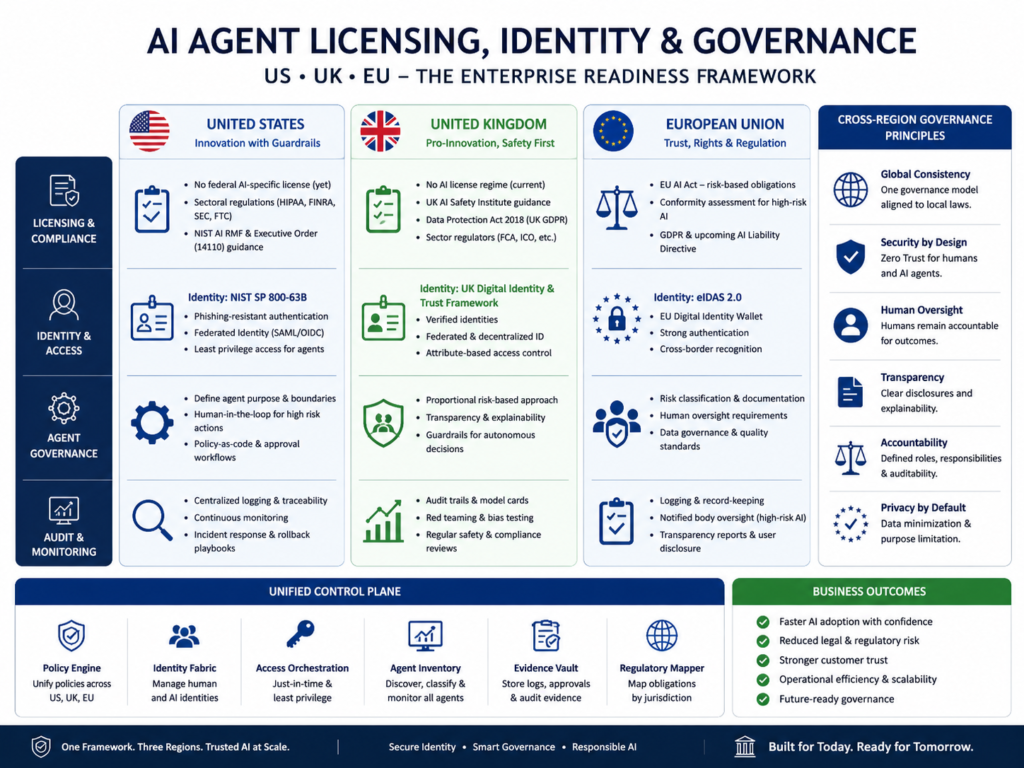
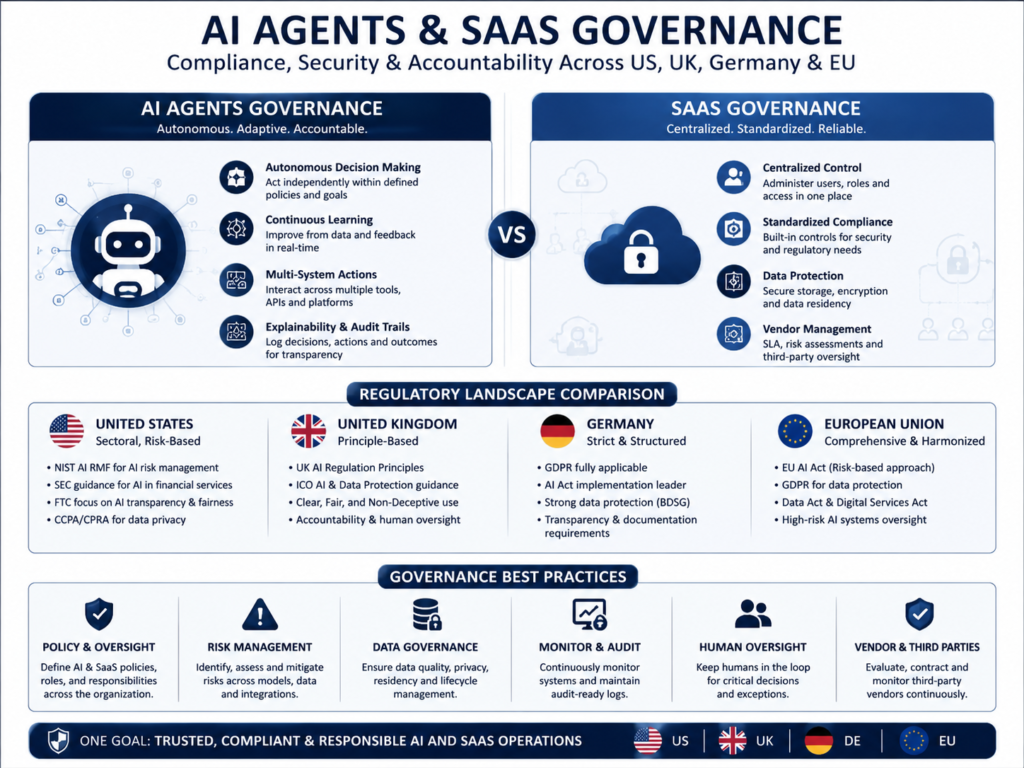
AI Agents vs SaaS in the USA, UK, Germany and EU
The economics of agentic software may be global, but governance is not. AI agents vs SaaS decisions should reflect the privacy, security, financial-services and sector-specific requirements of each market.
USA.
A New York financial-services team or Austin SaaS company may initially focus on productivity, cost per workflow and license reduction. But agent access still needs to fit enterprise IAM, security controls and applicable privacy or industry rules.
For healthcare workflows involving electronic protected health information, the HIPAA Security Rule requires safeguards including appropriate access controls and mechanisms for recording and examining system activity.
Payment-card environments should also account for PCI DSS requirements. PCI DSS v4.0.1 was published in June 2024 and is the current supported version listed by the PCI Security Standards Council.
UK.
A London fintech or Manchester enterprise should connect licensee optimization with UK data-protection accountability and applicable sector requirements.
The ICO continues to identify lawfulness, purpose limitation, data minimization, security and accountability among the core UK data-protection principles. Its guidance has also been updated to reflect amendments introduced by the Data (Use and Access) Act 2026.
For agents handling personal information, enterprises should document purpose, control access, minimize unnecessary data and maintain traceability.
Germany and EU.
Organizations in Berlin, Munich, Frankfurt and elsewhere in the EU may need to consider GDPR requirements alongside the EU AI Act, DORA and sector-specific supervisory expectations.
The EU AI Act entered into force on August 1, 2024 and uses a risk-based regulatory framework.
For regulated financial entities, DORA places particular emphasis on ICT risk and third-party providers. BaFin states that relevant ICT third-party risk should be assessed and monitored throughout the service lifecycle, including pre-contract risk assessment and due diligence.
Data location, cross-border transfers, machine identity, third-party dependencies and agent auditability should therefore be considered before large-scale deployment.
How to Decide Whether to Keep, Cut or Reprice SaaS
Do not start with the application list. Start with the work.
Map what employees actually do, identify workflows suitable for automation, test the agent against operational and risk metrics, and only then change licenses or commercial terms.
Map SaaS Seats to Workflows
Inventory.
Applications
Active users
Actual utilization
Contract terms
Data ownership
Integrations
Business processes supported by each seat
This shows whether a license represents current business value or simply historical provisioning.
Pilot AI Agents Against Cost, Accuracy and Risk
Choose a controlled workflow and track.
Completion rate
Cost per successful task
Exception rate
Human-review time
Error rate
Security events
Business outcome
Do not evaluate the pilot only by asking whether the agent can complete the task. The important question is whether it can complete the task reliably, economically and within your control requirements.
Mak It Solutions’ services portfolio covers integration, SaaS and automation projects that can support this type of pilot.
Consolidate Seats and Renegotiate the Commercial Model
Once a workflow has been proven:
Remove licenses that are genuinely redundant
Consolidate overlapping tools
Revisit named-user commitments
Negotiate usage- or agent-based terms where appropriate
Set consumption limits
Preserve audit evidence for every license change
This approach turns license optimization into a controlled operating decision rather than a speculative cost-cutting exercise.
Concluding Remarks
The real AI agents vs SaaS story is not the disappearance of enterprise software. It is the weakening of the assumption that every unit of software value requires another human seat.
AI agents can reduce manual interaction with SaaS while increasing API activity, automated transactions and machine-driven consumption. That creates a different enterprise software economy one measured increasingly by workflows and outcomes rather than logins alone. ( Click Here’s )
If you are assessing AI agents vs SaaS across your software portfolio, start with one measurable workflow instead of a company-wide license cut. Mak It Solutions can help map integrations, test agent economics and build the reporting and governance needed for a scoped automation decision. Request a focused estimate for your first pilot.
Key Takeaways
AI agents are more likely to compress selected SaaS seats than eliminate SaaS itself.
Repetitive support, sales-operations and back-office workflows are strong automation candidates.
Systems of record, compliance platforms and collaboration software are more durable.
Enterprises should compare cost per successful workflow, not seat price alone.
API and non-human licensing terms should be checked before licenses are removed.
Production agents need identity management, least privilege, audit trails and human escalation.
SaaS vendors may lose some human seats while gaining API, transaction and agent-driven consumption.
FAQs
Q : Can one AI agent safely access multiple SaaS applications?
A : Yes, provided access is deliberately controlled. Give the agent a unique non-human identity, limit permissions to the APIs and data it actually needs, log its actions and require human approval for sensitive operations.
Shared administrator credentials should be avoided, and high-risk workflows need a clear revocation and escalation process.
Q : What metrics show whether an AI agent is cheaper than a SaaS seat?
A : Compare cost per successful task or workflow rather than subscription price alone.
Include license savings, model usage, API costs, infrastructure, implementation, retries and human-review time. Completion rate and exception rate also matter because a low-cost agent that frequently fails may deliver poor ROI.
Q : How should procurement teams negotiate AI-related SaaS contracts?
A : Clarify what the vendor considers a user, whether agent or API access requires separate licensing and how automated consumption is measured.
Contracts should also address usage limits, failed-action billing, data handling, security responsibilities, audit rights, price escalation and termination terms.
Q : What happens to SaaS renewal forecasts when headcount no longer tracks usage?
A : Headcount becomes a weaker forecasting proxy.
Finance teams may need separate forecasts for human licenses, agent activity, API usage and transaction volume. Renewal planning should combine actual utilization with expected workflow automation rather than assuming employee growth will produce equivalent seat growth.
Q : Should enterprises use vendor-embedded agents or independent orchestration platforms?
A : Vendor-embedded agents can be easier to deploy within one ecosystem and may inherit existing integrations and permissions.
Independent orchestration platforms can be more useful when a workflow must cross several SaaS systems. The better option depends on integration depth, security, observability, cost and vendor lock-in.
[…] AI SaaS Pricing: Usage, Outcome or Hybrid? […]
[…] That relationship becomes weaker when software performs work independently of headcount. Mak It Solutions explores this shift further in its AI Agents vs SaaS pricing analysis. […]