


Usage-Based Pricing vs Per-User Pricing: 2026 Guide
Usage-Based Pricing vs Per-User Pricing: 2026 Guide
Usage-Based Pricing vs Per-User Pricing: 2026 Guide
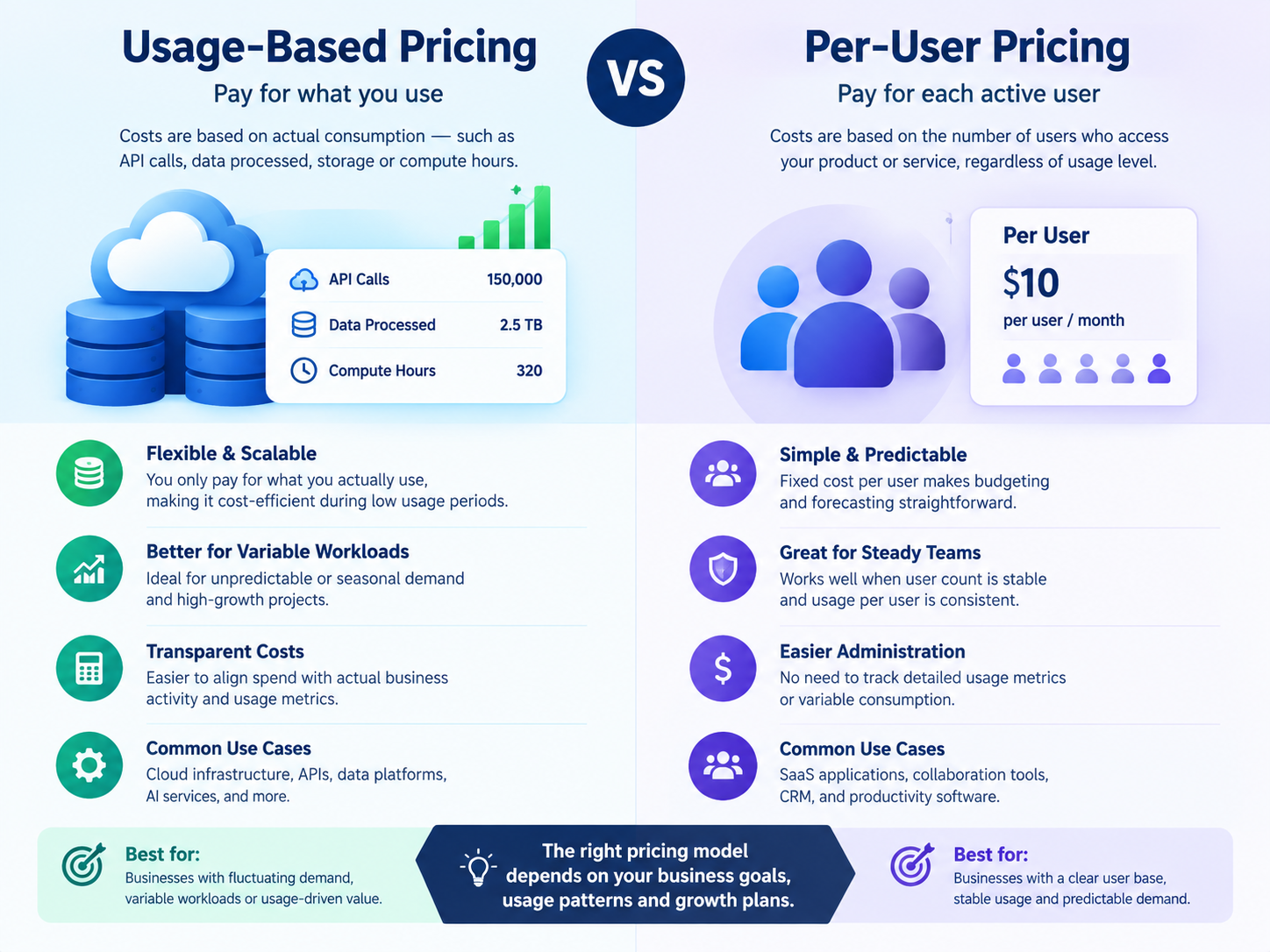
Choosing between usage-based pricing vs per-user pricing comes down to one question: what actually drives customer value?
Usage-based pricing charges for measurable consumption, such as API calls, tokens, transactions, compute or data processed. Per-user pricing charges for access by seats or users. For APIs, AI and infrastructure, consumption often tracks value more closely; for collaboration and employee-led SaaS, seat pricing can still be the cleaner fit. Hybrid pricing works when both access and consumption matter.
The right model should also make sense for your cost structure, gross margin, procurement process and customers’ ability to predict their bills.
Usage-Based Pricing vs Per-User Pricing: Key Difference
Usage-based pricing scales with measurable consumption. Per-user pricing scales with the number of users or seats.
Neither model is automatically better. The stronger choice is usually the one that connects price to a value metric customers understand and your business can measure reliably.
What Is Usage-Based or Consumption-Based Pricing?
Consumption-based pricing also called metered billing or pay-per-use charges customers according to what they consume.
Common billing units include.
API calls
AI tokens or credits
Transactions
Automated workflows
Storage
Compute time
Data processed
It works particularly well when heavier product usage creates more customer value while also increasing the vendor’s cost to serve.
The shift toward this model is not limited to infrastructure businesses. Stripe reported that almost 73% of surveyed subscription businesses planned to offer more usage-based pricing plans by Q1 2025.
What Is Per-User or Per-Seat Pricing?
Per-user pricing charges according to provisioned or active users. It remains intuitive for collaboration, productivity and workflow software because customer value often increases as more employees use the product.
For example, adding another salesperson to a CRM or another project manager to a collaboration platform can create a clear reason for another paid seat.
That relationship becomes weaker when software performs work independently of headcount. Mak It Solutions explores this shift further in its AI Agents vs SaaS pricing analysis.
Usage-Based vs Per-Seat Pricing at a Glance
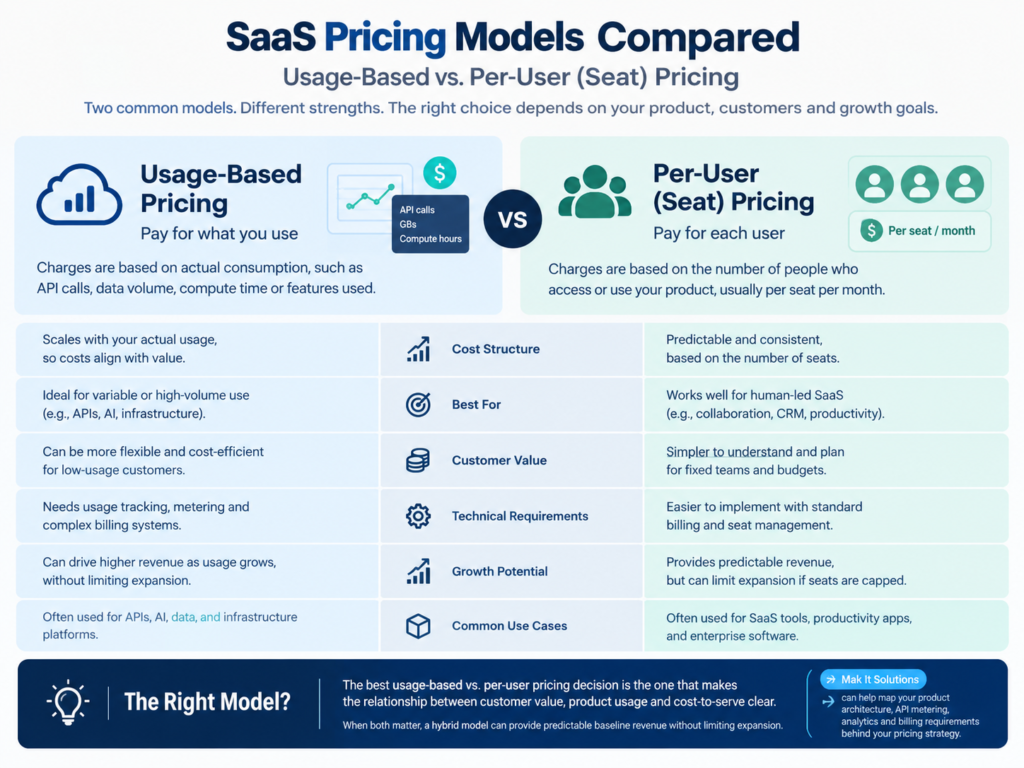
| Factor | Usage-Based Pricing | Per-User Pricing |
|---|---|---|
| Value alignment | Strong when consumption drives value | Strong when people drive value |
| Customer cost predictability | Moderate | High |
| Revenue predictability | Moderate | High |
| Scalability | High | Often linked to headcount |
| Expansion revenue | Grows naturally with consumption | Usually requires additional seats |
| Procurement simplicity | Moderate | Usually straightforward |
| Typical fit | APIs, AI, cloud, automation | Collaboration and productivity SaaS |
Cost, Revenue and TCO: Which Pricing Model Is More Predictable?
Per-user pricing generally makes invoices and recurring revenue easier to forecast. Usage-based pricing introduces more variability, but it can connect revenue more closely to customer activity and infrastructure costs.
Customer Bills: Fixed Seats vs Variable Consumption
With seat pricing, budgeting is simple. If a company needs 100 seats at a contracted rate, finance can forecast the subscription without estimating API traffic or token consumption.
Usage pricing requires a different approach. Customers need visibility into current consumption, projected spend and overages. Spending caps, alerts and usage dashboards can reduce bill shock.
For buyers, total cost of ownership should include more than the headline subscription price. Implementation, integration, support, variable infrastructure consumption and unused seat capacity can all change the real cost.
ARR, MRR, Gross Margin and Expansion Revenue
Seat subscriptions make ARR and MRR comparatively easy to model. Expansion typically happens when customers buy more seats, upgrade plans or add products.
Usage pricing creates another expansion mechanism: customers can spend more simply because they use the product more.
That can be powerful, but only when unit economics remain healthy. Gartner reported that the worldwide IaaS market reached approximately $171.8 billion in 2024, representing 22.5% growth from the previous year.
For AI-heavy products, the connection between consumption and cost becomes even more important. Mak It Solutions’ FinOps for AI guide explains how teams can connect GPU and infrastructure consumption with cost control.
Credits, Caps and Minimum Commitments
Usage-based pricing does not have to mean completely unpredictable bills.
Vendors can introduce.
Prepaid credits
Included monthly allowances
Annual minimum commitments
Volume discounts
Spending caps
Usage notifications
Contracted overage rates
These controls give customers more predictability without removing the connection between consumption and price.
API Pricing Models.
For APIs, usage-based pricing vs per-user pricing is often an easier decision because API activity rarely depends directly on the number of human users.
If value increases with requests, transactions, tokens, compute or data processing, a consumption metric usually provides a more natural starting point.
Pay Per API Call, Token, Transaction or Compute
There is no universal meter for API pricing.
A stable data API might charge per request. An AI product may meter tokens, model calls, generated outputs or tasks. Payment platforms commonly charge per transaction, while infrastructure platforms can meter compute time, storage or transferred data.
The goal is not to select the most technically convenient metric. It is to choose one customers can understand and connect to the value they receive.
Mak It Solutions’ API monetization for AI agents guide looks at these machine-driven monetization patterns in more detail.
API Subscription vs Pay-As-You-Go Pricing
API businesses are not limited to pure PAYG.
Possible structures include.
Fixed API subscriptions
Pay-as-you-go consumption
Tiered usage
Prepaid credit balances
Minimum commitments with overages
Subscription plus included usage
For many B2B products, a predictable base allowance plus variable overages provides a practical middle ground.
Why AI, Infrastructure and Automation Favor Usage Pricing
One customer can generate thousands of automated actions without hiring another employee. That makes headcount a poor value metric for many AI agents, developer platforms and automated workflows.
IDC projected worldwide AI spending of approximately $235 billion in 2024, highlighting the scale of investment flowing into AI technologies and related infrastructure.
Teams building these products can also use an API-first architecture to connect authentication, quotas, metering and monetization more cleanly.
When Per-User or Per-Seat Pricing Still Wins
Collaboration and Human-Led SaaS Products
Seat pricing remains effective when people are the primary unit of value.
Think collaboration tools, employee productivity platforms, approval workflows and business applications where bringing another team member into the product genuinely increases adoption and utility.
Active-user billing can be an alternative where customers resist paying for inactive provisioned seats.
Why Buyers Like Predictable Per-User Costs
For an enterprise buyer in New York or London, a fixed annual seat commitment is easy to explain internally.
Procurement teams can forecast spending, issue purchase orders and review renewals without having to model uncertain token or API consumption.
That simplicity should not be underestimated, particularly in enterprise sales.
When Seat Pricing Stops Reflecting Customer Value
Per-user pricing becomes harder to justify when.
Automation replaces manual activity
API usage grows independently of headcount
AI agents perform large volumes of work
Heavy users create dramatically higher costs than light users
Customers obtain more output without adding employees
Mak It Solutions’ future-proof SaaS pricing strategy for AI agents examines how SaaS companies can adapt as this relationship changes.
Hybrid SaaS Pricing: The Best of Both Models?
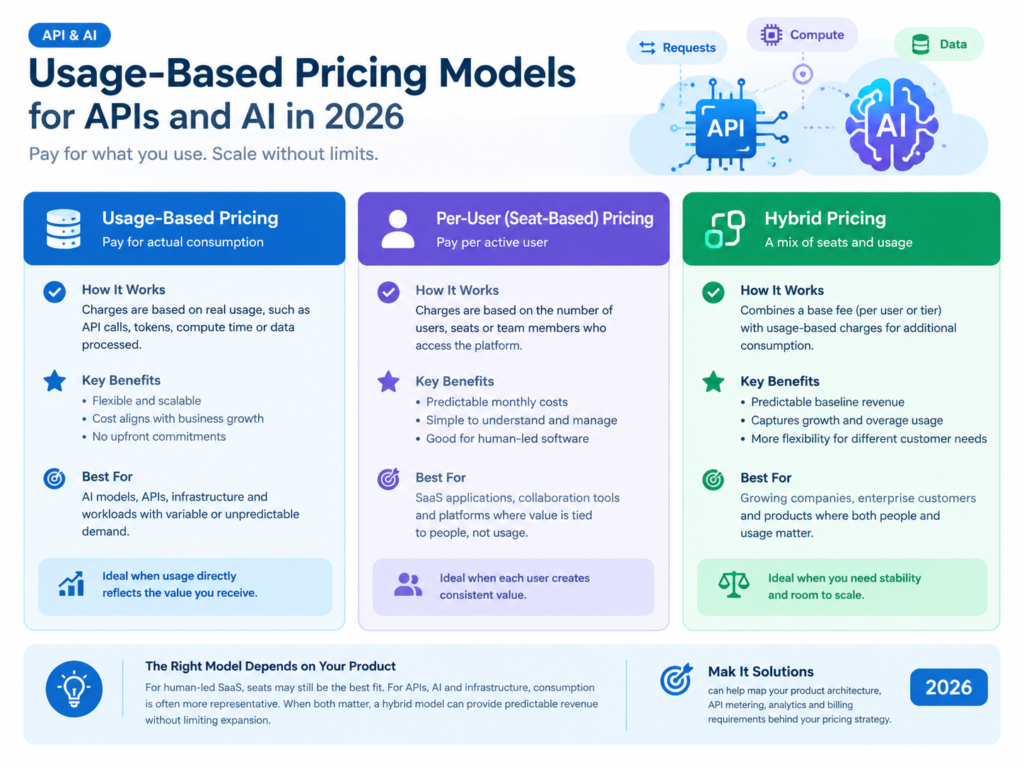
Hybrid SaaS pricing combines a predictable platform or seat charge with variable usage fees.
This structure can protect baseline recurring revenue while still allowing revenue to expand when API, AI or infrastructure consumption grows.
Subscription Plus Usage Pricing
Common hybrid structures include.
Platform fee + API calls
Seats + AI credits
Subscription + transactions
Base plan + included usage + overages
Hybrid pricing makes the most sense when platform access and consumption create value independently.
Credits, Allowances and Tiered Overages
Included usage makes the initial price easier to understand. Larger customers can then move into prepaid credit pools, volume discounts or contracted overage tiers.
This gives vendors room to support both light and heavy users without forcing every customer into the same consumption profile.
Usage-Based Billing Software and Metering Requirements
Reliable usage pricing needs more than a pricing page.
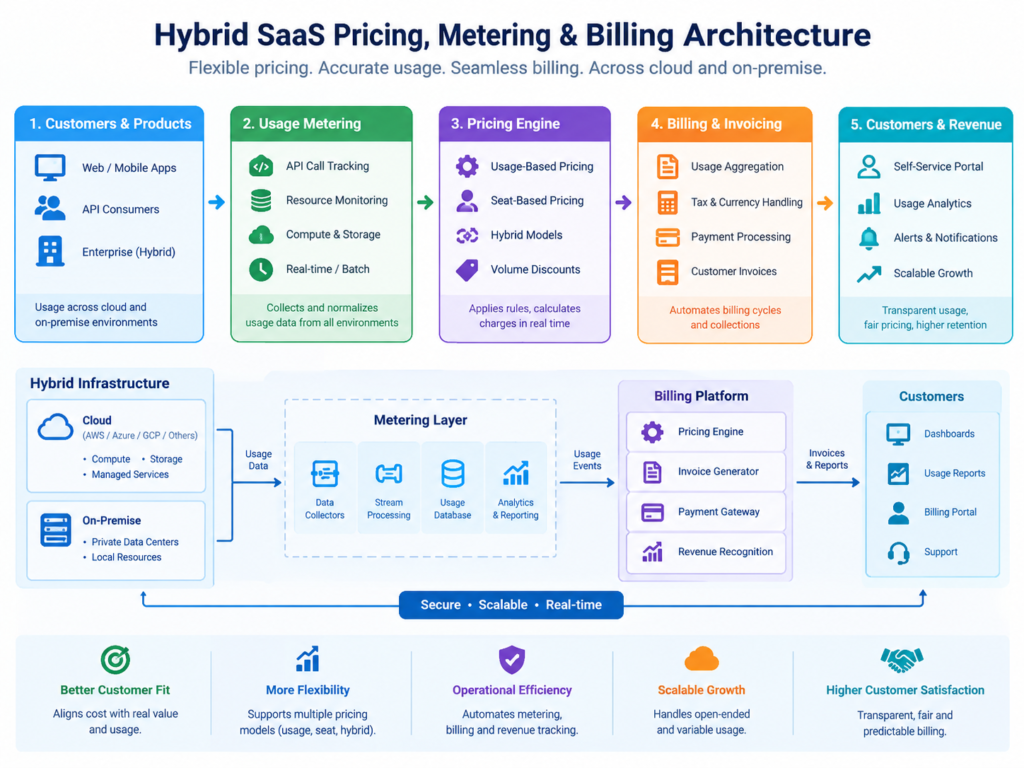
A production billing architecture should support accurate.
Metering
Rating
Usage aggregation
Invoicing
Audit trails
Usage dashboards
Threshold alerts
Credit balances and overages
Platforms such as Stripe, Charge bee, Paddle and Metronome support different parts of the billing stack.
High-volume products may also need dependable Node.js development services or another backend architecture capable of processing metering events reliably.
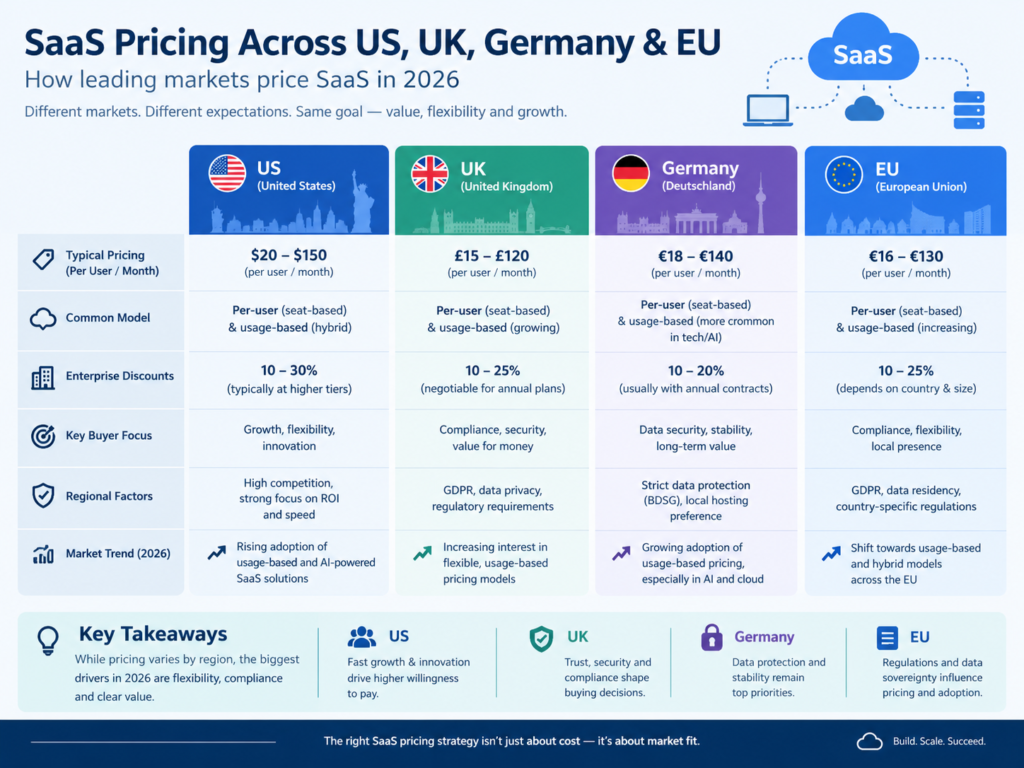
USA, UK, Germany and EU Pricing Considerations
Pricing architecture also affects procurement, currency, tax handling and compliance. The right setup for a US startup may need adjustments before it works smoothly in London, Berlin or another EU market.
US SaaS Pricing.
US enterprise contracts commonly use USD billing, annual commitments and negotiated usage allowances.
SOC 2 is frequently used as an enterprise security assurance signal. PCI DSS becomes relevant when payment-card data or environments fall within scope.
For healthcare SaaS involving electronic protected health information, the HHS HIPAA Security Rule guidance outlines administrative, physical and technical safeguards for regulated entities.
UK SaaS Pricing.
UK buyers may prefer GBP billing, transparent VAT treatment and clearly documented overage rules.
The UK GDPR remains part of the country’s data-protection framework, but businesses should also account for changes made by the Data (Use and Access) Act 2025. The Act received Royal Assent on 19 June 2025, and the ICO reported on 19 June 2026 that all of its data-protection provisions were in force.
The ICO’s data-protection principles continue to emphasize areas such as lawfulness, transparency, data minimisation, security and accountability.
Fintech and NHS-related SaaS can introduce additional regulatory and procurement requirements depending on the product and data involved.
Germany/DACH and EU.
In Germany, customers may encounter terms such as nutzungsbasierte Preise, Preis pro Nutzer, Pay-per-Use and hybrides Preismodell.
SaaS vendors selling across Germany and the wider EU should consider EUR pricing, VAT handling, GDPR/DSGVO obligations, data processing arrangements and relevant data-residency requirements.
The official EU GDPR text on EUR-Lex remains the primary legislative reference.
For financial-sector products, DORA may also affect ICT risk and third-party arrangements depending on the organisation’s role and scope. BaFin notes that cloud providers are an important focus under DORA, although not every cloud provider is automatically classified as a critical ICT third-party provider.
VAT OSS can also matter for eligible cross-border consumer sales in markets such as France, the Netherlands and Ireland.
Pricing, tax and compliance requirements depend on your business model and jurisdiction. This section is general information, not legal or tax advice.
How to Choose Your SaaS Pricing Model in 2026
Start with the value metric rather than the billing software.
Choose per-user pricing when value grows reliably with human adoption. Choose usage-based pricing when value grows with API calls, tokens, transactions, compute or another measurable form of consumption. Consider hybrid pricing when customers receive meaningful value from both platform access and variable usage.
Choose a Value Metric That Tracks Customer Value
Compare possible metrics such as seats, active users, API calls, tokens, credits, transactions, compute and data processed.
A strong metric should satisfy three tests.
Customers understand it.
Engineering can measure it accurately.
Finance can connect it to revenue and gross margin.
Match Pricing to the Product Type
Use the product’s value mechanics as your starting point rather than copying a competitor.
| Product Type | Likely Starting Model |
|---|---|
| Collaboration SaaS | Per-user / per-seat |
| API platform | Usage-based |
| AI SaaS | Usage-based or hybrid |
| Infrastructure | Usage-based |
| Enterprise platform | Subscription or hybrid |
| Automation software | Usage-based or hybrid |
Launch, Test and Optimize Safely
Before migrating an installed customer base, test the proposed pricing structure with a controlled segment.
Measure willingness to pay, consumption distribution, gross margin, invoice volatility and expansion revenue. Give customers dashboards, spending alerts and enough historical usage data to estimate future costs.
Also test how the commercial model works across USD, GBP and EUR where relevant.
Mak It Solutions’ Business Intelligence Services can help teams monitor usage, margins, customer cohorts and pricing performance after launch.
Before choosing billing software, map three things clearly: your value metric, your cost driver and your customers’ procurement requirements.
Final Thoughts
The best pricing model is not simply the one that is easiest to bill it is the one that most clearly connects customer value, product usage and your cost to serve.
For human-led SaaS, per-user pricing can remain effective when value scales with the number of people using the product. For APIs, AI products and infrastructure, usage-based pricing can provide a closer connection between consumption and value. When both predictable revenue and scalable usage matter, a hybrid model can offer a practical balance.
Before changing your pricing structure, evaluate your value metric, usage patterns, infrastructure costs, metering requirements and customer expectations. A well-designed pricing model should support both customer growth and sustainable margins.
Mak It Solutions can help map the product architecture, API metering, analytics and billing requirements behind your pricing strategy.
Request a scoped consultation with Mak It Solutions before committing to a billing-platform migration.
Key Takeaways
Usage-based pricing is strongest when customer value scales with measurable consumption.
Per-user pricing remains effective for collaboration and human-led SaaS.
Hybrid pricing can combine predictable recurring revenue with consumption-driven expansion.
API and AI businesses need accurate metering, transparent overages, dashboards and spending controls.
Pricing decisions should account for gross margin, TCO, procurement and regional compliance—not just competitor pricing.
Test a new pricing model with real usage and customer data before migrating the full installed base.
FAQs
Q : How should an early-stage SaaS test usage pricing before a full migration?
A : Start with one customer segment, feature or new pricing tier rather than moving every account at once. Track consumption, willingness to pay, gross margin, invoice volatility and support issues. A controlled pilot gives you evidence to refine the meter, allowance and overage rate before changing established contracts.
Q : Can prepaid credits reduce bill shock for API customers?
A : Yes. Prepaid credits give customers a defined spending envelope while preserving consumption-based economics. A good implementation should also show remaining credits, current usage and threshold alerts so customers can act before exhausting their balance.
Q : How do annual SaaS contracts work with variable usage charges?
A : An annual contract can combine a fixed platform or minimum commitment with included usage and variable overages. The agreement should clearly define the billable metric, usage allowance, reconciliation period and overage treatment.
Q : What usage information should customers see on invoices and dashboards?
A : Show the billable metric, quantity consumed, included allowance, overage quantity, applicable unit rate and total charge. Enterprise customers may also benefit from downloadable usage records, historical trends and audit trails for internal cost allocation.
Q : Should existing customers be grandfathered when SaaS pricing changes?
A : Grandfathering can reduce churn, but it does not have to preserve legacy pricing forever. Alternatives include renewal-based migration, transition periods or phased rollouts. Give customers enough notice and usage history to estimate how the new pricing model will affect future bills.
[…] makes transparent pricing models increasingly valuable. Mak It Solutions’ usage-based versus per-user pricing guide covers some of the commercial variables software buyers […]