


API Monetization for AI Agents: Protect Revenue
API Monetization for AI Agents: Protect Revenue
API Monetization for AI Agents: Protect Revenue
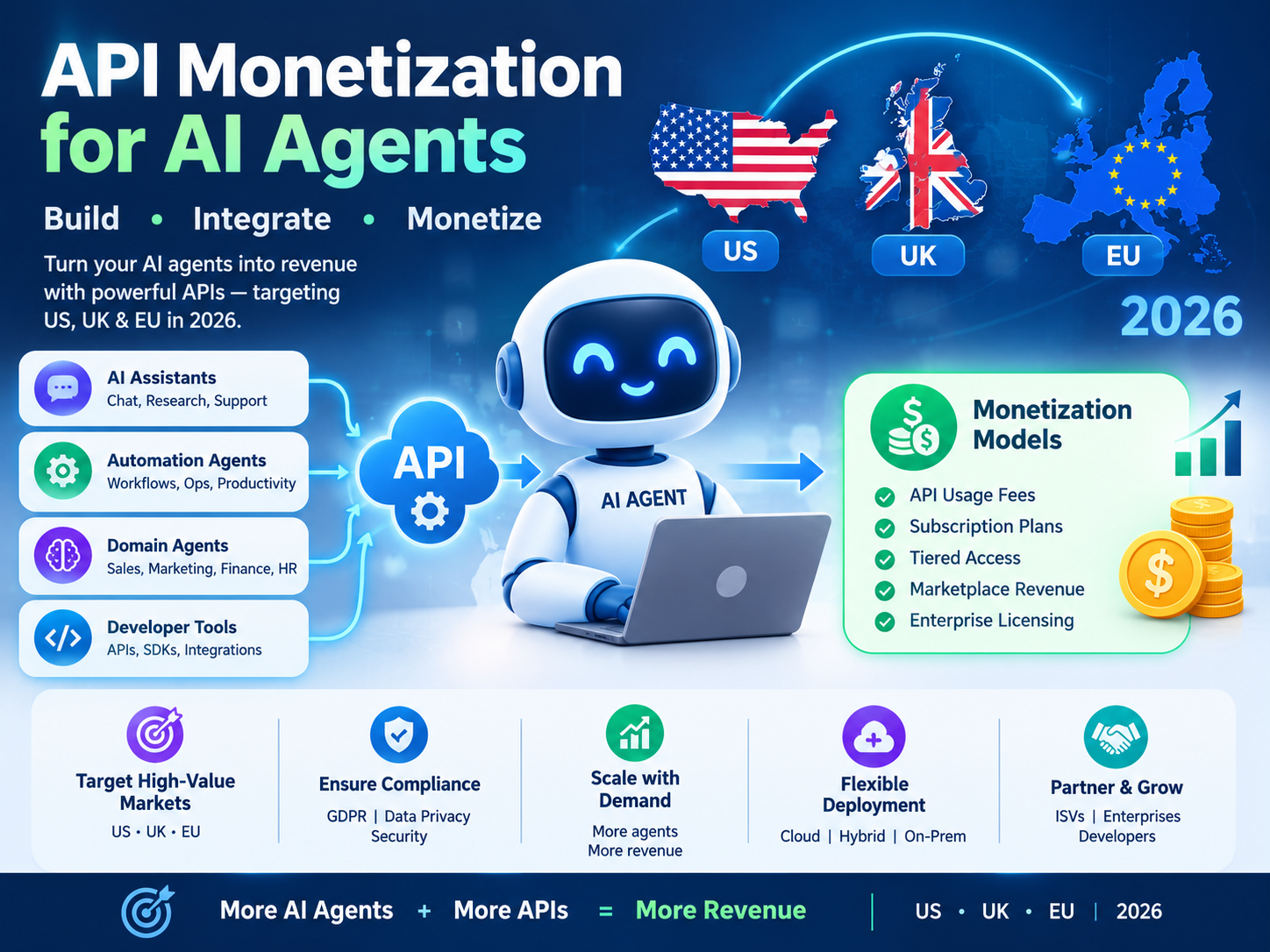
API monetization for AI agents is becoming a commercial priority as software consumption shifts beyond people clicking through SaaS interfaces. Autonomous agents can discover services, call APIs, trigger workflows and consume compute at machine speed without necessarily creating another paid seat.
Put simply, API monetization for AI agents means pricing, metering, authorizing and charging autonomous software for the APIs and machine-accessible services it consumes. A strong model connects every agent request to a customer, commercial entitlement, measurable usage unit and controlled billing or payment workflow.
That matters because agent activity can scale far faster than traditional user activity. Postman reported that 62% of companies generated revenue from APIs in 2024, while AI-driven API traffic increased by 73%.
What Is API Monetization for AI Agents?
Traditional SaaS economics usually connect revenue to human users and seats. Machine customers behave differently. A single agent can execute repeated API calls, interact with multiple systems and consume substantial infrastructure without adding another employee to the customer account.
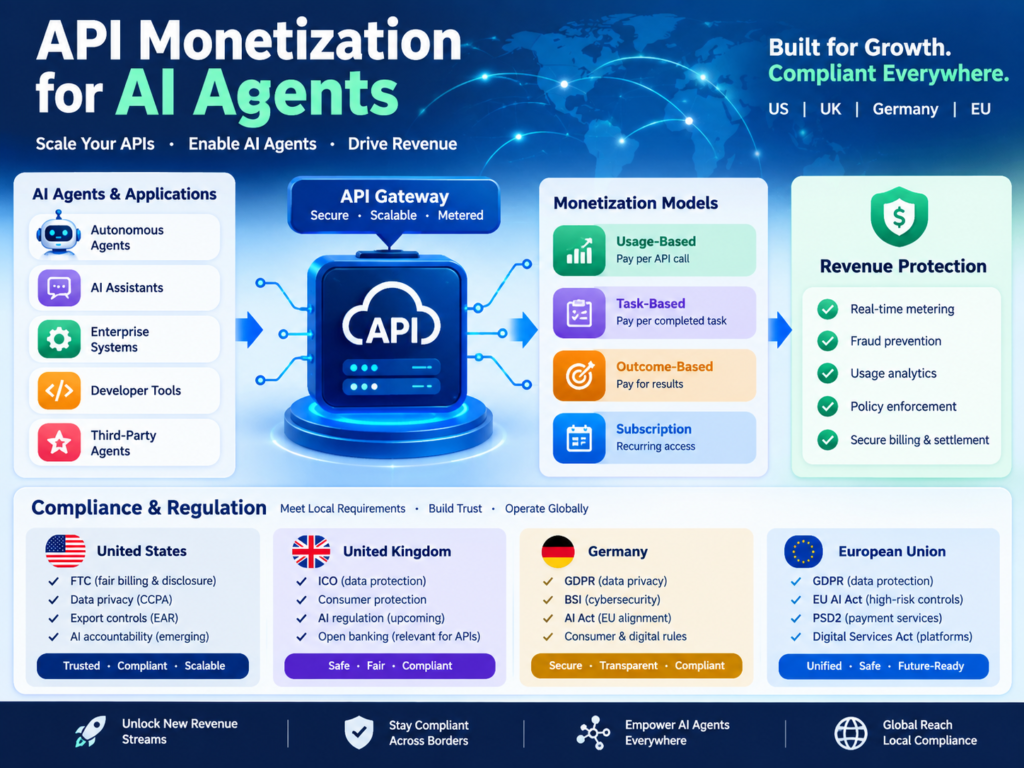
API monetization for AI agents replaces the assumption that all value must be captured through seats. Instead, pricing can follow requests, tokens, tasks, credits, outcomes or a combination of these units.
Postman’s 2025 research illustrates the gap: 89% of developers used AI, but only 24% were designing APIs with AI agents in mind.
This shift also connects with Mak It Solutions’ AI Agents vs SaaS analysis and agentic arbitrage guide.
Where Agent-Driven Revenue Leakage Starts
Revenue leakage often begins when agent calls are unmetered, buried inside legacy subscription plans or attributed to shared credentials.
Chained workflows amplify the problem. One customer action may trigger several API calls, model requests, retrieval operations and third-party data services. The visible request can look inexpensive while the full autonomous workflow carries a much higher cost.
In practice, SaaS teams need to understand the entire execution chain—not just the first endpoint that an agent touches.
When Agent-Native Billing Becomes Necessary
Agent-native billing deserves attention when.
API activity is growing faster than paid-seat growth.
Inference, data or infrastructure costs rise faster than subscription revenue.
Customers increasingly request APIs, MCP tools or automated workflows.
Shared credentials make usage attribution unreliable.
Autonomous workloads can generate unpredictable consumption.
The broader adoption trend reinforces the urgency. Stanford’s 2025 AI Index reported organizational AI use at 78% in 2024, up from 55% in 2023.
AI Agent API Pricing Models That Protect Margins
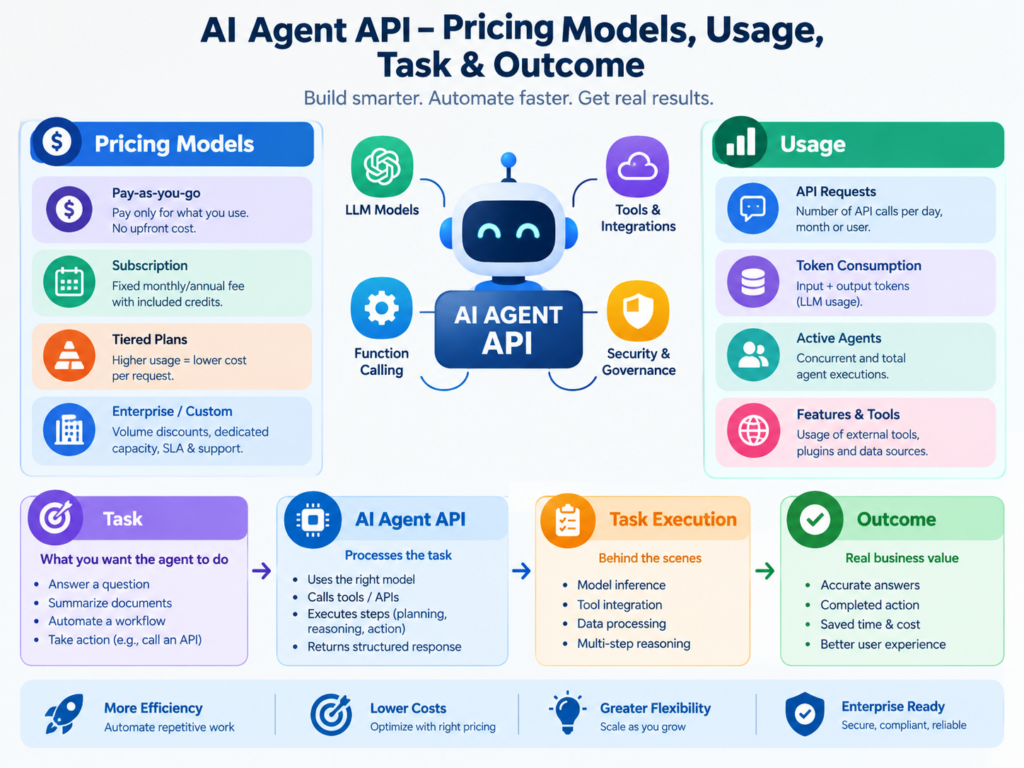
There is no single pricing model that works for every agent-facing API. The right billing metric should reflect both the value customers receive and the costs the provider absorbs.
| Pricing model | Best fit | Main consideration |
|---|---|---|
| Per API call | Predictable, lightweight endpoints | Easy to understand but may ignore differences in request complexity |
| Per token | LLM and inference-heavy services | Closely tracks model usage but can feel abstract to buyers |
| Per task | Multi-step agent workflows | Connects pricing to useful work rather than individual calls |
| Prepaid credits | Controlled autonomous spending | Gives agents a clear commercial balance |
| Outcome-based | Auditable business results | Requires reliable measurement of successful outcomes |
Per-Call, Per-Token, Per-Task and Outcome Pricing
Per-call pricing is simple to meter and explain. It works well when requests have relatively consistent costs.
Per-token pricing tracks inference consumption more closely, although buyers may find it harder to forecast.
Per-task pricing can be stronger when several API calls collectively complete one business process.
Outcome pricing moves further toward value. Instead of charging for technical activity, the provider charges for an auditable result, such as an invoice reconciled or a support ticket resolved. Mak It Solutions’ outcome-based SaaS pricing guide explores this approach in more detail.
Prepaid Credits, Consumption Billing and Hybrid Plans
Prepaid credits can give autonomous agents a defined spending balance. Consumption billing scales with actual workloads, while hybrid plans combine recurring subscriptions with included usage and overage charges.
For established SaaS vendors, hybrid pricing is often practical because it protects recurring revenue while preventing unlimited machine consumption. The SaaS pricing strategy for AI agents provides a complementary packaging framework.
Choose the Billing Metric Through Unit Economics
Start with the cost of delivering a successful request, task or outcome.
Include expenses such as.
Model inference
Third-party APIs and data
Storage and retrieval
Chained downstream calls
Retries
Observability
Payment processing
Support and operational overhead
From there, define the desired gross margin, minimum viable transaction size, rate limits and customer spending controls.
Mak It Solutions’ FinOps for AI guide is useful when consumption needs to be tied directly to financial accountability.
How AI Agents Pay for APIs.
Charging an autonomous agent requires more than attaching a price to an endpoint. The resource still needs authentication, commercial entitlements, usage metering and rules governing how payment or billing authorization occurs.
An agent can request a capability, receive machine-readable commercial requirements, authorize the payment or draw against an approved balance, and access the resource after the required checks succeed.
How an x402 API Payment Flow Works
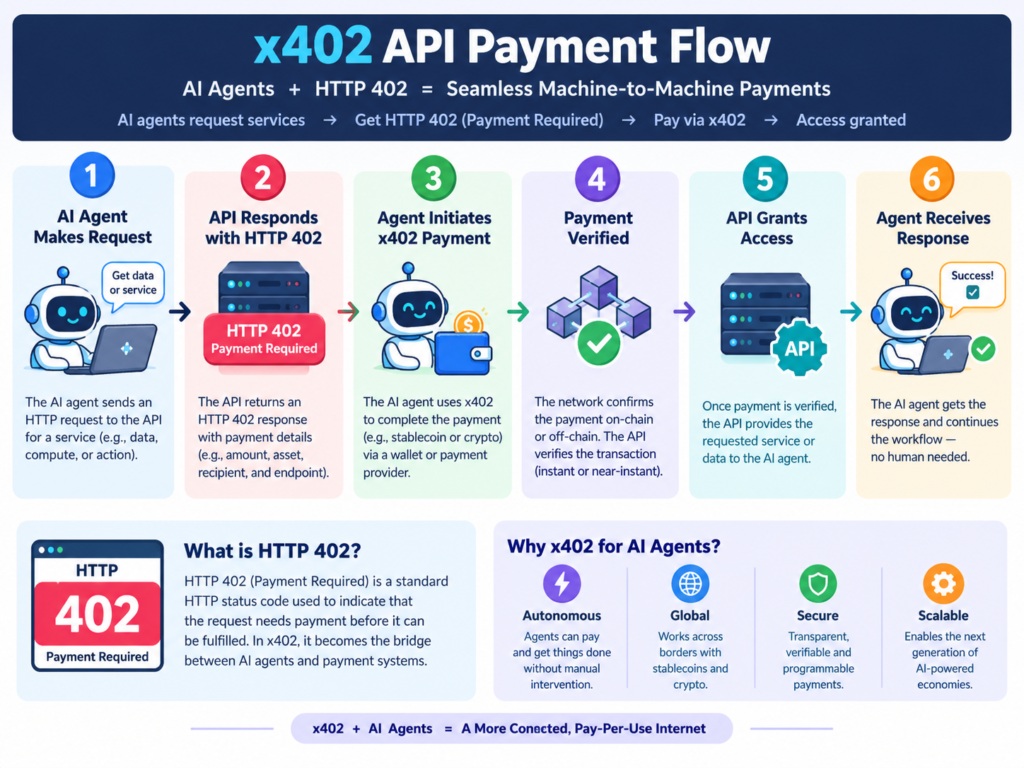
The current x402 specification defines an open payment standard for clients purchasing access to external resources. In a typical HTTP flow, a client requests a protected resource, the server can respond with HTTP 402 Payment Required and payment requirements, and the client submits a signed payment authorization on a subsequent request.
The server can then verify the authorization, execute the protected request according to the applicable payment flow, settle the payment and return the result.
That makes API micropayments and machine-to-machine purchasing technically feasible without forcing a human through a conventional checkout each time. The official x402 project documents the evolving standard.
MCP Tools, Agent Wallets and Machine Commerce
Paid machine capabilities do not have to stop at REST APIs. The current x402 specification also describes support across transport layers including HTTP, MCP and agent-to-agent scenarios.
An MCP-accessible tool could therefore sit behind identity, entitlements, metering and machine-readable commercial rules. An agent wallet or billing account can handle approved spending while the provider continues to identify the enterprise customer responsible for that agent.
That customer-level attribution matters when several autonomous agents operate under the same organization.
Why x402 Is Only Part of the Monetization Strategy
A payment protocol does not replace commercial governance.
The x402 specification explicitly treats client-side budget management as outside the core protocol, even though implementations can add spending controls.
A production monetization layer still needs.
Spending limits
Entitlement management
Usage reconciliation
Delivery verification
Refund policies
Accounting controls
Failure handling
Audit trails
Appropriate regulatory treatment for payment methods
The payment mechanism is one component of the business model—not the business model itself.
Protect API Revenue With Metering and Governance
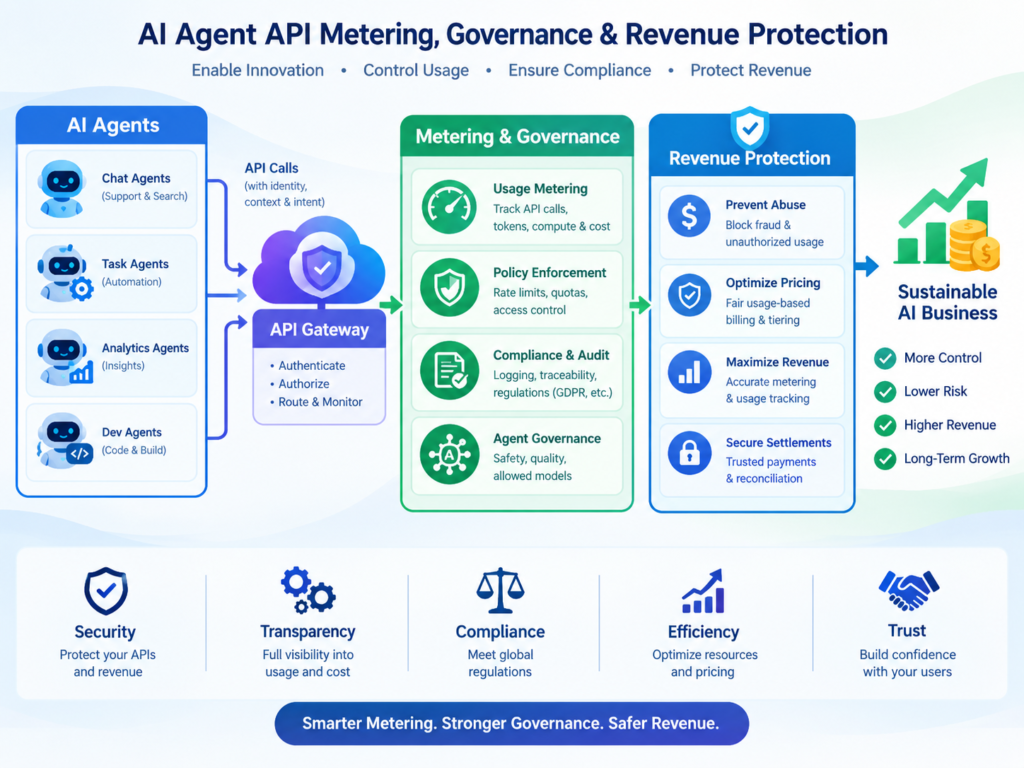
Agent-generated infrastructure consumption should have a corresponding commercial identity. Every production request should be attributable, authenticated, metered and governed by policy.
Give Every Agent an Identity and Entitlement
Avoid giving multiple production agents the same generic API credential.
Each agent identity should connect to.
A customer or organization
Permitted capabilities
Contractual entitlements
Rate policies
Spending controls
Revocation rules
This improves billing attribution and security at the same time. Mak It Solutions’ AI agent identity management guide covers the broader non-human identity model.
Meter the Entire Agent Execution Chain
API usage metering should follow downstream consumption rather than recording only the initial request.
Useful billable-event records can include the customer, agent, endpoint or tool, task, quantity consumed, applied pricing unit and associated infrastructure cost.
For systems that need a controlled API and integration layer, Mak It Solutions’ back-end development services cover related architecture.
Add Rate Limits, Budgets and Audit Trails
Agents can repeat actions faster than humans, so commercial safeguards should operate automatically.
Set per-agent usage policies, spending ceilings, alerts and cut-offs. Keep reliable records of billable events, authorization decisions and exceptions so finance and product teams can reconcile usage with invoices.
A business intelligence layer can turn this data into margin, consumption and revenue-leakage dashboards.
US, UK, Germany and EU Requirements
Regional requirements should shape API monetization architecture before autonomous payments reach production. Privacy, payment security, financial regulation, invoicing and contractual obligations differ across jurisdictions and sectors.
United States.
A San Francisco SaaS platform, New York fintech or Austin API company may encounter SOC 2 expectations during enterprise procurement.
Where cardholder-data environments are in scope, teams should assess PCI DSS obligations. The PCI Security Standards Council continues to list PCI DSS v4.0.1 in its document library.
Healthcare APIs involving ePHI may also create HIPAA obligations. HHS states that a cloud provider creating, receiving, maintaining or transmitting ePHI on behalf of a covered entity can qualify as a business associate.
California businesses should separately evaluate CCPA/CPRA requirements where applicable.
United Kingdom.
For usage-based API billing in the UK, London fintech’s and Manchester SaaS providers need to consider UK GDPR, the Data Protection Act 2018 and any applicable FCA or Open Banking obligations.
Where personal data is involved, teams should address lawful processing, security and data minimization. The ICO’s AI guidance covers these principles, although the regulator notes that parts of its guidance are under review following the Data (Use and Access) Act 2025.
Germany and the EU.
For API Monetarisierung für KI-Agenten Deutschland, teams in Berlin, Munich or Frankfurt should connect nutzungsbasierte API Abrechnung für KI with GDPR/DSGVO requirements, lawful processing, data minimisation and cross-border data controls.
In-scope EU financial entities should also assess DORA and relevant financial-services requirements. DORA has applied since 17 January 2025. (EUR-Lex)
The EU AI Act has phased obligations. Its Article 50 transparency requirements have applied since 2 August 2026. (European Commission)
For companies operating across markets such as Hamburg, Dublin, Amsterdam or Paris, VAT treatment, invoice evidence and regional data architecture should be considered alongside the payment design.
This section provides general technology and compliance context, not legal, financial or tax advice.
Build an API Monetization for AI Agents Strategy
The safest rollout starts by finding where agents already consume value, then connecting pricing, metering, identity, payment and policy around a commercially meaningful capability.
Audit Agent Usage and Revenue Leakage First
Inventory APIs and MCP tools already accessible to agents.
Map each capability to its.
Customer
Commercial contract
Infrastructure cost
Downstream dependencies
Existing meter or entitlement
Look closely for unpriced calls, unlimited bundled access and workflows where costs rise faster than revenue.
Connect Pricing, Metering, Payments and Policy
Choose the billable unit first. Then implement usage metering, entitlement checks, agent identity, rate controls and spending limits.
Only after those foundations are clear should the payment or billing mechanism be connected.
x402 may be useful for machine-native payments, but it should sit inside a broader API architecture rather than dictate the entire monetization strategy. Mak It Solutions’ API-first architecture guide provides additional architectural context.
Pilot Without Breaking Existing Enterprise Contracts
Start with a valuable agent-accessible API or workflow rather than repricing the entire SaaS portfolio at once.
A practical rollout can preserve negotiated enterprise commitments while introducing a new meter, included usage allowance, credits or overage structure for agent consumption.
Shadow billing is also useful: measure what agent activity would have cost before putting the new charges into production. Reconcile those results with finance or ERP records and expand only when the economics, reliability and customer experience are clear.
Concluding Remarks
AI agents change who or what consumes software, but they do not change the need for sustainable unit economics.
A strong API monetization for AI agents strategy makes machine activity commercially visible. Every important request should connect back to identity, entitlements, usage, cost and an appropriate billing or payment mechanism.
If agent traffic is growing faster than revenue, start by measuring where that gap appears. Mak It Solutions can help map API usage, pricing units, metering, identity controls and billing architecture into a scoped implementation plan.
Request a focused estimate from Mak It Solutions and begin with one high-value API or agent workflow.
Key Takeaways
API monetization for AI agents should connect machine activity to customer identity, entitlement and revenue.
Per-call, token, task, credit, outcome and hybrid pricing models suit different unit economics.
x402 can support machine-native payment interactions, but it does not replace metering, budgets or governance.
Agent-specific identities improve billing attribution, security and auditability.
Rate limits and spending controls reduce the risk of uncontrolled autonomous consumption.
US, UK, German and EU deployments require region- and sector-aware compliance.
A focused pilot is safer than immediately changing an entire SaaS pricing model.
FAQs
Q : How can an API distinguish a legitimate AI agent from an abusive bot?
A : Authentication is more dependable than trying to classify traffic from behavior alone. Give approved agents unique credentials or workload identities, connect them to an accountable customer and enforce scoped permissions and rate policies. Behavioral monitoring can then help identify unusual activity.
Q : Can multiple autonomous agents use the same enterprise customer account?
A : Yes, but they should generally have separate credentials or workload identities underneath that account. Central billing can still aggregate consumption into one customer invoice while individual identities preserve attribution, revocation and agent-specific spending controls.
Q : What usage data should API providers retain for billing disputes?
A : Retain enough information to reproduce the commercial event, including customer and agent identity, timestamp, capability invoked, quantity consumed, pricing unit, entitlement, payment or invoice reference and relevant policy decision. Retention should follow contractual, privacy and regulatory requirements rather than keeping detailed agent data indefinitely.
Q : How can SaaS companies introduce agent pricing without disrupting existing contracts?
A : New customers, optional agent capabilities and renewal periods provide natural transition points. Existing subscriptions can also remain in place while the provider introduces included agent usage, credits or negotiated overages. Shadow billing helps both vendor and customer understand the financial impact before a pricing change goes live.
Q : Do autonomous API payments create VAT or invoicing issues in the EU?
A : Potentially. Automating the payment step does not remove VAT, invoicing, accounting or customer-location obligations. Providers should establish who the legal buyer and seller are, how transactions are documented and how machine payments reconcile with finance systems, with professional tax or legal advice where required.
[…] API security and monetization controls can help protect the underlying services and business […]